
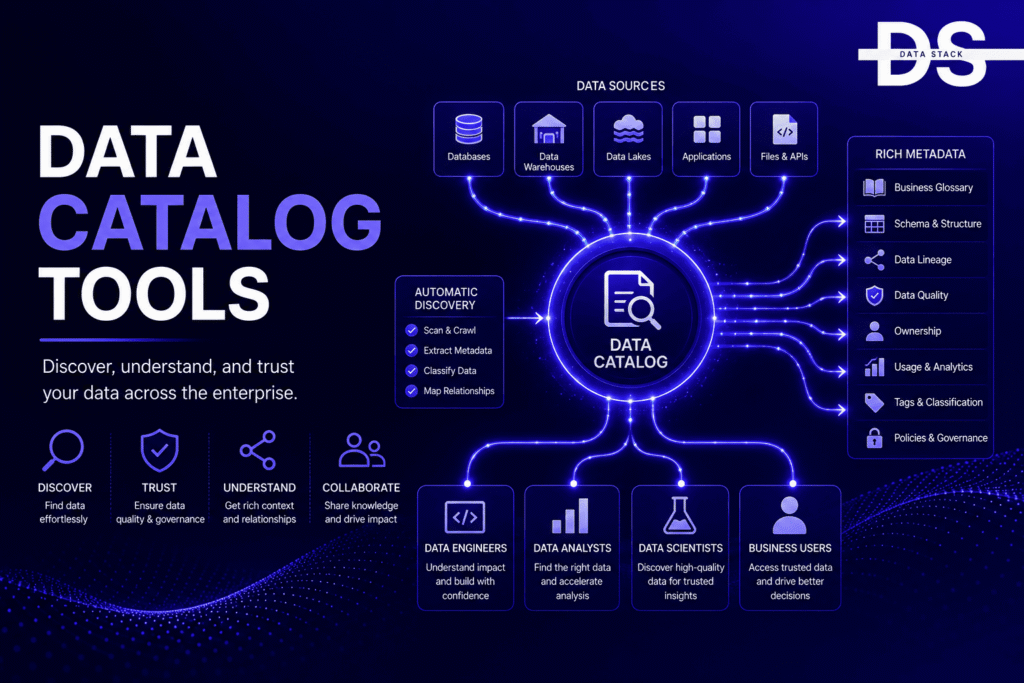
Organizations collect data from hundreds of applications, databases, warehouses, cloud platforms, and operational systems. While data volumes continue to grow, finding and understanding the right information often becomes increasingly difficult.
Analysts struggle to locate trusted datasets. Business users rely on tribal knowledge. Data teams spend time answering repetitive questions about ownership, definitions, and lineage.
This is where data catalog tools provide value.
Data catalog platforms create a centralized inventory of data assets, making it easier to discover, understand, govern, and use information across the organization. Modern solutions combine metadata management, lineage tracking, governance workflows, and collaboration capabilities to help teams work more efficiently.
As organizations invest more heavily in analytics, AI, and governance initiatives, data catalogs have become a foundational component of modern data strategies.
What Are Data Catalog Tools?
Data catalog tools are platforms that help organizations discover, organize, document, and govern data assets across multiple systems.
They typically provide:
- Metadata management.
- Data discovery capabilities.
- Business glossaries.
- Data lineage tracking.
- Governance workflows.
- Search and collaboration features.
Organizations use data catalogs to improve visibility, trust, and accessibility across enterprise data environments.
Benefits of Data Catalog Tools
- Improve data discovery across the organization.
- Increase trust in business data.
- Reduce time spent searching for information.
- Strengthen governance initiatives.
- Improve collaboration between business and technical teams.
- Support self-service analytics programs.
- Enhance data lineage visibility.
Leading Data Catalog Platforms Compared
| Tool | Best For | Deployment | Good Fit |
|---|---|---|---|
| Alation | Enterprise data intelligence | Cloud | Large organizations |
| Collibra | Governance and cataloging | Cloud | Enterprises |
| Atlan | Modern data teams | Cloud | Cloud-first businesses |
| Microsoft Purview | Microsoft ecosystems | Cloud | Azure customers |
| Informatica Data Catalog | Enterprise metadata management | Cloud | Large enterprises |
| Data.World | Collaborative cataloging | Cloud | Business teams |
| Ataccama ONE | Catalog plus quality management | Cloud | Data-driven organizations |
| OvalEdge | Governance and discovery | Cloud | Mid-market and enterprise |
| Secoda | Modern analytics teams | Cloud | Growing organizations |
| IBM Knowledge Catalog | Enterprise governance | Cloud, Hybrid | Large organizations |
10 Best Data Catalog Tools
#1 Alation
Alation is one of the most recognized data catalog platforms in the market and is frequently considered a category leader. The platform combines data cataloging, governance, search, lineage, stewardship, and collaboration capabilities within a unified environment.
Organizations use Alation to help employees discover trusted information faster while improving governance and accountability across data assets. Its search-driven user experience has helped drive adoption among both business and technical teams.
Alation is particularly strong in environments where data discovery and knowledge sharing are critical priorities.
For organizations seeking a mature enterprise catalog platform, Alation remains one of the strongest options available.
Key Features
- Provides enterprise-grade data catalog capabilities.
- Supports business glossaries and stewardship workflows.
- Enables data discovery and search.
- Tracks lineage across data environments.
- Improves collaboration around data assets.
Why Choose This Tool
Choose Alation if your organization wants a market-leading platform for data discovery and governance.
G2 Rating: 4.4/5
Gartner Rating: 4.6/5
#2 Collibra
Collibra is a data intelligence platform that combines cataloging, governance, metadata management, lineage, and policy management capabilities.
The platform helps organizations create a trusted view of enterprise data while supporting governance and compliance initiatives. Many large enterprises adopt Collibra as part of broader governance programs because of its extensive workflow and stewardship capabilities.
Organizations evaluating catalog platforms often compare Metadata Management Tools and Data Governance Tools because these disciplines are closely connected to catalog initiatives.
For enterprises focused on governance and compliance, Collibra remains a leading choice.
Key Features
- Supports cataloging, governance, and metadata management.
- Provides stewardship and policy management workflows.
- Enables lineage tracking and impact analysis.
- Supports compliance and regulatory initiatives.
- Helps improve trust in enterprise data.
Why Choose This Tool
Choose Collibra if your organization prioritizes governance and data intelligence.
G2 Rating: 4.5/5
Gartner Rating: 4.6/5
Showcase your software to buyers actively comparing tools. Submit your product for editorial review and get featured on Data Stack Hub.
Submit Your Tool →#3 Atlan
Atlan has emerged as one of the fastest-growing modern data catalog platforms. Built for cloud-first organizations, the platform focuses on helping data teams discover, document, and govern information efficiently.
The platform integrates closely with modern data stacks including Snowflake, Databricks, dbt, BigQuery, and other cloud analytics technologies. Its modern user experience and collaboration capabilities have made it particularly popular among data teams.
For organizations building modern cloud-native analytics environments, Atlan is a compelling option.
Key Features
- Provides cloud-native cataloging capabilities.
- Supports metadata management and lineage tracking.
- Integrates with modern analytics ecosystems.
- Enables collaboration across teams.
- Supports governance initiatives.
Why Choose This Tool
Choose Atlan if your organization wants a modern catalog platform designed for cloud data environments.
G2 Rating: 4.6/5
Gartner Rating: 4.7/5
#4 Microsoft Purview
Microsoft Purview combines cataloging, governance, lineage, compliance, and discovery capabilities within Microsoft’s broader data ecosystem.
The platform helps organizations automatically discover and classify data assets across Azure, Microsoft Fabric, Microsoft 365, Power BI, and hybrid environments. Automated scanning and metadata collection reduce manual effort while improving visibility into enterprise information.
Organizations heavily invested in Microsoft technologies frequently select Purview because of its deep ecosystem integration.
Key Features
- Provides automated cataloging and discovery.
- Supports metadata management and lineage.
- Integrates with Microsoft analytics platforms.
- Enables governance and compliance initiatives.
- Improves visibility across enterprise data assets.
Why Choose This Tool
Choose Microsoft Purview if your organization operates primarily within Microsoft’s ecosystem.
G2 Rating: 4.4/5
Gartner Rating: 4.5/5
#5 Informatica Data Catalog
Informatica Data Catalog is part of Informatica’s broader Intelligent Data Management Cloud platform and helps organizations discover, understand, and govern data assets across complex environments.
The platform automatically scans data sources, collects metadata, identifies relationships, and provides lineage visibility. Organizations can use these capabilities to improve trust, reduce duplication, and make data assets easier to find and understand.
Informatica is particularly attractive to enterprises that already use Informatica for integration, governance, quality, or master data initiatives.
For organizations seeking enterprise-scale metadata discovery and cataloging capabilities, Informatica Data Catalog remains a strong option.
Key Features
- Supports automated metadata discovery.
- Provides lineage and impact analysis capabilities.
- Helps improve visibility into enterprise data assets.
- Integrates with Informatica’s broader platform.
- Supports governance and stewardship initiatives.
Why Choose This Tool
Choose Informatica Data Catalog if your organization requires enterprise-grade cataloging and metadata management.
G2 Rating: 4.3/5
Gartner Rating: 4.6/5
#6 Data.World
Data.World combines data cataloging, metadata management, governance, and collaboration capabilities within a business-friendly platform.
The solution focuses heavily on helping teams find, understand, and share data assets more effectively. Search functionality, documentation, business glossaries, and collaboration features make it easier for technical and non-technical users to work with data.
Organizations looking to improve data literacy and self-service analytics often evaluate Data Discovery Tools alongside platforms such as Data.World because both focus on helping users find trusted information.
For organizations emphasizing collaboration and accessibility, Data.World is a compelling choice.
Key Features
- Supports collaborative data cataloging.
- Provides business glossaries and documentation capabilities.
- Improves data discovery and search experiences.
- Enables self-service analytics initiatives.
- Supports metadata management and governance.
Why Choose This Tool
Choose Data.World if your organization wants a collaborative platform for cataloging and sharing data assets.
G2 Rating: 4.5/5
Gartner Rating: 4.4/5
Increase your product visibility by reaching software buyers researching the best tools. Every submission is reviewed by our editorial team.
Feature My Tool →#7 Ataccama ONE
Ataccama ONE combines data cataloging, governance, metadata management, quality monitoring, and master data management capabilities within a unified platform.
The platform helps organizations create trusted data assets by combining discovery and cataloging capabilities with broader quality and governance initiatives. This approach is particularly attractive for organizations pursuing enterprise-wide data trust programs.
Unlike standalone catalog platforms, Ataccama extends beyond discovery into ongoing quality management and governance workflows.
For enterprises looking for a broader data trust platform, Ataccama ONE is a strong option.
Key Features
- Combines cataloging, governance, and quality management.
- Supports automated metadata discovery.
- Provides lineage and stewardship capabilities.
- Helps improve trust in enterprise data.
- Supports enterprise-scale deployments.
Why Choose This Tool
Choose Ataccama ONE if your organization wants cataloging capabilities combined with quality and governance initiatives.
G2 Rating: 4.5/5
Gartner Rating: 4.7/5
#8 OvalEdge
OvalEdge is a data catalog and governance platform designed to help organizations improve visibility into their data landscape.
The platform provides metadata management, lineage tracking, governance workflows, business glossaries, and search capabilities. Organizations frequently use OvalEdge to support self-service analytics and reduce the effort required to locate trusted information.
OvalEdge has become increasingly popular among mid-sized and enterprise organizations seeking a balance between functionality and implementation complexity.
Key Features
- Supports enterprise data cataloging initiatives.
- Provides metadata management and lineage tracking.
- Helps users discover trusted data assets.
- Supports governance workflows and stewardship.
- Enables self-service analytics programs.
Why Choose This Tool
Choose OvalEdge if your organization wants a balanced platform for discovery, cataloging, and governance.
G2 Rating: 4.5/5
Gartner Rating: 4.5/5
#9 Secoda
Secoda is a modern data catalog platform built primarily for cloud-native analytics teams.
The platform focuses on making documentation, lineage, metadata, and discovery accessible to both technical and business users. Integrations with modern data stack technologies have helped drive adoption among growing organizations.
Secoda emphasizes ease of use and fast deployment, making it attractive for organizations that want cataloging capabilities without the complexity associated with larger enterprise platforms.
For modern data teams, Secoda is a platform worth evaluating.
Key Features
- Provides modern data catalog capabilities.
- Supports metadata management and documentation.
- Enables lineage visibility and collaboration.
- Integrates with modern cloud data stacks.
- Improves data discovery across teams.
Why Choose This Tool
Choose Secoda if your organization wants a lightweight and modern catalog platform.
G2 Rating: 4.7/5
Gartner Rating: Not Available
#10 IBM Knowledge Catalog
IBM Knowledge Catalog helps organizations discover, govern, classify, and manage data assets across complex enterprise environments.
The platform combines cataloging, metadata management, governance, policy enforcement, and AI-powered discovery capabilities. Organizations use it to improve visibility, strengthen governance programs, and support analytics initiatives.
IBM’s enterprise focus makes the platform particularly attractive to large organizations with significant governance and compliance requirements.
For enterprises pursuing large-scale cataloging and governance initiatives, IBM Knowledge Catalog remains a strong choice.
Key Features
- Supports enterprise cataloging and governance.
- Provides metadata management and lineage visibility.
- Enables AI-assisted discovery capabilities.
- Helps strengthen compliance initiatives.
- Supports large-scale enterprise deployments.
Why Choose This Tool
Choose IBM Knowledge Catalog if your organization requires enterprise-grade cataloging and governance capabilities.
G2 Rating: 4.2/5
Gartner Rating: 4.5/5
How to Choose a Data Catalog Tool
The best data catalog platform depends on your governance maturity, analytics strategy, and data ecosystem.
When evaluating solutions, consider the following:
- Metadata Management Capabilities: Strong metadata collection and management are foundational to effective cataloging.
- Discovery Experience: Search functionality should make it easy for users to find trusted information.
- Lineage Tracking: Understanding where data comes from and how it moves across systems improves trust and governance.
- Governance Support: Look for stewardship workflows, policy management, and compliance capabilities.
- Integration Ecosystem: Verify compatibility with warehouses, databases, analytics platforms, and cloud services.
- Collaboration Features: Business glossaries, documentation, and shared knowledge help increase adoption.
- Scalability: Enterprise environments require solutions capable of cataloging thousands of assets across multiple systems.
Alation, Collibra, and Atlan are often considered category leaders. Microsoft Purview is a natural choice for Microsoft-centric organizations, while Informatica and IBM provide strong enterprise capabilities. Data.World, OvalEdge, and Secoda offer compelling alternatives depending on collaboration and usability requirements.
Browse expertly curated software recommendations across hundreds of business categories.
Browse Top Tools →Conclusion
Data catalog tools help organizations create visibility, trust, and accessibility across growing data environments. As analytics, AI, and governance initiatives become more important, cataloging platforms increasingly serve as the foundation for effective data management.
Alation and Collibra continue to lead enterprise cataloging initiatives, while Atlan has become a popular choice among modern cloud-first organizations. Microsoft Purview integrates closely with Microsoft’s ecosystem, and Informatica and IBM provide strong enterprise-grade capabilities. Organizations prioritizing collaboration should evaluate Data.World, while Secoda and OvalEdge offer attractive alternatives for modern data teams.
The right platform depends on your governance goals, metadata strategy, analytics maturity, and long-term data vision.
FAQs
1. What are data catalog tools?
Data catalog tools help organizations discover, organize, document, and govern data assets across multiple systems and environments.
2. Why are data catalog tools important?
They improve data discovery, strengthen governance, increase trust in business information, and support self-service analytics initiatives.
3. What is the best data catalog tool?
Alation, Collibra, Atlan, Microsoft Purview, and Informatica Data Catalog are among the leading data catalog platforms available today.
4. What is the difference between a data catalog and metadata management?
A data catalog helps users discover and understand data assets, while metadata management focuses on collecting, organizing, and maintaining metadata itself.
5. Do data catalog tools support data lineage?
Yes. Most modern catalog platforms provide lineage tracking capabilities that help users understand data origins and movement.
6. Are data catalog tools used for governance?
Yes. Governance is one of the primary use cases for data catalog platforms because they help enforce policies, stewardship, and accountability.
7. Which industries use data catalogs?
Financial services, healthcare, retail, manufacturing, government, telecommunications, and technology organizations commonly use catalog platforms.
8. Can data catalog tools improve self-service analytics?
Yes. Catalogs make it easier for users to discover trusted datasets without relying heavily on data teams.
9. What should I look for in a data catalog platform?
Evaluate metadata management, discovery capabilities, lineage tracking, governance support, integrations, collaboration features, and scalability.
10. How do I choose a data catalog solution?
Select a platform that aligns with your governance requirements, analytics goals, data ecosystem, and long-term data strategy.