
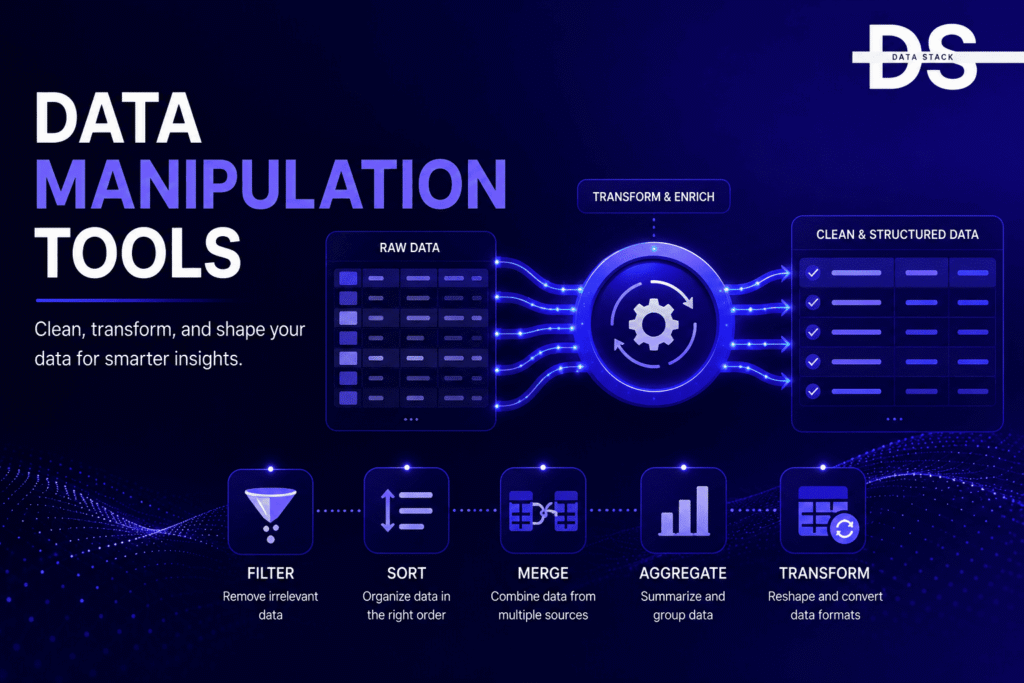
Raw data rarely arrives in a format that’s ready for analysis.
Organizations often need to combine datasets, remove unnecessary fields, standardize formats, filter records, create calculated values, and restructure information before it can support reporting, analytics, or machine learning initiatives.
Performing these tasks manually becomes increasingly difficult as data volumes grow.
That’s why organizations use data manipulation tools.
These platforms help users transform, reshape, enrich, clean, and prepare data efficiently while reducing manual effort. Modern solutions range from visual low-code platforms to advanced analytics and engineering environments capable of handling large-scale workloads.
Whether you’re preparing information for dashboards, business intelligence projects, or AI initiatives, choosing the right data manipulation tool can significantly improve productivity.
What Are Data Manipulation Tools?
Data manipulation tools are software platforms that help users modify, transform, restructure, and prepare data for downstream use.
Common manipulation activities include:
- Filtering records.
- Aggregating datasets.
- Merging information.
- Creating calculated fields.
- Standardizing formats.
- Reshaping data structures.
- Transforming values.
Organizations use these tools to prepare datasets for reporting, analytics, machine learning, and operational workflows.
Benefits of Data Manipulation Tools
- Reduce manual data preparation effort.
- Improve dataset consistency and accuracy.
- Accelerate analytics workflows.
- Simplify transformation processes.
- Support reporting and business intelligence initiatives.
- Improve productivity for analysts and engineers.
- Enable scalable data preparation practices.
Data Manipulation Software Comparison
| Tool | Best For | Deployment | Good Fit |
|---|---|---|---|
| Alteryx Designer | Self-service manipulation | Cloud, Desktop | Analysts |
| Trifacta | Data preparation workflows | Cloud | Analytics teams |
| KNIME | Open-source data workflows | Desktop, Server | Data professionals |
| Microsoft Power Query | Spreadsheet transformation | Desktop, Cloud | Microsoft users |
| dbt | Warehouse transformations | Cloud | Analytics engineering |
| Talend Data Fabric | Enterprise transformation | Cloud, Hybrid | Enterprises |
| Apache Spark | Large-scale transformations | Cloud, Self-Hosted | Engineering teams |
| Dataiku | Collaborative data preparation | Cloud | Analytics and AI teams |
8 Best Data Manipulation Tools
#1 Alteryx Designer
Alteryx Designer is one of the most widely used platforms for data preparation and manipulation. The platform provides a drag-and-drop workflow environment that allows users to transform, clean, combine, and enrich datasets without extensive coding.
Organizations use Alteryx to automate repetitive preparation tasks, reduce spreadsheet dependency, and accelerate analytics projects. Its broad connector ecosystem allows teams to work with information from databases, files, cloud platforms, and business applications.
For analysts and business users, Alteryx remains one of the strongest data manipulation platforms available.
Key Features
- Provides visual workflow development.
- Supports cleansing, transformation, and enrichment.
- Automates repetitive data preparation tasks.
- Connects multiple data sources.
- Supports analytics and reporting initiatives.
Why Choose This Tool
Choose Alteryx Designer if your organization wants powerful self-service data manipulation capabilities.
G2 Rating: 4.5/5
Gartner Rating: 4.5/5
#2 Trifacta
Trifacta focuses on helping users prepare and manipulate data through visual workflows and intelligent recommendations.
The platform automatically identifies quality issues, suggests transformations, and helps users create analytics-ready datasets faster. This reduces the time spent manually preparing information before reporting or analysis.
Organizations seeking easier ways to prepare large datasets frequently evaluate Trifacta alongside Data Preparation Tools because both categories overlap significantly.
For analytics teams, Trifacta remains a leading option.
Key Features
- Supports visual transformation workflows.
- Uses machine learning to recommend transformations.
- Helps identify quality issues quickly.
- Simplifies preparation for analytics projects.
- Supports cloud analytics environments.
Why Choose This Tool
Choose Trifacta if your organization wants a user-friendly platform for transforming and preparing data.
G2 Rating: 4.4/5
Gartner Rating: 4.5/5
Showcase your software to buyers actively comparing tools. Submit your product for editorial review and get featured on Data Stack Hub.
Submit Your Tool →#3 KNIME
KNIME is an open-source analytics platform that provides extensive capabilities for data manipulation, transformation, preparation, and workflow automation.
Users can build visual workflows that combine, filter, aggregate, and transform information from multiple sources. The platform also supports advanced analytics and machine learning use cases.
Its open-source model makes KNIME particularly attractive for organizations seeking flexibility without significant licensing costs.
For technical teams and analysts, KNIME offers a powerful environment for manipulating and preparing data.
Key Features
- Provides visual workflow-based data manipulation.
- Supports transformation, aggregation, and filtering.
- Integrates with databases and analytics platforms.
- Supports advanced analytics and machine learning.
- Offers open-source flexibility.
Why Choose This Tool
Choose KNIME if your organization wants an open-source platform for data manipulation and analytics workflows.
G2 Rating: 4.6/5
Gartner Rating: 4.5/5
#4 Microsoft Power Query
Power Query is Microsoft’s data preparation and transformation engine used within Excel, Power BI, Microsoft Fabric, and other Microsoft products.
The platform allows users to import, clean, reshape, merge, and transform datasets through a visual interface. Its accessibility has made it one of the most widely used data manipulation tools in business environments.
Organizations already invested in Microsoft analytics products frequently use Power Query as part of their reporting workflows.
For Microsoft-centric organizations, Power Query is often the easiest starting point for data manipulation.
Key Features
- Supports visual data transformation workflows.
- Integrates with Excel and Power BI.
- Enables merging, filtering, and reshaping operations.
- Connects to multiple data sources.
- Reduces manual spreadsheet preparation work.
Why Choose This Tool
Choose Microsoft Power Query if your organization relies on Microsoft’s analytics ecosystem.
G2 Rating: 4.5/5
Gartner Rating: Not Available
#5 dbt
dbt (Data Build Tool) has become one of the most important platforms for modern data transformation and manipulation within cloud data warehouses.
Unlike traditional ETL tools, dbt focuses on transforming data after it has been loaded into a warehouse. Teams can use SQL-based workflows to clean, restructure, aggregate, and prepare information for reporting and analytics.
Organizations building modern analytics stacks frequently evaluate Data Transformation Tools alongside dbt because transformation and manipulation activities are closely connected in warehouse-centric architectures.
For analytics engineering teams, dbt has become a foundational platform.
Key Features
- Supports SQL-based data transformations.
- Enables modular and reusable workflows.
- Provides testing and documentation capabilities.
- Integrates with major cloud data warehouses.
- Helps create analytics-ready datasets.
Why Choose This Tool
Choose dbt if your organization performs most transformations within cloud data warehouses.
G2 Rating: 4.6/5
Gartner Rating: 4.6/5
#6 Talend Data Fabric
Talend Data Fabric provides enterprise capabilities for data integration, transformation, preparation, and quality management.
Organizations use Talend to manipulate data across complex environments while maintaining consistency and governance standards. Its visual workflow environment simplifies transformation processes and helps teams build repeatable preparation pipelines.
Because Talend combines multiple capabilities within a single platform, it is frequently used in large-scale enterprise data initiatives.
For organizations seeking enterprise-grade manipulation and transformation capabilities, Talend remains a strong option.
Key Features
- Supports transformation and preparation workflows.
- Connects cloud, on-premises, and hybrid systems.
- Provides visual workflow development.
- Supports enterprise-scale deployments.
- Integrates quality and governance capabilities.
Why Choose This Tool
Choose Talend Data Fabric if your organization requires enterprise-scale data transformation and manipulation.
G2 Rating: 4.3/5
Gartner Rating: 4.4/5
Increase your product visibility by reaching software buyers researching the best tools. Every submission is reviewed by our editorial team.
Feature My Tool →#7 Apache Spark
Apache Spark is one of the most widely used distributed processing engines for manipulating and transforming large datasets.
Engineering teams use Spark to filter, aggregate, enrich, restructure, and process information across massive environments. Its distributed architecture allows organizations to manipulate data at scales that would be difficult using traditional tools.
Spark supports batch processing, streaming, SQL operations, machine learning, and advanced analytics workloads.
For organizations handling large-scale data workloads, Spark remains a foundational technology.
Key Features
- Supports large-scale distributed transformations.
- Processes structured and unstructured data.
- Provides SQL and DataFrame-based manipulation capabilities.
- Scales across distributed environments.
- Supports analytics and machine learning initiatives.
Why Choose This Tool
Choose Apache Spark if your organization needs scalable data manipulation for large datasets.
G2 Rating: 4.5/5
Gartner Rating: Not Available
#8 Dataiku
Dataiku is a collaborative analytics and AI platform that includes extensive capabilities for preparing, cleaning, enriching, and manipulating data.
The platform enables technical and non-technical users to build workflows that transform information before it is used for analytics or machine learning projects. Visual interfaces combined with code-based flexibility make Dataiku attractive to a wide range of teams.
Organizations frequently adopt Dataiku when they want to combine preparation, analytics, and AI workflows within a single environment.
For teams seeking collaboration and flexibility, Dataiku is a compelling choice.
Key Features
- Supports collaborative data preparation workflows.
- Provides visual and code-based transformation options.
- Integrates analytics and AI capabilities.
- Connects multiple enterprise data sources.
- Supports governance and workflow management.
Why Choose This Tool
Choose Dataiku if your organization wants a collaborative platform for analytics and data preparation.
G2 Rating: 4.5/5
Gartner Rating: 4.6/5
How to Choose a Data Manipulation Tool
The best data manipulation platform depends on your technical expertise, data volumes, analytics requirements, and workflow preferences.
When evaluating solutions, consider the following:
- Ease of Use: Business users often prefer visual interfaces, while technical teams may require code-based flexibility.
- Data Volume: Large-scale workloads may require distributed processing platforms such as Apache Spark.
- Transformation Requirements: Evaluate whether you need simple preparation workflows or complex transformation pipelines.
- Collaboration Needs: Some platforms support business and technical users within the same environment.
- Integration Support: Ensure compatibility with databases, cloud warehouses, analytics tools, and business applications.
- Automation Capabilities: Automated workflows can significantly reduce manual effort.
- Scalability: Choose a platform that can support future growth and increasingly complex data environments.
Alteryx, Trifacta, and Power Query are excellent choices for analysts and business users. KNIME provides open-source flexibility, while dbt is ideal for warehouse-centric transformation workflows. Talend, Spark, and Dataiku are strong options for organizations requiring scalability and enterprise capabilities.
Browse expertly curated software recommendations across hundreds of business categories.
Browse Top Tools →Conclusion
Data manipulation tools help organizations transform raw information into datasets that are ready for reporting, analytics, machine learning, and operational decision-making.
Alteryx and Trifacta continue to lead self-service preparation initiatives, while Power Query remains a popular option within Microsoft environments. KNIME provides open-source flexibility, dbt dominates warehouse-based transformations, and Apache Spark remains a foundational technology for large-scale processing. Talend and Dataiku offer broader enterprise capabilities that support complex data programs.
The right choice depends on your technical requirements, team expertise, and long-term analytics strategy.
FAQs
1. What are data manipulation tools?
Data manipulation tools help users transform, restructure, filter, aggregate, and prepare data for analytics, reporting, machine learning, and operational use.
2. Why are data manipulation tools important?
They reduce manual preparation effort, improve data consistency, and help organizations create analytics-ready datasets faster.
3. What is the best data manipulation tool?
Alteryx, Trifacta, KNIME, dbt, Apache Spark, and Dataiku are among the most widely used data manipulation platforms available today.
4. What is the difference between data manipulation and data transformation?
Data manipulation is a broader concept that includes filtering, restructuring, aggregating, and modifying data. Data transformation is one specific type of manipulation focused on changing data formats or structures.
5. Is Excel a data manipulation tool?
Excel can perform basic manipulation tasks, but dedicated platforms such as Power Query, Alteryx, and KNIME provide significantly more advanced capabilities.
6. Which data manipulation tool is best for analysts?
Alteryx, Trifacta, and Power Query are popular choices because they provide visual workflows and require minimal coding.
7. Which data manipulation tool is best for developers?
Apache Spark and dbt are widely used by technical teams because they provide scalability and code-based flexibility.
8. Are data manipulation tools used in AI projects?
Yes. Data manipulation is often required before information can be used for machine learning and AI workloads.
9. What industries use data manipulation platforms?
Financial services, healthcare, retail, manufacturing, technology, telecommunications, and government organizations all use data manipulation tools.
10. How do I choose a data manipulation tool?
Evaluate usability, scalability, integration support, transformation requirements, collaboration features, and long-term data strategy before selecting a platform.