
Organizations collect data from hundreds of applications, databases, warehouses, cloud platforms, SaaS tools, and operational systems. While data volumes continue to grow, one challenge remains surprisingly common: employees often struggle to find the data they need.
Analysts spend hours searching for datasets. Engineers inherit undocumented pipelines. Business teams rely on tribal knowledge to locate reports and dashboards. Governance teams struggle to understand what information exists and who owns it.
This is where Data Discovery Tools help.
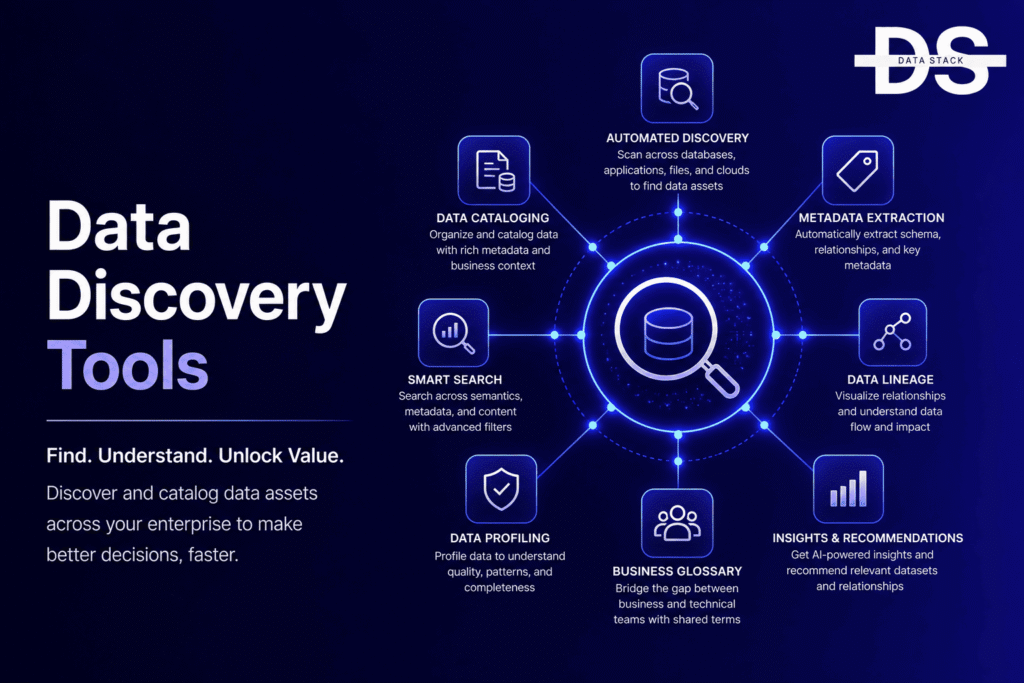
Data Discovery Software enables organizations to identify, locate, understand, and access data assets across enterprise environments. Modern Data Discovery Platforms combine metadata management, search, cataloging, lineage, governance, and collaboration capabilities to make data easier to find and trust.
As organizations invest in analytics, AI, governance, and self-service reporting initiatives, data discovery has become a foundational capability for modern data programs.
What Are Data Discovery Tools?
Data Discovery Tools are software platforms that help organizations identify, search, understand, and access data assets across enterprise environments. These platforms collect metadata from databases, warehouses, applications, reports, dashboards, and cloud services to create a searchable inventory of available information. Organizations use Data Discovery Software to improve data accessibility, strengthen governance, accelerate analytics initiatives, reduce duplication, and help users locate trusted datasets more efficiently.
Benefits of Data Discovery Software
- Improve visibility into enterprise data assets.
- Reduce time spent searching for datasets and reports.
- Support self-service analytics initiatives.
- Improve collaboration between business and technical teams.
- Strengthen governance and compliance programs.
- Increase trust in analytics and reporting.
- Help organizations maximize the value of existing data investments.
Data Discovery Software Comparison
| Tool | Best For | Deployment | Good Fit |
|---|---|---|---|
| Alation | Data intelligence and discovery | Cloud | Enterprises |
| Collibra | Governance-driven discovery | Cloud | Large organizations |
| Atlan | Modern cloud discovery | Cloud | Cloud-first businesses |
| Microsoft Purview | Microsoft ecosystems | Cloud | Azure customers |
| Informatica Enterprise Data Catalog | Enterprise discovery | Cloud | Large enterprises |
| IBM Knowledge Catalog | Governance and cataloging | Cloud, Hybrid | Enterprises |
| Data.World | Collaborative discovery | Cloud | Business teams |
| OvalEdge | Discovery and governance | Cloud | Mid-market organizations |
| Ataccama ONE | Discovery and data trust | Cloud | Enterprises |
| Secoda | Modern discovery platform | Cloud | Growing teams |
| OpenMetadata | Open-source discovery | Cloud, Self-Hosted | Engineering teams |
| Apache Atlas | Open-source metadata discovery | Self-Hosted | Hadoop environments |
| SAP Data Intelligence | SAP-centric discovery | Cloud, Hybrid | SAP customers |
13 Best Data Discovery Tools
#1 Alation
Alation is widely recognized as one of the market leaders in Data Discovery Software and has played a major role in shaping the modern data catalog category. The platform helps organizations discover, understand, and trust data assets across warehouses, databases, BI tools, analytics environments, and operational systems.
A major reason organizations adopt Alation is its ability to combine discovery with active metadata intelligence. Rather than functioning as a static catalog, Alation continuously collects usage patterns, query history, ownership information, and behavioral insights that help users identify trusted datasets quickly.
Large enterprises frequently use Alation to support self-service analytics, data literacy programs, governance initiatives, and AI-driven data discovery efforts. The platform bridges the gap between technical teams and business users by making enterprise data assets easier to locate and understand.
Organizations evaluating Data Discovery Tools often compare Metadata Management Tools and Data Catalog Tools because these categories overlap significantly. However, Alation’s strength lies in combining discovery, governance, and active metadata into a single experience.
Key Features
- Automatically discovers and catalogs datasets across databases, warehouses, BI tools, and cloud platforms.
- Uses active metadata to surface trusted and frequently used data assets.
- Provides enterprise search capabilities that help users find relevant information quickly.
- Supports stewardship, governance, and ownership workflows.
- Enables lineage visibility and impact analysis across enterprise systems.
- Improves collaboration between technical and business users.
Why Choose This Tool
Alation is ideal for enterprises that want a mature discovery platform with strong search, metadata intelligence, governance, and self-service analytics capabilities. Organizations prioritizing data democratization and data literacy frequently shortlist Alation.
G2 Rating: 4.4/5
Gartner Rating: 4.6/5
Showcase your software to buyers actively comparing tools. Submit your product for editorial review and get featured on Data Stack Hub.
Submit Your Tool →#2 Collibra
Collibra is one of the most widely adopted enterprise Data Discovery Platforms, particularly among organizations pursuing governance, compliance, and stewardship initiatives. The platform helps users discover data assets while ensuring that ownership, policies, definitions, and governance requirements remain visible and accessible.
Unlike some discovery-focused platforms that prioritize search alone, Collibra emphasizes governance-driven discovery. Users can locate datasets while simultaneously understanding lineage, business definitions, stewardship responsibilities, and compliance requirements. This additional context helps improve trust and consistency across the organization.
Collibra is especially popular in highly regulated industries where governance and auditability are critical business requirements. Financial institutions, healthcare providers, insurers, and government organizations frequently deploy the platform to improve both discovery and governance outcomes.
Key Features
- Provides enterprise-wide search and discovery capabilities.
- Connects discovery workflows with governance and stewardship initiatives.
- Supports business glossaries and metadata management.
- Enables lineage visibility and impact analysis.
- Helps organizations improve compliance and audit readiness.
- Improves trust in business-critical data assets.
Why Choose This Tool
Collibra is best suited for organizations that want data discovery tightly integrated with governance, stewardship, and compliance programs rather than operating as a standalone catalog.
G2 Rating: 4.5/5
Gartner Rating: 4.6/5
#3 Atlan
Atlan has emerged as one of the fastest-growing Data Discovery Tools by focusing on modern cloud-native data ecosystems. Built specifically for environments powered by Snowflake, Databricks, BigQuery, Redshift, dbt, and modern analytics platforms, Atlan helps organizations discover and understand data across distributed environments.
The platform combines discovery, metadata management, governance, lineage, and collaboration capabilities within a modern user experience. This accessibility has helped Atlan gain traction among organizations seeking alternatives to more traditional enterprise catalog platforms.
A key differentiator is Atlan’s active metadata approach. The platform continuously captures relationships, usage patterns, ownership details, and operational context, making discovery more intelligent and actionable.
Organizations investing in modern data stacks often shortlist Atlan because it combines strong discovery capabilities with collaboration and governance features that support self-service analytics initiatives.
Key Features
- Supports automated discovery across modern cloud data platforms.
- Uses active metadata to improve search relevance and trust.
- Provides lineage, governance, and collaboration capabilities.
- Integrates with dbt, Snowflake, Databricks, BigQuery, and other cloud platforms.
- Helps users identify trusted datasets and business assets quickly.
- Improves accessibility across technical and business teams.
Why Choose This Tool
Atlan is ideal for cloud-first organizations seeking a modern Data Discovery Platform that balances usability, governance, metadata management, and collaboration.
G2 Rating: 4.6/5
Gartner Rating: 4.7/5
#4 Microsoft Purview
Microsoft Purview has become one of the most widely adopted Data Discovery Platforms for organizations operating within Microsoft-centric ecosystems. The platform combines data discovery, metadata management, governance, classification, lineage, and compliance capabilities within a unified environment.
Organizations use Purview to automatically scan and catalog data assets across Microsoft Fabric, Azure Data Lake Storage, Azure Synapse Analytics, Power BI, SQL Server, Microsoft 365, and numerous third-party systems. This automated discovery process helps reduce manual documentation efforts while improving visibility into enterprise information assets.
One of Purview’s biggest advantages is its deep integration with the Microsoft ecosystem. Organizations already using Azure services can quickly establish discovery capabilities while extending governance and compliance initiatives across their environments.
The platform is particularly attractive to enterprises pursuing self-service analytics, governance modernization, and regulatory compliance initiatives.
Key Features
- Automatically discovers and catalogs data assets across Azure, Microsoft Fabric, and third-party systems.
- Provides metadata management, lineage tracking, and governance capabilities.
- Supports automated classification of sensitive and regulated data.
- Enables enterprise search across structured and unstructured information assets.
- Integrates discovery workflows with compliance and governance initiatives.
- Helps improve visibility into cloud and hybrid environments.
Why Choose This Tool
Microsoft Purview is ideal for organizations heavily invested in Microsoft technologies that want discovery, governance, and metadata management capabilities from a single platform.
G2 Rating: 4.4/5
Gartner Rating: 4.5/5
#5 Informatica Enterprise Data Catalog
Informatica Enterprise Data Catalog is one of the most established enterprise Data Discovery Software solutions available today. The platform helps organizations discover, understand, govern, and trust data assets across large-scale environments.
Enterprises frequently choose Informatica because discovery is closely tied to metadata management, lineage, governance, data quality, and master data initiatives. Informatica’s broader ecosystem allows organizations to connect these disciplines within a unified platform.
The solution is particularly strong in complex enterprise environments where data assets are distributed across cloud platforms, on-premises systems, warehouses, applications, and analytics environments. Automated scanning and metadata harvesting capabilities help organizations build a comprehensive inventory of enterprise data assets.
Key Features
- Discovers and catalogs assets across cloud, hybrid, and on-premises environments.
- Harvests metadata automatically from databases, warehouses, and business applications.
- Supports lineage visibility and impact analysis initiatives.
- Integrates with governance, quality, and metadata management programs.
- Provides enterprise search capabilities across large-scale environments.
- Helps organizations improve trust and visibility across data ecosystems.
Why Choose This Tool
Informatica Enterprise Data Catalog is best suited for large enterprises that need discovery capabilities integrated with governance, lineage, metadata management, and broader enterprise data initiatives.
G2 Rating: 4.3/5
Gartner Rating: 4.6/5
Increase your product visibility by reaching software buyers researching the best tools. Every submission is reviewed by our editorial team.
Feature My Tool →#6 IBM Knowledge Catalog
IBM Knowledge Catalog combines data discovery, metadata management, governance, cataloging, and AI-assisted search capabilities within a unified platform. The solution is widely used by enterprises seeking stronger visibility into distributed information assets.
Organizations use IBM Knowledge Catalog to discover datasets, understand relationships, establish ownership, and improve trust in business information. AI-assisted discovery capabilities help users locate relevant datasets and business assets more efficiently than traditional search approaches.
The platform is particularly popular among organizations operating in regulated industries where governance, stewardship, and auditability requirements are significant priorities.
Key Features
- Supports AI-assisted data discovery and metadata enrichment.
- Provides enterprise search across structured and unstructured assets.
- Enables governance, stewardship, and ownership workflows.
- Supports lineage visibility and impact analysis.
- Helps improve compliance and audit readiness.
- Integrates discovery with broader governance initiatives.
Why Choose This Tool
IBM Knowledge Catalog is ideal for enterprises seeking discovery capabilities that support governance, compliance, and metadata management programs.
G2 Rating: 4.2/5
Gartner Rating: 4.5/5
#7 Data.World
Data.World approaches Data Discovery Software from a collaboration and knowledge-sharing perspective. The platform combines discovery, cataloging, governance, business glossaries, and knowledge graph technology to improve access to enterprise information.
A key differentiator is its focus on making data discovery accessible to both technical and business users. Rather than limiting discovery capabilities to data teams, Data.World helps organizations democratize access to information while maintaining governance controls.
The platform’s knowledge graph architecture connects datasets, reports, business concepts, lineage relationships, and metadata into a unified environment that improves context and usability.
Key Features
- Supports collaborative data discovery across business and technical teams.
- Uses knowledge graph technology to connect data assets and relationships.
- Provides metadata management and governance capabilities.
- Enables business glossary creation and stewardship workflows.
- Supports enterprise search across distributed environments.
- Helps improve data literacy and self-service analytics initiatives.
Why Choose This Tool
Data.World is a strong choice for organizations that want discovery capabilities accessible across the business rather than limited to technical users.
G2 Rating: 4.5/5
Gartner Rating: 4.4/5
#8 OvalEdge
OvalEdge combines Data Discovery, metadata management, governance, cataloging, and lineage capabilities within a practical enterprise platform. Organizations use the solution to improve visibility into data assets while strengthening governance and collaboration.
The platform is particularly attractive to mid-market and enterprise organizations that want strong discovery functionality without the complexity associated with some larger governance platforms. Automated metadata harvesting and search capabilities help users locate relevant information quickly.
OvalEdge balances governance and usability, making it easier for both technical and business users to participate in discovery initiatives.
Key Features
- Automatically discovers assets across enterprise systems and analytics environments.
- Supports metadata management, lineage, and governance initiatives.
- Provides enterprise search capabilities and business glossaries.
- Enables stewardship and ownership workflows.
- Helps improve self-service analytics adoption.
- Improves visibility into enterprise data assets.
Why Choose This Tool
OvalEdge is well suited for organizations seeking practical discovery capabilities that balance governance requirements with usability and accessibility.
G2 Rating: 4.5/5
Gartner Rating: 4.5/5
#9 Ataccama ONE
Ataccama ONE extends Data Discovery beyond cataloging by combining discovery, governance, metadata management, observability, data quality, and master data management capabilities within a unified platform.
Organizations frequently adopt Ataccama because discovery is only one component of broader data trust initiatives. By connecting discovery with governance and quality metrics, the platform helps users understand not only where data exists but also whether it can be trusted.
The solution is particularly attractive to enterprises pursuing large-scale governance, compliance, and data quality modernization programs.
Key Features
- Combines discovery with governance, observability, and quality monitoring.
- Automatically discovers and catalogs enterprise data assets.
- Provides metadata management and lineage capabilities.
- Supports stewardship and ownership workflows.
- Helps improve trust in business-critical information.
- Integrates discovery with broader data trust initiatives.
Why Choose This Tool
Ataccama ONE is ideal for organizations that want discovery capabilities integrated into larger governance and data trust strategies.
G2 Rating: 4.5/5
Gartner Rating: 4.7/5
#10 Secoda
Secoda is a modern Data Discovery Platform designed specifically for cloud-native analytics environments. The platform combines cataloging, metadata management, discovery, documentation, lineage, and collaboration capabilities within an intuitive user experience.
Organizations use Secoda to help analysts, engineers, and business stakeholders find trusted information quickly. Automated metadata collection reduces manual effort while improving visibility into cloud warehouses and analytics systems.
Secoda has become increasingly popular among growing data teams that want modern discovery functionality without enterprise-level complexity.
Key Features
- Supports automated discovery across modern cloud data platforms.
- Provides metadata management and documentation capabilities.
- Enables lineage visibility and dependency tracking.
- Improves search and accessibility across analytics environments.
- Supports collaborative knowledge-sharing initiatives.
- Integrates with warehouses, BI platforms, and orchestration tools.
Why Choose This Tool
Secoda is a strong option for organizations seeking a lightweight, modern discovery platform optimized for cloud analytics environments.
G2 Rating: 4.7/5
Gartner Rating: Not Available
#11 OpenMetadata
OpenMetadata has emerged as one of the fastest-growing open-source Data Discovery Tools. The platform combines discovery, metadata management, cataloging, governance, lineage, and collaboration capabilities while supporting modern cloud data stacks.
Organizations frequently evaluate OpenMetadata as an alternative to commercial catalog platforms because it provides extensive functionality while maintaining deployment flexibility. Its growing ecosystem and active community have helped drive adoption across modern data teams.
Key Features
- Supports automated discovery across cloud-native data ecosystems.
- Provides metadata management, cataloging, and lineage capabilities.
- Integrates with Snowflake, Databricks, BigQuery, Airflow, dbt, and more.
- Enables governance and stewardship workflows.
- Supports collaborative documentation and discovery initiatives.
- Offers open-source flexibility for deployment and customization.
Why Choose This Tool
OpenMetadata is ideal for organizations seeking modern discovery capabilities through an open-source platform that supports contemporary analytics architectures.
G2 Rating: 4.7/5
Gartner Rating: Not Available
#12 Apache Atlas
Apache Atlas is one of the most widely used open-source metadata and discovery platforms within Hadoop and big data ecosystems. The project provides discovery, governance, lineage, classification, and metadata management capabilities.
Many organizations deploy Atlas to create searchable inventories of enterprise data assets while maintaining full control over infrastructure and customization. While commercial platforms often provide more polished experiences, Atlas remains highly attractive for organizations committed to open-source technologies.
Key Features
- Provides open-source discovery and metadata management capabilities.
- Supports classification, governance, and lineage initiatives.
- Enables enterprise search across Hadoop ecosystem assets.
- Supports ownership and stewardship workflows.
- Integrates with open-source analytics and big data platforms.
- Allows extensive customization and deployment flexibility.
Why Choose This Tool
Apache Atlas is best suited for organizations operating Hadoop or open-source ecosystems that require customizable discovery and governance capabilities.
G2 Rating: 4.1/5
Gartner Rating: Not Available
#13 SAP Data Intelligence
SAP Data Intelligence provides discovery, governance, integration, orchestration, and metadata management capabilities for organizations operating SAP-centric environments. The platform helps users locate, understand, and manage information assets across SAP and non-SAP systems.
Many enterprises adopt SAP Data Intelligence because discovery initiatives often need to span ERP systems, analytics platforms, operational applications, and cloud environments. The platform helps unify visibility across these diverse systems.
Key Features
- Supports discovery across SAP and non-SAP environments.
- Provides metadata management and governance capabilities.
- Enables lineage visibility and impact analysis.
- Integrates with SAP analytics, ERP, and cloud platforms.
- Supports compliance and stewardship initiatives.
- Helps organizations improve visibility across enterprise systems.
Why Choose This Tool
SAP Data Intelligence is ideal for enterprises that require discovery capabilities integrated with SAP-centric data management and governance initiatives.
G2 Rating: 4.2/5
Gartner Rating: 4.5/5
How to Choose Data Discovery Software
Selecting the right Data Discovery Tool depends on your organization’s data maturity, governance requirements, analytics goals, and overall data architecture.
Many buyers initially focus on search capabilities, but the most successful Data Discovery Platforms provide much more than a searchable inventory. Modern solutions combine metadata management, governance, lineage, stewardship, collaboration, and data intelligence capabilities that help organizations maximize the value of their data assets.
When evaluating Data Discovery Software, consider the following factors:
- Discovery Coverage: Ensure the platform can scan databases, warehouses, cloud platforms, BI tools, SaaS applications, and operational systems used across your organization.
- Search Experience: Strong search functionality helps users find datasets, reports, dashboards, and business assets quickly.
- Metadata Management: Discovery becomes significantly more valuable when supported by rich metadata, ownership information, and business context.
- Lineage Visibility: Understanding where data comes from and how it moves improves trust and governance outcomes.
- Governance Integration: Organizations operating in regulated environments often require stewardship workflows, policy management, and compliance support.
- Collaboration Features: Business glossaries, documentation, knowledge sharing, and stewardship capabilities improve adoption and usability.
- Cloud Compatibility: Verify support for Snowflake, Databricks, BigQuery, Redshift, Azure, AWS, Google Cloud, and other technologies used within your environment.
- Scalability: Large enterprises require platforms capable of managing millions of metadata assets across thousands of systems.
- Business Accessibility: The best discovery initiatives empower both technical and non-technical users to find trusted information.
Organizations focused on governance often shortlist Collibra, Informatica, IBM, and Microsoft Purview. Modern cloud-native teams frequently evaluate Atlan, Secoda, and OpenMetadata. Companies prioritizing data intelligence and self-service analytics commonly consider Alation among the leading options.
Browse expertly curated software recommendations across hundreds of business categories.
Browse Top Tools →Conclusion
Data Discovery Tools have become essential for organizations trying to maximize the value of growing data ecosystems. As information spreads across warehouses, cloud platforms, applications, analytics environments, and operational systems, finding trusted data becomes increasingly challenging.
Modern Data Discovery Platforms help organizations solve this problem by improving visibility, accessibility, governance, and trust. Rather than relying on tribal knowledge and manual documentation, users can quickly locate datasets, understand context, identify ownership, and access reliable information for analytics and decision-making.
Alation, Collibra, Microsoft Purview, Informatica, and Atlan continue to lead the market for enterprise discovery initiatives. OpenMetadata and Apache Atlas provide strong open-source alternatives, while Secoda, OvalEdge, and Data.World offer compelling options for organizations seeking a balance between usability and governance.
The right platform ultimately depends on your governance maturity, architecture, compliance requirements, and long-term data strategy. Organizations that invest in discovery capabilities often see improvements in analytics adoption, governance effectiveness, operational efficiency, and trust in business data.
FAQs
1. What are Data Discovery Tools?
Data Discovery Tools help organizations identify, search, understand, and access data assets across databases, warehouses, cloud platforms, applications, and analytics environments.
2. Why is data discovery important?
Data discovery improves visibility into enterprise information assets, reduces time spent searching for data, supports self-service analytics, and strengthens governance initiatives.
3. What is the difference between Data Discovery Tools and Data Catalog Tools?
Data Discovery Tools focus on helping users find and understand data assets, while Data Catalog Tools often provide broader capabilities including metadata management, governance, lineage, and stewardship.
4. What are the best Data Discovery Platforms?
Alation, Collibra, Atlan, Microsoft Purview, Informatica Enterprise Data Catalog, and IBM Knowledge Catalog are among the leading platforms available today.
5. How do Data Discovery Tools support governance?
These platforms help organizations establish ownership, document metadata, track lineage, manage policies, and improve compliance readiness.
6. Can Data Discovery Software improve self-service analytics?
Yes. Discovery platforms make it easier for business users and analysts to locate trusted datasets without relying on technical teams.
7. What role does metadata play in data discovery?
Metadata provides context such as ownership, definitions, lineage, usage patterns, and quality information that helps users understand and trust data assets.
8. Are there open-source Data Discovery Tools?
Yes. OpenMetadata and Apache Atlas are among the most widely adopted open-source platforms in this category.
9. Which industries use Data Discovery Platforms?
Financial services, healthcare, retail, manufacturing, telecommunications, government, and technology organizations commonly deploy data discovery solutions.
10. How do I choose the right Data Discovery Tool?
Evaluate discovery coverage, metadata capabilities, governance integration, search functionality, lineage visibility, scalability, cloud compatibility, and usability across business and technical teams.