
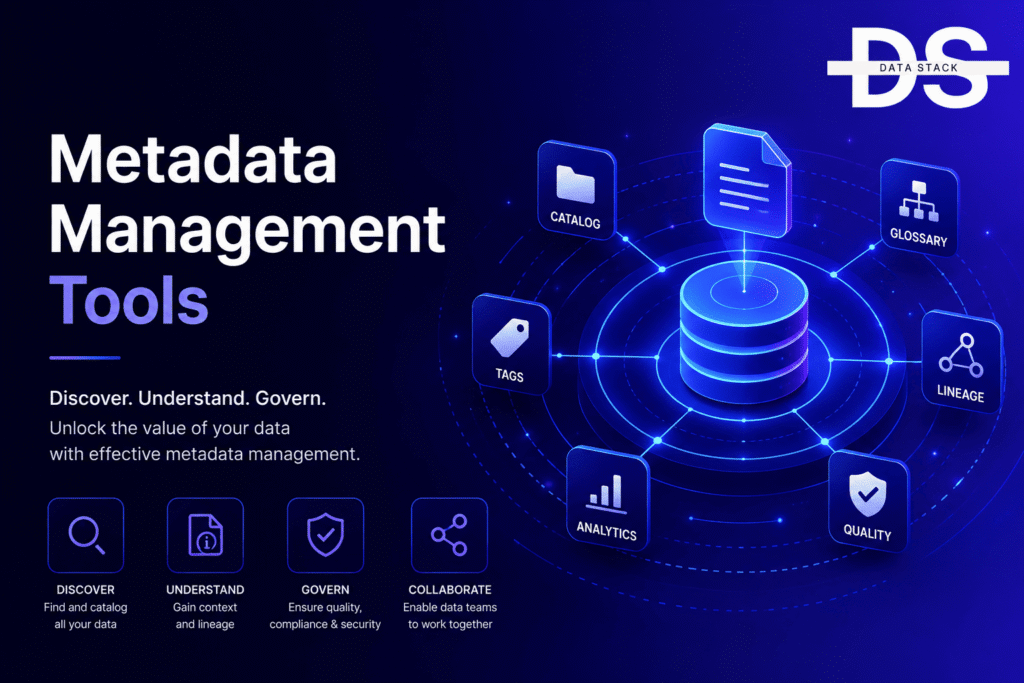
Metadata has become one of the most important assets in modern data ecosystems.
As organizations collect information across data warehouses, cloud platforms, applications, business systems, analytics environments, and AI platforms, understanding that information becomes increasingly difficult. Teams often struggle to identify data owners, trace lineage, understand definitions, evaluate trustworthiness, and determine how datasets are used across the business.
Without effective metadata management, organizations face governance challenges, poor data quality, reduced analytics confidence, compliance risks, and inefficient collaboration between business and technical teams.
This is where Metadata Management Tools help.
Metadata Management Software enables organizations to discover, organize, govern, enrich, and maintain metadata across enterprise systems. Modern Metadata Management Platforms support technical metadata, business metadata, operational metadata, active metadata, governance workflows, lineage tracking, stewardship processes, and enterprise data intelligence initiatives.
As data volumes continue to grow, metadata management is increasingly becoming a foundational component of modern data governance and analytics strategies.
What Are Metadata Management Tools?
Metadata Management Tools are software platforms that help organizations collect, organize, govern, maintain, and activate metadata across enterprise systems. These platforms manage technical metadata, business metadata, operational metadata, lineage information, ownership details, governance policies, and other contextual information that helps users understand and trust data assets. Organizations use Metadata Management Software to improve data discovery, governance, compliance, analytics, stewardship, and enterprise-wide data intelligence initiatives.
Key Features of Metadata Management Software
- Centralized metadata repositories that store technical, business, and operational metadata.
- Automated metadata discovery across databases, warehouses, cloud services, and applications.
- Data lineage capabilities that track relationships and dependencies across systems.
- Governance and stewardship workflows that improve accountability and ownership.
- Search and discovery features that help users locate trusted information quickly.
- Active metadata capabilities that capture usage patterns and contextual insights.
- Compliance and audit support for regulatory and governance initiatives.
Metadata Management Platform Comparison
| Tool | Best For | Deployment | Good Fit |
|---|---|---|---|
| Alation | Active metadata and data intelligence | Cloud | Enterprises |
| Collibra | Metadata governance | Cloud | Large organizations |
| Atlan | Modern active metadata management | Cloud | Cloud-first businesses |
| Informatica Metadata Management | Enterprise metadata governance | Cloud | Enterprises |
| Microsoft Purview | Microsoft ecosystems | Cloud | Azure customers |
| IBM Knowledge Catalog | Enterprise metadata management | Cloud, Hybrid | Large enterprises |
| Data.World | Collaborative metadata management | Cloud | Business teams |
| Ataccama ONE | Metadata plus data quality | Cloud | Enterprises |
| OvalEdge | Metadata governance and discovery | Cloud | Mid-market and enterprise |
| Secoda | Modern metadata platform | Cloud | Growing data teams |
10 Best Metadata Management Tools
#1 Alation
Alation is widely recognized as one of the leading Metadata Management Platforms and is frequently considered a pioneer in active metadata management. Unlike traditional metadata repositories that focus primarily on documentation, Alation helps organizations transform metadata into actionable intelligence that improves governance, discovery, and collaboration.
The platform collects metadata from databases, cloud warehouses, BI tools, analytics environments, and operational systems, creating a centralized view of enterprise data assets. What differentiates Alation from many competitors is its active metadata approach. The platform continuously captures usage patterns, query behavior, relationships, and business context, helping organizations understand not only what data exists but also how it is being used.
Large enterprises often deploy Alation to improve self-service analytics, strengthen governance programs, and increase trust in business data. The platform also helps bridge the gap between business users and technical teams by making metadata more accessible and understandable.
Organizations evaluating Metadata Management Tools frequently compare Data Catalog Tools because the two categories overlap significantly. However, Alation’s strength lies in combining cataloging with broader metadata intelligence and governance capabilities.
For enterprises seeking a mature and highly adopted Metadata Management Software solution, Alation remains one of the strongest options available.
Key Features
- Supports active metadata management initiatives.
- Provides automated metadata discovery capabilities.
- Enables governance and stewardship workflows.
- Supports lineage tracking and impact analysis.
- Improves enterprise-wide data discovery.
Why Choose This Tool
Alation is ideal for organizations that want a metadata platform capable of supporting governance, discovery, active metadata initiatives, and enterprise data intelligence programs from a single environment.
G2 Rating: 4.4/5
Gartner Rating: 4.6/5
Showcase your software to buyers actively comparing tools. Submit your product for editorial review and get featured on Data Stack Hub.
Submit Your Tool →#2 Collibra
Collibra is one of the most widely adopted enterprise Metadata Management Tools available today and is frequently selected by organizations pursuing large-scale governance and compliance initiatives.
The platform focuses heavily on metadata governance, business glossaries, stewardship, policy management, and metadata standardization. Organizations use Collibra to establish ownership, improve accountability, and create a common understanding of data assets across business and technical teams.
One of Collibra’s biggest strengths is its ability to manage both business metadata and technical metadata within a unified framework. This allows organizations to connect technical data assets with business definitions, policies, and governance requirements. The result is improved consistency, stronger compliance, and better communication across teams.
Collibra is particularly popular among highly regulated industries such as healthcare, financial services, insurance, and government where metadata governance plays a critical role in compliance and risk management.
For enterprises prioritizing governance and control, Collibra remains a category leader.
Key Features
- Supports technical and business metadata management.
- Provides governance and stewardship workflows.
- Enables metadata standardization across systems.
- Supports compliance and audit requirements.
- Includes lineage and impact analysis capabilities.
Why Choose This Tool
Collibra is best suited for organizations that view metadata management as a core component of enterprise governance and compliance programs.
G2 Rating: 4.5/5
Gartner Rating: 4.6/5
#3 Atlan
Atlan has emerged as one of the fastest-growing Metadata Management Platforms by focusing on active metadata, collaboration, and modern cloud data ecosystems.
Built specifically for cloud-native environments, Atlan integrates closely with technologies such as Snowflake, Databricks, BigQuery, Redshift, dbt, and modern analytics stacks. The platform helps organizations discover, govern, document, and activate metadata while improving collaboration across teams.
One of Atlan’s strongest differentiators is user experience. Many traditional metadata repositories are designed primarily for technical users, whereas Atlan focuses on making metadata accessible and useful for analysts, engineers, data stewards, and business users alike.
The platform also leverages active metadata to help organizations understand data relationships, identify trusted assets, and improve decision-making. As organizations continue investing in analytics, AI, and self-service data initiatives, Atlan has become an increasingly attractive option.
For cloud-first organizations seeking a modern Metadata Management Software solution, Atlan is one of the most compelling choices available.
Key Features
- Supports active metadata and collaboration initiatives.
- Integrates with modern cloud data platforms.
- Enables metadata discovery and documentation.
- Provides governance and stewardship capabilities.
- Supports lineage and dependency analysis.
Why Choose This Tool
Atlan is a strong choice for organizations building modern cloud-native data environments that want metadata management combined with collaboration and active metadata intelligence.
G2 Rating: 4.6/5
Gartner Rating: 4.7/5
#4 Informatica Metadata Management
Informatica Metadata Management is one of the most established Enterprise Metadata Management Tools in the market and is frequently used by large organizations managing complex data ecosystems. The platform helps organizations discover, analyze, govern, and maintain metadata across databases, ETL tools, cloud environments, analytics platforms, and business applications.
A major reason enterprises adopt Informatica is its ability to create a comprehensive metadata repository that brings together technical metadata, business metadata, operational metadata, and lineage information from multiple systems. This centralized approach helps organizations improve governance, reduce silos, and gain a clearer understanding of how information flows across the business.
The platform is particularly strong in lineage analysis. Organizations can trace data movement from source systems through transformations and into downstream reports, dashboards, and applications. This capability is valuable for compliance, audit, governance, and impact analysis initiatives.
Companies already using Informatica for integration, governance, or data quality programs often select Informatica Metadata Management because of its close integration with the broader Informatica ecosystem.
For enterprises requiring deep metadata visibility across large-scale environments, Informatica remains a leading option.
Key Features
- Provides enterprise-scale metadata repository capabilities.
- Supports technical, business, and operational metadata.
- Enables end-to-end lineage analysis.
- Integrates with Informatica data management products.
- Supports governance and compliance initiatives.
Why Choose This Tool
Informatica Metadata Management is ideal for large organizations that require comprehensive metadata governance, lineage visibility, and integration with enterprise data management initiatives.
G2 Rating: 4.3/5
Gartner Rating: 4.6/5
#5 Microsoft Purview
Microsoft Purview is Microsoft’s unified data governance and metadata management platform designed for cloud, hybrid, and multi-cloud environments.
The platform helps organizations discover, classify, govern, and manage metadata across Azure, Microsoft Fabric, Power BI, Microsoft 365, SQL Server, and third-party systems. Automated scanning capabilities reduce manual effort by continuously collecting metadata from enterprise environments.
One of Purview’s biggest strengths is its integration with the broader Microsoft ecosystem. Organizations using Azure analytics services, Microsoft Fabric, and Power BI can leverage native metadata management capabilities without introducing an entirely separate governance platform.
Purview also supports lineage tracking, data classification, policy enforcement, and governance workflows, making it a strong option for organizations pursuing enterprise-wide governance initiatives.
As Microsoft continues investing heavily in analytics, AI, and governance technologies, Purview has become an increasingly important platform within modern data ecosystems.
Key Features
- Supports metadata discovery and classification.
- Provides automated scanning and metadata collection.
- Enables lineage and governance capabilities.
- Integrates with Azure and Microsoft Fabric.
- Supports compliance and policy management initiatives.
Why Choose This Tool
Microsoft Purview is best suited for organizations that rely heavily on Microsoft technologies and want metadata management integrated into their broader governance strategy.
G2 Rating: 4.4/5
Gartner Rating: 4.5/5
Increase your product visibility by reaching software buyers researching the best tools. Every submission is reviewed by our editorial team.
Feature My Tool →#6 IBM Knowledge Catalog
IBM Knowledge Catalog combines metadata management, governance, cataloging, lineage, and AI-driven discovery capabilities within a single platform.
Organizations use the platform to create a centralized view of enterprise data assets while improving governance and metadata visibility. IBM helps users discover information, understand relationships, and maintain trusted metadata across complex business environments.
A notable differentiator is IBM’s focus on AI-assisted metadata discovery. Automated classification and metadata enrichment capabilities help organizations manage growing volumes of information without excessive manual effort.
Large enterprises often deploy IBM Knowledge Catalog as part of broader governance and data intelligence programs. The platform is especially common in regulated industries that require strong governance and auditability.
For organizations seeking enterprise-grade metadata governance capabilities, IBM remains a strong contender.
Key Features
- Supports metadata governance and cataloging.
- Provides AI-assisted metadata discovery.
- Enables lineage and impact analysis.
- Supports stewardship and governance initiatives.
- Helps improve visibility into enterprise data assets.
Why Choose This Tool
IBM Knowledge Catalog is ideal for organizations that need enterprise metadata management combined with governance, lineage, and AI-driven discovery capabilities.
G2 Rating: 4.2/5
Gartner Rating: 4.5/5
#7 Data.World
Data.World approaches metadata management from a collaboration and knowledge-sharing perspective. The platform combines metadata management, business glossaries, governance, cataloging, and discovery capabilities to help organizations improve data accessibility.
One of the platform’s biggest strengths is its ability to make metadata useful for both business and technical users. Rather than limiting metadata to governance teams, Data.World encourages collaboration through documentation, shared knowledge, and searchable metadata assets.
Organizations frequently use Data.World to improve data literacy, enable self-service analytics, and establish common business definitions across departments. The platform’s knowledge graph architecture further helps connect data assets, business concepts, and relationships.
Companies looking to democratize metadata often find Data.World particularly attractive because of its user-friendly experience and collaborative capabilities.
Key Features
- Supports collaborative metadata management.
- Provides business glossary capabilities.
- Enables metadata discovery and search.
- Uses knowledge graph technology for relationships.
- Supports governance and stewardship initiatives.
Why Choose This Tool
Data.World is a strong choice for organizations that want metadata management to be accessible across both business and technical teams.
G2 Rating: 4.5/5
Gartner Rating: 4.4/5
#8 Ataccama ONE
Ataccama ONE combines metadata management, data quality, governance, observability, and master data management capabilities within a unified platform.
Rather than treating metadata as a standalone initiative, Ataccama positions metadata as a foundation for broader data trust programs. Organizations can collect, govern, and enrich metadata while continuously monitoring quality and governance metrics.
The platform’s AI-assisted capabilities help identify metadata relationships, improve governance processes, and reduce manual effort. These features make Ataccama particularly attractive to organizations pursuing enterprise-wide data trust initiatives.
By combining metadata management with governance and quality programs, Ataccama helps reduce platform sprawl while improving visibility across enterprise environments.
Key Features
- Supports metadata, governance, and quality initiatives.
- Provides AI-assisted metadata management capabilities.
- Enables stewardship and governance workflows.
- Supports enterprise data trust programs.
- Improves metadata visibility and quality.
Why Choose This Tool
Ataccama ONE is ideal for organizations that want metadata management integrated into broader governance and data quality initiatives.
G2 Rating: 4.5/5
Gartner Rating: 4.7/5
#9 OvalEdge
OvalEdge is a metadata management and governance platform designed to help organizations improve data discovery, lineage visibility, and metadata accessibility.
The platform provides metadata repositories, governance workflows, lineage tracking, business glossaries, and stewardship capabilities. Organizations use OvalEdge to improve collaboration between business and technical teams while reducing the effort required to locate trusted data assets.
OvalEdge has become increasingly popular among mid-sized and enterprise organizations because it delivers strong metadata capabilities without the complexity associated with some larger enterprise platforms.
The platform is often selected by organizations looking for a balance between governance, usability, and implementation effort.
Key Features
- Supports metadata repositories and governance workflows.
- Provides lineage tracking and impact analysis.
- Enables business glossary management.
- Improves data discovery across teams.
- Supports stewardship and ownership initiatives.
Why Choose This Tool
OvalEdge is a strong option for organizations seeking practical metadata management capabilities with a balance of governance and usability.
G2 Rating: 4.5/5
Gartner Rating: 4.5/5
#10 Secoda
Secoda is a modern Metadata Management Platform designed specifically for cloud-native data teams. The platform combines metadata management, cataloging, documentation, lineage, and collaboration capabilities within a streamlined user experience.
One of Secoda’s biggest strengths is simplicity. Many traditional metadata management solutions can be difficult to adopt, while Secoda focuses on providing an intuitive environment that encourages usage across organizations.
The platform integrates with modern cloud data stacks including Snowflake, BigQuery, Databricks, Redshift, dbt, and BI platforms. Automated metadata collection helps reduce manual effort while improving visibility across data assets.
As organizations continue adopting modern analytics architectures, Secoda has emerged as a popular option for teams that want metadata management without excessive complexity.
Key Features
- Supports metadata discovery and documentation.
- Integrates with modern cloud analytics platforms.
- Provides lineage and collaboration capabilities.
- Automates metadata collection processes.
- Improves accessibility for technical and business users.
Why Choose This Tool
Secoda is ideal for growing organizations that want modern metadata management capabilities with a simple and user-friendly experience.
G2 Rating: 4.7/5
Gartner Rating: Not Available
How to Choose Metadata Management Software
Choosing the right Metadata Management Tool depends on your governance goals, data architecture, metadata maturity, and business requirements.
Consider the following factors:
- Metadata Coverage: Ensure support for technical, business, operational, and active metadata.
- Lineage Capabilities: Strong lineage tracking improves governance, compliance, and impact analysis.
- Governance Features: Look for stewardship workflows, ownership management, and policy enforcement capabilities.
- Discovery Experience: Search and discovery features should help users find trusted information quickly.
- Integration Ecosystem: Verify compatibility with databases, warehouses, analytics platforms, and cloud services.
- Collaboration Support: Metadata becomes more valuable when both business and technical users can contribute and consume information.
- Scalability: Large enterprises require solutions capable of managing millions of metadata assets across multiple environments.
Alation, Collibra, and Atlan are among the strongest enterprise metadata management platforms available today. Informatica, Microsoft Purview, and IBM provide extensive governance capabilities, while Secoda and OvalEdge offer modern alternatives for growing data teams.
Browse expertly curated software recommendations across hundreds of business categories.
Browse Top Tools →Conclusion
Metadata Management Tools have become essential components of modern data governance, analytics, AI, and compliance initiatives. As organizations continue generating more data across increasingly complex environments, metadata provides the context needed to understand, trust, and govern information effectively.
Alation, Collibra, and Atlan continue to lead active metadata and data intelligence initiatives, while Informatica, Microsoft Purview, and IBM provide enterprise-grade governance capabilities. Data.World emphasizes collaboration, Ataccama combines metadata with broader data trust initiatives, and Secoda and OvalEdge provide modern alternatives for cloud-native environments.
The right Metadata Management Software ultimately depends on your governance requirements, metadata strategy, analytics maturity, and long-term data management goals.
FAQs
1. What are Metadata Management Tools?
Metadata Management Tools help organizations collect, organize, govern, maintain, and activate metadata across enterprise systems.
2. What is metadata management software used for?
Metadata Management Software is used to improve governance, discovery, lineage, compliance, stewardship, and data intelligence initiatives.
3. What types of metadata do these platforms manage?
Most platforms manage technical metadata, business metadata, operational metadata, lineage information, ownership details, and governance metadata.
4. What is active metadata?
Active metadata refers to metadata that continuously captures usage patterns, relationships, and behavioral insights rather than functioning as static documentation.
5. What is the difference between metadata management and data catalog tools?
Metadata management focuses on collecting, governing, and maintaining metadata, while data catalogs primarily focus on discovery and accessibility of data assets.
6. Which Metadata Management Tool is best?
Alation, Collibra, Atlan, Informatica Metadata Management, and Microsoft Purview are among the leading solutions available today.
7. Why is metadata important for governance?
Metadata provides ownership, lineage, definitions, classifications, and context that support governance and compliance initiatives.
8. Do metadata management platforms support data lineage?
Yes. Most enterprise metadata platforms provide lineage tracking capabilities to help organizations understand data movement and dependencies.
9. Which industries use metadata management software?
Financial services, healthcare, retail, manufacturing, government, telecommunications, and technology organizations commonly use metadata management platforms.
10. How do I choose the right Metadata Management Platform?
Evaluate metadata coverage, governance features, lineage capabilities, integrations, collaboration support, scalability, and alignment with your long-term data strategy.