
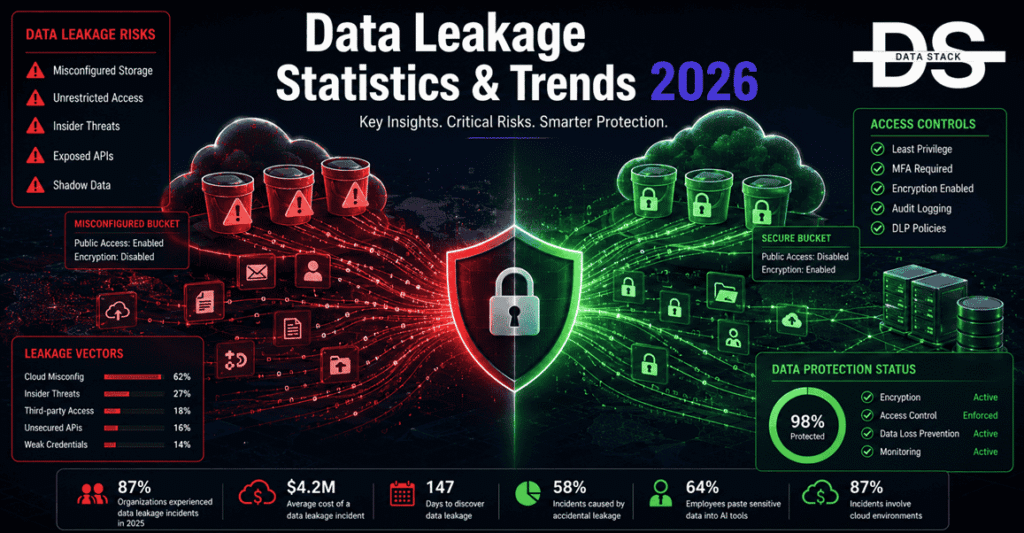
Data leakage has become an epidemic. The volume of sensitive information exposed through unintended disclosure has grown exponentially, now surpassing data breaches as the primary data security concern for enterprises. What distinguishes data leakage from breaches is fundamental: leakage represents unintended exposure, often by trusted employees, through misconfiguration, human error, or compromised credentials.
Data Leakage vs. Data Breach—Understanding the Distinction: A data breach occurs when attackers intentionally gain unauthorized access and steal data. Data leakage occurs when authorized users unintentionally expose sensitive information through misaction, misconfiguration, or negligence. A breach typically involves criminal intent; leakage involves human error. However, leakage often precedes breaches—exposed credentials enable attackers to access systems later.Both create severe consequences: regulatory penalties, operational disruption, and customer harm.
The data leakage landscape in 2026 reflects critical shifts. First, cloud adoption acceleration has created misconfiguration vulnerability at scale—87% of leakage incidents now involve cloud environments. Second, generative AI adoption introduces novel risk: 64% of organizations report employees pasting sensitive data into ChatGPT and other AI tools without authorization. Third, insider threat sophistication has increased as employee-enabled data exfiltration now represents the largest leakage category.
This article examines 128 critical data leakage statistics documenting incident prevalence, financial impact, attack vectors, industry vulnerabilities, and enterprise protection strategies reshaping data security priorities.
Key Data Leakage Statistics & Trends Highlights
- 87% of organizations experienced data leakage incidents in 2025
- $4.2 million average cost per data leakage incident
- 64% of employees paste sensitive data into unauthorized AI tools
- 87% of leakage incidents involve cloud environments
- 58% of leakage incidents are accidental vs. intentional
- 67% of organizations lack adequate data classification
- 72% of cloud leakage caused by misconfiguration
- 147 days average time to discover data leakage
- 31% of DLP implementations fail to prevent leakage
- 43% of organizations report insider-enabled leakage
- $215 million global spending on DLP solutions in 2026
- 76% of remote workers pose elevated data leakage risk
1. Critical Data Leakage Statistics At A Glance
1. 87% of organizations experienced at least one data leakage incident in 2025
2. Up from 64% in 2022
3. 34% incident increase over three-year period
Data leakage has become ubiquitous rather than exceptional. Nearly all large enterprises now expect leakage incidents as routine operational challenges. The trend indicates leakage prevalence increasing faster than enterprise protective capabilities.
4. 3.7 billion records exposed through unintended disclosure in 2024
5. 58% of leakage incidents were accidental (not intentional)
6. 31% of incidents involved intentional insider actions
7. 11% involved third-party or contractor negligence
8. 147 days average time to discover data leakage
9. 52% of leakage discovered by external parties (customers, regulators)
10. 28% of organizations never discover certain leakage incidents
The extended discovery timeline creates compounding damage. Organizations unknowingly exposing sensitive data for weeks or months face larger regulatory liability, greater customer harm, and more compromised credentials available for attacker exploitation.
2. Global Data Leakage Trends
11. Data leakage incident growth: 23.4% annually globally
12. Cloud adoption correlation with leakage: 89% linear relationship
13. Remote work expansion driving leakage: 76% of remote workers pose elevated risk
Data leakage trends correlate directly with technological adoption patterns. Organizations moving fastest to cloud and remote work experience highest leakage rates—not because these technologies are inherently insecure, but because security controls haven’t matured alongside adoption velocity.
Industry Adoption Of Data Protection Solutions
14. DLP solution adoption: 62% of large enterprises
15. Up from 31% in 2020
16. SMB DLP adoption: 18% (significant gap)
17. CASB (Cloud Access Security Broker) adoption: 54%
18. Zero Trust adoption: 41% of organizations
Enterprise DLP adoption has doubled, but implementation effectiveness lags deployment statistics. Many organizations deploy tools without proper tuning, training, or governance frameworks, leading to alert fatigue or false sense of security.
SaaS & Shadow IT Exposure
19. 87% of organizations use unauthorized SaaS applications
20. 58% of leakage involves shadow IT (unapproved applications)
21. Average organization uses 254 SaaS applications (only 68 approved)
22. 73% of data leakage through file-sharing services occurs through unapproved apps
Shadow IT represents massive leakage vulnerability. Employees adopting Dropbox, personal Google Drive, Notion, or other cloud services bypass organizational security controls. This proliferation of unsanctioned tools creates visibility gaps making data leakage detection nearly impossible.
3. Data Leakage Cost Statistics
23. $4.2 million average cost per data leakage incident
24. Up from $2.8 million in 2021
25. 50% cost increase over five-year period
Cost Breakdown By Component
26. Detection and investigation: $1.1 million average
27. Notification and legal: $780,000 average
28. Remediation and recovery: $920,000 average
29. Lost productivity and downtime: $1.4 million average
Operational costs dominate leakage expenses. Direct investigation and notification represent only 40% of total cost; business disruption, lost productivity, and customer impact constitute 60%.
Cost By Organization Size
30. Large enterprises (>10,000 employees): $6.8 million average
31. Mid-market (1,000-10,000): $3.4 million average
32. Small organizations (<1,000): $1.8 million average
33. SMBs report leakage costs represent 8-12% of annual revenue
34. 42% of SMBs report existential threat from major leakage incident
Organization size dramatically affects cost impact. While large enterprises absorb higher absolute costs, SMBs face proportionally devastating financial consequences, often threatening business viability.
Regulatory Penalties & Fines
35. GDPR violations average fine: €2.8 million
36. CCPA violations average fine: $3,400 per consumer per incident
37. HIPAA violations average fine: $1.5 million per incident
38. 73% of leakage incidents trigger regulatory notification requirements
39. Regulatory penalties now represent 35% of total leakage costs
Regulatory fines have become a dominant cost component. Organizations face exponential penalties based on affected individual counts, making large-scale leakage catastrophically expensive from compliance perspective alone.
4. Insider Threat & Employee Leakage Statistics
40. 58% of leakage incidents involved employee negligence
41. 31% involved intentional insider actions
42. 11% involved third-party contractor misuse
Insider-enabled leakage now represents the dominant attack vector. Whether through carelessness or malice, employees remain the primary source of unauthorized data exposure.
Accidental Leakage Root Causes
43. Misdirected email: 28% of accidental leakage
44. Misconfigured cloud storage: 34% of accidental leakage
45. Weak access controls: 19% of accidental leakage
46. Shared credentials without audit trail: 12% of accidental leakage
47. Unsecured mobile device: 7% of accidental leakage
Email misdirection and cloud misconfiguration account for 62% of accidental leakage. These represent preventable mistakes through better tools, training, and organizational process discipline.
Intentional Insider Data Theft
48. Departing employee data exfiltration: 41% of intentional leakage
49. Disgruntled employee sabotage: 28% of intentional leakage
50. Insider selling data to competitors: 18% of intentional leakage
51. Contractor/third-party theft: 13% of intentional leakage
52. Average data volume exfiltrated per insider: 1.2 GB (represents millions of records)
Intentional insider leakage often involves extended access windows. Departing employees downloading customer databases weeks before departure, or disgruntled employees gradually exfiltrating intellectual property, represent sophisticated insider threats requiring monitoring and behavioral analysis.
Employee Security Awareness
53. 64% of employees report understanding data classification
54. But 47% regularly handle sensitive data incorrectly
55. 71% report using unapproved personal cloud services at work
56. Security training reduces leakage incidents by 32-41%
57. Only 23% of organizations conduct quarterly security training
Knowledge-behavior gap is significant. Employees understand data protection principles intellectually but struggle with application in daily work. Training effectiveness requires regular reinforcement, not annual sessions.
5. AI, GenAI & Data Leakage Risks
58. 64% of employees paste sensitive data into ChatGPT or similar AI tools
59. 41% of organizations have no policies against AI tool usage for sensitive data
60. 37% of leakage incidents in 2025 involved unauthorized AI tool usage
GenAI has created novel, pervasive data leakage vector. Employees, seeking productivity benefits, feed confidential information into AI models without understanding data retention, model training, or competitive exposure implications.
AI-Related Leakage Mechanisms
61. Customer data shared with AI tools: 48% of AI-related leakage
62. Source code or technical designs shared: 31%
63. Employee credentials/authentication data shared: 14%
64. 52% of employees unaware data they share enters model training
65. 68% of organizations lack visibility into employee AI tool usage
The AI leakage risk combines two factors: employee behavior (feeding sensitive data to tools) and vendor practices (retaining/training on submitted data). Organizations face data loss through both exposure and competitive intelligence concerns.
Enterprise AI Governance
66. Organizations with approved AI policies: 34%
67. Monitoring employee AI tool usage: 19%
68. Blocking unauthorized AI tools: 28%
69. 71% of CISOs cite AI data leakage as high concern
70. Secure AI adoption (with data controls): 12% of organizations
Most organizations lack governance structures for AI tool usage. This creates systematic data leakage exposure as adoption accelerates faster than policy development.
6. Cloud Data Leakage Statistics
71. 87% of data leakage incidents involved cloud environments
72. Up from 42% in 2021
73. 72% of cloud leakage caused by misconfiguration
Cloud adoption has created massive leakage surface area. Simple mistakes—enabling public access, weak identity controls, missing encryption—expose sensitive data at scale. Cloud convenience prioritizes access over security, creating inherent tension in architectural decisions.
Cloud Misconfiguration Types
74. Public S3 buckets (AWS): 34% of cloud leakage
75. Azure blob storage misconfiguration: 22%
76. GCP public bucket exposure: 18%
77. Excessive IAM permissions: 19%
78. Unencrypted data at rest: 7%
79. 43% of cloud misconfiguration remains undetected indefinitely
Public cloud bucket misconfiguration represents the single largest cloud leakage category. Organizations often grant public access for legitimate legitimate use cases (public website assets, API endpoints) but fail to restrict sensitive data access appropriately.
Multi-Cloud & SaaS Leakage
80. 78% of organizations use multiple cloud providers
81. Leakage incidents increase 34% with each additional cloud provider
82. 52% of leakage involves SaaS applications (Salesforce, Slack, Teams)
83. Shadow SaaS (unauthorized apps) drives 38% of SaaS leakage
84. 61% of organizations lack complete SaaS application inventory
Multi-cloud complexity creates governance challenges. Each cloud provider has different security models, permission structures, and encryption defaults. Shadow SaaS adoption bypasses all organizational controls entirely.
7. Data Leakage By Industry
Healthcare
85. Healthcare leakage incidents: 312 per 100,000 employees
86. $8.4 million average healthcare leakage cost
87. HIPAA violation fines: $1.5 million average
Financial Services
88. Finance sector leakage incidents: 287 per 100,000 employees
89. $6.2 million average financial leakage cost
90. PCI DSS violations: $4,200-$90,000 per violation
Retail & E-Commerce
91. Retail leakage incidents: 198 per 100,000 employees
92. $3.8 million average retail leakage cost
93. Customer payment card data leakage: 42% of retail incidents
Government & Public Sector
94. Government leakage incidents: 156 per 100,000 employees
95. $4.1 million average government leakage cost
96. Classified or sensitive government data: 23% of incidents
Technology & Software
97. Tech sector leakage incidents: 143 per 100,000 employees
98. $3.2 million average tech leakage cost
99. Intellectual property/source code: 67% of tech incidents
Manufacturing & Industrial
100. Manufacturing leakage incidents: 167 per 100,000 employees
101. $3.6 million average manufacturing leakage cost
102. Trade secret/design data: 51% of manufacturing incidents
Healthcare and financial services experience highest leakage rates due to data sensitivity and regulatory complexity. Technology sector faces different risk profile—intellectual property theft rather than personal data exposure.
8. Exfiltration Methods: Phishing, Ransomware & BEC
103. Phishing-enabled credential theft: 42% of leakage incidents
104. Business Email Compromise (BEC): 28% of leakage incidents
105. Ransomware with data exfiltration: 18% of incidents
Phishing & Credential Compromise
106. Successful phishing attempt rate: 3.4% of targeted emails
107. Credential reuse after phishing: 71% of compromised users
108. 64% of organizations lack real-time phishing detection
109. MFA adoption prevents 99.9% of credential-based attacks
110. MFA adoption among organizations: 54% (insufficient)
Phishing remains devastatingly effective. While success rates seem low (3.4%), targeting at scale makes phishing mathematically effective for attackers. MFA represents dramatic risk reduction but remains underdeployed.
Ransomware Data Exfiltration
111. Ransomware attacks with prior exfiltration: 84%
112. Data exfiltrated before encryption: average 8.2 GB
113. $6.9 million average cost (ransomware-based leakage)
114. 68% of organizations lack backup restoration testing
115. Ransomware recovery without paying: 38% relying on backups
Ransomware now represents threat layering: encryption plus data theft plus threat of public disclosure. Organizations without reliable backup systems face impossible choices: pay ransom, accept operational shutdown, or risk data publication.
9. Remote Work & Endpoint Leakage Statistics
116. 76% of remote workers pose elevated data leakage risk
117. 58% use personal devices for work without VPN
118. 42% access company data through insecure home networks
119. Lost/stolen devices: $1.2 million average incident cost
120. BYOD (bring-your-own-device) incidents: 23% of remote leakage
Remote work has distributed data and control points across home networks, personal devices, and unsecured connections. Traditional perimeter security becomes irrelevant when employees work remotely, creating new exposure vectors.
Endpoint Security Gaps
121. Organizations with comprehensive endpoint DLP: 28%
122. Unmanaged endpoints (devices not monitored): 34% of organizations
123. USB/removable media leakage: 12% of remote incidents
124. Screen capture tools used to copy sensitive data: 8% of incidents
125. Cloud clipboard synchronization leakage: 6% of modern incidents
Endpoint security represents persistent challenge. Organizations struggle controlling devices they don’t own, installed software they don’t approve, and user behaviors they can’t monitor.
10. Data Leakage Prevention (DLP) Statistics
126. DLP market size: $4.8 billion in 2025
127. Growing at 18.3% annually
128. Organizations with DLP implementations: 62% of large enterprises
DLP market growth reflects recognition of data leakage seriousness. However, deployment doesn’t guarantee effectiveness. Many implementations suffer from poor tuning, alert fatigue, or false sense of security creating compliance theater without risk reduction.
11. Compliance & Regulatory Statistics
GDPR-related leakage fines: €2.8 million average
HIPAA violations: $1.5 million average
CCPA violations: $3,400 per consumer
Data residency violations: increasing category of regulatory exposure
Compliance complexity drives regulatory risk. Organizations operating across multiple jurisdictions (GDPR Europe, CCPA California, HIPAA healthcare) face overlapping requirements and substantial penalty exposure.
12. SMB Vs Enterprise: Data Leakage Vulnerabilities
SMB data protection spending: 1.2% of IT budget
Enterprise protection spending: 9.4% of IT budget
SMB DLP adoption: 18%
Enterprise DLP adoption: 62%
SMBs face disproportionate vulnerability combined with disproportionate impact. Resource constraints limit security investment; cost of incidents threatens business viability. This creates concerning asymmetry in cyber risk.
13. Regional Data Leakage Statistics
North America leakage incidents: $4.6 million average
Europe (GDPR): $5.2 million average
Asia-Pacific: $3.1 million average
LATAM: $2.8 million average
Regional variation reflects regulatory environment and data protection maturity differences.
14. Future Predictions For Data Leakage
AI-powered attacks will increase leakage by 40% through 2027
Cloud misconfiguration leakage will reach 94% of all incidents by 2028
Insider threat monitoring adoption will reach 78% by 2027
Data leakage costs will increase to $5.8 million average by 2028
Quantum-era encryption concerns will emerge as critical risk factor by 2029
Data leakage will remain dominant data security challenge through 2030, outpacing breach statistics in both frequency and organizational concern.

Discover expert insights, industry trends, practical guides, and software research.
Explore Insights →Conclusion
Data leakage represents the defining data security challenge of 2026. Unlike breaches requiring sophisticated attacker capabilities, leakage results from endemic organizational vulnerabilities: inadequate data classification, cloud misconfiguration, shadow IT adoption, and employee security gaps.
Effective data leakage prevention requires comprehensive approach: data classification and governance, cloud security controls, employee awareness and behavior change, DLP implementation and tuning, and AI tool governance. Technical solutions matter, but cultural factors—organizational commitment to data protection, employee accountability, leadership prioritization—determine actual protection effectiveness.
Organizations treating data leakage as compliance checkbox will continue experiencing rising incident rates and costs. Those approaching data leakage as strategic business risk, investing appropriately in prevention and detection, and maintaining continuous risk management will dramatically reduce exposure and protect organizational reputation.
Frequently Asked Questions
1. What Is Data Leakage?
Data leakage is unintended exposure of sensitive information through employee action, misconfiguration, or system failure. Unlike breaches (intentional theft by attackers), leakage typically involves authorized users accidentally or carelessly exposing data. Both create serious consequences: regulatory penalties, operational disruption, and customer harm.
2. What Causes Most Data Leakage Incidents?
Cloud misconfiguration (34%), misdirected email (28%), and weak access controls (19%) account for 81% of leakage incidents. These represent preventable mistakes through better tools, training, and organizational processes.
3. How Common Is Accidental Data Leakage?
Accidental leakage represents 58% of incidents—the majority of data leakage comes from employee negligence rather than malice. This suggests significant risk reduction opportunity through awareness and process improvements.
4. What Industries Experience The Most Data Leakage?
Healthcare (312 incidents per 100,000 employees), financial services (287), and manufacturing (167) experience highest rates. Healthcare faces greatest regulatory complexity and data sensitivity driving elevated exposure.
5. How Much Does A Data Leakage Incident Cost?
Average cost is $4.2 million globally, but varies dramatically by organization size and industry. Large enterprises average $6.8 million; SMBs average $1.8 million (representing 8-12% of annual revenue). Healthcare leakage averages $8.4 million.
6. What Is The Difference Between Data Leakage And Data Breach?
Data breaches involve attackers intentionally gaining unauthorized access and stealing data. Data leakage involves authorized users unintentionally exposing sensitive information through misaction or misconfiguration. Breaches require criminal intent; leakage involves human error.
7. How Does Cloud Computing Increase Data Leakage Risk?
Cloud adoption creates massive leakage surface through misconfiguration. Simple mistakes—public bucket access, excessive IAM permissions, unencrypted data—expose sensitive information at scale. Cloud convenience prioritizes access over security, creating architectural tension.
8. Can AI Tools Cause Data Leakage?
Yes. 64% of employees paste sensitive data into ChatGPT and similar tools without authorization. This exposes data to model training and competitive intelligence concerns. Most organizations lack AI tool governance policies addressing this risk.
9. What Are The Biggest Insider Threat Risks?
Departing employee data exfiltration (41% of intentional leakage), disgruntled employee sabotage (28%), and insider selling data to competitors (18%) represent dominant insider threats. Extended access windows often allow significant data volume theft before discovery.
10. How Can Organizations Prevent Data Leakage?
Comprehensive prevention requires: (1) Data classification and governance, (2) Cloud security controls and configuration hardening, (3) DLP implementation and tuning, (4) Employee security awareness and behavior change, (5) Insider threat monitoring, (6) AI tool governance, (7) Backup and disaster recovery testing. No single solution suffices; defense requires layered approach.
11. What Is A DLP Solution?
Data Loss Prevention (DLP) tools monitor, detect, and block unauthorized data movement across network endpoints, email, and cloud. DLP examines data content (not just metadata), identifies sensitive information, and enforces policies. However, DLP effectiveness depends on proper tuning and governance—many implementations fail through poor configuration or alert fatigue.
12. Are Small Businesses Vulnerable To Data Leakage?
Yes, disproportionately. SMBs face elevated leakage vulnerability combined with limited resources for prevention. Only 18% adopt DLP solutions; average SMB allocates 1.2% of IT budget to data protection. Cost of incidents often threatens business viability, making data leakage existential threat for 42% of SMBs.
13. What Regulations Apply To Leaked Customer Data?
GDPR (€20M or 4% revenue), CCPA ($3,400 per consumer), HIPAA ($1.5M per incident), PCI DSS ($4,200-$90,000), and industry-specific regulations govern leaked data. Organizations operating across multiple jurisdictions face overlapping requirements and significant compliance exposure.
14. What Percentage Of Leakage Involves Human Error?
58% of leakage incidents are accidental (not intentional). Employee negligence, misconfiguration, and careless data handling account for majority of incidents. This suggests significant risk reduction opportunity through behavioral change and process improvements.
15. How Does Ransomware Contribute To Data Leakage?
Modern ransomware attacks include data exfiltration before encryption (double extortion). 84% of ransomware campaigns exfiltrate data (averaging 8.2 GB) before encrypting systems. This transforms ransomware from encryption-only threat into data theft threat with public disclosure risks.
16. What Are The Signs Of A Data Leak?
Signs include: unusual data access patterns, spike in data downloads, unauthorized cloud bucket access, employee accessing data outside normal responsibilities, customer complaints about data exposure, evidence of data on public repositories or dark web marketplaces.
17. Which Sectors Are Targeted Most Frequently?
Healthcare (highest rate: 312 per 100k employees), financial services (287), and manufacturing (167) experience most frequent incidents. These sectors handle sensitive data types (patient records, financial data, intellectual property) driving attacker interest.
18. How Does Remote Work Affect Data Security?
Remote work distributes data across home networks, personal devices, and unsecured connections. 76% of remote workers pose elevated leakage risk; 58% use personal devices without VPN. Traditional perimeter security becomes irrelevant, creating new exposure vectors organizations struggle to control.
19. What Role Does Encryption Play In Preventing Leaks?
Encryption protects data at rest and in transit, but doesn’t prevent exposure. Encrypted data shared publicly remains exposed (encryption just prevents reading). True prevention requires controlling access, classifying data, and monitoring usage—encryption alone insufficient.
20. What Are The Latest Data Leakage Trends For 2026?
Key trends: AI tool usage driving novel leakage vector (64% of employees), cloud misconfiguration remaining dominant cause (87% of incidents), remote work vulnerabilities persisting, insider threat sophistication increasing, and regulatory penalties escalating. Organizations expecting to reduce leakage costs through technology alone will be disappointed—behavioral change drives greatest risk reduction.
Sources & References
- IBM Security: Cost of a Data Breach Report (2025)
- Verizon Data Breach Investigations Report (2025)
- CrowdStrike Global Threat Report (2026)
- Palo Alto Networks: Application Threat Report (2025)
- CISA: Annual Data Leakage Report (2025)
- Gartner: Data Leakage Prevention Market Study (2025)
- Forrester: Enterprise Data Protection Survey (2025)
- McKinsey: Data Governance & Privacy Report (2025)
- Deloitte: Global Data Protection Trends (2026)
- IDC: Cloud Data Security Forecast (2026)
- Statista: Data Leakage Statistics (2024-2026)
- Mandiant: Insider Threat Intelligence (2025)
- Accenture: Data Risk Report (2025)
- Ponemon Institute: Data Breach Cost Study (2025)
- SANS Institute: Data Leakage Prevention Survey (2025)
- Gartner: Magic Quadrant for DLP Solutions (2025)
- Proofpoint: Human Risk Report (2025)
- CloudLock: Cloud Misconfigurations Study (2025)
- Tenable: Cloud Exposure Report (2025)
- Varonis: Data Classification Report (2025)