
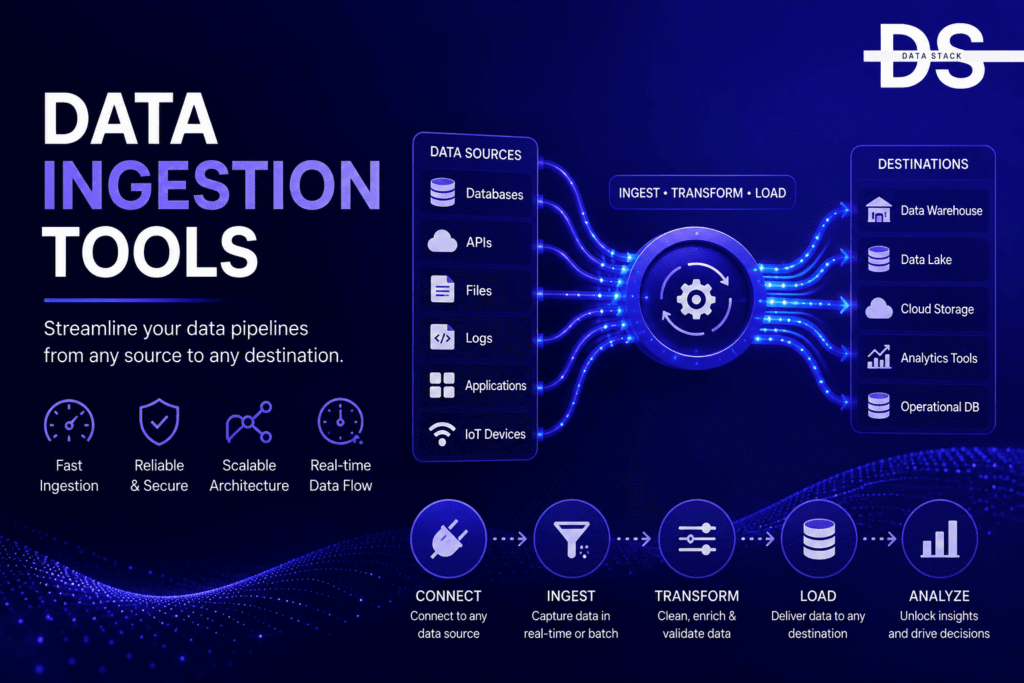
Modern organizations collect information from dozens of sources. Applications, databases, SaaS platforms, cloud services, IoT devices, and operational systems continuously generate data that businesses want to analyze and use.
However, before data can support reporting, analytics, machine learning, or business intelligence, it first needs to be collected and delivered to a central destination.
That’s where data ingestion tools help.
These platforms automate the process of moving data from source systems into data warehouses, lakehouses, analytics platforms, and operational environments. They reduce engineering effort, improve reliability, and help organizations create scalable data architectures.
Whether you’re building a modern analytics stack or supporting real-time business operations, choosing the right ingestion platform is critical.
What Are Data Ingestion Tools?
Data ingestion tools are platforms that collect, move, and deliver data from source systems into storage, analytics, or processing environments.
These tools typically support:
- Batch ingestion workflows.
- Real-time data streaming.
- Change data capture (CDC).
- SaaS application integrations.
- Database replication.
- Automated pipeline management.
Organizations use ingestion tools to ensure trusted data is continuously available for downstream systems.
Benefits of Data Ingestion Tools
- Automate data collection and movement.
- Reduce manual pipeline maintenance.
- Support real-time and batch workloads.
- Improve reliability and scalability.
- Accelerate analytics initiatives.
- Simplify integration between systems.
- Reduce engineering overhead.
Data Ingestion Platforms Compared
| Tool | Best For | Deployment | Good Fit |
|---|---|---|---|
| Fivetran | Automated data ingestion | Cloud | Analytics teams |
| Airbyte | Open-source ingestion | Cloud, Self-Hosted | Modern data teams |
| Hevo Data | No-code ingestion | Cloud | Growing businesses |
| Matillion Data Loader | Cloud ingestion | Cloud | Cloud-first organizations |
| Informatica IDMC | Enterprise ingestion | Cloud | Large enterprises |
| Talend Data Fabric | Integration and ingestion | Cloud, Hybrid | Enterprises |
| AWS Glue | AWS ingestion workflows | Cloud | AWS customers |
| Azure Data Factory | Microsoft ecosystems | Cloud | Azure customers |
| Stitch | Simple ELT pipelines | Cloud | Small and mid-sized teams |
| StreamSets | Complex data movement | Cloud, Hybrid | Enterprise environments |
10 Best Data Ingestion Tools
#1 Fivetran
Fivetran is one of the most widely adopted data ingestion platforms in the market. The platform helps organizations move data from applications, databases, files, and cloud systems into warehouses and lakehouses with minimal manual effort.
One of Fivetran’s biggest strengths is automation. The platform automatically manages connectors, schema changes, and pipeline maintenance, allowing engineering teams to focus on analytics rather than infrastructure.
Organizations building modern analytics stacks frequently evaluate Data Pipeline Tools alongside ingestion platforms because both play critical roles in delivering reliable data to downstream systems.
For teams seeking a low-maintenance ingestion solution, Fivetran remains one of the strongest choices available.
Key Features
- Supports hundreds of prebuilt connectors.
- Automatically handles schema evolution.
- Reduces manual pipeline maintenance.
- Integrates with major cloud warehouses and lakehouses.
- Supports scalable ELT workflows.
Why Choose This Tool
Choose Fivetran if your organization wants highly automated and reliable data ingestion.
G2 Rating: 4.4/5
Gartner Rating: 4.5/5

Showcase your software to buyers actively comparing tools. Submit your product for editorial review and get featured on Data Stack Hub.
Submit Your Tool →#2 Airbyte
Airbyte has become one of the fastest-growing data ingestion platforms thanks to its open-source foundation and extensive connector ecosystem.
The platform enables organizations to move data between applications, APIs, databases, and analytics platforms while maintaining flexibility and control. Teams can use Airbyte Cloud or deploy it within their own environments.
Airbyte is especially attractive to organizations seeking an alternative to fully managed commercial platforms while still supporting modern ELT workflows.
For teams prioritizing flexibility and extensibility, Airbyte is a leading option.
Key Features
- Provides open-source and cloud deployment options.
- Supports hundreds of connectors.
- Enables custom connector development.
- Supports modern ELT architectures.
- Reduces vendor lock-in.
Why Choose This Tool
Choose Airbyte if your organization wants flexible and extensible data ingestion capabilities.
G2 Rating: 4.5/5
Gartner Rating: Not Available
#3 Hevo Data
Hevo Data is a no-code data ingestion platform designed to simplify data movement for analytics teams and growing organizations.
The platform allows users to collect and synchronize data from SaaS applications, databases, cloud storage systems, and streaming sources without building custom pipelines. Built-in transformation capabilities further reduce engineering effort.
Organizations that need fast deployment and minimal maintenance often shortlist Hevo Data alongside Fivetran and Airbyte.
For businesses looking for ease of use and rapid implementation, Hevo Data is a strong contender.
Key Features
- Provides no-code data ingestion workflows.
- Supports real-time and batch ingestion.
- Includes built-in transformation capabilities.
- Connects SaaS applications, databases, and cloud systems.
- Simplifies analytics pipeline development.
Why Choose This Tool
Choose Hevo Data if your organization wants an easy-to-manage platform for modern data ingestion.
G2 Rating: 4.6/5
Gartner Rating: 4.7/5
#4 Matillion Data Loader
Matillion Data Loader is a cloud-native ingestion platform designed to help organizations collect and load data into modern cloud analytics environments.
The solution integrates closely with platforms such as Snowflake, Databricks, Amazon Redshift, and Google BigQuery. Its simplicity and cloud-first architecture make it attractive for organizations modernizing their data stack.
Many teams evaluating ingestion solutions also review Data Integration Tools because ingestion is often the first step in broader integration initiatives.
Key Features
- Supports cloud-native ingestion workflows.
- Integrates with major cloud analytics platforms.
- Provides automated scheduling capabilities.
- Simplifies warehouse and lakehouse ingestion.
- Supports scalable cloud deployments.
Why Choose This Tool
Choose Matillion Data Loader if your organization operates a cloud-first analytics environment.
G2 Rating: 4.4/5
Gartner Rating: 4.5/5
#5 Informatica Intelligent Data Management Cloud (IDMC)
Informatica IDMC provides enterprise-grade ingestion, integration, governance, metadata management, and quality capabilities within a unified cloud platform.
Organizations use Informatica to move data from operational systems, applications, databases, and cloud environments into analytics platforms while maintaining visibility and governance. Its extensive connector ecosystem and enterprise-focused features make it a common choice among large organizations.
Unlike many ingestion-focused products, Informatica supports broader data management initiatives that extend beyond simple data movement.
For enterprises requiring scalability, governance, and operational reliability, Informatica remains one of the strongest options available.
Key Features
- Supports enterprise-scale data ingestion workflows.
- Connects applications, databases, APIs, and cloud platforms.
- Provides governance and metadata management capabilities.
- Supports cloud, hybrid, and multi-cloud environments.
- Enables automated and scalable data movement.
Why Choose This Tool
Choose Informatica IDMC if your organization requires enterprise-grade ingestion and data management capabilities.
G2 Rating: 4.3/5
Gartner Rating: 4.6/5
Increase your product visibility by reaching software buyers researching the best tools. Every submission is reviewed by our editorial team.
Feature My Tool →#6 Talend Data Fabric
Talend Data Fabric combines data ingestion, integration, transformation, quality, and governance capabilities within a single platform.
The solution helps organizations collect and deliver information from multiple sources while improving consistency and reliability across the data lifecycle. Its visual development environment simplifies pipeline creation and operational management.
Talend is often selected by organizations that want a unified platform rather than separate ingestion and integration solutions.
For enterprises managing diverse data ecosystems, Talend remains a trusted choice.
Key Features
- Supports ingestion, integration, and transformation workflows.
- Connects cloud, on-premises, and hybrid environments.
- Provides visual pipeline development capabilities.
- Helps improve reliability across data flows.
- Supports enterprise-scale deployments.
Why Choose This Tool
Choose Talend Data Fabric if your organization wants ingestion and integration capabilities within a single platform.
G2 Rating: 4.3/5
Gartner Rating: 4.4/5
#7 AWS Glue
AWS Glue is Amazon’s fully managed data integration and ingestion service. It helps organizations discover, ingest, transform, and prepare data for analytics workloads within AWS environments.
The service integrates closely with Amazon S3, Amazon Redshift, Amazon Athena, Amazon EMR, and other AWS services. Organizations already operating within AWS often choose Glue because it reduces operational overhead and simplifies ingestion workflows.
AWS Glue is particularly attractive for cloud-native organizations building scalable analytics architectures.
Key Features
- Provides serverless data ingestion and integration.
- Supports automated data discovery and cataloging.
- Integrates with AWS analytics and storage services.
- Enables scalable cloud-native workflows.
- Reduces infrastructure management requirements.
Why Choose This Tool
Choose AWS Glue if your organization relies heavily on AWS for analytics and data infrastructure.
G2 Rating: 4.2/5
Gartner Rating: 4.4/5
#8 Azure Data Factory
Azure Data Factory is Microsoft’s cloud-based data integration and ingestion platform. It enables organizations to build, schedule, and manage ingestion pipelines across cloud and on-premises systems.
The platform integrates closely with Microsoft Fabric, Azure Synapse Analytics, Azure Data Lake Storage, and Power BI. This makes it a common choice for organizations already invested in Microsoft’s ecosystem.
Organizations implementing large-scale analytics projects often evaluate Azure Data Factory alongside Data Engineering Tools because both categories play important roles in modern data architectures.
Key Features
- Supports cloud-based ingestion and orchestration.
- Connects hundreds of data sources.
- Provides scheduling and automation capabilities.
- Integrates with Azure analytics services.
- Supports enterprise-scale pipeline development.
Why Choose This Tool
Choose Azure Data Factory if your organization operates primarily within Microsoft Azure environments.
G2 Rating: 4.3/5
Gartner Rating: 4.5/5
#9 Stitch
Stitch is a cloud-based data ingestion platform focused on simplicity and ease of deployment. The platform helps organizations move information from applications and databases into analytics destinations with minimal configuration.
Stitch is particularly popular among startups, growing businesses, and smaller analytics teams that want reliable ingestion capabilities without extensive engineering resources.
Its straightforward pricing and deployment model make it attractive for organizations beginning their analytics journey.
Key Features
- Supports automated cloud-based ingestion workflows.
- Connects applications and databases to analytics platforms.
- Provides simple setup and management.
- Reduces engineering effort for data movement.
- Supports common analytics use cases.
Why Choose This Tool
Choose Stitch if your organization wants a straightforward platform for data ingestion and analytics workflows.
G2 Rating: 4.1/5
Gartner Rating: Not Available
#10 StreamSets
StreamSets is a data movement platform designed for organizations managing complex ingestion and operational data flows.
The platform supports batch processing, streaming data, change data capture (CDC), and hybrid data movement scenarios. Its monitoring and observability capabilities help organizations maintain reliable pipelines across distributed environments.
StreamSets is often selected by enterprises with large-scale ingestion requirements and complex infrastructure environments.
For organizations requiring flexibility across cloud and hybrid architectures, StreamSets is a strong option.
Key Features
- Supports batch, streaming, and CDC workflows.
- Provides operational monitoring and observability.
- Enables data movement across hybrid environments.
- Helps manage complex ingestion architectures.
- Supports enterprise-scale deployments.
Why Choose This Tool
Choose StreamSets if your organization manages complex data ingestion and movement requirements.
G2 Rating: 4.4/5
Gartner Rating: 4.5/5
How to Choose a Data Ingestion Tool
The best data ingestion platform depends on your architecture, data volumes, latency requirements, and operational preferences.
When evaluating solutions, consider the following:
- Connector Availability: Ensure the platform supports your databases, SaaS applications, APIs, and cloud services.
- Real-Time vs Batch Requirements: Some organizations require streaming ingestion, while others focus on scheduled batch workloads.
- Scalability: Verify the platform can handle future growth without extensive redesign.
- Operational Overhead: Managed platforms reduce maintenance, while open-source tools offer greater flexibility.
- Cloud Compatibility: Consider alignment with AWS, Azure, Google Cloud, Snowflake, Databricks, or other target platforms.
- Monitoring Capabilities: Visibility into failures and performance is critical for reliable ingestion.
- Security and Compliance: Enterprise environments often require governance and auditing features.
Fivetran and Hevo Data are strong choices for organizations seeking simplicity and automation. Airbyte provides flexibility through its open-source model. Informatica and Talend are well-suited for enterprise environments, while AWS Glue and Azure Data Factory are natural choices for organizations invested in their respective cloud ecosystems.
Browse expertly curated software recommendations across hundreds of business categories.
Browse Top Tools →Conclusion
Data ingestion tools serve as the foundation of modern analytics and data architectures by ensuring information is reliably collected and delivered from source systems to downstream destinations.
Fivetran continues to lead the market for automated ingestion, while Airbyte provides flexibility for organizations that value open-source extensibility. Hevo Data simplifies deployment for growing businesses, and Matillion supports cloud-first analytics initiatives. Informatica, Talend, and StreamSets offer enterprise-grade capabilities, while AWS Glue and Azure Data Factory integrate closely with their respective cloud ecosystems.
The right platform depends on your technical requirements, data strategy, and long-term architecture goals.
FAQs
1. What are data ingestion tools?
Data ingestion tools collect and move data from source systems into warehouses, lakehouses, analytics platforms, and operational environments.
2. Why are data ingestion tools important?
They automate data collection, reduce manual effort, improve reliability, and ensure analytics systems have access to timely information.
3. What is the best data ingestion tool?
Fivetran, Airbyte, Hevo Data, Informatica, and Talend are among the leading data ingestion platforms available today.
4. What is the difference between data ingestion and data integration?
Data ingestion focuses on collecting and moving data into a destination, while data integration combines, transforms, and synchronizes information across systems.
5. Can data ingestion tools support real-time processing?
Yes. Many modern platforms support streaming ingestion, change data capture (CDC), and near real-time data synchronization.
6. Are there open-source data ingestion tools?
Yes. Airbyte is one of the most widely adopted open-source data ingestion platforms.
7. What is change data capture (CDC)?
CDC identifies and transfers only changed records, reducing latency and improving ingestion efficiency.
8. Which ingestion platform is best for AWS?
AWS Glue is often the preferred choice for organizations heavily invested in AWS services.
9. Which ingestion platform is best for Microsoft Azure?
Azure Data Factory is one of the most widely used ingestion platforms within Azure environments.
10. How do I choose a data ingestion platform?
Evaluate connector support, scalability, latency requirements, cloud compatibility, monitoring capabilities, and operational complexity before selecting a solution.