
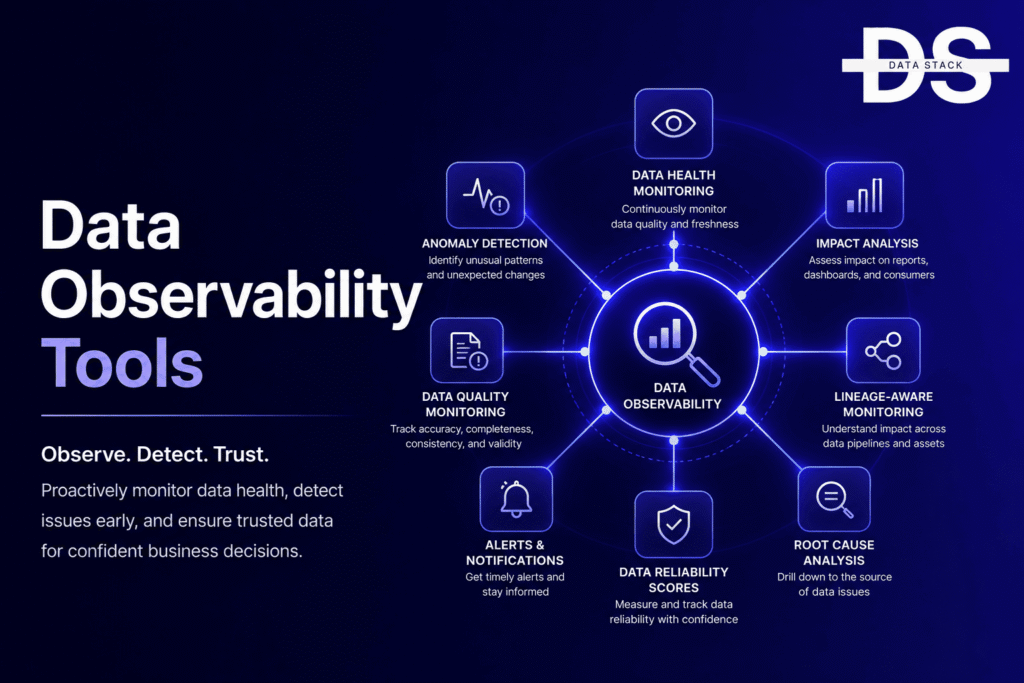
Modern data teams are expected to deliver reliable, trustworthy, and timely information across analytics, business intelligence, machine learning, and operational systems. However, as organizations continue expanding their data ecosystems, maintaining data reliability becomes increasingly difficult.
A broken pipeline, schema change, delayed dataset, duplicate records, or unexpected anomaly can quickly impact dashboards, reports, AI models, and business decisions. Unfortunately, many organizations discover these problems only after stakeholders notice incorrect data.
This challenge has fueled the rise of Data Observability Tools.
Data Observability Software helps organizations continuously monitor data health, identify anomalies, detect pipeline failures, monitor freshness, track schema changes, and improve overall data reliability. Rather than relying on manual checks, modern Data Observability Platforms provide automated monitoring and proactive alerting that helps teams resolve issues before they impact the business.
As analytics and AI become increasingly mission-critical, observability has become a core component of modern data operations strategies.
What Are Data Observability Tools?
Data Observability Tools are software platforms that help organizations monitor, measure, and improve the health of data across pipelines, warehouses, lakehouses, analytics systems, and operational environments. These platforms continuously evaluate metrics such as freshness, completeness, volume, schema stability, distribution patterns, and data quality. Organizations use Data Observability Software to improve data reliability, reduce downtime, accelerate root cause analysis, detect anomalies, and strengthen trust in business information.
Key Features of Data Observability Software
- Continuous monitoring of data quality, freshness, and completeness metrics.
- Automated anomaly detection that identifies unexpected changes in datasets.
- Schema change monitoring across pipelines and analytics environments.
- Root cause analysis capabilities that accelerate issue resolution.
- Data lineage integration for dependency tracking and impact analysis.
- Data incident management workflows that improve operational response.
- Alerting systems that proactively notify teams of potential issues.
Data Observability Platform Comparison
| Tool | Best For | Deployment | Good Fit |
|---|---|---|---|
| Monte Carlo | Enterprise observability | Cloud | Large enterprises |
| Bigeye | Modern observability | Cloud | Data teams |
| Acceldata | Enterprise data reliability | Cloud | Large organizations |
| Databand | Data pipeline monitoring | Cloud | IBM customers |
| Soda | Data quality observability | Cloud | Modern data teams |
| Anomalo | Automated anomaly detection | Cloud | Analytics teams |
| Metaplane | Warehouse monitoring | Cloud | Growing teams |
| Ataccama ONE | Observability plus governance | Cloud | Enterprises |
| Informatica Cloud Data Observability | Enterprise reliability | Cloud | Large organizations |
| Talend Trust Score | Data trust initiatives | Cloud | Talend users |
| Datafold | Data quality monitoring | Cloud | Engineering teams |
| Observe | Operational observability | Cloud | Modern enterprises |
| PagerDuty Operations Cloud | Incident response workflows | Cloud | Enterprise operations |
13 Best Data Observability Tools
#1 Monte Carlo
Monte Carlo is widely regarded as one of the category leaders in Data Observability Software and has played a major role in popularizing the concept of data observability itself. The platform helps organizations monitor data health across warehouses, pipelines, analytics systems, and business applications while reducing the risk of data downtime.
Large enterprises frequently adopt Monte Carlo because it provides broad visibility into data quality, freshness, volume, schema changes, and operational reliability. Rather than relying on manually defined validation rules, the platform continuously analyzes datasets and automatically identifies unusual behavior that may indicate problems.
One of Monte Carlo’s biggest differentiators is its focus on data downtime prevention. By proactively detecting anomalies and surfacing incidents before stakeholders are affected, the platform helps organizations improve trust in analytics and reporting environments.
Organizations investing heavily in analytics, machine learning, and executive reporting often view Monte Carlo as a foundational component of modern data operations programs.
Key Features
- Continuously monitors freshness, volume, schema, and distribution metrics across enterprise datasets.
- Detects anomalies automatically using statistical and behavioral analysis techniques.
- Provides end-to-end visibility into data health across pipelines and warehouses.
- Supports root cause analysis through lineage and dependency tracking capabilities.
- Helps reduce data downtime through proactive monitoring and alerting.
- Integrates with modern cloud data platforms and analytics ecosystems.
Why Choose This Tool
Monte Carlo is ideal for enterprises that want comprehensive observability capabilities across complex analytics environments. Organizations prioritizing reliability, proactive monitoring, and large-scale data operations often consider it one of the strongest platforms available.
G2 Rating: 4.6/5
Gartner Rating: 4.7/5

Showcase your software to buyers actively comparing tools. Submit your product for editorial review and get featured on Data Stack Hub.
Submit Your Tool →#2 Bigeye
Bigeye is a Data Observability Platform designed to help organizations improve confidence in analytics, reporting, and business intelligence systems. The platform focuses on continuous monitoring and proactive issue detection, helping teams identify problems before they affect stakeholders.
Organizations use Bigeye to monitor freshness, completeness, distribution patterns, schema changes, and other key reliability indicators across modern cloud data environments. By automatically tracking these metrics, the platform helps reduce manual monitoring effort while improving operational visibility.
One of Bigeye’s strengths is its focus on usability. Data teams can quickly deploy monitoring across critical datasets and begin identifying risks without building extensive custom validation frameworks. This makes the platform particularly attractive to organizations looking for rapid observability adoption.
For companies seeking a balance between functionality and ease of implementation, Bigeye remains one of the most compelling observability solutions available.
Key Features
- Monitors freshness, completeness, schema stability, and volume metrics automatically.
- Provides proactive anomaly detection across cloud data environments.
- Supports warehouse monitoring and data reliability initiatives.
- Enables faster incident response through automated alerting workflows.
- Integrates with modern analytics and cloud platforms.
- Improves confidence in business intelligence and reporting systems.
Why Choose This Tool
Bigeye is a strong choice for organizations seeking modern data observability capabilities without the operational complexity associated with larger enterprise platforms.
G2 Rating: 4.7/5
Gartner Rating: Not Available
#3 Acceldata
Acceldata is an Enterprise Data Observability Platform that focuses on data reliability, performance monitoring, pipeline health, and operational visibility across modern data ecosystems. Unlike some observability vendors that focus primarily on data quality, Acceldata takes a broader approach by monitoring the underlying infrastructure, pipelines, compute resources, and data assets that support analytics and AI initiatives.
Organizations operating large-scale environments often select Acceldata because data issues are not always caused by bad records or schema changes. Performance bottlenecks, infrastructure failures, resource constraints, and pipeline inefficiencies can also affect business outcomes. Acceldata helps teams identify and resolve these issues before they impact stakeholders.
The platform is particularly popular among enterprises running large cloud data platforms, lakehouses, and complex analytics architectures where reliability and operational efficiency are critical priorities.
Key Features
- Monitors data pipelines, warehouses, lakehouses, and infrastructure components from a unified platform.
- Detects performance bottlenecks, resource utilization issues, and operational inefficiencies before they affect downstream users.
- Supports anomaly detection across data quality, freshness, volume, and operational metrics.
- Provides root cause analysis capabilities that connect data incidents with underlying system issues.
- Helps improve reliability across analytics, machine learning, and reporting environments.
- Supports enterprise-scale observability programs across complex architectures.
Why Choose This Tool
Acceldata is ideal for enterprises that need visibility into both data reliability and the infrastructure supporting analytics operations. Organizations running large-scale cloud data environments often benefit from its broader operational perspective.
G2 Rating: 4.5/5
Gartner Rating: 4.6/5
#4 Databand
Databand, acquired by IBM, is a Data Pipeline Monitoring and Observability platform focused on helping organizations identify and resolve issues before they impact business users. The platform provides visibility into pipeline execution, orchestration workflows, data quality, and operational reliability.
Databand is particularly attractive to data engineering teams because it helps monitor the entire lifecycle of data movement rather than focusing solely on final datasets. Teams can quickly identify failed jobs, delayed pipelines, unexpected schema changes, and operational bottlenecks.
The platform has gained significant adoption among organizations operating modern orchestration and workflow management environments where reliability and rapid incident response are critical.
Key Features
- Monitors data pipelines, orchestration workflows, and ETL processes continuously.
- Detects failed jobs, delayed executions, and operational anomalies automatically.
- Provides data quality monitoring alongside pipeline observability capabilities.
- Enables root cause analysis through dependency tracking and workflow visibility.
- Integrates with modern orchestration, warehouse, and analytics platforms.
- Improves operational reliability across data engineering environments.
Why Choose This Tool
Databand is best suited for organizations that want strong pipeline monitoring and operational observability capabilities integrated with broader data reliability initiatives.
G2 Rating: 4.5/5
Gartner Rating: 4.5/5
#5 Soda
Soda has become one of the most popular Data Quality Monitoring and Observability Platforms among modern cloud-native data teams. The platform focuses on helping organizations proactively identify quality issues before they affect analytics, reporting, and machine learning systems.
Unlike traditional data quality solutions that often require extensive implementation efforts, Soda emphasizes simplicity and accessibility. Teams can define quality checks, monitor critical datasets, and establish observability workflows without introducing excessive operational complexity.
The platform integrates closely with modern cloud warehouses and analytics environments, making it particularly attractive for organizations operating Snowflake, Databricks, BigQuery, Redshift, and similar technologies.
Key Features
- Supports automated data quality monitoring across modern cloud platforms.
- Detects anomalies related to freshness, completeness, volume, and schema changes.
- Enables rule-based and statistical observability approaches.
- Provides proactive alerting before issues impact downstream consumers.
- Integrates with popular warehouses, lakehouses, and analytics environments.
- Supports collaborative incident investigation workflows.
Why Choose This Tool
Soda is a strong choice for organizations that prioritize data quality observability and want a platform that balances functionality, usability, and implementation speed.
G2 Rating: 4.7/5
Gartner Rating: Not Available
Increase your product visibility by reaching software buyers researching the best tools. Every submission is reviewed by our editorial team.
Feature My Tool →#6 Anomalo
Anomalo is a Data Observability Software platform built around automated anomaly detection and machine learning-driven monitoring. Rather than requiring organizations to manually define large numbers of validation rules, Anomalo uses AI and statistical techniques to identify unusual behavior automatically.
This approach helps teams uncover issues that traditional rule-based monitoring systems may miss. Unexpected changes in distributions, volume patterns, customer activity, financial metrics, and operational datasets can be detected before they impact business users.
Organizations pursuing modern data reliability programs frequently evaluate Anomalo because it reduces the operational burden associated with maintaining large validation frameworks.
Key Features
- Uses machine learning to identify anomalies automatically across enterprise datasets.
- Detects unusual patterns in freshness, volume, distribution, and quality metrics.
- Reduces reliance on manually maintained validation rules.
- Provides proactive alerting before business users encounter issues.
- Supports root cause investigations through contextual monitoring insights.
- Helps improve trust in analytics and reporting environments.
Why Choose This Tool
Anomalo is ideal for organizations that want intelligent observability capabilities driven by machine learning rather than extensive manual rule configuration.
G2 Rating: 4.8/5
Gartner Rating: Not Available
#7 Metaplane
Metaplane is a modern Data Observability Platform that focuses on helping data teams maintain trust in analytics systems through automated monitoring and anomaly detection. The platform has gained popularity among growing organizations because it combines strong observability functionality with an intuitive user experience.
Organizations use Metaplane to monitor warehouse health, schema stability, freshness metrics, and data quality indicators across cloud analytics environments. Automated monitoring helps teams identify incidents before they affect reports, dashboards, and downstream stakeholders.
One of Metaplane’s strengths is its ability to provide actionable observability insights without overwhelming teams with excessive complexity or configuration requirements.
Key Features
- Monitors data warehouse health and operational reliability continuously.
- Detects anomalies across freshness, schema, volume, and quality dimensions.
- Provides proactive alerts when unusual behavior is detected.
- Supports incident investigation and troubleshooting workflows.
- Integrates with modern cloud data platforms and analytics tools.
- Helps improve confidence in reporting and business intelligence environments.
Why Choose This Tool
Metaplane is a strong option for organizations seeking modern observability capabilities that are easy to deploy and maintain while still delivering meaningful operational insights.
G2 Rating: 4.8/5
Gartner Rating: Not Available
#8 Ataccama ONE
Ataccama ONE extends beyond traditional Data Observability Tools by combining observability, governance, metadata management, data quality, and master data management capabilities within a unified platform. This broader approach helps organizations build comprehensive data trust programs.
Rather than treating observability as a standalone monitoring function, Ataccama integrates observability metrics with stewardship, governance, and quality initiatives. This provides additional context when investigating incidents and assessing business impact.
Organizations focused on enterprise governance and data trust frequently shortlist Ataccama because of its ability to consolidate multiple data management initiatives within a single environment.
Key Features
- Combines observability, governance, metadata management, and data quality capabilities.
- Monitors freshness, quality, completeness, and operational health metrics.
- Supports root cause analysis through integrated metadata and lineage visibility.
- Provides stewardship workflows and governance controls.
- Helps organizations improve trust in business-critical information.
- Supports enterprise-scale reliability and governance programs.
Why Choose This Tool
Ataccama ONE is best suited for organizations that want observability capabilities integrated into broader governance and data trust initiatives rather than operating as a standalone monitoring solution.
G2 Rating: 4.5/5
Gartner Rating: 4.7/5
#9 Informatica Cloud Data Observability
Informatica Cloud Data Observability is designed for enterprises that need visibility into data reliability across large-scale, distributed environments. As part of Informatica’s broader Intelligent Data Management Cloud ecosystem, the platform helps organizations monitor data health, detect anomalies, and improve trust in analytics and operational systems.
Many enterprises choose Informatica because observability is rarely an isolated requirement. Data quality, governance, metadata management, lineage, and master data management initiatives often intersect. Informatica’s approach allows organizations to connect observability insights with broader data management programs.
The platform is particularly attractive to organizations managing large volumes of data across cloud, hybrid, and multi-cloud architectures where maintaining consistent reliability can be challenging.
Key Features
- Monitors data quality, freshness, completeness, and schema stability across enterprise environments.
- Detects anomalies automatically using statistical and behavioral monitoring techniques.
- Integrates observability insights with metadata management and governance workflows.
- Supports root cause analysis through lineage and dependency visibility.
- Provides proactive alerting to reduce data downtime and operational risk.
- Helps organizations improve trust in analytics, reporting, and AI initiatives.
Why Choose This Tool
Informatica Cloud Data Observability is ideal for enterprises that already use Informatica technologies or want observability capabilities integrated with governance, quality, lineage, and metadata management initiatives.
G2 Rating: 4.4/5
Gartner Rating: 4.6/5
#10 Talend Trust Score
Talend Trust Score approaches Data Observability through the lens of data trust and data quality management. Rather than focusing solely on monitoring operational metrics, the platform helps organizations understand whether datasets are reliable enough for analytics, reporting, and business decision-making.
Organizations can continuously evaluate quality indicators, identify risks, and monitor trends that affect confidence in enterprise information. This makes the platform particularly useful for companies pursuing data governance and trust initiatives.
Talend’s observability capabilities are most valuable when combined with its integration and data quality solutions, creating a more comprehensive view of enterprise data health.
Key Features
- Measures trustworthiness across critical business datasets.
- Monitors data quality trends and reliability indicators continuously.
- Supports anomaly detection and issue identification workflows.
- Integrates with broader data integration and governance initiatives.
- Helps organizations establish measurable data trust metrics.
- Improves visibility into quality-related business risks.
Why Choose This Tool
Talend Trust Score is best suited for organizations that want observability capabilities focused on business trust and data quality rather than purely technical monitoring.
G2 Rating: 4.3/5
Gartner Rating: 4.4/5
#11 Datafold
Datafold is a Data Observability and Data Quality Monitoring platform that has gained popularity among modern data engineering teams. The platform focuses heavily on helping organizations validate changes before they impact production environments.
One of Datafold’s most distinctive capabilities is data diff technology, which allows teams to compare datasets before and after transformations, schema modifications, or pipeline updates. This helps identify issues early and reduces the risk of introducing errors into analytics environments.
Organizations operating fast-moving data engineering workflows frequently select Datafold because it supports modern development practices and helps teams maintain reliability while accelerating delivery.
Key Features
- Compares datasets before and after pipeline changes using data diff technology.
- Detects quality issues before they impact production systems.
- Supports monitoring of freshness, completeness, and reliability metrics.
- Enables proactive validation during development and deployment processes.
- Helps reduce incidents caused by transformation and schema changes.
- Integrates with modern cloud data platforms and engineering workflows.
Why Choose This Tool
Datafold is ideal for data engineering teams that want observability capabilities focused on change management, validation, and preventing production data incidents.
G2 Rating: 4.7/5
Gartner Rating: Not Available
#12 Observe
Observe is an observability platform that extends traditional monitoring concepts into modern data operations environments. While the company serves broader observability use cases, its capabilities can help organizations understand operational behavior across data systems, pipelines, and analytics platforms.
Organizations use Observe to correlate events, metrics, logs, and operational signals that influence data reliability. This broader perspective can be valuable when data incidents are caused by infrastructure, application, or operational issues rather than purely data quality problems.
For enterprises seeking visibility across both operational systems and data environments, Observe provides a compelling approach.
Key Features
- Correlates operational telemetry with data reliability metrics.
- Supports monitoring across infrastructure, applications, and analytics systems.
- Helps identify root causes of complex operational incidents.
- Provides observability across modern cloud environments.
- Improves visibility into cross-system dependencies.
- Supports enterprise incident investigation workflows.
Why Choose This Tool
Observe is a strong choice for organizations that want to connect operational observability with data reliability and incident management initiatives.
G2 Rating: 4.6/5
Gartner Rating: Not Available
#13 PagerDuty Operations Cloud
PagerDuty Operations Cloud is not a traditional Data Observability Platform, but it plays an important role in incident management and operational response workflows. Many organizations use PagerDuty alongside observability tools to ensure that detected issues are routed to the right teams and resolved quickly.
When data incidents occur, rapid response is often just as important as detection. PagerDuty helps organizations automate notifications, escalation policies, incident coordination, and operational response processes.
As observability programs mature, incident response capabilities become increasingly important. This is why PagerDuty is frequently integrated with observability, monitoring, and reliability platforms.
Key Features
- Automates incident response and escalation workflows.
- Routes alerts to appropriate teams based on predefined policies.
- Supports collaboration during data and operational incidents.
- Integrates with observability, monitoring, and reliability platforms.
- Helps reduce mean time to detection and resolution.
- Improves operational resilience and response efficiency.
Why Choose This Tool
PagerDuty Operations Cloud is best suited for organizations that need strong incident management capabilities alongside observability platforms to improve operational response and reliability.
G2 Rating: 4.5/5
Gartner Rating: 4.5/5
How to Choose Data Observability Software
The best Data Observability Tool depends on your architecture, team maturity, reliability requirements, and governance objectives.
When evaluating Data Observability Platforms, consider:
- Monitoring Coverage: Ensure the platform can monitor freshness, completeness, schema stability, volume, distribution, and quality metrics.
- Anomaly Detection: Automated anomaly detection can identify issues that manual validation rules may miss.
- Root Cause Analysis: Strong investigation workflows reduce the time required to resolve incidents.
- Lineage Integration: Data lineage improves observability by exposing dependencies and downstream impacts.
- Data Quality Monitoring: Many organizations need quality and observability capabilities working together.
- Cloud Compatibility: Verify support for warehouses, lakehouses, orchestration platforms, and analytics tools already in use.
- Incident Management: Mature observability programs often require alerting, escalation, and response workflows.
- Governance Alignment: Some organizations benefit from observability platforms integrated with governance and metadata management initiatives.
Monte Carlo, Bigeye, Acceldata, and Informatica are among the strongest enterprise-focused platforms. Soda, Metaplane, and Datafold are popular among modern data teams, while Ataccama provides a broader governance-driven approach.
Browse expertly curated software recommendations across hundreds of business categories.
Browse Top Tools →Conclusion
Data Observability Tools have become essential for organizations that depend on reliable analytics, reporting, machine learning, and operational data systems.
As data ecosystems continue to grow, manual monitoring approaches struggle to keep pace. Modern observability platforms help organizations detect anomalies, identify incidents, monitor data quality, improve reliability, and reduce business risk.
Monte Carlo continues to lead the category, while Bigeye, Acceldata, and Informatica provide strong enterprise capabilities. Soda, Metaplane, Anomalo, and Datafold offer compelling options for modern cloud-native data teams. Ataccama extends observability into broader governance initiatives, and PagerDuty strengthens incident response workflows.
The right Data Observability Platform ultimately depends on your reliability goals, architecture complexity, governance requirements, and operational maturity.
FAQs
1. What are Data Observability Tools?
Data Observability Tools help organizations monitor data health, reliability, freshness, quality, schema stability, and operational performance across data ecosystems.
2. Why is data observability important?
Data observability helps detect issues before they impact analytics, reporting, AI systems, and business decisions.
3. What is the difference between data observability and data quality?
Data quality focuses on validating data accuracy and consistency, while data observability provides continuous visibility into overall data health and reliability.
4. What are the best Data Observability Platforms?
Monte Carlo, Bigeye, Acceldata, Soda, Informatica Cloud Data Observability, Metaplane, and Ataccama ONE are among the leading platforms available today.
5. What is data downtime?
Data downtime occurs when data becomes unavailable, inaccurate, delayed, or unreliable for business use.
6. How does data observability support analytics teams?
Observability platforms help analytics teams identify issues quickly, reduce downtime, improve trust, and maintain reporting accuracy.
7. Do Data Observability Tools support root cause analysis?
Yes. Most modern platforms provide investigation capabilities that help teams identify the underlying causes of data incidents.
8. Can observability tools monitor data pipelines?
Yes. Many platforms monitor pipelines, orchestration workflows, transformations, and warehouse operations.
9. Which industries use Data Observability Software?
Financial services, healthcare, retail, manufacturing, technology, telecommunications, and government organizations commonly use observability platforms.
10. How do I choose a Data Observability Tool?
Evaluate monitoring coverage, anomaly detection capabilities, lineage integration, incident management support, governance alignment, and compatibility with your data ecosystem.