
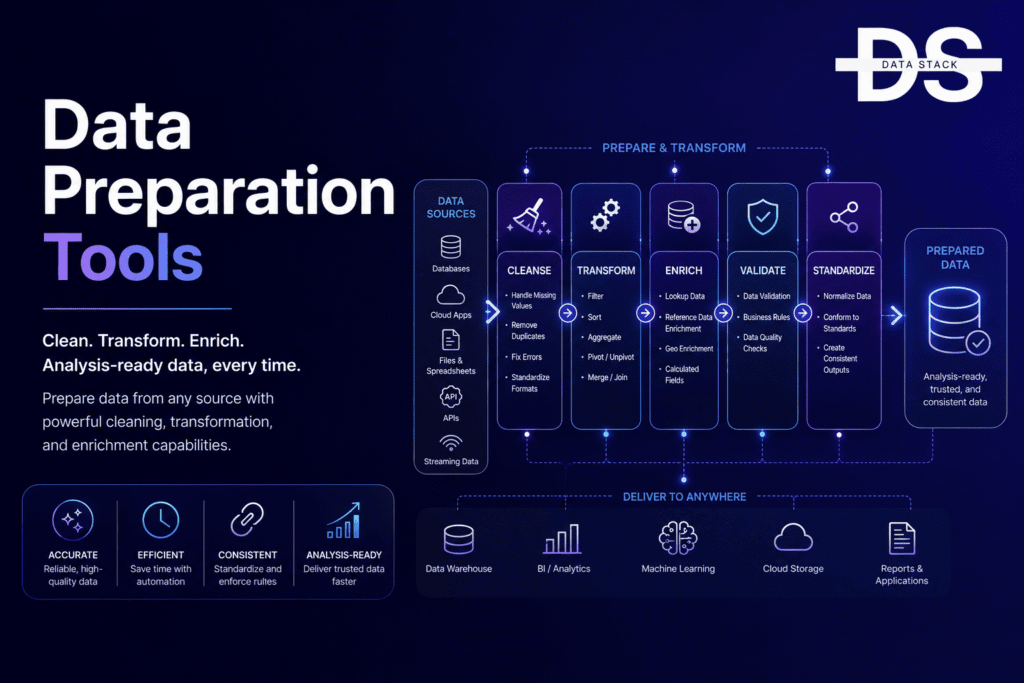
Raw data is rarely ready for analytics, business intelligence, machine learning, or reporting.
Organizations collect information from databases, SaaS applications, spreadsheets, APIs, cloud platforms, operational systems, and external sources. Unfortunately, this data often contains duplicates, missing values, inconsistent formats, incorrect mappings, and quality issues that make analysis difficult.
Before organizations can generate insights, they must prepare their data.
This is where Data Preparation Tools help.
Data Preparation Software enables organizations to clean, transform, enrich, standardize, validate, and organize data before it is used for analytics, reporting, AI, and operational decision-making. Modern Data Preparation Platforms automate many of the tasks that traditionally consumed significant analyst and engineering time.
As organizations continue investing in analytics and AI initiatives, data preparation remains one of the most important stages of the modern data lifecycle.
What Are Data Preparation Tools?
Data Preparation Tools are software platforms that help organizations clean, transform, enrich, validate, and organize data before it is used for analytics, reporting, machine learning, and operational workflows. These platforms automate tasks such as data cleansing, normalization, deduplication, profiling, transformation, enrichment, and validation. Organizations use Data Preparation Software to improve data quality, reduce manual effort, accelerate analytics projects, and increase confidence in business decisions.
Key Features of Data Preparation Software
- Automated data cleansing and standardization capabilities.
- Data transformation and normalization workflows.
- Data profiling and quality assessment features.
- Data enrichment from internal and external sources.
- Visual preparation interfaces for business users and analysts.
- Integration with databases, warehouses, applications, and cloud platforms.
- Validation and quality controls before data reaches downstream systems.
Data Preparation Software Comparison
| # | Tool | Best For | Deployment | Good Fit |
|---|---|---|---|---|
| 1 | Ingestro | AI-powered data operations and automated customer data preparation | Cloud | Global software and service providers |
| 2 | Prophecy | AI-generated data preparation and analysis on cloud data platforms | Cloud | Enterprise analytics and business teams |
| 3 | Alteryx Designer | Enterprise data preparation | Cloud, Desktop | Enterprises |
| 4 | Trifacta | Self-service data preparation | Cloud | Analytics teams |
| 5 | Talend Data Preparation | Data quality and preparation | Cloud | Enterprises |
| 6 | Dataiku | Analytics and AI preparation | Cloud | Data teams |
| 7 | KNIME | Open-source data preparation | Desktop, Cloud | Analysts |
| 8 | Informatica Data Preparation | Enterprise data management | Cloud | Large organizations |
| 9 | Microsoft Power Query | Microsoft ecosystem | Cloud, Desktop | Business users |
| 10 | Tableau Prep | Tableau users | Cloud, Desktop | BI teams |
| 11 | IBM DataStage | Enterprise transformation | Cloud, Hybrid | Enterprises |
| 12 | Qlik Talend Cloud | Modern data preparation | Cloud | Analytics environments |
| 13 | SAS Data Management | Enterprise data quality | Cloud | Large enterprises |
| 14 | Paxata | Self-service preparation | Cloud | Business analysts |
| 15 | AWS Glue DataBrew | AWS-native preparation | Cloud | AWS customers |
14 Best Data Preparation Tools
#1 Ingestro
Ingestro is an AI-powered platform that automates data operations for global software and service providers, turning inconsistent customer files into clean, system-ready data.
Its AI agents automatically detect headers, suggest field mappings, and identify or resolve data issues, so implementation and operations teams no longer need to build custom integrations or templates for each new customer.
Companies across human resources, payroll, tax, and other industries rely on Ingestro to keep customer data flowing without relying on engineering.
Key Features
- Ingests data across any file format or source, without custom integration work.
- Gives non-technical teams a shared workspace to create and adjust data workflows.
- Automatically applies the workflows you built once to every new incoming file.
- Turns plain-language instructions into clear, editable data preparation steps.
- Validates, transforms, and enriches data in a single pass, no manual rework needed.
- Tracks every run with a full audit trail, version history, and role-based approvals.
Why Choose This Platform
Ingestro is best suited for organizations seeking enterprise-grade data preparation capabilities for faster customer onboarding, without adding headcount as their customer base grows.
G2 Rating: 4.7/5
Showcase your software to buyers actively comparing tools. Submit your product for editorial review and get featured on Data Stack Hub.
Submit Your Tool →#2 Prophecy
Prophecy is an agentic data preparation and analysis platform that turns plain-English requests into visual data workflows that analysts and business users can inspect, refine, and validate. Users describe a business goal, and Prophecy’s AI agents, built on a specialized version of Claude Code, generate the workflow that prepares the data and then produce the analysis on top of it.
Transparency is the platform’s main differentiator. Each step of an AI-generated workflow appears as a visual component on the canvas, so users can open any step, check its logic, profile the interim data, and adjust it before the workflow is scheduled or deployed. Behind the visual layer, workflows run as production-grade code natively on Databricks, Snowflake, or BigQuery, which keeps compute, governance, and security inside the organization’s existing cloud data platform.
Prophecy also supports organizations moving off desktop preparation tools, because its import feature brings existing Alteryx and Informatica workflows into the platform. Enterprises including HSBC, JP Morgan, Microsoft, Amgen, and Toyota are listed among its customers.
Key Features
- Generates complete data preparation workflows from natural-language prompts.
- Displays every AI-generated step as a visual workflow that users can inspect, refine, and validate.
- Cleans, standardizes, deduplicates, joins, and reshapes data through built-in visual components.
- Profiles interim datasets and runs reusable data tests for uniqueness, null values, and accepted values.
- Runs, schedules, and monitors workflows natively on Databricks, Snowflake, and BigQuery.
- Imports existing Alteryx and Informatica workflows to speed up cloud migration.
Why Choose This Tool
Prophecy is best suited for enterprises that want AI to speed up data preparation for analysts and business users while keeping every workflow visible, governed, and running on their own cloud data platform.
G2 Rating: 4.6/5
Gartner Rating: 4.8/5
#3 Alteryx Designer
Alteryx Designer is one of the most widely recognized Data Preparation Tools and remains a market leader for organizations that need advanced preparation, transformation, and analytics workflows. The platform helps users combine data from multiple sources, clean inconsistencies, enrich records, and prepare datasets for reporting, analytics, and machine learning initiatives.
A major reason organizations adopt Alteryx is its low-code visual workflow environment. Rather than writing extensive scripts, analysts can build complex preparation pipelines through drag-and-drop interfaces. This accessibility has made Alteryx particularly popular among business analysts, analytics teams, and citizen data professionals.
The platform is frequently used for financial reporting, operational analytics, customer analysis, forecasting, and advanced analytics projects. Large enterprises often standardize on Alteryx because it can support both business users and technical teams within a single environment.
For organizations seeking a mature and feature-rich Data Preparation Platform, Alteryx remains one of the strongest choices available.
Key Features
- Cleans, transforms, enriches, and blends data from multiple enterprise sources.
- Provides low-code workflow design that reduces reliance on custom scripting.
- Supports advanced preparation workflows for analytics and machine learning projects.
- Integrates with databases, cloud warehouses, spreadsheets, APIs, and business applications.
- Enables repeatable and automated preparation processes.
- Helps organizations reduce manual spreadsheet-based preparation work.
Why Choose This Tool
Alteryx is ideal for organizations that want enterprise-grade data preparation capabilities combined with automation, analytics, and broad connectivity. It is particularly attractive to analytics teams managing complex preparation workflows.
G2 Rating: 4.5/5
Gartner Rating: 4.7/5
#4 Trifacta
Trifacta helped popularize self-service Data Preparation Software by focusing on making data cleansing and transformation accessible to business users. The platform enables organizations to prepare data for analytics, reporting, and machine learning projects without requiring extensive technical expertise.
One of Trifacta’s key differentiators is its intelligent recommendations engine. The platform analyzes datasets and suggests transformations, standardization rules, and quality improvements that can accelerate preparation workflows. This helps users identify issues and resolve them more efficiently.
Organizations frequently use Trifacta when preparing large datasets stored in cloud warehouses, data lakes, and modern analytics platforms. Its combination of visual interfaces and intelligent automation makes it attractive for self-service analytics initiatives.
Key Features
- Provides visual data preparation workflows for business and analytics users.
- Automatically suggests transformations and quality improvements.
- Supports cleansing, standardization, enrichment, and validation processes.
- Integrates with cloud data warehouses and lake environments.
- Helps accelerate analytics and reporting projects.
- Reduces manual preparation effort through intelligent automation.
Why Choose This Tool
Trifacta is best suited for organizations seeking self-service data preparation capabilities that balance usability, automation, and scalability.
G2 Rating: 4.4/5
Gartner Rating: 4.5/5
#5 Talend Data Preparation
Talend Data Preparation combines preparation, quality management, transformation, and governance capabilities within a broader data integration ecosystem. Organizations use the platform to improve data quality while preparing information for analytics, reporting, operational systems, and AI initiatives.
A major advantage of Talend is its integration with data quality and governance programs. Rather than treating preparation as a standalone activity, Talend helps organizations establish repeatable workflows that improve consistency and trust across datasets.
The platform supports both business and technical users, making it suitable for organizations pursuing enterprise-wide data modernization initiatives.
Key Features
- Supports cleansing, transformation, enrichment, and standardization workflows.
- Integrates preparation with broader data quality initiatives.
- Provides reusable preparation pipelines across teams.
- Supports governance and compliance requirements.
- Connects to cloud, hybrid, and on-premises environments.
- Helps improve trust in analytics and reporting datasets.
Why Choose This Tool
Talend Data Preparation is ideal for organizations that want preparation capabilities integrated with data quality, governance, and broader data integration programs.
G2 Rating: 4.3/5
Gartner Rating: 4.5/5
Increase your product visibility by reaching software buyers researching the best tools. Every submission is reviewed by our editorial team.
Feature My Tool →#6 Dataiku
Dataiku is a comprehensive analytics, AI, and Data Preparation Platform that helps organizations transform raw information into analytics-ready datasets. While the platform is often associated with machine learning and advanced analytics, data preparation remains one of its most widely used capabilities.
Organizations use Dataiku to clean, enrich, profile, transform, and validate data before it reaches dashboards, reports, forecasting models, and AI systems. The platform’s visual workflows help business users and analysts prepare data without extensive coding, while technical teams can extend workflows using Python, SQL, and other technologies when needed.
One of Dataiku’s strongest differentiators is its ability to connect preparation directly to downstream analytics and machine learning initiatives. This helps organizations reduce tool sprawl while maintaining consistent workflows throughout the data lifecycle.
Key Features
- Supports visual and code-based data preparation workflows.
- Enables cleansing, enrichment, transformation, and validation processes.
- Connects preparation activities directly to analytics and AI projects.
- Supports collaborative workflows across business and technical teams.
- Integrates with cloud warehouses, databases, and analytics platforms.
- Helps improve consistency across enterprise preparation processes.
Why Choose This Tool
Dataiku is ideal for organizations that want data preparation tightly integrated with analytics, machine learning, and AI initiatives rather than operating as a standalone process.
G2 Rating: 4.5/5
Gartner Rating: 4.6/5
#7 KNIME
KNIME is one of the most popular open-source Data Preparation Tools and is widely used by analysts, data scientists, researchers, and business teams. The platform provides a visual workflow environment that enables users to prepare, transform, and enrich data without requiring extensive programming expertise.
Organizations often choose KNIME because it combines flexibility with accessibility. Users can create preparation workflows through drag-and-drop components while still accessing advanced scripting and automation capabilities when needed. This balance has helped KNIME build a large and active user community.
The platform is frequently used for analytics, reporting, machine learning preparation, and research projects where cost-effective preparation capabilities are important.
Key Features
- Provides open-source visual workflow-based data preparation.
- Supports cleansing, transformation, enrichment, and integration workflows.
- Enables advanced customization through scripting extensions.
- Connects to databases, files, APIs, and cloud platforms.
- Supports automation and repeatable preparation processes.
- Helps reduce dependence on manual spreadsheet workflows.
Why Choose This Tool
KNIME is a strong option for organizations seeking powerful preparation capabilities through an open-source platform that offers significant flexibility and customization.
G2 Rating: 4.6/5
Gartner Rating: 4.5/5
#8 Informatica Data Preparation
Informatica Data Preparation is an enterprise-focused solution that helps organizations clean, transform, profile, and prepare data for analytics and operational use cases. As part of Informatica’s broader data management ecosystem, the platform integrates preparation workflows with governance, quality, metadata management, and integration initiatives.
Large enterprises frequently adopt Informatica because preparation activities rarely occur in isolation. Organizations often need to combine preparation with governance, quality monitoring, lineage, and compliance requirements. Informatica provides a unified environment that supports these broader objectives.
The platform is particularly well suited for organizations operating large-scale cloud, hybrid, and multi-cloud architectures.
Key Features
- Supports enterprise-scale preparation and transformation workflows.
- Provides automated profiling and quality assessment capabilities.
- Integrates with metadata management and governance initiatives.
- Supports cloud, hybrid, and on-premises environments.
- Enables repeatable and governed preparation processes.
- Helps improve consistency across enterprise data programs.
Why Choose This Tool
Informatica Data Preparation is best suited for enterprises that need preparation capabilities integrated with governance, quality, metadata, and broader data management initiatives.
G2 Rating: 4.3/5
Gartner Rating: 4.6/5
#9 Microsoft Power Query
Microsoft Power Query is one of the most widely used Data Preparation Tools in the world because of its integration with Microsoft Excel, Power BI, Microsoft Fabric, and other Microsoft technologies. The platform enables users to clean, transform, and organize data before analysis and reporting.
Business users frequently rely on Power Query to automate repetitive preparation tasks that would otherwise require manual spreadsheet manipulation. The platform’s visual transformation interface makes it accessible to non-technical users while still supporting sophisticated preparation workflows.
Organizations heavily invested in the Microsoft ecosystem often view Power Query as a natural starting point for data preparation initiatives.
Key Features
- Provides visual transformation workflows within Microsoft products.
- Supports cleansing, filtering, shaping, and normalization processes.
- Connects to databases, cloud platforms, spreadsheets, and SaaS applications.
- Automates repetitive preparation tasks.
- Integrates directly with Power BI and Microsoft Fabric.
- Helps improve reporting and analytics efficiency.
Why Choose This Tool
Microsoft Power Query is ideal for organizations already using Microsoft analytics products that want accessible and cost-effective preparation capabilities.
G2 Rating: 4.5/5
Gartner Rating: 4.5/5
#10 Tableau Prep
Tableau Prep is a Data Preparation Platform designed to help users clean, shape, and organize data before visualization and reporting within Tableau environments. The platform focuses on simplifying preparation workflows for analysts and business intelligence teams.
Organizations frequently use Tableau Prep to combine datasets, identify quality issues, standardize values, and create analytics-ready data pipelines. Its visual interface aligns closely with Tableau’s broader philosophy of making analytics more accessible to business users.
The platform is especially attractive for organizations that have standardized on Tableau for reporting and visualization initiatives.
Key Features
- Supports visual preparation workflows for analysts and BI teams.
- Cleans, combines, and transforms data before reporting.
- Integrates directly with Tableau analytics environments.
- Identifies quality issues and inconsistencies automatically.
- Supports repeatable preparation workflows.
- Improves efficiency across reporting and dashboard projects.
Why Choose This Tool
Tableau Prep is best suited for organizations that use Tableau extensively and want preparation capabilities optimized for business intelligence workflows.
G2 Rating: 4.3/5
Gartner Rating: 4.4/5
#11 IBM DataStage
IBM DataStage is an enterprise-grade data integration and preparation platform that helps organizations transform, cleanse, and prepare data across large-scale environments. The solution is widely used in organizations operating complex integration and analytics architectures.
Many enterprises choose IBM DataStage because preparation activities often need to scale across thousands of systems, applications, and datasets. The platform supports these requirements through strong integration, transformation, and automation capabilities.
Its enterprise focus makes it particularly attractive for large organizations with extensive governance and operational requirements.
Key Features
- Supports large-scale transformation and preparation workflows.
- Provides enterprise-grade automation and orchestration capabilities.
- Enables integration across cloud and on-premises systems.
- Supports quality, governance, and compliance initiatives.
- Helps prepare information for analytics and operational systems.
- Scales across complex enterprise architectures.
Why Choose This Tool
IBM DataStage is ideal for large enterprises that require highly scalable preparation capabilities integrated with broader integration and governance initiatives.
G2 Rating: 4.2/5
Gartner Rating: 4.5/5
#12 Qlik Talend Cloud
Qlik Talend Cloud combines preparation, integration, quality management, and governance capabilities within a modern cloud platform. Organizations use the solution to prepare and improve data before analytics, reporting, and operational use.
The platform emphasizes automation and data trust, helping organizations establish repeatable preparation processes that improve consistency across business functions.
Key Features
- Supports cloud-native preparation and transformation workflows.
- Integrates preparation with quality and governance initiatives.
- Enables automation of repetitive preparation processes.
- Connects to cloud warehouses, applications, and analytics environments.
- Helps improve data trust and reliability.
- Supports enterprise modernization initiatives.
Why Choose This Tool
Qlik Talend Cloud is a strong option for organizations seeking modern cloud-based preparation capabilities integrated with broader trust and governance initiatives.
G2 Rating: 4.3/5
Gartner Rating: 4.5/5
#13 SAS Data Management
SAS Data Management helps organizations prepare, cleanse, transform, and govern data for analytics, reporting, and advanced modeling initiatives. The platform is widely used in highly regulated industries where quality, governance, and consistency are critical priorities.
Organizations often choose SAS because preparation workflows frequently support risk management, compliance reporting, forecasting, and advanced analytics projects.
Key Features
- Supports enterprise data cleansing and transformation workflows.
- Provides profiling, quality monitoring, and preparation capabilities.
- Enables governance and stewardship initiatives.
- Supports analytics and regulatory reporting requirements.
- Integrates with enterprise data ecosystems.
- Helps improve trust in analytical outcomes.
Why Choose This Tool
SAS Data Management is ideal for organizations operating highly regulated environments where governance and preparation quality are mission-critical.
G2 Rating: 4.3/5
Gartner Rating: 4.5/5
#14 Paxata
Paxata helped pioneer self-service data preparation by enabling business users to cleanse, enrich, and transform data without extensive technical expertise. The platform focuses on improving accessibility and reducing reliance on specialized engineering resources.
Organizations use Paxata to prepare information for analytics, reporting, and operational decision-making while accelerating project delivery timelines.
Key Features
- Provides self-service preparation capabilities for business users.
- Supports cleansing, enrichment, and transformation workflows.
- Enables collaborative preparation across teams.
- Reduces dependence on technical resources.
- Supports analytics and reporting initiatives.
- Helps accelerate time-to-insight.
Why Choose This Tool
Paxata is a strong choice for organizations seeking self-service preparation capabilities that empower business users to work more independently.
G2 Rating: 4.2/5
Gartner Rating: 4.3/5
#15 AWS Glue DataBrew
AWS Glue DataBrew is Amazon’s visual Data Preparation Tool designed to help organizations clean and transform information stored within AWS environments. The platform enables users to prepare data without writing code, making it accessible to analysts and business users.
Organizations operating AWS-centric architectures frequently adopt DataBrew because it integrates naturally with other AWS analytics, storage, and processing services.
Key Features
- Provides no-code preparation workflows within AWS environments.
- Supports cleansing, transformation, and normalization processes.
- Includes pre-built transformation functions for common preparation tasks.
- Integrates with Amazon S3, AWS Glue, and analytics services.
- Helps reduce manual preparation effort.
- Supports cloud-native analytics initiatives.
Why Choose This Tool
AWS Glue DataBrew is ideal for organizations that want cloud-native preparation capabilities tightly integrated with AWS analytics and storage services.
G2 Rating: 4.4/5
Gartner Rating: 4.4/5
How to Choose Data Preparation Software
Choosing the right Data Preparation Tool depends on the complexity of your data environment, the technical skill level of your users, governance requirements, and downstream analytics goals.
Many organizations initially evaluate preparation tools based on transformation capabilities alone. However, the most successful implementations also consider automation, governance, collaboration, quality management, and integration requirements.
When evaluating Data Preparation Software, consider the following factors:
- Data Cleansing Capabilities: Look for strong support for standardization, deduplication, normalization, enrichment, and validation.
- Ease of Use: Business analysts often prefer visual workflows, while technical teams may require scripting and automation capabilities.
- Data Quality Integration: Preparation becomes more effective when combined with profiling, monitoring, and quality management capabilities.
- Automation Support: Automated preparation workflows reduce manual effort and improve consistency.
- Scalability: Large organizations require platforms capable of processing significant data volumes across multiple systems.
- Cloud Compatibility: Verify support for Snowflake, Databricks, BigQuery, Redshift, Azure, AWS, Google Cloud, and other technologies used by your organization.
- Governance and Compliance: Enterprises operating regulated environments may require stewardship workflows, lineage visibility, and governance controls.
- Analytics and AI Integration: Organizations increasingly want preparation workflows that connect directly to analytics, machine learning, and AI initiatives.
- Collaboration Features: Shared workflows, reusable assets, and documentation capabilities improve adoption across teams.
Organizations focused on enterprise-scale preparation often evaluate Alteryx, Informatica, Talend, IBM DataStage, and SAS Data Management. Modern cloud-first teams frequently consider Dataiku, AWS Glue DataBrew, and Qlik Talend Cloud. Companies seeking open-source flexibility commonly shortlist KNIME. Teams standardized on Databricks, Snowflake, or BigQuery that want AI-generated workflows business users can validate often shortlist Prophecy.
Browse expertly curated software recommendations across hundreds of business categories.
Browse Top Tools →Conclusion
Data Preparation Tools remain one of the most important components of modern analytics and AI initiatives. Regardless of how advanced reporting, machine learning, or business intelligence systems become, poor-quality raw data continues to create challenges throughout the data lifecycle.
Modern Data Preparation Software helps organizations address these challenges by automating cleansing, transformation, enrichment, profiling, validation, and standardization activities. This improves efficiency, reduces manual effort, accelerates project delivery, and increases confidence in analytical outcomes.
Alteryx continues to lead the market for enterprise preparation workflows, while Dataiku, Talend, Informatica, and IBM provide strong enterprise-focused alternatives. Ingestro stands out for its AI-powered approach to automating customer data preparation and mapping, helping software and service providers reduce manual integration work. Prophecy stands out for its agentic approach, generating visual preparation workflows from plain-English prompts that run natively on Databricks, Snowflake, and BigQuery. KNIME offers a compelling open-source option, while cloud-native solutions such as AWS Glue DataBrew and Qlik Talend Cloud continue gaining adoption among modern analytics teams.
The right platform ultimately depends on your data architecture, governance maturity, analytics strategy, and operational requirements. Organizations that invest in effective preparation capabilities often see improvements in data quality, analytics adoption, and overall business decision-making.
FAQs
1. What are Data Preparation Tools?
Data Preparation Tools help organizations clean, transform, enrich, validate, and organize data before it is used for analytics, reporting, machine learning, and operational workflows.
2. Why is data preparation important?
Data preparation improves data quality, reduces inconsistencies, removes duplicates, standardizes formats, and ensures information is ready for analysis and decision-making.
3. What is the difference between Data Preparation and Data Transformation?
Data preparation is a broader process that includes cleansing, profiling, enrichment, validation, and transformation. Data transformation specifically focuses on changing data formats, structures, or values.
4. What are the best Data Preparation Tools?
Alteryx, Dataiku, Talend Data Preparation, Informatica Data Preparation, KNIME, and AWS Glue DataBrew are among the leading platforms available today.
5. Can Data Preparation Software improve data quality?
Yes. Most modern preparation platforms include profiling, validation, cleansing, deduplication, standardization, and enrichment capabilities that improve overall data quality.
6. Are there open-source Data Preparation Tools?
Yes. KNIME is one of the most widely adopted open-source platforms for data preparation, analytics, and workflow automation.
7. How do Data Preparation Tools support analytics initiatives?
These platforms help ensure that information used for reporting, dashboards, forecasting, and analytics projects is accurate, consistent, and ready for analysis.
8. Do Data Preparation Platforms support cloud environments?
Yes. Most modern platforms integrate with cloud warehouses, lakehouses, SaaS applications, and cloud analytics services.
9. Which industries use Data Preparation Software?
Financial services, healthcare, retail, manufacturing, telecommunications, government, and technology organizations commonly deploy data preparation solutions.
10. How do I choose the right Data Preparation Tool?
Evaluate cleansing capabilities, automation support, quality integration, cloud compatibility, governance requirements, scalability, usability, and alignment with your analytics strategy.