
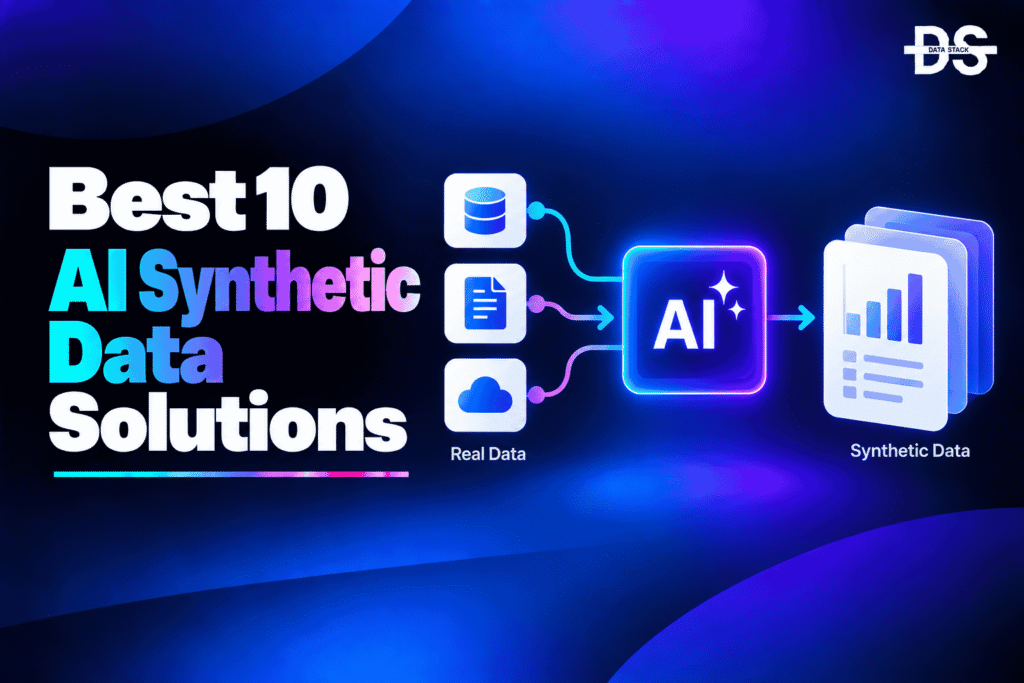
Organizations need large volumes of high-quality data to develop AI models, train machine learning systems, test applications, and build analytics workflows. However, using real-world data can create challenges around privacy, security, availability, cost, and regulatory compliance. Sensitive datasets may also be difficult to share across teams or environments.
AI synthetic data tools address these challenges by using artificial intelligence, machine learning, generative models, and statistical techniques to create new datasets that replicate important characteristics of real-world data without directly exposing the original records. Depending on the use case, synthetic data can be generated for structured databases, images, text, time-series data, healthcare records, financial information, and other data types.
Synthetic data is particularly useful when organizations have limited access to real data or need additional examples for AI and machine learning workflows. Teams can use generated data to test applications, train models, simulate scenarios, develop software, and experiment with data without always relying on production datasets.
However, synthetic data is not automatically suitable for every purpose. The generated dataset needs to preserve the characteristics that matter for the intended use case while avoiding unnecessary leakage of information from the source data. Organizations should therefore evaluate data quality, privacy, statistical fidelity, utility, bias, scalability, and the specific AI capabilities of each platform.
What Are AI Synthetic Data Tools?
AI synthetic data tools are platforms that use artificial intelligence, machine learning, generative models, or statistical techniques to generate artificial datasets that reproduce important characteristics of real-world data.
For structured data, these tools can learn relationships between columns, distributions, patterns, and dependencies in an original dataset and then generate new records with similar characteristics. Other platforms specialize in synthetic images, text, video, healthcare data, financial data, or other domain-specific datasets.
The goal is not simply to create random information. Useful synthetic data should retain enough of the statistical and structural properties of the original data to support a particular task while reducing the need to expose or directly use sensitive production information.
AI Synthetic Data Tools vs. Traditional Data Generation
| Capability | Traditional Data Generation | AI Synthetic Data |
|---|---|---|
| Data generation | Rules and manually created records | AI, ML, and generative models |
| Realism | Often requires manual design | Can learn patterns from real datasets |
| Complex relationships | Usually manually configured | AI can learn relationships and dependencies |
| Unstructured data | Often difficult to generate realistically | Generative AI can create text, images, and other content |
| Privacy | Depends on how data is generated | Can reduce direct use of real records |
| Scalability | May require significant manual work | Large datasets can be generated automatically |
| Custom scenarios | Rules need to be created manually | AI can generate data based on specified conditions |
| Machine learning | Limited realism in complex datasets | Can generate data designed for ML workflows |
| Data augmentation | Manual or rule-based | AI-generated variations and examples |
AI Synthetic Data Tools Comparison
The comparison table below provides a quick overview of the best AI synthetic data tools, highlighting their AI capabilities, automation features, and primary synthetic data use cases.
| Tool | AI Capabilities | What You Can Automate | Primary Synthetic Data Focus | Best For |
|---|---|---|---|---|
| Gretel | Generative AI, synthetic data generation, privacy-aware generation | Data generation, transformation, augmentation, evaluation | Synthetic tabular and unstructured data | Developers and AI teams |
| Mostly AI | Generative AI, deep learning, synthetic data modeling | Synthetic data generation, augmentation, privacy evaluation | Enterprise synthetic data | Regulated industries |
| Hazy | Generative AI and machine learning for synthetic data | Synthetic data generation, privacy testing, data sharing | Privacy-safe synthetic data | Financial services |
| Tonic.ai | Generative AI, synthetic data generation, data de-identification | Test data generation, masking, synthetic data creation | Software testing and development | Engineering teams |
| Syntho | AI-driven synthetic data generation and privacy technology | Data generation, augmentation, privacy enhancement | Enterprise synthetic data | Data teams |
| YData | Generative models, machine learning, data profiling | Synthetic data generation, validation, data quality analysis | Data science workflows | Data scientists |
| DataCebo / SDV | Generative modeling, probabilistic learning, synthetic data generation | Tabular, relational, and time-series data generation | Open-source synthetic data | Developers and researchers |
| NVIDIA | Generative AI and simulation technologies | Synthetic data generation, simulation, augmentation | AI and computer vision data | AI developers |
| MDClone | AI-powered synthetic health data generation | Healthcare data generation, exploration, research datasets | Healthcare synthetic data | Healthcare organizations |
| MOSTLY AI | Generative AI and privacy-preserving synthetic data | Tabular and multimodal synthetic data generation | Enterprise AI and analytics | Enterprise data teams |
10 Best AI Synthetic Data Tools
Let’s take a closer look at the 10 best AI synthetic data tools and explore how their AI capabilities can help organizations generate realistic data for AI development, analytics, testing, research, and machine learning workflows.
#1. Gretel
Gretel is a synthetic data platform built specifically for generating high-quality artificial data for AI and machine learning workflows. It uses generative AI models to learn patterns and distributions from source datasets and create synthetic data designed to preserve useful characteristics while reducing exposure to sensitive information. The platform supports tabular, text, and time-series data, making it suitable for multiple synthetic-data use cases.
Gretel has also expanded beyond traditional synthetic data generation with Gretel Navigator, a compound AI system that can create, edit, and augment tabular datasets using natural language or code. Its AI capabilities are particularly relevant for organizations that need domain-specific training data, data augmentation, privacy-safe datasets, or synthetic data for LLM and ML development.
The platform also provides data-quality and privacy evaluation capabilities and supports workflows that can connect data sources and destinations, allowing synthetic data generation to become part of repeatable data pipelines rather than a one-time process.
Key Features
- Generative AI synthetic data: Generates artificial datasets that learn patterns and distributions from source data.
- Gretel Navigator: Uses a compound AI system to create, edit, and augment tabular data using natural language or code.
- Tabular data generation: Generates synthetic structured datasets while preserving important relationships and distributions.
- Synthetic text generation: Supports generation of artificial text and training data for language-model workflows.
- Time-series synthesis: Generates synthetic time-series data for use cases such as financial and sensor data.
- AI training-data generation: Creates domain-specific datasets for training and fine-tuning AI and ML models.
- Data augmentation: Can generate additional examples and address underrepresented data patterns.
- Privacy and quality evaluation: Provides quality and privacy assessments for generated datasets.
Showcase your software to buyers actively comparing tools. Submit your product for editorial review and get featured on Data Stack Hub.
Submit Your Tool →#2. MOSTLY AI
MOSTLY AI is a synthetic data platform focused on generating realistic, privacy-preserving datasets from real-world data. Its generative AI approach is designed to learn statistical properties and relationships in source datasets and create synthetic records that retain useful data characteristics without directly reproducing the original records.
The platform is particularly focused on structured and tabular data and is designed for organizations that need synthetic datasets for analytics, AI development, testing, research, and data sharing. MOSTLY AI’s platform can generate completely new datasets while providing controls for data utility, quality, privacy, formats, and scale.
Its emphasis on preserving relationships and statistical characteristics makes it relevant for organizations where synthetic data needs to remain useful for downstream analytical and machine learning workflows rather than simply providing random test records.
Key Features
- AI-powered synthetic data generation: Uses advanced AI models to generate artificial datasets based on real-world data.
- Statistical relationship preservation: Maintains important correlations and patterns from source data.
- Full synthetic data generation: Can create completely new datasets without retaining original records.
- Privacy-focused generation: Uses privacy-preserving techniques to reduce exposure of sensitive information.
- Synthetic data quality analysis: Provides automated evaluation of generated-data quality.
- Structured data synthesis: Supports generation of realistic synthetic structured datasets.
- Data transformation: Provides capabilities for preparing source data for synthetic generation.
- Scalable data generation: Designed to synthesize large quantities of data for enterprise use cases.
Also Read: Best Mostly AI Alternatives and Competitors in 2026
#3. Hazy
Hazy is a synthetic data platform focused on helping organizations generate artificial datasets while protecting sensitive information. Its technology is designed for organizations that need realistic data for analytics, testing, AI development, and data sharing without exposing the underlying personal or confidential information contained in production datasets.
The platform is particularly associated with regulated industries where access to real-world data can be restricted by privacy, security, or compliance requirements. Synthetic data can provide teams with a way to work with realistic datasets while reducing direct exposure to identifiable information.
Hazy’s approach focuses on preserving the statistical utility of source data while applying privacy-preserving synthetic data generation. This makes it relevant for organizations that need to balance data utility with privacy requirements when developing AI and analytical applications.
Key Features
- AI-driven synthetic data generation: Uses machine learning techniques to generate realistic artificial datasets.
- Privacy-preserving synthesis: Creates synthetic records designed to reduce exposure of original sensitive information.
- Statistical fidelity: Preserves important statistical characteristics and relationships from source data.
- Sensitive-data protection: Helps organizations work with data without directly exposing production records.
- Synthetic data for AI: Supports AI and machine learning development where access to real data is restricted.
- Data sharing: Enables organizations to share useful datasets while reducing privacy risks.
- Regulated-industry support: Designed for use cases where privacy and compliance requirements are particularly important.
- Data utility evaluation: Helps organizations assess whether generated data remains useful for its intended purpose.
#4. Tonic.ai
Tonic.ai provides synthetic data and data de-identification technology designed primarily for software development, testing, and AI development. Its Tonic Fabricate product uses a conversational AI agent to generate realistic synthetic data across databases, APIs, and files while maintaining relationships between connected data assets.
Tonic’s approach is particularly useful when engineering teams need realistic data that resembles production environments without exposing actual customer information. Fabricate can generate relational data, JSON, PDFs, DOCX files, emails, and other content while maintaining logical consistency across generated datasets.
The platform also includes AI-assisted validation. Its Data Agent can work with a Validation Agent that reviews generated data and prompts refinements, helping improve the output when the original request is incomplete or imprecise. Tonic also supports synthetic data generation for AI training and reinforcement-learning workflows.
Key Features
- Conversational AI data generation: Generate synthetic data through natural-language interaction.
- AI-powered Fabricate: Creates realistic synthetic data from schemas, databases, and user requirements.
- Cross-system synthesis: Generates referentially intact data across databases, APIs, and files.
- AI training data generation: Generates labeled synthetic training data for AI and ML workflows.
- Validation Agent: Uses AI to review generated data and refine outputs.
- Unstructured synthetic data: Generates content such as PDFs, DOCX files, and emails.
- AI agent training data: Supports synthetic data generation for reinforcement learning and AI-agent development.
- MCP integration: Allows synthetic data generation through compatible AI tools such as Claude and Cursor.
Also Read: Best Tonic.ai Alternatives and Competitors in 2026
#5. Syntho
Syntho is an AI-powered synthetic data platform designed to help organizations generate realistic artificial datasets while reducing privacy risks associated with using production data. The platform is aimed at organizations that need usable data for software development, analytics, testing, AI, and machine learning without exposing sensitive records.
Its synthetic data approach can help organizations overcome situations where real datasets are difficult to access because of privacy, security, or compliance restrictions. Instead of distributing original customer or business records, teams can work with generated datasets that reproduce relevant characteristics for their intended use case.
Syntho is particularly relevant for organizations that need synthetic data as part of a broader privacy and data-management strategy. The platform can be used to create artificial data while maintaining useful patterns and relationships required by downstream analytical and development workflows.
Key Features
- AI-powered synthetic data generation: Generates artificial datasets based on patterns in source data.
- Privacy-preserving data synthesis: Helps reduce direct exposure to sensitive production information.
- Synthetic tabular data: Generates structured datasets for analytics, testing, and AI workflows.
- Pattern and relationship preservation: Maintains relevant characteristics of source data.
- Data utility analysis: Helps assess whether synthetic datasets retain sufficient usefulness.
- AI and ML data generation: Supports synthetic data use cases for machine learning and AI development.
- Automated synthetic data workflows: Reduces manual effort involved in generating repeatable datasets.
- Enterprise data privacy: Supports organizations that need synthetic alternatives to sensitive production data.
Increase your product visibility by reaching software buyers researching the best tools. Every submission is reviewed by our editorial team.
Feature My Tool →#6. YData
YData provides data-quality and synthetic-data capabilities designed for data science and machine learning teams. Its platform helps teams understand, prepare, and generate better datasets for AI workflows, including synthetic data generation and data-quality analysis.
YData’s synthetic data capabilities are particularly relevant when teams need additional training examples or want to experiment with data without relying exclusively on original datasets. Its tooling can help data scientists evaluate datasets, identify issues, and generate synthetic data as part of a broader data preparation workflow.
The platform is more closely aligned with data science workflows than some enterprise synthetic-data platforms. This makes it useful for teams that want synthetic data generation alongside data profiling, quality analysis, and other activities involved in preparing datasets for machine learning.
Key Features
- AI-powered synthetic data generation: Generates artificial data for data science and machine learning workflows.
- Data quality analysis: Helps evaluate whether datasets are suitable for AI and ML applications.
- Synthetic data validation: Supports evaluation of generated datasets against source-data characteristics.
- Data profiling: Provides visibility into dataset structure and quality before synthesis.
- Machine learning workflows: Integrates synthetic data generation into broader data-science processes.
- Data augmentation: Helps create additional training examples for ML workflows.
- Python-based workflows: Supports programmatic data science and synthetic-data workflows.
- AI dataset preparation: Helps teams build and improve datasets used for AI development.
#7. DataCebo / SDV
Synthetic Data Vault (SDV) is an open-source ecosystem for generating synthetic data across different data structures, including single tables, relational datasets, and time-series data. DataCebo develops and maintains SDV and provides tools designed to help developers and data scientists generate synthetic datasets programmatically.
SDV uses probabilistic and machine learning-based models to learn patterns and relationships from real datasets and generate new records. Its relational capabilities are particularly useful when synthetic data needs to preserve relationships across multiple connected tables rather than treating every table as an isolated dataset.
Because SDV is open source, it is particularly useful for developers, researchers, and data science teams that want direct control over synthetic-data generation workflows. Teams can integrate the library into Python-based applications and customize how synthetic datasets are generated and evaluated.
Key Features
- Machine learning-based synthesis: Uses generative models to learn patterns from source datasets.
- Tabular data generation: Generates synthetic records for structured datasets.
- Relational data synthesis: Preserves relationships between multiple connected tables.
- Time-series synthesis: Supports generation of synthetic sequential and time-dependent data.
- Model customization: Allows developers to configure and experiment with different synthesis approaches.
- Synthetic data evaluation: Provides tools for evaluating generated data against source datasets.
- Python integration: Supports programmatic synthetic-data generation within data-science workflows.
- Open-source AI tooling: Gives developers direct control over synthetic-data generation and experimentation.
#8. NVIDIA
NVIDIA provides synthetic data generation capabilities through its generative AI and simulation ecosystem, with a strong focus on creating training data for AI, robotics, computer vision, and physical AI applications. Its technologies can generate photorealistic and physically accurate synthetic environments and data that can be used to train and test AI systems.
NVIDIA Omniverse and related technologies allow developers to create simulated environments and generate large volumes of synthetic data without collecting every example from the physical world. This is particularly useful for computer vision, robotics, autonomous systems, and industrial AI, where obtaining enough real-world training data can be expensive or difficult.
NVIDIA’s approach is different from tools focused primarily on synthetic tabular business data. Its strength is AI-generated simulation and multimodal data, including images, video, 3D environments, and sensor data. This makes it particularly relevant for teams developing physical AI and computer-vision applications.
Key Features
- Generative AI data creation: Uses generative AI technologies to create data for AI development.
- Synthetic image generation: Generates artificial visual data for computer-vision training.
- Simulation-based data generation: Creates training data through simulated environments.
- 3D synthetic environments: Supports realistic virtual environments for AI and robotics.
- Digital twins: Enables organizations to create simulated representations of physical environments.
- Computer vision training data: Generates varied visual scenarios that can supplement real-world datasets.
- Robotics data generation: Supports synthetic data workflows for robotics and physical AI.
- Sensor simulation: Can generate simulated sensor data for AI systems operating in physical environments.
G2 Rating: NVIDIA has many products listed across G2, so a single company-wide rating would not be meaningful for this specific synthetic-data capability. I would not force a G2 rating for NVIDIA in this article.
#9. MDClone
MDClone is a healthcare data platform that uses synthetic data technology to help healthcare organizations explore and analyze clinical information while reducing the need to expose identifiable patient records. Its platform creates synthetic representations of healthcare data that can be used for research, analytics, operational planning, and innovation.
The platform is specifically designed around healthcare data, where privacy, security, and regulatory requirements can make it difficult for researchers, clinicians, analysts, and developers to work directly with patient-level information. MDClone’s synthetic data environment allows users to explore realistic clinical scenarios while helping protect patient privacy.
Its approach is particularly useful for healthcare organizations that need to make data more accessible across research and analytics teams. Synthetic data can also support collaboration and application development where direct access to production patient data would introduce additional privacy or security concerns.
Key Features
- AI-powered synthetic healthcare data: Generates synthetic representations of clinical and patient data.
- Patient-data privacy: Helps teams work with realistic data while reducing direct exposure to identifiable patient information.
- Clinical data synthesis: Creates synthetic datasets based on healthcare information.
- Synthetic cohort generation: Helps users create representative patient populations for analysis and research.
- Healthcare analytics: Supports analytical workflows without requiring direct access to identifiable production records.
- Research data generation: Enables researchers to explore clinical datasets in a privacy-conscious environment.
- Data exploration: Allows healthcare teams to investigate patterns and scenarios using synthetic representations.
- Healthcare AI development: Can support AI and machine learning use cases involving clinical data.
#10. Mostly AI
MOSTLY AI is a generative synthetic data platform designed to create realistic artificial datasets while preserving the statistical characteristics and relationships that make the original data useful. The platform is primarily focused on enterprise data and supports use cases such as analytics, AI development, testing, research, and data sharing.
Its generative approach allows organizations to create synthetic versions of sensitive datasets instead of distributing the original records. The platform is designed to preserve correlations and other relationships between variables, which is important when synthetic data will be used for machine learning or analytical workloads where simple randomization would not provide enough realism.
MOSTLY AI also provides privacy and utility evaluation capabilities so organizations can assess whether generated data provides an appropriate balance between usefulness and protection. This makes it relevant for enterprises that need synthetic data as part of a broader data privacy and AI strategy.
Key Features
- Generative AI synthetic data: Uses generative models to create realistic artificial datasets.
- Relationship preservation: Maintains important relationships and correlations between data attributes.
- Privacy-preserving generation: Helps reduce the need to share or expose original sensitive records.
- Synthetic tabular data: Generates realistic structured datasets for enterprise use cases.
- AI training data: Supports creation of datasets for machine learning and AI development.
- Data augmentation: Can generate additional examples while preserving important characteristics.
- Privacy evaluation: Helps assess the privacy properties of generated datasets.
- Data utility evaluation: Helps determine whether synthetic data retains sufficient value for its intended use.
How to Choose the Right AI Synthetic Data Tool
- Synthetic data quality: Check whether the generated data preserves the patterns, distributions, relationships, and characteristics that matter for your specific use case.
- AI capabilities: Evaluate the underlying AI or generative models and whether they are appropriate for the type of data you need to generate.
- Data type support: Make sure the platform supports your requirements, whether that means tabular, relational, time-series, text, images, healthcare data, or other specialized formats.
- Privacy protection: Check how effectively the platform reduces the risk of exposing sensitive information from the original dataset and whether it provides privacy evaluation capabilities.
- Data utility: Evaluate whether synthetic datasets remain useful for your intended purpose, such as AI training, analytics, testing, research, or application development.
- Complex relationships: For relational or enterprise datasets, check whether the tool can preserve relationships between tables, columns, records, and other data dependencies.
- AI and ML training: If your primary goal is AI development, check whether the generated data can provide useful training, fine-tuning, augmentation, or evaluation examples.
- Data validation: Look for capabilities that compare synthetic data with source data and help assess quality, privacy, statistical similarity, and model performance.
- Scalability: Consider whether the platform can generate the volume of synthetic data you need without creating significant performance or infrastructure challenges.
- Integration and usability: Check whether the tool integrates with your existing data stack and whether your data science, engineering, or analytics teams can incorporate synthetic data generation into their existing workflows.
Browse expertly curated software recommendations across hundreds of business categories.
Browse Top Tools →Conclusion
AI synthetic data tools provide organizations with a way to generate realistic datasets without relying exclusively on sensitive production data. They can support AI training, machine learning, analytics, software testing, research, data sharing, and data augmentation, particularly when access to real-world data is limited by privacy, security, or regulatory requirements.
The tools covered in this article take different approaches to synthetic data. Gretel, MOSTLY AI, Hazy, Syntho, and YData focus heavily on generating synthetic datasets for data science, AI, analytics, and privacy-focused use cases. Tonic.ai has a strong focus on software development, testing, and AI training data, while DataCebo/SDV provides an open-source approach for developers and data scientists. NVIDIA takes a different direction, concentrating on synthetic data generated through simulation for computer vision, robotics, and physical AI. MDClone specializes in healthcare data and clinical use cases.
The best tool depends largely on what type of synthetic data you need to generate and why you need it. A platform designed for tabular enterprise data may not be the right choice for computer-vision training, while a tool designed for healthcare datasets may be unnecessary for a software testing workflow.
Organizations should therefore evaluate synthetic data using real representative datasets before making a decision. Data quality, privacy, statistical fidelity, utility, supported data types, AI capabilities, scalability, and integration with the existing data stack are more important than simply choosing a platform with the largest feature list.
Synthetic data should also not automatically be treated as a completely risk-free substitute for real data. Organizations should validate whether generated datasets adequately protect sensitive information and whether they retain enough useful characteristics for the intended application.
For teams building AI systems, synthetic data can become particularly valuable when real training data is scarce, expensive to collect, difficult to share, or subject to privacy restrictions. When generated and evaluated correctly, it can supplement real-world datasets and provide additional flexibility throughout the AI development lifecycle.
Frequently Asked Questions
1. What are AI synthetic data tools?
AI synthetic data tools use artificial intelligence, machine learning, generative models, or statistical techniques to create artificial datasets that reproduce useful characteristics of real-world data.
2. How does AI generate synthetic data?
AI synthetic data systems learn patterns, distributions, relationships, and other characteristics from existing data and use those learned patterns to generate new records or content that resembles the original dataset.
3. Is synthetic data the same as anonymized data?
No. Anonymized data is derived from real data by removing or transforming identifying information, while synthetic data consists of newly generated records created using learned patterns or statistical properties.
4. What is synthetic data used for?
Common use cases include AI training, machine learning, software testing, analytics, research, data sharing, data augmentation, simulation, and application development.
5. Can synthetic data be used to train AI models?
Yes. Synthetic data can supplement real-world training datasets, particularly when real data is limited, expensive to obtain, difficult to share, or contains sensitive information.
6. Can synthetic data protect sensitive information?
It can reduce direct exposure to original records, but organizations should still evaluate the privacy characteristics of generated datasets. High-quality synthetic data should be tested for potential leakage and re-identification risks.
7. What types of data can AI synthetic data tools generate?
Capabilities vary by platform. Some tools specialize in tabular and relational data, while others support time-series, text, images, healthcare data, sensor data, 3D environments, or other specialized formats.
8. Can synthetic data replace real data?
Not always. Synthetic data can supplement or, for certain use cases, substitute for real data, but its suitability depends on the task. Some AI models and analytical workflows may still require representative real-world data for validation or final evaluation.
9. What are the best AI synthetic data tools in 2026?
The tools covered in this article are:
- Gretel
- MOSTLY AI
- Hazy
- Tonic.ai
- Syntho
- YData
- DataCebo / SDV
- NVIDIA
- MDClone
The tools serve different synthetic-data requirements, so the appropriate option depends on the data type and intended use case.
10. What is synthetic tabular data?
Synthetic tabular data consists of artificially generated rows and columns designed to reproduce important characteristics of a real structured dataset, including distributions, relationships, and correlations.
11. What is synthetic data augmentation?
Synthetic data augmentation involves generating additional artificial examples to increase the size or diversity of an existing dataset. It can be useful when certain classes, scenarios, or examples are underrepresented.
12. Is synthetic data useful for software testing?
Yes. Synthetic data can provide realistic test datasets without requiring developers and QA teams to use sensitive production records. It can also allow teams to generate specific scenarios that may be difficult to obtain from production data.
13. What should I look for in an AI synthetic data tool?
Important factors include data quality, AI capabilities, privacy protection, supported data types, statistical fidelity, data utility, complex relationship preservation, validation, scalability, and integrations.
14. Is open-source synthetic data software available?
Yes. Synthetic Data Vault (SDV) from DataCebo is an open-source option that provides tools for generating synthetic tabular, relational, and time-series data.
15. Is synthetic data useful for generative AI?
Yes. Synthetic data can be used to create additional training and evaluation examples for generative AI systems, including domain-specific datasets and scenarios that may be difficult or expensive to collect from real-world sources.