
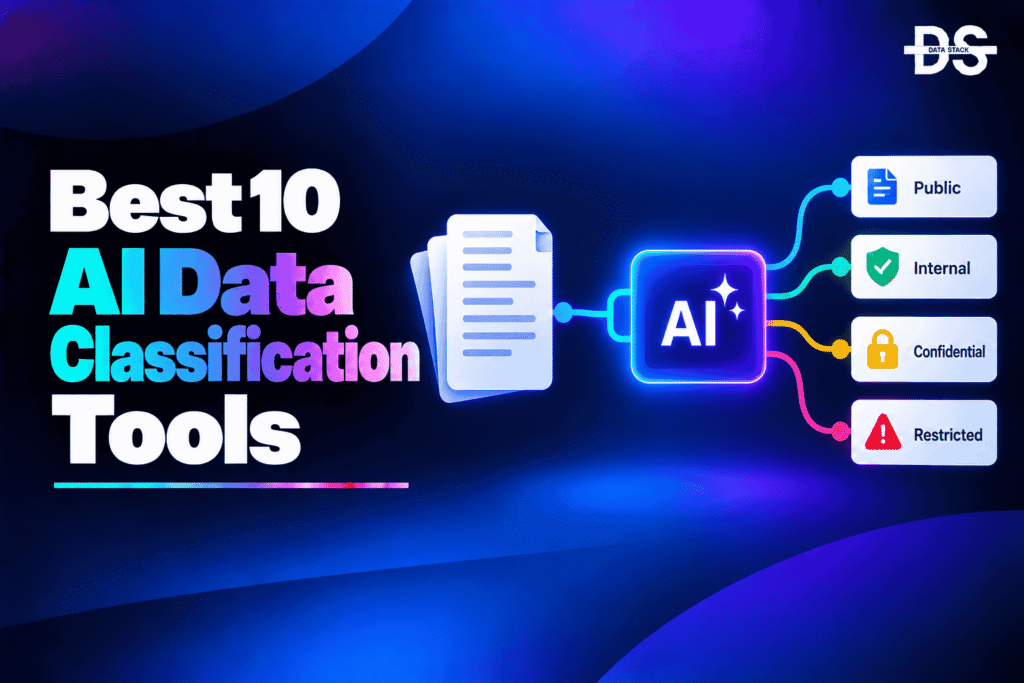
Organizations generate and store enormous amounts of structured, semi-structured, and unstructured data across databases, cloud storage, SaaS applications, data warehouses, emails, documents, and AI systems. As these environments grow, manually identifying sensitive information such as PII, PHI, financial records, credentials, intellectual property, and confidential business data becomes increasingly difficult.
AI data classification tools use artificial intelligence, machine learning, natural-language processing, pattern recognition, and contextual analysis to identify and categorize data at scale. Instead of relying entirely on manually configured rules or predefined patterns, AI-powered classification can analyze the content and context of data to determine what type of information it contains.
AI-based classification is becoming particularly important as organizations adopt generative AI and AI agents. Data classification can help organizations understand what sensitive information exists, where it is stored, which systems and users can access it, and what data may need additional controls before being used by AI applications. Modern platforms are increasingly extending classification beyond traditional databases and files to cloud environments, SaaS applications, AI systems, and other data surfaces.
#4. Microsoft Purview
Microsoft Purview is Microsoft’s unified data governance, security, and compliance platform, with data discovery and classification capabilities across Microsoft and supported non-Microsoft environments. Its classification capabilities can identify sensitive information and apply sensitivity labels to help organizations manage and protect data across different services and workloads.
Purview uses built-in and custom sensitive information types, trainable classifiers, and machine learning-based capabilities to identify data that matches particular business, regulatory, or security requirements. Trainable classifiers can be used for content that may be difficult to identify through simple pattern matching, allowing organizations to classify information based on its overall content and context.
The platform is particularly relevant for organizations already using Microsoft 365, Azure, Microsoft Fabric, and other Microsoft services because classification can connect with broader Microsoft information protection, data loss prevention, and governance capabilities. This allows classification results to become part of a wider data protection workflow rather than remaining standalone labels.
Key Features
- AI-assisted data classification: Uses intelligent classification capabilities to identify sensitive and business-critical information.
- Trainable classifiers: Uses machine learning to classify content that may not be easily identified through predefined patterns.
- Sensitive information types: Detects predefined and custom categories of sensitive information.
- Sensitivity labeling: Applies labels to help organizations identify and protect classified data.
- Custom classification: Allows organizations to create classification logic for specific business requirements.
- Context-aware classification: Can use content and contextual signals when identifying information.
- Unstructured data classification: Supports classification of documents and other content-based data.
- AI-assisted information protection: Connects classification with broader data protection and compliance workflows.
#5. Securiti
Securiti is a data and AI security platform that provides discovery, classification, privacy, governance, and AI governance capabilities across enterprise data environments. Its AI-powered classification capabilities help organizations identify sensitive information across databases, cloud environments, applications, files, and other data sources.
Securiti combines automated discovery and classification with contextual information about data, users, systems, and data flows. This allows organizations to understand not only what type of information they have, but also where that information exists and how it is being used. Its classification capabilities cover a range of sensitive and regulated data categories.
The platform also extends data classification into AI governance. As organizations introduce AI applications and agents that interact with enterprise information, classification can help determine what data is sensitive and what controls may be appropriate before that information is accessed or processed by AI systems.
Key Features
- AI-powered data classification: Uses AI and intelligent classification techniques to identify sensitive information.
- Automated sensitive-data discovery: Finds sensitive information across connected enterprise data sources.
- Contextual classification: Combines classification with information about data, users, systems, and data flows.
- Sensitive-data categorization: Identifies and categorizes different types of sensitive and regulated information.
- AI data governance: Extends classification and discovery into AI governance workflows.
- Data-flow intelligence: Helps organizations understand how classified data moves between systems.
- Custom classification: Supports organization-specific classification requirements.
- AI security controls: Uses classification context to support broader security and governance policies.
Showcase your software to buyers actively comparing tools. Submit your product for editorial review and get featured on Data Stack Hub.
Submit Your Tool →#6. Informatica
Informatica provides enterprise data management and data intelligence capabilities through its AI-powered CLAIRE technology. Its classification capabilities help organizations discover and categorize data across databases, cloud platforms, applications, data warehouses, and other enterprise systems.
CLAIRE uses machine learning and metadata intelligence to understand relationships and context across an organization’s data environment. Informatica’s approach is particularly useful for large organizations where classification needs to work across many different systems and where manually maintaining rules and metadata would be difficult.
Classification is also connected with Informatica’s broader data intelligence capabilities. This means organizations can combine classification with metadata, data quality, lineage, governance, and discovery information to build a more complete understanding of their data.
Key Features
- CLAIRE AI: Uses AI and machine learning across Informatica’s data intelligence capabilities.
- AI-assisted data classification: Helps identify and categorize data across enterprise environments.
- Intelligent metadata analysis: Uses metadata to provide additional context around classified data.
- Machine learning-based classification: Applies intelligent techniques to improve data categorization.
- Sensitive-data identification: Helps identify sensitive and regulated information.
- Relationship intelligence: Uses relationships between data assets to improve data understanding.
- Automated metadata enrichment: Adds contextual information that can support classification.
- AI-powered data intelligence: Connects classification with discovery, lineage, quality, and governance information.
#7. Nightfall AI
Nightfall AI is a data security platform focused on discovering and protecting sensitive information across SaaS applications, cloud environments, developer tools, AI applications, and other data surfaces. Its classification capabilities use machine learning and AI-based detection to identify sensitive information such as PII, credentials, financial information, and other confidential content.
Nightfall combines predefined detectors with machine learning and more advanced AI techniques to identify sensitive data in content that may not be easy to classify using simple keyword or regular-expression matching. Its platform is designed to monitor data as it moves through modern applications and workflows, making classification useful for security and data-loss-prevention use cases.
Nightfall’s capabilities are also relevant to generative AI environments. As employees and applications send information to AI services, intelligent detection can help identify sensitive information before it reaches an external or unauthorized destination.
Key Features
- ML-powered sensitive-data detection: Uses machine learning to identify sensitive information across supported data sources.
- AI-powered classifiers: Applies intelligent classification to content beyond basic pattern matching.
- PII detection: Identifies personally identifiable information and other sensitive categories.
- Credential detection: Detects secrets, API keys, passwords, and other credentials.
- Custom classifiers: Allows organizations to define classification requirements for specific data types.
- Natural-language classification: Supports more flexible detection requirements using AI-based approaches.
- Unstructured-content analysis: Classifies sensitive information within text and other supported content.
- AI application protection: Helps identify sensitive information moving into generative AI and other AI applications.
#8. Sentra
Sentra is a cloud data security platform that provides automated data discovery, classification, and risk analysis across cloud data environments. Its AI-driven approach helps organizations identify sensitive information across data warehouses, databases, object storage, and other cloud data repositories.
The platform automatically discovers data and applies classification to help organizations understand what information exists within their cloud environment. Sentra can identify categories of sensitive information and connect classification results with broader risk context, helping security teams prioritize data that may require additional protection.
Its classification capabilities are particularly relevant for cloud-first organizations where data can be distributed across multiple cloud providers and storage technologies. Combining AI-driven classification with data discovery and risk analysis can help reduce the manual work involved in maintaining an accurate inventory of sensitive cloud data.
Key Features
- AI-driven data classification: Uses intelligent classification to identify sensitive information across cloud data environments.
- Automated sensitive-data discovery: Finds sensitive information across supported cloud repositories.
- Contextual classification: Adds data and risk context to classification results.
- Cloud-native classification: Designed to classify data across modern cloud environments.
- Sensitive-data identification: Detects categories of sensitive and regulated information.
- Automated data inventory: Builds an inventory of discovered and classified data.
- Risk-aware classification: Connects classification results with data security and risk context.
- AI-powered data security: Uses classification intelligence to support broader cloud data protection workflows.
#9. Forcepoint
Forcepoint provides data security and data loss prevention capabilities that use AI and machine learning to help organizations understand, classify, and protect sensitive information. Its approach combines content analysis with user, device, application, and behavioral context to determine how data should be handled.
Forcepoint can classify sensitive content across endpoints, networks, cloud applications, and other environments. Rather than treating classification as an isolated metadata exercise, its platform connects classification with DLP policies and security controls. This can help organizations identify sensitive information and determine whether specific data movements or actions should be allowed.
AI and behavioral analysis can add another layer of context to classification and protection decisions. This is particularly useful when organizations need to distinguish between legitimate business activity and potentially risky handling of sensitive information.
Key Features
- AI-assisted data classification: Uses intelligent analysis to identify sensitive content.
- Machine learning: Applies ML techniques to improve detection and classification capabilities.
- Context-aware classification: Considers data, user, device, application, and activity context.
- Sensitive-content detection: Identifies sensitive information across supported environments.
- Behavioral intelligence: Uses behavioral signals to add context to data protection decisions.
- Automated classification: Reduces manual effort involved in identifying and categorizing sensitive data.
- AI-assisted DLP: Connects classification intelligence with data loss prevention policies.
- Risk-based data protection: Uses classification and contextual signals to support security decisions.
Increase your product visibility by reaching software buyers researching the best tools. Every submission is reviewed by our editorial team.
#10. Spirion
Spirion is a data privacy and security platform focused on discovering, classifying, and protecting sensitive information across enterprise environments. Its capabilities help organizations identify sensitive data stored across endpoints, servers, cloud environments, and other repositories.
The platform combines automated data discovery and classification with sensitive-data identification to help organizations understand where regulated and confidential information exists. AI-assisted capabilities can help analyze data at scale and reduce the manual effort involved in reviewing large numbers of files and records.
Spirion is particularly relevant for organizations that need visibility into sensitive information before applying security, privacy, retention, or remediation policies. Its classification capabilities can provide a foundation for identifying high-risk data and prioritizing subsequent protection actions.
Key Features
- AI-assisted data classification: Uses intelligent analysis to help identify and categorize sensitive information.
- Automated sensitive-data discovery: Scans supported environments to find sensitive information.
- PII identification: Helps identify personally identifiable and other regulated information.
- Contextual data analysis: Uses available content and metadata context to improve classification.
- Sensitive-data categorization: Organizes discovered information into relevant data categories.
- Automated data inventory: Maintains visibility into discovered sensitive data.
- Risk-focused classification: Helps identify sensitive information that may require additional protection.
- Classification-driven remediation: Uses classification results to support downstream privacy and security workflows.
What Are AI Data Classification Tools?
AI data classification tools are platforms that use AI, machine learning, pattern recognition, contextual analysis, or other intelligent techniques to identify and categorize data based on its content, sensitivity, business meaning, or regulatory requirements.
Traditional data classification often relies on manually created rules, regular expressions, keywords, and predefined patterns. These methods remain useful, but AI can add contextual understanding and help identify information that may be difficult to detect through simple pattern matching.
For example, an AI classification engine may distinguish between a random sequence of numbers and an actual sensitive identifier by analyzing surrounding context. Modern platforms can also classify unstructured content such as documents, source code, contracts, emails, and other files, depending on the platform and its supported data sources.
AI Data Classification Tools vs. Traditional Classification
| Capability | Traditional Data Classification | AI Data Classification |
|---|---|---|
| Classification | Rules, keywords, patterns | AI, ML, patterns, and contextual signals |
| Sensitive-data detection | Predefined rules and patterns | Context-aware classification |
| Unstructured data | Often requires extensive rules | AI can analyze content and context |
| Custom classifications | Manually configured | Can use AI-assisted or natural-language definitions |
| False positives | Can require extensive rule tuning | AI can use additional context to improve precision |
| Data context | Primarily classification labels | Can combine content, metadata, identity, usage, and context |
| Scale | Can require significant rule management | Intelligent automation can reduce manual classification work |
| AI data | Often limited | Increasingly supports AI-generated data and AI environments |
| Remediation | Usually separate workflows | Some platforms connect classification to automated controls |
AI Data Classification Tools Comparison
The comparison table below provides a quick overview of the best AI data classification tools, highlighting their AI capabilities, automation features, and primary classification use cases.
| Tool | AI Capabilities | What You Can Automate | Primary Classification Focus | Best For |
|---|---|---|---|---|
| BigID | AI-powered discovery, intelligent classification, contextual data intelligence | Data discovery, sensitive-data classification, categorization, data mapping | Sensitive-data classification | Enterprise data environments |
| Varonis | AI classification, contextual analysis, intelligent data discovery | Classification, labeling, data discovery, remediation workflows | Data security and classification | Enterprise data security |
| Cyera | AI-native classification, contextual intelligence, adaptive classification | Classification, tagging, sensitive-data discovery, risk prioritization | Cloud and enterprise data classification | Cloud-first enterprises |
| Microsoft Purview | Intelligent classification, trainable classifiers, sensitive-data detection | Classification, labeling, sensitivity management, DLP workflows | Microsoft data classification | Microsoft environments |
| Securiti | AI-powered discovery, classification, contextual data intelligence | Discovery, classification, mapping, governance workflows | Data privacy and AI governance | Privacy-focused enterprises |
| Informatica | CLAIRE AI, intelligent classification, metadata intelligence | Classification, metadata enrichment, discovery, governance workflows | Enterprise data intelligence | Large enterprises |
| Nightfall AI | ML-based detection, LLM-based classifiers, AI-powered sensitive-data detection | PII detection, sensitive-content classification, policy enforcement | Data security and DLP | SaaS and AI data protection |
| Sentra | AI-driven classification, contextual data intelligence | Discovery, classification, risk analysis, data mapping | Cloud data security | Cloud-native environments |
| Forcepoint | AI-assisted classification, behavioral and contextual analysis | Classification, labeling, DLP policy enforcement | Data security and DLP | Security-focused organizations |
| Spirion | AI-assisted discovery and classification, sensitive-data intelligence | Discovery, classification, tagging, remediation | Sensitive-data discovery | Hybrid and on-prem environments |
10 Best AI Data Classification Tools
Let’s take a closer look at the 10 best AI data classification tools and explore how their AI-focused classification capabilities can help organizations identify sensitive information, understand data context, and improve data security and governance.
#1. BigID
BigID is a data discovery, classification, and intelligence platform designed to help organizations find and understand sensitive data across cloud, SaaS, on-premises, and other enterprise environments. Its classification capabilities can identify and categorize sensitive information across structured, semi-structured, and unstructured data, making it relevant for organizations managing large and distributed data estates.
BigID’s AI-powered approach goes beyond simply matching predefined patterns. The platform combines discovery and classification with contextual information to help organizations understand what data they have, where it is located, and how it relates to broader data security and governance requirements. BigID currently says its platform can classify data into more than 2,000 categories and can also discover AI models and agents interacting with data.
This makes BigID particularly relevant for organizations preparing their data environments for AI. Classification can help teams identify sensitive information before it is exposed to AI applications, while contextual discovery can help connect data classification with downstream security, privacy, and governance workflows.
Key Features
- AI-powered sensitive-data classification: Uses intelligent classification to identify and categorize sensitive information across supported data sources.
- Context-aware classification: Adds contextual information to discovered data to improve understanding of what the data represents.
- Large-scale data categorization: Supports classification across thousands of data categories.
- Structured and unstructured classification: Can classify information across different data formats and environments.
- AI data discovery: Discovers sensitive data and provides context around where it exists.
- AI and agent discovery: Helps identify AI models and agents that can access enterprise data.
- Intelligent data mapping: Connects classification findings with broader data relationships and environments.
- AI security readiness: Uses classification as a foundation for understanding and protecting data used by AI systems.
#2. Varonis
Varonis provides data discovery and classification capabilities designed to identify sensitive information across structured and unstructured environments. Its current classification approach combines AI with sophisticated pattern matching to identify sensitive data and provide additional context around where that information exists.
The platform can discover sensitive data across databases, data warehouses, files, folders, buckets, SaaS applications, and email. Varonis says its classification engine can identify categories including PII, PCI, PHI, passwords, secrets, and tokens, while its models and policies can operate without requiring customer training data.
Varonis also connects classification with labeling and remediation. For example, classification results can be used to improve sensitivity labels and downstream DLP controls. Its AI security capabilities additionally extend classification to AI-generated content, helping organizations identify sensitive information in data created through AI workflows.
Key Features
- AI-powered classification: Combines AI with pattern matching to identify sensitive information.
- Contextual classification: Adds context to classification results to improve understanding of sensitive data.
- Sensitive-data discovery: Finds sensitive information across databases, warehouses, files, SaaS applications, and email.
- PII, PCI, and PHI classification: Identifies common categories of regulated and sensitive information.
- Secret and credential detection: Helps identify passwords, secrets, tokens, and similar sensitive information.
- AI-generated data classification: Supports classification of content generated through AI workflows.
- Automated sensitivity labeling: Can use classification results to improve and automate labeling workflows.
- AI-assisted data security: Connects classification with broader data security, exposure monitoring, and remediation workflows.
#3. Cyera
Cyera is an AI-native data security platform with a strong focus on data discovery, classification, and understanding data risk across cloud, SaaS, database, and on-premises environments. Its classification engine uses AI to identify sensitive and proprietary information while incorporating organizational context to improve the usefulness of classification results.
Cyera’s approach is designed to move beyond static classification labels. Its AI-native classification can learn an organization’s business context and classify information such as intellectual property, source code, contracts, and other sensitive business data. The platform also supports creating classifications using natural-language prompts, allowing organizations to define specific classification requirements without relying exclusively on traditional static rules.
The platform combines classification with identity, access, usage, and data movement context. This allows classification results to contribute to broader risk analysis rather than functioning as isolated labels. Cyera also positions its classification capabilities for AI environments, where understanding sensitive data and its relationship to users, identities, and AI systems becomes increasingly important.
Key Features
- AI-native data classification: Uses AI to classify sensitive and proprietary information across enterprise data environments.
- Context-enriched classification: Combines classification with business, identity, access, and usage context.
- Adaptive classification: AI can learn organizational context to improve how sensitive information is identified.
- Natural-language classification: Allows organizations to create classifications using natural-language prompts.
- Custom AI classifications: Supports creating classifications for organization-specific data types.
- Unstructured-data classification: Identifies sensitive information in documents, source code, contracts, and other unstructured content.
- Cloud and SaaS classification: Supports classification across major cloud, SaaS, database, and on-premises environments.
- AI security context: Connects data classification with AI-related data access, exposure, and governance requirements.
#4. Microsoft Purview
Microsoft Purview is Microsoft’s unified data governance, security, and compliance platform, with data discovery and classification capabilities across Microsoft and supported non-Microsoft environments. Its classification capabilities can identify sensitive information and apply sensitivity labels to help organizations manage and protect data across different services and workloads.
Purview uses built-in and custom sensitive information types, trainable classifiers, and machine learning-based capabilities to identify data that matches particular business, regulatory, or security requirements. Trainable classifiers can be used for content that may be difficult to identify through simple pattern matching, allowing organizations to classify information based on its overall content and context.
The platform is particularly relevant for organizations already using Microsoft 365, Azure, Microsoft Fabric, and other Microsoft services because classification can connect with broader Microsoft information protection, data loss prevention, and governance capabilities. This allows classification results to become part of a wider data protection workflow rather than remaining standalone labels.
Key Features
- AI-assisted data classification: Uses intelligent classification capabilities to identify sensitive and business-critical information.
- Trainable classifiers: Uses machine learning to classify content that may not be easily identified through predefined patterns.
- Sensitive information types: Detects predefined and custom categories of sensitive information.
- Sensitivity labeling: Applies labels to help organizations identify and protect classified data.
- Custom classification: Allows organizations to create classification logic for specific business requirements.
- Context-aware classification: Can use content and contextual signals when identifying information.
- Unstructured data classification: Supports classification of documents and other content-based data.
- AI-assisted information protection: Connects classification with broader data protection and compliance workflows.
#5. Securiti
Securiti is a data and AI security platform that provides discovery, classification, privacy, governance, and AI governance capabilities across enterprise data environments. Its AI-powered classification capabilities help organizations identify sensitive information across databases, cloud environments, applications, files, and other data sources.
Securiti combines automated discovery and classification with contextual information about data, users, systems, and data flows. This allows organizations to understand not only what type of information they have, but also where that information exists and how it is being used. Its classification capabilities cover a range of sensitive and regulated data categories.
The platform also extends data classification into AI governance. As organizations introduce AI applications and agents that interact with enterprise information, classification can help determine what data is sensitive and what controls may be appropriate before that information is accessed or processed by AI systems.
Key Features
- AI-powered data classification: Uses AI and intelligent classification techniques to identify sensitive information.
- Automated sensitive-data discovery: Finds sensitive information across connected enterprise data sources.
- Contextual classification: Combines classification with information about data, users, systems, and data flows.
- Sensitive-data categorization: Identifies and categorizes different types of sensitive and regulated information.
- AI data governance: Extends classification and discovery into AI governance workflows.
- Data-flow intelligence: Helps organizations understand how classified data moves between systems.
- Custom classification: Supports organization-specific classification requirements.
- AI security controls: Uses classification context to support broader security and governance policies.
#6. Informatica
Informatica provides enterprise data management and data intelligence capabilities through its AI-powered CLAIRE technology. Its classification capabilities help organizations discover and categorize data across databases, cloud platforms, applications, data warehouses, and other enterprise systems.
CLAIRE uses machine learning and metadata intelligence to understand relationships and context across an organization’s data environment. Informatica’s approach is particularly useful for large organizations where classification needs to work across many different systems and where manually maintaining rules and metadata would be difficult.
Classification is also connected with Informatica’s broader data intelligence capabilities. This means organizations can combine classification with metadata, data quality, lineage, governance, and discovery information to build a more complete understanding of their data.
Key Features
- CLAIRE AI: Uses AI and machine learning across Informatica’s data intelligence capabilities.
- AI-assisted data classification: Helps identify and categorize data across enterprise environments.
- Intelligent metadata analysis: Uses metadata to provide additional context around classified data.
- Machine learning-based classification: Applies intelligent techniques to improve data categorization.
- Sensitive-data identification: Helps identify sensitive and regulated information.
- Relationship intelligence: Uses relationships between data assets to improve data understanding.
- Automated metadata enrichment: Adds contextual information that can support classification.
- AI-powered data intelligence: Connects classification with discovery, lineage, quality, and governance information.
Also Read: Best Informatica Alternatives & Competitors in 2026
#7. Nightfall AI
Nightfall AI is a data security platform focused on discovering and protecting sensitive information across SaaS applications, cloud environments, developer tools, AI applications, and other data surfaces. Its classification capabilities use machine learning and AI-based detection to identify sensitive information such as PII, credentials, financial information, and other confidential content.
Nightfall combines predefined detectors with machine learning and more advanced AI techniques to identify sensitive data in content that may not be easy to classify using simple keyword or regular-expression matching. Its platform is designed to monitor data as it moves through modern applications and workflows, making classification useful for security and data-loss-prevention use cases.
Nightfall’s capabilities are also relevant to generative AI environments. As employees and applications send information to AI services, intelligent detection can help identify sensitive information before it reaches an external or unauthorized destination.
Key Features
- ML-powered sensitive-data detection: Uses machine learning to identify sensitive information across supported data sources.
- AI-powered classifiers: Applies intelligent classification to content beyond basic pattern matching.
- PII detection: Identifies personally identifiable information and other sensitive categories.
- Credential detection: Detects secrets, API keys, passwords, and other credentials.
- Custom classifiers: Allows organizations to define classification requirements for specific data types.
- Natural-language classification: Supports more flexible detection requirements using AI-based approaches.
- Unstructured-content analysis: Classifies sensitive information within text and other supported content.
- AI application protection: Helps identify sensitive information moving into generative AI and other AI applications.
#8. Sentra
Sentra is a cloud data security platform that provides automated data discovery, classification, and risk analysis across cloud data environments. Its AI-driven approach helps organizations identify sensitive information across data warehouses, databases, object storage, and other cloud data repositories.
The platform automatically discovers data and applies classification to help organizations understand what information exists within their cloud environment. Sentra can identify categories of sensitive information and connect classification results with broader risk context, helping security teams prioritize data that may require additional protection.
Its classification capabilities are particularly relevant for cloud-first organizations where data can be distributed across multiple cloud providers and storage technologies. Combining AI-driven classification with data discovery and risk analysis can help reduce the manual work involved in maintaining an accurate inventory of sensitive cloud data.
Key Features
- AI-driven data classification: Uses intelligent classification to identify sensitive information across cloud data environments.
- Automated sensitive-data discovery: Finds sensitive information across supported cloud repositories.
- Contextual classification: Adds data and risk context to classification results.
- Cloud-native classification: Designed to classify data across modern cloud environments.
- Sensitive-data identification: Detects categories of sensitive and regulated information.
- Automated data inventory: Builds an inventory of discovered and classified data.
- Risk-aware classification: Connects classification results with data security and risk context.
- AI-powered data security: Uses classification intelligence to support broader cloud data protection workflows.
#9. Forcepoint
Forcepoint provides data security and data loss prevention capabilities that use AI and machine learning to help organizations understand, classify, and protect sensitive information. Its approach combines content analysis with user, device, application, and behavioral context to determine how data should be handled.
Forcepoint can classify sensitive content across endpoints, networks, cloud applications, and other environments. Rather than treating classification as an isolated metadata exercise, its platform connects classification with DLP policies and security controls. This can help organizations identify sensitive information and determine whether specific data movements or actions should be allowed.
AI and behavioral analysis can add another layer of context to classification and protection decisions. This is particularly useful when organizations need to distinguish between legitimate business activity and potentially risky handling of sensitive information.
Key Features
- AI-assisted data classification: Uses intelligent analysis to identify sensitive content.
- Machine learning: Applies ML techniques to improve detection and classification capabilities.
- Context-aware classification: Considers data, user, device, application, and activity context.
- Sensitive-content detection: Identifies sensitive information across supported environments.
- Behavioral intelligence: Uses behavioral signals to add context to data protection decisions.
- Automated classification: Reduces manual effort involved in identifying and categorizing sensitive data.
- AI-assisted DLP: Connects classification intelligence with data loss prevention policies.
- Risk-based data protection: Uses classification and contextual signals to support security decisions.
Also Read: Best Forcepoint Alternatives and Competitors in 2026
#10. Spirion
Spirion is a data privacy and security platform focused on discovering, classifying, and protecting sensitive information across enterprise environments. Its capabilities help organizations identify sensitive data stored across endpoints, servers, cloud environments, and other repositories.
The platform combines automated data discovery and classification with sensitive-data identification to help organizations understand where regulated and confidential information exists. AI-assisted capabilities can help analyze data at scale and reduce the manual effort involved in reviewing large numbers of files and records.
Spirion is particularly relevant for organizations that need visibility into sensitive information before applying security, privacy, retention, or remediation policies. Its classification capabilities can provide a foundation for identifying high-risk data and prioritizing subsequent protection actions.
Key Features
- AI-assisted data classification: Uses intelligent analysis to help identify and categorize sensitive information.
- Automated sensitive-data discovery: Scans supported environments to find sensitive information.
- PII identification: Helps identify personally identifiable and other regulated information.
- Contextual data analysis: Uses available content and metadata context to improve classification.
- Sensitive-data categorization: Organizes discovered information into relevant data categories.
- Automated data inventory: Maintains visibility into discovered sensitive data.
- Risk-focused classification: Helps identify sensitive information that may require additional protection.
- Classification-driven remediation: Uses classification results to support downstream privacy and security workflows.
How to Choose the Right AI Data Classification Tool
- AI classification accuracy: Check how effectively the tool uses AI and machine learning to identify sensitive information and reduce false positives compared with basic rule-based classification.
- Data types and coverage: Make sure it can classify the types of data you actually use, including structured, unstructured, cloud, SaaS, databases, documents, and other relevant sources.
- Sensitive-data categories: Check whether it can identify the specific data types important to your organization, such as PII, PHI, financial data, credentials, intellectual property, and confidential information.
- Custom classification: Look for the ability to create custom categories for organization-specific or industry-specific data that standard classifiers may not recognize.
- AI and unstructured data: If your organization uses generative AI or stores large amounts of unstructured content, check whether the tool can classify AI-related and content-based data effectively.
- Automation and integrations: Evaluate how well classification integrates with your existing data discovery, DLP, governance, security, and compliance workflows.
- Security, privacy, and cost: Review how the vendor handles your data, where AI processing occurs, available deployment options, and whether pricing scales reasonably with your data environment.
Browse expertly curated software recommendations across hundreds of business categories.
Browse Top Tools →Conclusion
AI data classification tools help organizations identify, categorize, and understand sensitive information across increasingly complex data environments. As businesses adopt cloud platforms, SaaS applications, data warehouses, and generative AI, manually classifying every file, table, document, and data record becomes increasingly difficult.
AI adds an important layer to traditional classification by using machine learning, contextual analysis, natural-language processing, and intelligent pattern recognition to identify information at scale. This can help organizations discover sensitive data that may be difficult to identify through basic keyword searches or predefined rules.
The tools covered in this article take different approaches to AI-powered classification. BigID, Varonis, Cyera, Securiti, and Sentra combine classification with broader data discovery and security capabilities, while Microsoft Purview and Informatica connect classification closely with enterprise data governance and management. Nightfall AI focuses strongly on protecting sensitive information across modern SaaS and AI environments, while Forcepoint and Spirion combine classification with broader data security and privacy workflows.
When evaluating AI data classification tools, organizations should look beyond the number of supported classifiers. Classification accuracy, data-source coverage, custom classification capabilities, AI and unstructured-data support, integrations, automation, security, and privacy should all be considered.
For organizations adopting generative AI, classification is becoming even more important. Understanding what sensitive information exists before that data reaches AI applications can help teams establish appropriate security and governance controls.
The right AI data classification tool ultimately depends on the organization’s data environment, classification requirements, security priorities, and existing technology stack. A practical evaluation using representative real-world data is the best way to determine whether a platform can deliver the accuracy and coverage required at scale.
Frequently Asked Questions
1. What are AI data classification tools?
AI data classification tools use artificial intelligence, machine learning, contextual analysis, and pattern recognition to automatically identify and categorize data based on its sensitivity, content, business meaning, or regulatory requirements.
2. How do AI data classification tools work?
These tools analyze data and its surrounding context to identify categories such as PII, PHI, financial information, credentials, intellectual property, and other sensitive information. Depending on the platform, they may use machine learning, predefined classifiers, natural-language processing, and custom classification models.
3. How are AI data classification tools different from traditional classification tools?
Traditional classification commonly relies on keywords, regular expressions, predefined rules, and manually configured policies. AI-powered classification can add contextual understanding, machine learning, intelligent pattern recognition, and automated classification to improve how sensitive information is identified.
4. Can AI data classification tools classify unstructured data?
Yes. Many AI-powered classification platforms can analyze unstructured content such as documents, PDFs, emails, source code, files, and other text-based information. However, the supported data types and depth of classification vary between tools.
5. Can AI data classification tools identify sensitive data?
Yes. Identifying sensitive information is one of the primary use cases. Depending on the platform, classification can include PII, PHI, PCI data, financial information, credentials, secrets, intellectual property, and confidential business information.
6. Can AI data classification tools classify data used by AI applications?
Some platforms provide capabilities specifically designed to discover and classify data associated with generative AI applications, AI models, and AI agents. This can help organizations understand what sensitive information may be accessed or processed by AI systems.
7. Can AI data classification tools create custom classifications?
Yes. Many platforms allow organizations to create custom classifiers or categories for proprietary information, internal terminology, industry-specific data, or other information that standard classifiers may not recognize.
8. Can AI data classification replace traditional rules?
Not necessarily. AI and traditional rules can complement each other. Rules and patterns are effective for clearly defined data types, while AI can add contextual understanding and help classify more complex information.
9. What are the best AI data classification tools in 2026?
The 10 tools covered in this article are:
- BigID
- Varonis
- Cyera
- Microsoft Purview
- Securiti
- Informatica
- Nightfall AI
- Sentra
- Forcepoint
- Spirion
10. What should I consider when choosing an AI data classification tool?
Important factors include AI classification accuracy, data-source coverage, sensitive-data categories, custom classification, unstructured and AI data support, integrations, automation, security, privacy, and cost.
11. Are AI data classification tools useful for data governance?
Yes. Classification can provide important context for data governance by identifying sensitive information and helping organizations apply appropriate policies, labels, access controls, retention rules, and compliance processes.
12. Can AI data classification reduce manual work?
Yes. AI-powered classification can automate much of the process of discovering and categorizing sensitive information, reducing the need for teams to manually inspect large volumes of data and create individual classification rules.
13. Do AI data classification tools work across cloud environments?
Many modern platforms support classification across cloud storage, databases, data warehouses, SaaS applications, and other cloud environments. However, organizations should verify that the specific platforms and data sources in their stack are supported.
14. What is contextual data classification?
Contextual classification considers more than the individual value or keyword being analyzed. It can use surrounding content, metadata, relationships, business context, or other signals to determine what a particular piece of data represents.
15. Can AI data classification tools integrate with DLP?
Many enterprise platforms can connect classification with data loss prevention (DLP) policies and workflows. Classification results can help determine which data requires additional protection or whether particular data movements should be restricted.