
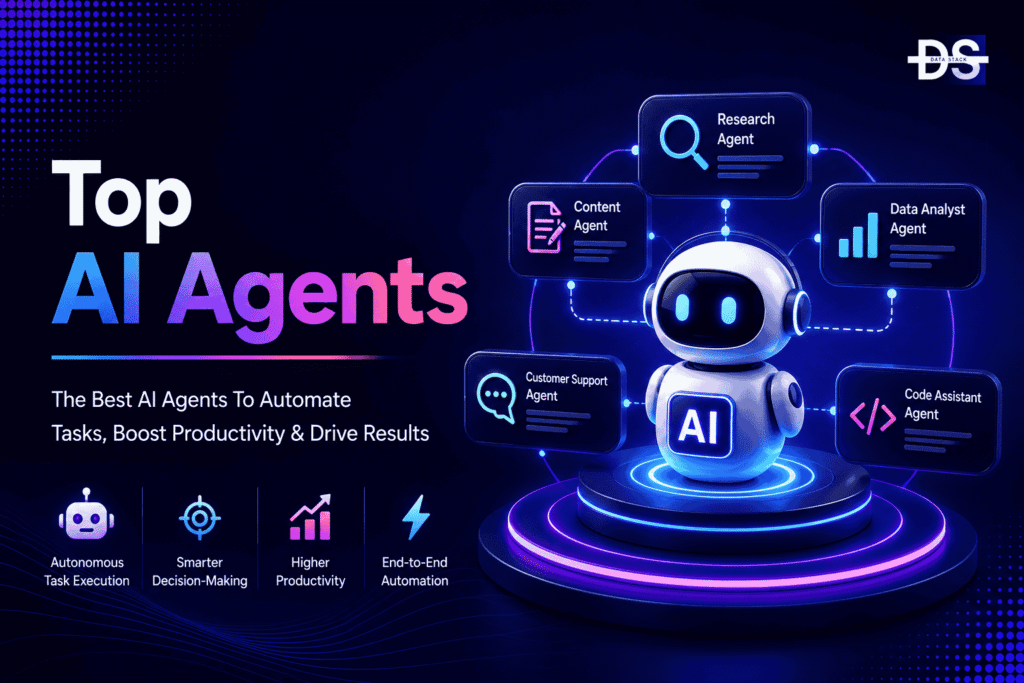
AI agents are moving beyond traditional chatbots by combining AI reasoning with the ability to plan tasks, use tools, access information, and execute multiple steps with less human intervention. In 2026, AI agents are being used for research, software development, business automation, customer operations, and other workflows where completing a task matters more than simply generating a response.
The adoption of AI is also creating stronger demand for systems that can do more than generate content or answer questions. McKinsey’s 2025 global survey found that 62% of organizations are at least experimenting with AI agents, while 23% report scaling an agentic AI system somewhere in their enterprise. This growing experimentation is pushing businesses to evaluate where autonomous or semi-autonomous AI can deliver measurable improvements.
The AI agent landscape now includes general-purpose agents, research agents, coding agents, browser-based agents, workflow automation agents, and multi-agent systems. Some can browse the web and gather information, while others can write and test code, interact with applications, automate business processes, or coordinate multiple AI models. As a result, choosing an AI agent depends heavily on the type of work it needs to perform and the level of autonomy required.
AI agents are software systems that use artificial intelligence to understand a goal, plan one or more steps, use available tools or data, and take actions to complete a task with varying levels of human supervision. Unlike a basic chatbot that primarily generates responses, an AI agent can interact with external systems, make decisions during a workflow, and continue working toward an objective.
This guide covers 11 AI agents across general-purpose work, research, coding, automation, and agentic workflows. We compare them based on their primary use cases, key features, pricing, free access, open-source availability, and user ratings to help you choose the right AI agent for your workflow.
Table of Contents
ToggleWhy Use AI Agents?
Traditional software automation generally follows predefined rules, while AI agents can interpret changing inputs, decide what actions to take, and work through multiple steps toward a goal. This makes them useful for workflows that involve unstructured information, judgment-based tasks, or frequent changes in the steps required to complete an outcome.
AI agents can also extend the capabilities of existing AI assistants by connecting models to external tools, business applications, databases, websites, and APIs. Instead of asking an AI system to explain how to complete a task, users can increasingly delegate parts of the workflow and let the agent carry out those actions under defined permissions and levels of human oversight.
Key reasons to use AI agents include:
- Automate multi-step workflows: AI agents can break broader objectives into individual actions and work through them sequentially instead of requiring users to manually execute every step.
- Handle unstructured information: Agents can interpret emails, documents, conversations, web pages, and other information that is difficult to process with traditional rule-based automation.
- Connect AI with business systems: AI agents can interact with supported applications, APIs, databases, and other tools to perform actions within existing workflows.
- Reduce manual work: Repetitive research, data collection, information processing, customer operations, and administrative activities can be delegated to agents where appropriate.
- Accelerate research and analysis: Research-oriented agents can gather information, compare sources, summarize findings, and produce structured outputs with less manual effort.
- Support software development: Coding agents can generate code, investigate errors, modify files, run tests, and assist developers across multiple stages of development.
- Improve workflow flexibility: Unlike rigid automation, AI agents can adapt their approach when inputs, conditions, or required actions change during a task.
- Scale specialized work: Organizations can deploy agents for specific functions such as sales, customer support, IT operations, research, or data workflows without requiring every process to be handled manually.
The value of AI agents ultimately depends on the complexity of the workflow and the level of autonomy required. They are most useful when an agent can reliably perform multiple actions, access the right information and tools, and operate within clearly defined permissions and human oversight.
Top 11 AI Agents: Comparison
The best AI agents in 2026 vary in how much autonomy they provide, the tasks they can complete, and the systems they can interact with. The following comparison includes general-purpose agents, research and coding agents, workflow automation platforms, and open-source options.
| Tool | Open Source | Best For | Pricing | Free Plan/Trial | G2 Rating |
|---|---|---|---|---|---|
| ChatGPT Agent | No | General-purpose autonomous tasks | Included with eligible ChatGPT plans | Yes | 4.7/5 |
| Claude | No | Research, analysis, and complex tasks | Free; Pro $20/month | Yes | 4.5/5 |
| Microsoft Copilot Studio | No | Enterprise AI agents | Custom pricing | Trial available | 4.4/5 |
| Google Gemini | No | Research and Google Workspace workflows | Free; paid plans available | Yes | 4.4/5 |
| GitHub Copilot | No | Coding agents | Free; Pro $10/month | Yes | 4.5/5 |
| Zapier Agents | No | Business workflow automation | Free; paid plans available | Yes | 4.5/5 |
| CrewAI | Yes | Multi-agent AI workflows | Free self-hosted; paid options available | Yes | N/A |
| AutoGen | Yes | Multi-agent application development | Free and open source | Yes | N/A |
| OpenHands | Yes | Autonomous software development | Free and open source; cloud options available | Yes | N/A |
| LangGraph | Yes | Agent orchestration and development | Free and open source; paid platform available | Yes | N/A |
| Browser Use | Yes | Browser-based AI automation | Free and open source; paid options available | Yes | N/A |
Also Read: Top AI Tools in 2026: 11 Best AI Software and Platforms
Best AI Agents in 2026
The best AI agents can handle different levels of autonomy, from completing individual tasks with access to external tools to coordinating multiple agents across complex workflows. Here are the 11 AI agents selected for their capabilities, use cases, flexibility, and relevance to current agentic AI adoption.
#1 ChatGPT Agent
ChatGPT Agent extends ChatGPT beyond conversational assistance by enabling it to carry out multi-step tasks using a combination of reasoning, web browsing, research, and computer interaction capabilities. Instead of only providing instructions or generating an answer, the agent can work through a task, interact with websites and supported tools, and produce an outcome with the user retaining control over important actions.
It is useful for workflows that require several steps, such as researching a topic, navigating websites, gathering information, working with files, and completing online tasks. ChatGPT Agent can combine information gathering with actions in the same workflow, making it more capable than a conventional chatbot for tasks that require interaction with external systems.
For business users, ChatGPT Agent can support research, analysis, reporting, planning, data-related work, and other knowledge-intensive workflows. Users can also provide instructions and review the agent’s progress, which makes it suitable for tasks where some level of human oversight is still required.
Key Features
- Computer interaction: ChatGPT Agent can interact with websites and computer interfaces to perform actions required to complete supported tasks rather than simply explaining the steps to the user.
- Web browsing and research: The agent can search for information across the web, gather relevant material, and use the results as part of a broader multi-step task.
- Multi-step task execution: Users can provide a higher-level objective and allow the agent to determine and execute multiple actions needed to work toward the requested outcome.
- File and data handling: ChatGPT can work with supported files and information as part of agentic workflows, allowing users to incorporate documents and other data into tasks.
- Tool usage: The agent can use supported tools and external capabilities during a task, allowing it to move between information gathering, reasoning, and execution.
- Task planning: ChatGPT Agent can break a complex objective into smaller actions and determine an appropriate sequence for completing the task.
- User oversight: Users remain involved in important workflows and can monitor or intervene when an action requires confirmation, helping maintain control over agent behavior.
- Broad workflow support: Because it combines reasoning, research, browsing, and computer interaction, it can support a wider range of tasks than AI agent tools designed for only one specific function.
Pricing: ChatGPT Agent is available with eligible paid ChatGPT plans. ChatGPT Plus is $20/month, while Pro is $200/month; Business and Enterprise plans are also available.
Best For: General-purpose autonomous tasks, research, web-based workflows, and knowledge work.
G2 Rating: 4.7/5
#2 Claude
Claude is an AI agent tool from Anthropic that can assist with complex research, analysis, coding, writing, and knowledge-work tasks. Its agentic capabilities allow it to work through multi-step problems, use available tools, interact with connected environments, and maintain context while progressing toward a defined objective.
Claude is particularly useful for workflows where the task requires reasoning across multiple pieces of information rather than producing a single response. Users can provide documents, instructions, or project context and ask Claude to analyze information, develop an approach, create an output, or work through a complex problem.
For businesses and development teams, Claude can support research, software development, document analysis, content workflows, and other tasks that benefit from extended reasoning and tool use. Its Projects and Artifacts capabilities also provide structured environments for managing ongoing work and refining outputs.
Key Features
- Agentic task execution: Claude can work through complex objectives by reasoning about the task, determining appropriate steps, and using available capabilities to progress toward the requested outcome.
- Tool use: Claude can interact with supported tools and connected environments, allowing it to perform actions rather than limiting its role to generating conversational responses.
- Research capabilities: Claude can help investigate topics, analyze information, compare findings, and synthesize material into structured outputs for research and knowledge workflows.
- Computer interaction: Supported Claude agent capabilities can interact with computer environments to perform tasks that require navigating interfaces and working with applications.
- Coding assistance: Claude can work with codebases, generate and modify code, investigate technical problems, and help developers complete multi-step software development tasks.
- Projects: Users can organize conversations and relevant reference material into projects, providing persistent context for longer-running research, writing, and professional workflows.
- Artifacts: Artifacts provide an interactive workspace for creating and refining documents, code, visualizations, and other outputs generated during an AI-assisted workflow.
- Extended reasoning: Claude is designed to handle complex reasoning tasks where the agent needs to evaluate information, consider multiple steps, and produce a more developed result.
Pricing: Free plan available. Claude Pro starts at $20/month. Team and Enterprise plans are also available.
Best For: Research, analysis, coding, complex knowledge work, and multi-step AI workflows.
G2 Rating: 4.5/5
Showcase your software to buyers actively comparing tools. Submit your product for editorial review and get featured on Data Stack Hub.
Submit Your Tool →#3 Microsoft Copilot Studio
Microsoft Copilot Studio is an AI agent development and automation platform that allows organizations to create, customize, deploy, and manage AI agents for business workflows. Rather than functioning only as an end-user AI assistant, it gives organizations tools to build agents that can interact with business data, applications, workflows, and external services.
Organizations can create agents for customer service, employee support, IT operations, sales, and other business processes. These agents can use organizational knowledge and connect with Microsoft and third-party systems through supported connectors and integrations, allowing them to perform actions within business workflows.
Copilot Studio is particularly relevant for enterprises already using Microsoft 365, Power Platform, and other Microsoft business services. It provides a more structured approach to deploying AI agent tools across an organization while allowing administrators to manage how agents access data and perform actions.
Key Features
- Custom AI agent development: Copilot Studio allows organizations to create agents tailored to specific business functions, workflows, and user requirements without having to build an entire agent system from scratch.
- Agent orchestration: The platform can coordinate conversational reasoning, business logic, tools, and actions so agents can work through tasks rather than only answer user questions.
- Microsoft ecosystem integration: Agents can connect with Microsoft 365, Power Platform, Dynamics 365, and other supported Microsoft services to operate within existing business environments.
- Connectors and APIs: Copilot Studio provides ways to connect agents with external applications, services, and business data so they can retrieve information or perform supported actions.
- Knowledge grounding: Organizations can provide agents with relevant business information and knowledge sources so responses and actions are grounded in company-specific context.
- Workflow automation: Agents can trigger workflows and business processes, allowing organizations to combine conversational AI with automated actions.
- Enterprise administration: Organizations can manage agent deployments, access, environments, and governance requirements across teams and business functions.
- Customer and employee agents: Businesses can build specialized agents for customer interactions, internal employee assistance, service operations, and other recurring workflows.
Pricing: Custom pricing based on usage and deployment requirements. Microsoft offers trial capabilities for eligible users and organizations.
Best For: Enterprise AI agents, business process automation, Microsoft-centric organizations, and custom agent development.
G2 Rating: 4.4/5
#4 Google Gemini
Google Gemini provides AI agent capabilities for research, productivity, coding, and multi-step tasks across Google’s ecosystem. Its agentic functionality allows users to move beyond simple question answering by giving Gemini a goal and allowing it to work through multiple steps, use supported tools, and interact with information and applications as part of the task.
Gemini is particularly useful for users already working with Google services because its capabilities can connect with Google’s broader ecosystem. Depending on the available plan and feature, users can combine AI assistance with information from services such as Gmail, Google Drive, and other Google Workspace applications.
For businesses, Gemini can support research, document analysis, planning, coding, productivity, and other knowledge workflows. Its combination of Google’s search capabilities, multimodal AI, and agentic functionality makes it useful for tasks where an AI system needs to gather information and work through a sequence of actions.
Key Features
- Agentic task execution: Gemini can work through multi-step objectives by determining actions needed to complete a task rather than limiting interactions to single-turn responses.
- Deep research: Gemini can conduct multi-step research, gather information from multiple sources, and synthesize findings into a structured result for more complex research workflows.
- Google Workspace integration: Supported Gemini capabilities can work with Google applications such as Gmail, Drive, Docs, and other Workspace services, helping agents operate within familiar business workflows.
- Multimodal understanding: Gemini can process supported text, images, documents, and other information types, allowing agents to reason across different forms of input.
- Web information access: Gemini can use Google’s information ecosystem to help research topics, identify relevant information, and incorporate findings into broader tasks.
- Coding capabilities: Developers can use Gemini for code generation, analysis, debugging, and other software development tasks that can involve multiple reasoning steps.
- Large-context processing: Gemini can work with substantial amounts of information, which is useful when an agent needs to analyze lengthy documents or multiple pieces of source material.
- Google Cloud and enterprise capabilities: Organizations can access Gemini-based AI capabilities through Google’s enterprise and cloud ecosystem for building and deploying AI-powered workflows.
Pricing: Free access is available. Paid Google AI plans provide additional capabilities, while enterprise pricing varies by Google Workspace and Google Cloud offering.
Best For: Research, productivity, Google Workspace workflows, and multimodal AI tasks.
G2 Rating: 4.4/5
#5 GitHub Copilot
GitHub Copilot has evolved from an AI coding assistant into a broader coding agent that can help developers complete multi-step software development tasks. Instead of only suggesting code while a developer types, supported agentic capabilities can analyze a task, modify files, work through implementation steps, and help developers move changes toward completion.
Developers can use GitHub Copilot across different stages of the software development lifecycle, including planning, coding, debugging, testing, and reviewing changes. Its integration with GitHub and supported development environments allows AI assistance to operate within workflows that developers already use for managing source code and software projects.
For development teams, GitHub Copilot also provides organizational administration, policy controls, and enterprise capabilities. This makes it one of the more practical AI agent tools for organizations looking to introduce agentic development workflows while keeping software development within established repositories and processes.
Key Features
- Coding agents: GitHub Copilot can work on development tasks by analyzing requirements, making code changes, and progressing through multiple steps instead of only generating individual code suggestions.
- AI code completion: Copilot provides context-aware code suggestions while developers work, helping accelerate routine implementation and reduce repetitive coding.
- Code generation: Developers can describe a desired function or implementation in natural language and use Copilot to generate relevant code based on the surrounding project context.
- Repository awareness: Copilot can use available repository and development context to provide more relevant assistance when working with existing projects and codebases.
- AI-assisted debugging: Developers can use Copilot to investigate errors, understand potential causes, and generate or modify code intended to resolve technical problems.
- Testing assistance: Copilot can help generate tests and support developers in validating changes as part of the broader development workflow.
- GitHub integration: The platform operates within GitHub’s software development ecosystem, allowing AI-assisted workflows to connect with repositories and established development processes.
- Enterprise administration: Business and Enterprise plans provide organizations with controls for managing access, policies, and AI coding usage across development teams.
Pricing: Free plan available with limitations. GitHub Copilot Pro is $10/month, Business is $19/user/month, and Enterprise is $39/user/month.
Best For: Coding agents, software development, code generation, debugging, and developer productivity.
G2 Rating: 4.5/5
#6 Zapier Agents
Zapier Agents is an AI agent tool for creating agents that can perform business tasks across connected applications and workflows. Built on Zapier’s automation ecosystem, it allows users to give an agent instructions, provide relevant business knowledge, and connect it with the applications needed to complete tasks.
The platform is designed for business users who want to automate processes without building an AI agent framework from scratch. Agents can work with information from connected applications and use actions across Zapier’s large integration ecosystem, making them useful for tasks involving lead management, customer operations, marketing, data handling, and administrative workflows.
Zapier Agents can also complement traditional workflow automation. Instead of requiring every possible condition to be predefined, an agent can interpret incoming information and determine which supported actions should be taken, while Zapier handles the application-level execution.
Key Features
- AI agent creation: Users can create agents around specific business objectives and provide instructions describing what the agent should accomplish.
- Application integrations: Agents can connect with applications available through Zapier’s integration ecosystem, allowing them to retrieve information and perform actions across business software.
- Workflow automation: Zapier Agents can combine AI reasoning with automated workflows so agents can interpret information and trigger appropriate actions.
- Business knowledge: Users can provide relevant company information and context to help agents make more useful decisions during assigned tasks.
- Multi-step execution: Agents can work through multiple actions toward an objective rather than requiring users to manually trigger each step.
- Marketing and sales workflows: Businesses can use agents for tasks involving leads, customer information, outreach preparation, content workflows, and other recurring processes.
- No-code agent building: The platform is designed so business users can create and configure agents without having to develop the underlying AI infrastructure themselves.
- Zapier automation ecosystem: Agents can work alongside existing Zapier automations, allowing organizations to combine agentic behavior with established application workflows.
Pricing: Free access is available, with paid Zapier plans providing additional usage and automation capabilities.
Best For: Business workflow automation, application-based tasks, and no-code AI agents.
G2 Rating: 4.5/5
Increase your product visibility by reaching software buyers researching the best tools. Every submission is reviewed by our editorial team.
Feature My Tool →#7 CrewAI
CrewAI is an open-source framework for building AI agent systems in which multiple specialized agents can collaborate on a larger task. Instead of relying on one general-purpose agent to handle everything, developers can define different agents with specific roles, goals, and responsibilities and coordinate their work through structured workflows.
The framework is designed for developers building custom agentic applications for research, content generation, data processing, business automation, and other multi-step use cases. Developers can define how agents communicate, what tools they can use, and how tasks should be sequenced, giving them greater control over the behavior of the resulting system.
CrewAI is particularly relevant when a workflow benefits from multiple specialized AI agents working together. It can be used with different language models and tools, allowing development teams to build agent systems around their preferred models and infrastructure rather than being tied to a single commercial AI platform.
Key Features
- Multi-agent orchestration: CrewAI allows developers to create multiple specialized agents and coordinate their activities so different parts of a complex workflow can be handled by different AI workers.
- Role-based agents: Developers can define an agent’s role, goal, and responsibilities, helping each agent focus on a specific part of a broader task.
- Task management: Work can be divided into individual tasks and assigned to appropriate agents, allowing developers to structure how an agent team progresses toward a final result.
- Tool integration: Agents can be equipped with tools that allow them to retrieve information, interact with external services, or perform actions required by the application.
- Sequential and hierarchical workflows: Developers can structure agent execution using different workflow patterns depending on whether tasks need to follow a fixed sequence or be coordinated through higher-level processes.
- Model flexibility: CrewAI can work with supported language models and providers, giving developers flexibility when selecting the underlying AI models used by their applications.
- Custom agent workflows: Developers can define the behavior and interaction patterns of their agents instead of relying on a fixed workflow provided by a commercial AI application.
- Open-source development: The framework can be self-hosted and customized, making it suitable for teams that want greater control over their AI agent architecture and deployment.
Pricing: Free and open source. Paid options are available for managed enterprise capabilities.
Best For: Multi-agent AI applications, agent orchestration, and custom AI workflows.
#8 AutoGen
AutoGen is an open-source framework for building applications that use multiple AI agents to collaborate on tasks. Developed within the Microsoft ecosystem, it provides developers with building blocks for creating agent conversations, coordinating specialized agents, and connecting AI models with tools and application logic.
The framework is intended for developers who want to build custom agentic applications rather than use a ready-made AI agent product. Agents can be configured to communicate with one another, involve human input when required, and use tools or code execution as part of a broader workflow.
AutoGen is useful for research and development teams experimenting with multi-agent architectures, coding workflows, task automation, and applications where different AI agents need to collaborate to solve a problem.
Key Features
- Multi-agent conversations: AutoGen allows developers to create multiple AI agents that communicate and collaborate, making it possible to divide complex problems among specialized agents.
- Agent customization: Developers can configure agents with different roles, instructions, capabilities, and behaviors based on the requirements of the application.
- Tool and function integration: Agents can be connected to functions and external tools so they can retrieve information or perform actions as part of a workflow.
- Human-in-the-loop workflows: Developers can incorporate human participation into agent conversations when a task requires review, approval, or additional input before continuing.
- Code execution: Supported workflows can allow agents to generate and execute code, which can be useful for programming, analysis, and tasks where computation is part of the solution.
- Flexible agent workflows: Developers can design different interaction patterns between agents rather than being restricted to a single predefined orchestration model.
- Model flexibility: AutoGen supports working with compatible AI models and providers, giving developers flexibility in selecting the models used by their applications.
- Open-source framework: Teams can inspect, customize, and deploy the framework as part of their own AI agent applications rather than depending exclusively on a proprietary agent platform.
Pricing: Free and open source.
Best For: Multi-agent application development, AI research, coding workflows, and custom agent systems.
#9 OpenHands
OpenHands is an open-source AI agent platform focused on software development tasks. It allows developers to use AI agents to work with code, repositories, development environments, and software engineering tasks rather than limiting AI assistance to code suggestions or conversational explanations.
The platform is designed around agentic software development, allowing an AI agent to reason about a task and interact with a development environment to make changes, run commands, investigate problems, and work toward completing the requested objective. This makes it different from conventional coding assistants that primarily provide inline suggestions.
OpenHands is particularly relevant for developers and engineering teams experimenting with autonomous coding workflows and open-source alternatives to commercial coding agents. Its open architecture also provides developers with greater flexibility over deployment and the AI models used in their environment.
Key Features
- Autonomous software development: OpenHands allows AI agents to work through software engineering tasks by interacting with code and development environments instead of only generating isolated snippets.
- Codebase interaction: Agents can inspect existing project files, understand relevant code, and make changes based on the task they have been given.
- Terminal interaction: The agent can interact with a development environment and execute supported commands as part of completing a software engineering workflow.
- Task execution: Developers can assign broader objectives and allow the agent to work through multiple actions required to make progress toward the requested result.
- Software debugging: Agents can investigate errors and problems within a project and attempt changes that address the underlying issue.
- Development environment support: OpenHands is designed to operate within controlled development environments where agents can interact with the tools required for software engineering tasks.
- Model flexibility: Developers can work with supported AI models and providers, providing flexibility when selecting the underlying model for their coding workflows.
- Open-source architecture: Teams can inspect, modify, self-host, and integrate the platform into their own development environments, making it a flexible option for organizations exploring autonomous coding.
Pricing: Free and open source. Managed cloud options may have usage-based or subscription pricing.
Best For: Autonomous coding, software development agents, and open-source AI development workflows.
#10 LangGraph
LangGraph is an open-source framework for building stateful, controllable AI agent and workflow applications. It is designed for developers who need more control over how an agent reasons, maintains state, interacts with tools, and moves between different stages of a workflow.
Unlike a ready-made AI agent application, LangGraph provides development infrastructure for building custom agent systems. Developers can define graphs that represent the steps and decisions within a workflow, allowing applications to combine language models, tools, memory, human intervention, and deterministic logic.
The framework is particularly useful for production-oriented agent applications where reliability, persistence, observability, and control are important. It can be used to build agents for research, customer support, software development, business automation, and other workflows that require structured execution.
Key Features
- Stateful agent workflows: LangGraph allows developers to build agents that maintain state across multiple steps, making it possible to preserve relevant information throughout a longer-running task.
- Graph-based orchestration: Developers can represent an agent workflow as connected nodes and transitions, providing explicit control over how the application moves between different actions and decisions.
- Tool integration: AI agents can be connected with external tools and functions so they can retrieve information or perform actions during execution.
- Human-in-the-loop control: Developers can introduce human review or approval points into workflows when an autonomous agent should not be allowed to continue without intervention.
- Persistence: LangGraph supports persistent workflow state, which is useful for applications where an agent needs to pause, resume, or maintain context across multiple interactions.
- Multi-agent workflows: Developers can use the framework to coordinate multiple specialized agents or combine agentic components within a larger application.
- Production-oriented architecture: LangGraph provides controls that help developers build more structured and manageable agent applications rather than relying entirely on uncontrolled autonomous behavior.
- Open-source framework: Developers can use, customize, and deploy the framework within their own applications and infrastructure while retaining control over the agent architecture.
Pricing: Free and open source. LangGraph Platform and managed capabilities are available through paid offerings.
Best For: AI agent development, orchestration, stateful workflows, and production agent applications.
#11 Browser Use
Browser Use is an open-source AI agent tool designed to help AI systems interact with websites and browser-based applications. It provides an interface through which AI agents can navigate web pages, understand browser content, interact with elements, and perform tasks that would otherwise require a user to operate the browser manually.
The tool is particularly useful for developers building browser automation workflows where traditional automation can become difficult because websites change frequently or require the agent to interpret visual and textual context. By combining browser interaction with AI reasoning, developers can build agents capable of completing more flexible web-based tasks.
Browser Use can be integrated into custom agent applications and workflows, allowing developers to build systems for research, data collection, web testing, administrative tasks, and other browser-based processes. Its open-source nature also makes it suitable for teams that want to experiment with AI-powered browser automation without depending entirely on a proprietary platform.
Key Features
- AI-powered browser interaction: Browser Use enables AI agents to interact with websites by navigating pages, identifying relevant elements, and performing actions based on natural-language objectives.
- Web task automation: Developers can build agents that complete multi-step browser tasks such as navigating websites, entering information, collecting results, and moving between pages.
- Page understanding: The tool allows agents to work with information presented on web pages so they can make decisions based on the content and structure they encounter.
- Natural-language task execution: Developers can describe the objective of a browser workflow and allow an AI agent to determine the browser actions required to work toward that objective.
- Custom agent integration: Browser Use can be incorporated into broader AI agent applications, allowing browser interaction to become one capability within a larger workflow.
- Research and data collection: Agents can use browser access to gather information from websites and incorporate the results into research or data-processing workflows.
- Open-source flexibility: Developers can inspect and customize the project and integrate browser-based agent capabilities into their own applications and infrastructure.
- Developer-focused automation: Browser Use provides building blocks for teams developing AI agents that need to interact with web applications rather than relying only on APIs or static data sources.
Pricing: Free and open source. Paid cloud and hosted options are also available.
Best For: Browser automation, web research, data collection, and AI agents that interact with websites.
How to Choose the Best AI Agents
Choosing the right AI agents depends on the type of work you want to delegate, how much autonomy you need, and which applications or data the agent must access. A research agent, coding agent, and business automation agent can have very different architectures and capabilities, so comparing them only by general AI performance may not give you the right result.
Consider these factors when evaluating AI agent tools:
- Use case: Start by defining the task you want the agent to perform, such as research, coding, customer support, data processing, browser automation, or business workflow automation.
- Level of autonomy: Determine whether you need an agent that only recommends actions, performs individual tasks, or independently works through a multi-step workflow.
- Tool and application access: Check whether the agent can connect with the websites, APIs, databases, SaaS applications, or development environments required for your workflow.
- Reasoning and task planning: Evaluate how well the agent can understand objectives, break them into smaller tasks, choose appropriate actions, and adapt when conditions change.
- Reliability: Autonomous execution can introduce errors, so assess how consistently the agent completes tasks and how easily users can review or correct its actions.
- Human oversight: Consider whether the platform provides approval steps, intervention points, permissions, or other controls for workflows where complete autonomy is not appropriate.
- Data privacy and security: Review how prompts, business data, credentials, documents, and other information are handled, particularly when agents can access internal systems.
- Open-source and deployment options: If you need greater control over models, infrastructure, or data, consider open-source AI agent tools that can be self-hosted and customized.
- Model flexibility: Check whether the platform supports multiple AI models or locks you into a particular provider, especially if model performance and cost can change over time.
- Scalability and administration: Businesses should evaluate user management, monitoring, logging, permissions, governance, and support before deploying agents across larger teams.
- Pricing and usage limits: Compare subscription costs, API charges, agent execution limits, model costs, and other usage-based expenses against the expected volume of tasks.
The best AI agent is not necessarily the one with the highest level of autonomy. For many business workflows, a more controlled agent with clear permissions, reliable tool access, and human approval can be more valuable than an agent that operates with minimal supervision.
Browse expertly curated software recommendations across hundreds of business categories.
Browse Top Tools →Conclusion
AI agents are becoming an important part of the broader AI software landscape as organizations look for ways to move from generating information to actually completing tasks. Unlike conventional AI assistants that primarily respond to prompts, agentic systems can plan actions, use tools, interact with applications, and work through multiple steps toward a defined objective. This makes them particularly relevant for research, software development, business automation, and other workflows that involve repetitive or multi-stage work.
The 11 AI agents covered in this guide represent different approaches to agentic AI. ChatGPT Agent, Claude, and Gemini provide broad capabilities for users who want general-purpose AI assistance with greater task execution. Microsoft Copilot Studio and Zapier Agents focus more heavily on business workflows and application automation, while GitHub Copilot is particularly suited to software development. Open-source options such as CrewAI, AutoGen, OpenHands, LangGraph, and Browser Use provide developers with greater flexibility when building or deploying their own AI agent systems.
Open-source AI agent tools can be especially valuable when customization, self-hosting, model flexibility, or control over infrastructure is important. Frameworks such as CrewAI and AutoGen are suited to developers building multi-agent applications, while OpenHands focuses on autonomous software development and LangGraph provides infrastructure for more controlled, stateful agent workflows. Browser Use addresses another important use case by giving agents the ability to interact with websites and browser-based applications.
Before selecting an AI agent, focus on the workflow rather than simply choosing the most popular platform. Consider the level of autonomy required, available tools and integrations, reasoning capabilities, reliability, security, human oversight, deployment options, and total cost. The right AI agent should be capable enough to complete meaningful work while still providing the control and visibility your workflow requires.
Frequently Asked Questions (FAQs)
#1. What are AI agents?
AI agents are software systems that can understand a goal, plan actions, use tools or data, and execute multiple steps to complete a task with varying levels of human supervision.
#2. What are the best AI agents in 2026?
Some of the leading AI agents and agent platforms in 2026 include ChatGPT Agent, Claude, Microsoft Copilot Studio, Google Gemini, GitHub Copilot, Zapier Agents, CrewAI, AutoGen, OpenHands, LangGraph, and Browser Use.
#3. What is the difference between an AI agent and an AI chatbot?
An AI chatbot primarily responds to user prompts and questions, while an AI agent can take actions toward a goal. Agents can plan multiple steps, use external tools, access information, and interact with applications depending on their capabilities and permissions.
#4. Are AI agents fully autonomous?
Not always. The level of autonomy varies by tool and workflow. Some agents require approval before taking actions, while others can complete multiple steps independently within defined permissions and environments.
#5. Are there open-source AI agent tools?
Yes. CrewAI, AutoGen, OpenHands, LangGraph, and Browser Use are examples of open-source tools and frameworks that developers can use to build or deploy AI agent workflows.
#6. What are AI agents used for?
AI agents can be used for research, software development, browser automation, customer service, data processing, business workflow automation, information retrieval, content workflows, and other multi-step tasks.
#7. Which AI agents are best for coding?
GitHub Copilot is a strong option for AI-assisted and agentic software development. OpenHands is another option for developers interested in open-source autonomous coding workflows.
#8. Which AI agents are best for business automation?
Microsoft Copilot Studio and Zapier Agents are strong options for business automation because they can connect AI capabilities with applications, business processes, and workflows.
#9. Can AI agents work with business data?
Yes, depending on the platform and configuration. AI agents can work with documents, knowledge bases, applications, databases, and other business information. Organizations should evaluate permissions, data handling, security, and privacy before connecting agents to sensitive systems.
#10. How do I choose the right AI agent?
Start with the workflow you want to automate and determine the required level of autonomy. Then compare tool access, integrations, reasoning capabilities, reliability, security, human oversight, open-source options, deployment flexibility, and pricing to find the best fit.