
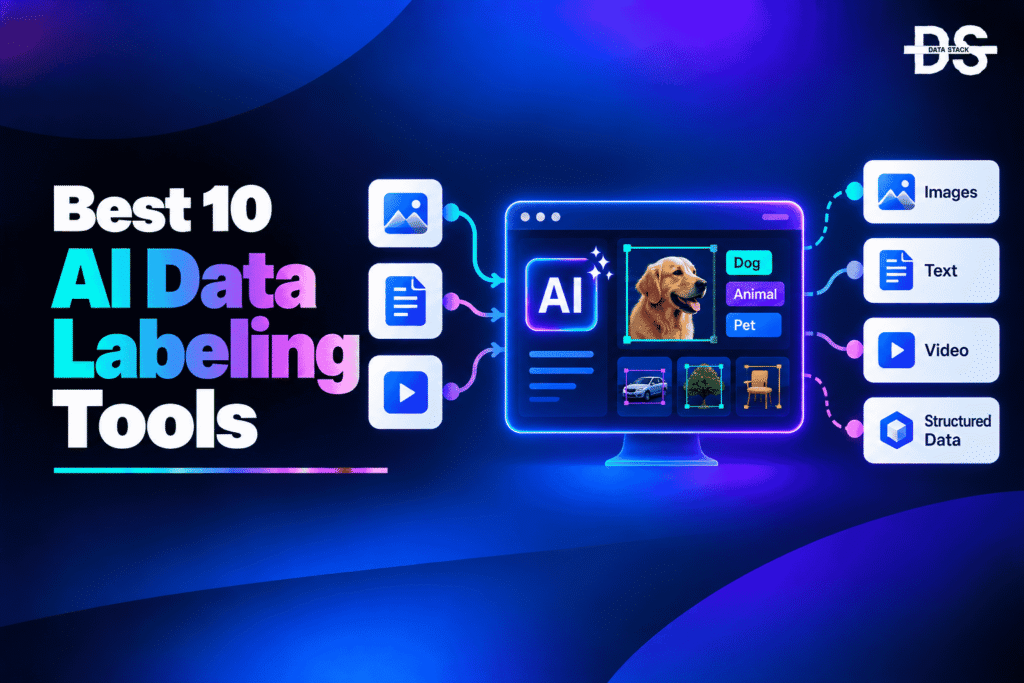
AI models depend on large volumes of high-quality training data, but raw data is rarely ready to use. Images, videos, text, audio, documents, and other datasets often need to be labeled, classified, segmented, or evaluated before they can be used to train and improve machine learning models. As AI projects scale, manually creating these annotations can become one of the most time-consuming parts of the development process.
AI data labeling tools use artificial intelligence and machine learning to make annotation workflows faster and more scalable. Instead of requiring human annotators to create every label manually, these tools can generate predictions, suggest annotations, automate repetitive tasks, identify difficult examples, and allow humans to review and correct AI-generated labels. This creates a human-in-the-loop workflow where AI handles predictable tasks while people focus on accuracy and edge cases.
The role of data labeling has also expanded with the growth of generative AI. Modern AI data labeling tools can support computer vision datasets as well as text, audio, video, documents, multimodal data, and datasets used for LLM training and evaluation. Some platforms provide capabilities for preference ranking, model-response evaluation, human feedback, and other workflows required to improve generative AI systems.
Choosing the right tool depends on the type of AI model being developed, the data that needs to be labeled, the level of automation required, and the amount of human review involved. The most suitable platform should not simply automate annotation; it should help teams create accurate, useful, and scalable AI training data while fitting into the broader machine learning workflow.
What Are AI Data Labeling Tools?
AI data labeling tools are software platforms that help teams annotate and organize data used to train, fine-tune, and evaluate artificial intelligence and machine learning models. They can support tasks such as image classification, object detection, segmentation, text classification, entity recognition, audio transcription, document annotation, and AI-output evaluation.
Traditional data labeling depends heavily on manual annotation. An annotator may draw a bounding box around an object, classify a document, identify an entity in a sentence, or evaluate an AI-generated response. AI-powered labeling introduces machine learning models into this process so that the system can generate initial predictions or recommendations before a human reviews them.
For example, an AI data labeling tool can identify objects in an image and create preliminary bounding boxes automatically. An annotator can then correct the predictions instead of drawing every box manually. In an LLM workflow, an AI labeling platform can help organize model responses before human reviewers rank them based on accuracy, relevance, safety, or another evaluation criterion.
The combination of AI automation and human review is particularly important because automatically generated labels are not always correct. AI data labeling tools therefore increasingly include active learning, quality control, review workflows, and dataset curation capabilities that help teams improve the quality of the data used by their AI models.
AI Data Labeling Tools vs. Traditional Data Labeling
| Capability | Traditional Data Labeling | AI Data Labeling |
|---|---|---|
| Annotation | Primarily manual | AI-assisted and manual |
| Pre-labeling | Limited | AI-generated predictions |
| Repetitive tasks | Mostly manual | Can be automated |
| Quality control | Human review | AI-assisted + human review |
| Active learning | Limited | Supported by many platforms |
| Data modalities | Often task-specific | Increasingly multimodal |
| LLM workflows | Limited | Evaluation and human-feedback support |
| Human-in-the-loop | Primarily manual | AI predictions + human validation |
| Model improvement | Usually separate | Can connect labeling with model workflows |
AI Data Labeling Tools Comparison
The comparison table below provides a quick overview of the best AI data labeling tools, highlighting their AI capabilities, automation features, best use cases, and G2 ratings.
These AI data labeling tools differ in how they use AI for automated labeling, model-assisted annotation, active learning, human feedback, quality control, and AI training data workflows.
| Tool | AI Capabilities | What You Can Automate | Best For | G2 Rating |
|---|---|---|---|---|
| SuperAnnotate | AI-assisted annotation, active learning, LLM workflows | Pre-labeling, annotation, QA, data curation | Multimodal AI training data | 4.8/5 |
| Encord | AI-assisted annotation, model-assisted labeling, active learning | Pre-labeling, review, curation, QA | Computer vision and multimodal AI | 4.8/5 |
| Labelbox | Model-assisted labeling, active learning, AI workflows | Pre-labeling, annotation, review | Enterprise AI training data | 4.5/5 |
| V7 Darwin | AI pre-labeling, predictive annotation, automated workflows | Annotation, tracking, QA, routing | Computer vision and document AI | 4.7/5 |
| Dataloop | AI-assisted annotation, active learning, automation | Annotation, QA, data workflows | Enterprise AI data operations | 4.4/5 |
| Scale AI | AI-assisted labeling, human feedback, LLM evaluation | Labeling, evaluation, feedback workflows | Generative AI and LLM training | 4.4/5 |
| Toloka | AI-assisted workflows, human feedback, LLM evaluation | Annotation, QA, routing, evaluation | LLM evaluation and human feedback | 4.0/5 |
| Label Studio | ML-assisted labeling, model predictions, active learning | Pre-labeling, annotation, review | Custom AI/ML labeling workflows | 3.5/5 |
8 Best AI Data Labeling Tools
Let’s take a closer look at the 8 best AI data labeling tools and explore their AI capabilities, automation features, and use cases for creating high-quality training and evaluation data.
#1. SuperAnnotate
SuperAnnotate is an AI data platform designed to help teams create, manage, and improve high-quality training data for machine learning and generative AI applications. It combines data annotation with dataset management, data curation, quality control, and human-feedback workflows, making it useful for AI teams that need to manage training data throughout the model development lifecycle. The platform supports multiple data modalities and can be used across computer vision, multimodal AI, and generative AI projects.
For AI data labeling, SuperAnnotate uses AI-assisted annotation to reduce the amount of repetitive manual work required from annotators. AI models can generate initial predictions or annotations that human reviewers can then verify, edit, or approve. This model-assisted approach allows teams to move through large datasets more efficiently while keeping humans involved when AI predictions are uncertain or incorrect.
SuperAnnotate also extends beyond basic annotation into AI-focused data workflows. Active learning can help teams identify valuable examples for additional labeling, while data curation and quality-control capabilities help improve the resulting dataset. Its support for LLM and human-feedback workflows also makes it relevant for teams creating training and evaluation data for newer generative AI systems.
Key Features
- AI-Assisted Annotation: SuperAnnotate can use AI-generated predictions to create initial annotations, allowing human annotators to review and correct the results instead of labeling every data point manually.
- Model-Assisted Labeling: Machine learning models can provide preliminary labels that speed up annotation workflows, particularly when a dataset contains many examples with similar labeling requirements.
- Active Learning: The platform can help teams identify data that requires additional attention, allowing annotation resources to be focused on examples that can provide greater value for improving AI models.
- AI Data Curation: Teams can organize, review, and refine datasets so that the data used for model training is more relevant, consistent, and useful.
- Multimodal Annotation: SuperAnnotate supports annotation workflows across different types of AI data, making it suitable for projects that work with more than a single data modality.
- LLM Data Workflows: The platform supports workflows for creating and managing data used in large language model and generative AI development.
- Human-in-the-Loop Review: Human reviewers can validate and correct AI-generated annotations, helping teams maintain quality when automated predictions are inaccurate or ambiguous.
- Quality Control: Annotation review and quality workflows help teams identify labeling problems before datasets are used for AI model training or evaluation.
G2 Rating: 4.8/5
Also Read: Best SuperAnnotate Alternatives and Competitors in 2026
Showcase your software to buyers actively comparing tools. Submit your product for editorial review and get featured on Data Stack Hub.
Submit Your Tool →#2. Encord
Encord is an AI data platform designed to help machine learning teams create, curate, and evaluate high-quality datasets for AI models. Its capabilities cover data labeling, dataset management, model evaluation, and data quality, with support for computer vision, multimodal AI, and other machine learning workflows. This makes Encord relevant for teams that need to manage training data across multiple stages of AI development rather than using a labeling tool only for basic annotation.
Encord uses AI-assisted labeling to reduce the amount of manual work involved in creating training datasets. Its model-assisted annotation capabilities can generate initial predictions that annotators can review, correct, and approve. AI-powered annotation can be particularly useful for large datasets because repetitive labeling tasks can be accelerated while human reviewers remain responsible for validating the final annotations.
The platform also connects AI data labeling with active learning and dataset curation. Teams can use model and data-quality signals to identify difficult or informative examples that require additional annotation, helping them focus human effort where it can have the greatest impact. This creates an iterative workflow in which labeling, dataset improvement, and model development can work together rather than operating as separate processes.
Key Features
- AI-Assisted Annotation: Encord uses AI models to help generate annotations and predictions, giving annotators a starting point instead of requiring every label to be created manually.
- Model-Assisted Labeling: Existing machine learning models can provide preliminary labels that human reviewers can validate and correct, helping accelerate large-scale annotation projects.
- Active Learning: Encord can help teams identify valuable or difficult samples that deserve additional human labeling, allowing annotation resources to be concentrated on data that can improve model performance.
- Automated Annotation: AI-powered annotation capabilities can handle portions of repetitive labeling work, reducing the manual effort required to prepare large training datasets.
- Multimodal Data Labeling: The platform supports annotation across different data types, making it suitable for AI projects that work with images, video, text, audio, documents, and other multimodal datasets.
- AI Data Curation: Encord helps teams identify, organize, and refine training data so that datasets contain useful and representative examples for AI model development.
- Model Evaluation: Teams can connect their datasets with model evaluation workflows to understand where models perform poorly and identify data that may require additional labeling or curation.
- Human-in-the-Loop Workflows: Human reviewers remain part of the AI labeling process, allowing teams to verify model-generated annotations and correct errors before the data is used for training or evaluation.
G2 Rating: 4.8/5
Also Read: Best Encord Alternatives and Competitors in 2026
#3. Labelbox
Labelbox is an AI data labeling and training-data platform designed to help organizations create, manage, and improve datasets for machine learning and artificial intelligence applications. It provides annotation capabilities across multiple data types and combines labeling with data management, quality control, model-assisted workflows, and active learning. This makes it useful for AI teams that need to build reliable datasets for computer vision, natural language, generative AI, and other machine learning applications.
Labelbox uses AI and machine learning models to accelerate the annotation process through model-assisted labeling and pre-labeling. Instead of requiring annotators to create every label manually, models can generate initial predictions that reviewers can inspect, modify, or approve. This approach is particularly useful for large datasets where many examples can be labeled with similar patterns, allowing human teams to spend more time on difficult or ambiguous cases.
The platform also supports an iterative approach to AI training data. Model predictions and labeling results can help teams identify data that needs additional annotation, while active learning can help prioritize examples that are more valuable for model improvement. By connecting AI-assisted labeling with dataset management and quality workflows, Labelbox can support the process from initial annotation through ongoing training-data improvement.
Key Features
- AI-Assisted Labeling: Labelbox uses AI and machine learning capabilities to assist with annotation, helping teams reduce the amount of repetitive manual labeling required to create training datasets.
- Model-Assisted Annotation: Machine learning models can generate preliminary annotations that human reviewers can validate and correct, making the labeling process faster while retaining human oversight.
- Machine Learning Pre-Labeling: Models can provide initial labels before an annotator reviews the data, allowing teams to start with AI-generated predictions rather than an empty annotation task.
- Active Learning: Labelbox can help teams focus annotation efforts on data that is more useful for improving their models, rather than spending equal effort across every unlabeled example.
- Automated Annotation: AI-powered workflows can automate portions of repetitive labeling tasks, which can be especially valuable when working with large training datasets.
- Multimodal Data Labeling: The platform supports different data modalities, allowing AI teams to create labeled datasets for a range of machine learning and artificial intelligence applications.
- Human-in-the-Loop Review: Annotators can review and correct AI-generated labels, helping prevent incorrect predictions from becoming part of the final training dataset.
- Training Data Management: Labelbox helps teams organize and manage labeled datasets throughout the AI development process, making it easier to maintain and improve training data over time.
G2 Rating: 4.5/5
Also Read: Best Labelbox Alternatives and Competitors in 2026
#4. V7 Darwin
V7 Darwin is an AI data labeling platform designed primarily for teams building computer vision and document AI applications. It supports annotation workflows for images, video, documents, medical imaging, and other complex visual datasets used to train machine learning models. Its focus on AI-assisted annotation makes it particularly relevant for projects where labeling large numbers of visual examples manually would require significant time and resources.
V7 Darwin uses machine learning to generate predictions and preliminary annotations that can be reviewed by human annotators. Instead of drawing every bounding box, segmentation mask, or other annotation from scratch, teams can use AI-generated labels as a starting point and correct them when necessary. This model-assisted approach can accelerate repetitive visual annotation while keeping humans responsible for the accuracy of the final dataset.
The platform also supports more advanced AI data workflows for visual datasets, including object tracking across video frames, automated annotation, and workflow automation. These capabilities are useful when AI teams need to create consistent datasets for computer vision models that detect, classify, segment, or track objects. By combining AI predictions with human review, V7 Darwin can help teams move from raw visual data to training-ready datasets more efficiently.
Key Features
- AI-Assisted Labeling: V7 Darwin uses machine learning models to generate initial annotations, helping annotators complete visual labeling tasks faster than starting each annotation manually.
- Machine Learning Pre-Labeling: AI models can predict labels before human review, giving annotation teams a ready-made starting point that can be corrected when predictions are inaccurate.
- Object Detection: AI-assisted workflows can help identify and annotate objects within images, creating structured training data for computer vision models that need to recognize specific objects.
- Image Segmentation: The platform supports detailed segmentation workflows that allow AI teams to create training data showing the precise regions or boundaries of objects within visual data.
- Video Object Tracking: AI can assist with tracking objects across video frames, reducing the repetitive work involved in manually labeling the same object throughout a sequence.
- Automated Annotation: AI-powered annotation capabilities can automate portions of repetitive visual labeling tasks, making large computer vision datasets more manageable.
- Automated Workflow Routing: V7 Darwin can automate parts of the annotation workflow by routing tasks according to project requirements, helping teams manage labeling operations more efficiently.
- Human-in-the-Loop Review: Human annotators can review, correct, and validate AI-generated annotations so that automated predictions do not compromise the quality of the final training dataset.
G2 Rating: 4.7/5
Also Read: Best V7 Alternatives and Competitors in 2026
#5. Dataloop
Dataloop is an AI data platform that combines data labeling, dataset management, annotation workflows, and AI data operations for teams developing machine learning and computer vision applications. It is designed to help organizations manage the large and continuously changing datasets required to train, evaluate, and improve AI models. Its labeling environment supports multiple data types and can be integrated into broader machine learning workflows.
Dataloop uses AI-assisted annotation and automation to reduce repetitive work during the data-labeling process. AI models can generate predictions or preliminary annotations that human annotators review and correct, allowing teams to process large datasets without manually creating every label. This approach is especially useful when the same types of objects, classifications, or patterns occur repeatedly across a dataset.
Beyond annotation, Dataloop supports active learning and data-quality workflows that connect labeling with model improvement. Teams can identify difficult examples, send selected data back for additional annotation, and continuously refine their datasets as models evolve. This makes the platform useful for AI teams that want labeling to be part of an ongoing model-development lifecycle rather than a one-time data-preparation task.
Key Features
- AI-Assisted Annotation: Dataloop uses AI capabilities to assist with annotation tasks, helping teams reduce repetitive manual work when creating datasets for machine learning models.
- Model-Assisted Labeling: AI models can provide preliminary predictions that annotators can review and correct, allowing human teams to work from AI-generated starting points.
- Active Learning: Dataloop can help identify data that requires additional annotation or review, allowing teams to focus human labeling resources on examples that are more important for model improvement.
- Automated Labeling Workflows: AI and workflow automation can handle repetitive parts of the annotation process, helping teams process larger datasets with less manual intervention.
- AI Data Curation: Teams can organize, filter, and refine datasets to identify useful training examples and maintain higher-quality data for AI model development.
- Automated Quality Control: Quality workflows help identify annotation problems and provide review processes for checking whether AI-generated or human-created labels meet project requirements.
- Human-in-the-Loop Review: Human annotators can validate AI-generated predictions and correct inaccurate labels before the data is used to train or evaluate AI models.
- Machine Learning Data Operations: Dataloop connects annotation with broader AI data workflows, allowing teams to manage data preparation, labeling, review, and model-related processes within a connected environment.
G2 Rating: 4.4/5
Also Read: Best Dataloop Alternatives and Competitors (2026)
Increase your product visibility by reaching software buyers researching the best tools. Every submission is reviewed by our editorial team.
Feature My Tool →#6. Scale AI
Scale AI is an AI data platform focused on providing high-quality training and evaluation data for machine learning and generative AI systems. It combines data annotation, human-in-the-loop workflows, model evaluation, and AI data operations to support organizations developing advanced AI models. Its capabilities extend beyond traditional image and text labeling, making it relevant for teams working with computer vision, large language models, and other generative AI applications.
Scale AI uses a combination of AI automation and human expertise to accelerate data labeling and evaluation. Automated processes can help handle repetitive parts of data preparation, while human reviewers provide judgments for tasks where context, reasoning, or domain expertise is required. This approach is particularly important for complex AI datasets where simply assigning predefined labels is not enough to determine whether a model’s output is useful or correct.
Its capabilities are also relevant to LLM training and evaluation, where human feedback can become an important source of AI training data. Teams can evaluate model responses, compare outputs, assess quality against defined criteria, and generate structured feedback that can be used to improve AI systems. This makes Scale AI particularly useful for organizations that need both conventional data labeling and human-feedback workflows for generative AI.
Key Features
- AI-Assisted Data Labeling: Scale AI combines automated data-processing capabilities with human annotation to accelerate the creation of datasets used to train and improve AI models.
- Human-in-the-Loop Workflows: Human reviewers can provide judgments and corrections where automated systems cannot reliably determine the quality or meaning of a data sample.
- LLM Evaluation: The platform supports workflows for evaluating large language model outputs, allowing teams to assess responses against specific quality, accuracy, safety, or task-related criteria.
- Human Feedback Collection: Teams can collect structured human judgments about AI-generated outputs, creating feedback data that can be used to improve and evaluate generative AI systems.
- Model Response Comparison: Reviewers can compare multiple AI-generated responses and identify which output better satisfies a defined task or evaluation requirement.
- Generative AI Data Workflows: Scale AI supports data workflows designed around modern generative AI development, where training and evaluation data can include human preferences and model-output assessments.
- Automated Data Processing: Automation can reduce repetitive work involved in preparing, organizing, and processing data before it reaches human reviewers.
- AI Model Evaluation: Human and automated evaluation workflows can help teams identify weaknesses in AI models and generate data that supports subsequent model improvement.
G2 Rating: 4.4/5
Also Read: Best Scale AI Alternatives and Competitors in 2026
#7. Toloka
Toloka is an AI data platform that provides data labeling, human feedback, and evaluation workflows for teams developing machine learning and generative AI systems. Its platform is designed to help organizations create high-quality datasets by combining automated processes with human judgment. While it can support conventional annotation tasks, Toloka is particularly relevant to AI projects involving large language models, AI evaluation, and human feedback.
Toloka’s AI capabilities can help teams build and manage labeling workflows without requiring every component to be configured manually. Its AI-assisted approach can help create task instructions, annotation workflows, and quality-control processes based on the requirements of an AI project. Human annotators can then perform the required labeling or evaluation while automated quality mechanisms help maintain consistency across the resulting dataset.
The platform is particularly useful for generative AI workflows where the required training data is based on human judgments rather than simple object or category labels. Teams can use Toloka to evaluate AI-generated responses, compare outputs, collect preferences, assess response quality, and create structured human-feedback data. These workflows can support the development and evaluation of LLMs and other AI systems where human judgment is an important part of the training or evaluation process.
Key Features
- AI-Assisted Workflow Design: Toloka can use AI to help turn natural-language requirements into components of a data-labeling workflow, reducing the manual effort required to configure complex annotation projects.
- LLM Evaluation: The platform supports human evaluation of large language model outputs, allowing teams to assess responses according to criteria such as relevance, quality, accuracy, or safety.
- Human Feedback Collection: Teams can gather structured human judgments about AI outputs and use that information as feedback for training, fine-tuning, or evaluating AI systems.
- AI-Assisted Annotation: AI capabilities can help support parts of the annotation process, allowing human workers to focus on judgments that require greater attention or contextual understanding.
- Automated Quality Control: Quality mechanisms can help identify inconsistent annotations and maintain reliable results across large human-feedback and labeling projects.
- Skill-Based Task Routing: Tasks can be routed according to the skills or requirements needed for a particular labeling or evaluation workflow, helping match complex AI tasks with appropriate reviewers.
- AI Response Evaluation: Teams can create workflows where human reviewers assess AI-generated responses against predefined criteria, producing structured evaluation data for model development.
- Human-in-the-Loop Infrastructure: Toloka combines automated AI capabilities with human judgment, making it suitable for AI workflows where fully automated labeling would not provide sufficient accuracy or context.
G2 Rating: 4.0/5
Also Read: Best Toloka Alternatives and Competitors in 2026
#8. Label Studio
Label Studio is an open-source data labeling platform that allows AI and machine learning teams to create customized annotation workflows for training and evaluating models. It supports a wide range of data types and labeling tasks, including images, text, audio, video, documents, and time-series data. Its open-source architecture makes it particularly useful for technical teams that want greater control over their labeling environment and the ability to integrate annotation directly with their existing AI infrastructure.
Label Studio can incorporate machine learning models into the annotation process to provide AI-generated predictions and pre-labels. Instead of requiring annotators to label every example manually, teams can connect a model to the labeling workflow and use its predictions as a starting point. Annotators can then review, modify, or approve those predictions, creating a human-in-the-loop process that combines model automation with human validation.
The platform is also useful for teams that want to build customized AI data workflows rather than rely entirely on a fixed annotation environment. Machine learning integrations can connect labeling projects with external models and pipelines, while active-learning workflows can help teams use model predictions to determine which examples should receive additional attention. This makes Label Studio suitable for AI teams that need flexibility across different training-data and model-evaluation use cases.
Key Features
- ML-Assisted Labeling: Label Studio can connect machine learning models to annotation projects so that AI-generated predictions can assist annotators during the labeling process.
- AI Pre-Labeling: Models can generate preliminary annotations before human review, giving annotators a starting point and reducing the amount of repetitive work required for large datasets.
- Active Learning: Teams can use model predictions and annotation results to identify data that may require additional labeling, helping focus human effort on more informative examples.
- Custom AI Workflows: Label Studio allows technical teams to build annotation interfaces and workflows around specific AI tasks, datasets, and model requirements rather than relying on a fixed labeling configuration.
- Human-in-the-Loop Annotation: Annotators can review and correct AI-generated predictions, ensuring that automated labels are validated before being incorporated into training or evaluation datasets.
- Multimodal Data Labeling: The platform supports different data types and annotation tasks, allowing teams to build datasets for computer vision, natural language processing, speech, and other AI applications.
- Machine Learning Integration: Teams can connect external machine learning models and AI pipelines with labeling projects, making it possible to incorporate annotation into existing model-development workflows.
- Open-Source AI Labeling: Its open-source architecture gives technical teams greater flexibility to customize, integrate, and manage their AI data-labeling environment according to their infrastructure requirements.
G2 Rating: 3.5/5
Also Read: Best Label Studio Alternatives and Competitors (2026)
How to Choose the Right AI Data Labeling Tool
Choosing the right AI data labeling tool depends on the type of AI model you are building, the data you need to annotate, and how much of the labeling process you want to automate. Focus on the following factors:
- AI-Assisted Labeling: Check whether the platform can generate AI predictions, pre-label data, or automatically create annotations. These capabilities can significantly reduce repetitive manual labeling work.
- Data Types and AI Use Cases: Make sure the tool supports the data your AI project requires, such as images, video, text, audio, documents, 3D data, or multimodal datasets.
- Model-Assisted Annotation: Look for the ability to connect your own machine learning models or use built-in models to generate preliminary annotations that human reviewers can validate.
- Active Learning: Consider whether the platform can identify uncertain, difficult, or valuable samples so your team can prioritize the data that is most useful for improving the AI model.
- LLM and Generative AI Support: If you are developing generative AI applications, check for capabilities such as LLM response evaluation, preference ranking, human feedback, and AI-output assessment.
- Human-in-the-Loop Workflows: AI-generated labels still require validation for many use cases. Look for workflows that allow humans to review, correct, and approve AI-generated annotations efficiently.
- AI Quality Control: Evaluate whether the platform provides automated quality checks, annotation validation, reviewer workflows, and mechanisms for detecting inconsistent AI-generated or human-created labels.
- AI Workflow Integration: Check whether the tool can connect with your existing machine learning models, data pipelines, cloud storage, APIs, and AI development infrastructure.
- Automation and Scalability: Consider how much of the labeling workflow can be automated and whether the platform can handle your expected dataset size, annotation volume, and AI model workloads.
- Dataset Improvement: Look beyond initial labeling and evaluate whether the platform helps you continuously curate, refine, and improve training data as your AI models evolve.
Browse expertly curated software recommendations across hundreds of business categories.
Browse Top Tools →Conclusion
AI data labeling is no longer limited to manually assigning labels to raw datasets. Modern AI data labeling tools use machine learning, automation, active learning, and human-in-the-loop workflows to help teams create training and evaluation data more efficiently. This is particularly important as AI projects move from relatively small datasets to large-scale multimodal and generative AI workloads.
The tools covered in this article take different approaches to AI-assisted data labeling. Platforms such as SuperAnnotate, Encord, Labelbox, V7 Darwin, and Dataloop provide AI-assisted annotation and dataset workflows for teams working with machine learning and computer vision data. Scale AI and Toloka are particularly relevant to workflows involving LLM evaluation, human feedback, and generative AI. Label Studio provides an open-source option for teams that need customizable AI-assisted labeling workflows.
The right choice depends on your specific AI workflow. Computer vision teams may prioritize AI-powered object detection, segmentation, tracking, and pre-labeling, while generative AI teams may need LLM evaluation, response comparison, preference data, and human-feedback capabilities.
AI automation should also be evaluated alongside annotation quality. Automatically generated labels can accelerate dataset creation, but incorrect predictions can introduce errors into training data. Human review, quality control, and active learning therefore remain important components of many AI labeling workflows.
Before selecting a platform, test it with representative data from your own AI project. Evaluate how accurately its AI capabilities generate labels, how much manual work they eliminate, how easily humans can correct predictions, and how well the platform integrates with your existing model-development workflow.
Ultimately, the goal of an AI data labeling tool is not simply to automate annotation. It is to help AI teams create high-quality training and evaluation data faster, more consistently, and at the scale required to develop better AI models.
Frequently Asked Questions
1. What are AI data labeling tools?
AI data labeling tools are platforms that use AI and machine learning to help teams annotate, organize, and evaluate data used to train, fine-tune, and test AI models. They can generate predictions, create preliminary labels, automate repetitive annotation tasks, and support human review.
2. How does AI data labeling work?
AI data labeling typically uses a machine learning model to generate an initial prediction or annotation for a data sample. A human annotator can then review, correct, or approve that prediction. The verified data can be used to train, fine-tune, or evaluate an AI model.
3. What is AI-assisted data labeling?
AI-assisted data labeling uses artificial intelligence to help humans create annotations more efficiently. Instead of manually labeling every example, an AI model can generate preliminary labels that annotators review and correct.
4. Can AI automatically label training data?
Yes. AI models can automatically generate labels or pre-label datasets for many tasks. However, the accuracy of automated labeling depends on the model, data, and task, so human review can still be important for ambiguous or complex examples.
5. What types of data can AI labeling tools annotate?
Depending on the platform, AI data labeling tools can support images, video, text, audio, documents, 3D data, and multimodal datasets. Different tools specialize in different data types and AI applications.
6. What is model-assisted labeling?
Model-assisted labeling uses a machine learning model to generate preliminary annotations for unlabeled data. Human annotators then review and correct those predictions, allowing AI to handle part of the repetitive labeling process.
7. What is active learning in AI data labeling?
Active learning is an AI labeling approach where a model helps identify the data samples that are most valuable to label. This can include uncertain, difficult, or representative examples that may provide useful information for improving the model.
8. Can AI data labeling tools be used for LLMs?
Yes. Some AI data labeling platforms support LLM evaluation, response comparison, preference ranking, human feedback, and AI-output assessment. These workflows can help create data for training, fine-tuning, and evaluating generative AI systems.
9. What is human-in-the-loop AI labeling?
Human-in-the-loop AI labeling combines AI automation with human judgment. AI generates predictions or annotations, while human reviewers verify, correct, or approve them before the data is used for AI training or evaluation.
10. Can AI data labeling replace human annotators?
AI can automate many repetitive labeling tasks, but it does not necessarily eliminate human annotation. Human reviewers can still be important for complex examples, edge cases, subjective evaluations, and quality control.
11. What are the best AI data labeling tools in 2026?
The AI data labeling tools covered in this article are SuperAnnotate, Encord, Labelbox, V7 Darwin, Dataloop, Scale AI, Toloka, and Label Studio. They support different combinations of AI-assisted annotation, automated labeling, active learning, multimodal data, LLM evaluation, and human feedback.
12. How can AI improve data labeling?
AI can improve labeling efficiency by generating preliminary annotations, identifying difficult samples, automating repetitive tasks, assisting with quality control, and helping teams prioritize data for human review. This can reduce manual effort while maintaining human oversight.
13. What is AI pre-labeling?
AI pre-labeling occurs when a machine learning model generates initial labels before a human annotator reviews the data. For example, a computer vision model can identify objects and create preliminary bounding boxes that an annotator can validate or correct.
14. What is the difference between AI data labeling and traditional data labeling?
Traditional data labeling relies primarily on humans to create annotations manually. AI data labeling combines human annotation with AI-generated predictions, automation, active learning, and model-assisted workflows to accelerate the creation of training and evaluation data.
15. Which AI data labeling tools support LLM evaluation?
Tools such as Scale AI, Toloka, and SuperAnnotate support workflows relevant to LLM evaluation and human feedback. These workflows can include evaluating model responses, comparing outputs, collecting human preferences, and generating structured feedback data for AI systems.