
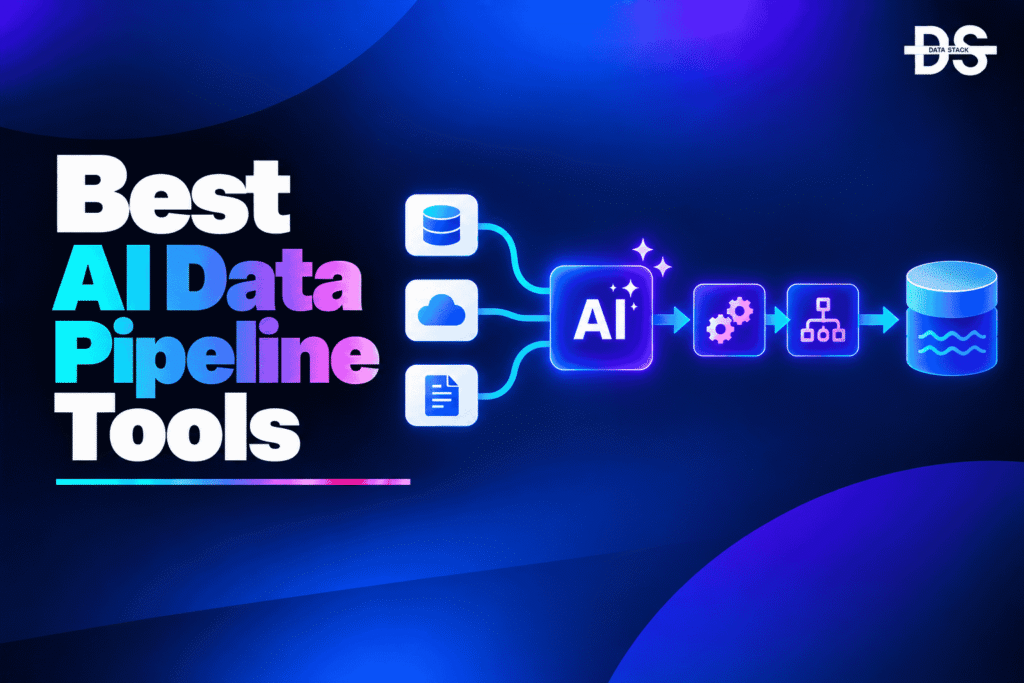
Data pipelines connect the systems that produce data with the platforms where that data is stored, transformed, analyzed, and used by AI applications. Modern pipelines can involve ingestion, transformation, orchestration, streaming, schema changes, quality checks, and delivery across multiple environments, making them increasingly difficult to build and maintain manually.
AI data pipeline tools add artificial intelligence and machine learning to these workflows to reduce repetitive engineering work. Depending on the platform, AI can help generate pipeline code, create transformations, understand schemas, troubleshoot failed jobs, recommend workflow changes, and assist with building pipelines for AI and machine learning workloads.
The role of AI varies considerably across the category. Some platforms use GenAI to help engineers create pipelines from natural-language requirements, while others apply AI to pipeline optimization, intelligent orchestration, schema management, or development assistance. Tools such as Databricks, Dagster, Prefect, Airflow, Fivetran, and Airbyte address different parts of the pipeline lifecycle, including orchestration, ingestion, transformation, and pipeline management.
This list focuses on tools where AI meaningfully contributes to data pipeline development or operation, rather than simply including a generic AI chatbot. The goal is to identify platforms that can help data teams build, automate, monitor, or maintain pipelines more efficiently while preparing reliable data for analytics, machine learning, and modern AI applications.
What Are AI Data Pipeline Tools?
AI data pipeline tools are software products that use generative AI, machine learning, or intelligent automation to help teams build, operate, optimize, and maintain data pipelines. They can assist with pipeline creation, code generation, transformation logic, schema handling, workflow orchestration, error troubleshooting, and other repetitive engineering tasks.
Traditional pipeline development often requires engineers to manually configure ingestion, write transformation code, define dependencies, schedule workflows, and investigate failures. AI data pipeline tools can add an intelligent layer to these processes by allowing engineers to describe requirements in natural language, generate pipeline components, identify potential issues, and automate parts of pipeline development and maintenance.
The category includes different types of tools. Some focus primarily on AI-assisted pipeline development and orchestration, while others specialize in intelligent data ingestion, connector creation, transformation, or operational automation. For example, Databricks is increasingly positioning Lakeflow around agentic data engineering, while Airbyte provides AI assistance for connector development. Dagster focuses on orchestration of data and AI pipelines and integrates with tools across the modern data stack.
AI Data Pipeline Tools vs. Traditional Data Pipeline Tools
The comparison table below provides a quick overview of the best AI data pipeline tools and solutions, highlighting their AI capabilities, automation features, and primary pipeline use cases.
| Capability | Traditional Data Pipelines | AI Data Pipelines |
|---|---|---|
| Pipeline development | Engineers manually configure workflows and write code | AI can generate or assist with pipeline components |
| Code generation | SQL, Python, and other code are written manually | GenAI can generate code from natural-language requirements |
| Data transformation | Engineers manually define transformation logic | AI can recommend or generate transformation logic |
| Schema handling | Changes are identified through rules or manual investigation | AI can help interpret schema changes and recommend responses |
| Error troubleshooting | Engineers inspect logs and failed tasks manually | AI can explain errors and suggest potential fixes |
| Workflow orchestration | Uses manually configured schedules and dependencies | AI can assist with workflow creation and optimization |
| Pipeline optimization | Engineers analyze performance and resource usage | AI/ML can identify patterns and recommend improvements |
| Documentation | Pipeline documentation is created and maintained manually | AI can generate explanations and documentation |
| Natural-language interaction | Primarily code and visual configuration | Engineers can describe supported pipeline requirements in natural language |
| Automation | Mostly rule-based and predefined | AI-assisted and increasingly context-aware automation |
AI Data Pipeline Tools Comparison
The comparison table below provides a quick overview of the best AI data pipeline tools, highlighting their AI capabilities, automation features, and primary pipeline use cases.
| Tool | AI Capabilities | What You Can Automate | Primary Pipeline Focus | Best For |
|---|---|---|---|---|
| Databricks | AI-assisted pipeline development, intelligent data engineering, natural-language assistance | Pipeline development, transformation, orchestration, monitoring, optimization | Data engineering and pipelines | Enterprise data teams |
| AWS Glue | ML-assisted data discovery, intelligent data integration, generative AI assistance | Data ingestion, transformation, cataloging, pipeline creation | Cloud data integration | AWS environments |
| Google Cloud Dataflow | AI-assisted development, intelligent pipeline monitoring and optimization | Batch processing, stream processing, transformations | Data processing pipelines | Google Cloud users |
| Azure Data Factory | AI-assisted pipeline development and data integration | Data ingestion, transformation, orchestration | Cloud data integration | Microsoft environments |
| Snowflake | AI-assisted data engineering, SQL assistance, intelligent automation | Data transformation, pipeline workflows, data processing | Cloud data pipelines | Snowflake users |
| Fivetran | AI-assisted connector and pipeline management, intelligent automation | Data ingestion, replication, schema handling | Automated data movement | ELT teams |
| Matillion | AI-assisted pipeline development and transformation | Data ingestion, transformation, orchestration | Cloud data integration | Modern data teams |
| Airbyte | AI-assisted connector and pipeline workflows | Data ingestion, replication, connector configuration | Data movement | Engineering teams |
| Informatica | AI-powered CLAIRE intelligence, intelligent data integration | Data integration, mapping, transformation, pipeline management | Enterprise data integration | Large enterprises |
| Talend | AI-assisted data integration, quality and pipeline management | Data integration, transformation, quality workflows | Data integration and quality | Enterprise data teams |
9 Best AI Data Pipeline Tools and Solutions
Let’s take a closer look at the 9 best AI data pipeline tools and solutions and explore how their AI capabilities can support modern data pipeline workflows.
#1. Databricks
Databricks is a unified data and AI platform with extensive capabilities for building, orchestrating, and managing data pipelines. Its Lakeflow suite brings together data ingestion, transformation, orchestration, and pipeline management, while Databricks Assistant and other AI capabilities provide intelligent assistance throughout the data engineering workflow. This combination makes Databricks relevant for teams that want AI-assisted pipeline development alongside their broader lakehouse infrastructure.
Databricks can use generative AI to help engineers write and explain SQL and code, troubleshoot pipeline-related issues, and accelerate the development of data transformations. Lakeflow also supports declarative pipeline development, allowing engineers to define the desired state of their data workflows while the platform handles aspects of pipeline execution and management. AI assistance can therefore complement both traditional and declarative approaches to pipeline engineering.
For example, an engineer can describe a required transformation, use AI assistance to generate the initial SQL or code, incorporate it into a Lakeflow pipeline, and then use the resulting workflow to continuously prepare data for analytics or AI applications. The engineer remains responsible for validating the generated logic, dependencies, and production behavior.
AI Capabilities
- AI-assisted pipeline development: Helps engineers create and modify pipeline logic using generative AI assistance.
- AI code generation: Generates SQL and supported programming code from natural-language requirements.
- Pipeline troubleshooting assistance: Helps engineers understand errors and investigate issues in data workflows.
- AI-assisted transformations: Generates or refines transformation logic used within data pipelines.
- Natural-language development: Allows engineers to describe supported engineering requirements without manually writing every component.
- Intelligent data engineering: Combines AI assistance with Lakeflow’s ingestion, transformation, and orchestration capabilities.
- AI development support: Helps prepare data pipelines for downstream machine learning and generative AI workloads.
What You Can Automate
- Pipeline development: Accelerate creation of ingestion and transformation pipelines.
- Data ingestion: Bring data from supported sources into lakehouse environments.
- SQL generation: Generate queries used for filtering, joining, aggregating, and transforming pipeline data.
- Data transformation: Automate recurring transformations within pipeline workflows.
- Pipeline orchestration: Coordinate ingestion and transformation processes across dependent workflows.
- Error investigation: Use AI assistance to understand pipeline and code errors.
- Data preparation: Prepare continuously updated datasets for analytics, machine learning, and AI applications.
- Pipeline maintenance: Modify and maintain workflows as data requirements change.
- AI data pipelines: Build repeatable workflows that prepare enterprise data for downstream AI workloads.
Best For
Data engineering teams that need AI-assisted pipeline development and orchestration within a unified lakehouse and AI platform.
AI Verdict
Databricks is particularly relevant when AI needs to be integrated into the full data pipeline lifecycle, from ingestion and transformation through orchestration and preparation for AI workloads. Its AI assistance can reduce repetitive engineering work, while Lakeflow provides the underlying pipeline infrastructure. Generated code and transformations still need engineering validation before production deployment.
Also Read: Best Databricks Alternatives and Competitors
Showcase your software to buyers actively comparing tools. Submit your product for editorial review and get featured on Data Stack Hub.
#2. Fivetran
Fivetran is an automated data movement platform that helps organizations continuously replicate data from applications, databases, APIs, and other sources into cloud warehouses, lakehouses, and other destinations. Its value in AI-powered data pipelines comes primarily from reducing the manual work involved in building and maintaining ingestion workflows, while its AI capabilities increasingly assist developers with integration and connector-related tasks.
Fivetran automates much of the operational work behind data pipelines, including connector configuration, incremental data movement, schema handling, and synchronization. Its AI-assisted capabilities can help developers work with integration requirements and troubleshoot pipeline issues, while automated schema management reduces the need for engineers to manually modify pipelines every time an upstream source changes.
For example, a data engineering team can continuously replicate customer, product, or application data into a cloud warehouse and then use downstream transformation and AI systems to process that information. Fivetran is therefore particularly useful when the primary challenge is maintaining reliable, continuously updated data pipelines rather than generating complex transformation logic from scratch.
AI Capabilities
- AI-assisted data engineering: Provides intelligent assistance for supported integration and pipeline development tasks.
- AI-assisted connector development: Helps developers work with connector-related development and customization.
- Intelligent schema handling: Automatically manages many supported source-schema changes as data structures evolve.
- AI-assisted troubleshooting: Helps teams investigate integration and pipeline-related issues.
- Intelligent pipeline management: Reduces manual intervention required to keep data movement workflows operating.
- Context-aware integration assistance: Uses information about integrations and pipeline workflows to support development and troubleshooting.
- AI-supported data workflows: Combines intelligent assistance with automated data replication and synchronization.
What You Can Automate
- Data ingestion: Automatically ingest data from supported applications, databases, APIs, and other sources.
- Data replication: Continuously replicate source data into supported cloud destinations.
- Incremental synchronization: Move new or changed records without repeatedly transferring the entire dataset where supported.
- Schema management: Automatically handle many supported schema changes without manually rebuilding pipelines.
- Pipeline maintenance: Reduce repetitive engineering work required to maintain connectors and data movement.
- Data synchronization: Keep source and destination data aligned through recurring automated workflows.
- Pipeline monitoring: Monitor data movement and surface operational problems.
- AI data ingestion: Continuously provide updated information to analytics, machine learning, and AI workflows.
- Integration operations: Automate recurring data movement tasks that would otherwise require manual engineering intervention.
Best For
Organizations that need highly automated data ingestion and synchronization and want to reduce the engineering effort required to maintain continuously running data pipelines.
AI Verdict
Fivetran’s AI value is closely connected to its broader automation approach. Rather than positioning GenAI as the primary way to build an entire pipeline from natural-language instructions, it focuses heavily on automating the operational side of data movement and adding intelligent assistance around integration workflows. This makes it particularly relevant when pipeline reliability and reduced maintenance effort are the main priorities.
Also Read: Best Fivetran Alternatives and Competitors in 2026
#3. Airbyte
Airbyte is an open data integration platform for moving data from applications, databases, APIs, files, and other sources into warehouses, lakehouses, and other destinations. Its AI capabilities are particularly relevant to connector development and pipeline creation, helping engineers reduce the manual effort involved in building integrations and maintaining data movement workflows.
Airbyte provides a large connector ecosystem for data ingestion, while its AI-assisted development capabilities can help developers create and modify connectors and integration logic. Instead of manually writing every component required to connect a new source, engineers can use AI assistance to accelerate development and then review the resulting implementation. This approach is useful for organizations with custom data sources or integration requirements that go beyond prebuilt connectors.
For example, an engineering team could use Airbyte to continuously ingest data from a business application into a cloud warehouse, while AI assistance helps develop or customize the connector needed for that source. The resulting pipeline can then feed downstream transformation, analytics, machine learning, or generative AI workflows.
AI Capabilities
- AI-assisted connector development: Helps developers create and modify connectors for supported and custom data sources.
- AI coding assistance: Helps generate or refine code used in connector and integration development.
- Natural-language development assistance: Allows engineers to describe supported connector requirements and receive AI-generated development assistance.
- Intelligent integration development: Reduces repetitive coding work involved in creating data ingestion workflows.
- AI-assisted troubleshooting: Helps investigate connector and pipeline issues during development and maintenance.
- Context-aware development: Provides assistance based on the requirements and code involved in the integration workflow.
- AI-supported pipeline development: Combines AI development assistance with automated data movement capabilities.
What You Can Automate
- Data ingestion: Automatically extract information from applications, databases, APIs, and other supported sources.
- Data replication: Continuously replicate source data into warehouses, lakehouses, and other destinations.
- Connector development: Accelerate the creation and customization of data connectors.
- Pipeline creation: Build repeatable source-to-destination data movement workflows.
- Incremental data synchronization: Move new and changed records where supported instead of repeatedly transferring complete datasets.
- Schema synchronization: Keep destination structures aligned with supported source changes.
- Pipeline maintenance: Reduce manual effort when integration requirements or source systems change.
- AI data ingestion: Continuously deliver source data to downstream machine learning and AI workflows.
- Integration operations: Automate recurring extraction and loading processes across connected systems.
Best For
Data engineering teams that need flexible data ingestion and connector development, particularly when they work with many different sources or need to build custom integrations.
AI Verdict
Airbyte’s AI value is strongest around connector and integration development rather than AI-generated end-to-end data transformation. Its combination of AI-assisted development and automated data movement can reduce the work required to bring new sources into a data environment. Engineers should still review generated connector logic and test data synchronization before using custom integrations in production.
Also Read: Airbyte Alternatives and Competitors
#4. Prefect
Prefect is a workflow orchestration platform designed to help data teams build, schedule, monitor, and manage data and AI pipelines. Its approach to AI data pipelines centers on AI-assisted workflow development and orchestration, allowing engineers to combine Python-based pipeline development with intelligent assistance for building and operating workflows.
Prefect supports modern data workflows through flows, tasks, deployments, scheduling, retries, observability, and event-driven automation. Its AI-oriented capabilities can help engineers work with pipeline code and orchestration logic, while the platform handles operational requirements such as task dependencies, retries, scheduling, and workflow execution. This makes it useful for teams that need more control over pipeline behavior than a simple scheduled ETL process provides.
Prefect is also designed to orchestrate workflows involving machine learning and AI systems. For example, a team can create a pipeline that ingests data, runs transformations, invokes an AI or machine learning process, validates the resulting data, and triggers downstream tasks based on the outcome. AI assistance can help with development, while Prefect provides the orchestration layer needed to run the workflow reliably.
AI Capabilities
- AI-assisted workflow development: Helps engineers develop pipeline and orchestration logic more efficiently.
- AI coding assistance: Supports development of Python-based workflow code and pipeline components.
- Natural-language development: Can assist engineers in translating workflow requirements into implementation logic.
- AI workflow orchestration: Supports workflows where AI and machine learning tasks form part of a broader pipeline.
- Intelligent workflow assistance: Helps reduce repetitive development work involved in creating and maintaining flows.
- AI pipeline development: Allows data teams to incorporate AI tasks into orchestrated workflows.
- Context-aware engineering assistance: Helps developers work with workflow code and dependencies within their engineering environment.
What You Can Automate
- Pipeline orchestration: Coordinate multiple tasks and dependencies within data workflows.
- Workflow scheduling: Schedule recurring pipeline executions.
- Task execution: Run individual data engineering, transformation, machine learning, or AI tasks as part of a workflow.
- Retries and recovery: Automatically retry failed tasks based on configured workflow behavior.
- Data ingestion: Orchestrate extraction and loading processes across connected systems.
- Data transformation: Coordinate transformation tasks and their dependencies.
- AI workflows: Orchestrate workflows involving model inference, AI APIs, evaluation, and downstream processing.
- Event-driven pipelines: Trigger workflows based on supported events and conditions.
- Pipeline monitoring: Track workflow execution and identify failed or problematic tasks.
Best For
Data teams that need flexible workflow orchestration for data, machine learning, and AI pipelines, particularly when Python is central to their engineering workflows.
AI Verdict
Prefect is most relevant when AI needs to operate as part of a reliable, orchestrated workflow rather than as an isolated development assistant. Its strength is combining workflow orchestration with support for AI and machine learning tasks, allowing teams to coordinate ingestion, transformation, model execution, and downstream processing. AI-assisted development can accelerate workflow creation, but production reliability still depends on proper task design, testing, retries, and monitoring.
Also Read: Best Prefect Alternatives and Competitors in 2026
#5. Dagster
Dagster is a data orchestration platform designed to build, run, and monitor data and AI pipelines. Its approach focuses on understanding data workflows as structured assets and dependencies, making it possible for teams to manage complex pipelines while tracking how data moves through different stages. Its AI capabilities can assist with pipeline development and help teams build workflows that include machine learning and generative AI components.
Dagster provides a software-defined asset model, orchestration, scheduling, sensors, monitoring, and integrations with modern data and AI tools. Its AI-oriented capabilities can help engineers develop pipeline logic and integrate AI tasks into existing workflows. The platform is particularly useful when a pipeline needs to coordinate multiple transformations, data assets, models, and downstream AI processes rather than simply move data from one source to another.
For example, an AI data pipeline could ingest customer data, transform it into analytical datasets, generate embeddings, run an AI model, validate the output, and publish the resulting data to another system. Dagster can represent these dependencies and orchestrate the workflow while giving engineers visibility into the individual data assets involved.
AI Capabilities
- AI-assisted pipeline development: Helps engineers develop and maintain workflows that include data and AI tasks.
- AI workflow orchestration: Supports orchestration of machine learning, model inference, and generative AI steps alongside traditional data tasks.
- AI pipeline integration: Connects AI processing with upstream data ingestion and downstream data workflows.
- Intelligent asset workflows: Provides a structured way to manage data assets that feed AI applications.
- AI development assistance: Helps reduce repetitive work involved in developing pipeline components.
- Context-aware workflow management: Uses asset and dependency context to organize complex data workflows.
- AI-ready orchestration: Helps teams coordinate pipelines designed to prepare and deliver data for AI workloads.
What You Can Automate
- Data ingestion: Coordinate ingestion from databases, APIs, files, and other data sources.
- Data transformations: Run transformation steps in the correct dependency order.
- Pipeline orchestration: Coordinate complex workflows across multiple data and AI tasks.
- AI model workflows: Run model inference and other AI operations as part of a larger pipeline.
- Machine learning pipelines: Orchestrate training, evaluation, inference, and downstream data processing workflows.
- Data asset updates: Recompute or refresh downstream assets when upstream data changes.
- Workflow scheduling: Run recurring data and AI pipelines according to defined schedules.
- Event-driven execution: Trigger pipeline operations based on changes or configured events.
- Pipeline monitoring: Track asset and workflow execution to identify failures and operational issues.
Best For
Data and AI engineering teams that need asset-aware orchestration for complex data, machine learning, and AI pipelines.
AI Verdict
Dagster is particularly useful when an AI pipeline contains many interconnected data assets, transformations, models, and dependencies that need to be orchestrated as one workflow. Its AI value is closely tied to this orchestration layer rather than simply generating pipeline code. Teams looking for a primarily GenAI-driven pipeline builder may need additional AI development capabilities alongside Dagster.
Also Read: Best Dagster Alternatives and Competitors in 2026
Increase your product visibility by reaching software buyers researching the best tools. Every submission is reviewed by our editorial team.
Feature My Tool →#6. Google Cloud Dataflow
Google Cloud Dataflow is a fully managed service for building and running batch and streaming data pipelines. It is based on Apache Beam and can process large volumes of data across Google Cloud environments. Its AI relevance comes from its ability to support data pipelines for machine learning and generative AI workloads, combined with Google’s AI-assisted development capabilities for building and managing data workflows.
Dataflow supports batch processing, real-time streaming, data transformation, pipeline orchestration, and integration with Google Cloud AI services. Engineers can use Apache Beam SDKs to define transformations in Java, Python, or other supported environments, while Google Cloud’s AI-assisted development capabilities can help generate or refine code used in pipeline development. This allows teams to combine traditional pipeline engineering with AI-assisted development.
Dataflow is particularly useful when AI applications require continuously processed data rather than static datasets. For example, a streaming pipeline can process events as they arrive, transform and enrich them, and send the resulting information to an AI or machine learning system. This architecture can support real-time fraud detection, recommendation systems, personalization, monitoring, and other AI-driven applications.
AI Capabilities
- AI-assisted pipeline development: Google Cloud’s AI development assistance can help engineers create and refine pipeline code.
- AI code generation: Generate or modify supported Python, Java, SQL, or related engineering code used in pipeline development.
- AI workflow development: Helps engineers build data processing workflows that support downstream AI applications.
- Machine learning pipeline support: Provides infrastructure for processing data used by machine learning workflows.
- AI-ready streaming: Enables continuous data processing for applications that require near-real-time AI inputs.
- AI-assisted troubleshooting: AI coding assistance can help engineers understand and resolve issues in supported pipeline code.
- AI data preparation: Supports large-scale processing and transformation of data before it reaches AI and machine learning systems.
What You Can Automate
- Batch data processing: Process large datasets through repeatable pipeline workflows.
- Real-time streaming: Continuously process events and data as they arrive.
- Data transformation: Filter, join, aggregate, enrich, and restructure data within pipelines.
- Data ingestion: Move data from supported sources into downstream Google Cloud services.
- AI data preparation: Prepare continuously updated datasets for machine learning and AI applications.
- Feature data processing: Transform and deliver data used by machine learning workflows.
- Streaming AI workflows: Process events before sending them to downstream AI or ML systems.
- Pipeline scaling: Automatically scale processing resources based on workload requirements.
- Workflow execution: Run recurring or continuously operating data processing pipelines without managing the underlying infrastructure.
Best For
Data engineering teams that need large-scale batch and streaming pipelines for machine learning, real-time analytics, and AI applications, particularly within Google Cloud.
AI Verdict
Dataflow’s strongest AI-related value is its ability to provide the scalable data-processing layer behind AI applications rather than functioning primarily as a GenAI pipeline builder. Its batch and streaming architecture is well suited to continuously preparing data for AI systems, while Google Cloud’s AI-assisted development capabilities can help engineers write and maintain pipeline code. Teams looking for extensive built-in GenAI pipeline generation may need additional tools alongside Dataflow.
#7. Apache Airflow
Apache Airflow is an open-source workflow orchestration platform used to programmatically author, schedule, and monitor data pipelines. Although Airflow itself is not an AI-first data pipeline platform, it has become an important orchestration layer for workflows involving machine learning, generative AI, data processing, and AI applications. Its extensible architecture allows AI tasks and AI services to be incorporated directly into orchestrated workflows.
Airflow represents workflows as DAGs, allowing engineers to define tasks, dependencies, schedules, retries, and execution behavior in code. AI-assisted development tools can help engineers generate or modify Airflow DAG code, while Airflow itself coordinates the execution of the resulting workflow. This distinction is important: the AI assistance generally comes from the surrounding development ecosystem or integrated components rather than Airflow turning every pipeline requirement into a fully autonomous AI-generated workflow.
For example, an AI pipeline could use Airflow to ingest a dataset, run data-quality checks, execute transformations, generate embeddings, call an AI model, evaluate the output, and publish the resulting dataset. Airflow can coordinate these steps and manage dependencies while engineers retain control over the workflow logic.
AI Capabilities
- AI workflow orchestration: Supports workflows that contain machine learning, generative AI, and model-inference tasks.
- AI pipeline integration: Connects AI services and models with upstream data engineering tasks.
- AI-assisted DAG development: Engineers can use AI coding assistants to generate and modify Airflow workflow code.
- Machine learning workflow support: Coordinates training, evaluation, inference, and data preparation steps.
- AI task orchestration: Allows AI operations to run as individual tasks within larger pipelines.
- Extensible AI integrations: Airflow’s provider ecosystem allows teams to connect supported cloud, data, and AI services.
- AI workflow automation: Automates the execution and dependency management of complex AI-enabled data workflows.
What You Can Automate
- Data ingestion: Schedule and execute recurring extraction and loading workflows.
- Data transformation: Run SQL, Python, Spark, and other transformation tasks as pipeline steps.
- AI model execution: Trigger model inference or AI API operations at defined points in a workflow.
- Machine learning workflows: Coordinate training, evaluation, deployment-related, and inference tasks.
- Embedding pipelines: Automate workflows that transform data and generate embeddings for AI applications.
- Data-quality checks: Run validation and quality tasks before downstream AI processing.
- Pipeline scheduling: Schedule recurring data and AI workflows.
- Retries and dependencies: Automatically manage task dependencies and retry failed operations.
- End-to-end AI pipelines: Coordinate ingestion, preparation, transformation, AI processing, validation, and downstream delivery.
Best For
Engineering teams that need flexible, code-based orchestration for complex data, machine learning, and AI workflows and want extensive control over pipeline dependencies.
AI Verdict
Airflow is best understood as an AI-capable orchestration foundation rather than an AI-first pipeline generator. Its strength is coordinating complex AI and data workflows with explicit dependencies, schedules, retries, and integrations. Teams wanting natural-language pipeline generation or deeply integrated GenAI development will generally need an AI coding layer or additional AI-focused tooling alongside Airflow.
Also Read: Best Apache Airflow Alternatives and Competitors in 2026
#8. Mage AI
Mage AI is a data pipeline and orchestration platform designed specifically for modern data engineering workflows. It combines pipeline development, data integration, transformation, orchestration, and AI-assisted development capabilities in one environment. Its focus on AI-assisted pipeline creation makes it particularly relevant to teams looking for a more direct connection between generative AI and pipeline engineering.
Mage provides an integrated development environment where engineers can build pipelines using Python, SQL, and other supported approaches. Its AI capabilities can help generate pipeline code, write transformations, explain code, and accelerate development from natural-language descriptions. This can reduce the amount of repetitive coding required when building ingestion and transformation workflows.
For example, an engineer can describe a requirement for ingesting data from a source, transforming several fields, and loading the result into a warehouse. AI assistance can help generate the initial pipeline implementation, after which the engineer can inspect, modify, test, and run the workflow. This makes Mage particularly relevant for teams that want AI assistance directly inside the pipeline development experience.
AI Capabilities
- AI-assisted pipeline generation: Helps create pipeline components based on engineering requirements.
- AI code generation: Generates supported Python, SQL, and transformation code.
- Natural-language pipeline development: Allows engineers to describe supported pipeline requirements in natural language.
- AI-assisted transformation: Helps create transformation logic for pipeline steps.
- Code explanation: Helps engineers understand generated or existing pipeline code.
- AI-assisted debugging: Can help investigate problems in pipeline code and transformations.
- AI development assistance: Brings generative AI assistance directly into the pipeline development workflow.
What You Can Automate
- Pipeline creation: Accelerate the creation of ingestion and transformation pipelines.
- Data ingestion: Extract data from supported sources and load it into destinations.
- SQL transformations: Generate and execute SQL-based transformation steps.
- Python transformations: Build Python-based processing and transformation tasks.
- Data preparation: Clean, restructure, and prepare datasets for downstream applications.
- Pipeline scheduling: Run recurring pipeline workflows according to defined schedules.
- Pipeline testing: Validate pipeline components and transformation logic before production execution.
- Workflow maintenance: Modify existing pipelines as data requirements evolve.
- AI data workflows: Build pipelines that prepare data for machine learning and generative AI applications.
Best For
Data engineering teams that want AI-assisted pipeline development combined with ingestion, transformation, orchestration, and workflow management.
AI Verdict
Mage AI has a more direct connection between generative AI and pipeline development than traditional orchestration platforms. Its ability to assist with pipeline code and transformations can reduce the time required to create workflows from scratch. As with other AI-generated engineering workflows, teams should validate generated code, transformations, dependencies, and security requirements before production deployment.
#9. IBM DataStage
IBM DataStage is an enterprise data integration and pipeline platform for building, transforming, and delivering data across complex environments. Its AI relevance comes from IBM’s integration of watsonx.ai and generative AI capabilities into data engineering workflows, alongside DataStage’s existing capabilities for designing and executing enterprise data pipelines.
DataStage supports visual pipeline development, data transformation, batch processing, parallel execution, and connectivity across databases, applications, files, and cloud environments. AI-assisted capabilities can help developers generate or refine transformation logic, work with pipeline requirements, and accelerate repetitive engineering tasks. This allows organizations to combine established enterprise data integration with newer AI-assisted development approaches.
For example, a data engineering team can build a pipeline that extracts information from multiple enterprise systems, applies transformations, validates the resulting data, and delivers it to an analytical platform or AI workload. AI assistance can help with parts of the development process, while DataStage provides the execution and integration framework needed to run the workflow at enterprise scale.
AI Capabilities
- AI-assisted data engineering: Helps engineers accelerate supported pipeline development and transformation tasks.
- Generative AI assistance: Uses IBM’s generative AI capabilities to support development and data-related workflows.
- AI-assisted transformation: Helps create or refine transformation logic used within data pipelines.
- Natural-language development assistance: Can help translate supported requirements into development guidance or implementation logic.
- Intelligent data integration: Combines AI-assisted development with enterprise-scale data integration workflows.
- AI-ready data preparation: Supports preparation of data for machine learning and generative AI workloads.
- AI development support: Helps reduce repetitive engineering effort while allowing teams to retain control over production pipeline logic.
What You Can Automate
- Data ingestion: Move information from databases, applications, files, and other enterprise sources.
- Data transformation: Apply repeatable transformation, cleansing, joining, filtering, and restructuring operations.
- Pipeline execution: Run complex data integration workflows at scale.
- Data preparation: Prepare information for analytics, machine learning, and AI applications.
- Batch processing: Automate recurring enterprise data processing workloads.
- Data movement: Deliver transformed information to warehouses, databases, cloud platforms, and other destinations.
- Pipeline scheduling: Run recurring data workflows according to defined schedules.
- Transformation development: Use AI assistance to accelerate creation and modification of transformation logic.
- AI data pipelines: Build enterprise data workflows that supply downstream AI and machine learning systems.
Best For
Large organizations that need enterprise data integration and pipeline development with AI-assisted engineering capabilities across complex hybrid and cloud data environments.
AI Verdict
DataStage is most relevant for organizations that need to introduce AI assistance into an established enterprise data integration environment rather than replace their existing pipeline architecture with an AI-first platform. Its enterprise integration and transformation capabilities provide the underlying pipeline infrastructure, while AI assistance can reduce repetitive development work. Teams should evaluate the specific AI functionality available in their IBM environment because AI capabilities can vary by product, edition, and connected IBM services.
How to Choose the Right AI Data Pipeline Tool
Choosing the right AI data pipeline tool depends on how much of the pipeline lifecycle you want AI to assist with. Rather than evaluating only traditional capabilities such as connectors, scheduling, and orchestration, focus on whether the AI can meaningfully improve pipeline development, transformation, troubleshooting, optimization, and ongoing maintenance.
- AI pipeline generation: Check whether the tool can generate meaningful pipeline components from natural-language requirements. Test whether the generated workflow includes the correct sources, transformations, dependencies, and destinations.
- AI-assisted code generation: Evaluate whether AI can generate useful SQL, Python, PySpark, or other pipeline code. The output should be relevant to your actual data environment rather than generic sample code.
- AI-powered transformations: Look for AI that can generate or recommend transformations such as filtering, joins, aggregation, normalization, enrichment, and restructuring.
- AI-assisted ingestion: Check whether AI can help configure or develop connectors and ingestion workflows, particularly when your organization works with custom or less-common data sources.
- AI schema understanding: Evaluate whether the platform can understand source and destination schemas and assist with mapping, schema changes, and pipeline modifications.
- AI troubleshooting: Test whether the AI can interpret failed pipeline tasks, logs, SQL errors, and transformation problems and provide useful explanations or potential fixes.
- AI pipeline optimization: For large-scale environments, check whether AI or machine learning can identify inefficient workflows, resource usage patterns, bottlenecks, or opportunities to optimize pipeline execution.
- AI-assisted orchestration: Evaluate whether AI can help create or modify task dependencies, schedules, triggers, and workflow logic rather than simply generating individual code snippets.
- AI-powered monitoring: Check whether intelligent capabilities can identify unusual pipeline behavior, unexpected execution times, failures, or other operational patterns.
- Natural-language interaction: Determine whether engineers can describe pipeline requirements in plain language and turn those requirements into usable pipeline components.
- AI context and metadata: AI-generated output becomes more useful when it has access to relevant schemas, metadata, lineage, existing pipeline code, and project context. Check how much context the tool actually uses.
- AI documentation: Look for capabilities that can explain pipelines, transformations, dependencies, and workflow logic and help keep technical documentation current.
- AI support for streaming pipelines: If you operate real-time pipelines, evaluate whether AI capabilities work effectively with streaming data, event-driven workflows, and continuously changing data rather than only batch processes.
- AI support for AI workloads: Check whether the platform can prepare and deliver data for machine learning, RAG, embeddings, model inference, and other AI applications.
- AI accuracy and human review: Test AI-generated pipelines with real workloads. Engineers should be able to inspect, modify, test, and approve generated code and workflow logic before production execution.
- AI security and data privacy: Evaluate how the platform handles pipeline metadata, schemas, prompts, code, credentials, and sensitive data when AI features are used.
- Integration with your existing stack: Make sure the AI capabilities work with your current warehouses, databases, orchestration systems, cloud platforms, transformation tools, and programming languages.
- Practical engineering value: Finally, measure whether the AI actually reduces development and maintenance time. A tool with fewer AI features may provide more value if its AI performs reliably on the pipeline tasks your team handles most often.
Browse expertly curated software recommendations across hundreds of business categories.
Browse Top Tools →Conclusion
AI is changing data pipeline development by adding intelligent assistance to tasks that traditionally required significant manual engineering effort. Teams can increasingly use AI to generate pipeline code, develop transformations, understand schemas, troubleshoot failures, and prepare continuously updated data for machine learning and AI applications.
The AI data pipeline tools covered in this article take different approaches. Databricks combines AI-assisted engineering with lakehouse pipeline development, while Fivetran and Airbyte focus heavily on automated data ingestion and synchronization. Prefect, Dagster, and Apache Airflow provide orchestration foundations for complex data and AI workflows. Google Cloud Dataflow focuses on scalable batch and streaming processing, while Mage AI provides a more direct AI-assisted pipeline development experience. IBM DataStage brings AI-assisted capabilities into an established enterprise data integration environment.
The important distinction is that not every pipeline platform with an AI feature is necessarily an AI-first pipeline tool. The practical value comes from how deeply AI is integrated into pipeline development and operations. AI-generated code, intelligent transformations, schema understanding, troubleshooting, optimization, and workflow assistance can all reduce engineering effort when they work with enough context.
At the same time, AI should not remove engineering oversight from production pipelines. Generated code and transformations need to be reviewed, tested, validated, and monitored. This is especially important when pipelines process sensitive data or support business-critical applications.
For organizations building modern data infrastructure, the most useful AI data pipeline tools are those that combine meaningful AI capabilities with reliable ingestion, transformation, orchestration, monitoring, and scalability. The right choice ultimately depends on whether your priority is AI-assisted development, automated ingestion, workflow orchestration, real-time processing, or building reliable pipelines for downstream AI workloads.
Frequently Asked Questions
1. What are AI data pipeline tools?
AI data pipeline tools are software platforms that use generative AI, machine learning, or intelligent automation to help teams build, operate, optimize, and maintain data pipelines. They can assist with pipeline development, code generation, transformations, troubleshooting, orchestration, and data preparation.
2. How are AI data pipeline tools different from traditional data pipeline tools?
Traditional data pipeline platforms generally rely on manually configured workflows, code, rules, schedules, and dependencies. AI data pipeline tools add intelligent capabilities that can generate pipeline code, recommend transformations, understand schemas, explain failures, and assist with workflow development.
3. What can AI automate in data pipelines?
AI can assist with pipeline development, SQL and code generation, data transformations, schema analysis, connector development, troubleshooting, documentation, optimization, and data preparation. The level of automation varies significantly between platforms.
4. Can AI build a complete data pipeline?
Some platforms can generate substantial portions of a pipeline from natural-language requirements, but the level of end-to-end automation varies. Production pipelines generally still require engineers to review sources, transformations, dependencies, security controls, and execution behavior.
5. Can AI generate pipeline code?
Yes. AI capabilities can generate SQL, Python, PySpark, and other supported code used for ingestion, transformation, orchestration, and data processing. Generated code should be reviewed and tested before production use.
6. Can AI help troubleshoot failed data pipelines?
Yes. AI can analyze pipeline errors, logs, SQL problems, and failed tasks to explain potential causes and suggest fixes. The quality of the assistance depends on how much context the platform has about the pipeline and its underlying data environment.
7. Can AI optimize data pipelines?
Some platforms use AI or machine learning to identify inefficient workflows, unusual execution patterns, resource usage issues, or potential optimization opportunities. These capabilities vary significantly across tools.
8. Are AI data pipeline tools useful for real-time data?
Yes. Platforms such as Google Cloud Dataflow can support streaming pipelines that continuously process incoming data. These pipelines can prepare real-time information for analytics, machine learning, recommendation systems, monitoring, and other AI applications.
9. Can AI data pipelines support machine learning?
Yes. AI data pipelines can ingest, transform, validate, and deliver data used by machine learning workflows. Orchestration platforms can also coordinate training, evaluation, inference, and downstream processing tasks.
10. Can AI data pipelines support generative AI applications?
Yes. They can prepare and continuously deliver the data required by generative AI applications, including datasets for RAG systems, embeddings, model inference, evaluation, and AI-powered applications.
11. Are Airflow and Dagster AI data pipeline tools?
Airflow and Dagster are primarily workflow orchestration platforms rather than GenAI-first pipeline builders. However, they can orchestrate machine learning and generative AI workflows and can be combined with AI-assisted development tools.
12. What are the best AI data pipeline tools in 2026?
The 9 AI data pipeline tools covered in this article are:
- Databricks
- Fivetran
- Airbyte
- Prefect
- Dagster
- Google Cloud Dataflow
- Apache Airflow
- Mage AI
- IBM DataStage
They cover different use cases, including AI-assisted pipeline development, automated ingestion, connector development, orchestration, streaming data processing, transformation, and AI workflow automation.
13. What should you look for in an AI data pipeline tool?
Focus on AI pipeline generation, code generation, AI-powered transformations, schema understanding, connector assistance, troubleshooting, optimization, orchestration, monitoring, AI context, security, and integration with your existing data stack.
14. Can AI replace data pipeline engineers?
AI can automate and accelerate repetitive pipeline development and maintenance tasks, but engineers remain responsible for architecture, data modeling, security, validation, testing, business logic, reliability, and production operations.
15. What is the main benefit of AI data pipeline tools?
The primary benefit is reducing the manual effort involved in building, maintaining, troubleshooting, and optimizing data pipelines. AI can allow engineers to move faster while still keeping humans responsible for reviewing and controlling production workflows.