
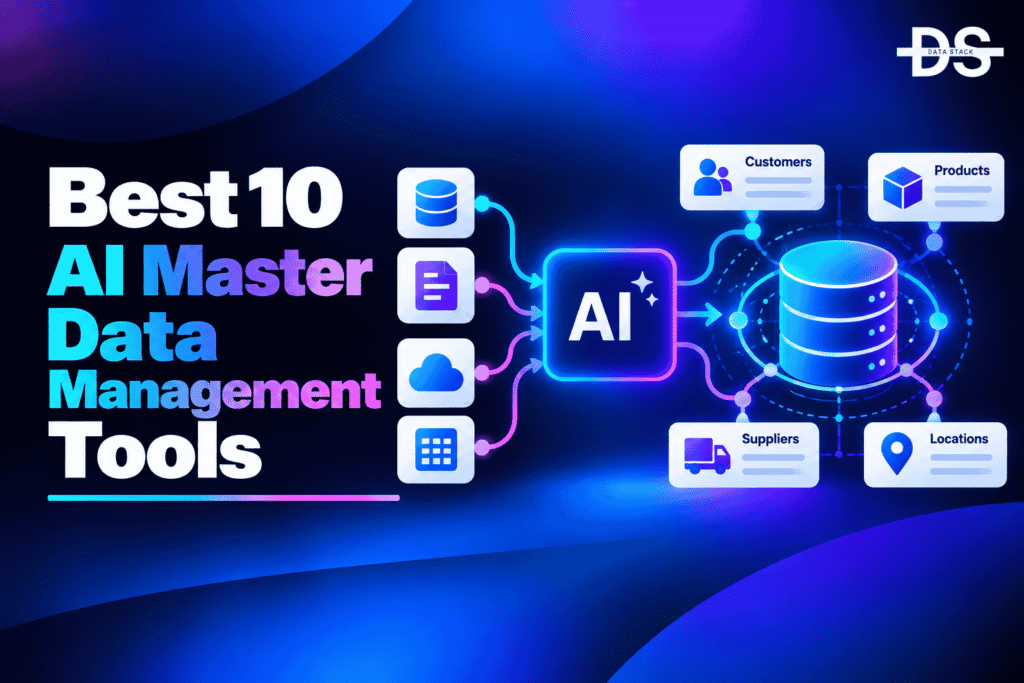
Master data sits at the center of many business processes. Customer, product, supplier, employee, location, and other core records are often stored across multiple applications, databases, and business systems. When those records contain different names, formats, identifiers, or incomplete information, organizations can end up with duplicate entities and inconsistent data. AI master data management tools help bring these records together, resolve duplicates, improve data quality, and create trusted master records.
Traditional master data management relies heavily on predefined rules, matching logic, validation rules, and manual data stewardship. AI adds another layer by using machine learning, probabilistic matching, semantic understanding, and other intelligent techniques to identify records that belong to the same entity, detect inconsistencies, recommend matches, enrich records, and prioritize the cases that require human review.
AI MDM Tools are also becoming more important as organizations prepare data for analytics and AI applications. AI systems depend on accurate information about customers, products, organizations, suppliers, and other entities. A trusted master record gives AI applications a consistent view of those entities instead of forcing them to work with fragmented records from different source systems.
In this guide, we compare the best AI master data management tools based on their AI capabilities, entity resolution and matching features, data quality automation, golden record management, and ideal use cases. We also cover their key AI-focused features, compare them side by side, explain how to choose the right tool, and answer common questions about AI-powered MDM.
What Are AI Master Data Management Tools?
AI master data management tools are software platforms that use artificial intelligence and machine learning to identify, match, standardize, enrich, consolidate, and govern important business data across multiple systems. These AI MDM tools help organizations create trusted master records for entities such as customers, products, suppliers, organizations, and locations.
Traditional MDM typically uses deterministic rules to decide whether two records represent the same entity. AI-powered MDM can go further by analyzing multiple attributes and patterns to identify probable matches even when records contain spelling differences, missing information, inconsistent formats, abbreviations, or other variations.
AI MDM Tools can also support the ongoing management of master data. They can identify new duplicates, recommend record matches, detect data-quality problems, assist data stewards, enrich incomplete records, and provide consistent entity information to applications, analytics platforms, and AI systems.
AI Master Data Management Tools vs. Traditional MDM Tools
| Capability | Traditional MDM Tools | AI Master Data Management Tools |
|---|---|---|
| Record matching | Rules-based matching | AI, ML, and probabilistic matching |
| Entity resolution | Predefined rules and manual review | Intelligent entity resolution |
| Duplicate detection | Rules and similarity thresholds | AI-assisted duplicate identification |
| Data standardization | Manual and rule-based | AI-assisted normalization |
| Data enrichment | Manual or predefined integrations | AI-assisted enrichment and recommendations |
| Golden records | Rule-based consolidation | AI-assisted consolidation and survivorship |
| Data stewardship | Manual workflows | AI-assisted recommendations and prioritization |
| Search | Keyword and attribute search | Semantic and natural-language search |
| Data quality | Rules and validation | AI-assisted detection and remediation |
| AI readiness | Primarily operational and analytical | Designed to provide trusted entity context for AI |
AI Master Data Management Tools Comparison
The table below compares the leading AI MDM Tools based on their AI capabilities, automation features, and ideal use cases.
| Tool | AI Capabilities | What You Can Automate | Best For | G2 Rating |
|---|---|---|---|---|
| Tamr | AI-native entity resolution, machine learning matching, GenAI-assisted curation | Matching, deduplication, standardization, enrichment | AI-native MDM and complex entity resolution | 4.6/5 |
| Reltio | AI-assisted entity resolution, intelligent data graph, AI-ready data | Matching, golden records, enrichment, quality | Cloud-native multidomain MDM | 4.4/5 |
| Informatica MDM | CLAIRE AI, intelligent matching, data quality intelligence | Matching, consolidation, enrichment, governance | Large enterprises | 4.3/5 |
| Semarchy | AI-assisted stewardship, entity resolution, enrichment | Match and merge, quality, enrichment, stewardship | Flexible multidomain MDM | 4.6/5 |
| Ataccama | AI-assisted matching, profiling, classification, data quality | Matching, profiling, quality, enrichment | Enterprise data trust and MDM | 4.6/5 |
| Profisee | AI-assisted matching, data quality, enrichment | Matching, consolidation, stewardship | Microsoft-centric MDM | 4.6/5 |
| Stibo Systems | AI-assisted matching, enrichment, classification | Product mastering, matching, enrichment | Product and multidomain MDM | 4.4/5 |
| IBM MDM | AI-assisted matching, entity resolution, data quality | Matching, consolidation, governance | Enterprise MDM | 4.1/5 |
8 Best AI Master Data Management Tools
AI master data management tools help businesses unify, cleanse, match, and govern critical data across multiple systems. Let’s explore 8 leading AI-powered MDM tools and see how they support accurate, consistent, and trusted master data.
#1. Tamr
Tamr is an AI-native master data management platform focused heavily on machine learning and artificial intelligence for data mastering and entity resolution. It is designed to unify information from multiple systems, identify records that represent the same real-world entity, standardize data, and create trusted master records.
Tamr’s approach is particularly useful for organizations dealing with large amounts of fragmented and inconsistent data. Instead of depending entirely on manually maintained matching rules, its machine learning capabilities can learn from data and feedback to improve entity resolution. The platform can work with customer, supplier, product, organization, and other entity types.
Tamr also uses AI across data curation and standardization. This makes it one of the strongest options for organizations specifically looking for AI MDM Tools rather than adding a small AI feature to an otherwise traditional MDM platform.
Key Features
- AI-Native Entity Resolution: Tamr uses machine learning to identify records that represent the same real-world entity even when names, addresses, identifiers, or other attributes differ between source systems.
- Machine Learning Matching: Matching models can learn from data and human feedback, allowing the system to improve its ability to identify genuine matches as more records are processed.
- GenAI-Assisted Data Curation: Generative AI can help data teams handle difficult curation and exception cases that may require more contextual understanding than standard matching rules provide.
- AI Data Standardization: Machine learning can help normalize values such as names, addresses, company information, and other attributes so records can be compared more consistently.
- Automated Deduplication: AI-powered matching can identify duplicate records across multiple systems and help consolidate them into trusted master records.
- Schema Mapping: AI can assist with understanding relationships between fields and schemas from different source systems, reducing manual mapping effort.
- Golden Record Creation: Tamr can consolidate multiple source records into a trusted representation of an entity that can be consumed by downstream applications and analytics systems.
- AI-Ready Master Data: Clean and unified entity data can provide a stronger foundation for AI applications, analytics, and AI agents that require consistent information about customers, products, suppliers, or organizations.
G2 Rating: 4.6/5
Also Read: Best Tamr Alternatives and Competitors in 2026
Showcase your software to buyers actively comparing tools. Submit your product for editorial review and get featured on Data Stack Hub.
Submit Your Tool →#2. Reltio
Reltio is a cloud-native multidomain master data management platform designed to create connected and trusted views of important business entities. It supports domains such as customers, products, suppliers, organizations, locations, and other entities while combining data integration, entity resolution, quality, governance, and relationship intelligence.
Reltio has increasingly focused on AI-ready data and intelligent data management. Its data graph connects entities and relationships across systems, while AI-assisted capabilities can help identify matching records, improve data quality, enrich profiles, and provide context around business entities.
For organizations looking for AI MDM Tools in a cloud-native environment, Reltio is particularly attractive when relationships between entities are important. Understanding how customers relate to households, products, organizations, suppliers, locations, and other entities can provide valuable context for analytics and AI applications.
Key Features
- AI-Assisted Entity Resolution: AI can help identify records that represent the same entity even when source records contain different names, addresses, identifiers, or other attributes.
- Intelligent Data Graph: Reltio connects entities and their relationships into a data graph, providing context that goes beyond individual master records.
- AI-Powered Data Quality: Intelligent data-quality capabilities can help identify inconsistencies and improve the reliability of master records.
- Real-Time Golden Records: Reltio maintains trusted entity profiles that can be updated as information changes across source systems.
- AI Data Enrichment: Master records can be enriched with additional information to provide more complete and useful entity profiles.
- Relationship Intelligence: Connected entity relationships can help organizations understand customers, products, suppliers, organizations, and other entities in greater context.
- AI-Ready Data Foundation: Trusted master records and relationships can provide structured context for analytics, machine learning, and generative AI applications.
- Multidomain MDM: Reltio allows organizations to manage multiple master data domains within one cloud-native environment.
G2 Rating: 4.4/5
#3. Informatica Multidomain MDM
Informatica Multidomain MDM is an enterprise master data management platform designed to consolidate, manage, govern, and distribute trusted master data across business systems. It supports multiple domains, including customer, product, supplier, location, and other enterprise data.
Informatica uses its CLAIRE AI technology to add intelligence to data management workflows. AI and machine learning can assist with matching, classification, data quality, recommendations, and other tasks that would otherwise require significant manual configuration and stewardship.
Informatica is a strong choice for large organizations that need MDM as part of a broader data management strategy. Its MDM capabilities can work alongside data integration, data quality, metadata, governance, lineage, and privacy capabilities, making it useful for complex enterprise environments.
Key Features
- CLAIRE AI: Informatica’s AI technology adds intelligence to data management processes and can support matching, classification, recommendations, and quality-related workflows.
- AI-Assisted Entity Matching: AI can help identify relationships between records across multiple systems, reducing dependence on manually maintained matching rules.
- Automated Duplicate Detection: Matching capabilities can identify duplicate entities across source systems and support consolidation into trusted master records.
- AI-Powered Data Quality: Intelligent data-quality capabilities can help identify inconsistencies, missing values, and other problems affecting master data.
- Golden Record Management: Source records can be consolidated into trusted master records that provide a consistent representation of important business entities.
- AI Data Enrichment: AI and connected data capabilities can help enrich master records and provide additional context around entities.
- Multidomain MDM: Organizations can manage customer, product, supplier, location, and other domains within the same MDM environment.
- Governance Integration: MDM can operate alongside Informatica’s broader governance, metadata, lineage, privacy, and data-quality capabilities.
G2 Rating: 4.3/5
#4. Semarchy
Semarchy provides multidomain master data management capabilities for organizations that need to consolidate, enrich, govern, and distribute trusted master data. It supports customer, product, supplier, location, reference, and other domains and provides tools for creating governed golden records.
Its AI and intelligent matching capabilities can assist with entity resolution, stewardship, data enrichment, and data-quality processes. The platform can combine deterministic rules with probabilistic and AI-assisted approaches, allowing organizations to use different matching techniques depending on the type and complexity of their master data.
Semarchy is particularly useful for organizations that need flexibility in how MDM is modeled and implemented. Teams can define their own entities, attributes, relationships, matching processes, and stewardship workflows while using intelligent automation to reduce repetitive data-management work.
Key Features
- AI-Assisted Entity Resolution: Semarchy can combine rules-based and intelligent matching techniques to identify records that likely represent the same entity.
- AI-Powered Stewardship: Intelligent recommendations can help data stewards prioritize records and cases that need human review instead of manually reviewing every potential match.
- AI Data Enrichment: AI-assisted capabilities can help improve incomplete master records and add useful contextual information.
- Match and Merge: The platform can identify duplicate or related records and consolidate them into governed golden records.
- Intelligent Data Modeling: Semarchy can model entities, attributes, relationships, and hierarchies to provide structured context for master data.
- Data Certification: Data quality, validation, matching, enrichment, and approval processes can work together to maintain trusted master records.
- AI-Ready Data Products: Master data can be delivered as governed data products for operational applications, analytics, and AI workloads.
- Multidomain MDM: Customer, product, supplier, location, and reference data can be managed within interconnected models.
G2 Rating: 4.6/5
#5. Ataccama
Ataccama provides an AI-augmented data management platform that combines master data management with data quality, governance, cataloging, observability, and data discovery. Its approach treats MDM as part of a broader effort to create trusted and reliable enterprise data.
AI and machine learning can assist with data profiling, entity matching, classification, anomaly detection, enrichment, and data-quality management. This is useful when organizations want their MDM processes to benefit from the same intelligent data-quality capabilities used across the rest of their data environment.
Ataccama is a strong option for enterprises that want to connect master data with data quality and governance. Instead of only identifying duplicate records, teams can use intelligent profiling and quality monitoring to understand why master data is unreliable and where problems originate.
Key Features
- AI-Assisted Entity Matching: Machine learning can help identify records that represent the same customer, product, supplier, organization, or other entity.
- Automated Data Profiling: Intelligent profiling can identify patterns, inconsistencies, missing values, and other issues across source data before it becomes part of master data.
- AI-Powered Data Quality: AI-assisted capabilities can help detect data-quality problems and prioritize remediation efforts.
- Automated Classification: AI can assist with classifying data and identifying attributes that require particular quality or governance treatment.
- Duplicate Detection: Intelligent matching can identify duplicate entities across fragmented systems and support consolidation.
- AI Data Enrichment: AI-assisted workflows can help improve incomplete records and provide additional context around mastered entities.
- Data Governance Integration: MDM can operate alongside data governance, cataloging, quality, and observability capabilities to create a broader trusted-data environment.
- Intelligent Data Monitoring: Continuous monitoring can help identify changes in data patterns and quality that could affect trusted master records.
G2 Rating: 4.6/5
Also Read: Best Ataccama Alternatives and Competitors in 2026
Increase your product visibility by reaching software buyers researching the best tools. Every submission is reviewed by our editorial team.
Feature My Tool →#6. Profisee
Profisee is a master data management platform that focuses on creating trusted master data across domains such as customer, product, supplier, and other enterprise entities. It is particularly relevant to organizations operating in Microsoft-centric data environments and can integrate with Microsoft data and analytics technologies.
Profisee provides intelligent matching and data-quality capabilities that can help organizations identify duplicate records, consolidate information, and maintain golden records. AI-assisted approaches can reduce the manual effort involved in matching and stewardship while allowing data teams to retain control over business rules.
The platform is a strong option for organizations that need MDM alongside Microsoft technologies such as Azure, SQL Server, Microsoft Fabric, and Power BI. It can provide a centralized master-data layer while fitting into an existing Microsoft-oriented data architecture.
Key Features
- AI-Assisted Matching: Intelligent matching helps identify records that represent the same entity across different source systems.
- Automated Duplicate Detection: Matching capabilities can identify duplicate customer, product, supplier, and other records that need to be consolidated.
- Golden Record Management: Profisee creates governed master records that provide a consistent representation of important business entities.
- AI-Assisted Data Stewardship: Intelligent recommendations can help data stewards focus on records that require attention instead of reviewing every record manually.
- Data Quality Management: Validation and quality rules can identify incomplete, inconsistent, or invalid master data before it is distributed downstream.
- Hierarchy Management: Organizations can manage relationships and hierarchies between master data entities, providing additional context for reporting and AI use cases.
- Microsoft Integration: Profisee works particularly well with Microsoft-oriented data environments, making it suitable for organizations using Azure and Microsoft analytics technologies.
- AI-Ready Master Data: Trusted master records can provide consistent entity information to analytics, applications, machine learning, and AI workloads.
G2 Rating: 4.6/5
#7. Stibo Systems
Stibo Systems provides multidomain master data management and product information management capabilities designed to help organizations create consistent, governed, and connected information across business systems. Its platform is particularly strong for organizations managing complex product information alongside customer, supplier, location, and other master data.
AI can support several parts of the mastering process, including matching, classification, enrichment, and product-data management. This is particularly useful for organizations with large product catalogs where attributes, categories, descriptions, and relationships need to be standardized across multiple systems and markets.
Stibo Systems is a strong choice for companies where product master data is a major priority, including retail, manufacturing, distribution, and other organizations with complex product portfolios. Its multidomain capabilities also allow product information to be connected with other important business entities.
Key Features
- AI-Assisted Entity Matching: Intelligent matching can help identify duplicate or related records across product, customer, supplier, and other domains.
- AI Product Classification: AI can help classify products into appropriate categories based on product attributes, descriptions, and other information.
- AI Data Enrichment: AI-assisted enrichment can help fill gaps in product information and improve the completeness of master records.
- Product Mastering: The platform provides a central environment for managing trusted product information across channels and systems.
- Automated Duplicate Detection: Matching capabilities can identify duplicate products and other master entities across different source systems.
- Multidomain MDM: Product information can be connected with customers, suppliers, locations, and other master data domains.
- Data Governance: Governance capabilities help organizations maintain consistent definitions, ownership, validation, and approval processes for master data.
- AI-Ready Product Data: Standardized and enriched product information can provide better context for analytics, recommendation systems, search, and AI applications.
G2 Rating: 4.4/5
#8. IBM Master Data Management
IBM Master Data Management provides enterprise capabilities for managing, matching, consolidating, and governing master data across multiple business domains. It is designed for organizations that need centralized and trusted views of customers, organizations, products, and other important business entities.
IBM’s MDM capabilities use matching and entity-resolution techniques to identify relationships between records and consolidate information. AI and automation can assist with data-quality analysis, matching, recommendations, and other data-management workflows.
IBM MDM is most appropriate for large enterprises with complex data architectures and significant governance requirements. Organizations that already use IBM’s broader data, analytics, governance, or AI ecosystem may also benefit from keeping MDM within the same technology environment.
Key Features
- AI-Assisted Entity Resolution: Intelligent matching can help identify records representing the same entity across multiple enterprise systems.
- Automated Matching: Matching capabilities can evaluate multiple attributes and identify potential duplicate or related records for consolidation.
- Golden Record Management: IBM MDM can consolidate information from different sources into trusted master records for downstream applications.
- Data Quality Management: Data-quality capabilities can identify inconsistencies and help organizations maintain reliable master data.
- AI-Assisted Stewardship: Intelligent workflows can help data stewards prioritize records and potential matches that require human intervention.
- Relationship Management: The platform can manage relationships between entities, providing additional context for business processes and analytics.
- Enterprise Governance: MDM can support governance and policy requirements across large and complex enterprise environments.
- AI-Ready Data: Trusted master data can provide consistent entity context for analytics, machine learning, and enterprise AI applications.
G2 Rating: 4.1/5
How to Choose the Right AI Master Data Management Tool
- AI Entity Resolution: Check whether the platform uses AI or machine learning to identify matching entities instead of relying entirely on manually configured rules.
- Matching Accuracy: Evaluate how well the tool handles spelling differences, incomplete records, abbreviations, inconsistent addresses, changing identifiers, and other real-world data variations.
- Golden Records: Make sure the platform can consolidate multiple source records into trusted master records while allowing your organization to control survivorship and business rules.
- Data Quality: Look for built-in profiling, validation, standardization, monitoring, and remediation capabilities so poor-quality source data does not continually contaminate master records.
- Data Domains: Confirm that the platform supports the domains you need, such as customer, product, supplier, organization, location, employee, or reference data.
- AI-Assisted Stewardship: Choose a tool that can prioritize difficult matching and data-quality cases so data stewards spend their time on exceptions rather than routine records.
- Data Enrichment: Check whether the platform can enrich master records and improve incomplete information without creating additional manual work.
- Integration: Make sure the platform connects with your existing databases, applications, warehouses, APIs, data pipelines, and analytics systems.
- Governance and Security: Evaluate ownership, approval workflows, access controls, auditability, policies, and other governance capabilities required for your master data.
- AI Readiness: If AI is an important part of your data strategy, choose a platform that can provide trusted master data and entity context to analytics platforms, AI models, and AI agents.
Browse expertly curated software recommendations across hundreds of business categories.
Browse Top Tools →Conclusion
AI master data management tools are becoming increasingly important as organizations try to create consistent and trusted data across fragmented systems. Traditional MDM remains important for governance, rules, workflows, and golden-record management, but AI can make several parts of the process more scalable by improving entity resolution, duplicate detection, enrichment, classification, and data stewardship.
Tamr is one of the strongest options when AI-native entity resolution is the primary requirement. Its machine learning approach is particularly useful for organizations dealing with large volumes of inconsistent records and complex entity-matching problems.
Reltio is a strong choice for cloud-native multidomain MDM, especially when organizations need connected entity data and relationship intelligence. Informatica Multidomain MDM is better suited to large enterprises that want MDM combined with broader data quality, integration, governance, metadata, and privacy capabilities.
Semarchy provides a flexible approach to multidomain MDM and is useful for organizations that want to combine intelligent matching with configurable data models and stewardship processes. Ataccama is particularly attractive when MDM needs to work closely with data quality, observability, classification, and governance.
For organizations operating heavily within the Microsoft ecosystem, Profisee is a strong option. Its MDM capabilities can fit naturally into Microsoft-oriented data architectures while providing matching, golden records, quality, and stewardship capabilities.
Stibo Systems is particularly relevant for organizations with complex product master data and large product catalogs. Its AI-assisted classification and enrichment capabilities can help organizations maintain consistent product information while connecting it with other master data domains.
IBM Master Data Management remains an option for large enterprises that need mature enterprise MDM and governance capabilities within complex environments.
When evaluating AI MDM Tools, organizations should not focus only on whether a vendor uses the word “AI” in its product description. The more important question is what AI actually does. A useful AI MDM platform should improve entity resolution, reduce manual stewardship, identify data-quality problems, enrich records, and help create trusted master data that downstream applications can actually use.
The best AI master data management tool will ultimately depend on your data domains, source-system complexity, matching requirements, governance model, deployment preferences, and AI strategy. Organizations with highly complex entity-resolution requirements may prioritize AI-native matching, while enterprises with broader data-management needs may prefer an MDM platform that combines AI with governance, quality, integration, and lineage.
As AI adoption grows, high-quality master data is becoming an increasingly important foundation. AI systems need consistent information about the entities they interact with, and AI MDM Tools can help organizations provide that consistency at scale.
Frequently Asked Questions
1. What are AI Master Data Management Tools?
AI Master Data Management Tools are platforms that use artificial intelligence and machine learning to manage, match, standardize, enrich, consolidate, and govern master data. They help organizations create trusted records for customers, products, suppliers, organizations, locations, and other important entities.
2. What are AI MDM Tools?
AI MDM Tools are master data management platforms that use AI to improve tasks such as entity resolution, duplicate detection, data matching, enrichment, classification, quality management, and data stewardship. They combine traditional MDM capabilities with intelligent automation.
3. How do AI MDM Tools work?
AI MDM Tools collect records from multiple systems and analyze attributes such as names, addresses, identifiers, product information, and other fields to determine which records represent the same entity. Machine learning and other AI techniques can identify likely matches and help consolidate them into trusted master records.
4. What is the difference between AI MDM and traditional MDM?
Traditional MDM relies heavily on predefined business rules, matching rules, validation, and manual stewardship. AI MDM adds machine learning and other intelligent techniques to improve entity resolution, identify complex matches, automate data-quality tasks, enrich records, and assist data stewards.
5. What is AI entity resolution?
AI entity resolution is the process of using artificial intelligence or machine learning to determine whether different records represent the same real-world entity. For example, an AI MDM platform may recognize that several customer records with slightly different names and addresses belong to the same person or organization.
6. Can AI MDM Tools identify duplicate records?
Yes. Duplicate detection is one of the core use cases for AI MDM Tools. AI can compare multiple attributes and identify potential duplicates even when records are not exact matches.
7. Can AI MDM Tools create golden records?
Yes. AI MDM Tools can help consolidate information from multiple source records into a trusted golden record. Organizations can typically combine AI recommendations with business rules and human stewardship before accepting the final master record.
8. What are the best AI MDM Tools in 2026?
The leading AI MDM Tools covered in this article are Tamr, Reltio, Informatica Multidomain MDM, Semarchy, Ataccama, Profisee, Stibo Systems, and IBM Master Data Management. The best choice depends on the organization’s data domains, entity-resolution requirements, governance needs, and existing technology stack.
9. Can AI MDM Tools manage customer data?
Yes. Customer master data is one of the most common MDM use cases. AI can help match customer records across CRM systems, billing platforms, marketing databases, support systems, and other sources to create a consistent customer profile.
10. Can AI MDM Tools manage product data?
Yes. AI MDM Tools can consolidate product records, identify duplicate products, standardize attributes, classify products, enrich descriptions, and maintain consistent product information across commerce, ERP, supply-chain, and analytics systems.
11. Can AI MDM Tools manage supplier data?
Yes. AI can help identify duplicate supplier records, standardize supplier names and addresses, consolidate information from procurement systems, and create trusted supplier master records.
12. How does AI improve master data quality?
AI can identify patterns and inconsistencies across records, detect likely duplicates, recommend matches, identify missing or unusual values, and assist with enrichment and standardization. This can reduce the amount of manual work required to maintain high-quality master data.
13. Can AI MDM Tools automate data stewardship?
They can automate parts of data stewardship. AI can prioritize records that need review, recommend potential matches or merges, identify quality problems, and generate suggestions. Human data stewards can then review higher-risk or ambiguous cases.
14. Can AI MDM Tools support AI applications?
Yes. Trusted master data can provide consistent entity information to AI models, analytics systems, applications, and AI agents. This is particularly important when AI applications need reliable information about customers, products, organizations, suppliers, or other business entities.
15. Are there open-source AI MDM Tools?
The MDM market is primarily dominated by commercial platforms, and there are fewer mature open-source options that provide the full combination of entity resolution, golden records, governance, stewardship, and multidomain MDM. Organizations looking for open-source solutions may need to combine open-source entity-resolution, data-quality, and metadata technologies rather than adopting a single complete open-source MDM platform.
16. What should I look for in an AI MDM Tool?
Look for AI-powered entity resolution, accurate matching, duplicate detection, golden-record management, data quality, enrichment, stewardship automation, multidomain support, integrations, governance, scalability, and AI readiness. The most important factor is whether the AI capabilities solve your actual data-matching and mastering problems rather than simply adding an AI feature to the platform.