
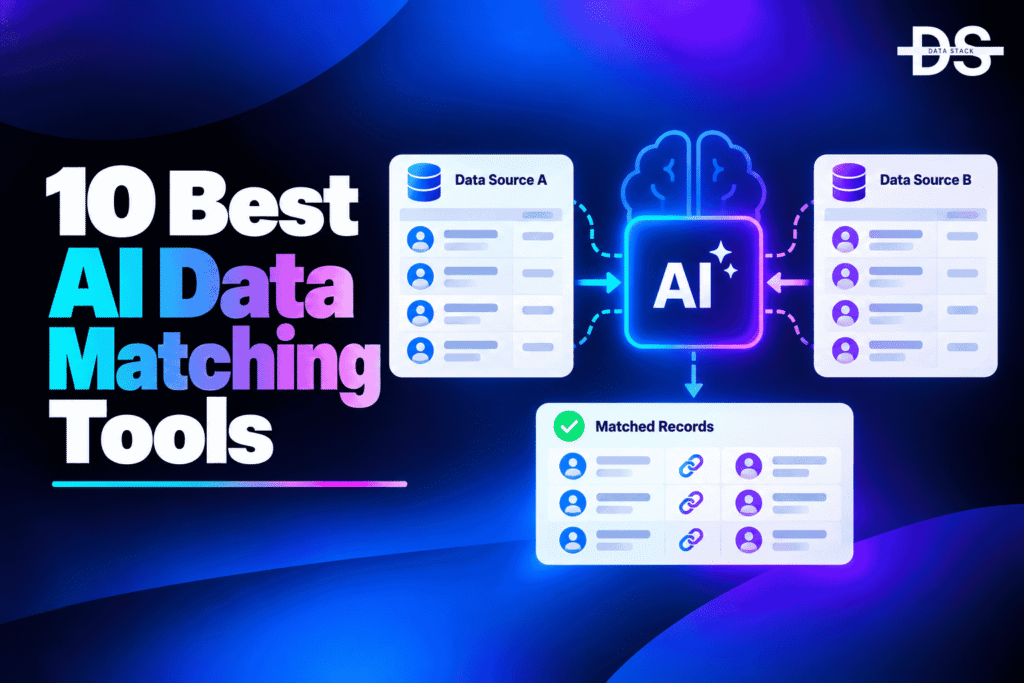
Data matching is a critical part of data quality, integration, analytics, and master data management. Organizations often have the same customer, company, product, supplier, or other entity represented differently across databases and applications. Names may be abbreviated, addresses may use different formats, identifiers may be missing, and records may contain typos or incomplete information. AI data matching tools help identify these relationships and determine which records refer to the same entity.
Traditional data matching usually depends on exact matches, predefined rules, fuzzy matching thresholds, and manually configured logic. These approaches work well for straightforward datasets but can become difficult to maintain when organizations have millions of records and many variations. AI can analyze multiple attributes and patterns to identify probable matches, rank potential matches, and learn from previous decisions.
AI-powered matching is particularly useful for customer 360 projects, MDM, CRM deduplication, data migration, fraud detection, lead consolidation, supplier management, and analytics. Instead of treating every record comparison as a simple text-matching problem, AI can use context and relationships to improve the identification of real-world entities.
In this guide, we compare the best AI data matching tools based on their AI capabilities, entity resolution, matching and deduplication features, automation capabilities, and ideal use cases. We also cover their key AI-focused features, compare them side by side, explain how to choose the right tool, and answer common questions about AI-powered data matching.
What Are AI Data Matching Tools?
AI data matching tools are software platforms that use artificial intelligence and machine learning to identify relationships between records and determine whether different records represent the same entity. These tools can compare names, addresses, identifiers, attributes, descriptions, and other data points to find likely matches even when records are not identical.
Unlike simple exact matching, AI-powered data matching can consider multiple signals and patterns when evaluating records. Depending on the platform, this can include machine learning, probabilistic matching, fuzzy matching, semantic similarity, natural-language processing, or other intelligent techniques.
AI data matching tools are commonly used to find duplicate records, resolve customer identities, consolidate supplier data, match product catalogs, support MDM initiatives, and improve data quality. They can also help data teams prioritize ambiguous matches for human review rather than manually checking every potential match.
AI Data Matching Tools Comparison
The table below compares the leading AI data matching tools based on their AI capabilities, automation features, and ideal use cases.
| Tool | AI Capabilities | What You Can Automate | Best For | G2 Rating |
|---|---|---|---|---|
| Tamr | ML entity resolution, AI matching, GenAI-assisted curation | Record matching, deduplication, standardization | Enterprise entity resolution | 4.6/5 |
| Reltio | AI-assisted entity resolution and intelligent data graph | Matching, merging, enrichment | Cloud-native multidomain matching | 4.4/5 |
| Informatica Data Quality | AI-assisted matching, CLAIRE AI, data quality | Matching, profiling, deduplication | Enterprise data quality | 4.3/5 |
| Ataccama | AI-assisted matching, profiling, classification | Matching, quality, enrichment | Enterprise data quality and matching | 4.6/5 |
| Data Ladder | AI-assisted matching, fuzzy matching, deduplication | Matching, merging, cleansing | Data cleansing and deduplication | 4.7/5 |
| WinPure | AI-assisted fuzzy matching and deduplication | Matching, cleansing, consolidation | SMB and data cleansing teams | 4.5/5 |
| Senzing | AI-driven entity resolution | Identity matching, relationship discovery | Identity and entity resolution | 4.8/5 |
| IBM Match 360 | AI-assisted entity resolution and matching | Matching, consolidation, customer 360 | Enterprise customer data | 4.2/5 |
8 Best AI Data Matching Tools
AI data matching tools use machine learning and intelligent algorithms to identify, compare, and link records across different data sources. Here’s a closer look at 8 leading AI data matching tools and how they help improve data quality and accuracy.
#1. Tamr
Tamr is an AI-native data mastering platform with a strong focus on entity resolution and matching records across fragmented data sources. It uses machine learning to identify records that represent the same real-world entity, making it useful for customer, supplier, product, organization, and other entity-matching projects.
Tamr is designed for situations where traditional rules-based matching becomes difficult to maintain. Instead of requiring data teams to manually define every possible variation, its machine learning approach can learn from data and human feedback. This makes it useful for large datasets containing inconsistent names, addresses, identifiers, and other attributes.
The platform also combines matching with data standardization and data mastering. This means organizations can move from identifying potential matches to creating cleaner and more trusted entity records rather than treating matching as an isolated data-cleaning task.
Key Features
- AI Entity Resolution: Tamr uses machine learning to determine which records are likely to represent the same real-world entity, even when the records contain significant variations.
- Machine Learning Matching: Matching models can learn from previous decisions and feedback, allowing matching accuracy to improve as the system processes more data.
- AI-Assisted Match Review: Potential matches can be surfaced for human review, allowing data stewards to focus on ambiguous records rather than manually comparing entire datasets.
- Fuzzy and Contextual Matching: The platform can account for variations in names, addresses, company information, and other attributes instead of requiring exact field-level matches.
- Automated Deduplication: AI matching can identify duplicate records and support their consolidation into cleaner master records.
- Data Standardization: Records can be standardized before or during matching so differences in formatting do not prevent related records from being identified.
- GenAI-Assisted Curation: Generative AI can help with difficult data-curation tasks and exceptions that require additional context.
- Entity Mastering: Matching results can be used to create trusted representations of customers, products, suppliers, organizations, and other entities.
G2 Rating: 4.6/5
Also Read: Best Tamr Alternatives and Competitors in 2026
#2. Reltio
Reltio is a cloud-native multidomain master data management platform that includes intelligent entity resolution and matching capabilities. It connects records from multiple systems and creates unified profiles for customers, organizations, products, suppliers, and other entities.
Its approach goes beyond comparing individual records by maintaining relationships between entities. This provides additional context when determining whether records belong to the same person, organization, household, product, or other entity.
Reltio is particularly useful for organizations that need data matching as part of a broader customer 360, product 360, or multidomain MDM initiative. Matching can be combined with data quality, enrichment, golden records, and relationship management.
Key Features
- AI-Assisted Entity Resolution: Reltio can identify records that likely represent the same entity by evaluating multiple attributes and relationships.
- Intelligent Matching: Matching capabilities can account for variations in source data rather than depending only on exact values.
- Relationship-Aware Matching: Entity relationships provide additional context that can help organizations understand how records are connected.
- Automated Duplicate Detection: Potential duplicate entities can be identified across connected systems and consolidated into trusted profiles.
- Golden Record Creation: Matched records can be merged into unified entity profiles that downstream applications can use.
- AI Data Enrichment: Entity profiles can be enriched with additional information to improve their completeness and usefulness.
- Real-Time Data Management: Matching and entity information can be maintained as source data changes.
- Multidomain Matching: Organizations can match customer, product, supplier, organization, location, and other types of master data.
G2 Rating: 4.4/5
Showcase your software to buyers actively comparing tools. Submit your product for editorial review and get featured on Data Stack Hub.
#3. Informatica Data Quality
Informatica Data Quality provides data profiling, cleansing, validation, matching, and data-quality capabilities for enterprise environments. Its AI and machine learning capabilities can assist with identifying relationships between records and improving the quality of data before it is used in analytics, applications, or MDM.
The platform is useful for organizations that need data matching alongside broader data-quality processes. Instead of only finding duplicate records, teams can profile source data, identify inconsistencies, standardize values, and then use matching capabilities to determine which records represent the same entity.
Informatica is particularly suitable for larger organizations with complex data environments where matching needs to work across multiple databases, applications, and business domains.
Key Features
- AI-Assisted Record Matching: Intelligent matching can compare records across systems and identify potential relationships between entities.
- CLAIRE AI: Informatica’s AI technology can provide intelligence across data-management workflows and assist with data-quality and matching tasks.
- Duplicate Detection: Matching processes can identify duplicate customer, supplier, product, and other records.
- Fuzzy Matching: Matching can account for variations in values rather than requiring identical field values.
- Automated Data Profiling: Profiling helps identify patterns, missing values, inconsistencies, and other problems that may affect matching accuracy.
- Data Standardization: Source values can be standardized before matching to reduce false negatives caused by formatting differences.
- Match and Consolidate: Potentially related records can be evaluated and consolidated to create cleaner datasets or master records.
- Enterprise Data Quality: Matching can be combined with broader quality, governance, integration, and MDM processes.
G2 Rating: 4.3/5
Also Read: 10 Best Informatica Alternatives & Competitors in 2026
#4. Ataccama
Ataccama combines data quality, data management, governance, and MDM capabilities with AI-assisted data processing. Its matching functionality can help organizations identify duplicate and related records across large and complex datasets.
The platform is designed for organizations where matching is closely connected with data quality. Profiling and automated quality analysis can identify issues in source data before matching, while intelligent matching can help resolve records after the data has been standardized.
Ataccama is a good fit for enterprise data teams that want matching capabilities within a broader data trust platform rather than using a standalone deduplication tool.
Key Features
- AI-Assisted Entity Matching: Machine learning can help identify records that represent the same entity across different source systems.
- Intelligent Data Profiling: AI-assisted profiling can identify patterns, anomalies, missing values, and inconsistencies that may affect matching.
- Automated Duplicate Detection: Intelligent matching can surface potential duplicate entities for consolidation or review.
- Data Standardization: Source data can be normalized to make matching more consistent across different systems.
- AI-Powered Data Quality: Intelligent quality analysis can help identify records that require correction before they are matched.
- Classification: AI can help classify data and attributes, providing additional context for matching and quality processes.
- Match and Merge: Related records can be consolidated after matching to create cleaner and more consistent entity data.
- Continuous Data Monitoring: Ongoing monitoring can identify changes in source data that may create new duplicates or matching problems.
G2 Rating: 4.6/5
Also Read: Best Ataccama Alternatives and Competitors in 2026
#5. Data Ladder
Data Ladder is a data quality and data matching platform designed to help organizations clean, standardize, deduplicate, and match records. Its capabilities are particularly useful for teams working with customer, contact, company, product, and other structured datasets.
The platform supports fuzzy matching and advanced comparison techniques that can identify records that are similar even when values differ. This makes it useful for datasets containing spelling variations, inconsistent formatting, incomplete information, and other common data-quality problems.
Data Ladder is a practical choice for organizations that want a dedicated data-matching and deduplication platform without necessarily implementing a full enterprise MDM system.
Key Features
- Fuzzy Data Matching: Data Ladder can identify similar records even when values are not exact matches, helping detect duplicates that basic SQL comparisons can miss.
- AI-Assisted Matching: Intelligent matching capabilities can help evaluate multiple attributes when determining whether records are related.
- Automated Deduplication: Duplicate records can be identified and prepared for consolidation across large datasets.
- Record Standardization: Data can be cleaned and standardized before matching so formatting differences do not interfere with comparisons.
- Multiple Matching Algorithms: Teams can use different matching approaches depending on the type and quality of the data being compared.
- Match Scoring: Potential matches can be scored so teams can distinguish stronger matches from records requiring additional review.
- Data Consolidation: Matching results can be used to merge duplicate records and create cleaner datasets.
- Batch Data Processing: Large datasets can be processed for recurring cleansing, matching, and deduplication workflows.
G2 Rating: 4.7/5
#6. WinPure
WinPure is a data quality and data cleansing platform that provides record matching, deduplication, standardization, and data enrichment capabilities. It is designed for organizations that need to clean and consolidate customer, contact, supplier, product, and other business datasets.
Its fuzzy matching capabilities help identify similar records that are not exact matches. This can be particularly useful when databases contain spelling errors, abbreviations, inconsistent addresses, duplicated contacts, or other variations created by different data-entry processes.
WinPure is a practical option for teams that need data matching and cleansing without the complexity of a large enterprise MDM implementation.
Key Features
- AI-Assisted Fuzzy Matching: Intelligent matching can identify similar records even when names, addresses, or other fields contain variations.
- Duplicate Detection: WinPure can identify potential duplicate records across datasets and help prepare them for consolidation.
- Data Cleansing: Records can be cleaned and standardized before matching to improve the quality of matching results.
- Match Rules: Teams can define how different fields should be evaluated when comparing records.
- Match Scoring: Potential matches can be ranked based on their similarity, making it easier to identify high-confidence and uncertain matches.
- Record Merging: Duplicate records can be consolidated into cleaner records after the matching process.
- Address and Contact Matching: The platform can help compare contact and address information where formatting differences frequently create duplicate records.
- Recurring Data Quality Workflows: Matching and cleansing processes can be repeated as new data is added to business systems.
G2 Rating: 4.5/5
Increase your product visibility by reaching software buyers researching the best tools. Every submission is reviewed by our editorial team.
Feature My Tool →#7. Senzing
Senzing is an entity resolution platform focused on identifying and understanding real-world entities across large and complex datasets. Rather than simply comparing strings, it builds an understanding of entity relationships and uses AI-driven entity resolution to determine whether records belong to the same person or organization.
The platform is particularly relevant for identity resolution, fraud detection, risk management, customer intelligence, and other use cases where understanding relationships between records is as important as finding duplicates.
Senzing can work with data from multiple sources and continuously update entity understanding as additional information becomes available. This makes it useful when organizations need to resolve identities without requiring a traditional MDM implementation.
Key Features
- AI Entity Resolution: Senzing uses AI-driven entity resolution to identify records that represent the same real-world entity across multiple data sources.
- Identity Resolution: The platform can consolidate fragmented information to create a more complete understanding of an individual or organization.
- Relationship Discovery: AI can identify relationships between entities and records, providing context that simple duplicate matching cannot provide.
- Real-Time Resolution: Entity identities can be updated as new information becomes available instead of requiring only periodic batch matching.
- Explainable Matching: The platform provides information about why records are considered related, helping teams investigate and validate matches.
- Fraud and Risk Matching: Entity resolution can help organizations identify connections between people, organizations, accounts, and other records in risk-related use cases.
- Large-Scale Matching: The platform is designed for high-volume entity-resolution workloads across multiple data sources.
- Data Source Integration: Multiple datasets can contribute information to entity profiles, improving resolution as additional evidence becomes available.
G2 Rating: 4.8/5
#8. IBM Match 360
IBM Match 360 is an entity resolution and master data capability designed to help organizations create a trusted view of customer and business data. It combines matching, data quality, governance, and entity management capabilities to help organizations identify relationships between records from different sources.
The platform is particularly suited to enterprise environments where customer 360 and trusted entity information are important. It can match records across different source systems and provide a consistent view that can be used by analytics, applications, and AI workloads.
IBM Match 360 is a good option for organizations already operating within an enterprise IBM data and AI environment, particularly when entity resolution needs to be integrated with broader data governance and analytics initiatives.
Key Features
- AI-Assisted Entity Resolution: Intelligent matching helps identify records that represent the same person, organization, or other entity across multiple sources.
- Customer 360 Matching: Records from CRM, marketing, sales, support, and other systems can be matched to create more complete customer profiles.
- Automated Duplicate Identification: Matching capabilities can identify potentially duplicated entities across source systems.
- Confidence-Based Matching: Potential matches can be evaluated based on the strength of available evidence, helping teams separate high-confidence matches from uncertain cases.
- Golden Record Creation: Matched information can be consolidated into trusted entity profiles.
- Data Quality Integration: Matching can work alongside data-quality processes to improve the reliability of source records.
- Relationship Management: Connections between entities can provide additional context for analytics and business applications.
- AI-Ready Entity Data: Resolved entities can provide more consistent context to AI and analytics applications.
G2 Rating: 4.2/5
How to Choose an AI Data Matching Tool
- Matching Accuracy: Check how well the tool handles spelling differences, abbreviations, incomplete records, inconsistent addresses, and other real-world variations.
- AI and ML Capabilities: Look for genuine machine learning or AI-assisted matching rather than a product that only uses basic fuzzy-string comparison.
- Entity Resolution: If you need to identify real-world customers, companies, products, or suppliers across systems, prioritize tools with strong entity-resolution capabilities.
- Match Confidence: The tool should provide scores or other signals that help distinguish high-confidence matches from ambiguous records.
- Deduplication: Check whether the platform can identify duplicates and help merge or consolidate them after matching.
- Data Standardization: Standardization before matching can significantly improve results, especially when source systems use different formats.
- Human Review: Look for workflows that allow data stewards to review uncertain matches instead of automatically merging every record.
- Scale: Consider how the platform performs with your actual data volume, especially if you need to compare millions of records across multiple systems.
- Integration: Make sure the tool can connect with your databases, CRM, ERP, data warehouse, APIs, and other systems where matching will be performed.
- Use Case: Choose a tool based on whether your primary requirement is deduplication, customer 360, MDM, fraud detection, product matching, supplier matching, or another specific matching problem.
Browse expertly curated software recommendations across hundreds of business categories.
Browse Top Tools →Conclusion
AI data matching tools can significantly reduce the effort required to identify related and duplicate records across fragmented datasets. Instead of relying entirely on exact values and manually maintained rules, AI-powered matching can evaluate multiple attributes, identify patterns, rank potential matches, and help data teams resolve entities more efficiently.
Tamr is one of the strongest options for organizations that need AI-native entity resolution and enterprise-scale data mastering. Reltio is well suited to organizations that want intelligent matching as part of a cloud-native multidomain MDM platform. Informatica Data Quality and Ataccama are stronger choices when matching needs to be combined with broader enterprise data-quality capabilities.
Data Ladder and WinPure are more focused options for data cleansing, fuzzy matching, and deduplication. They can be useful for teams that need to clean and match datasets without implementing a complete MDM platform.
Senzing stands out when the requirement goes beyond simple duplicate detection and involves identity resolution and relationship discovery. IBM Match 360 is a strong enterprise option for organizations looking to combine entity resolution with customer 360, governance, analytics, and AI initiatives.
When evaluating AI data matching tools, matching accuracy should be the first priority. A platform that claims to use AI but produces a large number of false matches or misses obvious relationships will create more work for data teams. The ability to explain, review, and correct matching decisions is equally important.
The right tool also depends on the type of data being matched. Customer and identity data may require relationship-aware entity resolution, while product data may benefit more from attribute matching and semantic similarity. Supplier data, healthcare records, financial data, and other domains can have their own matching requirements.
For organizations building an AI-ready data foundation, data matching is more than a deduplication exercise. Accurate entity resolution gives analytics platforms, MDM systems, applications, and AI models a more consistent understanding of the underlying entities. That makes reliable matching an important part of both modern data quality and enterprise AI strategies.
Frequently Asked Questions
1. What are AI Data Matching Tools?
AI data matching tools are software platforms that use artificial intelligence and machine learning to compare records and identify whether they represent the same entity. They can be used for customer matching, product matching, supplier matching, deduplication, entity resolution, and data quality.
2. What are the best AI data matching tools in 2026?
Some of the leading AI data matching tools include Tamr, Reltio, Informatica Data Quality, Ataccama, Data Ladder, WinPure, Senzing, and IBM Match 360. The best option depends on data volume, matching complexity, integration requirements, and whether you need standalone matching or a broader MDM platform.
3. What is AI data matching?
AI data matching uses artificial intelligence or machine learning to determine whether records from different datasets are related or represent the same real-world entity. It can consider multiple attributes and patterns rather than requiring exact field matches.
4. What is the difference between AI data matching and fuzzy matching?
Fuzzy matching generally identifies records based on the similarity between values, such as similar names or addresses. AI data matching can use machine learning, context, multiple attributes, relationships, and learned patterns to make more sophisticated matching decisions.
5. Can AI data matching tools find duplicate records?
Yes. Duplicate detection is one of the most common applications. AI can identify records that are likely duplicates even when they contain spelling differences, abbreviations, missing values, or inconsistent formatting.
6. What is AI entity resolution?
AI entity resolution is the process of determining which records from different sources refer to the same real-world entity. For example, several customer records may use different names, email addresses, or physical addresses while still belonging to the same person.
7. Can AI data matching tools match customer records?
Yes. Customer matching is a major use case. AI can compare names, addresses, emails, phone numbers, customer IDs, and other attributes to identify duplicate or related customer records across CRM, marketing, sales, support, and billing systems.
8. Can AI data matching tools match product data?
Yes. Product matching can be used to identify the same product across catalogs, marketplaces, suppliers, distributors, and internal systems. AI can compare product names, descriptions, attributes, specifications, and other information.
9. Can AI data matching tools replace human data stewards?
Usually, they reduce the amount of manual work rather than completely replacing data stewards. High-confidence matches can often be automated, while uncertain or high-impact matches can be sent to humans for review.
10. How accurate are AI data matching tools?
Accuracy depends heavily on the quality and type of source data, the matching approach, configuration, and use case. Strong platforms should provide confidence scores, review workflows, and feedback mechanisms so teams can monitor and improve matching quality.
11. Are AI data matching tools useful for MDM?
Yes. Data matching is one of the core capabilities required for master data management. Matching helps identify which records represent the same entity before they are consolidated into trusted golden records.
12. Can AI data matching tools work with large datasets?
Yes. Enterprise AI data matching platforms are designed to process large datasets across multiple sources. However, scalability varies by platform, architecture, data volume, and matching configuration, so organizations should test performance using representative data.
13. What data can AI matching tools compare?
They can compare many types of structured and semi-structured information, including names, addresses, email addresses, phone numbers, IDs, product descriptions, company information, locations, attributes, and other entity-related data.
14. Are there open-source AI data matching tools?
There are open-source libraries and frameworks that can be used to build entity-resolution and record-linkage workflows, but there are fewer mature open-source platforms that provide the complete experience of a commercial AI data matching product. Organizations choosing an open-source approach may need to combine matching libraries with their own data pipelines, review workflows, and data-quality infrastructure.
15. What should I look for in an AI data matching tool?
Look for matching accuracy, AI or machine learning capabilities, entity resolution, fuzzy and semantic matching, confidence scoring, deduplication, standardization, human review, scalability, integrations, and explainability. The best platform should fit the type of entities and matching problems your organization actually needs to solve.