
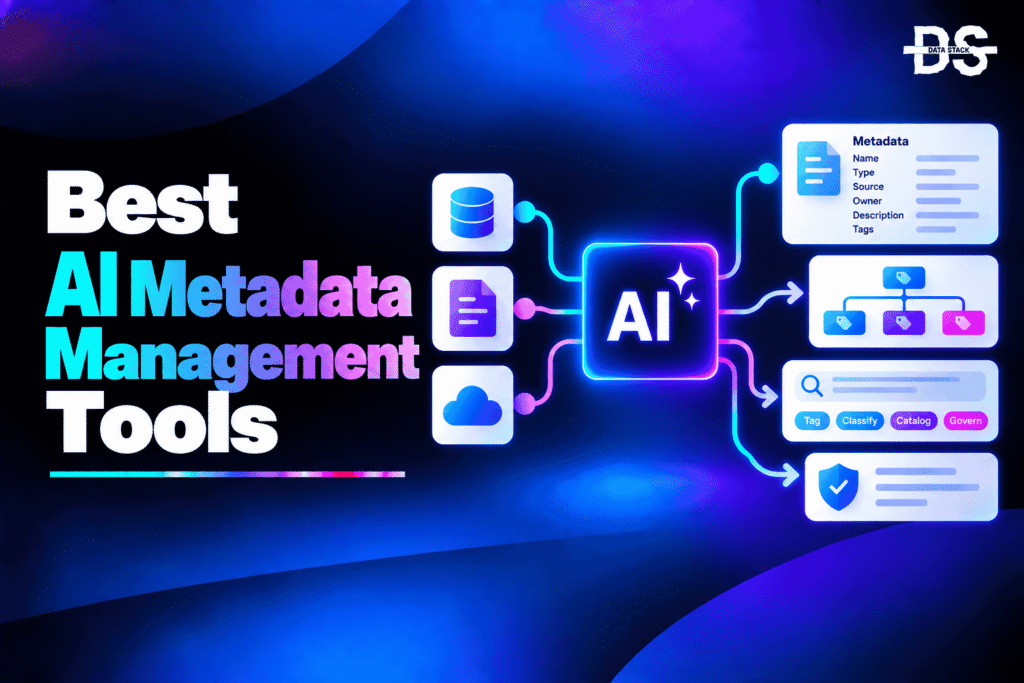
Metadata is the information that explains what data is, where it comes from, how it is transformed, who owns it, how it should be used, and how it relates to other data assets. As organizations add more databases, cloud warehouses, data pipelines, BI tools, SaaS applications, and AI systems, managing metadata manually becomes increasingly difficult. AI metadata management tools use artificial intelligence to help organizations discover, classify, enrich, organize, search, and govern metadata across complex data environments.
Traditional metadata management platforms collect technical and business metadata from different systems and make it available through catalogs, lineage graphs, and governance workflows. AI adds another layer by helping teams interpret metadata, generate descriptions, identify relationships, classify data, answer questions, recommend owners or tags, and make large metadata environments easier to manage.
AI is also making metadata more important for modern data and AI applications. AI agents and models need reliable context to understand which datasets are relevant, what they contain, whether they can be trusted, and how they should be used. A strong metadata management platform can provide this context while also helping data teams manage governance, quality, lineage, and discovery.
In this guide, we compare the best AI metadata management tools based on their AI capabilities, metadata discovery and enrichment features, automation, governance capabilities, and ideal use cases. We also cover their key AI-focused features, compare them side by side, explain how to choose the right tool, and answer common questions about AI-powered metadata management.
What Are AI Metadata Management Tools?
AI metadata management tools are software platforms that use artificial intelligence to automatically discover, organize, enrich, classify, search, and govern metadata across an organization’s data environment. They can analyze technical, business, operational, and usage metadata to create a more complete understanding of data assets and their relationships.
Metadata management traditionally involves collecting information such as table names, column names, data types, descriptions, owners, tags, lineage, and usage information. AI can reduce the manual work involved by generating descriptions, recommending classifications and tags, identifying relationships, summarizing datasets, detecting sensitive information, and answering natural-language questions about data assets.
AI metadata management is especially useful for large data estates where thousands or millions of assets make manual documentation difficult. It can also provide the context required by AI agents and analytics systems, helping them identify relevant and trustworthy data instead of relying only on raw technical structures.
AI Metadata Management Tools vs. Traditional Metadata Management Tools
| Capability | Traditional Metadata Management Tools | AI Metadata Management Tools |
|---|---|---|
| Metadata discovery | Automated collection and rules | Automated collection with AI-assisted interpretation |
| Data descriptions | Manually written or templated | AI-generated descriptions and summaries |
| Classification | Rules and manual tagging | AI-assisted classification and recommendations |
| Metadata enrichment | Manual or rule-based | AI-generated and context-aware enrichment |
| Data search | Keyword-based search | Natural-language and semantic search |
| Relationship discovery | Metadata rules and lineage | AI-assisted relationship identification |
| Data documentation | Manual documentation | AI-generated documentation |
| Sensitive data discovery | Rules and patterns | AI-assisted classification and detection |
| Metadata questions | Limited search and filtering | Natural-language questions and answers |
| AI context | Often limited | Metadata can be used as context for AI agents and applications |
AI Metadata Management Tools Comparison
The table below compares the leading AI metadata management tools based on their AI capabilities, metadata automation, and ideal use cases.
| Tool | AI Capabilities | What You Can Automate | Best For | G2 Rating |
|---|---|---|---|---|
| Atlan | AI metadata enrichment, natural-language search, AI agents | Descriptions, discovery, classification, metadata enrichment | Modern cloud data and AI stacks | 4.6/5 |
| Collibra | AI-assisted metadata enrichment, classification, governance | Metadata discovery, classification, documentation | Enterprise data governance | 4.5/5 |
| Informatica IDMC | CLAIRE AI, metadata intelligence, automated recommendations | Metadata discovery, classification, enrichment, governance | Large enterprises | 4.3/5 |
| Alation | AI-powered search, metadata intelligence, natural-language discovery | Metadata curation, discovery, documentation | Enterprise data intelligence | 4.4/5 |
| Microsoft Purview | AI-assisted classification, discovery, governance | Metadata collection, classification, cataloging | Microsoft and Azure environments | 4.4/5 |
| DataHub | AI assistant, AI agents, metadata intelligence | Metadata discovery, enrichment, documentation | Open-source modern data stacks | 4.6/5 |
| OpenMetadata | AI-ready metadata, intelligent discovery, metadata context | Metadata ingestion, classification, documentation | Open-source data teams | 4.5/5 |
| Secoda | AI search, AI metadata enrichment, documentation | Metadata documentation, search, categorization | Data discovery and documentation | 4.7/5 |
8 Best AI Metadata Management Tools
AI metadata management tools help organizations automatically discover, organize, enrich, and govern metadata across complex data environments. Let’s explore 8 leading tools and platforms and what they offer for modern data teams.
#1. Atlan
Atlan is a modern data and AI metadata platform that combines data cataloging, lineage, governance, discovery, and active metadata management. It connects metadata from data warehouses, databases, transformation tools, BI platforms, orchestration systems, and other parts of the modern data stack into a central context layer.
Its AI capabilities focus on making metadata easier to create, understand, search, and use. AI can help generate descriptions, explain data assets, answer questions about datasets, and provide context around lineage, ownership, quality, and usage. Instead of requiring data teams to manually inspect individual assets, users can interact with the metadata environment using natural language.
Atlan is particularly useful for organizations building modern cloud data and AI environments. Its metadata can also provide context to AI agents, helping them understand available datasets, relationships, ownership, and governance requirements before they use data.
Key Features
- AI Metadata Enrichment: AI can generate and improve descriptions for datasets, columns, and other assets, reducing the manual effort required to maintain useful metadata.
- Natural-Language Data Discovery: Users can search for data using natural-language questions instead of relying only on exact table names, column names, or technical terminology.
- AI Data Asset Summaries: AI can summarize important information about datasets, including their purpose, ownership, relationships, and usage context.
- Automated Metadata Collection: Atlan collects metadata from multiple data systems and keeps the catalog connected to the underlying data environment.
- AI-Powered Classification: AI can help identify and classify data assets based on their content, context, and metadata, making large catalogs easier to organize.
- AI Agent Context: Metadata, lineage, governance, and ownership information can provide context to AI agents so they can identify appropriate and trusted data.
- Metadata-Based Lineage Context: Metadata is connected with lineage so users can understand not only what a dataset is but also where it comes from and what depends on it.
- AI-Assisted Governance: AI can help teams identify relevant governance information and make metadata more useful for managing data access, ownership, and trust.
G2 Rating: 4.6/5
Showcase your software to buyers actively comparing tools. Submit your product for editorial review and get featured on Data Stack Hub.
Submit Your Tool →#2. Collibra
Collibra is an enterprise data intelligence and governance platform that combines metadata management, data cataloging, lineage, data quality, privacy, and governance. It is designed for organizations that need a centralized way to understand and manage data across large and complex environments.
Collibra’s AI capabilities can assist with metadata enrichment, classification, discovery, and governance. AI can help generate descriptions and recommendations, identify relevant relationships, and make metadata easier for business and technical users to understand. This is particularly important for enterprises where metadata is spread across many systems and needs to be governed consistently.
Collibra is also relevant to organizations managing AI data and AI governance. By connecting datasets with business definitions, policies, ownership, lineage, and other metadata, the platform can provide the context required to evaluate whether data is appropriate for analytics and AI use cases.
Key Features
- AI Metadata Enrichment: AI can help generate descriptions and contextual information for data assets, reducing the manual effort required to document large catalogs.
- AI-Assisted Classification: AI can assist with classifying data assets and identifying relevant categories, helping governance teams organize large metadata environments.
- Natural-Language Data Discovery: Users can find and understand data through natural-language interactions rather than depending entirely on technical search terms.
- Automated Metadata Collection: Collibra can collect metadata from supported systems and connect technical metadata with business and governance information.
- AI Governance Context: Metadata can provide AI systems and governance teams with information about ownership, policies, data usage, and business meaning.
- Business Glossary Integration: Technical metadata can be connected with business definitions so users understand what datasets and fields mean in business terms.
- Metadata-Based Data Governance: Metadata can be used to support policies, ownership, compliance, classification, and data stewardship workflows.
- Lineage and Metadata Integration: Metadata can be connected with lineage information to provide a more complete view of how data moves through the organization.
G2 Rating: 4.5/5
#3. Informatica Intelligent Data Management Cloud
Informatica Intelligent Data Management Cloud (IDMC) provides data integration, cataloging, metadata management, governance, quality, lineage, and privacy capabilities within one enterprise platform. Its CLAIRE AI technology adds intelligence to many of these capabilities and helps organizations understand and manage large amounts of metadata.
CLAIRE can analyze metadata and relationships across enterprise data assets and assist with discovery, classification, recommendations, and data management. This helps reduce the manual effort involved in maintaining metadata across large hybrid and multi-cloud environments.
Informatica is particularly suited to large enterprises that already manage significant amounts of data across databases, applications, cloud platforms, and legacy systems. Its metadata capabilities can be combined with data quality, governance, integration, and lineage to create a more complete enterprise data management environment.
Key Features
- CLAIRE AI: Informatica’s AI technology uses metadata and data relationships to provide recommendations and automate data management tasks across the platform.
- AI Metadata Intelligence: CLAIRE can analyze metadata relationships and context to help users understand enterprise data assets more effectively.
- Automated Metadata Discovery: Metadata can be collected from supported databases, applications, warehouses, integration systems, and other data sources.
- AI-Assisted Classification: AI can help identify and classify data assets based on their content and metadata, reducing manual categorization work.
- AI-Generated Recommendations: The platform can use metadata relationships and patterns to recommend classifications, relationships, and other data management actions.
- Sensitive Data Identification: AI-assisted capabilities can help identify sensitive and regulated information that needs additional governance or protection.
- Metadata and Lineage Integration: Metadata can be connected with lineage and transformation information to show how data moves through enterprise workflows.
- Enterprise Metadata Management: Informatica provides metadata capabilities across hybrid and multi-cloud environments, making it suitable for organizations with large and distributed data estates.
G2 Rating: 4.3/5
#4. Alation
Alation is a data intelligence platform that combines metadata management, data cataloging, governance, lineage, quality, and data discovery. Its metadata environment is designed to help both technical and business users find data and understand how it should be used.
AI plays an important role in Alation’s modern data intelligence capabilities. Natural-language search and AI-assisted discovery can help users find relevant datasets without knowing the exact technical names of tables or columns. AI can also use metadata, lineage, usage information, and business context to provide more useful answers about enterprise data.
Alation is a strong fit for organizations where metadata needs to serve a broad group of users rather than only data engineers. Business analysts, data scientists, governance teams, and technical users can use the same metadata environment to discover and understand data.
Key Features
- AI-Powered Data Search: Users can search for datasets and data assets using natural-language descriptions of what they need rather than relying solely on exact technical names.
- AI Data Discovery: AI can interpret user intent and metadata context to help identify relevant datasets, reports, and other assets.
- Metadata Enrichment: Metadata can be enriched with business definitions, ownership, usage information, quality signals, and other contextual information.
- AI-Assisted Documentation: AI can help generate descriptions and documentation for data assets, reducing the effort required from data stewards.
- Natural-Language Data Questions: Users can interact with the data catalog using natural-language questions to understand available data and its context.
- Lineage-Aware Metadata: Metadata is connected with lineage information so users can understand where data comes from and how it is used.
- Data Quality Context: Quality information can be associated with metadata so users can consider trust and reliability when selecting datasets.
- AI Agent Context: Metadata can provide AI systems with information about data definitions, ownership, quality, and appropriate usage.
G2 Rating: 4.4/5
#5. Microsoft Purview
Microsoft Purview is Microsoft’s data governance, catalog, discovery, and compliance platform. It provides metadata management across Microsoft and non-Microsoft data environments and integrates closely with services such as Microsoft Fabric, Azure, Power BI, and Azure Data Factory.
Purview uses automation and intelligent classification to help organizations discover and organize data assets. Its AI-focused capabilities are particularly relevant to organizations building AI and analytics workflows on Microsoft infrastructure because metadata can provide information about data ownership, classification, sensitivity, lineage, and governance.
Microsoft Purview is best suited to organizations that already use Microsoft technologies extensively. Instead of maintaining separate metadata systems for cloud data, BI, analytics, and governance, teams can use Purview as a central metadata and governance layer.
Key Features
- AI-Assisted Data Classification: Intelligent classification can help identify sensitive or important data categories across large numbers of assets.
- Automated Metadata Discovery: Purview can scan supported data sources and automatically collect metadata into the data catalog.
- AI-Ready Data Context: Metadata and governance information can provide context for AI and analytics applications operating across the Microsoft data environment.
- Natural-Language Data Discovery: Users can discover and understand data through more accessible search and discovery experiences.
- Sensitive Data Identification: Automated classification helps organizations identify sensitive information that requires additional controls.
- Lineage and Metadata Integration: Metadata can be connected with lineage information to provide visibility into data movement and dependencies.
- Microsoft Fabric Integration: Purview works closely with Microsoft Fabric and other Microsoft data services, making it useful for organizations building their data platform around the Microsoft ecosystem.
- Governance Automation: Metadata can support policies, classifications, ownership, compliance, and other governance workflows.
G2 Rating: 4.4/5
Increase your product visibility by reaching software buyers researching the best tools. Every submission is reviewed by our editorial team.
Feature My Tool →#6. DataHub
DataHub is an open-source metadata platform that provides data discovery, cataloging, lineage, governance, observability, and metadata management capabilities. It was designed around a metadata graph that connects datasets, pipelines, dashboards, users, domains, and other data assets.
DataHub has developed significant AI capabilities around this metadata graph. Its AI assistant allows users to ask natural-language questions about datasets, lineage, quality, ownership, and other metadata. AI agents can also work with metadata to automate discovery, documentation, governance, and other workflows.
For organizations looking for an open-source metadata management platform with a strong AI direction, DataHub is one of the most relevant options. Its metadata graph provides structured context that can be used by both people and AI applications.
Key Features
- Ask DataHub: Users can ask natural-language questions about data assets, metadata, lineage, quality, ownership, and other information stored in the platform.
- AI Metadata Search: AI can interpret natural-language requests and identify relevant data assets based on metadata and context.
- AI Agents: DataHub supports AI agents that can interact with the metadata graph and automate data management and discovery tasks.
- Automated Metadata Ingestion: Metadata can be collected from databases, warehouses, pipelines, BI tools, orchestration systems, and other data technologies.
- AI-Assisted Documentation: AI can help generate descriptions and documentation for datasets, dashboards, and other assets.
- Metadata Graph: DataHub connects technical and business metadata into a graph that can be used for discovery, lineage, governance, and AI context.
- Open-Source Core: DataHub provides an open-source foundation that organizations can deploy and customize according to their technical requirements.
- AI Context Layer: Metadata can provide structured context to AI applications and agents, helping them understand data definitions, relationships, ownership, and usage.
G2 Rating: 4.6/5
#7. OpenMetadata
OpenMetadata is an open-source metadata management platform that combines data discovery, cataloging, lineage, data quality, governance, and observability. It is designed for modern data teams that want a central metadata layer across databases, warehouses, pipelines, dashboards, and other data systems.
The platform provides the metadata foundation required for AI-powered data discovery and governance. By connecting technical metadata with ownership, descriptions, lineage, quality, and other context, OpenMetadata can make data easier for both humans and AI systems to understand.
OpenMetadata is particularly useful for engineering teams that want an open-source platform and greater control over their metadata infrastructure. It can be self-hosted and integrated with a wide range of modern data technologies.
Key Features
- AI-Ready Metadata: OpenMetadata provides structured metadata and context that can be used by AI applications and data assistants to understand enterprise data.
- Automated Metadata Ingestion: Metadata can be collected from supported databases, warehouses, pipelines, BI platforms, and other data sources.
- Intelligent Data Discovery: Users can search and discover datasets using metadata, business descriptions, ownership, tags, and other contextual information.
- AI-Assisted Documentation: AI can help data teams create or improve descriptions for datasets and other assets, reducing repetitive documentation work.
- Metadata Context: Technical metadata can be combined with business descriptions, ownership, quality, tags, and lineage to create a more complete data context layer.
- Data Quality Integration: Quality information can be connected with metadata so users can evaluate the reliability of datasets before using them.
- Open-Source Deployment: Organizations can self-host and customize OpenMetadata, giving engineering teams more control over their metadata platform.
- Lineage Integration: Metadata can be connected with lineage to show where data originates, how it changes, and which downstream assets depend on it.
G2 Rating: 4.5/5
#8. Secoda
Secoda is an AI-powered data discovery and metadata management platform designed to help teams find, understand, document, and manage data across their data stack. It combines data cataloging with AI-powered search and automated documentation to reduce the manual effort required to maintain a useful metadata environment.
Its AI capabilities are particularly focused on making metadata accessible to people who may not know the technical structure of the underlying data warehouse. Users can ask questions in natural language, discover relevant datasets, generate documentation, and understand data assets without manually navigating multiple systems.
Secoda is a good fit for data teams that want a lightweight AI-first approach to metadata management and data discovery. It can be particularly useful for organizations where data documentation and finding the right dataset are larger challenges than complex enterprise governance requirements.
Key Features
- AI Data Search: Users can ask natural-language questions about their data environment and use AI to identify relevant datasets, dashboards, and documentation.
- AI Metadata Documentation: AI can generate descriptions and documentation for data assets, reducing the amount of manual work required to keep a catalog current.
- Automated Metadata Collection: Secoda can connect to supported data systems and collect metadata automatically rather than requiring teams to document assets manually.
- AI-Powered Data Discovery: AI can interpret user intent and metadata context to help users find relevant data even when they do not know the exact dataset name.
- Natural-Language Data Questions: Users can ask questions about data assets and metadata in plain language and receive answers based on the available data context.
- Automated Data Documentation: Documentation workflows can be automated across datasets, columns, dashboards, and other assets.
- Metadata Organization: AI and automation can help organize data assets using descriptions, tags, owners, and other metadata attributes.
- Data Context for AI: Metadata can provide context for data-related AI workflows so users and AI systems have a better understanding of available data.
G2 Rating: 4.7/5
How to Choose the Right AI Metadata Management Tool
- AI Capabilities: Check what the platform actually automates with AI, such as metadata enrichment, classification, documentation, search, recommendations, or natural-language data discovery.
- Metadata Sources: Make sure the platform can connect to the databases, warehouses, BI tools, ETL platforms, SaaS applications, and other systems in your data stack.
- Automated Discovery: Choose a tool that can continuously collect metadata instead of requiring data teams to manually register and update every asset.
- Metadata Enrichment: Look for AI-generated descriptions, tags, classifications, business context, ownership recommendations, and other enrichment capabilities.
- Natural-Language Search: If business users will frequently use the platform, prioritize tools that let them search for data using natural-language questions instead of technical terminology.
- Data Classification: Check whether the platform can automatically identify sensitive, regulated, confidential, or otherwise important data that requires additional governance.
- Lineage Integration: Metadata becomes more useful when it is connected to lineage. Make sure you can understand where assets come from and what downstream systems depend on them.
- AI and Agent Context: If you are building AI applications or agents, check whether the platform can provide metadata, ownership, quality, lineage, and governance context to those systems.
- Governance Requirements: Evaluate support for ownership, business glossaries, policies, stewardship, access controls, compliance, and audit requirements.
- Scalability and Cost: Consider the number of data assets, metadata sources, users, AI workloads, and future growth. The platform should remain manageable as the data environment expands.
Browse expertly curated software recommendations across hundreds of business categories.
Browse Top Tools →Conclusion
AI metadata management tools are becoming an important part of modern data infrastructure because organizations now have more data assets, more systems, and more AI workloads to manage than ever before. Traditional metadata management provides the foundation for cataloging and organizing data, while AI can make that metadata easier to create, enrich, search, understand, and use.
Atlan is a strong choice for modern cloud data and AI environments, particularly where organizations want metadata, lineage, governance, and AI context to work together. Collibra is well suited to enterprises that need strong governance and metadata management across large and complex data estates, while Informatica IDMC combines AI-powered metadata intelligence with integration, quality, governance, and lineage capabilities.
Alation is a strong option for organizations that want metadata to support both technical and business users. Its focus on data intelligence and AI-assisted discovery makes it useful when the primary challenge is helping people find and understand trusted data.
For Microsoft-heavy environments, Microsoft Purview provides a natural metadata and governance layer across Microsoft Fabric, Azure, Power BI, and related services. Its automated discovery and classification capabilities can reduce the amount of manual metadata management required by large organizations.
Open-source platforms are also strong choices. DataHub stands out for its metadata graph and AI assistant and agent capabilities, making it particularly interesting for organizations building AI-ready data infrastructure. OpenMetadata provides another open-source alternative that combines metadata, discovery, lineage, quality, governance, and observability.
Secoda takes a more AI-first approach to data discovery and documentation and can be a good fit for smaller or mid-sized data teams that want to make metadata easier for everyday users to access and understand.
The best AI metadata management tool depends on the size and complexity of your data environment. Smaller teams may prioritize AI search and automated documentation, while large enterprises may need advanced governance, classification, lineage, security, and hybrid-cloud support.
The most important consideration is not simply whether a platform has an AI feature. The real value comes from how effectively AI works with your underlying metadata. A useful AI metadata platform should understand data assets, relationships, ownership, quality, lineage, and business meaning and make that context available when users and AI systems need it.
As organizations deploy more AI agents and data-driven applications, metadata is becoming a critical context layer. A well-managed metadata environment can help both humans and AI systems discover the right data, understand its meaning, evaluate its reliability, and use it appropriately.
Frequently Asked Questions
1. What are AI metadata management tools?
AI metadata management tools use artificial intelligence to discover, organize, enrich, classify, search, and manage metadata across an organization’s data environment. They can automate tasks such as generating descriptions, classifying data, identifying relationships, and answering questions about datasets.
2. How does AI improve metadata management?
AI can reduce manual metadata work by generating descriptions, recommending tags and classifications, identifying relationships between assets, summarizing datasets, and answering natural-language questions. This is particularly useful when organizations have thousands or millions of data assets.
3. What is the difference between metadata management and AI metadata management?
Traditional metadata management focuses on collecting, storing, organizing, and governing information about data. AI metadata management adds artificial intelligence to automate enrichment, classification, discovery, documentation, and analysis of that metadata.
4. What types of metadata can AI manage?
AI metadata platforms can manage technical metadata such as tables, columns, schemas, and data types, as well as business metadata such as descriptions, definitions, owners, domains, tags, classifications, quality information, lineage, and usage context.
5. Can AI automatically generate data descriptions?
Yes. Many AI-powered metadata platforms can analyze dataset and column context and generate descriptions automatically. Data teams can then review and modify the generated descriptions where necessary.
6. Can AI classify sensitive data?
Yes. AI can help identify sensitive information such as personally identifiable information, financial data, health-related information, credentials, or other regulated data categories. Organizations should still validate automated classifications before applying important governance policies.
7. Can AI metadata management tools provide natural-language search?
Yes. Natural-language search is one of the most useful AI capabilities in metadata platforms. Users can describe the type of data they need without knowing the exact table, column, dashboard, or technical terminology.
8. Can AI metadata tools help data engineers?
Yes. Data engineers can use AI metadata capabilities to discover datasets, understand dependencies, generate documentation, investigate lineage, identify data owners, and find relevant technical information without manually searching through multiple systems.
9. Can AI metadata tools help business users?
Yes. Business users can use natural-language search and AI-assisted discovery to find datasets, dashboards, metrics, and reports without needing to understand the underlying technical data architecture.
10. What are the best AI metadata management tools in 2026?
The leading tools covered in this article are Atlan, Collibra, Informatica Intelligent Data Management Cloud, Alation, Microsoft Purview, DataHub, OpenMetadata, and Secoda. The best choice depends on the size of your data environment, governance requirements, AI strategy, and deployment preferences.
11. Are there open-source AI metadata management tools?
Yes. DataHub and OpenMetadata are two strong open-source options. Both provide metadata management, cataloging, lineage, discovery, and governance capabilities that can serve as a foundation for AI-powered data workflows.
12. How does metadata help AI agents?
Metadata gives AI agents context about datasets, including what the data represents, who owns it, where it comes from, how it is transformed, how reliable it is, and how it should be used. This can help agents select more appropriate data and reduce the risk of using the wrong dataset.
13. Can AI metadata management tools improve data governance?
Yes. AI can automate or assist with classification, documentation, discovery, ownership, policy-related workflows, and sensitive-data identification. This can make governance more scalable, especially across large data environments.
14. Can AI metadata management tools work with data lineage?
Yes. Many modern metadata platforms integrate metadata and lineage. This allows users to understand both what a data asset is and where it came from or where it is used. Combining the two provides stronger context for impact analysis, governance, and troubleshooting.
15. What should I look for in an AI metadata management platform?
Look for AI-powered metadata enrichment, automated discovery, natural-language search, classification, documentation, lineage integration, governance, data quality context, AI-agent support, broad connector coverage, security, scalability, and deployment flexibility. The right combination depends on how your organization uses data and AI.