
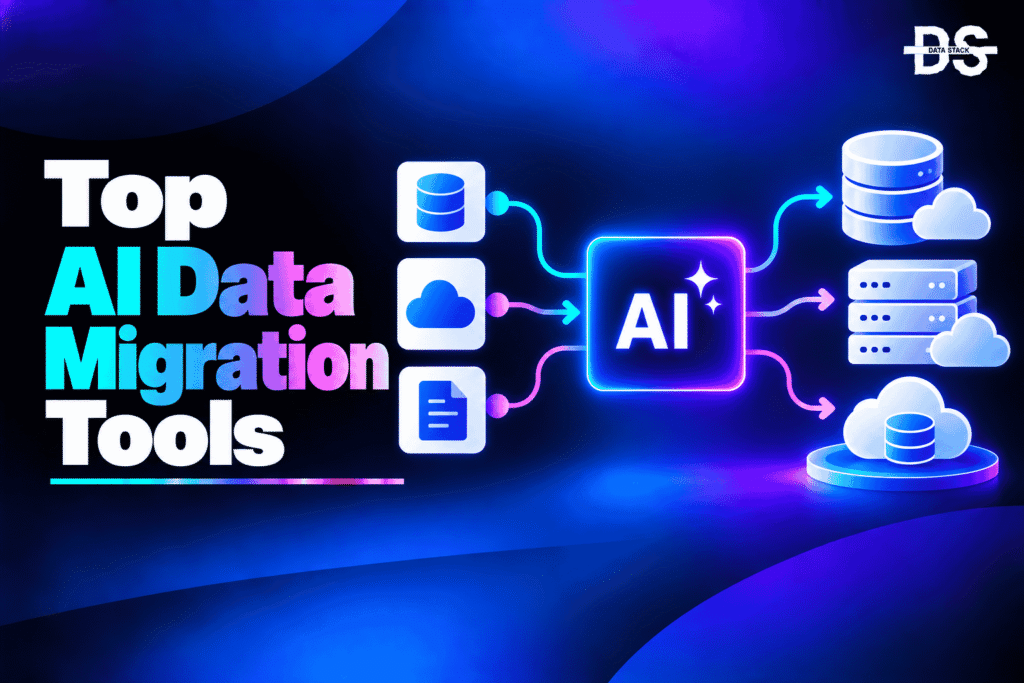
Data migration becomes complicated when organizations need to move information between databases, applications, data warehouses, cloud platforms, or legacy systems. Different schemas, inconsistent field names, outdated pipelines, duplicate records, and poor data quality can turn what looks like a simple data move into a lengthy project. AI data migration tools use artificial intelligence to automate or assist with tasks such as data mapping, transformation, validation, pipeline conversion, and migration planning.
Traditional data migration tools can move and transform data efficiently, but many still require engineers to manually configure mappings, write transformation logic, recreate pipelines, and investigate migration errors. AI-powered migration tools can reduce this work by understanding schemas and data structures, suggesting mappings, generating transformation logic, converting legacy pipelines, and helping teams identify problems before data reaches the target system.
The role of AI varies significantly between products. Some tools are designed specifically for AI-assisted system migrations and can automate source-to-target mapping and data preparation. Others add AI to existing ETL, ELT, replication, or integration platforms to help engineers build and modernize migration pipelines. Open-source platforms can also be useful when teams want more control over deployment, connectors, and migration infrastructure.
In this guide, we compare the best AI data migration tools based on their AI capabilities, migration automation, data mapping and transformation features, and ideal use cases. We also cover their key AI-focused features, compare them side by side, explain how to choose the right tool, and answer common questions about AI-powered data migration.
What Are AI Data Migration Tools?
AI data migration tools are software platforms that use artificial intelligence to help organizations plan, map, transform, validate, and move data from one system or environment to another. They can use AI to understand source and target schemas, recommend field mappings, generate transformation logic, convert legacy pipelines, identify data quality issues, and automate parts of the migration process.
Traditional migration workflows often require engineers to manually understand source structures, map fields to the target schema, create transformation rules, and test the resulting pipelines. AI can assist with these tasks by analyzing metadata and data patterns and generating recommendations or migration logic based on the source and target environments.
AI data migration is useful for cloud modernization, database migrations, ERP and CRM implementations, legacy ETL modernization, warehouse migrations, and recurring data onboarding. However, AI should not remove human review from important migrations. Teams still need to validate mappings, transformations, data quality, security, and the final migrated records.
AI Data Migration Tools vs. Traditional Data Migration Tools
| Capability | Traditional Data Migration Tools | AI Data Migration Tools |
|---|---|---|
| Schema analysis | Manual or rule-based | AI-assisted schema understanding |
| Field mapping | Manually configured | AI can recommend source-to-target mappings |
| Transformation logic | Engineers create rules or code | AI can generate or recommend transformations |
| Legacy pipeline conversion | Often requires manual rebuilding | AI can convert existing pipeline logic |
| Data quality checks | Predefined rules | AI-assisted issue detection and recommendations |
| Migration planning | Manually documented | AI can assist with planning and dependency analysis |
| Error investigation | Engineers inspect logs and data | AI can assist with identifying likely causes |
| Documentation | Created manually | AI can generate migration documentation |
| Validation | Manual or predefined tests | AI-assisted validation and reconciliation |
| Natural-language workflows | Limited | Users can describe migration tasks in natural language |
AI Data Migration Tools Comparison
The table below compares the leading AI data migration tools based on their AI capabilities, migration automation, best use cases, and G2 ratings.
| Tool | AI Capabilities | What You Can Automate | Best For | G2 Rating |
|---|---|---|---|---|
| Obvious / Flatfile | AI mapping, transformation, validation, data profiling | Data preparation, mapping, cleaning, validation, migration | System implementation and data onboarding | — |
| Matillion Maia | AI agents, pipeline generation, legacy ETL conversion | Pipeline migration, transformation, modernization | Legacy ETL modernization | 4.5/5 |
| Informatica IDMC | CLAIRE AI, AI agents, natural-language mapping and pipeline generation | Data integration, workload modernization, mappings | Enterprise cloud migration | 4.2/5 |
| SnapLogic | AI-led integration, intelligent modernization, natural-language pipeline creation | Legacy integration migration, pipeline creation | Enterprise integration modernization | 4.4/5 |
| Qlik Talend Cloud | Generative AI, AI pipeline creation, automated migration assessment | Data movement, pipeline migration, transformations | Governed enterprise migrations | 4.6/5 |
| Superglue | Agentic extraction, mapping, transformation, loading, validation | End-to-end business-system migrations | ERP, CRM, and business-system migration | — |
| Airbyte | AI-assisted data movement and integration workflows | Data replication, connector-based migration | Open-source and self-hosted data migration | 4.4/5 |
| CloverDX | AI-assisted pipeline development and migration automation | ETL, transformation, migration, validation | Engineering-led migrations | — |
8 Best AI Data Migration Tools
These AI data migration tools help automate the movement of data between systems while reducing manual effort, errors, and migration complexity. Below, we explore 8 leading AI data migration tools and their key capabilities, use cases, and strengths.
#1. Obvious / Flatfile
Obvious, formerly Flatfile, provides an AI-powered approach to data migration focused on preparing, mapping, cleaning, transforming, and validating data before it reaches a destination system. Its migration capabilities are designed for implementation teams and organizations dealing with inconsistent customer or legacy data during system migrations.
The platform’s AI agent can analyze incoming data and automatically match source fields to a target schema. It can also identify messy or inconsistent information and help transform it into the format required by the destination system. This is particularly useful when source files vary significantly between customers, departments, or legacy systems.
Obvious is a strong fit for data onboarding and system implementation projects where migration involves more than simply copying records from one database to another. Teams can use AI to reduce manual mapping and preparation work while keeping people involved in reviewing and approving important migration decisions.
Key Features
- AI-Powered Field Mapping: The AI agent can analyze incoming fields and automatically match them with the appropriate fields in the destination schema, reducing the manual work involved in source-to-target mapping.
- AI Data Transformation: AI can transform inconsistent source values and structures into formats that match the target system, including situations where information needs to be split, combined, or reformatted.
- Automated Data Profiling: The platform can inspect incoming data to identify its structure, quality, and potential migration problems before the data is loaded into the target environment.
- AI Data Validation: Migration data can be checked against validation rules and target requirements so teams can identify problems before production import.
- AI Deduplication: The platform can identify potential duplicate records and assist with deduplication as part of the migration preparation process.
- Schema Analysis: AI can help understand source and target schemas and identify relationships between fields, making complex migration projects easier to plan.
- Migration Collaboration: Teams can collaborate around migration data, review changes, and maintain visibility into preparation and validation rather than relying on disconnected spreadsheets.
- Migration Memory: AI can use previous project context and preferences to make future migration work more consistent across recurring implementations.
G2 Rating: —
Showcase your software to buyers actively comparing tools. Submit your product for editorial review and get featured on Data Stack Hub.
Submit Your Tool →#2. Matillion Maia
Matillion Maia is an AI data automation platform that uses AI agents to assist with data engineering and migration workflows. One of its most relevant capabilities for this category is Migration Agent, which can convert legacy ETL pipelines into modern cloud-native pipelines.
Migration Agent can analyze legacy transformation logic, dependencies, and pipeline metadata and reconstruct that logic as native pipelines for modern cloud data platforms. This is different from a basic data replication tool because the focus is on modernizing the migration logic itself, not simply copying records from one location to another.
Matillion is particularly useful for organizations moving away from legacy ETL platforms such as Informatica PowerCenter, Alteryx, IBM DataStage, SSIS, Oracle ODI, SAS Enterprise Guide, and other supported platforms. Ambiguous or unsupported logic can be flagged for human review rather than silently converted.
Key Features
- AI Migration Agent: Maia can analyze legacy ETL pipelines and convert their logic into modern warehouse-optimized pipelines, reducing the need to manually rebuild each workflow.
- Legacy ETL Conversion: The Migration Agent supports conversion from multiple legacy platforms, helping teams modernize existing data engineering investments rather than starting migration projects from scratch.
- AI Pipeline Generation: Maia agents can create data pipelines from natural-language instructions, allowing engineers to describe the desired workflow instead of manually configuring every component.
- Transformation Logic Analysis: AI analyzes existing transformation logic and pipeline dependencies before reconstructing the workflow in the target environment.
- Migration Compatibility Analysis: Generated migrations can identify unsupported or ambiguous components so engineers know which parts require additional review.
- AI-Assisted Data Engineering: Maia can automate repetitive pipeline development work beyond migration, making it useful for teams modernizing and rebuilding their broader data stack.
- Migration Testing: Matillion provides migration and pipeline testing capabilities that help teams compare outputs and verify that migrated workflows behave as expected.
- Modern Cloud Pipeline Generation: Migrated workloads can be converted into native pipelines designed for modern cloud data warehouses and platforms.
G2 Rating: 4.5/5
Also Read: Best Matillion Alternatives & Competitors in 2026
#3. Informatica Intelligent Data Management Cloud
Informatica Intelligent Data Management Cloud (IDMC) is an enterprise data management platform that combines data integration, migration, quality, governance, and AI capabilities. Its CLAIRE AI technology is used across the platform to assist with data engineering and modernization tasks.
Informatica’s CLAIRE Modernization Agent is specifically designed to automate the migration of on-premises data engineering workloads to Informatica’s cloud data management environment. It can assess and convert existing workloads while preserving business logic and reducing the amount of manual rebuilding required during modernization projects.
The platform is best suited to large enterprises managing complex hybrid and multi-cloud environments. Its combination of AI, data integration, metadata, governance, and quality capabilities makes it more appropriate for large-scale modernization programs than simple one-time data transfers.
Key Features
- CLAIRE Modernization Agent: AI can assess and convert legacy data engineering workloads, helping organizations modernize existing pipelines and workloads with less manual rebuilding.
- AI-Powered Mapping: CLAIRE Copilot can generate data integration mappings from natural-language descriptions, reducing the effort required to configure complex mappings manually.
- AI Pipeline Generation: Users can describe integration requirements in natural language and use AI assistance to generate data pipelines and integration workflows.
- Workload Modernization: AI can help organizations move legacy data engineering workloads toward modern cloud-based environments while retaining existing business logic.
- Metadata Intelligence: CLAIRE uses metadata to provide context for AI-assisted data management, helping recommendations and automation work with enterprise data structures.
- AI Data Quality Assistance: AI capabilities can assist with identifying and addressing data quality issues as part of broader migration and integration workflows.
- Natural-Language Data Management: Users can interact with enterprise data management capabilities through natural-language requests instead of relying exclusively on technical configuration.
- Enterprise Cloud Integration: IDMC supports complex hybrid and multi-cloud migration environments where security, governance, data quality, and integration need to operate together.
G2 Rating: 4.2/5
Also Read: Best Informatica Alternatives & Competitors in 2026
#4. SnapLogic
SnapLogic is an enterprise integration and automation platform that uses AI to help organizations build, modernize, and manage data and application integrations. Its Intelligent Modernizer, or SLIM, is designed specifically to help organizations analyze legacy integrations and determine how those workloads should be migrated.
SLIM can analyze existing integration logic, relationships, data flows, and dependencies before helping create modern integrations on the SnapLogic platform. Instead of performing a simple one-to-one conversion, the approach is intended to help teams modernize legacy workflows and avoid carrying unnecessary legacy components into the new environment.
SnapLogic is a strong option for enterprises where data migration is closely connected to application integration and broader workflow modernization. It is particularly relevant when migration projects involve multiple systems rather than only moving tables between databases.
Key Features
- AI Integration Modernization: SLIM analyzes legacy integrations and helps organizations determine what should be migrated, replaced, refactored, or retired.
- Legacy Integration Analysis: AI-assisted analysis can examine backend logic, relationships, dependencies, and data flows to provide a clearer picture of the existing integration environment.
- AI Pipeline Generation: SnapLogic uses natural-language and AI-assisted capabilities to help teams create modern integration pipelines without manually configuring every step.
- Migration Dependency Analysis: Understanding relationships between legacy workflows helps teams identify which integrations need to move together and which can be retired.
- Integration Refactoring: Rather than simply copying outdated workflows, SLIM can help create new integrations using modern SnapLogic patterns.
- Natural-Language Integration: Users can describe integration requirements in natural language and use AI to accelerate pipeline development.
- AI-Assisted Documentation: Analysis of legacy integrations can help produce documentation that explains existing workflows before migration.
- Enterprise Integration Automation: SnapLogic combines AI-assisted migration with application, API, and data integration capabilities for broader modernization programs.
G2 Rating: 4.4/5
#5. Qlik Talend Cloud
Qlik Talend Cloud combines data integration, replication, transformation, data quality, and governance capabilities for organizations moving data across on-premises and cloud environments. Its data movement capabilities support continuous replication and change-data capture, while generative AI can assist with pipeline development.
The platform also includes the Qlik Talend Cloud Migration Toolkit, which helps organizations inventory existing assets, assess compatibility, identify migration risks, organize migration groups, and automate parts of the migration process. This makes it relevant for organizations migrating existing data integration environments to Qlik Talend Cloud.
Qlik Talend Cloud is particularly useful for enterprise migrations where data movement needs to operate alongside data quality and governance. Its combination of CDC, migration assessment, transformation, and AI-assisted pipeline creation makes it suitable for complex modernization projects.
Key Features
- AI-Assisted Pipeline Creation: Generative AI can help create data pipelines from requirements, reducing the amount of manual pipeline configuration required.
- Migration Assessment: The Migration Toolkit can analyze existing assets and identify compatibility gaps, risks, dependencies, and required transformations before migration begins.
- Automated Asset Inventory: Migration workflows can automatically scan and catalog existing assets, helping teams understand what needs to be migrated.
- AI-Assisted Data Transformation: AI can support the transformation and enrichment of data as it moves between source and target environments.
- Change Data Capture: Qlik Replicate and Data Movement capabilities can continuously capture changes, which is useful for migrations that require limited downtime.
- Migration Tracking: Migration workflows provide tracking and verification capabilities so teams can monitor progress and check consistency.
- Data Quality and Governance: Migration can be combined with data quality and governance capabilities instead of treating data movement as an isolated process.
- Multi-Cloud Data Movement: Qlik supports movement between a wide range of databases, cloud platforms, warehouses, and data lakes.
G2 Rating: 4.6/5
Increase your product visibility by reaching software buyers researching the best tools. Every submission is reviewed by our editorial team.
Feature My Tool →#6. Superglue
Superglue is an agentic data migration platform designed specifically for business-system migrations. Instead of requiring teams to manually build an extraction, transformation, and loading workflow, its AI agent can help create the migration process from a natural-language description of the desired move.
The platform focuses on the full migration lifecycle, including extracting source data, mapping it to the target structure, transforming records, loading them into the destination, and validating the result. This makes it different from traditional ETL platforms that primarily provide the building blocks for engineers to construct migration pipelines.
Superglue is particularly suited to migrations involving systems such as ERP, CRM, billing, and other business applications where mapping business entities and handling inconsistent historical data can be more difficult than simply transferring database tables.
Key Features
- Agentic Migration Planning: Users can describe the migration in natural language, allowing the AI agent to help construct the extraction, mapping, transformation, loading, and validation workflow.
- AI Field Mapping: The agent can propose mappings between source and target fields, helping teams handle differences in schemas and business structures.
- AI Data Transformation: Migration transformations can be generated based on the source and target requirements, reducing manual transformation development.
- Automated Data Validation: The platform can validate migration results against the source to identify discrepancies before a migration is considered complete.
- Business-System Migration: Superglue focuses on migrations involving operational systems such as ERP, CRM, billing, and other business applications.
- AI-Assisted Extraction: The agent can help build extraction workflows across APIs, databases, and files rather than requiring teams to manually build every connector workflow.
- Migration Reconciliation: Source and target results can be compared to help identify missing or incorrectly migrated records.
- Agent-Driven Workflow: The AI agent handles much of the mechanical migration work while humans remain responsible for important mapping and approval decisions.
G2 Rating: —
#7. Airbyte
Airbyte is an open-source data integration platform designed to move data between applications, APIs, databases, warehouses, lakes, and other destinations. It is commonly used for data replication and ELT workflows and can be deployed in environments where teams want more control over their data movement infrastructure.
Airbyte is not an AI-native migration agent in the same way as Obvious or Superglue. Its relevance to AI data migration comes from its role in modern data movement and its growing support for AI-oriented workflows, where data needs to be moved from operational systems into destinations used by AI applications.
For engineering teams that want an open-source foundation for migration and data movement, Airbyte can be a strong option. Teams can combine its connector ecosystem and deployment flexibility with AI-assisted development or data workflows rather than relying on a fully managed proprietary migration platform.
Key Features
- Open-Source Data Movement: Airbyte provides an open-source foundation for moving data between applications, databases, APIs, warehouses, and other destinations.
- AI-Ready Data Movement: Data can be moved from operational sources into destinations used by AI applications, helping teams build the data foundation required for AI workflows.
- Large Connector Ecosystem: Airbyte provides a broad collection of connectors that can reduce the amount of custom integration work required during migration projects.
- Custom Connector Development: Teams can create or customize connectors when a required source or destination is not available as a standard connector.
- Incremental Data Sync: Incremental synchronization can help organizations keep source and target environments aligned during migration and cutover periods.
- Self-Hosted Deployment: Organizations can deploy Airbyte within their own infrastructure when they need greater control over data movement and security.
- API-Based Data Movement: Programmatic capabilities allow migration workflows to be integrated into broader data engineering systems.
- AI Application Integration: Airbyte can support data movement into environments used for AI agents, vector databases, and other AI applications.
G2 Rating: 4.4/5
Also Read: Airbyte Alternatives and Competitors
#8. CloverDX
CloverDX is a data integration platform designed for building and automating ETL, data transformation, data migration, and data quality workflows. It provides visual pipeline development alongside code and AI-assisted pipeline creation, giving engineering teams multiple ways to build migration workflows.
The platform can be used for legacy system replacement, client data onboarding, data migration, validation, and other data movement projects. Its AI capabilities are designed to assist engineers rather than completely replace the migration workflow, making it a practical option for teams that want AI support while retaining control over pipeline design.
CloverDX is especially relevant for organizations that need deployment flexibility. It can be deployed on-premises, in private cloud environments, or in containers, which can be important for migrations involving sensitive or regulated data.
Key Features
- AI-Assisted Pipeline Development: Engineers can use AI alongside visual and code-based development to accelerate the creation of migration and transformation workflows.
- Automated Data Migration: Pipelines can automate recurring or one-time data migration jobs instead of requiring engineers to manually move records between systems.
- AI Data Transformation: AI can assist with transformation logic while teams retain the ability to modify and control the resulting pipeline.
- Schema and Metadata Handling: Metadata-aware pipelines can help identify schema changes and potential migration problems before they affect production workflows.
- Data Quality Validation: Migration workflows can include validation steps to verify that transformed and migrated data meets expected requirements.
- Legacy System Replacement: CloverDX can support migration projects where organizations are replacing older systems or consolidating multiple data environments.
- Pipeline Automation: Migration workflows can run on schedules, triggers, or APIs, making the platform useful for both one-time migration projects and ongoing synchronization.
- Flexible Deployment: Organizations can deploy the platform on-premises, in their own cloud, or in containerized environments depending on security and infrastructure requirements.
G2 Rating: —
Also Read: Best CloverDX Alternatives and Competitors
How to Choose the Right AI Data Migration Tool
- Migration Type: First determine whether you are migrating databases, applications, SaaS systems, warehouses, legacy ETL pipelines, or customer data. Different tools are built for different migration patterns.
- AI Automation: Look at what the AI actually does. The strongest tools can assist with mapping, transformation, validation, pipeline creation, or legacy modernization rather than simply providing a chatbot alongside a traditional migration tool.
- Schema Mapping: If source and target systems have different structures, prioritize tools that can automatically identify and recommend source-to-target mappings.
- Data Transformation: Check whether the platform can handle data type conversion, field splitting and merging, value normalization, business rules, and other transformations required by your migration.
- Validation and Reconciliation: Choose a tool that can compare source and target data and identify missing, duplicated, or incorrectly transformed records before the migration is finalized.
- Legacy Pipeline Support: If you are modernizing an existing ETL environment, check whether the platform can understand and convert your current pipelines instead of requiring engineers to rebuild them manually.
- Data Quality: Migration can expose existing data problems. Look for profiling, validation, deduplication, anomaly detection, and other data-quality capabilities where necessary.
- Connectors and Integrations: Confirm that the tool supports your actual source and target systems. A strong AI layer is not useful if the platform cannot connect to the environments involved in your migration.
- Security and Governance: Evaluate encryption, access controls, audit trails, deployment options, data residency, and compliance requirements, especially when migrating sensitive enterprise data.
- Scalability and Cost: Test the platform against your actual data volume and migration frequency. Consider both the software cost and the engineering resources required to build, monitor, and maintain the migration.
Browse expertly curated software recommendations across hundreds of business categories.
Browse Top Tools →Conclusion
AI data migration tools are changing how organizations approach complex data movement and modernization projects. Instead of relying entirely on manually configured mappings, transformation scripts, and pipeline rebuilding, teams can use AI to understand schemas, recommend mappings, generate transformation logic, validate migrated data, and modernize legacy workflows.
The tools in this list take different approaches. Obvious / Flatfile and Superglue are focused heavily on AI-assisted migration itself, making them useful for system implementations, data onboarding, and business-system migrations. Matillion Maia, Informatica IDMC, and SnapLogic are particularly relevant for organizations modernizing legacy ETL and integration environments.
Qlik Talend Cloud combines migration assessment, data movement, CDC, transformation, quality, and governance, making it a strong option for larger enterprise migration programs. Airbyte provides an open-source alternative for teams that want control over their data movement infrastructure and need to connect operational data with modern analytics and AI environments.
CloverDX provides another flexible option for engineering teams that want to combine visual pipeline development, code, AI assistance, validation, and flexible deployment. It can be particularly useful for organizations handling legacy replacement and complex data migration projects.
The best AI data migration tool depends on what is being moved and how different the source and target environments are. A simple database replication project may not require an agentic migration platform, while a CRM, ERP, or legacy ETL modernization project can benefit significantly from AI-assisted mapping and transformation.
Regardless of the platform, teams should not treat AI-generated migrations as automatically correct. Source-to-target mappings, transformation rules, data quality, record counts, business logic, and final reconciliation should be tested before production cutover. AI can reduce the amount of manual work, but careful validation remains essential for a successful migration.
Frequently Asked Questions
1. What are AI data migration tools?
AI data migration tools use artificial intelligence to help organizations plan, map, transform, validate, and move data between systems. They can automate tasks such as schema analysis, field mapping, transformation generation, pipeline creation, and migration validation.
2. How do AI data migration tools work?
AI migration tools analyze source and target data structures, metadata, schemas, and sometimes the actual records being migrated. Based on this information, AI can recommend mappings, generate transformations, identify potential problems, and automate parts of the migration workflow.
3. What is the difference between AI data migration and traditional data migration?
Traditional data migration generally relies on manually configured mappings, transformation rules, scripts, and ETL pipelines. AI data migration adds intelligence to these workflows by helping understand schemas, recommend mappings, generate transformations, convert legacy pipelines, and identify migration issues.
4. Can AI automatically map source and target fields?
Yes. AI-powered migration tools can analyze source and destination schemas and recommend mappings between fields. Some platforms can also identify when fields need to be split, combined, renamed, or transformed before they can be loaded into the target system.
5. Can AI migrate data between databases?
Yes. AI can assist with database migration by analyzing schemas, generating transformation logic, mapping fields, and helping validate the migrated records. However, traditional database replication and CDC technologies may still be required for the actual movement of large volumes of data.
6. Can AI migrate legacy ETL pipelines?
Yes. This is one of the more advanced AI data migration use cases. Tools such as Matillion Maia, Informatica, and SnapLogic can analyze existing pipeline logic and help convert or modernize legacy ETL and integration workloads.
7. Can AI migrate CRM and ERP data?
Yes. AI can be particularly useful for CRM and ERP migrations because these projects often involve inconsistent schemas, different field names, complex business entities, duplicate records, and data transformation requirements.
8. Can AI validate migrated data?
Yes. AI-assisted migration platforms can help compare source and target data, identify discrepancies, check validation rules, and flag records that require human review. Traditional reconciliation and deterministic validation should still be used for critical migration projects.
9. What are the best AI data migration tools in 2026?
The leading options covered in this article are Obvious / Flatfile, Matillion Maia, Informatica Intelligent Data Management Cloud, SnapLogic, Qlik Talend Cloud, Superglue, Airbyte, and CloverDX. The best choice depends on whether the migration involves business systems, databases, cloud platforms, or legacy ETL pipelines.
10. What are the best AI tools for database migration?
For AI-assisted database and data movement workflows, Qlik Talend Cloud, Informatica, Airbyte, CloverDX, and Superglue are relevant options. The right choice depends on whether the project requires database replication, schema transformation, business-system mapping, or broader migration automation.
11. Are there open-source AI data migration tools?
Yes. Airbyte is an important open-source option for data movement and migration workflows. It provides connectors, custom connector development, self-hosted deployment, and integration capabilities that can be combined with AI-assisted data engineering workflows.
12. Can AI migrate data without coding?
Some platforms can significantly reduce or eliminate the amount of coding required for specific migration workflows. AI-powered platforms can generate mappings, transformations, and pipelines from natural-language requirements. However, complex enterprise migrations may still require engineers to review and customize the generated workflows.
13. Can AI migrate data from Excel and CSV files?
Yes. AI-powered migration platforms can analyze spreadsheet and CSV structures, identify fields, map columns to target schemas, clean inconsistent values, and transform the data into a format suitable for import into another system.
14. Can AI detect data quality problems during migration?
Yes. AI can help identify duplicate records, missing values, inconsistent formats, unusual values, schema mismatches, and other problems that could prevent a successful migration. Data profiling and deterministic validation rules should be used alongside AI for critical migrations.
15. Is AI data migration safe?
AI can make migration workflows more efficient, but safety depends on how the platform handles data, access, validation, and human approval. Organizations should evaluate security controls, encryption, deployment options, auditability, data retention, and validation capabilities before using an AI migration platform with sensitive data.