
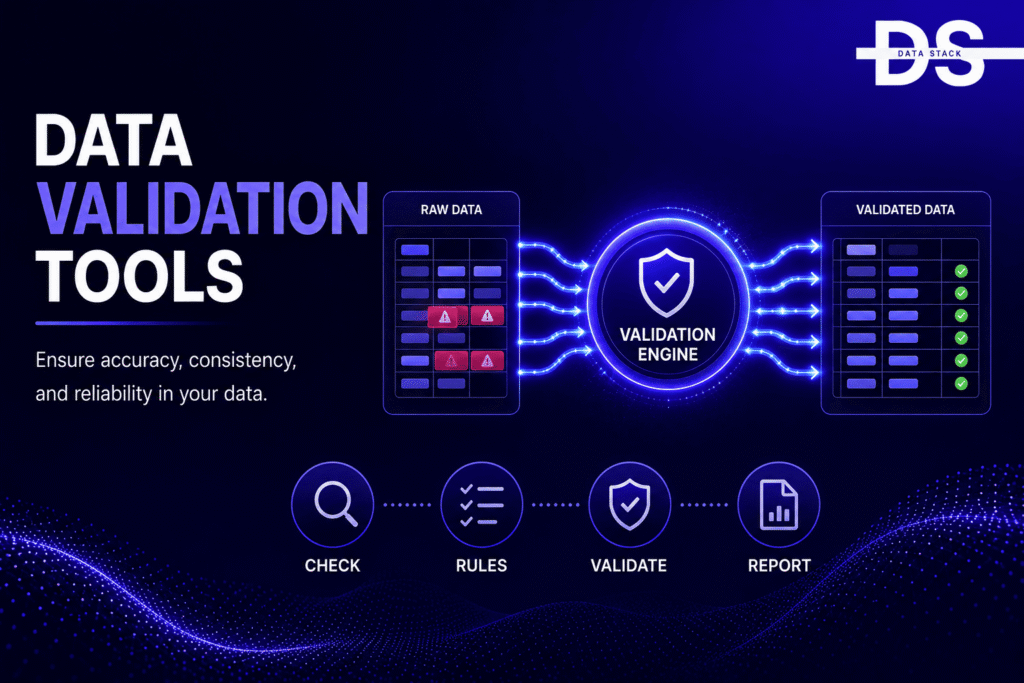
Data is only valuable when it can be trusted.
Organizations rely on information to drive reporting, analytics, machine learning, customer experiences, and operational decision-making. However, missing values, schema changes, duplicate records, invalid formats, and unexpected anomalies can quickly reduce confidence in business data.
As data volumes continue to grow, manual validation becomes increasingly difficult.
This is where data validation tools help.
These platforms automatically check datasets against predefined rules, identify inconsistencies, detect anomalies, and verify data quality before information is consumed by downstream systems. Modern validation solutions often combine monitoring, observability, testing, and governance capabilities to help organizations maintain reliable data environments.
Whether you’re building analytics pipelines, machine learning systems, or enterprise reporting platforms, selecting the right validation solution can significantly improve data trust and operational reliability.
What Are Data Validation Tools?
Data validation tools help organizations verify that data meets predefined quality, format, completeness, and business-rule requirements.
These platforms are commonly used to:
- Validate incoming datasets.
- Detect missing or invalid values.
- Enforce schema standards.
- Monitor data quality.
- Identify anomalies and inconsistencies.
- Improve reliability across data pipelines.
Organizations use validation tools to prevent bad data from impacting business processes and decision-making.
Benefits of Data Validation Tools
- Improve trust in business data.
- Detect errors before they affect analytics.
- Reduce manual validation effort.
- Improve compliance and governance initiatives.
- Strengthen data quality programs.
- Support AI and machine learning projects.
- Improve operational reliability.
Data Validation Software Comparison
| Tool | Best For | Deployment | Good Fit |
|---|---|---|---|
| Great Expectations | Open-source validation | Cloud, Self-Hosted | Data teams |
| Soda | Continuous validation | Cloud | Modern data teams |
| Monte Carlo | Enterprise observability | Cloud | Large organizations |
| Informatica Data Quality | Enterprise quality management | Cloud | Enterprises |
| Talend Data Fabric | Validation and integration | Cloud, Hybrid | Enterprises |
| Ataccama ONE | Data trust initiatives | Cloud | Large organizations |
| IBM InfoSphere QualityStage | Enterprise validation | Hybrid | Enterprises |
| SAS Data Quality | Regulated industries | Cloud, Hybrid | Large enterprises |
| Anomalo | Automated anomaly detection | Cloud | Analytics teams |
| Bigeye | Data observability and validation | Cloud | Modern data organizations |
10 Best Data Validation Tools
#1 Great Expectations
Great Expectations is one of the most widely adopted open-source data validation frameworks available today. The platform allows organizations to define expectations for their datasets and automatically verify whether incoming data meets those requirements.
Unlike traditional data quality tools that rely heavily on graphical interfaces, Great Expectations is built with data engineers and analytics teams in mind. Users can create validation rules programmatically and integrate them directly into modern data workflows.
One of the reasons Great Expectations has become so popular is its flexibility. Teams can validate schema structures, missing values, data distributions, uniqueness constraints, and business-specific rules before information reaches analytics platforms or production systems.
The platform also generates documentation that helps organizations understand dataset quality and validation outcomes. This improves transparency while making it easier to identify and resolve issues.
Organizations building modern analytics platforms frequently evaluate Data Pipeline Tools alongside validation solutions because validation often becomes an essential stage of pipeline development.
For engineering-focused teams that want flexibility and control, Great Expectations remains one of the strongest validation solutions available.
Key Features
- Provides open-source data validation capabilities.
- Supports schema, completeness, and quality checks.
- Enables automated testing within data pipelines.
- Generates documentation and validation reports.
- Integrates with modern analytics ecosystems.
Why Choose This Tool
Great Expectations is ideal for organizations that want a flexible and developer-friendly framework for validating datasets within modern analytics and engineering workflows.
G2 Rating: 4.6/5
Gartner Rating: Not Available
#2 Soda
Soda has emerged as one of the most popular modern data validation and quality monitoring platforms.
The platform helps organizations continuously monitor data quality across warehouses, lakehouses, and analytics environments. Teams can define validation rules, detect anomalies, monitor freshness, and identify unexpected changes before issues affect business operations.
One of Soda’s biggest strengths is usability. Unlike many traditional enterprise quality tools, Soda focuses on providing a streamlined experience that appeals to modern data teams working with cloud-native architectures.
The platform integrates closely with Snowflake, Databricks, BigQuery, Redshift, and other modern analytics platforms, making deployment relatively straightforward for organizations operating cloud-based data stacks.
Soda is particularly attractive for teams that want proactive visibility into data quality without introducing significant operational complexity.
Key Features
- Supports automated data validation workflows.
- Detects anomalies and unexpected data changes.
- Monitors freshness and completeness metrics.
- Integrates with modern cloud data platforms.
- Provides continuous quality monitoring.
Why Choose This Tool
Soda is a strong choice for organizations that want modern, cloud-native validation capabilities combined with continuous quality monitoring.
G2 Rating: 4.7/5
Gartner Rating: Not Available
Showcase your software to buyers actively comparing tools. Submit your product for editorial review and get featured on Data Stack Hub.
Submit Your Tool →#3 Monte Carlo
Monte Carlo is one of the leading platforms in the rapidly growing data observability market. While the platform extends beyond traditional validation, it provides powerful capabilities for identifying quality issues before they impact business users.
Rather than relying solely on manually defined rules, Monte Carlo automatically monitors datasets, pipelines, and data assets to detect anomalies, freshness issues, schema changes, and unexpected behavior.
Large enterprises frequently adopt Monte Carlo because it helps reduce the time required to identify and troubleshoot data incidents. Instead of waiting for broken dashboards or stakeholder complaints, teams receive proactive alerts when quality issues emerge.
The platform has become particularly popular among organizations operating complex modern data architectures with large numbers of datasets and pipelines.
For enterprises seeking automation and visibility across data environments, Monte Carlo is one of the strongest options available.
Key Features
- Provides automated data observability capabilities.
- Detects anomalies and schema changes.
- Monitors freshness and volume metrics.
- Helps identify data incidents proactively.
- Supports large-scale analytics environments.
Why Choose This Tool
Monte Carlo is best suited for organizations that want automated validation and observability capabilities across complex data ecosystems.
G2 Rating: 4.6/5
Gartner Rating: 4.7/5
#4 Informatica Data Quality
Informatica Data Quality is one of the most established enterprise platforms for validating, profiling, standardizing, and monitoring business data. Large organizations frequently deploy Informatica as part of broader data governance, master data management, and quality initiatives.
The platform helps teams define validation rules, identify inconsistencies, detect duplicates, and enforce quality standards across multiple systems. Organizations can validate customer records, financial data, operational datasets, product information, and other critical business assets before they are consumed by downstream applications.
One of Informatica’s biggest strengths is scalability. Enterprises managing thousands of datasets across cloud, on-premises, and hybrid environments often require a platform capable of supporting complex quality programs while maintaining governance and compliance standards.
The solution also integrates closely with Informatica’s broader ecosystem, making it attractive for organizations already using Informatica for integration, governance, or metadata management initiatives.
For enterprises seeking comprehensive validation and quality management capabilities, Informatica remains a category leader.
Key Features
- Supports enterprise-scale data validation workflows.
- Provides profiling, cleansing, and standardization capabilities.
- Helps enforce business and compliance rules.
- Integrates with governance and metadata initiatives.
- Supports cloud, hybrid, and on-premises environments.
Why Choose This Tool
Informatica Data Quality is ideal for organizations that need a mature enterprise platform capable of supporting large-scale validation, governance, and quality management programs.
G2 Rating: 4.3/5
Gartner Rating: 4.6/5
#5 Talend Data Fabric
Talend Data Fabric combines data integration, transformation, governance, quality management, and validation capabilities within a unified platform.
Organizations use Talend to validate information as it moves through pipelines and operational systems, helping prevent poor-quality data from reaching analytics environments or business applications. The platform allows teams to define validation rules, standardize information, and automate quality checks across multiple data sources.
A key advantage of Talend is its ability to combine validation and integration workflows within the same environment. Rather than relying on separate tools for movement and validation, organizations can manage both processes together.
Many enterprises evaluating validation solutions also compare Data Integration Tools because validation often becomes an important stage of integration projects.
For organizations seeking a unified approach to integration and validation, Talend remains a strong option.
Key Features
- Supports validation and integration workflows.
- Enables rule-based quality enforcement.
- Helps standardize and cleanse incoming data.
- Supports cloud and hybrid architectures.
- Provides enterprise-scale deployment capabilities.
Why Choose This Tool
Talend Data Fabric is a strong choice for organizations that want validation capabilities integrated directly into broader data management workflows.
G2 Rating: 4.3/5
Gartner Rating: 4.4/5
#6 Ataccama ONE
Ataccama ONE combines validation, quality management, governance, metadata management, and observability capabilities within a single platform.
The solution helps organizations build trusted data environments by continuously validating information and monitoring quality across systems. AI-assisted recommendations help teams identify quality issues and improve validation processes without excessive manual effort.
Unlike traditional validation tools that focus primarily on rule enforcement, Ataccama emphasizes data trust and continuous quality improvement. Organizations can monitor data health, identify anomalies, and validate business-critical information throughout its lifecycle.
The platform is particularly attractive to enterprises building long-term governance and quality programs rather than solving isolated validation challenges.
For organizations focused on creating trusted enterprise data assets, Ataccama ONE is one of the strongest options available.
Key Features
- Combines validation, governance, and quality management.
- Provides AI-assisted quality recommendations.
- Supports continuous monitoring and validation.
- Helps improve trust in enterprise data assets.
- Supports large-scale enterprise deployments.
Why Choose This Tool
Ataccama ONE is ideal for organizations that view validation as part of a broader data trust and governance strategy.
G2 Rating: 4.5/5
Gartner Rating: 4.7/5
Increase your product visibility by reaching software buyers researching the best tools. Every submission is reviewed by our editorial team.
Feature My Tool →#7 IBM InfoSphere QualityStage
IBM InfoSphere QualityStage helps organizations validate, standardize, match, and improve data quality across enterprise environments.
The platform is commonly used in large organizations that manage significant volumes of customer, supplier, operational, and financial data. Validation capabilities help ensure that information meets business standards before it enters downstream systems.
IBM’s long history in enterprise data management has made QualityStage a common choice among organizations with mature governance and compliance requirements. The platform also provides matching and deduplication capabilities that help improve overall dataset reliability.
For enterprises operating complex environments with strict quality requirements, QualityStage remains a proven solution.
Key Features
- Supports enterprise validation and standardization.
- Helps identify inconsistent and duplicate records.
- Provides matching and quality improvement capabilities.
- Supports governance and compliance initiatives.
- Integrates with IBM data management environments.
Why Choose This Tool
IBM InfoSphere QualityStage is best suited for organizations that require enterprise-grade validation and quality management across large-scale environments.
G2 Rating: 4.1/5
Gartner Rating: 4.4/5
#8 SAS Data Quality
SAS Data Quality helps organizations validate, standardize, enrich, and monitor business data used in analytics and operational processes.
The platform is particularly popular in highly regulated industries such as healthcare, banking, insurance, telecommunications, and government where data accuracy directly affects compliance and decision-making.
SAS provides extensive validation capabilities that help organizations identify invalid records, enforce standards, and improve consistency across business systems. Combined with the broader SAS analytics ecosystem, these capabilities allow teams to build more reliable reporting and predictive models.
Organizations operating in compliance-driven industries frequently value SAS because of its focus on governance, auditability, and quality controls.
For regulated environments, SAS remains one of the most respected validation platforms available.
Key Features
- Supports validation, enrichment, and standardization workflows.
- Helps improve data consistency and accuracy.
- Provides compliance-oriented quality controls.
- Integrates with SAS analytics environments.
- Supports enterprise-scale deployments.
Why Choose This Tool
SAS Data Quality is a strong option for organizations operating in regulated industries where data accuracy and compliance are critical.
G2 Rating: 4.4/5
Gartner Rating: 4.5/5
#9 Anomalo
Anomalo is a modern data quality and validation platform that focuses heavily on automated anomaly detection and proactive issue identification.
Instead of requiring teams to manually define every validation rule, Anomalo uses machine learning techniques to identify unusual behavior, quality issues, and unexpected changes across datasets. This approach helps organizations uncover problems that traditional rule-based systems may miss.
The platform has gained popularity among modern data teams because it reduces the effort required to maintain large validation programs while improving visibility into quality issues.
Organizations building Data Observability Tools initiatives often evaluate Anomalo because validation and observability increasingly overlap within modern data environments.
For organizations seeking automation and intelligent monitoring, Anomalo is a compelling option.
Key Features
- Uses machine learning to detect anomalies automatically.
- Helps identify unexpected quality issues.
- Supports proactive validation workflows.
- Reduces manual rule management effort.
- Improves visibility into dataset health.
Why Choose This Tool
Anomalo is best suited for organizations that want intelligent validation and anomaly detection without relying solely on manually defined rules.
G2 Rating: 4.8/5
Gartner Rating: Not Available
#10 Bigeye
Bigeye is a data observability platform that helps organizations monitor, validate, and improve the quality of business-critical data assets.
The platform continuously evaluates freshness, completeness, schema consistency, distribution patterns, and operational metrics to identify potential issues before they impact stakeholders. Automated monitoring reduces the burden on engineering teams while improving confidence in analytics systems.
Bigeye has become increasingly popular among organizations operating cloud-native analytics environments because it aligns well with modern data architectures.
Rather than focusing exclusively on validation, the platform combines validation, monitoring, and observability capabilities to provide a broader view of data health.
For organizations seeking modern validation and monitoring capabilities, Bigeye is a strong contender.
Key Features
- Provides automated validation and monitoring.
- Tracks freshness, completeness, and schema changes.
- Supports modern cloud analytics environments.
- Helps identify data incidents proactively.
- Improves confidence in analytics systems.
Why Choose This Tool
Bigeye is ideal for organizations that want validation capabilities combined with broader observability and monitoring functionality.
G2 Rating: 4.7/5
Gartner Rating: Not Available
How to Choose a Data Validation Tool
The best data validation platform depends on your data architecture, governance maturity, compliance requirements, and operational goals.
When evaluating solutions, consider:
- Validation Capabilities: Ensure the platform supports schema validation, completeness checks, business rules, and anomaly detection.
- Automation Features: Automated monitoring can reduce the effort required to maintain validation programs.
- Scalability: Large organizations require solutions capable of validating thousands of datasets across multiple environments.
- Integration Support: Verify compatibility with warehouses, pipelines, analytics platforms, and business applications.
- Governance Requirements: Organizations with strict compliance needs should evaluate stewardship, auditability, and policy management features.
- Observability Capabilities: Modern platforms increasingly combine validation and monitoring to improve visibility into data health.
- Ease of Adoption: Balance technical flexibility with usability for analysts, engineers, and business stakeholders.
Great Expectations and Soda are strong options for modern data teams, while Informatica, Talend, Ataccama, IBM, and SAS provide enterprise-grade capabilities. Monte Carlo, Anomalo, and Bigeye are excellent choices for organizations seeking automated validation and observability capabilities.
Browse expertly curated software recommendations across hundreds of business categories.
Browse Top Tools →Conclusion
Data validation tools help organizations ensure that information remains accurate, reliable, and trustworthy before it is consumed by analytics platforms, machine learning systems, or operational applications.
Great Expectations continues to be one of the most popular open-source validation frameworks, while Soda provides a modern cloud-native approach. Informatica, Talend, Ataccama, IBM, and SAS remain strong enterprise choices. Organizations focused on automation and observability should evaluate Monte Carlo, Anomalo, and Bigeye.
The right solution depends on your validation requirements, governance strategy, data architecture, and long-term quality objectives.
FAQs
1. What are data validation tools?
Data validation tools verify that datasets meet predefined quality, completeness, format, and business-rule requirements before they are used by downstream systems.
2. Why is data validation important?
Validation helps prevent inaccurate, incomplete, or inconsistent data from impacting reporting, analytics, AI models, and operational processes.
3. What is the best data validation tool?
Great Expectations, Soda, Monte Carlo, Informatica Data Quality, and Ataccama ONE are among the leading data validation solutions available today.
4. What is the difference between data validation and data quality?
Data validation focuses on checking whether data meets specific requirements, while data quality is a broader discipline that includes monitoring, governance, cleansing, and continuous improvement.
5. Are there open-source data validation tools?
Yes. Great Expectations is one of the most widely used open-source data validation frameworks.
6. Can validation tools detect anomalies automatically?
Yes. Platforms such as Monte Carlo, Anomalo, and Bigeye provide automated anomaly detection capabilities.
7. Which industries use data validation software?
Healthcare, financial services, retail, manufacturing, government, telecommunications, and technology organizations commonly use validation platforms.
8. How do validation tools support AI projects?
They help ensure training datasets are accurate and reliable, improving machine learning model performance.
9. What should I look for in a data validation platform?
Evaluate validation capabilities, automation, observability, governance support, scalability, and integration compatibility.
10. How do I choose a data validation tool?
Choose a platform that aligns with your quality requirements, compliance needs, architecture, and long-term data strategy.