
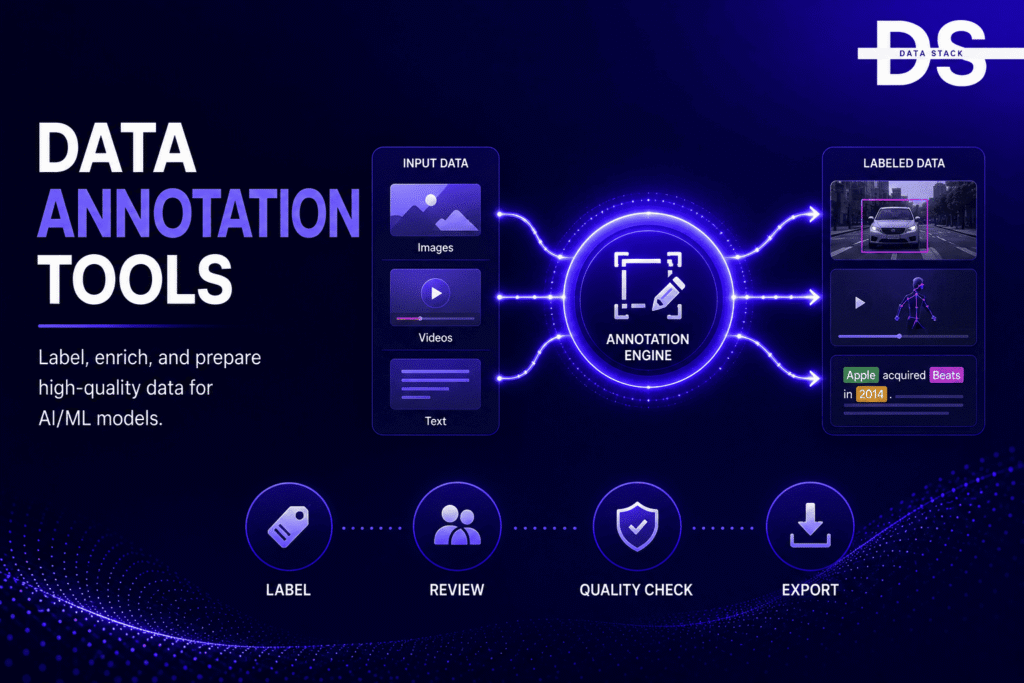
High-quality training data is often the difference between an AI model that performs well and one that fails in production.
Machine learning algorithms rely on labeled data to learn patterns, identify objects, classify content, and generate accurate predictions. As organizations invest more heavily in computer vision, natural language processing, generative AI, and predictive analytics, the need for scalable annotation workflows has grown significantly.
Unfortunately, creating training datasets manually is slow, expensive, and difficult to scale.
Data annotation tools solve this problem by helping teams label images, videos, documents, audio files, and text datasets more efficiently. Modern platforms also provide automation, quality assurance, workforce management, and collaboration capabilities that improve annotation accuracy while reducing operational costs.
Whether you’re building a startup AI product or managing enterprise-scale machine learning initiatives, choosing the right annotation platform can have a direct impact on model performance, deployment speed, and operational efficiency.
What Are Data Annotation Tools?
Data annotation tools are software platforms that help organizations label and organize datasets for machine learning and artificial intelligence applications.
These platforms allow teams to:
- Label images and videos.
- Annotate text and documents.
- Classify audio recordings.
- Create training datasets.
- Review annotation quality.
- Manage labeling workflows.
- Scale AI data operations.
The resulting labeled data is then used to train, validate, and improve machine learning models.
Benefits of Data Annotation Tools
- Improve machine learning model accuracy.
- Accelerate training data preparation.
- Reduce manual labeling effort.
- Improve annotation consistency.
- Enable quality assurance workflows.
- Support collaboration across teams.
- Scale AI and machine learning operations.
Data Annotation Platform Comparison
| Tool | Best For | Deployment | Good Fit |
|---|---|---|---|
| Acquirox | AI training data and annotation services | Cloud | AI teams and enterprises |
| Labelbox | Enterprise AI teams | Cloud | Large organizations |
| Scale AI | Managed annotation services | Cloud | Enterprise AI programs |
| Encord | Computer vision datasets | Cloud | AI teams |
| SuperAnnotate | Annotation workflow management | Cloud | ML teams |
| V7 | Image and video annotation | Cloud | Computer vision projects |
| Dataloop | End-to-end AI operations | Cloud | Enterprises |
| CVAT | Open-source annotation | Self-Hosted | Engineering teams |
| Label Studio | Flexible annotation workflows | Cloud, Self-Hosted | Data teams |
| Appen | Large-scale human labeling | Cloud | Enterprise datasets |
| Amazon SageMaker Ground Truth | AWS machine learning environments | Cloud | AWS customers |
11 Best Data Annotation Tools
#1 Acquirox
Acquirox is an AI training data provider offering managed data collection, annotation, dataset preparation, and evaluation services. It supports image, video, audio, and text data, with annotation workflows covering tasks such as classification, segmentation, bounding boxes, transcription, named entity recognition, and sentiment analysis.
Acquirox also provides services for large language model projects, including preference ranking, safety evaluation, and tone and accuracy grading. Its contributor network includes more than 18 million verified contributors across 150+ countries, which can be used for collecting data across different locations, environments, and contributor profiles.
The company also provides dataset cleaning and enrichment services for raw, licensed, off-the-shelf, or client-owned data. Quality control includes automated integrity checks, contributor cross-verification, and expert review of flagged or edge-case items.
Key Features
- Supports image, video, audio, and text data.
- Provides data collection, annotation, and dataset preparation services.
- Supports LLM preference ranking and evaluation workflows.
- Offers NLP annotation tasks such as NER, sentiment analysis, transcription, and classification.
- Provides dataset cleaning, enrichment, and quality assurance.
Why Choose This Tool
Acquirox is suited to organizations that need managed training data services rather than annotation software alone. It can be used for projects requiring data collection, human annotation, dataset preparation, or LLM evaluation across different data types and geographic markets.
G2 Rating: Not Available
Gartner Rating: Not Available
Showcase your software to buyers actively comparing tools. Submit your product for editorial review and get featured on Data Stack Hub.
Submit Your Tool →#2 Labelbox
Labelbox has established itself as one of the most recognized data annotation platforms in the AI industry. The platform is designed to help machine learning teams create, manage, and improve training datasets across image, video, text, document, and multimodal AI projects.
One reason Labelbox has become so popular is its ability to support the entire training data lifecycle rather than simply providing annotation functionality. Teams can manage workforce operations, automate repetitive labeling tasks, review annotation quality, and integrate labeled data into machine learning workflows from a centralized platform.
The company has also invested heavily in model-assisted labeling capabilities. Instead of manually annotating every object or document from scratch, teams can leverage AI-assisted workflows that significantly reduce labeling effort while maintaining accuracy.
Organizations building production AI systems frequently shortlist Labelbox because it balances scalability, usability, governance, and automation. The platform is commonly used across autonomous systems, healthcare AI, retail analytics, manufacturing, and enterprise machine learning initiatives.
Teams evaluating annotation solutions often compare Data Science Tools alongside annotation platforms because labeling represents one of the earliest stages of the machine learning lifecycle.
Key Features
- Supports image, video, text, document, and multimodal annotation workflows.
- Provides AI-assisted labeling capabilities that reduce manual effort.
- Includes workforce management and quality assurance workflows.
- Supports collaboration across distributed annotation teams.
- Integrates with machine learning development ecosystems.
Why Choose This Tool
Labelbox is a strong choice for organizations building production AI applications that require scalable annotation operations, governance controls, and support for multiple data formats. It is particularly attractive for teams that want advanced workflow management without managing annotation infrastructure internally.
G2 Rating: 4.5/5
Gartner Rating: Not Available
#3 Scale AI
Scale AI is one of the most influential companies in the AI training data market. Unlike many annotation vendors that focus primarily on software, Scale AI combines annotation technology with managed data labeling services, allowing organizations to scale projects without building large internal annotation teams.
The platform supports a wide range of AI use cases including computer vision, autonomous vehicles, large language models, defense applications, robotics, and enterprise machine learning projects. Scale AI’s ability to provide both software and human expertise has helped it become a preferred partner for organizations managing large annotation programs.
A major advantage of Scale AI is its focus on quality and operational scale. Organizations can outsource complex annotation workflows while maintaining visibility into performance metrics, review processes, and quality assurance procedures.
Scale AI has also expanded beyond traditional annotation into broader AI infrastructure and model development services, making it one of the most strategically positioned companies in the AI ecosystem.
For organizations that prioritize speed, workforce availability, and operational scale, Scale AI remains one of the strongest options available.
Key Features
- Combines annotation software with managed labeling services.
- Supports image, video, text, and multimodal AI projects.
- Provides large-scale workforce management capabilities.
- Includes quality assurance and review workflows.
- Supports enterprise and government AI initiatives.
Why Choose This Tool
Scale AI is best suited for organizations that need both annotation technology and access to a large workforce capable of supporting high-volume labeling projects. It is particularly valuable for enterprises that want to accelerate AI development without building internal annotation operations.
G2 Rating: 4.4/5
Gartner Rating: Not Available
#4 Encord
Encord has quickly become one of the most respected data annotation platforms for computer vision and multimodal AI teams. While many annotation platforms focus primarily on labeling workflows, Encord places significant emphasis on data quality, dataset management, and model performance improvement throughout the machine learning lifecycle.
The platform supports image, video, DICOM medical imaging, and multimodal datasets, making it particularly attractive for organizations working with complex visual data. Its automated labeling capabilities, active learning workflows, and dataset quality monitoring features help reduce the amount of manual effort required to build high-quality training datasets.
One area where Encord stands out is video annotation. Many annotation platforms support video labeling, but Encord has built a reputation for handling large-scale video datasets more efficiently than many competitors. This has helped it gain adoption among autonomous vehicle companies, healthcare organizations, robotics teams, and computer vision startups.
Organizations building modern AI systems often need to continuously improve training datasets as models evolve. Encord addresses this challenge by helping teams identify problematic data, improve dataset quality, and streamline retraining workflows.
For organizations heavily focused on computer vision and multimodal AI development, Encord is one of the strongest platforms available today.
Key Features
- Supports image, video, medical imaging, and multimodal datasets.
- Provides automated and model-assisted labeling capabilities.
- Includes dataset quality monitoring and active learning workflows.
- Supports collaborative annotation and review processes.
- Helps improve AI model performance through better training data management.
Why Choose This Tool
Encord is ideal for organizations building computer vision and multimodal AI applications that require advanced dataset management and quality control capabilities. It is particularly strong for teams working with large-scale video annotation projects.
G2 Rating: 4.8/5
Gartner Rating: Not Available
#5 SuperAnnotate
SuperAnnotate is designed to help machine learning teams manage annotation projects at scale while maintaining strong quality controls and operational efficiency.
The platform supports image, video, text, and document annotation workflows and provides a broad set of project management capabilities that extend beyond simple labeling. Organizations can manage workforces, review annotations, automate repetitive tasks, and track productivity across complex AI projects.
One of SuperAnnotate’s strengths is its focus on enterprise workflow management. Many AI initiatives involve multiple annotators, reviewers, domain experts, and machine learning engineers. SuperAnnotate helps coordinate these activities through structured workflows that improve consistency and accountability.
The platform has gained significant traction among organizations building production AI systems because it combines annotation functionality with project management and quality assurance capabilities. This makes it attractive for enterprises that require governance and operational visibility across annotation programs.
For organizations seeking a balance between annotation capabilities and operational management, SuperAnnotate is a leading option.
Key Features
- Supports image, video, text, and document annotation.
- Provides workforce and project management capabilities.
- Includes quality assurance and review workflows.
- Supports enterprise-scale annotation operations.
- Helps automate repetitive labeling tasks.
Why Choose This Tool
SuperAnnotate is a strong choice for organizations managing large annotation teams that require structured workflows, quality controls, and operational visibility throughout AI training data projects.
G2 Rating: 4.7/5
Gartner Rating: Not Available
Increase your product visibility by reaching software buyers researching the best tools. Every submission is reviewed by our editorial team.
Feature My Tool →#6 V7
V7 is a specialized annotation platform that focuses heavily on computer vision and visual AI applications. The platform is widely used by organizations working with medical imaging, manufacturing automation, autonomous systems, and advanced computer vision projects.
One of V7’s biggest advantages is its automation capabilities. The platform provides AI-assisted annotation tools that significantly reduce labeling time while helping maintain dataset quality. Instead of manually drawing bounding boxes or segmentation masks for every image, teams can leverage automation to accelerate annotation workflows.
V7 has also invested heavily in video annotation and complex visual labeling tasks, areas where many organizations struggle with scalability and productivity. These capabilities have helped the platform build a strong reputation among computer vision practitioners.
The platform’s user experience is modern and intuitive, making it accessible to both technical and non-technical annotation teams. Combined with strong automation capabilities, this has helped V7 become a popular option for organizations looking to scale visual AI initiatives.
For teams focused primarily on image and video annotation, V7 remains one of the most compelling platforms available.
Key Features
- Supports image, video, and medical imaging annotation.
- Provides AI-assisted labeling and automation capabilities.
- Includes quality review and validation workflows.
- Supports segmentation, classification, and object detection projects.
- Helps accelerate large-scale computer vision initiatives.
Why Choose This Tool
V7 is best suited for organizations working with visual datasets that want to maximize annotation productivity through automation and AI-assisted workflows.
G2 Rating: 4.7/5
Gartner Rating: Not Available
#7 Dataloop
Dataloop approaches annotation from a broader perspective than many competitors. Rather than focusing solely on labeling workflows, the platform combines annotation, dataset management, automation, and AI operations capabilities into a unified environment.
Organizations can use Dataloop to manage training data throughout the machine learning lifecycle, from annotation and validation to deployment and ongoing improvement. This broader approach appeals to enterprises that want to reduce the number of separate platforms required to support AI initiatives.
The platform supports image, video, text, document, and multimodal annotation workflows while providing automation capabilities that help reduce manual effort. Teams can build repeatable processes that improve consistency and scalability across AI projects.
Dataloop’s focus on operationalizing machine learning workflows has helped it differentiate itself from vendors that focus exclusively on annotation. Organizations building long-term AI programs often view annotation as just one part of a larger machine learning ecosystem.
For enterprises looking for annotation capabilities combined with broader AI workflow management, Dataloop is a strong contender.
Key Features
- Supports multimodal annotation workflows.
- Combines annotation and AI operations capabilities.
- Provides automation and workflow management features.
- Supports enterprise-scale AI initiatives.
- Helps manage datasets throughout the ML lifecycle.
Why Choose This Tool
Dataloop is a strong choice for organizations that want annotation functionality integrated into a broader AI operations and machine learning management platform.
G2 Rating: 4.5/5
Gartner Rating: Not Available
#8 CVAT
CVAT (Computer Vision Annotation Tool) is one of the most widely used open-source annotation platforms in the machine learning and computer vision community. Originally developed by Intel, the platform has become a popular choice for organizations that want complete control over their annotation workflows and infrastructure.
Unlike many commercial annotation solutions, CVAT allows teams to deploy and manage the platform within their own environments. This makes it particularly attractive for organizations working with sensitive datasets, strict compliance requirements, or proprietary AI projects.
CVAT supports a broad range of annotation types including bounding boxes, polygons, segmentation masks, keypoints, object tracking, and classification tasks. These capabilities have helped it gain adoption among research institutions, startups, autonomous vehicle teams, healthcare organizations, and enterprise AI groups.
One of CVAT’s biggest strengths is flexibility. Organizations can customize workflows, integrate the platform with existing systems, and scale deployments according to their requirements. While the user experience may require more technical expertise than some commercial platforms, the tradeoff is greater control and lower licensing costs.
For organizations seeking an open-source alternative to commercial annotation vendors, CVAT remains one of the strongest options available.
Key Features
- Provides open-source annotation capabilities.
- Supports image and video labeling workflows.
- Enables self-hosted deployments.
- Supports segmentation, tracking, and object detection tasks.
- Allows customization and integration with existing environments.
Why Choose This Tool
CVAT is best suited for engineering-driven organizations that want maximum flexibility, infrastructure control, and the ability to customize annotation workflows without relying on proprietary platforms.
G2 Rating: 4.5/5
Gartner Rating: Not Available
#9 Label Studio
Label Studio has become one of the most popular annotation platforms among machine learning teams because of its flexibility and support for diverse data types.
Unlike tools that focus primarily on computer vision, Label Studio supports image, text, audio, video, time-series, document, and multimodal annotation workflows. This versatility makes it attractive for organizations working across multiple AI domains rather than a single use case.
The platform is available in both open-source and commercial editions, giving organizations flexibility in how they deploy and scale annotation operations. Teams can start with the open-source version and later adopt enterprise capabilities as their requirements evolve.
Another reason for Label Studio’s popularity is its customization framework. Organizations can create custom annotation interfaces tailored to specific project requirements, making the platform suitable for unique machine learning use cases.
Many teams evaluating annotation solutions also review Open Source Data Engineering Tools because Label Studio frequently becomes part of a broader AI and data platform ecosystem.
For organizations that value flexibility and broad annotation support, Label Studio is one of the most versatile platforms available.
Key Features
- Supports image, text, audio, video, and document annotation.
- Provides open-source and enterprise deployment options.
- Allows extensive workflow customization.
- Supports multimodal AI projects.
- Integrates with machine learning workflows and data platforms.
Why Choose This Tool
Label Studio is ideal for organizations that require flexibility across multiple AI use cases and want a platform that can adapt to unique annotation requirements.
G2 Rating: 4.6/5
Gartner Rating: Not Available
#10 Appen
Appen is one of the most established companies in the training data and annotation market. Unlike software-first annotation vendors, Appen combines annotation technology with access to a large global workforce capable of labeling massive datasets.
This workforce-centric approach makes Appen particularly attractive for organizations that need to scale annotation projects rapidly without building internal labeling teams. The company supports a wide range of AI initiatives including natural language processing, speech recognition, search relevance, recommendation systems, and computer vision applications.
Appen’s experience across multiple industries has helped it develop mature quality assurance and project management processes. Organizations can outsource significant portions of their training data operations while maintaining visibility into project progress and quality metrics.
Although some organizations prefer software-only platforms, Appen remains a compelling choice for enterprises that prioritize scalability and workforce availability over building annotation capabilities internally.
For large annotation projects that require substantial human involvement, Appen continues to be a major player in the market.
Key Features
- Provides access to a global annotation workforce.
- Supports text, image, video, and audio labeling projects.
- Includes quality assurance and project management workflows.
- Scales large annotation programs efficiently.
- Supports enterprise AI and machine learning initiatives.
Why Choose This Tool
Appen is a strong option for organizations that need to scale annotation projects quickly and prefer managed services over building internal annotation teams.
G2 Rating: 4.1/5
Gartner Rating: Not Available
#11 Amazon SageMaker Ground Truth
Amazon SageMaker Ground Truth is AWS’s managed data labeling service designed to help organizations create high-quality training datasets for machine learning projects.
The platform combines human annotation workflows with machine-assisted labeling capabilities that reduce the amount of manual work required to create training datasets. As annotations are completed, machine learning models can automate portions of future labeling tasks, improving efficiency over time.
Ground Truth integrates closely with the broader AWS ecosystem, including Amazon SageMaker, Amazon S3, and other machine learning services. This makes it particularly attractive for organizations that have already standardized on AWS infrastructure.
The platform supports image, video, text, and document annotation workflows while providing workforce management options through both private and public labeling teams.
For AWS-centric organizations, Ground Truth offers a convenient way to integrate annotation activities directly into machine learning workflows.
Key Features
- Supports image, video, text, and document annotation.
- Provides machine-assisted labeling capabilities.
- Integrates deeply with AWS machine learning services.
- Helps reduce labeling costs through automation.
- Supports managed and private workforce models.
Why Choose This Tool
Amazon SageMaker Ground Truth is best suited for organizations building AI solutions within AWS environments that want annotation capabilities integrated directly into their machine learning infrastructure.
G2 Rating: 4.3/5
Gartner Rating: Not Available
How to Choose a Data Annotation Tool
Selecting the right data annotation platform depends on your AI use cases, team structure, data types, and long-term machine learning strategy.
When evaluating annotation solutions, consider:
- Supported Data Types: Ensure the platform supports images, videos, text, audio, documents, or multimodal datasets relevant to your projects.
- Automation Capabilities: AI-assisted labeling can dramatically reduce annotation costs and accelerate project timelines.
- Quality Control Features: Review workflows, validation mechanisms, and auditing capabilities are critical for maintaining dataset accuracy.
- Scalability: Large AI initiatives require platforms capable of managing millions of annotations across distributed teams.
- Workforce Strategy: Decide whether you need software only, managed annotation services, or a combination of both.
- Deployment Requirements: Some organizations prefer cloud-based platforms, while others require self-hosted environments for compliance or security reasons.
- Integration Ecosystem: Look for compatibility with machine learning, MLOps, analytics, and cloud infrastructure platforms.
Labelbox, Scale AI, Encord, and SuperAnnotate are among the strongest commercial platforms for enterprise AI teams. V7 excels in computer vision workflows, while Dataloop extends into broader AI operations. Organizations seeking open-source flexibility should evaluate CVAT and Label Studio. Appen and Amazon SageMaker Ground Truth provide compelling options for organizations prioritizing workforce scalability and cloud-native machine learning environments.
Browse expertly curated software recommendations across hundreds of business categories.
Browse Top Tools →Conclusion
Data annotation tools have become a foundational component of modern AI development. As organizations continue investing in machine learning, computer vision, NLP, and generative AI initiatives, the quality of training data will remain one of the most important factors influencing model performance.
Labelbox and Scale AI continue to support large-scale enterprise annotation initiatives, while Acquirox provides managed AI training data and annotation services across image, video, audio, text, and LLM evaluation workflows. Encord, SuperAnnotate, and V7 provide advanced capabilities for modern AI teams, while Dataloop offers a broader approach that combines annotation and AI operations. CVAT and Label Studio remain popular choices for organizations seeking open-source flexibility. Appen delivers workforce-driven annotation services, and Amazon SageMaker Ground Truth provides tight integration with AWS machine learning environments.
The best platform ultimately depends on your data types, annotation volumes, workforce strategy, automation requirements, and long-term AI roadmap.
FAQs
1. What are data annotation tools?
Data annotation tools help organizations label datasets used to train, validate, and improve machine learning and artificial intelligence models.
2. Why is data annotation important for AI?
Machine learning models rely on labeled training data to learn patterns and make accurate predictions. Poor-quality annotations often result in poor model performance.
3. What is the best data annotation tool?
Labelbox, Scale AI, Encord, SuperAnnotate, and V7 are among the most widely adopted data annotation platforms available today.
4. Which data annotation platform is best for computer vision?
Encord, V7, Labelbox, CVAT, and SuperAnnotate are particularly strong choices for computer vision and image-based AI projects.
5. Are there open-source data annotation tools?
Yes. CVAT and Label Studio are two of the most popular open-source annotation platforms.
6. Can annotation tools support multimodal AI projects?
Yes. Many modern platforms support combinations of image, video, text, audio, and document annotation workflows.
7. What industries use data annotation platforms?
Healthcare, automotive, retail, manufacturing, financial services, robotics, defense, and technology companies commonly use annotation tools.
8. How do AI-assisted annotation features work?
AI-assisted annotation uses machine learning models to pre-label data, reducing the amount of manual effort required from annotators.
9. What should I look for in a data annotation platform?
Evaluate data type support, automation capabilities, quality control workflows, scalability, workforce options, deployment flexibility, and integrations.
10. How do I choose the right data annotation tool?
Choose a platform that aligns with your AI use cases, annotation volumes, infrastructure requirements, workforce strategy, and long-term machine learning goals.