
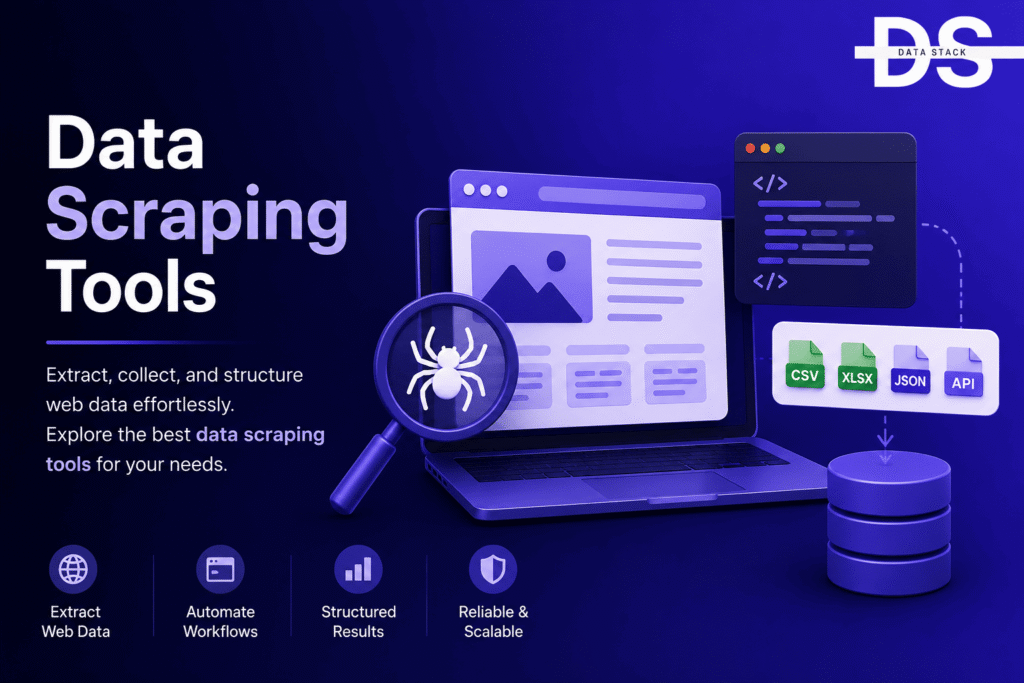
Organizations increasingly rely on external data to support decision-making, competitive analysis, AI initiatives, lead generation, and market research. While valuable information exists across websites, marketplaces, directories, and public platforms, collecting that data manually is often slow and inefficient.
That’s where data scraping tools help.
These platforms automate the process of collecting information from websites and online sources. Modern scraping solutions can extract structured data, monitor website changes, automate workflows, and support large-scale data collection projects.
Whether you’re building a competitive intelligence program, gathering research data, or supporting analytics initiatives, the right scraping tool can save significant time and effort.
To help you choose, we reviewed the best data scraping tools based on ease of use, scalability, automation capabilities, reliability, and market adoption.
What Are Data Scraping Tools?
Data scraping tools are software platforms that automate the process of collecting information from websites, online databases, directories, and public digital sources.
These tools can:
- Extract structured and unstructured data.
- Monitor websites for updates.
- Automate large-scale data collection.
- Support analytics and research projects.
- Feed data into business intelligence and AI workflows.
Organizations use scraping tools to gather information that would otherwise require extensive manual effort.
Key Features of Data Scraping Tools
- Website data extraction and automation.
- Visual no-code scraping capabilities.
- API and integration support.
- Scheduled data collection workflows.
- Data export to databases and analytics platforms.
- Proxy and anti-blocking capabilities.
- Cloud-based scraping infrastructure.
- Large-scale web data collection support.
Comparison Table
| Tool | Best For | Deployment | Good Fit |
|---|---|---|---|
| Bright Data | Enterprise web data collection | Cloud | Large organizations |
| Oxylabs | Large-scale scraping | Cloud | Data-driven businesses |
| Apify | Automation and scraping | Cloud | Developers and teams |
| Octoparse | No-code scraping | Cloud, Desktop | Business users |
| ParseHub | Visual scraping | Desktop | Researchers |
| Scrapy | Open-source scraping | Self-Hosted | Developers |
| Web Scraper | Browser-based scraping | Cloud, Browser | Small teams |
| Zyte | Managed scraping services | Cloud | Enterprises |
| Import.io | Enterprise extraction | Cloud | Large organizations |
| Diffbot | AI-powered extraction | Cloud | AI and analytics teams |
| Data Miner | Browser scraping | Browser | Individuals |
| Browse AI | No-code automation | Cloud | Non-technical users |
12 Best Data Scraping Tools
#1 Bright Data
Bright Data is one of the most widely recognized web data collection platforms available today. The platform provides scraping infrastructure, proxy networks, datasets, and automation capabilities that support large-scale data collection initiatives.
Organizations use Bright Data for market research, price monitoring, competitive intelligence, AI training data, and business analytics projects. Its global proxy network helps improve reliability when collecting information from websites at scale.
Many enterprises choose Bright Data because it combines infrastructure and scraping capabilities within a single platform.
For organizations requiring enterprise-grade web data collection, Bright Data remains a market leader.
Key Features
- Supports large-scale web data collection projects.
- Provides proxy infrastructure and anti-blocking capabilities.
- Enables automated website monitoring and extraction.
- Supports structured data delivery and integrations.
- Helps organizations collect web data at enterprise scale.
Why Choose This Tool
Choose Bright Data if your organization requires enterprise-grade web data collection and scraping infrastructure.
G2 Rating: 4.6/5
Gartner Rating: Not Available
#2 Oxylabs
Oxylabs provides web scraping infrastructure and data collection solutions designed for organizations that need reliable access to public web data.
The platform combines proxy services, scraping APIs, automation capabilities, and web intelligence tools that help teams collect information efficiently across multiple websites and markets.
Organizations commonly use Oxylabs for e-commerce monitoring, SEO research, pricing intelligence, lead generation, and market analysis.
For businesses focused on large-scale data collection, Oxylabs is one of the strongest alternatives to Bright Data.
Key Features
- Provides large-scale web scraping infrastructure.
- Supports automated data extraction workflows.
- Includes proxy networks and scraping APIs.
- Helps organizations collect public web data reliably.
- Supports market research and competitive intelligence projects.
Why Choose This Tool
Choose Oxylabs if your organization needs scalable web data collection and proxy infrastructure.
G2 Rating: 4.7/5
Gartner Rating: Not Available
Showcase your software to buyers actively comparing tools. Submit your product for editorial review and get featured on Data Stack Hub.
Submit Your Tool →#3 Apify
Apify is a cloud-based scraping and automation platform that helps developers and organizations collect, process, and automate web data workflows.
The platform offers a large marketplace of prebuilt actors that can scrape websites, monitor content, and automate repetitive online tasks. Users can also create custom scraping workflows using JavaScript and Python.
Many organizations evaluating scraping platforms also compare Apify with Data Extraction Tools because both categories frequently overlap in analytics and automation projects.
For teams seeking flexibility and automation, Apify is a leading option.
Key Features
- Supports custom and prebuilt scraping workflows.
- Provides cloud-based execution and scheduling capabilities.
- Includes automation and web monitoring features.
- Supports JavaScript and Python development.
- Offers a large marketplace of reusable actors.
Why Choose This Tool
Choose Apify if your organization wants a flexible cloud platform for scraping and automation.
G2 Rating: 4.8/5
Gartner Rating: Not Available
#4 Octoparse
Octoparse is one of the most popular no-code web scraping platforms available today. It allows users to collect website data through a visual interface without requiring programming skills.
The platform supports scheduled extraction workflows, cloud execution, and export capabilities for analytics and reporting projects. Its ease of use has made it particularly popular among marketers, researchers, and business analysts.
Organizations looking for simple automation often evaluate Octoparse alongside Data Collection Tools because both categories focus on gathering information efficiently.
For non-technical users, Octoparse remains one of the easiest scraping tools to adopt.
Key Features
- Provides no-code website data extraction capabilities.
- Supports cloud-based scraping and scheduling.
- Helps users collect structured web data easily.
- Exports data to spreadsheets and databases.
- Supports a wide range of websites and use cases.
Why Choose This Tool
Choose Octoparse if your organization wants a no-code platform for web scraping and data collection.
G2 Rating: 4.6/5
Gartner Rating: Not Available
#5 ParseHub
ParseHub is a visual web scraping platform that allows users to extract data from websites without writing code. The platform uses a point-and-click interface to help users select website elements and build scraping workflows.
One of ParseHub’s strengths is its ability to handle dynamic websites that rely heavily on JavaScript. Users can collect data from interactive pages, forms, tables, and other complex web structures.
Researchers, analysts, marketers, and small businesses often choose ParseHub because it lowers the technical barrier associated with web scraping projects.
For organizations looking for a beginner-friendly scraping solution, ParseHub remains a strong choice.
Key Features
- Provides visual point-and-click web scraping capabilities.
- Supports dynamic and JavaScript-heavy websites.
- Allows scheduled and automated extraction workflows.
- Exports data to multiple formats and destinations.
- Reduces the need for custom coding.
Why Choose This Tool
Choose ParseHub if your organization wants an easy-to-use visual platform for extracting website data.
G2 Rating: 4.3/5
Gartner Rating: Not Available
#6 Scrapy
Scrapy is one of the most widely used open-source web scraping frameworks. Built in Python, it provides developers with a highly flexible environment for building custom data extraction applications.
Unlike no-code platforms, Scrapy gives engineering teams complete control over scraping logic, data processing, scheduling, and integrations. This flexibility makes it a popular choice for large-scale data collection projects.
Organizations building custom data pipelines often use Scrapy alongside Open Source Data Engineering Tools and Data Pipeline Tools to support broader analytics initiatives.
For developers and engineering teams, Scrapy remains one of the strongest scraping frameworks available.
Key Features
- Provides a powerful open-source scraping framework.
- Supports large-scale custom web scraping projects.
- Integrates with Python-based analytics workflows.
- Enables advanced data processing and automation.
- Offers complete control over extraction logic.
Why Choose This Tool
Choose Scrapy if your organization needs a highly customizable framework for large-scale web scraping.
G2 Rating: 4.5/5
Gartner Rating: Not Available
Increase your product visibility by reaching software buyers researching the best tools. Every submission is reviewed by our editorial team.
Feature My Tool →#7 Web Scraper
Web Scraper is a browser-based scraping platform that allows users to collect information directly from websites using a visual sitemap approach.
The tool is popular among individuals and small teams because it combines ease of use with flexibility. Users can define navigation paths, select data points, and automate extraction without extensive technical expertise.
The platform supports both browser-based and cloud-based scraping workflows, making it suitable for a variety of use cases.
For organizations looking for a lightweight scraping solution, Web Scraper is worth considering.
Key Features
- Provides browser-based scraping capabilities.
- Uses visual sitemap creation for extraction workflows.
- Supports cloud and local scraping execution.
- Exports data into common business formats.
- Requires minimal technical expertise.
Why Choose This Tool
Choose Web Scraper if your organization wants a lightweight and accessible web scraping platform.
G2 Rating: 4.4/5
Gartner Rating: Not Available
#8 Zyte
Zyte, formerly known as Scrapinghub, is a web data extraction platform focused on helping organizations collect web information at scale.
The platform combines scraping infrastructure, smart proxies, extraction APIs, and managed services. Organizations can use Zyte to build and maintain reliable web data collection workflows without managing complex infrastructure themselves.
Zyte is particularly attractive to enterprises that require reliable data extraction while minimizing operational overhead.
For organizations seeking managed web data collection capabilities, Zyte remains a strong option.
Key Features
- Provides managed web scraping and extraction services.
- Supports large-scale web data collection projects.
- Includes proxy management and anti-blocking capabilities.
- Offers APIs for structured data extraction.
- Helps organizations reduce scraping infrastructure complexity.
Why Choose This Tool
Choose Zyte if your organization wants managed web scraping infrastructure and services.
G2 Rating: 4.5/5
Gartner Rating: Not Available
#9 Import.io
Import.io is an enterprise web data extraction platform that helps organizations convert website information into structured datasets.
The platform focuses on making large-scale web data collection accessible to business users and enterprise teams. Organizations commonly use Import.io for competitive intelligence, market monitoring, pricing analysis, and research initiatives.
Import.io’s managed approach helps reduce the complexity often associated with maintaining large scraping operations.
For enterprises looking for a business-focused web extraction platform, Import.io is a strong option.
Key Features
- Converts website information into structured datasets.
- Supports enterprise-scale data collection projects.
- Provides managed extraction workflows.
- Helps organizations automate market intelligence initiatives.
- Supports analytics and reporting use cases.
Why Choose This Tool
Choose Import.io if your organization wants enterprise-focused web data extraction capabilities.
G2 Rating: 4.0/5
Gartner Rating: Not Available
#10 Diffbot
Diffbot uses artificial intelligence and machine learning to automatically understand and extract information from websites.
Unlike traditional scraping tools that often require custom selectors and extraction rules, Diffbot analyzes page structures automatically. This reduces setup complexity and improves scalability across different website types.
Organizations frequently use Diffbot to build knowledge graphs, support AI initiatives, enrich datasets, and automate large-scale information collection projects.
For businesses looking for AI-powered extraction capabilities, Diffbot offers a unique approach.
Key Features
- Uses AI to understand and extract website data automatically.
- Reduces manual scraping configuration requirements.
- Supports large-scale data collection and enrichment projects.
- Helps organizations build knowledge graphs and datasets.
- Integrates with analytics and AI workflows.
Why Choose This Tool
Choose Diffbot if your organization wants AI-driven data extraction and enrichment capabilities.
G2 Rating: 4.4/5
Gartner Rating: Not Available
#11 Data Miner
Data Miner is a browser-based scraping tool that allows users to extract information from websites directly through Chrome and Edge extensions.
The platform is designed for users who need quick access to website data without building complex scraping infrastructure. Data Miner provides prebuilt extraction recipes while also allowing users to create custom extraction workflows.
Many marketers, researchers, recruiters, sales teams, and analysts use Data Miner because it simplifies the process of collecting structured information from web pages.
For individuals and small teams, Data Miner provides an accessible entry point into web scraping.
Key Features
- Extracts website data directly from browser extensions.
- Provides prebuilt and customizable scraping recipes.
- Supports exports to spreadsheets and databases.
- Requires minimal technical expertise.
- Helps automate repetitive data collection tasks.
Why Choose This Tool
Choose Data Miner if your organization wants a simple browser-based solution for collecting website data.
G2 Rating: 4.5/5
Gartner Rating: Not Available
#12 Browse AI
Browse AI is a no-code automation and web scraping platform designed to help users extract, monitor, and automate website data collection without programming knowledge.
The platform allows users to train robots visually and automate tasks such as monitoring prices, tracking competitors, collecting leads, and extracting structured information from websites.
Browse AI has gained popularity among business users because it combines ease of use with cloud-based automation capabilities. Organizations can schedule data collection workflows and receive updates automatically when website information changes.
For non-technical users seeking automation and scraping capabilities, Browse AI is one of the strongest options available.
Key Features
- Provides no-code web scraping and automation capabilities.
- Supports website monitoring and change detection.
- Allows users to train extraction robots visually.
- Automates recurring data collection workflows.
- Integrates with business applications and automation platforms.
Why Choose This Tool
Choose Browse AI if your organization wants a beginner-friendly platform for web scraping and automation.
G2 Rating: 4.8/5
Gartner Rating: Not Available
How to Choose a Data Scraping Tool
The best data scraping tool depends on your technical expertise, data collection requirements, scalability needs, and compliance considerations.
When evaluating solutions, consider the following:
- Ease of Use: Business users often prefer no-code tools, while developers may require greater customization and control.
- Scalability: Large-scale scraping projects require infrastructure that can handle millions of requests reliably.
- Dynamic Website Support: Ensure the platform can collect data from JavaScript-heavy and interactive websites.
- Automation Capabilities: Scheduling, monitoring, and workflow automation can significantly reduce manual effort.
- Proxy and Anti-Blocking Features: Large-scale scraping often requires proxy management and anti-detection capabilities.
- Integration Support: Verify compatibility with databases, warehouses, analytics tools, and business applications.
- Compliance Requirements: Organizations should ensure data collection practices comply with applicable laws and website terms.
Bright Data, Oxylabs, and Zyte are strong choices for enterprise-scale scraping initiatives. Apify offers flexibility for developers and automation teams, while Octoparse, ParseHub, Data Miner, and Browse AI are excellent options for non-technical users. Organizations seeking open-source flexibility should evaluate Scrapy.
Browse expertly curated software recommendations across hundreds of business categories.
Browse Top Tools →Conclusion
Data scraping tools help organizations automate the collection of information from websites and online sources, reducing manual effort while improving the availability of external data for analytics, research, AI, and business intelligence initiatives.
Bright Data and Oxylabs continue to lead enterprise-scale web data collection, while Apify provides a flexible platform for developers and automation teams. Octoparse, ParseHub, Data Miner, and Browse AI make scraping accessible to non-technical users, and Scrapy remains one of the most powerful open-source frameworks available.
The right choice depends on your technical requirements, project scale, automation needs, and long-term data strategy.
FAQs
1. What are data scraping tools?
Data scraping tools are platforms that automate the process of collecting information from websites, directories, databases, and other online sources.
2. Why are data scraping tools used?
Organizations use data scraping tools for market research, competitive intelligence, lead generation, analytics, AI training data, price monitoring, and business intelligence initiatives.
3. What is the best data scraping tool?
Bright Data, Oxylabs, Apify, Octoparse, and Zyte are among the most widely used data scraping platforms available today.
4. Is web scraping legal?
Web scraping legality depends on the data being collected, applicable regulations, and website terms of service. Organizations should always review legal and compliance requirements before collecting data.
5. What is the difference between data scraping and data extraction?
Data scraping typically focuses on collecting information from websites, while data extraction can involve collecting information from websites, databases, applications, files, and other sources.
6. Are there no-code data scraping tools?
Yes. Octoparse, ParseHub, Browse AI, and Data Miner are popular no-code web scraping solutions.
7. Which scraping tool is best for developers?
Scrapy and Apify are among the most popular choices for developers because they provide flexibility and customization capabilities.
8. Can data scraping tools handle dynamic websites?
Yes. Many modern scraping platforms support JavaScript-heavy and dynamic websites through browser automation and advanced extraction techniques.
9. What industries use data scraping tools?
E-commerce, technology, finance, research, marketing, recruiting, consulting, and analytics teams commonly use scraping platforms.
10. How do I choose the right data scraping tool?
Evaluate ease of use, scalability, automation capabilities, dynamic website support, integration options, and compliance requirements before selecting a platform.