
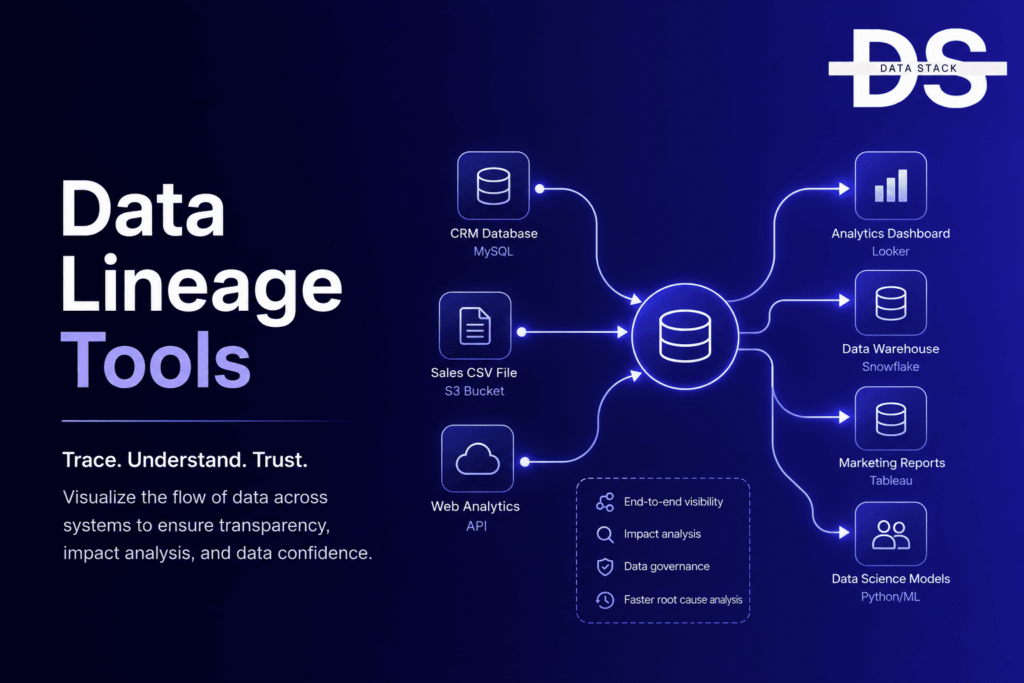
Modern organizations rely on increasingly complex data ecosystems that span cloud warehouses, lakehouses, ETL pipelines, business applications, analytics platforms, AI systems, and operational databases.
As these environments grow, understanding how information moves between systems becomes significantly more difficult.
A single KPI on an executive dashboard may depend on dozens of upstream sources, multiple transformation pipelines, several business rules, and numerous downstream consumers. When a data issue occurs, organizations often struggle to determine where the problem originated, what systems are affected, and how quickly it can be resolved.
This is where Data Lineage Tools provide value.
Data Lineage Software helps organizations visualize, track, and understand how information moves across enterprise systems. These platforms create visibility into data flows, transformations, dependencies, ownership, and relationships. Modern Data Lineage Platforms also support governance, compliance, impact analysis, root cause analysis, metadata management, and audit initiatives.
As analytics, AI, governance, and regulatory requirements continue to expand, lineage capabilities have become a foundational component of modern data management strategies.
What Are Data Lineage Tools?
Data Lineage Tools are software platforms that help organizations track, visualize, and understand how data moves across enterprise systems. These platforms capture relationships between databases, applications, pipelines, reports, dashboards, transformations, and downstream consumers, providing visibility into how information flows throughout the organization. Companies use Data Lineage Software to improve governance, compliance, troubleshooting, impact analysis, auditability, root cause analysis, and confidence in business data.
Key Features of Data Lineage Software
- Automated lineage discovery that maps relationships across enterprise systems.
- End-to-end visibility into data movement, transformations, and dependencies.
- Column-level lineage capabilities for detailed impact analysis.
- Integration with metadata management and governance initiatives.
- Compliance and audit support through transparent data flow mapping.
- Root cause analysis capabilities that accelerate issue resolution.
- Business and technical lineage views that improve collaboration.
Data Lineage Software Comparison
| Tool | Best For | Deployment | Good Fit |
|---|---|---|---|
| Collibra Data Lineage | Governance-driven lineage | Cloud | Enterprises |
| Informatica Enterprise Data Catalog | Enterprise lineage | Cloud | Large organizations |
| Alation | Active metadata and lineage | Cloud | Enterprises |
| Microsoft Purview | Microsoft environments | Cloud | Azure customers |
| Atlan | Modern cloud lineage | Cloud | Cloud-first businesses |
| IBM Knowledge Catalog | Governance and compliance | Cloud, Hybrid | Enterprises |
| MANTA | Automated lineage discovery | Cloud, Hybrid | Large enterprises |
| OvalEdge | Lineage and governance | Cloud | Mid-market organizations |
| Data.World | Business-friendly lineage | Cloud | Business teams |
| Ataccama ONE | Data trust initiatives | Cloud | Enterprises |
| Apache Atlas | Open-source lineage | Self-Hosted | Engineering teams |
| OpenMetadata | Modern open-source metadata | Cloud, Self-Hosted | Data teams |
| SAP Data Intelligence | SAP-centric lineage | Cloud, Hybrid | SAP customers |
13 Best Data Lineage Tools
#1 Collibra Data Lineage
Collibra is widely regarded as one of the leading enterprise Data Lineage Platforms and is frequently shortlisted by organizations building large-scale governance, compliance, and metadata management programs. Rather than treating lineage as a standalone capability, Collibra integrates lineage directly into broader governance initiatives, helping organizations understand not only where data comes from but also how it is governed and used across the business.
The platform automatically discovers relationships between systems, applications, reports, pipelines, and business assets, providing end-to-end visibility into enterprise data flows. This visibility is particularly valuable when organizations need to perform impact analysis before making changes, investigate data quality issues, or satisfy regulatory requirements.
One of Collibra’s strongest differentiators is its ability to connect technical lineage with business context. Technical teams can understand transformations and dependencies, while business users can see ownership, policies, definitions, and governance requirements associated with data assets.
Large enterprises in financial services, healthcare, insurance, and government frequently deploy Collibra because lineage, governance, and compliance are deeply interconnected requirements. The platform has become especially valuable for organizations operating under increasing regulatory scrutiny.
Companies evaluating Data Lineage Tools often compare Data Governance Tools because governance programs frequently depend on strong lineage visibility.
Key Features
- Provides automated lineage discovery across enterprise systems.
- Supports business and technical lineage visualization.
- Enables impact analysis before system changes occur.
- Integrates lineage with governance and stewardship initiatives.
- Improves compliance, auditability, and data trust.
Why Choose This Tool
Collibra is best suited for organizations that view lineage as part of a broader governance strategy. Enterprises that need strong compliance controls, stewardship workflows, business glossaries, and metadata governance alongside lineage capabilities will often find Collibra one of the most complete solutions in the market.
G2 Rating: 4.5/5
Gartner Rating: 4.6/5
Showcase your software to buyers actively comparing tools. Submit your product for editorial review and get featured on Data Stack Hub.
Submit Your Tool →#2 Informatica Enterprise Data Catalog
Informatica Enterprise Data Catalog is one of the most established Enterprise Data Lineage Software solutions available today. The platform helps organizations discover, understand, and govern information while providing detailed visibility into how data moves across complex environments.
A major reason enterprises choose Informatica is its deep lineage capabilities. Organizations can trace information from source systems through transformation pipelines and into downstream reports, dashboards, machine learning models, and operational applications. This visibility helps teams understand dependencies, assess risk, and reduce the likelihood of unexpected disruptions.
The platform is particularly strong in large enterprises operating hybrid environments. Organizations managing cloud platforms, on-premises systems, ETL tools, analytics environments, and operational applications often require comprehensive lineage capabilities that span multiple technologies.
Another differentiator is Informatica’s integration with metadata management, governance, data quality, and master data management initiatives. This allows organizations to build a unified view of enterprise data assets rather than managing lineage in isolation.
For enterprises seeking mature lineage capabilities combined with broader data management functionality, Informatica remains one of the strongest options available.
Key Features
- Supports end-to-end data lineage visibility.
- Provides impact analysis and dependency tracking.
- Integrates lineage with metadata management initiatives.
- Supports enterprise-scale hybrid environments.
- Improves governance and compliance programs.
Why Choose This Tool
Informatica Enterprise Data Catalog is ideal for organizations that require deep lineage visibility across complex environments and want lineage integrated with broader enterprise data management initiatives.
G2 Rating: 4.3/5
Gartner Rating: 4.6/5
#3 Alation
Alation has built a strong reputation as one of the leading platforms for active metadata, data intelligence, and lineage management. While many organizations initially adopt Alation for cataloging and metadata initiatives, its lineage capabilities have become increasingly important as analytics environments grow more complex.
The platform helps organizations understand how data is created, transformed, consumed, and trusted across the enterprise. Rather than simply displaying technical relationships between systems, Alation enriches lineage with business context, usage patterns, ownership information, stewardship details, and collaboration insights. This approach helps both technical and business users understand not only where data originates but also how it is used and whether it should be trusted.
One of Alation’s strongest differentiators is its focus on active metadata. By continuously capturing query activity, usage behavior, and relationships, the platform provides more dynamic lineage visibility than traditional static documentation approaches. This makes it easier to perform impact analysis, identify dependencies, and support self-service analytics initiatives.
Organizations pursuing data intelligence, governance, and analytics modernization programs frequently shortlist Alation because lineage becomes more valuable when combined with metadata, stewardship, and discovery capabilities.
For enterprises seeking lineage visibility supported by strong metadata intelligence, Alation remains one of the strongest solutions in the market.
Key Features
- Supports active metadata and lineage management.
- Provides business and technical lineage visibility.
- Captures usage patterns and dependency relationships.
- Enables impact analysis and root cause investigations.
- Integrates lineage with governance and discovery initiatives.
Why Choose This Tool
Alation is a strong choice for organizations that want lineage capabilities combined with active metadata, collaboration, and enterprise data intelligence. It is particularly attractive for organizations trying to improve data trust and self-service analytics adoption.
G2 Rating: 4.4/5
Gartner Rating: 4.6/5
#4 Microsoft Purview
Microsoft Purview has rapidly become one of the most widely adopted Data Lineage Platforms for organizations operating within Azure and Microsoft-centric ecosystems. The platform combines lineage, metadata management, governance, compliance, classification, and cataloging capabilities within a unified solution.
Organizations use Purview to automatically discover and map relationships across Microsoft Fabric, Azure Data Lake, Azure Synapse Analytics, Power BI, SQL Server, Microsoft 365, and numerous third-party systems. Automated lineage generation significantly reduces manual documentation efforts while improving visibility into complex data environments.
A key advantage of Purview is its deep integration with Microsoft’s broader analytics and AI ecosystem. As organizations adopt Microsoft Fabric and modernize analytics environments, lineage becomes increasingly important for understanding dependencies, validating reports, and supporting governance initiatives.
Purview also helps organizations improve auditability and compliance readiness by providing transparency into data movement and transformations. This capability is particularly valuable in regulated industries where demonstrating data provenance is critical.
For organizations heavily invested in Microsoft technologies, Purview is often one of the most logical and cost-effective lineage solutions available.
Key Features
- Provides automated lineage discovery capabilities.
- Supports Microsoft Fabric and Azure services.
- Enables impact analysis and dependency tracking.
- Integrates governance and compliance workflows.
- Supports technical and business lineage visibility.
Why Choose This Tool
Microsoft Purview is ideal for organizations that want lineage, governance, and metadata management tightly integrated with Microsoft analytics, cloud, and AI platforms.
G2 Rating: 4.4/5
Gartner Rating: 4.5/5
#5 Atlan
Atlan has emerged as one of the fastest-growing cloud-native Data Lineage Software platforms by focusing on modern analytics environments and active metadata strategies. Built specifically for cloud data stacks, Atlan helps organizations understand relationships across Snowflake, Databricks, BigQuery, Redshift, dbt, and other modern technologies.
The platform automatically captures lineage information as data moves through transformation pipelines, analytics environments, and business applications. This visibility helps teams understand downstream impacts before changes are deployed, reducing risk and improving operational reliability.
One of Atlan’s strongest differentiators is usability. Traditional lineage platforms often require significant training and technical expertise, while Atlan focuses on creating an experience that is accessible to analysts, engineers, stewards, and business users alike. This improves adoption and helps organizations derive more value from lineage initiatives.
Organizations building modern cloud-native analytics ecosystems frequently select Atlan because lineage, metadata management, governance, and collaboration are delivered through a single platform.
For cloud-first organizations, Atlan represents one of the strongest modern alternatives to traditional enterprise lineage solutions.
Key Features
- Supports automated lineage and active metadata initiatives.
- Integrates with modern cloud data platforms.
- Provides dependency tracking and impact analysis.
- Supports governance and collaboration workflows.
- Improves visibility into modern analytics ecosystems.
Why Choose This Tool
Atlan is best suited for cloud-native organizations that want lineage capabilities tightly integrated with metadata management, governance, and modern data stack technologies.
G2 Rating: 4.6/5
Gartner Rating: 4.7/5
Increase your product visibility by reaching software buyers researching the best tools. Every submission is reviewed by our editorial team.
Feature My Tool →#6 IBM Knowledge Catalog
IBM Knowledge Catalog combines lineage, governance, metadata management, cataloging, and AI-assisted discovery capabilities within a single enterprise platform. The solution is frequently deployed by large organizations that require strong governance controls alongside detailed visibility into data movement and dependencies.
The platform helps organizations understand how information flows between operational systems, warehouses, reports, analytics environments, and business processes. Automated lineage discovery reduces manual effort while improving confidence in governance and compliance initiatives.
One of IBM’s key strengths is its focus on regulated industries. Organizations operating in healthcare, financial services, insurance, telecommunications, and government sectors often require strong auditability and lineage visibility to satisfy compliance obligations. IBM’s governance-first approach aligns well with these requirements.
The platform also leverages AI-assisted metadata discovery and enrichment capabilities that help organizations manage increasingly complex data ecosystems. This combination of lineage, governance, and intelligence has helped IBM maintain a strong position in enterprise environments.
For organizations prioritizing governance, compliance, and auditability, IBM remains a compelling lineage solution.
Key Features
- Supports automated lineage discovery.
- Provides governance and metadata management capabilities.
- Enables impact and dependency analysis.
- Supports regulatory and compliance initiatives.
- Leverages AI-assisted metadata enrichment.
Why Choose This Tool
IBM Knowledge Catalog is ideal for organizations that require lineage capabilities integrated with governance, compliance, and enterprise metadata management programs.
G2 Rating: 4.2/5
Gartner Rating: 4.5/5
#7 MANTA
MANTA is one of the most specialized Data Lineage Tools available and is frequently regarded as a leader in automated lineage discovery. Unlike broader governance platforms where lineage is one feature among many, MANTA focuses specifically on lineage visibility, impact analysis, and dependency mapping.
The platform automatically scans databases, ETL tools, BI environments, cloud platforms, reporting systems, and enterprise applications to generate detailed lineage maps. This automation significantly reduces the manual effort traditionally associated with lineage documentation.
A major differentiator for MANTA is its column-level lineage capability. Organizations can trace individual data elements through transformations, pipelines, and downstream systems, providing a level of visibility that many competing solutions cannot match. This capability is especially valuable for compliance programs, regulatory audits, and complex root cause investigations.
Large enterprises frequently select MANTA when lineage is a primary business requirement rather than a secondary governance capability. Organizations dealing with highly complex data architectures often view MANTA as one of the most technically advanced lineage solutions available.
Key Features
- Provides automated lineage discovery across systems.
- Supports detailed column-level lineage analysis.
- Enables advanced impact analysis capabilities.
- Supports compliance and audit initiatives.
- Improves troubleshooting and root cause analysis.
Why Choose This Tool
MANTA is best suited for organizations that require highly detailed automated lineage visibility and consider lineage a mission-critical capability rather than an optional governance feature.
G2 Rating: 4.7/5
Gartner Rating: 4.6/5
#8 OvalEdge
OvalEdge is a Data Lineage Platform that combines lineage, metadata management, governance, cataloging, and data discovery capabilities within a single solution. The platform has gained popularity among mid-market and enterprise organizations looking for strong lineage functionality without the implementation complexity often associated with larger governance platforms.
Organizations use OvalEdge to visualize how data moves across databases, pipelines, warehouses, reports, and business applications. This visibility helps improve governance, accelerate troubleshooting, and reduce the risks associated with system changes. OvalEdge is particularly attractive for organizations that want lineage capabilities alongside metadata and cataloging initiatives rather than purchasing separate tools for each requirement.
Unlike some lineage-focused solutions that primarily serve technical users, OvalEdge emphasizes usability and collaboration across business and technical teams. This broader accessibility helps improve adoption and enables more stakeholders to benefit from lineage visibility.
Key Features
- Automatically maps relationships between source systems, transformation pipelines, analytics platforms, and downstream business assets.
- Provides end-to-end lineage visibility that helps organizations understand how information moves across enterprise environments.
- Supports impact analysis capabilities that identify affected reports, dashboards, and applications before changes are deployed.
- Integrates lineage with metadata repositories, business glossaries, and governance workflows.
- Helps improve compliance readiness by documenting data flows and transformation paths.
- Enables stewardship teams to better understand ownership and dependency relationships across data assets.
Why Choose This Tool
OvalEdge is a strong choice for organizations that want lineage, governance, metadata management, and cataloging capabilities in a single platform. It is particularly attractive for companies seeking enterprise functionality without the complexity and cost often associated with larger governance-focused vendors.
G2 Rating: 4.5/5
Gartner Rating: 4.5/5
#9 Data.World
Data.World approaches Data Lineage Software from a collaboration and knowledge-sharing perspective. The platform combines lineage, metadata management, cataloging, governance, and knowledge graph capabilities to help organizations create a more complete understanding of enterprise data assets.
A major differentiator is its ability to connect technical lineage information with business concepts and organizational knowledge. Rather than limiting lineage visibility to engineers and architects, Data.World helps business users understand where information originates, how it changes, and how it supports decision-making.
Organizations pursuing data literacy, self-service analytics, and governance initiatives frequently select Data.World because lineage becomes more valuable when business stakeholders can easily access and understand it.
Key Features
- Uses knowledge graph technology to connect lineage relationships, metadata assets, business definitions, and governance information.
- Provides business-friendly lineage visualizations that improve accessibility beyond technical teams.
- Enables impact analysis by exposing dependencies between reports, datasets, applications, and operational systems.
- Supports stewardship, ownership tracking, and governance workflows.
- Improves data discovery through integrated metadata and lineage capabilities.
- Helps organizations establish a shared understanding of business-critical data assets.
Why Choose This Tool
Data.World is ideal for organizations that want lineage information to be useful across the entire business rather than only within technical teams. Companies focused on collaboration, data literacy, and self-service analytics often find Data.World particularly valuable.
G2 Rating: 4.5/5
Gartner Rating: 4.4/5
#10 Ataccama ONE
Ataccama ONE combines Data Lineage, data quality, governance, metadata management, observability, and master data management capabilities within a unified data trust platform. Rather than treating lineage as an isolated capability, Ataccama positions it as a foundational component of broader enterprise trust initiatives.
Organizations use Ataccama to understand how information flows through systems while simultaneously monitoring quality, governance, and stewardship metrics. This integrated approach provides more context than standalone lineage solutions and helps organizations improve confidence in business-critical information.
The platform is particularly attractive to enterprises that want to consolidate multiple governance and trust initiatives into a single environment.
Key Features
- Combines lineage visibility with data quality, governance, and metadata management capabilities.
- Automatically discovers relationships between systems, pipelines, reports, and business assets.
- Supports root cause analysis by linking lineage information with quality metrics and operational insights.
- Enables impact analysis across complex enterprise architectures.
- Provides stewardship workflows that improve accountability and ownership.
- Supports compliance initiatives through transparent data flow documentation.
Why Choose This Tool
Ataccama ONE is best suited for organizations that want lineage capabilities integrated into a broader governance, quality, and data trust strategy. Enterprises looking to reduce tool sprawl often find Ataccama particularly compelling.
G2 Rating: 4.5/5
Gartner Rating: 4.7/5
#11 Apache Atlas
Apache Atlas is one of the most widely adopted open-source Data Lineage Tools, particularly among organizations operating Hadoop, big data, and data lake environments. Originally developed within the Apache ecosystem, Atlas provides metadata management, governance, classification, and lineage capabilities without commercial licensing costs.
Organizations frequently deploy Atlas when they require control over infrastructure and want to customize lineage functionality to meet unique business requirements. While commercial platforms often provide more polished user experiences, Atlas remains attractive because of its flexibility and strong integration with open-source data technologies.
Engineering-focused teams commonly use Atlas as the foundation for broader metadata and governance initiatives.
Key Features
- Provides open-source lineage and metadata management capabilities.
- Automatically captures lineage across Hadoop ecosystem components.
- Supports classification, tagging, and governance workflows.
- Enables dependency analysis across data pipelines and assets.
- Integrates with open-source analytics and data engineering platforms.
- Allows organizations to customize lineage implementations according to business requirements.
Why Choose This Tool
Apache Atlas is ideal for organizations that prioritize open-source technologies, infrastructure control, and customization flexibility. It is particularly attractive for engineering teams operating large-scale data lake environments.
G2 Rating: 4.1/5
Gartner Rating: Not Available
#12 OpenMetadata
OpenMetadata has emerged as one of the fastest-growing open-source metadata and lineage platforms. The project was built to support modern cloud-native data stacks and has gained traction among organizations looking for an alternative to expensive commercial metadata and lineage platforms.
The platform provides lineage, metadata management, cataloging, governance, and collaboration capabilities while integrating with modern technologies such as Snowflake, Databricks, BigQuery, Redshift, Airflow, dbt, and Kafka.
Its modern architecture and active community have helped OpenMetadata become one of the most promising open-source lineage solutions available today.
Key Features
- Supports automated lineage discovery across modern cloud data platforms.
- Integrates with warehouses, orchestration tools, streaming systems, and analytics environments.
- Provides metadata management, cataloging, and governance capabilities.
- Enables impact analysis through detailed dependency tracking.
- Supports collaborative documentation and stewardship initiatives.
- Delivers enterprise-style functionality through an open-source model.
Why Choose This Tool
OpenMetadata is a strong choice for organizations that want modern lineage capabilities without the licensing costs associated with enterprise commercial platforms. It is especially attractive for cloud-native engineering teams.
G2 Rating: 4.7/5
Gartner Rating: Not Available
#13 SAP Data Intelligence
SAP Data Intelligence is designed to help organizations manage data movement, orchestration, governance, and lineage across SAP and non-SAP environments. The platform is particularly popular among enterprises that operate large SAP landscapes and require visibility into complex business processes.
Organizations use SAP Data Intelligence to understand how information flows between ERP systems, warehouses, analytics environments, applications, and operational platforms. This visibility improves governance, supports compliance initiatives, and reduces risk when modifying business-critical processes.
Because many SAP customers manage highly interconnected systems, lineage plays a crucial role in understanding dependencies and maintaining operational stability.
Key Features
- Provides lineage visibility across SAP and non-SAP environments.
- Supports data orchestration, integration, and governance initiatives.
- Enables impact analysis across business-critical processes.
- Helps organizations document data provenance and transformation logic.
- Integrates with SAP analytics, ERP, and cloud technologies.
- Supports compliance and audit readiness requirements.
Why Choose This Tool
SAP Data Intelligence is best suited for organizations heavily invested in SAP technologies that require lineage, governance, and orchestration capabilities within a familiar ecosystem.
G2 Rating: 4.2/5
Gartner Rating: 4.5/5
How to Choose Data Lineage Software
Choosing the right Data Lineage Tool depends on your governance maturity, architecture complexity, compliance requirements, and long-term data strategy.
Many organizations initially focus only on lineage visualization, but the most successful implementations typically evaluate lineage alongside metadata management, governance, cataloging, and observability capabilities.
When evaluating Data Lineage Software, consider the following factors:
- Lineage Depth: Determine whether you need table-level lineage, column-level lineage, business lineage, technical lineage, or full end-to-end data lineage capabilities.
- Automated Discovery: Automated lineage collection significantly reduces manual documentation effort and improves accuracy.
- Impact Analysis: Strong impact analysis helps teams understand downstream consequences before making changes to pipelines, schemas, or reports.
- Root Cause Analysis: Platforms that support troubleshooting workflows can dramatically reduce incident resolution times.
- Metadata Integration: Lineage becomes more valuable when connected to metadata repositories, governance programs, and business glossaries.
- Governance Support: Stewardship workflows, ownership management, and compliance reporting are often critical in enterprise environments.
- Cloud and Hybrid Compatibility: Verify support for your data warehouses, ETL tools, orchestration platforms, BI tools, and cloud services.
- Scalability: Large enterprises need platforms capable of managing thousands of systems and millions of metadata relationships.
- Business Accessibility: Some platforms focus primarily on technical users, while others make lineage easier for business stakeholders to understand.
Organizations seeking governance-driven lineage often prioritize Collibra, Informatica, IBM, and Microsoft Purview. Companies focused on automated lineage discovery frequently evaluate MANTA. Cloud-native teams commonly shortlist Atlan and OpenMetadata, while enterprises pursuing broader data trust initiatives often consider Ataccama ONE.
Browse expertly curated software recommendations across hundreds of business categories.
Browse Top Tools →Conclusion
Data Lineage Tools have evolved from specialized governance technologies into essential components of modern data ecosystems.
As organizations invest in analytics, AI, data governance, regulatory compliance, and self-service reporting, understanding how information moves across systems becomes increasingly important. Without lineage visibility, teams struggle to troubleshoot issues, assess change impacts, satisfy audit requirements, and maintain trust in business data.
Collibra, Informatica, Microsoft Purview, and IBM continue to lead enterprise governance-focused lineage initiatives. MANTA stands out for its deep automated and column-level lineage capabilities, while Atlan provides a modern cloud-native approach built around active metadata. OpenMetadata and Apache Atlas offer compelling open-source alternatives, and Ataccama ONE extends lineage into broader data trust and governance programs.
The right Data Lineage Platform ultimately depends on your architecture, governance strategy, compliance requirements, and operational priorities. Organizations that invest in lineage capabilities today are often better positioned to support analytics modernization, AI adoption, and long-term data governance success.
FAQs
1. What are Data Lineage Tools?
Data Lineage Tools help organizations track, visualize, and understand how data moves across systems, pipelines, transformations, reports, and downstream applications.
2. Why is data lineage important?
Data lineage improves governance, compliance, auditability, troubleshooting, impact analysis, and trust in analytics and reporting environments.
3. What is end-to-end data lineage?
End-to-end data lineage provides complete visibility into how information flows from source systems through transformations and into downstream consumers such as reports, dashboards, and machine learning models.
4. What is column-level lineage?
Column-level lineage tracks individual fields and attributes as they move through transformations, providing more granular visibility than table-level lineage.
5. What is the difference between business lineage and technical lineage?
Business lineage focuses on how information supports business processes and decisions, while technical lineage focuses on system-level flows, transformations, and dependencies.
6. Which are the best Data Lineage Tools?
Collibra, Informatica Enterprise Data Catalog, Microsoft Purview, MANTA, Atlan, IBM Knowledge Catalog, and Ataccama ONE are among the leading Data Lineage Platforms available today.
7. Are there open-source Data Lineage Tools?
Yes. Apache Atlas and OpenMetadata are among the most popular open-source Data Lineage Software solutions.
8. How does data lineage support compliance?
Data lineage helps organizations demonstrate data provenance, transformation history, ownership, and usage patterns required for audits and regulatory initiatives.
9. What should I look for in a Data Lineage Platform?
Evaluate lineage depth, automated discovery capabilities, impact analysis, metadata integration, governance support, scalability, and compatibility with your data ecosystem.
10. Can Data Catalog Tools provide lineage capabilities?
Many modern Data Catalog Platforms include lineage functionality alongside metadata management, governance, and discovery features.