
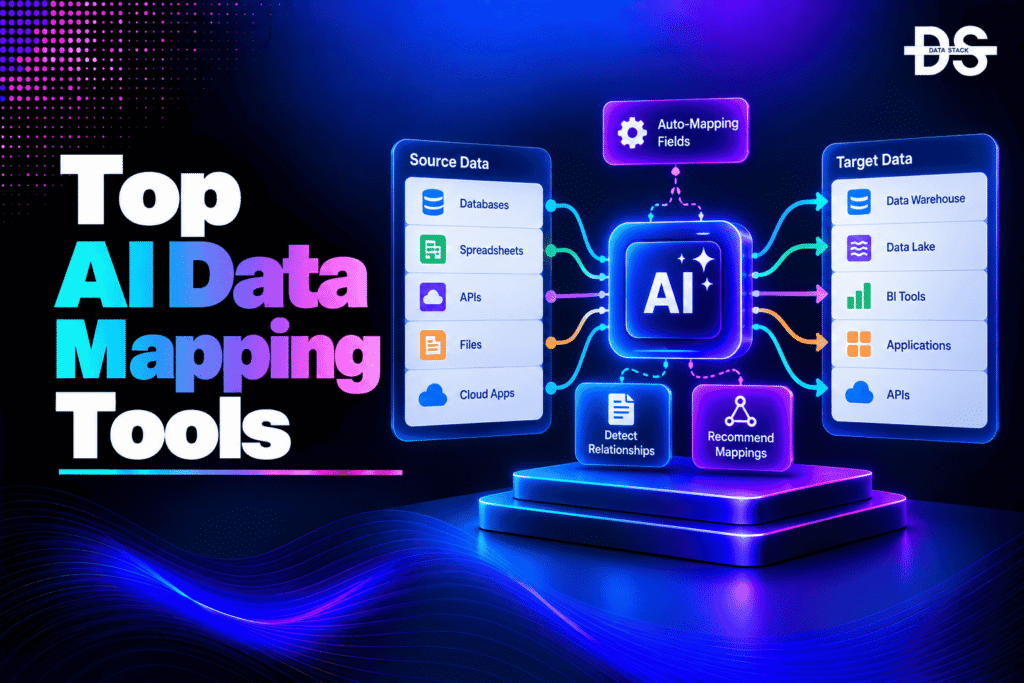
Data mapping is a critical part of data integration, migration, transformation, and modernization projects. Organizations routinely need to move information between systems that use different field names, structures, formats, and data models. Manually identifying which source fields correspond to which target fields can become extremely time-consuming as the number of systems and data elements grows.
AI data mapping tools use artificial intelligence and machine learning to automate parts of this process. Instead of requiring users to connect every field manually, AI can analyze source and target schemas, understand field names and data structures, identify potential relationships, recommend field-to-field mappings, and suggest transformation logic. Some newer platforms can generate substantial portions of a mapping from the source and destination structures and then allow users to review and approve the recommendations.
The emergence of AI-powered data mapping tools is particularly important for organizations dealing with frequent migrations, partner onboarding, EDI, application integration, and complex data transformation. GenAI can further simplify mapping by allowing users to describe transformation requirements in natural language, while machine learning can use previous mapping patterns to improve future recommendations. Adeptia, for example, describes an AI mapping approach that analyzes source and destination schemas and proposes mapping rules, while Altova’s 2026 MapForce release added AI that analyzes actual data structures and suggests field connections and transformations.
However, not every integration platform with an AI assistant should automatically be considered an AI data mapping tool. For this list, the focus is on platforms where AI, machine learning, or GenAI directly contributes to mapping, schema matching, field matching, transformation suggestions, or mapping automation.
What Are AI Data Mapping Tools?
AI data mapping tools use artificial intelligence, machine learning, and generative AI to identify and establish relationships between source and target data structures. They can analyze schemas, field names, sample data, metadata, and previous mapping patterns to recommend how information should move from one system to another.
Traditional data mapping generally requires users to manually establish field relationships and transformation rules. AI tools for data mapping can automate part of this work by suggesting matches, generating transformation logic, detecting schema differences, and helping users resolve ambiguous mappings. The final mapping can then be reviewed and approved before it is deployed.
AI Data Mapping Tools vs. Traditional Data Mapping Tools
| Capability | Traditional Data Mapping | AI Data Mapping |
|---|---|---|
| Schema analysis | Users manually examine source and target structures | AI can analyze source and target schemas automatically |
| Field matching | Fields are connected manually | AI can recommend source-to-target field matches |
| Semantic matching | Relies heavily on field names and manual interpretation | AI can understand semantic relationships between differently named fields |
| Transformation logic | Users manually configure transformations | AI can suggest or generate transformation functions |
| Mapping patterns | Previous mappings are reused manually | ML can learn from previous mapping patterns |
| Schema changes | Users identify and update mappings manually | AI can detect changes and suggest mapping updates |
| Natural-language mapping | Mapping requirements are configured through UI or code | GenAI can interpret natural-language mapping instructions |
| Human review | Users build and validate mappings manually | AI generates suggestions that users can review and approve |
| Automation | Primarily rule-based and manually configured | AI-assisted and increasingly automated |
AI Data Mapping Tools Comparison
AI data mapping platforms differ significantly in how deeply AI is involved. Some use AI to recommend field connections, while others can analyze actual source and target data, generate transformations, learn from previously approved mappings, or create mappings through natural-language instructions.
| Tool | AI Capabilities | What You Can Automate | Best For | Free Trial | G2 Rating |
|---|---|---|---|---|---|
| Adeptia | AI-powered schema analysis, field matching, mapping suggestions | Source-to-target mapping and transformation suggestions | Enterprise & B2B integration | Demo | 4.5/5* |
| Altova MapForce | Altova AI analyzes structures and suggests field connections and transformations | Mapping generation and transformation logic | Complex data transformation | Yes — trial | 4.5/5* |
| Informatica IDMC | CLAIRE AI, AI-generated mappings and transformations | Mapping creation, transformations, metadata mapping | Enterprise data integration | Yes — 30 days | 4.3/5 |
| Boomi | Pathfinder mapping suggestions and AI-assisted integration | Profile mapping and integration mapping | Cloud integration | Yes | 4.5/5 |
| Workato | AIRO-assisted mapping and formula generation | Mapping formulas and transformation logic | AI-powered automation | Yes | 4.7/5 |
| Ataccama ONE | AI/ML relationship discovery and intelligent matching | Relationship mapping and data matching | Enterprise data intelligence | Demo | 4.6/5 |
| MuleSoft Anypoint Platform | AI-assisted integration and transformation capabilities | Integration mapping and transformations | API-led integration | Yes — trial | 4.4/5 |
| SnapLogic | AI-assisted pipeline and transformation generation | Mapping and pipeline creation | Intelligent integration | Yes — trial | 4.5/5 |
| Qlik Talend Cloud | AI-assisted data integration and intelligent transformation | Data integration and mapping workflows | Cloud data integration | Yes — trial | 4.5/5 |
9 Best AI Data Mapping Tools
The tools below focus on AI-powered schema matching, field mapping, mapping generation, transformation suggestions, and intelligent data integration. The goal is to distinguish genuine AI data mapping capabilities from platforms that simply add a generic AI chatbot to an otherwise traditional mapping interface.
#1. Adeptia
Adeptia is an enterprise data integration platform that provides AI-powered capabilities for automating data mapping and transformation. Its AI mapping functionality can analyze source and destination schemas, understand field relationships, and recommend how data should be mapped between different systems. This can reduce the manual effort involved in building mappings for recurring integration and data-exchange workflows.
AI Capabilities
- AI-powered schema analysis: Adeptia can analyze source and destination structures to understand their fields and relationships.
- Intelligent field matching: AI can identify potential relationships between source and target fields even when their names or structures differ.
- AI mapping recommendations: The platform can suggest mapping rules based on the structures and information available in the source and destination schemas.
- AI-assisted transformations: AI can help determine how source data should be transformed to satisfy the target structure.
What You Can Automate
- Source-to-target mapping: Automatically identify potential relationships between source and destination fields.
- Schema matching: Analyze different schemas and suggest corresponding fields.
- Transformation mapping: Recommend transformation logic required to move data between different formats and structures.
- Mapping creation: Reduce the amount of manual work required to create integration mappings.
- Mapping workflows: Incorporate mapping recommendations into broader data integration processes.
Key Features
- AI Data Mapping: Uses AI to analyze source and destination schemas and recommend mappings.
- Schema matching: Helps identify relationships between fields across different data structures.
- Data transformation: Supports transformations required to make source data compatible with target systems.
- Data integration: Connects mapping capabilities with broader integration workflows.
- B2B integration: Supports data exchange scenarios where organizations frequently need to map information between different partner formats.
Best For
Enterprise teams that need AI-assisted data mapping for complex integration, transformation, and B2B data exchange workflows.
AI Verdict
Adeptia is a strong fit for this category because AI is directly applied to the data-mapping process. Instead of using AI only for general assistance, the platform can analyze source and target schemas and recommend field relationships and mapping rules, reducing one of the most manual parts of integration projects.
Showcase your software to buyers actively comparing tools. Submit your product for editorial review and get featured on Data Stack Hub.
Submit Your Tool →#2. Altova MapForce
Altova MapForce is a visual data mapping and transformation platform that supports mappings between databases, XML, JSON, EDI, flat files, and other data formats. Its newer AI capabilities can analyze source and target structures and suggest field connections and transformation functions, bringing generative AI directly into the mapping workflow.
AI Capabilities
- AI-generated mappings: Altova AI can analyze source and target structures and suggest connections between their fields.
- AI transformation suggestions: The platform can recommend transformation functions when source and target data structures require different formats or processing.
- Structure-aware AI: AI analyzes the actual data structures rather than simply matching field names.
- AI-assisted mapping refinement: Generated mapping suggestions can be reviewed and modified within the visual mapping environment.
What You Can Automate
- Field connections: Generate suggested relationships between source and target fields.
- Mapping generation: Use AI to create an initial mapping instead of starting entirely from a blank canvas.
- Transformation functions: Generate suggestions for functions needed to transform source data into the target format.
- Schema analysis: Analyze the structures involved in a mapping project.
- Mapping refinement: Start with AI-generated mappings and manually adjust them where business requirements require additional logic.
Key Features
- AI-powered mapping: Uses AI to suggest field connections and mapping logic.
- Visual mapping: Provides a visual interface for reviewing and modifying mappings.
- Multi-format support: Supports databases, XML, JSON, EDI, CSV, and other data formats.
- Transformation functions: Provides extensive transformation capabilities for complex mappings.
- Code generation: Can generate execution code from completed mappings.
Best For
Data integration and migration teams that need AI-assisted visual mapping across multiple structured data formats.
AI Verdict
MapForce is particularly relevant to AI data mapping because its newer AI capabilities operate directly inside the mapping process. AI can help create field connections and transformation functions, while users retain control over reviewing and refining the generated mapping before implementation.
#3. Informatica IDMC
Informatica Intelligent Data Management Cloud (IDMC) combines data integration, data quality, governance, cataloging, and transformation capabilities with Informatica’s CLAIRE AI technology. CLAIRE can use metadata intelligence and generative AI to assist with mapping, transformation, and integration tasks.
AI Capabilities
- CLAIRE AI: Uses machine learning and metadata intelligence across Informatica’s data management environment.
- AI-generated mappings: GenAI capabilities can help create mappings based on natural-language descriptions and available metadata.
- AI-assisted transformations: CLAIRE can assist with generating transformation logic for integration workflows.
- Metadata-driven mapping: AI can use relationships and metadata to provide context when creating mappings.
What You Can Automate
- Mapping creation: Generate initial mapping structures using AI-assisted capabilities.
- Field matching: Identify relationships between source and target data elements.
- Transformation logic: Generate or recommend transformation expressions.
- Metadata mapping: Use metadata relationships to support mapping decisions.
- Integration workflows: Incorporate mappings into broader automated data integration processes.
Key Features
- CLAIRE AI: Provides AI and GenAI capabilities across Informatica’s data management platform.
- Cloud Data Integration: Supports visual and automated data integration workflows.
- Mapping Designer: Provides an environment for creating and managing data mappings.
- Metadata intelligence: Uses metadata to understand relationships between data assets.
- Data transformation: Supports complex transformation requirements across enterprise systems.
Best For
Large enterprises that need AI-assisted data mapping integrated with enterprise data integration, governance, quality, and metadata management.
AI Verdict
Informatica stands out when AI-powered mapping needs to operate within a broader enterprise data environment. CLAIRE can use metadata intelligence and GenAI to assist with mappings and transformations, reducing manual configuration while allowing data teams to review and control the resulting integration logic.
#4. Boomi
Boomi is an integration and automation platform that uses AI to assist with integration development, data mapping, transformation, and workflow creation. Its AI capabilities can help users work with integration components and mapping requirements while its broader platform handles connections between applications, databases, APIs, and other systems.
AI Capabilities
- AI-assisted mapping: Boomi’s AI capabilities can assist users in creating and configuring mappings between data structures.
- Intelligent field matching: AI can help identify potential relationships between source and target fields.
- AI-assisted transformation: AI can help generate or refine transformation logic required by integration workflows.
- Natural-language assistance: Users can interact with supported integration development capabilities through natural-language instructions.
What You Can Automate
- Field mapping: Reduce manual effort when connecting source fields with destination fields.
- Transformation logic: Assist with creating formulas and transformations for mapped data.
- Integration development: Automate portions of the process of building integration workflows.
- Schema-based mapping: Use source and destination structures to assist mapping decisions.
- Mapping maintenance: Help update mappings as integration requirements evolve.
Key Features
- AI-assisted integration: Applies AI to integration development and automation workflows.
- Data mapping: Provides visual capabilities for connecting source and target fields.
- Data transformation: Supports transformations across connected applications and data sources.
- Integration platform: Provides connectors and workflows for application and data integration.
- Process automation: Connects data mapping with broader business-process automation.
Best For
Organizations that need AI-assisted data mapping as part of a broader cloud integration and automation platform.
AI Verdict
Boomi is useful when data mapping is one component of a larger integration workflow. Its AI capabilities can reduce manual work around field mapping and transformation, while the underlying integration platform handles the connectivity and execution required to move data between systems.
#5. Workato
Workato is an enterprise automation and integration platform that uses AI to assist with building integrations, transformations, and data workflows. Its AI capabilities can help users work with data mappings and formulas, reducing the amount of manual configuration required when connecting applications with different data structures.
AI Capabilities
- AI-assisted field mapping: AI can help identify relationships between fields when building integration recipes.
- AI formula generation: Workato’s AI capabilities can assist with creating formulas and transformation logic from natural-language requirements.
- Natural-language instructions: Users can describe transformation requirements and use AI assistance to generate relevant integration logic.
- AI-assisted integration development: AI can help accelerate the creation and modification of integration workflows that contain mapping and transformation steps.
What You Can Automate
- Field mapping: Assist with connecting fields between source and destination applications.
- Transformation formulas: Generate or refine formulas used to transform mapped data.
- Integration workflows: Build repeatable workflows that move and transform data between applications.
- Mapping modifications: Use AI assistance when updating existing transformations as requirements change.
- Data transformations: Automate calculations, formatting, and other transformations required during integration.
Key Features
- AI-assisted automation: Uses AI to help build and modify integration workflows.
- Data mapping: Maps information between connected applications and systems.
- Formula generation: AI can assist with creating transformation formulas.
- Recipe-based workflows: Packages mappings and transformations into reusable automation workflows.
- Application connectivity: Provides integrations across business applications, databases, APIs, and other systems.
Best For
Integration and automation teams that need AI-assisted mapping and transformation within application and data workflows.
AI Verdict
Workato’s AI value is strongest when mapping is part of a larger automation workflow. Rather than treating mapping as an isolated activity, its AI assistance can help users translate mapping and transformation requirements into integration logic, reducing the amount of manual formula and workflow development.
Increase your product visibility by reaching software buyers researching the best tools. Every submission is reviewed by our editorial team.
Feature My Tool →#6. Ataccama ONE
Ataccama ONE is an enterprise data management platform that combines data quality, data cataloging, data observability, governance, and master data management with AI and machine-learning capabilities. Its intelligent data understanding and matching capabilities can help organizations discover relationships between data elements and establish connections across complex data environments.
AI Capabilities
- AI-powered relationship discovery: Machine learning can help identify relationships between data elements and datasets.
- Intelligent matching: AI-assisted matching can identify records and data elements that may represent the same entity or concept.
- Semantic data understanding: AI can analyze data characteristics and context to help identify meaningful relationships.
- AI-assisted classification: Intelligent classification can provide additional context when identifying and connecting data elements.
What You Can Automate
- Relationship discovery: Automatically identify potential relationships between data elements.
- Entity matching: Identify records that may represent the same entity across different sources.
- Data classification: Classify data to provide context for downstream mapping and integration activities.
- Schema understanding: Analyze data structures and characteristics to improve understanding before mapping.
- Matching workflows: Automate portions of the process of identifying corresponding information across datasets.
Key Features
- AI-powered data discovery: Helps identify and understand relationships across enterprise data.
- Entity matching: Supports intelligent matching of records across different sources.
- Data catalog: Provides metadata and context around data assets.
- Data classification: Helps categorize data based on its content and characteristics.
- Master Data Management: Connects intelligent matching with the creation and management of trusted entities.
Best For
Enterprise teams that need AI-assisted data relationship discovery and intelligent matching as part of broader data integration and master-data workflows.
AI Verdict
Ataccama is particularly useful when data mapping involves understanding relationships between entities and data elements, rather than simply connecting two identically named columns. Its AI-assisted matching and discovery capabilities can help teams identify relationships that would otherwise require significant manual analysis.
#7. MuleSoft Anypoint Platform
MuleSoft Anypoint Platform is an integration platform used to connect applications, APIs, data sources, and business systems. Its AI capabilities can assist developers with integration development and transformation tasks, while Anypoint’s mapping and transformation functionality provides the underlying environment for connecting differently structured data.
AI Capabilities
- AI-assisted integration development: AI can help users create and modify integration workflows.
- Natural-language development assistance: AI can help translate integration requirements into technical implementation steps.
- AI-assisted transformation: AI capabilities can assist with generating or refining transformation logic.
- Intelligent development support: AI can reduce manual effort involved in creating integration and mapping components.
What You Can Automate
- Data transformation: Build repeatable transformations between source and target structures.
- Field mapping: Connect fields across applications and APIs within integration workflows.
- Integration development: Use AI assistance to accelerate portions of integration creation.
- Transformation logic: Generate or refine mapping-related expressions and logic.
- Integration maintenance: Assist with modifying workflows as source or target requirements change.
Key Features
- Anypoint DataWeave: Provides the core transformation language for mapping and transforming data.
- AI-assisted development: Helps users build and modify integration workflows.
- API integration: Connects applications and services through APIs.
- Visual integration: Provides tools for designing integration flows.
- Data transformation: Supports complex transformations across different formats and structures.
Best For
Organizations that need AI-assisted mapping and transformation within an API-led integration environment.
AI Verdict
MuleSoft is most relevant when data mapping is part of a larger API and application integration workflow. Its AI capabilities can help reduce development effort around transformations and integrations, while DataWeave provides the detailed mapping and transformation control needed for complex enterprise scenarios.
#8. SnapLogic
SnapLogic is an intelligent integration platform that uses AI to assist with building data pipelines, integrations, and transformation workflows. Its AI capabilities can help users generate integration logic and work with data transformations, reducing the amount of technical configuration required to connect systems with different structures.
AI Capabilities
- AI-assisted pipeline generation: AI can help create integration workflows from natural-language requirements.
- AI-assisted transformation: AI can assist with data transformation logic within integration pipelines.
- Schema-aware integration: Integration workflows can use source and target structures to determine how data should move between systems.
- Natural-language interaction: Users can describe integration requirements and use AI assistance to accelerate implementation.
What You Can Automate
- Mapping workflows: Build repeatable mappings between source and target systems.
- Transformation logic: Generate and configure transformations within integration pipelines.
- Pipeline creation: Use AI assistance to accelerate the creation of data integration pipelines.
- Schema-based integration: Connect differently structured data sources through transformation workflows.
- Integration modifications: Accelerate changes to existing pipelines when mapping requirements evolve.
Key Features
- SnapGPT: Provides generative AI assistance for integration development.
- Intelligent integration: Combines AI with visual data and application integration.
- Pipeline automation: Builds reusable workflows for moving and transforming data.
- Data transformation: Supports transformations across multiple data formats.
- Visual pipeline development: Allows users to build and modify integration workflows without writing every component manually.
Best For
Data integration teams that want GenAI-assisted mapping and transformation within visual data pipelines.
AI Verdict
SnapLogic is useful for teams that want GenAI to participate in the integration-development process surrounding data mapping. Its AI capabilities can accelerate pipeline and transformation creation, while the visual platform provides control over the final mapping and integration logic.
#9. Qlik Talend Cloud
Qlik Talend Cloud provides cloud-based data integration, transformation, quality, and data management capabilities. Its intelligent capabilities can assist teams with data preparation and integration workflows, while AI can help users work more efficiently with data transformation and integration requirements.
AI Capabilities
- AI-assisted data integration: AI capabilities can assist users with data integration and transformation workflows.
- Intelligent data preparation: AI can help analyze and work with data during preparation and integration activities.
- AI-assisted development: Generative AI capabilities can reduce manual effort when creating or modifying data workflows.
- Data-quality intelligence: Intelligent quality capabilities can provide additional context when integrating and mapping data.
What You Can Automate
- Data integration: Automate the movement of data between source and target systems.
- Transformation workflows: Apply repeatable transformations to prepare data for destination systems.
- Mapping workflows: Incorporate source-to-target mappings into reusable integration processes.
- Data preparation: Automate preparation steps required before data is loaded into target environments.
- Integration monitoring: Monitor data workflows and identify problems that may affect mapping and transformation processes.
Key Features
- Talend Data Integration: Provides integration and transformation capabilities for connecting different data environments.
- AI-assisted workflows: Adds intelligent assistance to supported data development processes.
- Data quality: Combines integration with capabilities for improving and monitoring data quality.
- Data transformation: Supports complex transformation requirements across different sources and targets.
- Cloud integration: Provides cloud-based data integration workflows for modern data environments.
Best For
Organizations that need AI-assisted data integration and mapping alongside data transformation and quality capabilities.
AI Verdict
Qlik Talend Cloud is best suited to organizations where mapping needs to operate as part of a broader data integration and data-quality workflow. Its AI-assisted capabilities can help reduce development effort, while Talend’s established transformation and integration functionality provides the underlying control over how data moves between systems.