
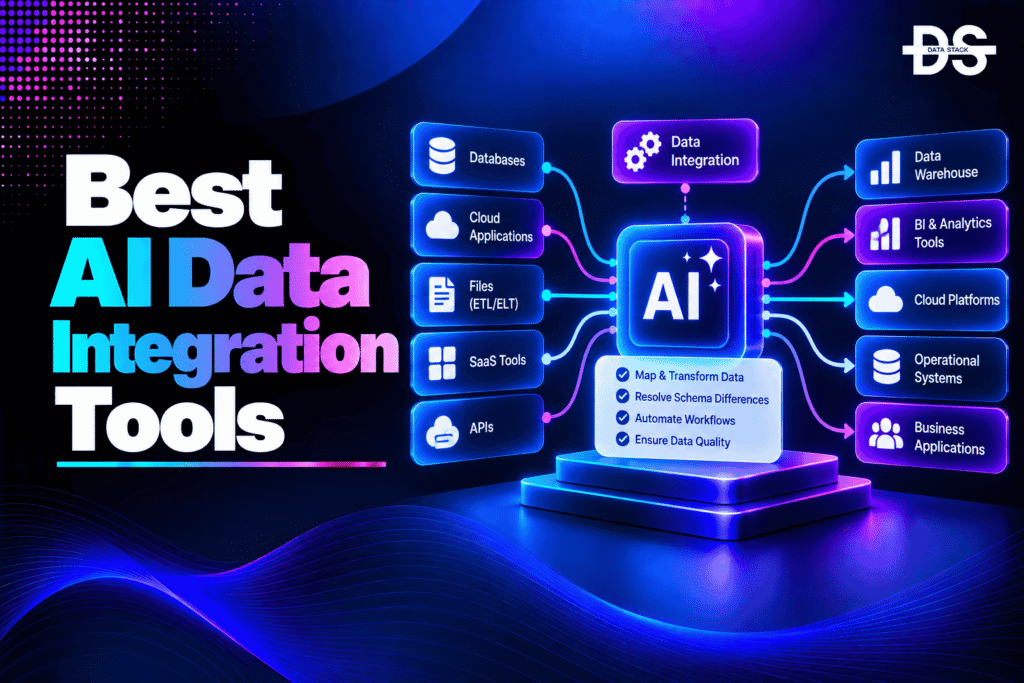
Data integration connects information from databases, applications, APIs, files, cloud platforms, and other sources so organizations can use it across analytics, operations, machine learning, and AI workflows. As data environments become more distributed, manually configuring integrations, transformations, schemas, and pipelines becomes increasingly difficult to maintain.
AI data integration tools use artificial intelligence, machine learning, and generative AI to automate and improve parts of the integration process. AI can help discover data sources, understand schemas, recommend mappings, generate transformation logic, identify anomalies, and assist users in building integration pipelines. Instead of configuring every component manually, teams can use AI to accelerate the creation and maintenance of data workflows.
The rise of AI-powered data integration tools is particularly important for organizations building modern data stacks and AI applications. GenAI can allow users to describe integration requirements in natural language, while machine learning can identify relationships and patterns across data sources. Some platforms can also use metadata and previous integration patterns to recommend how new data should be connected.
However, an integration platform should not be considered an AI data integration tool simply because it has added a chatbot or AI assistant. This list focuses on platforms where AI, machine learning, or GenAI meaningfully contributes to data discovery, integration development, schema matching, transformation, pipeline creation, monitoring, or integration automation.
Table of Contents
ToggleWhat Are AI Data Integration Tools?
AI data integration tools use artificial intelligence and machine learning to connect, transform, synchronize, and manage data across different systems. They can automate tasks such as source discovery, schema analysis, field matching, transformation generation, pipeline creation, and data-quality monitoring.
Traditional integration generally depends on manually configured connectors, mappings, transformations, and workflows. AI tools for data integration can use the context available in schemas, metadata, previous workflows, and natural-language instructions to recommend or generate parts of the integration process.
For example, an AI-powered platform may analyze a source database and target warehouse, identify corresponding fields, recommend transformations, and generate an initial integration workflow. A data engineer can then review the generated workflow and modify it before deployment.
AI Data Integration Tools vs. Traditional Data Integration Tools
| Capability | Traditional Data Integration | AI Data Integration |
|---|---|---|
| Source discovery | Sources are manually identified and configured | AI can assist with discovering and understanding data sources |
| Schema analysis | Engineers manually inspect source and target schemas | AI can analyze schemas and metadata automatically |
| Field mapping | Fields are manually mapped | AI can recommend semantic field mappings |
| Transformation | Logic is manually configured using SQL, code, or visual tools | AI can generate or recommend transformation logic |
| Pipeline creation | Engineers manually build integration pipelines | GenAI can assist with generating pipeline components |
| Data relationships | Relationships are manually identified or predefined | AI can discover potential relationships across data |
| Natural-language interaction | Primarily UI, SQL, or code based | Users can describe integration requirements in natural language |
| Monitoring | Uses predefined rules and alerts | AI/ML can identify unusual pipeline or data behavior |
| Maintenance | Schema and workflow changes are handled manually | AI can help identify changes and recommend updates |
| Automation | Primarily rule-based | AI-assisted and increasingly context-aware |
AI Data Integration Tools Comparison
AI data integration platforms differ in how deeply artificial intelligence is incorporated into the integration lifecycle. Some focus on GenAI-assisted pipeline creation, while others use machine learning for schema matching, transformation, data discovery, or intelligent monitoring.
| Tool | AI Capabilities | What You Can Automate | Best For | Free Trial | G2 Rating |
|---|---|---|---|---|---|
| Informatica IDMC | CLAIRE AI, intelligent mapping, metadata intelligence | Integration, mappings, transformations | Enterprise data integration | Yes — 30 days | 4.3/5 |
| Boomi | AI-assisted integration development and mapping | Integrations, mappings, workflows | Application & data integration | Yes | 4.5/5 |
| Workato | AI-assisted recipes, mapping, and transformation | Integration workflows and automation | Enterprise automation | Yes | 4.7/5 |
| SnapLogic | GenAI-assisted pipeline creation and transformation | Pipelines and integrations | Intelligent integration | Yes — trial | 4.5/5 |
| MuleSoft Anypoint Platform | AI-assisted integration development | APIs, integrations, transformations | API-led integration | Yes — trial | 4.4/5 |
| Adeptia | AI-powered integration mapping and schema analysis | Data integration and mappings | B2B & enterprise integration | Demo | 4.5/5* |
| Qlik Talend Cloud | AI-assisted integration and transformation | Data pipelines and transformations | Cloud data integration | Yes — trial | 4.5/5 |
| Matillion | AI-assisted data pipeline development | Pipelines and transformations | Cloud data platforms | Yes — trial | 4.5/5 |
| Fivetran | AI-assisted development and automated schema handling | Data ingestion and pipeline management | Automated ELT | Yes — free plan/trial | 4.2/5 |
9 Best AI Data Integration Tools
The tools below were selected for their AI, machine-learning, or GenAI capabilities that directly support data integration workflows. The focus is on AI-assisted source discovery, schema understanding, mapping, pipeline creation, transformation, and integration automation—not simply the presence of an AI chatbot.
#1. Informatica IDMC
Informatica Intelligent Data Management Cloud (IDMC) is an enterprise data integration platform that uses CLAIRE AI to help organizations discover, connect, transform, and manage data across complex environments. Its AI capabilities are integrated throughout the platform, supporting data integration, mapping, transformation, data quality, governance, and metadata management rather than functioning as a separate AI assistant.
CLAIRE AI combines machine learning, metadata intelligence, and generative AI to understand relationships between data assets and assist with integration development. It can help identify source-to-target relationships, recommend mappings, generate or refine transformation logic, and provide intelligent recommendations based on available metadata and data context. Its AI-assisted capabilities can also help users work with integration assets using natural-language instructions where supported.
IDMC includes Cloud Data Integration, AI-assisted mapping, metadata intelligence, data transformation, data quality, and enterprise connectivity across databases, applications, APIs, files, and cloud environments. This allows organizations to use AI throughout the integration lifecycle while maintaining the control and governance required for enterprise data workflows.
AI Capabilities
- CLAIRE AI: Uses machine learning, metadata intelligence, and generative AI to provide intelligent assistance across Informatica’s data management and integration capabilities.
- AI-assisted data discovery: Helps users understand available data assets, metadata, relationships, and dependencies before building integration workflows.
- Intelligent field mapping: Analyzes source and target structures to help identify potential relationships between fields and accelerate mapping development.
- AI-assisted transformation: Helps users generate or refine transformation logic required to move data between different structures and systems.
- Metadata intelligence: Uses metadata relationships and contextual information to provide more intelligent recommendations during integration development.
- GenAI assistance: Allows users to interact with supported integration capabilities using natural-language instructions.
- Intelligent recommendations: Can recommend integration components, mappings, transformations, and other development actions based on available context.
What You Can Automate
- Data source discovery: Analyze and understand data sources, assets, metadata, and relationships to reduce manual discovery work.
- Source-to-target mapping: Identify potential relationships between fields and accelerate the creation of mappings across different systems.
- Data transformations: Generate or recommend transformation logic needed to convert source data into the format required by the destination.
- Integration pipeline development: Use AI assistance to accelerate the creation and configuration of data integration workflows.
- Data preparation: Incorporate transformation and quality processes into integration workflows before data reaches its destination.
- Schema and metadata analysis: Use available metadata to understand how data assets relate to each other and support integration decisions.
- Integration maintenance: Assist teams when existing integration workflows, mappings, or requirements need to be modified.
- Data-quality workflows: Connect integration with data-quality capabilities so data can be validated and improved as part of the broader workflow.
- Enterprise data movement: Automate the movement of data between applications, databases, cloud platforms, APIs, and other enterprise systems.
Best For
Large enterprises that need AI-powered data integration combined with data quality, governance, metadata management, and enterprise-scale transformation.
AI Verdict
Informatica is particularly strong for organizations that want AI to participate across the full data integration lifecycle. CLAIRE AI is used for discovery, metadata understanding, mapping, transformation, and integration development, while IDMC provides the underlying enterprise connectivity and governance. This makes it more than a traditional integration platform with an AI assistant—the AI capabilities are connected to core data management workflows.
Showcase your software to buyers actively comparing tools. Submit your product for editorial review and get featured on Data Stack Hub.
Submit Your Tool →#2. Boomi
Boomi is an enterprise integration and automation platform that uses AI to help organizations connect applications, databases, APIs, cloud services, and other data sources. Its AI capabilities are designed to reduce the manual effort involved in developing integrations by assisting with data mapping, transformation, workflow creation, and integration development. Rather than requiring users to configure every component from scratch, Boomi’s intelligent capabilities can help accelerate different stages of the integration process.
Boomi combines AI-assisted development with data mapping, transformation, application connectivity, reusable integration workflows, and process automation. Its platform can help users work with different data structures and connect information between systems, while AI assistance can provide recommendations and help translate integration requirements into technical workflows. This is particularly useful for organizations managing many integrations across SaaS applications, databases, APIs, and enterprise systems.
The platform also provides a broader environment for managing and executing those integrations. This means AI-assisted development can be connected to the actual integration workflow rather than being limited to an isolated conversational interface. Teams can use Boomi to create repeatable processes for moving, transforming, and synchronizing data while using AI to reduce some of the manual development involved.
AI Capabilities
- AI-assisted integration development: Helps users create, configure, and modify integration workflows using intelligent assistance.
- Intelligent data mapping: Helps identify relationships between source and target fields when integrating systems with different data structures.
- AI-assisted transformation: Helps users create or refine transformation logic required to convert data between different formats.
- Natural-language assistance: Allows users to describe integration requirements in more conversational terms and receive AI-assisted development support.
- Intelligent recommendations: Provides contextual suggestions during integration development to help users configure workflows more efficiently.
- AI-assisted workflow development: Helps reduce the technical effort involved in creating reusable integration and automation processes.
- Integration intelligence: Applies AI assistance within the broader integration environment so recommendations can be used as part of actual workflows.
What You Can Automate
- Application integration: Connect applications, SaaS platforms, databases, APIs, and enterprise systems through reusable integration workflows.
- Data mapping: Assist with identifying and connecting corresponding fields between source and destination systems.
- Data transformation: Create and refine formulas, transformations, and other logic required to make source data compatible with destination systems.
- Integration workflow creation: Accelerate the development of repeatable workflows that move and process information between systems.
- Data synchronization: Automate the movement and synchronization of information across connected applications and data sources.
- Process automation: Combine data integration with broader business-process automation so data movement can trigger or support downstream actions.
- Integration maintenance: Use AI assistance when existing workflows, mappings, or transformations need to be modified.
- Multi-system connectivity: Automate workflows involving multiple applications and data sources rather than building isolated point-to-point integrations.
- Data movement: Automate the transfer of information between connected systems while applying the required mappings and transformations.
Best For
Organizations looking for AI-assisted application and data integration within a broader enterprise automation platform.
AI Verdict
Boomi is a strong fit for organizations that want AI to assist with the actual development and maintenance of integrations. Its AI capabilities extend into mapping, transformation, workflow creation, and integration development, while the broader platform provides the connectors and automation environment required to execute those workflows at scale.
#3. Workato
Workato is an enterprise integration and automation platform that combines data integration, application connectivity, workflow automation, and AI-assisted development. Its AI capabilities help teams build and modify integration workflows, create transformation logic, work with data mappings, and automate processes across applications and data sources. This allows users to reduce the amount of manual configuration required when connecting systems with different structures and requirements.
Workato’s platform combines AI-assisted recipe development, data mapping, transformation, application connectivity, API integration, and business-process automation. Its AI capabilities can help users translate natural-language requirements into integration workflows and assist with formulas and transformation logic. The platform’s recipe-based approach also allows these integrations to be packaged into reusable workflows that can be triggered by events, schedules, or other business conditions.
For data teams, Workato is particularly useful when integration is not limited to moving data from one system to another. A single workflow can connect multiple applications, transform information, apply business logic, and trigger downstream actions. AI assistance can reduce the development effort involved in creating these workflows while users retain control over the final integration logic.
AI Capabilities
- AI-assisted recipe development: Helps users create and modify integration recipes based on their requirements.
- Natural-language automation: Allows users to describe desired workflows and use AI assistance to translate those requirements into integration logic.
- AI-assisted data mapping: Helps users identify and configure relationships between fields across connected applications.
- AI formula generation: Can assist with creating formulas and transformation expressions required to process integrated data.
- AI-assisted transformation: Helps users develop logic for changing data formats, values, and structures during an integration.
- GenAI development assistance: Uses generative AI to accelerate integration development and reduce repetitive configuration work.
- Context-aware workflow assistance: AI can assist with integration components within the broader Workato automation environment rather than operating independently.
What You Can Automate
- Application integration: Connect SaaS applications, databases, APIs, and enterprise systems through reusable workflows.
- Data synchronization: Move and synchronize information between multiple systems based on events or scheduled workflows.
- Field mapping: Assist with connecting corresponding fields between source and destination applications.
- Data transformation: Generate and apply formulas, expressions, and transformation logic while data moves through a workflow.
- Integration recipes: Build reusable automation recipes that combine data movement, transformation, and business logic.
- Multi-step workflows: Connect multiple applications and perform several integration actions within a single automated process.
- Data preparation: Transform and standardize information before sending it to downstream systems.
- Workflow maintenance: Use AI assistance to modify existing recipes when integration requirements change.
- Business-process automation: Combine data integration with actions such as record creation, updates, notifications, and downstream application processes.
Best For
Enterprise teams that want AI-assisted data integration combined with application connectivity and business-process automation.
AI Verdict
Workato is particularly useful when data integration needs to operate as part of a broader automated business workflow. Its AI capabilities can assist with recipe creation, mapping, formulas, and transformations, while the underlying platform connects those AI-assisted components to real applications and operational processes.
#4. SnapLogic
SnapLogic is an intelligent integration platform that uses generative AI to help organizations build data pipelines, application integrations, and transformation workflows. Its AI capabilities are designed to reduce the technical effort involved in creating integrations by allowing users to describe requirements in natural language and receive assistance with pipeline creation, transformation, and workflow development.
SnapLogic combines GenAI-assisted pipeline development, data integration, application connectivity, transformation, and visual workflow design. Its SnapGPT capabilities can help users translate natural-language requirements into integration workflows, while the platform’s library of Snaps provides prebuilt components for connecting applications, databases, APIs, files, and other systems. This allows teams to move from an integration requirement to a working pipeline without manually configuring every component from scratch.
The platform is also designed for both data and application integration, so AI-assisted development can be used across different integration scenarios. Users can review and modify generated workflows through the visual interface, giving data engineers control over transformations, connections, and execution logic before deploying the integration.
AI Capabilities
- GenAI pipeline development: Uses generative AI to help create integration pipelines from natural-language requirements.
- SnapGPT: Provides AI assistance for building and working with integration workflows.
- Natural-language integration: Allows users to describe what they want an integration to accomplish instead of manually configuring every component.
- AI-assisted transformation: Helps users create or refine transformation logic within integration pipelines.
- AI-assisted workflow modification: Can help users update or extend existing pipelines as requirements change.
- Intelligent integration development: Uses AI to reduce repetitive development work across data and application integration projects.
- Contextual development assistance: AI assistance operates within the integration environment so generated logic can be incorporated into actual workflows.
What You Can Automate
- Pipeline creation: Generate initial data integration pipelines from natural-language descriptions and requirements.
- Data movement: Automate the movement of information between databases, applications, APIs, cloud platforms, and other sources.
- Data transformation: Apply transformations required to standardize or restructure information before it reaches a destination.
- Application integration: Connect business applications through reusable integration workflows.
- Data integration: Combine information from multiple sources into downstream platforms such as data warehouses and analytics environments.
- Pipeline modification: Use AI assistance to update existing workflows when integration requirements change.
- Multi-step workflows: Build workflows that combine data extraction, transformation, loading, validation, and downstream actions.
- Integration development: Reduce manual configuration when creating new pipelines and integration processes.
- Data preparation: Transform and prepare data during the integration process before it is consumed by analytics or AI systems.
Best For
Data and integration teams that want GenAI-assisted pipeline development and intelligent data integration across cloud applications, databases, APIs, and enterprise systems.
AI Verdict
SnapLogic is a strong AI-focused integration option because generative AI is directly connected to pipeline development. Its natural-language approach can help teams turn integration requirements into working workflows faster, while the visual platform and Snap library provide the control needed to review, refine, and deploy those AI-assisted integrations.
#5. MuleSoft Anypoint Platform
MuleSoft Anypoint Platform is an enterprise integration platform for connecting applications, APIs, databases, SaaS platforms, and other systems. Its AI capabilities assist with integration development, API development, data transformation, and workflow creation, helping developers reduce the amount of manual work involved in designing and maintaining complex integrations.
The platform combines AI-assisted development, API-led connectivity, DataWeave transformation, integration workflows, and reusable APIs. MuleSoft’s AI capabilities can help developers work with integration requirements and generate or refine implementation logic, while DataWeave provides the underlying language for transforming and mapping data between different structures. This combination makes the platform suitable for organizations where data integration is closely connected with application and API integration.
MuleSoft also provides a broad ecosystem for enterprise connectivity, allowing teams to connect applications and data sources through reusable APIs and integration flows. AI assistance can accelerate development, but engineers retain control over the final transformation and integration logic, which is important for complex enterprise workflows.
AI Capabilities
- AI-assisted integration development: Helps developers create and modify integration workflows more efficiently.
- Natural-language development assistance: Allows users to describe integration requirements and receive AI-assisted implementation guidance.
- AI-assisted transformation: Helps generate or refine transformation logic for integrated data.
- AI-assisted API development: Supports development activities around APIs and application connectivity.
- Intelligent coding assistance: Can reduce repetitive development work involved in creating integration components.
- Context-aware development: AI assistance can work with the integration development environment and relevant project context.
- AI-supported workflow development: Helps developers accelerate the creation and modification of integration processes.
What You Can Automate
- Application integration: Connect applications and services through APIs and reusable integration flows.
- Data transformation: Transform data between different formats, structures, and application requirements.
- Field mapping: Map source and target fields within integration workflows.
- API integrations: Build workflows that connect applications and data through APIs.
- Integration development: Accelerate the creation of integration components with AI assistance.
- Data movement: Automate the movement of information between applications, databases, APIs, and other systems.
- Transformation workflows: Apply DataWeave transformations as information moves through an integration.
- Integration maintenance: Assist with modifying workflows and transformation logic as requirements change.
- Multi-system integration: Connect several applications and services through coordinated API and data workflows.
Best For
Enterprises that need AI-assisted integration development alongside API-led connectivity and advanced data transformation.
AI Verdict
MuleSoft is most relevant when AI-assisted data integration needs to operate within a broader API and application integration architecture. Its AI capabilities can accelerate development while DataWeave and Anypoint’s integration infrastructure provide the detailed control required for complex enterprise transformations.
Increase your product visibility by reaching software buyers researching the best tools. Every submission is reviewed by our editorial team.
Feature My Tool →#6. Adeptia
Adeptia is an enterprise data integration platform that uses AI to simplify data connectivity, schema mapping, transformation, and B2B data exchange. Its AI-powered capabilities can analyze source and destination structures, identify potential relationships between data fields, and assist with creating mappings and integration workflows.
Adeptia combines AI-powered data mapping, schema analysis, transformation, application connectivity, and B2B integration in one platform. Its intelligent mapping capabilities can help organizations understand relationships between differently structured data sources and destinations, reducing the amount of manual field-by-field configuration required for integration projects. The platform also supports data transformation so mapped information can be converted into the format required by the destination system.
The platform is particularly relevant to organizations managing complex B2B integrations, where data structures can vary significantly between partners. AI-assisted mapping can help accelerate the process of identifying corresponding fields and preparing transformation rules, while Adeptia’s integration infrastructure handles the actual movement and processing of the data.
AI Capabilities
- AI-powered schema analysis: Analyzes source and destination structures to help understand their fields and relationships.
- Intelligent field matching: Identifies potential relationships between fields across different data structures.
- AI-assisted mapping: Helps recommend or create source-to-target mappings based on available data and schema context.
- AI-assisted transformation: Helps determine transformation logic required to make source data compatible with destination systems.
- Intelligent data integration: Applies AI assistance to broader integration workflows rather than limiting it to isolated mapping tasks.
- AI-assisted B2B integration: Helps reduce manual configuration when integrating data across organizations with different formats and schemas.
- Context-aware mapping: Uses information about source and target structures to improve mapping recommendations.
What You Can Automate
- Schema matching: Analyze source and target schemas and identify potential field relationships.
- Source-to-target mapping: Assist with mapping fields between different applications, databases, files, and partner systems.
- Data transformation: Transform information between different formats and structures during integration.
- B2B data exchange: Automate the movement and processing of data between business partners.
- Integration workflows: Build repeatable processes for extracting, mapping, transforming, and delivering information.
- Data synchronization: Keep information synchronized across connected systems and partners.
- Mapping workflows: Reduce manual effort when creating mappings for recurring integration projects.
- Data preparation: Apply transformation and preparation steps before information reaches destination systems.
- Multi-system integration: Connect multiple enterprise systems through coordinated data integration workflows.
Best For
Organizations that need AI-assisted data integration and mapping for enterprise, B2B, and complex multi-system data exchange.
AI Verdict
Adeptia has a direct AI use case in schema analysis, field matching, mapping, and transformation. This makes it particularly useful for integration environments where teams regularly need to connect differently structured data from customers, partners, applications, and internal systems.
#7. Qlik Talend Cloud
Qlik Talend Cloud is a cloud data integration and management platform that combines data integration, transformation, data quality, and data pipeline capabilities with intelligent and AI-assisted functionality. It helps organizations move data from diverse sources into cloud and analytical environments while providing tools for preparing and transforming that data along the way.
The platform brings together data integration, transformation, data quality, cloud pipelines, and AI-assisted development. Qlik and Talend technologies provide connectivity across databases, applications, files, APIs, and cloud environments, while intelligent capabilities can help teams work more efficiently with data preparation and integration tasks. This is especially useful for organizations that want integration and data quality to operate together rather than maintaining separate workflows.
Qlik Talend Cloud also supports the broader data lifecycle, allowing teams to build pipelines, transform data, apply quality processes, and prepare information for analytics and AI applications. Its AI-assisted capabilities can reduce manual development effort while the underlying platform provides the controls needed to manage enterprise data workflows.
AI Capabilities
- AI-assisted integration development: Helps users work more efficiently when creating and modifying data integration workflows.
- Intelligent data preparation: AI-assisted capabilities can help analyze and prepare data during integration.
- AI-assisted transformation: Helps users develop and refine transformations required for downstream systems.
- Intelligent data quality: Applies intelligent capabilities to identify and improve data-quality issues that can affect integrated data.
- AI-assisted workflow development: Reduces manual effort when building supported data pipelines and integration processes.
- Data intelligence: Uses information about data assets and their characteristics to support better integration and preparation decisions.
- AI-supported data engineering: Helps teams accelerate selected data engineering activities within the cloud integration environment.
What You Can Automate
- Data ingestion: Move information from databases, applications, APIs, files, and other sources into target environments.
- Data pipelines: Build repeatable pipelines for extracting, transforming, and loading information.
- Data transformation: Apply transformations required to standardize and restructure data.
- Data preparation: Clean, standardize, and prepare information before it reaches analytical or operational destinations.
- Data-quality workflows: Incorporate quality checks and remediation processes into integration pipelines.
- Cloud data integration: Connect cloud and on-premises data sources with downstream cloud platforms.
- Data synchronization: Keep information synchronized across connected environments.
- Pipeline maintenance: Manage and update integration workflows as data requirements change.
- Analytics and AI data preparation: Prepare integrated data for analytics, machine learning, and AI workloads.
Best For
Organizations that need AI-assisted cloud data integration combined with data quality, transformation, and data preparation capabilities.
AI Verdict
Qlik Talend Cloud is a good fit for organizations that want AI assistance across a broader data integration and data quality workflow. Rather than focusing only on moving data, the platform combines integration, transformation, preparation, and quality capabilities, making it useful for building data pipelines that support analytics and AI workloads.
#8. Matillion
Matillion is a cloud data integration and transformation platform designed for modern data warehouses, lakehouses, and cloud data environments. Its AI capabilities help data teams accelerate pipeline development, transformation, and data engineering tasks, allowing users to spend less time manually building repetitive workflows. The platform is particularly relevant to organizations that need to prepare data for analytics, machine learning, and AI applications.
Matillion combines AI-assisted data engineering, data ingestion, pipeline development, transformation, orchestration, and cloud connectivity. Its AI capabilities can help users generate or refine SQL and transformation logic, work with pipeline development requirements, and accelerate repetitive data engineering tasks. The platform supports integrations with cloud data platforms and provides visual development capabilities so teams can inspect and modify the resulting workflows.
Matillion also supports the broader process of preparing data for downstream consumption. Teams can bring information from multiple sources into cloud environments, transform and standardize it, and organize it into workflows for analytics and AI workloads. AI assistance can reduce development time while engineers maintain control over the actual pipeline and transformation logic.
AI Capabilities
- AI-assisted pipeline development: Helps data teams create and modify data integration pipelines more efficiently.
- AI-assisted SQL generation: Can help generate or refine SQL used for data transformation and preparation.
- Natural-language assistance: Allows users to describe data engineering requirements and receive AI-assisted development support.
- AI-assisted transformation: Helps create transformation logic for preparing data for downstream systems.
- Intelligent data engineering: Uses AI to reduce repetitive development work across supported data engineering tasks.
- AI-assisted workflow modification: Helps users update existing pipelines and transformation logic when requirements change.
- AI development assistance: Provides intelligent support within the data engineering workflow rather than operating separately from the pipeline environment.
What You Can Automate
- Data ingestion: Bring data from applications, databases, APIs, files, and other sources into cloud data platforms.
- Pipeline creation: Build repeatable ingestion and transformation workflows.
- SQL transformations: Generate and refine SQL used to clean, standardize, aggregate, and restructure data.
- Data preparation: Prepare information for analytics, reporting, machine learning, and AI applications.
- Data transformation: Apply repeatable transformation logic as data moves through pipelines.
- Pipeline orchestration: Coordinate multiple data ingestion and transformation steps within broader workflows.
- Data movement: Automate the movement of information between source systems and cloud data platforms.
- Pipeline maintenance: Modify workflows as source structures, business requirements, and downstream needs change.
- AI data preparation: Create pipelines that prepare structured and transformed data for AI and machine-learning workloads.
Best For
Data engineering teams that need AI-assisted cloud data integration and transformation for analytics, machine learning, and AI workloads.
AI Verdict
Matillion is particularly relevant for teams that view data integration as part of a broader cloud data engineering workflow. Its AI assistance can accelerate pipeline creation, SQL development, and transformation work, while its cloud-focused architecture provides the infrastructure needed to prepare integrated data for analytics and AI applications.
Also Read: Best Matillion Alternatives & Competitors in 2026
#9. Fivetran
Fivetran is an automated data integration platform that continuously moves data from applications, databases, APIs, and other sources into cloud destinations. Its approach focuses heavily on reducing the operational work required to maintain data pipelines, including automated schema handling, connector management, and data synchronization. AI-assisted capabilities add another layer of automation for data engineering and integration-related tasks.
Fivetran supports automated connectors, data replication, schema management, pipeline monitoring, and AI-assisted data engineering. Instead of requiring teams to manually build and maintain every ingestion pipeline, Fivetran manages many of the underlying processes involved in moving source data into destinations such as cloud data warehouses and lakehouses. Its automated handling of schema changes can also reduce the amount of engineering intervention required when source systems evolve.
The platform is particularly useful for organizations that prioritize reliable, low-maintenance data movement. While Fivetran’s AI capabilities are not centered on generating complete integration architectures in the same way as some GenAI-first platforms, its combination of intelligent assistance and extensive automation can significantly reduce repetitive integration and pipeline-management work.
AI Capabilities
- AI-assisted data engineering: Provides intelligent assistance for supported data engineering and integration tasks.
- AI-assisted development: Helps data teams work more efficiently with integration-related development requirements.
- Intelligent schema handling: Automated capabilities can identify and respond to changes in source data structures.
- Intelligent pipeline management: Uses automation to reduce routine intervention required to keep integrations operating.
- AI-assisted troubleshooting: Intelligent capabilities can help data teams investigate and resolve integration-related issues.
- Context-aware data workflows: Integration automation can use source and destination information to manage data movement and pipeline behavior.
- Intelligent data movement: Combines automated connectors and data synchronization with intelligent capabilities to reduce operational overhead.
What You Can Automate
- Data ingestion: Automatically replicate data from supported applications, databases, APIs, and other sources.
- Data synchronization: Continuously synchronize source data with cloud destinations.
- Schema management: Automatically handle many supported source-schema changes without requiring manual pipeline rebuilding.
- Pipeline maintenance: Reduce routine engineering work required to maintain data connectors and pipelines.
- Data replication: Move data from operational systems into warehouses, lakehouses, and other analytical destinations.
- Pipeline monitoring: Monitor data movement and surface integration or operational issues.
- Destination loading: Automatically load and update data in supported cloud destinations.
- Integration operations: Automate many repetitive tasks associated with running and maintaining data pipelines.
- AI data workflows: Provide integrated data pipelines that can feed analytics, machine learning, and AI applications.
Best For
Organizations that want highly automated data integration and data movement with minimal pipeline maintenance.
AI Verdict
Fivetran takes a different approach from GenAI-first integration platforms. Its main strength is automation of data movement and pipeline operations, while AI-assisted capabilities further reduce the effort required by data teams. It is particularly useful when the goal is to keep data continuously synchronized with minimal manual pipeline maintenance rather than generate complex integration workflows from natural-language instructions.
Also Read: Best Fivetran Alternatives and Competitors in 2026
How to Choose the Right AI Data Integration Tool
- AI-powered pipeline generation: Look for tools that can use GenAI to create initial integration pipelines from natural-language requirements rather than requiring every component to be configured manually.
- AI schema understanding: Check whether the platform can analyze source and destination schemas, data types, metadata, and structures to understand how systems should be connected.
- AI field mapping: Prioritize tools that can recommend source-to-target relationships using semantic understanding rather than relying only on identical field names.
- AI-generated transformations: Evaluate whether AI can generate or recommend SQL, formulas, expressions, or other transformation logic based on the desired outcome.
- Natural-language integration: Look for platforms where you can describe an integration requirement in plain language and have AI translate it into pipeline, mapping, or transformation components.
- AI-powered source discovery: If you work with many systems, consider whether AI can help discover, classify, and understand available data sources and their relationships.
- AI-assisted data preparation: Check whether AI can help clean, standardize, enrich, or transform data as part of the integration workflow rather than treating integration and preparation as completely separate processes.
- Intelligent schema matching: For migrations and multi-system integrations, look for AI that can identify corresponding fields and structures across different schemas.
- AI-assisted workflow maintenance: Source systems change over time. Check whether the platform can detect schema or integration changes and recommend updates to existing workflows.
- AI-powered error analysis: Look for tools that can use AI to explain integration failures, identify potential causes, and help engineers troubleshoot pipeline problems.
- AI-based anomaly detection: For continuous integrations, consider whether machine learning can identify unusual data or pipeline behavior that may indicate an integration problem.
- Metadata intelligence: AI becomes more useful when it can access metadata, lineage, schemas, and relationships. Check how much context the platform provides to its AI capabilities.
- Human review and control: AI-generated pipelines and transformations should be reviewable before deployment. Make sure engineers can inspect, modify, test, and approve AI-generated integration logic.
- Integration scalability: Evaluate whether AI capabilities can work across hundreds or thousands of sources, tables, pipelines, and workflows without creating excessive manual review.
- Connector ecosystem: AI does not compensate for missing connectivity. Make sure the platform supports the databases, applications, APIs, warehouses, SaaS platforms, and file formats you actually need to integrate.
- Transformation flexibility: Check whether the AI-generated workflows can handle complex business transformations rather than only simple field-to-field data movement.
- AI explainability: When AI recommends a mapping, transformation, or pipeline component, look for enough context to understand why the recommendation was made.
- Security and governance: For enterprise integrations, evaluate how AI features handle sensitive data, credentials, metadata, access controls, and governance requirements.
- AI accuracy on your data: Test the platform using representative schemas and integration requirements. The usefulness of AI depends on how accurately it understands your specific data environment and business rules.
Browse expertly curated software recommendations across hundreds of business categories.
Browse Top Tools →Conclusion
AI data integration tools are making it easier to connect, transform, and manage data across increasingly complex environments. Instead of relying entirely on manually configured pipelines, mappings, and transformations, AI can help teams understand schemas, generate integration logic, recommend mappings, and troubleshoot problems.
The tools covered in this list take different approaches to AI-powered data integration. Informatica IDMC, Boomi, Workato, SnapLogic, and Adeptia use AI to assist with integration development, mappings, transformations, and workflow creation. MuleSoft combines AI-assisted development with API-led integration, while Qlik Talend Cloud and Matillion focus on AI-assisted data engineering, transformation, and cloud data workflows. Fivetran takes a more automated approach to data movement, schema handling, and pipeline maintenance.
When evaluating these platforms, the most important factor is not whether a product has an AI feature, but how deeply AI participates in the integration process. AI-generated pipelines, semantic field matching, transformation generation, schema understanding, anomaly detection, and intelligent troubleshooting can provide substantially more value than a standalone conversational assistant.
AI can reduce repetitive integration work, but it does not eliminate the need for engineering oversight. Generated mappings and transformations should be reviewed and tested before production deployment, particularly when integrations involve financial, customer, security, or other business-critical data.
For organizations building modern data and AI infrastructure, the most useful platforms are those that combine AI assistance with reliable connectors, strong transformation capabilities, monitoring, governance, and human control.
Frequently Asked Questions
1. What are AI data integration tools?
AI data integration tools use artificial intelligence, machine learning, or generative AI to help connect, transform, synchronize, and manage data between different systems. AI can assist with schema analysis, field mapping, pipeline creation, transformation, monitoring, and troubleshooting.
2. How are AI data integration tools different from traditional data integration tools?
Traditional integration tools primarily depend on manually configured connectors, mappings, transformations, and workflows. AI-powered data integration tools can use AI to understand schemas, recommend mappings, generate transformation logic, and accelerate pipeline development.
3. How is AI changing data integration?
AI is making integration development more automated and accessible. Users can increasingly describe integration requirements in natural language, while AI can analyze schemas, generate pipeline components, recommend transformations, and help troubleshoot integration problems.
4. What AI technologies are used in data integration tools?
Common technologies include machine learning, generative AI, natural-language processing, semantic matching, metadata intelligence, anomaly detection, pattern recognition, and AI-assisted code or transformation generation.
5. What can AI data integration tools automate?
AI can help automate source discovery, schema analysis, field mapping, pipeline generation, transformation logic, data preparation, integration monitoring, anomaly detection, troubleshooting, and parts of pipeline maintenance.
6. Can AI build data integration pipelines?
Yes. Some platforms use GenAI to generate initial pipeline or workflow components from natural-language instructions. Engineers can then review, modify, test, and deploy the generated integration.
7. Can AI automatically map data between different systems?
Yes. AI can analyze source and target schemas and recommend relationships between fields. Semantic matching can also identify fields that represent similar concepts even when their names are different.
8. Can AI generate data transformation logic?
Yes. Some AI integration platforms can generate or recommend SQL, formulas, expressions, or other transformation logic based on natural-language requirements and available data context.
9. Can AI data integration tools detect integration problems?
Yes. AI and machine-learning capabilities can help identify unusual data or pipeline behavior and can assist in analyzing errors and identifying potential causes. The specific capabilities vary by platform.
10. Can AI data integration tools handle schema changes?
Some platforms can automatically detect supported schema changes and update or adapt integration workflows. Others can alert teams to changes and use AI to recommend the required modifications.
11. Can AI data integration tools replace data engineers?
No. AI can automate repetitive integration tasks and accelerate development, but engineers remain important for architecture, business logic, security, validation, testing, governance, and production deployment.
12. What are the best AI data integration tools in 2026?
The 9 AI data integration tools covered in this list are:
- Informatica IDMC
- Boomi
- Workato
- SnapLogic
- MuleSoft Anypoint Platform
- Adeptia
- Qlik Talend Cloud
- Matillion
- Fivetran
These tools cover different AI-powered integration use cases, including pipeline generation, intelligent mapping, transformation assistance, application integration, data ingestion, schema handling, and AI-assisted data engineering.
13. Are AI data integration tools useful for AI and machine learning?
Yes. AI applications depend on reliable access to data from multiple sources. AI-powered integration tools can help prepare, transform, synchronize, and connect data for machine learning, analytics, RAG systems, and other GenAI workloads.
14. Can AI data integration tools integrate cloud and on-premises systems?
Many enterprise platforms support both cloud and on-premises environments. The exact capabilities depend on the product and available connectors, so organizations should verify support for their specific databases, applications, APIs, and infrastructure.
15. What should you look for in an AI data integration tool?
Focus on AI-powered pipeline generation, schema understanding, semantic field matching, transformation generation, natural-language integration, intelligent monitoring, anomaly detection, AI-assisted troubleshooting, schema-change handling, connector coverage, governance, and human review controls. The most important consideration is whether AI meaningfully reduces the work required to build and maintain integrations.