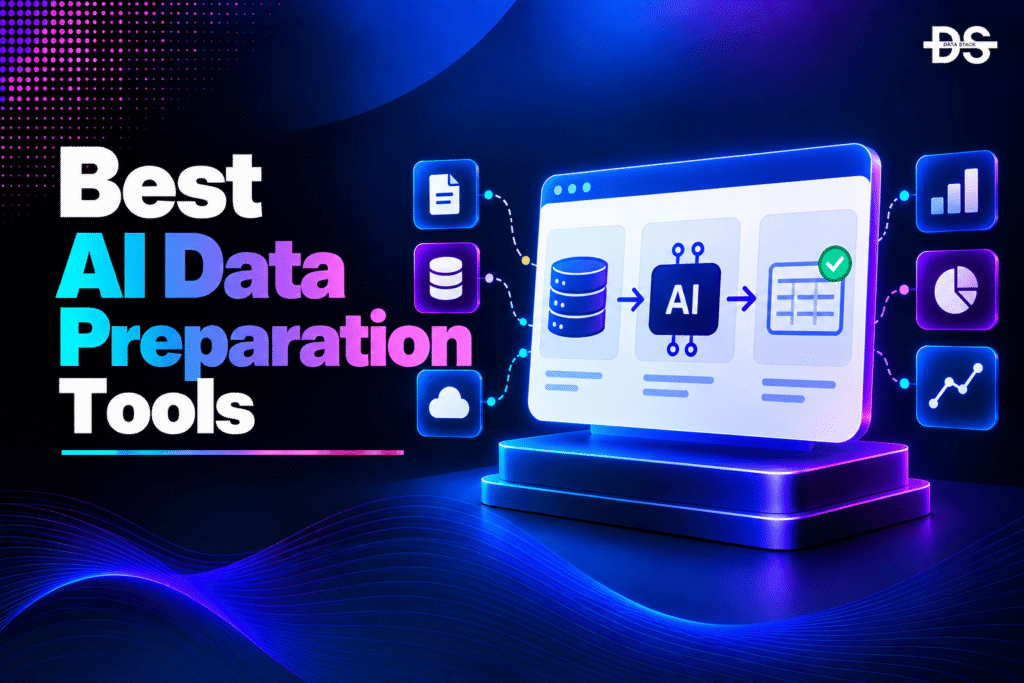
AI Data Preparation Tools - Featured Image | DSH

9 Best AI Data Preparation Tools in 2026

Data preparation is one of the most time-consuming parts of working with data. Teams often need to profile datasets, identify inconsistent values, clean records, standardize formats, map fields, and create transformations before data can be used for analytics, machine learning, or AI applications. Traditional data preparation tools can automate many of these tasks through predefined rules and workflows, but they still require significant manual configuration and technical knowledge.

AI is changing how these workflows are built and executed. Modern AI data preparation tools can use machine learning, natural language processing, generative AI, and other intelligent techniques to identify patterns, recommend transformations, generate preparation logic, detect anomalies, and help users work with data using natural-language instructions. Instead of configuring every transformation manually, users can increasingly describe what they want to achieve and let the platform assist with the underlying preparation process.

However, not every data platform that includes an AI assistant is an AI data preparation tool. The depth of AI integration varies significantly between products. Some tools use AI to recommend transformations or generate SQL, while others can automate profiling, cleaning, enrichment, schema matching, or parts of an entire preparation workflow. Understanding these differences is important when evaluating AI-powered data preparation tools and determining how much of the workflow they can actually automate.

In this guide, we examine the best AI data preparation tools and how they use AI to simplify data preparation workflows. We compare their AI capabilities, automation options, data preparation features, use cases, free-trial availability, and G2 ratings to help you identify the tools that best fit your data workflows.

What Are AI Data Preparation Tools?

AI data preparation tools are software platforms that use artificial intelligence and machine learning to help profile, clean, transform, enrich, and organize raw data for analytics, machine learning, and AI applications. Unlike traditional tools that primarily rely on predefined rules, SQL, scripts, or manually configured workflows, AI-powered tools can identify patterns, recommend actions, generate preparation logic, and automate parts of the data preparation process.

AI capabilities vary across platforms. Some tools use machine learning to detect anomalies and identify data-quality issues, while others use generative AI and large language models to understand natural-language instructions, generate transformations or SQL, and help users work with unfamiliar datasets. The level of automation also differs, ranging from AI-assisted recommendations to automated preparation workflows.

AI data preparation does not necessarily mean fully autonomous data preparation. Most platforms combine AI with traditional rules, visual workflows, and code so users can review and control the resulting changes. This makes it important to evaluate not just whether a tool uses AI, but what the AI actually does and how much of the preparation workflow it can automate.

AI Data Preparation Tools vs. Traditional Data Preparation Tools

Capability Traditional Data Preparation AI Data Preparation
Data profiling Uses predefined rules and configured checks Identifies patterns, anomalies, and potential issues using AI/ML
Data cleaning Requires manually configured rules Can recommend or automate cleaning actions
Data transformation Relies on SQL, code, or visual recipes Can generate transformations from natural-language instructions
Schema matching Fields are mapped manually or through predefined rules AI can identify semantic relationships between fields
Anomaly detection Uses fixed thresholds and rules Can detect unusual patterns using ML-based approaches
Data enrichment Relies on configured enrichment workflows AI can assist with classification, extraction, and enrichment
User interaction Primarily visual interfaces, SQL, or code Adds natural-language interaction and AI assistance
Automation Rule-based and scheduled workflows AI-assisted and increasingly context-aware automation

AI Data Preparation Tools Comparison

AI data preparation tools use AI, machine learning, and GenAI to assist with tasks such as profiling, cleaning, transforming, enriching, and preparing data for analytics, machine learning, and AI applications.

Tool AI Capabilities What You Can Automate Best For Free Trial G2 Rating
Dataiku GenAI-powered preparation, natural-language workflows, AI assistants Transformations, cleaning, enrichment, preparation steps Enterprise data teams Yes — 14 days 4.4/5
Databricks AI-native data engineering, Genie, natural-language workflows SQL, transformations, pipeline development, preparation workflows Data engineering and AI teams Yes — 14 days 4.6/5
Snowflake Cortex AI, AI-assisted data engineering, natural-language workflows SQL, transformations, pipeline development, AI data processing AI-ready data platforms Yes — free trial 4.6/5
Microsoft Fabric Copilot-assisted preparation, natural-language data transformation Data transformations, queries, dataflows, pipelines Microsoft data and BI teams Yes — free trial 4.7/5
Informatica CLAIRE AI, intelligent discovery, mapping, data quality Profiling, mapping, cleansing, transformation, enrichment Large enterprises Yes — 30 days 4.2/5
Talend Data Fabric AI-assisted data quality and integration Cleaning, standardization, matching, transformation Enterprise data teams Yes — 14 days 4.3/5
AWS Glue GenAI-assisted data quality and ML-powered data discovery Data discovery, quality rules, ETL transformations AWS data teams Yes — free usage 4.3/5
Ataccama ONE AI agents, AI rule recommendations, anomaly detection Rule creation, anomaly investigation, metadata enrichment Enterprise data-quality teams Contact for trial 4.2/5
Julius AI Conversational AI, natural-language data manipulation Filtering, transformation, analysis, visualization Users seeking conversational data workflows Yes — free plan 4.5/5

9 Best AI Data Preparation Tools

The tools below were selected based on their actual AI capabilities for data preparation, including AI-assisted cleaning, transformation, profiling, enrichment, data-quality workflows, natural-language preparation, and preparation of data for AI applications. We’ve also considered the level of automation each platform provides and whether its AI capabilities are central to the product rather than simply an unrelated AI add-on.
🚀 Get Your Tool Featured

Showcase your software to buyers actively comparing tools. Submit your product for editorial review and get featured on Data Stack Hub.

Submit Your Tool →

#1. Dataiku

Dataiku is an enterprise data and AI platform that combines visual and code-based workflows for preparing, transforming, analyzing, and operationalizing data. Its data-preparation capabilities include more than 100 built-in transformers, while its GenAI-powered assistants allow users to describe preparation tasks in natural language and turn those instructions into preparation steps or visual recipes.

AI Capabilities

  • GenAI-powered preparation: Dataiku can interpret natural-language instructions for data preparation and convert them into preparation steps that users can review and refine.
  • AI-assisted transformations: Its AI capabilities can help users identify and apply relevant preparation operations based on the data they are working with.
  • AI code assistance: GenAI assistants can help generate and explain SQL and Python code, reducing the effort required to build customized preparation workflows.
  • LLM integration: Dataiku’s LLM Mesh allows teams to use multiple LLM providers and models within governed data and AI workflows.

What You Can Automate

  • Data transformations: Users can describe desired transformations in natural language and use AI assistance to accelerate the creation of the corresponding preparation workflow.
  • Data cleaning: Common cleansing and standardization operations can be incorporated into repeatable workflows instead of being performed manually for each dataset.
  • Data enrichment: Dataiku supports enrichment workflows across structured and specialized data, including text, images, geospatial, and time-series data.
  • SQL and code generation: AI can assist technical users in creating or modifying code required for customized data preparation.
  • Workflow creation: AI-generated preparation steps can help users build workflows faster while retaining the ability to review and modify each operation.

Key Features

  • 100+ built-in transformers: Dataiku provides a broad range of transformation functions for cleaning, reshaping, converting, enriching, and manipulating datasets.
  • Visual data preparation: Users can build preparation workflows through visual recipes without writing code for every transformation.
  • Python, R, and SQL support: Technical teams can combine visual preparation with programming languages when workflows require custom logic.
  • Data quality and lineage: Quality checks and lineage capabilities help teams understand potential data issues and track how datasets change through preparation.
  • Specialized data preparation: The platform supports preparation for text, images, geospatial data, and time-series data in addition to conventional tabular datasets.

Best For

Enterprise data teams that need GenAI-assisted data preparation alongside visual workflows, coding capabilities, data quality, and governance.

AI Verdict

Dataiku is particularly useful for organizations that want to introduce GenAI into established data-preparation workflows without giving up control over the resulting transformations. Its AI assistants can accelerate preparation work, while its visual recipes and code-based capabilities provide the flexibility needed for more complex enterprise workflows.

#2. Databricks

Databricks is a data and AI platform that combines data engineering, analytics, machine learning, and AI capabilities in a unified environment. Its AI-native data engineering capabilities can help users build and modify data-preparation workflows using natural-language instructions, while its broader platform supports SQL, notebooks, pipelines, and large-scale data transformation.

AI Capabilities

  • AI-native data preparation: Databricks uses AI to help users create and modify data workflows, reducing the need to manually configure every preparation step.
  • Natural-language workflow creation: Users can describe desired data transformations in natural language, allowing AI to generate relevant workflow components and code.
  • AI-assisted SQL: Databricks can help generate and refine SQL for querying and transforming data, which can speed up preparation tasks for technical and less technical users.
  • Intelligent data engineering: AI capabilities can assist with pipeline development and troubleshooting, helping teams build and maintain preparation workflows more efficiently.

What You Can Automate

  • Data transformations: AI-assisted workflows can generate transformation logic for operations such as filtering, joining, aggregating, and reshaping datasets.
  • SQL-based preparation: Users can describe preparation requirements and use AI assistance to generate SQL that performs the required transformations.
  • Pipeline development: Natural-language instructions can accelerate the creation of data pipelines that ingest, transform, and prepare data for downstream workloads.
  • Data quality workflows: Data engineering teams can incorporate validation and quality checks into repeatable preparation pipelines rather than handling them manually.
  • Workflow refinement: AI assistance can help modify existing workflows when preparation requirements change, reducing the effort involved in rewriting transformation logic.

Key Features

  • Lakeflow Designer: Provides a visual, AI-assisted environment for building data-preparation and data-engineering workflows using a combination of visual configuration and natural-language interaction.
  • SQL and notebooks: Teams can use SQL, Python, and notebooks to build customized preparation workflows and handle more complex transformation requirements.
  • Lakeflow pipelines: Supports automated data pipelines for ingesting and transforming data across large-scale workloads.
  • Unity Catalog: Provides centralized governance, discovery, and management of data assets used throughout preparation and AI workflows.
  • Delta Lake: Provides a transactional data layer that supports reliable data processing and transformation for analytics and AI workloads.

Best For

Data engineering and AI teams that need AI-assisted data preparation alongside scalable pipelines, SQL, notebooks, governance, and machine learning capabilities.

AI Verdict

Databricks is particularly suited to teams that want AI assistance directly within their data engineering and preparation environment rather than as a separate AI tool. Its natural-language capabilities can reduce the effort involved in creating transformations and pipelines, while its underlying engineering infrastructure provides the scale and control required for enterprise data workloads.

#3. Snowflake

Snowflake is a cloud data platform that combines data engineering, analytics, and AI capabilities in a single environment. Its Cortex AI features and AI-assisted development capabilities can help teams work with data using natural-language prompts while building transformations, pipelines, and other workflows needed to prepare data for analytics and AI applications.

AI Capabilities

  • Cortex AI: Snowflake’s Cortex AI capabilities bring generative AI and machine learning directly into the data platform, allowing teams to process and work with data without moving it to a separate AI environment.
  • AI-assisted data engineering: AI assistance can help developers create and modify SQL and data-engineering workflows, reducing the manual effort involved in preparing datasets.
  • Natural-language interaction: Users can interact with data and AI capabilities using natural-language instructions, making certain preparation and analysis tasks more accessible to non-SQL users.
  • AI-ready data processing: Snowflake supports AI workflows involving both structured and unstructured data, allowing teams to prepare data for downstream AI applications within the same platform.

What You Can Automate

  • SQL transformations: AI assistance can help generate SQL for filtering, joining, aggregating, and transforming datasets based on natural-language requirements.
  • Data pipeline development: Teams can accelerate the creation and modification of pipelines used to ingest and transform data.
  • Data classification: Snowflake’s AI capabilities can assist with identifying and classifying sensitive or relevant data within datasets.
  • Unstructured data preparation: Teams can process and extract information from documents, text, and other unstructured sources for downstream analytics and AI workloads.
  • AI-powered data processing: Cortex functions can be incorporated into workflows to classify, summarize, extract, and transform information as part of broader data pipelines.

Key Features

  • Snowflake Cortex AI: Provides access to generative AI and machine learning capabilities directly within Snowflake, reducing the need to move data between separate systems.
  • Cortex Analyst: Allows users to ask questions about structured enterprise data using natural language and translates those requests into SQL-based analysis.
  • Dynamic Tables: Automatically maintain transformed datasets based on defined queries, helping teams build continuously updated preparation workflows.
  • SQL and Snowpark: Supports SQL as well as Python and other programming approaches through Snowpark for more customized preparation and transformation workflows.
  • Support for structured and unstructured data: Snowflake can work with tables as well as documents, text, images, and other data types used in modern AI workflows.

Best For

Organizations building AI-ready data platforms that want data engineering, transformation, analytics, and generative AI capabilities within the same cloud data environment.

AI Verdict

Snowflake is a strong option for teams that want to combine AI-assisted data engineering with a broader cloud data platform. Its advantage for data preparation is the ability to bring AI capabilities directly into SQL, pipelines, structured data, and unstructured-data workflows rather than treating preparation and AI as separate processes.

#4. Microsoft Fabric

Microsoft Fabric is an end-to-end analytics platform that brings data integration, engineering, warehousing, analytics, and AI capabilities into one environment. Its Copilot features extend into data preparation through Dataflow Gen2, where users can use natural-language prompts to work with data and generate transformation steps without manually configuring every operation.

AI Capabilities

  • Copilot for data preparation: Fabric Copilot can assist users with data transformation tasks by interpreting natural-language instructions and helping generate the required preparation steps.
  • Natural-language data interaction: Users can describe what they want to do with a dataset instead of manually configuring every transformation, making preparation workflows more accessible.
  • AI-assisted Power Query: Copilot can help generate transformation steps and explain how data is being modified within Dataflow Gen2.
  • AI-assisted data engineering: Fabric integrates AI assistance across data engineering and analytics workflows, allowing teams to use AI while preparing data for downstream workloads.

What You Can Automate

  • Data transformations: Users can describe desired transformations and use Copilot to assist with operations such as filtering, splitting, merging, and reshaping data.
  • Data cleaning: AI assistance can help identify and apply common cleaning operations, reducing repetitive manual configuration.
  • Query generation: Natural-language instructions can be converted into queries or transformation logic, helping users prepare data without writing every step manually.
  • Dataflow development: Copilot can accelerate the creation and modification of Dataflow Gen2 workflows used to ingest and transform data.
  • Data preparation explanations: Users can ask Copilot to explain transformation logic, making existing preparation workflows easier to understand and modify.

Key Features

  • Dataflow Gen2: Provides a low-code environment for ingesting and transforming data using Power Query, with Copilot assistance available for supported preparation tasks.
  • Copilot: Brings natural-language AI assistance into Fabric workflows, helping users create, transform, and work with data.
  • Power Query: Provides a large collection of transformation capabilities for cleaning, reshaping, combining, and preparing datasets.
  • Data Factory: Provides pipelines and data-integration capabilities for moving and preparing data across different sources.
  • Notebooks and Spark: Data engineers can use notebooks and Apache Spark when preparation workflows require more advanced programming and large-scale processing.

Best For

Organizations already using the Microsoft data ecosystem that want AI-assisted data preparation alongside Power BI, Data Factory, SQL, Spark, and other analytics capabilities.

AI Verdict

Microsoft Fabric is particularly useful for teams that want natural-language AI assistance built into their existing data-preparation environment. Copilot can reduce the manual work involved in creating transformations and understanding workflows, while Dataflow Gen2 and Power Query provide the underlying preparation capabilities.

⭐ Ready to Reach More Buyers?

Increase your product visibility by reaching software buyers researching the best tools. Every submission is reviewed by our editorial team.

Feature My Tool →

#5. Informatica

Informatica is an enterprise data management platform that combines data integration, data quality, governance, and AI-powered capabilities through its CLAIRE AI technology. Its AI capabilities can assist with discovering, mapping, profiling, cleansing, and transforming data, making it suitable for organizations managing complex data environments and large-scale preparation workflows.

AI Capabilities

  • CLAIRE AI: Informatica’s CLAIRE AI uses machine learning and metadata intelligence to understand data relationships, recommend actions, and assist with data management and preparation tasks.
  • AI-assisted data discovery: AI can help identify relationships and patterns across datasets, making it easier for teams to understand unfamiliar data before preparing it.
  • Intelligent mapping: CLAIRE can recommend mappings between source and target fields based on metadata and previously established relationships, reducing manual mapping work.
  • AI-powered data quality: AI capabilities can assist with identifying data-quality issues and recommending rules or actions to improve the reliability of prepared datasets.

What You Can Automate

  • Data profiling: AI-assisted profiling can help identify patterns, relationships, and potential quality issues across datasets before they enter downstream workflows.
  • Schema and field mapping: Intelligent recommendations can accelerate the process of mapping fields between different data sources and targets.
  • Data cleansing: Data-quality workflows can automate standardization, validation, matching, and other cleansing operations across datasets.
  • Data transformation: Informatica can incorporate transformation logic into repeatable data-integration workflows, reducing manual preparation work.
  • Data enrichment: Data can be enriched with additional attributes and metadata as part of broader preparation and integration workflows.

Key Features

  • CLAIRE AI: Provides AI and machine-learning capabilities across Informatica’s data-management environment, using metadata to improve discovery, mapping, quality, and automation.
  • Cloud Data Integration: Provides visual and code-assisted workflows for connecting, transforming, and preparing data from multiple sources.
  • Data Quality: Includes capabilities for profiling, standardization, validation, matching, and monitoring data quality.
  • Intelligent Data Management: Uses metadata and relationships across data assets to help teams understand and manage complex data environments.
  • Enterprise data integration: Supports preparation across databases, cloud services, applications, files, and other enterprise data sources.

Best For

Large enterprises that need AI-assisted data preparation alongside data integration, data quality, governance, and metadata management across complex data environments.

AI Verdict

Informatica is particularly suited to organizations where data preparation is closely connected to enterprise data quality and integration. CLAIRE AI adds intelligence to activities such as discovery, mapping, and quality management, while Informatica’s broader platform provides the infrastructure required to prepare data across diverse enterprise sources.

6. Talend Data Fabric

Talend Data Fabric is an enterprise data integration and data quality platform that combines data preparation, profiling, cleansing, transformation, and governance capabilities. Its AI-assisted capabilities can help teams identify data-quality issues, accelerate preparation workflows, and work with data across different sources and environments.

AI Capabilities

  • AI-assisted data quality: Talend uses AI and machine learning capabilities to help identify patterns and potential data-quality problems, giving teams more context when preparing datasets.
  • Intelligent data profiling: AI-assisted profiling can help teams understand the structure, patterns, and quality of data before applying preparation operations.
  • AI-assisted integration: Intelligent recommendations can help users build and manage data integration and transformation workflows across multiple sources.
  • Generative AI assistance: Talend’s newer AI capabilities can assist users with data-related tasks and reduce the amount of manual configuration required for certain workflows.

What You Can Automate

  • Data cleansing: Talend can automate standardization, validation, deduplication, and other cleansing operations across repeatable workflows.
  • Data profiling: Profiling workflows can automatically examine datasets and surface quality characteristics and potential issues.
  • Data transformation: Users can build repeatable transformations for combining, restructuring, and preparing data for downstream systems.
  • Data matching: Matching capabilities can help identify related or duplicate records across datasets, reducing manual record comparison.
  • Data integration: Automated pipelines can ingest and transform data from multiple sources before delivering it to analytics, applications, or data platforms.

Key Features

  • Data Quality: Provides profiling, cleansing, standardization, validation, matching, and monitoring capabilities for improving data reliability.
  • Data Integration: Connects data across databases, applications, cloud services, APIs, and other enterprise sources.
  • Visual data preparation: Users can build preparation and transformation workflows through graphical interfaces instead of writing every operation manually.
  • Data profiling and discovery: Helps teams understand datasets and identify quality problems before data is used downstream.
  • Cloud and enterprise deployment: Supports data workflows across cloud and hybrid environments, making it suitable for organizations managing data across multiple systems.

Best For

Enterprise data teams that need AI-assisted data preparation combined with data quality, integration, profiling, and governance capabilities across multiple data sources.

AI Verdict

Talend is a practical choice for organizations that want to add AI-assisted capabilities to established data-quality and integration workflows. Its strongest value comes from combining preparation and quality management rather than positioning AI as a completely autonomous replacement for traditional data engineering.

7. AWS Glue

AWS Glue is a serverless data integration and preparation service that helps teams discover, catalog, clean, transform, and move data across AWS and other environments. Its machine learning and generative AI capabilities extend traditional ETL workflows by assisting with data discovery, schema handling, and data-quality operations.

AI Capabilities

  • Generative AI-assisted data quality: AWS Glue can use generative AI to recommend data-quality rules based on the data and its context, reducing the effort required to create rules manually.
  • Machine learning-based schema discovery: Glue crawlers can automatically examine data sources and infer schemas, helping teams discover the structure of unfamiliar datasets.
  • AI-assisted data preparation: Glue’s intelligent capabilities can help users identify data-quality requirements and incorporate appropriate checks into preparation workflows.
  • Natural-language assistance: AWS is increasingly integrating generative AI into data engineering workflows, allowing teams to use AI to accelerate certain preparation and transformation tasks.

What You Can Automate

  • Data discovery: Glue crawlers can automatically scan supported data sources, identify schemas, and populate metadata in the Glue Data Catalog.
  • Data-quality rule generation: Generative AI can recommend context-specific quality rules, helping teams create validation checks without manually defining every rule.
  • ETL transformations: Glue jobs can automate operations such as filtering, joining, cleansing, restructuring, and converting datasets.
  • Schema management: Automatically inferred schemas can reduce the manual work involved in identifying the structure of incoming data.
  • Data pipeline execution: Scheduled and event-driven Glue workflows can repeatedly run preparation and transformation jobs as new data arrives.

Key Features

  • Glue Data Catalog: Provides a centralized metadata repository that helps teams discover and manage datasets and their schemas.
  • Glue Studio: Offers a visual interface for creating, monitoring, and managing ETL jobs without requiring every transformation to be written from scratch.
  • Glue Data Quality: Provides automated data-quality checks and integrates with data pipelines to validate datasets before downstream use.
  • Glue crawlers: Automatically discover data and infer schemas from supported sources, helping prepare datasets for processing.
  • Serverless ETL: Runs data-preparation and transformation workloads without requiring teams to provision or manage dedicated infrastructure.

Best For

Data teams already working in the AWS ecosystem that need scalable data discovery, ETL, data-quality checks, and AI-assisted preparation capabilities.

AI Verdict

AWS Glue is a strong option for organizations that want to combine serverless data preparation with AI-assisted data-quality and discovery capabilities. Its AI functionality is most valuable when used alongside Glue’s established cataloging, crawling, and ETL infrastructure rather than as a standalone generative-AI data-preparation tool.

8. Ataccama ONE

Ataccama ONE is an enterprise data management and data quality platform that uses AI to help organizations discover, profile, cleanse, monitor, and improve data. Its newer AI and agentic capabilities extend beyond simple recommendations, helping teams generate data-quality rules, investigate anomalies, enrich metadata, and perform multi-step data-management tasks.

AI Capabilities

  • AI-powered data quality: Ataccama uses AI to identify data-quality issues and recommend actions for improving accuracy, completeness, consistency, and reliability.
  • AI rule recommendations: Its AI capabilities can generate or recommend data-quality rules based on the characteristics and context of datasets, reducing manual rule creation.
  • AI agents: Ataccama ONE’s AI agents can assist with multi-step data-management tasks, including exploring data, generating SQL, investigating quality issues, and executing supported workflows.
  • AI-assisted metadata enrichment: AI can help enrich and interpret metadata, making it easier for teams to understand datasets and their relationships.
  • Anomaly detection: Machine learning capabilities can identify unusual patterns and potential data-quality problems that may not be captured by simple predefined rules.

What You Can Automate

  • Data profiling: Ataccama can profile datasets to identify quality characteristics, patterns, and potential problems before data is used downstream.
  • Data-quality rule creation: AI can recommend rules based on the observed data, reducing the manual effort involved in defining validation requirements.
  • Anomaly investigation: AI-assisted workflows can help investigate unusual records or quality issues and provide additional context around potential causes.
  • Metadata enrichment: AI can help classify and enrich metadata so users can understand data assets without manually documenting every field.
  • Data cleansing: Repeatable cleansing, standardization, validation, and matching workflows can be incorporated into broader data-quality processes.

Key Features

  • ONE AI Agent: Provides agentic assistance for data-quality and data-management tasks, including data exploration, SQL generation, and workflow support.
  • Data profiling: Helps teams examine datasets and identify patterns, missing values, anomalies, and other quality characteristics.
  • Data quality management: Supports rules, monitoring, validation, cleansing, and quality measurement across enterprise datasets.
  • Metadata management: Provides capabilities for discovering, documenting, classifying, and enriching information about data assets.
  • Data matching and deduplication: Helps identify related or duplicate records and improve consistency across datasets.

Best For

Large organizations that need AI-assisted data preparation closely integrated with enterprise data quality, metadata management, profiling, and governance.

AI Verdict

Ataccama ONE stands out when data preparation is closely tied to data quality and enterprise governance. Its AI capabilities go beyond basic recommendations by assisting with rule creation, anomaly investigation, metadata enrichment, and multi-step data-management workflows, while human oversight remains important for validating the resulting actions.

9. Julius AI

Julius AI is an AI-powered data analysis platform that lets users work with datasets using natural-language instructions. Rather than requiring users to write SQL or Python for every task, Julius can help clean, transform, analyze, visualize, and model data through a conversational interface, making it particularly useful for users who want a more accessible way to prepare data for analysis.

AI Capabilities

  • Conversational data preparation: Users can describe what they want to do with a dataset in natural language, allowing Julius to interpret the request and perform the relevant data operation.
  • AI-powered data cleaning: Julius can help identify and address common data-quality problems, including missing values, inconsistent formats, and other issues that can affect analysis.
  • Natural-language transformation: Users can request transformations conversationally instead of manually writing code for every filtering, restructuring, or calculation task.
  • AI-generated code: Julius can generate Python or other code required to perform more advanced data manipulation, giving users a way to inspect or refine the underlying workflow.
  • Context-aware analysis: The AI can work with the uploaded dataset and use its structure and contents to determine how requested operations should be applied.

What You Can Automate

  • Data cleaning: Julius can assist with cleaning datasets by identifying issues and applying requested corrections or preparation operations.
  • Filtering and transformation: Users can ask Julius to filter records, modify columns, restructure datasets, or apply calculations without manually building each operation.
  • Missing-value handling: Natural-language instructions can be used to identify and handle missing values as part of the preparation process.
  • Data analysis: Once data has been prepared, Julius can automatically analyze the dataset and generate insights, calculations, and visualizations based on user instructions.
  • Data visualization: Users can ask the AI to create charts and visual representations from prepared datasets without manually configuring every visualization.

Key Features

  • Natural-language data interaction: Users can communicate with datasets conversationally rather than relying exclusively on SQL, Python, or spreadsheet formulas.
  • File and dataset support: Julius can work with common data formats and allows users to upload datasets for analysis and preparation.
  • AI-generated Python: The platform can generate Python code for data manipulation and analysis, providing additional flexibility for more complex tasks.
  • Automated visualizations: Julius can create charts and other visual outputs from datasets based on natural-language requests.
  • Interactive analysis: Users can continue asking questions or requesting additional transformations as they work through a dataset, making preparation and analysis part of the same conversational workflow.

Best For

Analysts, business users, researchers, and other teams that want AI-powered data preparation and analysis through natural-language instructions without needing to write code for every data task.

AI Verdict

Julius AI takes a more AI-native and conversational approach to data preparation than the enterprise data platforms in this list. Its main advantage is accessibility: users can describe cleaning, transformation, and analysis requirements in plain language and let the AI handle much of the underlying work. It is better suited to interactive dataset-level preparation and analysis than complex enterprise data pipelines or large-scale data integration environments.

How to Choose the Right AI Data Preparation Tool

The right AI data preparation tool depends on the type of data you work with, the complexity of your preparation workflows, the level of AI automation you need, and the environment where your data already lives. An enterprise managing thousands of datasets will have different requirements from an analyst who wants to clean a CSV using natural-language instructions.

Consider the following factors when evaluating AI tools for data preparation:

  • AI capabilities: Check whether the platform uses AI for actual preparation tasks such as profiling, cleaning, transformation, schema matching, enrichment, or data-quality management. An AI chatbot added to a data platform does not necessarily make the platform an AI data preparation tool.
  • Level of automation: Determine whether AI only recommends actions or can actually generate and execute preparation steps. Tools differ significantly in how much human configuration and review they require.
  • Data volume and complexity: Consider whether you are preparing individual files, enterprise datasets, streaming data, or large-scale data used for machine learning and AI applications. Some tools are designed for interactive preparation, while others are built around production pipelines.
  • Natural-language capabilities: If non-technical users will use the platform, look for tools that allow users to describe preparation tasks in plain language and generate transformations without writing SQL or code manually.
  • Data-quality capabilities: Look for profiling, validation, anomaly detection, deduplication, standardization, and monitoring if data quality is a major part of your preparation workflow.
  • Integration with your data stack: The tool should work with the databases, cloud platforms, warehouses, file formats, and applications your team already uses. Native integration can significantly reduce the effort required to build and maintain preparation workflows.
  • Human oversight: AI-generated transformations can introduce errors or misunderstand business rules. Choose a platform that allows users to review, modify, validate, and audit AI-generated preparation steps before they reach production.
  • AI and governance requirements: Organizations preparing sensitive or regulated data should evaluate how the platform handles data access, privacy, security, model usage, lineage, and governance alongside its AI capabilities.
  • Preparation for AI workloads: If your goal is to prepare data for machine learning, GenAI, or RAG applications, check whether the platform supports the specific data types and preparation workflows required by those workloads.

The most important distinction is how deeply AI is integrated into the preparation workflow. A platform that can generate a SQL query is useful, but a platform that can profile data, identify quality problems, recommend transformations, generate preparation logic, and help execute and monitor the resulting workflow provides a much broader AI-assisted preparation experience.

Explore More Top Tools

Browse expertly curated software recommendations across hundreds of business categories.

Browse Top Tools →

Conclusion

AI data preparation tools are moving beyond traditional ETL and data-cleaning workflows by using GenAI, machine learning, natural-language interfaces, and intelligent automation to reduce the manual effort involved in preparing data. The tools covered in this list take different approaches, from enterprise platforms such as Dataiku, Databricks, Informatica, and Ataccama ONE to more conversational tools such as Julius AI.

The right choice depends on your data environment, preparation requirements, level of AI automation, scalability needs, and technical expertise. For enterprise workloads, capabilities such as data quality, governance, lineage, integration, and production pipelines can be just as important as the AI features themselves. For analysts and less technical users, natural-language data preparation can provide a simpler way to clean and transform datasets.

As AI becomes more integrated into data workflows, AI-powered data preparation tools can help teams spend less time on repetitive preparation tasks and more time using prepared data for analytics, machine learning, and GenAI applications. However, AI-generated transformations and recommendations should still be reviewed and validated, particularly when working with sensitive, business-critical, or regulated data.

Frequently Asked Questions

1. What are AI data preparation tools?

AI data preparation tools use artificial intelligence, machine learning, or generative AI to assist with tasks such as data cleaning, profiling, transformation, enrichment, quality checking, and preparation for analytics or AI workloads.

2. How are AI data preparation tools different from traditional data preparation tools?

Traditional tools generally rely on manually configured rules and transformations, while AI-powered data preparation tools can use machine learning or GenAI to recommend actions, generate transformations, interpret natural-language instructions, detect patterns, and automate parts of the preparation workflow.

3. What can AI data preparation tools automate?

Depending on the platform, they can automate or assist with data cleaning, profiling, transformation, enrichment, schema discovery, data-quality checks, deduplication, field mapping, SQL generation, and preparation workflow development.

4. How is AI changing data preparation?

AI is making data preparation more conversational and automated. Instead of manually configuring every transformation, users can increasingly describe what they want to accomplish in natural language and use AI to generate or recommend the required preparation steps.

5. What are the best AI data preparation tools in 2026?

Some of the notable AI tools for data preparation covered in this list are:

  1. Dataiku
  2. Databricks
  3. Snowflake
  4. Microsoft Fabric
  5. Informatica
  6. Talend Data Fabric
  7. AWS Glue
  8. Ataccama ONE
  9. Julius AI

The tools differ considerably in their AI capabilities, automation level, scalability, and intended users.

6. Can AI tools clean data automatically?

Yes. Many AI-powered data preparation tools can assist with identifying and correcting common data-quality problems, standardizing values, handling missing data, detecting anomalies, and applying repeatable cleaning operations. The exact level of automation varies by platform.

7. Can AI data preparation tools prepare data for GenAI applications?

Yes. Several platforms can prepare data used for machine learning and GenAI workflows. Depending on the tool, this can include cleaning and transforming structured data, processing unstructured content, enriching datasets, and preparing information for downstream AI applications.

8. Are AI data preparation tools suitable for enterprise data?

Yes. Platforms such as Dataiku, Databricks, Informatica, Microsoft Fabric, Snowflake, Talend, and Ataccama ONE provide capabilities designed for enterprise environments. Organizations should evaluate scalability, governance, security, integration, lineage, and human oversight in addition to AI capabilities.

9. Do AI data preparation tools require coding?

Not always. Many provide visual interfaces or natural-language capabilities that allow users to perform common preparation tasks without writing code. However, SQL, Python, or other programming capabilities can still be useful for complex transformations and customized workflows.

10. Are AI-generated data transformations always accurate?

No. AI-generated transformations and recommendations should be reviewed and validated before being applied to important datasets. AI may misunderstand business rules, field meanings, or unusual data patterns, particularly when the available context is limited.

11. What should you consider when choosing an AI data preparation tool?

Consider its AI capabilities, automation level, supported data sources, scalability, data-quality features, integrations, governance, security, natural-language capabilities, pricing, and ability to support your specific analytics or AI workflows.

12. Can AI data preparation replace data engineers?

AI can automate and accelerate many repetitive preparation and transformation tasks, but it does not eliminate the need for data engineers in complex environments. Data engineers remain important for architecture, pipelines, governance, data modeling, validation, security, and production workflows.

13. Are AI data preparation tools useful for small datasets?

Yes. Conversational tools such as Julius AI can be useful for analysts and business users working with individual files or smaller datasets, while enterprise platforms are better suited to organizations managing larger and more complex data environments.

🚀 Get Your Tool Featured

Submit your software for editorial review and reach buyers actively comparing tools.

Maximum number of entries exceeded.
Scroll to Top