
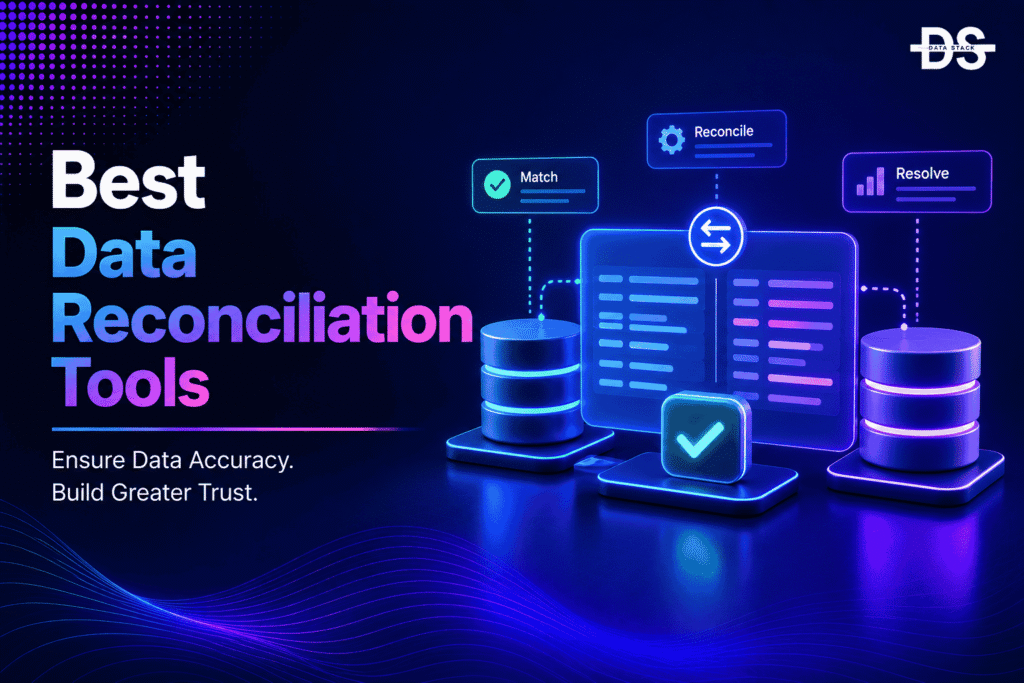
A mismatch between two systems can be more than a data-quality nuisance. It can affect financial reporting, regulatory submissions, customer records, inventory, analytics, or downstream applications when teams assume that information from different sources is aligned when it is not.
The scale of the problem is significant. A 2025 AutoRek study of 250 senior managers across U.S. asset management, capital markets, hedge funds, and fund administration found that 79% said their reconciliation processes struggle with current data volumes or would struggle if those volumes increased. The same study found that 57% still rely on spreadsheets, in-house systems, or legacy software for reconciliation.
Data reconciliation tools are software platforms that compare data from different sources, identify discrepancies, and help teams validate whether records, values, or transactions are consistent. Depending on the product, reconciliation can involve record-level matching, aggregate comparisons, financial transactions, database tables, files, or data moving through pipelines.
The market includes tools built for very different environments. Financial institutions may need transaction matching, exception management, audit trails, and regulatory controls, while data engineering teams may need automated comparisons between databases, warehouses, or pipeline outputs. Some platforms also support continuous reconciliation rather than relying on periodic manual checks.
This guide covers the best data reconciliation tools in 2026 and compares them based on matching and comparison capabilities, supported data sources, automation, exception handling, scalability, workflow management, auditability, integrations, deployment options, pricing, and open-source availability.
Table of Contents
ToggleWhy Do You Need Data Reconciliation Tools?
Data reconciliation tools help organizations verify that information remains consistent as it moves between systems, databases, applications, and reporting environments. They reduce the need for manual comparisons and make it easier to identify discrepancies before they affect business operations.
Common reasons to use data reconciliation tools include:
- Identify data discrepancies: Compare records and values across systems to detect mismatches, missing records, unexpected changes, and inconsistencies.
- Automate reconciliation: Replace repetitive spreadsheet-based comparisons with automated reconciliation workflows that can run on scheduled or continuous intervals.
- Reduce manual errors: Automated matching and validation can reduce mistakes introduced through manual data comparison and data entry.
- Reconcile financial transactions: Compare payments, settlements, invoices, trades, balances, and other financial records across internal and external systems.
- Validate data migrations: Check whether records were transferred correctly when moving data between databases, applications, warehouses, or other platforms.
- Monitor data pipelines: Compare source and destination data to identify issues introduced during extraction, transformation, loading, or other pipeline processes.
- Handle large datasets: Process volumes of records that would be impractical to compare manually using spreadsheets or basic scripts.
- Manage exceptions: Centralize mismatched records and provide workflows for investigating, assigning, resolving, and tracking reconciliation exceptions.
- Maintain audit trails: Record reconciliation activities, discrepancies, resolutions, and user actions for compliance and operational review.
- Improve reporting accuracy: Validate underlying datasets before they are used for financial reports, dashboards, analytics, or business decisions.
- Detect missing or duplicate records: Identify records that appear in one source but not another, as well as duplicate or unexpectedly repeated entries.
- Support multiple data sources: Reconcile information across databases, files, APIs, cloud applications, data warehouses, and other systems.
- Standardize reconciliation processes: Establish repeatable rules and workflows instead of allowing different teams to use inconsistent manual reconciliation methods.
- Speed up issue resolution: Surface discrepancies and relevant source information in one workflow so teams can investigate problems faster.
The right tool depends heavily on the type of reconciliation being performed. Financial reconciliation, database comparison, data migration validation, and continuous pipeline reconciliation require different capabilities, so teams should consider their data sources, matching logic, reconciliation frequency, data volume, exception-management requirements, and audit needs before selecting a platform.
Top Data Reconciliation Tools: Comparison
Data reconciliation tools range from platforms built for financial and transaction reconciliation to solutions designed for database comparison, data quality, and automated pipeline validation. The comparison below highlights the capabilities, pricing, and open-source availability of leading options.
| Tool | Best For | Open Source | Pricing | G2 Rating |
|---|---|---|---|---|
| BlackLine | Financial reconciliation and accounting | No | Custom pricing | 4.5/5 |
| Trintech | Financial close and reconciliation | No | Custom pricing | 4.4/5 |
| FloQast | Accounting reconciliation and close management | No | Custom pricing | 4.7/5 |
| ReconArt | Enterprise financial reconciliation | No | Custom pricing | 4.5/5 |
| Duco | Automated financial data reconciliation | No | Custom pricing | 4.6/5 |
| Datafold | Data diffing and pipeline validation | No | Free; paid plans available | 4.7/5 |
| Great Expectations | Data validation and reconciliation workflows | Yes | Open source; commercial options available | 4.4/5 |
| dbt | Data transformation testing and validation | Yes | Free; paid plans available | 4.5/5 |
Best 8 Data Reconciliation Tools in 2026
The 8 data reconciliation tools below cover financial close and transaction matching, enterprise reconciliation, and technical data comparison and validation. They include both commercial platforms and open-source options for teams with different reconciliation requirements.
#1 BlackLine
BlackLine is a financial close and accounting automation platform with reconciliation capabilities designed to help finance teams compare account balances, transactions, and supporting information across financial systems. It is primarily aimed at organizations that need to standardize and automate reconciliation as part of a broader financial close process rather than treating reconciliation as a standalone data-comparison task.
Its reconciliation capabilities can be used for high-volume account reconciliation, transaction matching, variance investigation, and exception management. BlackLine also connects reconciliation with other financial-close activities, giving controllers and accounting teams a centralized environment for monitoring outstanding items and maintaining documentation. This makes it more focused on finance and accounting processes than general-purpose data reconciliation between databases or data warehouses.
Key Features
- Account reconciliation: Automates reconciliation of account balances and supporting details while helping teams identify items that require investigation.
- Transaction matching: Matches transactions and related records across different sources using configurable matching rules.
- Automated reconciliation workflows: Supports recurring reconciliation processes so teams can reduce spreadsheet-based and manual work.
- Exception management: Routes unmatched or unusual items for review and provides workflows for investigation and resolution.
- Financial close integration: Connects reconciliation with broader close-management activities, including task management, journal processes, and reporting.
- Risk-based reconciliation: Helps organizations prioritize reconciliation activities according to account risk, materiality, and other configurable criteria.
- Audit trails: Maintains supporting documentation and activity history to provide visibility into reconciliation and review processes.
- ERP and system integrations: Integrates with financial systems and other enterprise applications to bring source information into reconciliation workflows.
Pricing: Custom pricing based on the organization’s requirements.
G2 Rating: 4.5/5
#2 Trintech
Trintech provides financial close and reconciliation software designed for accounting and finance teams managing large volumes of financial data. Its Cadency platform brings account reconciliation, transaction matching, close management, and financial controls into a centralized environment, making it particularly relevant to enterprises that need structured reconciliation processes across multiple business units and systems.
Rather than focusing primarily on technical database comparisons, Trintech is designed around finance-specific reconciliation requirements. Teams can automate recurring reconciliations, establish matching rules, manage exceptions, and maintain evidence for review and audit processes. The platform can also support reconciliations involving high transaction volumes, which is useful for organizations moving away from spreadsheet-heavy processes.
Key Features
- Account reconciliation: Automates account reconciliations and helps finance teams manage supporting information and review requirements.
- Transaction matching: Compares transactions from different sources and identifies matched and unmatched items using configurable rules.
- Automated workflows: Creates standardized reconciliation processes with defined tasks, approvals, and review steps.
- Exception management: Centralizes unmatched transactions and other reconciliation exceptions for investigation and resolution.
- Financial close management: Connects reconciliation with broader financial-close processes and activities.
- Risk-based controls: Supports configurable controls and review processes for organizations managing financial reporting risk.
- Audit documentation: Captures reconciliation evidence and workflow history to support internal and external audit requirements.
- ERP integration: Connects with financial systems and enterprise data sources to support automated reconciliation workflows.
Pricing: Custom pricing based on requirements.
G2 Rating: 4.4/5
Showcase your software to buyers actively comparing tools. Submit your product for editorial review and get featured on Data Stack Hub.
#3 FloQast
FloQast is an accounting and financial close management platform that includes account reconciliation capabilities for finance teams. It helps organizations standardize reconciliations, assign responsibilities, monitor completion, and connect supporting documentation with the financial close process.
The platform is designed more specifically for accounting operations than for general-purpose technical data reconciliation. Its reconciliation functionality can help teams manage account balances and supporting schedules while providing visibility into the status of reconciliations across departments. FloQast also integrates reconciliation into a broader close-management workflow, making it useful for organizations looking to replace disconnected spreadsheets and manual tracking.
Key Features
- Account reconciliations: Provides structured workflows for preparing, reviewing, and completing account reconciliations.
- Automated reconciliation: Helps automate recurring reconciliation activities and reduce manual preparation work.
- Reconciliation templates: Teams can standardize how different accounts and business units perform reconciliation.
- Workflow management: Assigns reconciliation tasks and tracks their progress through preparation and review stages.
- Variance identification: Helps teams identify differences that require investigation during the reconciliation process.
- Supporting documentation: Centralizes account support and documentation associated with reconciliation activities.
- Close management integration: Connects reconciliations with broader month-end and year-end close processes.
- ERP integrations: Integrates with accounting and enterprise systems to bring financial information into close and reconciliation workflows.
Pricing: Custom pricing based on organization size and requirements.
G2 Rating: 4.7/5
#4 ReconArt
ReconArt is an enterprise reconciliation platform designed to automate financial, operational, and transaction reconciliation processes. It supports organizations that need to compare large volumes of data across multiple systems while managing unmatched records, exceptions, approvals, and reconciliation reporting from a centralized environment.
The platform can be used for a broad range of reconciliation scenarios rather than only traditional general-ledger account reconciliation. Organizations can configure reconciliation rules around different data sources and processes, making ReconArt relevant to financial institutions, payment organizations, corporations, and other businesses dealing with high-volume transaction data.
Key Features
- Account reconciliation: Supports automated comparison of financial account information and balances from different sources.
- Transaction matching: Matches transactions across systems using configurable rules and matching criteria.
- Multi-source reconciliation: Brings data from different applications, files, databases, and financial systems into reconciliation workflows.
- Exception management: Identifies unmatched records and provides workflows for investigating and resolving discrepancies.
- Automated processing: Supports scheduled and automated reconciliation jobs for recurring processes.
- Workflow and approvals: Provides configurable workflows for review, approval, investigation, and resolution.
- Audit trails: Records reconciliation activity and supporting information for audit and compliance requirements.
- Reporting: Provides reporting and dashboards for reconciliation status, exceptions, matches, and outstanding issues.
Pricing: Custom pricing based on deployment and organizational requirements.
G2 Rating: 4.5/5
#5 Duco
Duco is a data automation platform focused on data reconciliation, matching, and control processes for financial services and other data-intensive organizations. It allows teams to bring together data from different sources, apply configurable reconciliation logic, identify exceptions, and automate processes that would otherwise require spreadsheets or custom scripts.
Duco is designed to handle complex reconciliation requirements where source data can arrive in different formats or structures. Its self-service approach allows business and operations teams to configure reconciliation processes without relying entirely on developers to build and maintain custom comparison logic.
Key Features
- Data reconciliation: Compares datasets from different sources and identifies records or values that do not match.
- Transaction matching: Supports configurable matching rules for comparing transactions across internal and external systems.
- Data normalization: Helps standardize data from different sources before comparison and matching.
- Exception management: Surfaces unmatched and problematic records for investigation and resolution.
- No-code configuration: Allows users to create and modify reconciliation workflows without extensive programming.
- Workflow automation: Automates recurring reconciliation processes and reduces manual intervention.
- Data ingestion: Supports bringing data from files, applications, and other sources into reconciliation workflows.
- Audit and reporting: Provides visibility into reconciliation outcomes, exceptions, and process history.
Pricing: Custom pricing based on requirements.
G2 Rating: 4.6/5
#6 Datafold
Datafold is a data-diffing and data-quality platform designed primarily for data engineering teams that need to compare datasets and validate changes across databases and data warehouses. Its comparison capabilities can help teams determine whether a transformation, migration, or pipeline change has produced the expected results.
Unlike finance-focused reconciliation platforms, Datafold is aimed at technical data workflows. Teams can compare tables and query results, identify changed records, and integrate data-diff checks into development processes. This makes it particularly relevant when reconciliation is required as part of data migration, warehouse development, or pipeline validation rather than accounting close.
Key Features
- Data diffing: Compares datasets and identifies inserted, deleted, or changed records between source and destination environments.
- Column-level comparison: Helps data engineers investigate differences at the field level rather than only comparing aggregate totals.
- Database comparison: Supports comparisons across databases and data warehouse environments.
- Data migration validation: Helps teams verify that migrated data matches the expected source data after a migration.
- Pipeline validation: Can be used to check whether transformations produce expected outputs before changes are deployed.
- CI/CD integration: Allows data comparison and validation to become part of software development and deployment workflows.
- Change analysis: Provides visibility into how data changed between different versions or environments.
- Developer workflow integration: Supports technical teams working with SQL, Git, databases, and modern data-stack environments.
Pricing: Free options are available, with paid plans and enterprise pricing based on requirements.
G2 Rating: 4.7/5
Increase your product visibility by reaching software buyers researching the best tools. Every submission is reviewed by our editorial team.
Feature My Tool →#7 Great Expectations
Great Expectations is an open-source data-quality framework that allows data teams to define expectations about how their datasets should look and behave. While it is not a dedicated reconciliation platform, teams can use its validation framework to compare expected data conditions across pipeline stages and identify discrepancies before downstream systems consume incorrect data.
The framework is particularly useful for data engineering teams that want to build reconciliation and validation logic directly into their pipelines. Instead of providing a finance-oriented reconciliation interface, Great Expectations uses programmatic expectations and validation workflows that can be integrated with data pipelines, orchestration tools, and CI/CD processes.
Key Features
- Data validation: Defines expectations for values, schemas, distributions, completeness, uniqueness, and other dataset characteristics.
- Custom expectations: Developers can create validation rules for reconciliation requirements that are specific to their data environment.
- Schema validation: Checks whether datasets conform to expected structures, columns, data types, and other schema requirements.
- Pipeline integration: Validation can be incorporated into data pipelines to detect issues before data moves downstream.
- Validation results: Produces structured results showing which expectations passed or failed.
- Data documentation: Generates documentation around datasets, expectations, and validation results.
- Python support: Provides a Python-based framework that can be integrated into existing data-engineering workflows.
- Open-source: The core Great Expectations project is available under an open-source license, allowing teams to run and customize it within their own environments.
Pricing: Great Expectations Core is open source and free. Commercial GX Cloud capabilities are available under paid plans.
G2 Rating: 4.4/5
#8 dbt
dbt is an open-source data transformation and testing framework used by data teams to build, document, and validate analytical data pipelines. Although dbt is not a dedicated data reconciliation product, its data tests and transformation workflows can be used to validate whether data remains consistent and meets expected conditions as it moves through a warehouse.
Teams can use dbt tests to check uniqueness, non-null values, relationships, accepted values, and custom business rules. This makes it useful for reconciliation scenarios where the goal is to detect discrepancies between transformed datasets or ensure that pipeline outputs satisfy predefined expectations.
Key Features
- Data tests: Provides tests that identify unexpected values, missing records, duplicates, broken relationships, and other data-quality issues.
- Custom SQL tests: Teams can create custom SQL-based validation rules for business-specific reconciliation requirements.
- Relationship testing: Tests relationships between models and helps identify records that do not have expected parent or reference records.
- Schema testing: Validates columns, data types, constraints, and other expected properties of transformed datasets.
- Source freshness: Helps monitor whether source data has arrived within the expected timeframe.
- CI/CD integration: Data tests can run as part of development and deployment workflows to catch issues before changes reach production.
- Documentation: Generates documentation around models, columns, dependencies, and data transformations.
- Open-source core: dbt Core provides an open-source foundation that data teams can run and integrate with their own data-engineering environments.
Pricing: dbt Core is open source and free. dbt Cloud offers paid plans, with pricing varying by edition and usage.
G2 Rating: 4.5/5.
Also Read: Best dbt Alternatives & Competitors in 2026
How to Choose the Best Data Reconciliation Tool
Choosing a data reconciliation tool starts with understanding what you are actually reconciling. A platform designed for accounting and transaction matching may not provide the database comparison or pipeline validation capabilities required by a data engineering team.
- For financial reconciliation: Consider BlackLine, Trintech, FloQast, ReconArt, or Duco when account balances, transactions, financial close, approvals, and audit requirements are central to the workflow.
- For transaction matching: Look for configurable matching rules, tolerance handling, one-to-many and many-to-many matching, and automated exception management.
- For database reconciliation: Datafold is more relevant when the requirement involves comparing tables, validating migrations, or identifying changes between databases and warehouses.
- For data pipeline validation: Great Expectations and dbt can be useful when reconciliation is part of broader data-quality and transformation testing workflows.
- For large datasets: Check how the platform handles high record volumes, parallel processing, incremental reconciliation, and recurring workloads.
- For exception management: Look for centralized exception queues, investigation workflows, assignments, approvals, and resolution tracking.
- For audit requirements: Financial and regulated environments should prioritize detailed audit trails, reconciliation history, evidence management, and role-based access controls.
- For automation: Evaluate scheduling, APIs, event-based processing, workflow automation, and integration with orchestration or CI/CD systems.
- For multiple data sources: Confirm that the tool supports the databases, files, applications, APIs, warehouses, and financial systems you need to reconcile.
- For open-source requirements: Great Expectations and dbt provide open-source foundations that can be customized and integrated into existing technical workflows.
- For deployment: Compare SaaS, private cloud, self-hosted, and hybrid options based on security, compliance, infrastructure, and data-residency requirements.
- For business-user adoption: Finance and operations teams may benefit from no-code or low-code reconciliation interfaces, while engineering teams may prefer SQL, Python, APIs, and configuration-based workflows.
Browse expertly curated software recommendations across hundreds of business categories.
Browse Top Tools →Conclusion
Data reconciliation tools help organizations maintain consistency when information is distributed across financial systems, databases, applications, data warehouses, and operational platforms. By automating comparisons and highlighting discrepancies, they can reduce manual reconciliation work and make data issues easier to identify and investigate.
The tools covered in this guide address different reconciliation requirements. BlackLine, Trintech, and FloQast focus heavily on accounting and financial close processes, while ReconArt and Duco provide broader transaction and enterprise reconciliation capabilities. These platforms are better suited to organizations where reconciliation is closely connected to financial operations, controls, approvals, and audit requirements.
For technical data teams, Datafold takes a different approach by focusing on data diffing and comparisons across databases and data environments. Great Expectations and dbt are open-source options that can support reconciliation as part of broader data validation and pipeline-testing workflows rather than providing dedicated financial reconciliation applications.
There is no single best data reconciliation tool for every organization. Finance teams may prioritize transaction matching, account reconciliation, exception management, and audit trails, while data engineering teams may care more about database comparisons, schema validation, pipeline integration, and automated testing.
Open-source tools can be a good fit when teams want control over their validation logic and infrastructure. Commercial reconciliation platforms can provide more specialized workflows, user interfaces, integrations, and enterprise controls with less custom development.
Before selecting a platform, identify the systems and datasets that need to be reconciled, the type and volume of discrepancies you expect, and how frequently reconciliation needs to run. Also evaluate matching logic, automation, exception handling, auditability, integrations, deployment requirements, and total cost.
Ultimately, the right data reconciliation tool should make discrepancies easier to detect, investigate, and resolve while fitting naturally into the financial, operational, or data-engineering workflows where reconciliation takes place.
Frequently Asked Questions
#1. What are data reconciliation tools?
Data reconciliation tools are software platforms that compare information from two or more sources to identify discrepancies, missing records, mismatched values, and other inconsistencies. They can be used for financial transactions, databases, data migrations, and data pipelines.
#2. What are the best data reconciliation tools in 2026?
Some of the leading options include BlackLine, Trintech, FloQast, ReconArt, Duco, Datafold, Great Expectations, and dbt. The appropriate choice depends on whether the primary requirement is financial reconciliation, transaction matching, database comparison, or data pipeline validation.
#3. What is financial data reconciliation?
Financial data reconciliation is the process of comparing financial records from different sources to confirm that balances and transactions agree. It can include bank transactions, general-ledger accounts, payments, settlements, invoices, and other financial records.
#4. Can data reconciliation be automated?
Yes. Modern reconciliation platforms can automate data ingestion, matching, comparison, exception detection, workflow routing, and reporting. Automation can reduce repetitive spreadsheet-based reconciliation and allow teams to run processes on scheduled or continuous intervals.
#5. What is the difference between data reconciliation and data validation?
Data validation checks whether data meets predefined rules or quality requirements. Reconciliation specifically compares data between two or more sources to determine whether the information agrees. The two processes are often used together.
#6. Can data reconciliation tools compare databases?
Yes. Some tools can compare records, tables, schemas, or query results across databases and data warehouses. Datafold, for example, is designed for technical data comparison and can help validate database migrations and data pipeline changes.
#7. Are there open-source data reconciliation tools?
Yes. Great Expectations and dbt are open-source tools that can support reconciliation-related workflows through data validation, testing, relationship checks, and custom business rules. They are not dedicated financial reconciliation platforms.
#8. How do data reconciliation tools handle mismatched records?
Depending on the platform, mismatches can be identified using configurable matching rules, tolerances, keys, transformations, or business logic. Unmatched records can then be routed into exception workflows for investigation and resolution.
#9. What should I look for in a data reconciliation tool?
Consider supported data sources, matching capabilities, automation, data volume, exception management, audit trails, integrations, deployment options, security, and pricing. Financial teams should also consider accounting and compliance requirements.
#10. Can data reconciliation tools replace spreadsheets?
They can replace many spreadsheet-based reconciliation processes, particularly when organizations handle large datasets or recurring reconciliation tasks. However, the appropriate level of automation depends on the complexity of the reconciliation rules and the organization’s workflow requirements.