
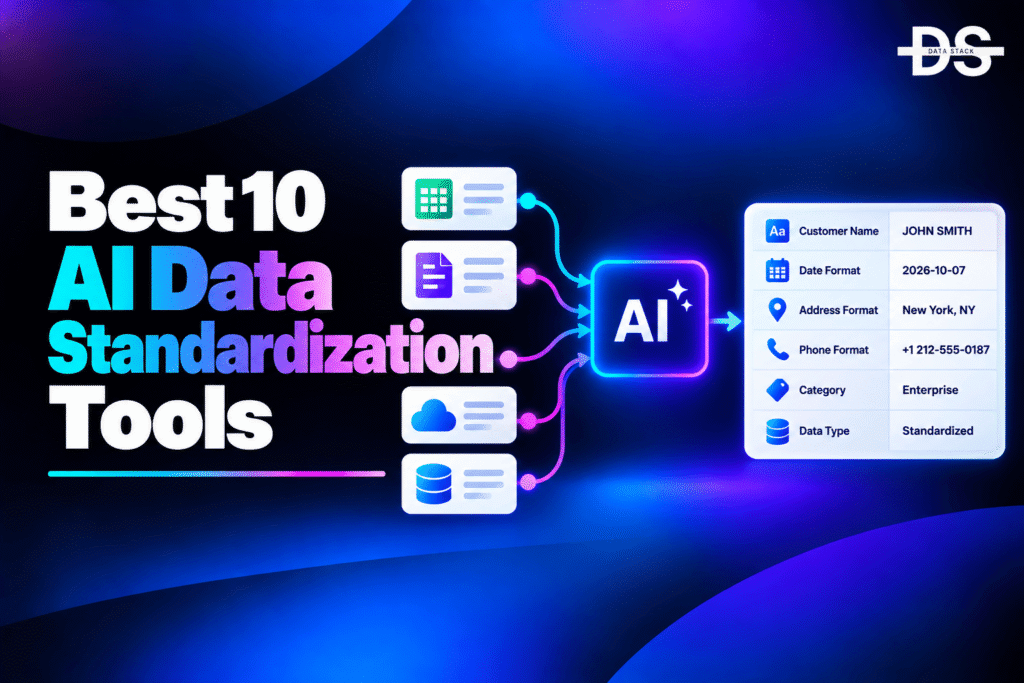
Data often arrives in different formats even when it represents the same information. Customer names may use different capitalization, phone numbers may contain different country codes, addresses may follow different structures, and product or industry values may use inconsistent terminology. These inconsistencies make it harder to integrate datasets, match records, maintain master data, and produce reliable analytics. AI data standardization tools help organizations automatically identify and normalize these differences.
Traditional data standardization usually relies on predefined transformation rules. For example, a team may create rules to convert dates into a specific format, standardize state names, normalize phone numbers, or change text to lowercase. These rules remain useful, but maintaining them across millions of records and different data sources can become time-consuming. AI can help identify patterns, classify values, understand context, and recommend appropriate standardization actions.
AI-powered standardization is particularly useful for customer data, product data, addresses, supplier information, healthcare data, financial records, and data migration projects. It can also work alongside data matching, deduplication, MDM, data quality, and analytics workflows to create more consistent data before it reaches downstream systems.
In this guide, we compare the best AI data standardization tools based on their AI capabilities, automated standardization features, data-quality capabilities, transformation capabilities, and ideal use cases. We also cover their key AI-focused features, compare them side by side, explain how to choose the right tool, and answer common questions about AI-powered data standardization.
What Are AI Data Standardization Tools?
AI data standardization tools are software platforms that use artificial intelligence and machine learning to identify inconsistent data formats, values, structures, and terminology and convert them into a consistent standard. These tools help make information from different sources easier to compare, integrate, analyze, and manage.
Traditional standardization uses predefined rules to transform known variations. AI-powered standardization can go further by identifying patterns and similarities in data, classifying values, suggesting transformations, and helping teams handle variations that were not explicitly defined in advance.
For example, an AI data standardization tool may recognize that “CA,” “Calif.”, and “California” represent the same state, or that different phone-number formats refer to the same country and numbering structure. It can also help normalize addresses, product descriptions, company names, units of measurement, dates, and other fields.
AI Data Standardization Tools Comparison
The table below compares the leading AI data standardization tools based on their AI capabilities, automation features, and ideal use cases.
| Tool | AI Capabilities | What You Can Automate | Best For | G2 Rating |
|---|---|---|---|---|
| Informatica Data Quality | CLAIRE AI, intelligent profiling, AI-assisted transformation | Standardization, cleansing, validation | Enterprise data quality | 4.3/5 |
| Ataccama ONE | AI-assisted profiling, classification, quality analysis | Standardization, cleansing, classification | Enterprise data management | 4.2/5 |
| Tamr | Machine learning, AI-assisted curation and standardization | Standardization, matching, enrichment | Enterprise data mastering | 4.4/5 |
| Precisely Trillium | AI-assisted profiling, matching, standardization | Data cleansing, standardization, validation | Enterprise data quality | 4.6/5 |
| Talend Data Quality | AI-assisted data profiling and quality workflows | Standardization, cleansing, validation | Data integration and quality | 4.3/5 |
| Data Ladder | Intelligent matching, fuzzy logic, data cleansing | Standardization, cleansing, deduplication | Data cleansing teams | 4.7/5 |
| OpenRefine | Clustering and pattern-based transformations | Standardization, transformation, reconciliation | Open-source data cleaning | 4.6/5 |
| Great Expectations | Automated data-quality validation | Standardization validation, quality checks | Open-source data pipelines | 4.4/5 |
8 Best AI Data Standardization Tools
Let’s take a closer look at 8 leading AI data standardization tools and what sets them apart. We’ll examine their key features, capabilities, and best use cases to help you find the right option.
#1. Informatica Data Quality
Informatica Data Quality is an enterprise data-quality platform that provides profiling, cleansing, validation, matching, standardization, and enrichment capabilities. Its CLAIRE AI technology adds intelligent capabilities to data-management workflows and can help teams understand and improve inconsistent data.
The platform can standardize information across different systems and sources, making it useful for organizations dealing with large volumes of customer, supplier, product, financial, and operational data. Standardization can be combined with validation and cleansing so that data is corrected before it is used by downstream applications.
Informatica is particularly suitable for large organizations where standardization needs to be part of a broader data-quality, governance, integration, or MDM program. Instead of treating normalization as a one-time cleanup task, teams can incorporate it into repeatable enterprise data workflows.
Key Features
- CLAIRE AI: Informatica’s AI capabilities can assist with understanding data, identifying patterns, and automating parts of data-quality and transformation workflows.
- Intelligent Data Profiling: The platform can analyze datasets to identify patterns, inconsistent formats, missing values, and other characteristics that affect standardization.
- Automated Standardization: Data can be normalized according to defined standards across multiple systems and data sources.
- Address Standardization: Address data can be cleaned and standardized to improve consistency across customer and business records.
- Data Format Normalization: Dates, phone numbers, codes, text values, and other fields can be transformed into consistent formats.
- Data Quality Rules: Standardization can be combined with validation rules to ensure normalized data continues to meet business requirements.
- AI-Assisted Data Classification: Intelligent classification can help identify the type and context of data before applying appropriate standardization processes.
- Enterprise Data Integration: Standardized data can be incorporated into broader integration, governance, matching, and MDM workflows.
G2 Rating: 4.3/5
#2. Ataccama ONE
Ataccama ONE is an enterprise data-management platform that combines data quality, observability, governance, cataloging, MDM, and data processing capabilities. Its AI-assisted functionality can help organizations identify inconsistent data and automate parts of data standardization.
The platform is designed for complex environments where information comes from multiple applications and business systems. AI-assisted profiling and classification can help data teams understand the contents of datasets before applying standardization and cleansing rules.
Ataccama is particularly useful when standardization needs to be connected with broader data-quality management. Teams can profile data, identify inconsistent values, standardize them, validate the results, and monitor quality continuously.
Key Features
- AI-Assisted Data Profiling: Intelligent profiling can identify patterns, formats, inconsistencies, and unusual values across datasets.
- Automated Data Standardization: Standardization processes can normalize values across different systems and data sources.
- AI-Assisted Classification: Machine learning can help classify data attributes and identify the type or meaning of values.
- Pattern Recognition: Intelligent analysis can identify recurring data patterns that can be used to develop standardization logic.
- Data Cleansing: Inconsistent and invalid values can be corrected as part of broader data-quality workflows.
- Standardized Reference Values: Teams can create consistent representations for business terms, categories, codes, and other frequently varying values.
- Continuous Quality Monitoring: Standardized data can be monitored over time to identify new inconsistencies.
- MDM Integration: Standardization can support matching and master-data processes by making records more consistent before they are consolidated.
G2 Rating: 4.2/5
Also Read: Best Ataccama Alternatives and Competitors in 2026
Showcase your software to buyers actively comparing tools. Submit your product for editorial review and get featured on Data Stack Hub.
#3. Tamr
Tamr is an AI-native data mastering platform that uses machine learning to help organizations clean, standardize, match, and unify data from multiple sources. Its approach is particularly useful when data contains many variations that are difficult to handle with manually maintained rules.
The platform can learn patterns from data and feedback to improve the way information is standardized and matched. This makes it useful for customer, supplier, product, company, and other enterprise datasets where different source systems may represent the same information in different ways.
Tamr combines standardization with entity resolution and data mastering. This allows organizations to normalize source data and then use that standardized information to identify related records and build more trusted entity data.
Key Features
- Machine Learning Standardization: Tamr uses machine learning to help identify and normalize variations across source data.
- AI-Assisted Data Curation: Intelligent workflows can help data teams resolve inconsistent values and other data-quality problems.
- Pattern-Based Normalization: The platform can identify patterns across records and apply appropriate transformations to similar data.
- Entity-Aware Standardization: Standardization can be performed in the context of entities such as customers, companies, suppliers, and products.
- Data Enrichment: Standardized information can be combined with enrichment processes to improve completeness and usability.
- Automated Data Cleansing: Cleaning and standardization can be incorporated into repeatable data workflows.
- Feedback-Driven Improvement: Human decisions can provide feedback that helps improve matching and standardization outcomes.
- Data Mastering: Standardized records can be used to create more consistent and trusted master data.
G2 Rating: 4.4/5
Also Read: Best Tamr Alternatives and Competitors in 2026
#4. Precisely Trillium
Precisely Trillium is an enterprise data-quality platform designed for profiling, cleansing, matching, enrichment, and standardization. It is built for organizations that need to improve consistency across large and complex datasets.
The platform can help normalize information such as customer records, addresses, names, product information, and other business data. Its data-quality capabilities allow organizations to identify inconsistent values and apply standardization before the data is used for analytics, integration, or operational processes.
Precisely Trillium is particularly useful for enterprise data-quality programs where standardization needs to work alongside matching, validation, enrichment, and governance.
Key Features
- AI-Assisted Data Quality: Intelligent capabilities can help identify data-quality problems and prioritize areas requiring standardization.
- Automated Data Profiling: Profiling helps teams understand how data is structured and where inconsistent formats or values exist.
- Data Standardization: Different representations of the same value can be normalized into consistent formats.
- Address Standardization: Address information can be standardized to improve consistency and downstream matching.
- Name Standardization: Variations in personal and organization names can be normalized before matching or analysis.
- Data Cleansing: Invalid and inconsistent information can be corrected as part of the standardization process.
- Reference Data Management: Standardization can use reference values and approved business definitions to create consistency.
- Matching Integration: Standardized records can be matched more effectively after variations have been normalized.
G2 Rating: 4.6/5
#5. Talend Data Quality
Talend Data Quality provides data profiling, cleansing, validation, standardization, matching, and integration capabilities. It is useful for organizations that need to normalize data before moving it into data warehouses, applications, analytics environments, or other systems.
The platform allows teams to identify inconsistent values and apply repeatable transformations to create more consistent datasets. Its integration capabilities also make it possible to include standardization as part of larger data pipelines rather than treating it as a separate manual activity.
Talend is a practical choice for data teams that want standardization to operate alongside data integration and data-quality workflows. It can be used across customer, product, operational, and other business datasets.
Key Features
- AI-Assisted Data Profiling: Intelligent profiling can help identify patterns, inconsistencies, and potential standardization requirements.
- Automated Data Cleansing: Data can be cleaned and normalized as part of repeatable data-processing workflows.
- Data Standardization: Different representations of values can be converted into consistent formats.
- Data Validation: Standardized data can be checked against quality and business rules before moving downstream.
- Pattern Recognition: Data patterns can be analyzed to help identify values that require transformation.
- Reference Data Matching: Values can be aligned with approved reference values to improve consistency.
- Pipeline Integration: Standardization can be incorporated directly into data-integration workflows.
- Data Quality Monitoring: Teams can monitor standardized datasets to identify new inconsistencies over time.
G2 Rating: 4.3/5
Also Read: Best Talend Alternatives and Competitors
#6. Data Ladder
Data Ladder is a data-quality platform focused on data cleansing, matching, deduplication, standardization, and enrichment. It is particularly useful for teams working with customer, contact, company, and other structured datasets that contain inconsistent values.
The platform can normalize data before matching or deduplication, helping reduce differences caused by formatting, spelling, capitalization, and other common inconsistencies. This makes standardization useful as part of a broader data-cleaning workflow.
Data Ladder is a good option for organizations that want dedicated data-cleansing capabilities without implementing a complete enterprise MDM platform.
Key Features
- Intelligent Data Standardization: Data Ladder can help normalize inconsistent values across datasets before they are matched or consolidated.
- Fuzzy Matching: Similar values can be identified even when differences remain after standardization.
- Address Standardization: Address data can be cleaned and normalized to create more consistent customer and contact records.
- Name Normalization: Personal and company names can be standardized to reduce variations across source systems.
- Data Cleansing: Invalid, incomplete, and inconsistent records can be corrected as part of the cleaning process.
- Automated Transformation: Repeatable transformations can be applied to large datasets rather than manually editing individual records.
- Reference Matching: Values can be aligned with approved lists and reference datasets.
- Deduplication Integration: Standardized data can be used as the input for duplicate detection and record consolidation.
G2 Rating: 4.7/5
Increase your product visibility by reaching software buyers researching the best tools. Every submission is reviewed by our editorial team.
Feature My Tool →#7. OpenRefine
OpenRefine is an open-source tool for cleaning and transforming messy datasets. It is particularly useful for identifying inconsistent values, clustering similar data, transforming fields, and reconciling information from different sources.
While OpenRefine is not an AI-first commercial data-standardization platform, its clustering capabilities can identify similar values and help users standardize them together. This makes it a valuable open-source option for teams that need practical data cleaning and normalization.
OpenRefine works particularly well for analysts, researchers, developers, and data teams handling CSV files, spreadsheets, databases, and other structured datasets. It provides considerable flexibility for teams that are comfortable performing data-cleaning operations themselves.
Key Features
- Intelligent Clustering: Similar values can be grouped together so teams can identify different representations of the same underlying value.
- Automated Value Transformation: Transformations can be applied across large numbers of records instead of editing values individually.
- Pattern-Based Cleaning: Teams can identify recurring patterns and use them to normalize inconsistent information.
- Data Type Conversion: Values can be converted into appropriate data types and standardized formats.
- Text Normalization: Inconsistent capitalization, spacing, punctuation, and other text variations can be corrected.
- Reconciliation: Data can be matched against external sources to improve consistency and identify entities.
- Bulk Editing: Standardization changes can be applied to many records simultaneously.
- Open-Source: Organizations can use and customize the tool without adopting a proprietary enterprise data-quality platform.
G2 Rating: 4.6/5
Also Read: Best OpenRefine Alternatives and Competitors in 2026
#8. Great Expectations
Great Expectations is an open-source data-quality framework that allows teams to define expectations and validate whether data conforms to those expectations. While its primary purpose is validation rather than automated standardization, it can play an important role in standardization workflows.
Data teams can use Great Expectations to ensure that standardized datasets continue to follow required formats, data types, ranges, schemas, and business rules. This makes it particularly useful after a transformation or standardization process has been performed.
Great Expectations is best suited to technical teams that want to build data-standardization pipelines with explicit validation controls. It can be integrated into data engineering and AI/ML workflows to make sure normalized data meets defined requirements before it moves downstream.
Key Features
- Standardization Validation: Teams can validate whether standardized data follows the required formats and values.
- Schema Validation: Data structures can be checked to ensure standardized datasets contain expected columns and types.
- Format Validation: Dates, numbers, identifiers, and other fields can be checked against defined standards.
- Completeness Checks: Required fields can be validated to ensure standardization processes do not introduce missing information.
- Pattern Validation: Teams can check whether values follow expected formats after transformation.
- Automated Data Testing: Validation can be integrated into recurring data pipelines.
- AI/ML Data Validation: Standardized datasets can be validated before being passed into model training or inference workflows.
- Open-Source Framework: Teams can build their own standardization and validation workflows around the framework.
G2 Rating: 4.4/5
How to Choose an AI Data Standardization Tool
The right AI data standardization tool depends on the type of data you need to normalize and where standardization fits into your data workflow. Focus on these factors:
- AI Capabilities: Check whether the platform uses AI or machine learning to identify patterns, classify values, or recommend standardization.
- Data Types: Make sure it can handle the specific data you need to standardize, such as names, addresses, phone numbers, dates, product attributes, and business categories.
- Automation: Look for tools that can standardize large datasets automatically rather than requiring manual corrections.
- Data Quality: Consider whether the platform also supports cleansing, validation, profiling, and monitoring.
- Reference Data: Check whether you can standardize values against approved reference lists, codes, taxonomies, or business definitions.
- Integration: Make sure the tool connects with your databases, CRM, ERP, data warehouse, data lake, and data pipelines.
- Scalability: Evaluate whether it can handle your current data volume and continue to perform as the number of records and sources grows.
- Accuracy: Test the tool using real-world data containing spelling variations, abbreviations, inconsistent formats, and incomplete values.
- Use Case: Choose based on whether you need customer data standardization, product data normalization, address cleansing, migration, MDM, or general data quality.
- AI Readiness: If standardized data will be used for analytics or AI, prioritize tools that produce consistent, structured, and reliable datasets.
Browse expertly curated software recommendations across hundreds of business categories.
Browse Top Tools →Conclusion
AI data standardization tools help organizations turn inconsistent information into data that can be compared, integrated, analyzed, and reused more reliably. As data comes from more applications and sources, standardization becomes increasingly important for maintaining consistent customer, product, supplier, and operational information.
Informatica Data Quality is a strong enterprise option for organizations that need AI-assisted standardization alongside profiling, cleansing, validation, integration, and broader data-quality capabilities. Its CLAIRE AI capabilities make it particularly relevant for large organizations looking to automate parts of data management.
Ataccama ONE is another strong enterprise platform where standardization needs to operate alongside data quality, governance, observability, and MDM. It is well suited to organizations managing complex data environments across multiple domains.
Tamr is a strong choice when standardization needs to be combined with entity resolution and data mastering. Its machine learning approach can help organizations handle inconsistent data while building more trusted customer, supplier, company, and product records.
Precisely Trillium provides mature data-quality capabilities for standardization, cleansing, matching, and enrichment. It is particularly useful for enterprise environments where data quality is closely connected to customer and business information.
Talend Data Quality is a practical option for organizations that want to incorporate standardization directly into data-integration workflows. Its combination of cleansing, validation, and integration capabilities can help teams normalize data before it reaches downstream systems.
Data Ladder is a useful option for focused data-cleansing and standardization requirements. It can help teams normalize customer, contact, and business information before matching and deduplication.
For organizations looking for an open-source approach, OpenRefine is one of the most useful options for interactive data cleaning and normalization. Its clustering and transformation capabilities make it particularly helpful when working with messy datasets that require hands-on exploration.
Great Expectations serves a different role. Rather than automatically standardizing data, it can validate whether standardized datasets meet expected formats and business requirements. This makes it a useful companion to data-transformation workflows.
When selecting an AI data standardization platform, organizations should look beyond the term “AI.” The important question is whether the tool can accurately understand the variations present in your data and consistently transform them into the required standard.
For example, customer data may require name and address normalization, while product data may require attribute and unit standardization. A financial dataset may need consistent currencies, dates, and account identifiers. Each use case can require different transformation logic.
AI can reduce the amount of manual work involved in identifying these patterns, but business rules and reference data remain important. The strongest approach often combines AI-assisted pattern recognition with explicit standards defined by the organization.
Standardized data also creates a stronger foundation for other data-management processes. Matching and deduplication generally become more accurate when records use consistent formats. MDM systems can create better golden records, analytics teams can produce more reliable reports, and AI systems can work with cleaner inputs.
Ultimately, the best AI data standardization tool depends on the complexity of your data, the number of sources you need to normalize, and whether standardization is a standalone requirement or part of a larger data-quality and MDM strategy.
Frequently Asked Questions
1. What are AI Data Standardization Tools?
AI data standardization tools are software platforms that use artificial intelligence and machine learning to identify inconsistent data and convert it into consistent formats, values, structures, or terminology.
2. What are the best AI data standardization tools in 2026?
Some of the leading options include Informatica Data Quality, Ataccama ONE, Tamr, Precisely Trillium, Talend Data Quality, Data Ladder, OpenRefine, and Great Expectations. The best choice depends on the type of data, scale, integrations, and level of automation required.
3. How does AI data standardization work?
AI data standardization tools analyze data to identify patterns, variations, and relationships between values. They can then recommend or apply transformations that convert inconsistent representations into a common standard.
4. What is the difference between data standardization and data cleansing?
Data standardization focuses on making data consistent in format, structure, terminology, and representation. Data cleansing is broader and can include correcting errors, removing invalid values, handling missing data, and resolving other quality problems.
5. Can AI standardize customer data?
Yes. AI can help standardize customer names, addresses, phone numbers, email formats, geographic information, customer categories, and other fields before the data is matched or consolidated.
6. Can AI standardize addresses?
Yes. Address standardization is a common use case. AI-assisted tools can help identify different representations of addresses and convert them into a consistent format for matching, analytics, and customer-data management.
7. Can AI standardize product data?
Yes. AI can help normalize product names, descriptions, categories, units, attributes, specifications, and other product information. This is particularly useful when product data comes from multiple suppliers or catalogs.
8. Can AI standardization improve data matching?
Yes. Standardizing data before matching can significantly improve matching accuracy. When names, addresses, codes, and other values use consistent formats, matching systems have fewer variations to process.
9. Are AI data standardization tools useful for MDM?
Yes. Standardization is an important part of master data management. Consistent data makes it easier to match records, create golden records, manage reference data, and maintain trusted master entities.
10. Are there open-source AI data standardization tools?
Yes. OpenRefine is a widely used open-source option for data cleaning, clustering, transformation, and normalization. Great Expectations can also be used to validate whether standardized data meets defined expectations.
11. Can AI automatically standardize messy data?
AI can automate many standardization tasks, particularly when patterns are clear. However, organizations should still review transformations for important business data because some values require domain-specific context that AI may not reliably infer.
12. What types of data can be standardized with AI?
AI can help standardize names, addresses, phone numbers, dates, currencies, product attributes, company information, geographic values, categories, units of measurement, identifiers, and many other structured data fields.
13. Can AI data standardization be automated in data pipelines?
Yes. Many enterprise data-quality and data-integration platforms allow standardization to be incorporated directly into data pipelines. This means incoming data can be normalized automatically before reaching warehouses, applications, analytics systems, or AI workflows.
14. What should I look for in an AI data standardization tool?
Look for AI capabilities, automated transformations, data profiling, reference-data support, cleansing, validation, integrations, scalability, accuracy, and support for your specific data types. The tool should also allow you to define business-specific standards where automated AI decisions are not sufficient.
15. Why is AI data standardization important for AI?
AI systems perform better when their input data is consistent and structured. Standardizing values before model training, analytics, or inference can reduce unnecessary variations and make datasets easier for AI systems to process and analyze.