
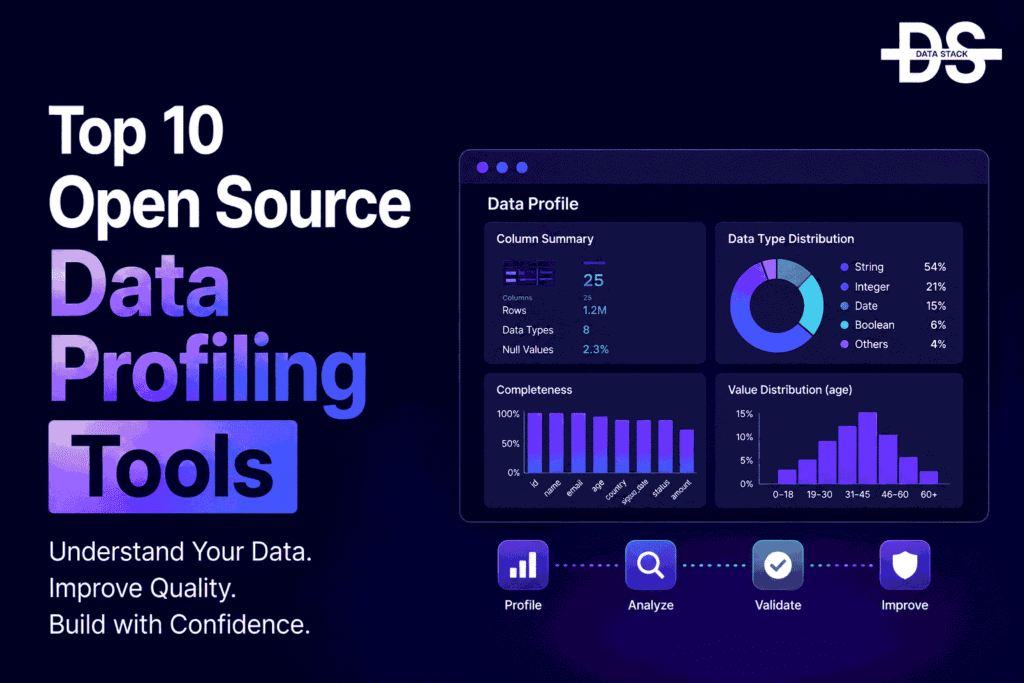
Before teams can improve data quality, validate datasets, or build reliable pipelines, they need to understand what is actually inside the data. Large datasets can contain missing values, duplicate records, inconsistent formats, unexpected distributions, outliers, and structural issues that are not visible through a simple query or manual inspection.
Data profiling helps identify these characteristics by analyzing the structure, content, and statistical properties of a dataset. Depending on the tool, profiling can include column distributions, null values, uniqueness, data types, patterns, correlations, anomalies, and other indicators that help teams understand the condition of their data before using it downstream.
Open source data profiling tools take different approaches to this problem. Some are libraries designed for programmatic profiling, while others provide visual interfaces for exploring datasets or combine profiling with data quality validation and monitoring. This guide compares 10 open source tools that can help teams profile and understand data across different environments.
Table of Contents
ToggleWhat is a Data Profiling Tool?
A data profiling tool analyzes datasets to provide information about their structure, content, and quality characteristics. It can examine columns, data types, completeness, uniqueness, value distributions, patterns, and other properties that help teams understand how data is organized and whether potential issues exist.
Data profiling is commonly used before data migration, transformation, integration, quality testing, or analytics. The right tool depends on whether the team needs automated profiling inside a pipeline, large-scale profiling with a processing engine, exploratory analysis through a visual interface, or profiling capabilities combined with broader data quality workflows.
Open Source Data Profiling Tools Comparison for 2026
| Tool Name | Category | Best For | Key Strength | Deployment Options | Licensing |
|---|---|---|---|---|---|
| ydata-profiling | Python Data Profiling | Automated exploratory data analysis | Detailed profile reports from pandas datasets | Python environment, notebooks | MIT |
| Deequ | Data Quality & Profiling | Large-scale Spark datasets | Constraint suggestions and scalable data profiling | Self-hosted, Spark environments | Apache 2.0 |
| Great Expectations | Data Quality | Programmatic dataset analysis | Data profiling and expectation-based validation | Self-hosted, Docker, cloud | Apache 2.0 |
| Soda Core | Data Quality Monitoring | SQL-based data profiling and checks | Metrics, checks, and dataset condition analysis | Self-hosted, Docker, Kubernetes | Apache 2.0 |
| DataProfiler | Data Profiling Library | Structured and unstructured data analysis | Automated data type detection and profiling | Python environment, self-hosted | Apache 2.0 |
| OpenRefine | Data Exploration & Cleaning | Interactive dataset inspection | Faceted exploration and data transformation | Desktop, self-hosted | BSD |
| DataCleaner | Data Quality & Profiling | Visual data profiling workflows | Column analysis and data quality profiling | Desktop, self-hosted | Apache 2.0 |
| Pandas Profiling Alternative: Sweetviz | Exploratory Data Analysis | Fast visual dataset profiling | Comparative visual analysis and reports | Python environment, notebooks | MIT |
| Apache Griffin | Data Quality | Big data quality measurement | Batch and streaming data quality analysis | Self-hosted, Hadoop ecosystem | Apache 2.0 |
| dbt Core | Analytics Engineering | Profiling through tests and SQL analysis | Reusable tests and data model analysis | Self-hosted, CLI, cloud infrastructure | Apache 2.0 |
The 10 Best Open Source Data Profiling Tools in 2026
The best open source data profiling tools range from lightweight Python libraries to enterprise-oriented data quality platforms. Some generate detailed reports automatically, while others help teams profile large datasets, identify patterns, or build profiling into repeatable data workflows.
#1 ydata-profiling
ydata-profiling is an open source Python library for generating detailed reports about datasets. It can automatically analyze data types, missing values, unique values, distributions, correlations, duplicate records, and other characteristics, making it useful for quickly understanding an unfamiliar dataset.
The tool is particularly useful during exploratory data analysis and early-stage data investigation. Instead of manually writing separate queries or scripts for common profiling tasks, teams can generate a consolidated report that highlights the structure and characteristics of a dataset.
Key Features
- Automated profile reports: Generates detailed reports covering multiple characteristics of a dataset.
- Data type analysis: Identifies and summarizes the types of data present in individual columns.
- Missing value analysis: Highlights null and missing values across the dataset.
- Distribution analysis: Provides information about value distributions and statistical characteristics.
- Correlation detection: Helps identify relationships between supported variables.
- Duplicate detection: Identifies duplicate records and other potential data issues.
Best For
ydata-profiling is best for data analysts and data scientists who need a fast open source data profiling tool for automatically generating detailed exploratory reports from Python datasets.
#2 Deequ
Deequ is an open source library for profiling and validating large datasets in Apache Spark environments. It helps teams calculate data quality metrics, analyze dataset characteristics, and identify patterns that can later be converted into automated constraints and validation rules.
Its Spark-native approach makes it particularly useful when datasets are too large for lightweight local profiling tools. Teams can profile data at scale and use the resulting metrics to understand completeness, uniqueness, distributions, and other characteristics.
Key Features
- Large-scale data profiling: Analyzes datasets using Apache Spark for distributed processing.
- Automatic constraint suggestions: Profiles data to identify characteristics that can help generate data quality constraints.
- Column-level metrics: Calculates metrics such as completeness, uniqueness, and distinctness.
- Data pattern analysis: Helps teams understand distributions and characteristics across datasets.
- Anomaly detection support: Can identify unusual changes in data metrics over time.
- Programmatic workflows: Allows profiling and validation to be integrated into data engineering pipelines.
Best For
Deequ is best for data engineering teams that need an open source data profiling tool for analyzing and understanding large datasets in Apache Spark environments.
Showcase your software to buyers actively comparing tools. Submit your product for editorial review and get featured on Data Stack Hub.
Submit Your Tool →#3 Great Expectations
Great Expectations is an open source data quality framework that can also support data profiling by helping teams inspect dataset characteristics and turn those observations into reusable validation rules. Rather than limiting profiling to one-time reports, it allows teams to use what they learn about the data to build ongoing quality checks.
This makes it useful when profiling is part of a broader data quality workflow. Teams can examine data characteristics, define expectations, and run those validations repeatedly as new data enters the pipeline.
Key Features
- Dataset inspection: Helps teams analyze data characteristics before defining validation rules.
- Expectation-based validation: Converts assumptions about data into reusable checks.
- Column and value analysis: Supports examining completeness, uniqueness, values, and other dataset properties.
- Automated validation: Runs profiling-derived checks as part of data pipelines.
- Validation documentation: Provides visibility into defined expectations and validation results.
- Pipeline integration: Can be incorporated into automated data workflows.
Best For
Great Expectations is best for teams that want to combine open source data profiling with reusable data quality validation and automated pipeline checks.
#4 Soda Core
Soda Core is an open source data quality framework that helps teams measure and evaluate data characteristics through checks and metrics. While its primary focus is data quality monitoring, it can also be used to inspect datasets and establish metrics that reveal patterns, completeness, duplicates, and other conditions.
Its declarative approach is useful when teams want profiling-related checks to become part of an ongoing data workflow rather than generating a one-time exploratory report.
Key Features
- Data metric analysis: Calculates metrics that help teams understand dataset conditions.
- Declarative checks: Defines checks for characteristics such as missing values, duplicates, and schema conditions.
- SQL-based analysis: Runs against supported data platforms without requiring all data to be moved elsewhere.
- Automated execution: Allows checks to run repeatedly within pipelines and scheduled workflows.
- Threshold monitoring: Helps identify when data characteristics move outside expected conditions.
- Reusable definitions: Supports consistent profiling and quality rules across multiple datasets.
Best For
Soda Core is best for teams that need open source data profiling capabilities combined with repeatable data quality checks and automated monitoring.
#5 DataProfiler
DataProfiler is an open source Python library designed to automatically profile structured and unstructured data. It can identify data types, generate statistical summaries, detect patterns, and provide information that helps teams understand unfamiliar datasets.
The tool is particularly useful when profiling requirements go beyond standard tabular analysis. Its automated detection capabilities can help identify characteristics across different types of data without requiring teams to manually configure every column before analysis.
Key Features
- Automatic data type detection: Identifies likely data types across structured datasets.
- Structured data profiling: Generates statistics and characteristics for tabular data.
- Unstructured data support: Provides profiling capabilities for supported unstructured data.
- Pattern detection: Identifies patterns within values to help understand dataset content.
- Statistical summaries: Generates metrics describing columns and dataset characteristics.
- Python integration: Can be incorporated into notebooks and programmatic data workflows.
Best For
DataProfiler is best for data teams that need an open source data profiling library with automated type detection and support for analyzing both structured and supported unstructured data.
#6 OpenRefine
OpenRefine is an open source tool for exploring, cleaning, and transforming messy data. It provides an interactive interface that allows users to inspect values, identify inconsistencies, filter records, and group similar values before applying transformations.
Although it is not a dedicated data profiling platform, its faceted browsing and clustering capabilities make it useful for manually understanding the characteristics of smaller or moderately sized datasets. Users can quickly identify unusual values, inconsistent categories, and formatting problems that may not be obvious in a spreadsheet.
Key Features
- Faceted data exploration: Groups and filters records based on column values and characteristics.
- Data clustering: Helps identify similar but inconsistent values that may represent the same entity.
- Interactive inspection: Allows users to explore records and identify data issues visually.
- Data transformation: Supports cleaning and restructuring data during exploration.
- Multiple data formats: Can work with several common structured data formats.
- Reconciliation support: Can connect data with external services for supported reconciliation workflows.
Best For
OpenRefine is best for analysts and data practitioners who need an interactive open source tool for exploring, profiling, and cleaning messy datasets.
Increase your product visibility by reaching software buyers researching the best tools. Every submission is reviewed by our editorial team.
Feature My Tool →#7 DataCleaner
DataCleaner is an open source data quality application that provides profiling and analysis capabilities through a graphical interface. Users can inspect columns, analyze values, identify data quality patterns, and create repeatable analysis jobs without relying entirely on custom code.
Its visual workflow makes it useful for teams that prefer a GUI-based approach to data profiling. It can support profiling across different data sources and help users move from initial data exploration into more structured data quality analysis.
Key Features
- Visual data profiling: Provides a graphical interface for exploring dataset characteristics.
- Column analysis: Examines values, data types, completeness, and other column-level properties.
- Data quality analysis: Helps identify patterns and potential issues across datasets.
- Repeatable analysis jobs: Allows profiling workflows to be saved and reused.
- Multiple data source support: Can connect to supported files and data systems.
- Data transformation support: Includes capabilities for preparing and transforming data.
Best For
DataCleaner is best for teams that need a visual open source data profiling tool for exploring datasets and building repeatable data quality workflows.
#8 Sweetviz
Sweetviz is an open source Python library for exploratory data analysis that generates visual reports from pandas DataFrames. It can summarize dataset characteristics and compare datasets or subsets to help users identify differences, distributions, missing values, and other patterns.
The tool is especially useful for quick exploratory analysis where visual comparisons are important. It can generate an interactive HTML report without requiring users to manually create charts for common profiling tasks.
Key Features
- Automated visual reports: Generates visual summaries of dataset characteristics.
- Dataset comparison: Compares two datasets or subsets to identify differences.
- Feature analysis: Provides summaries for individual columns and variables.
- Missing value analysis: Highlights missing data and related patterns.
- Association analysis: Identifies relationships between supported variables.
- Python and pandas integration: Works directly with pandas DataFrames and notebook workflows.
Best For
Sweetviz is best for data analysts and data scientists who need a lightweight open source data profiling tool for visual exploratory analysis and dataset comparison.
#9 Apache Griffin
Apache Griffin is an open source data quality platform designed for measuring and monitoring data quality in large-scale data environments. It supports defining quality metrics and evaluating data across batch and streaming workflows.
While its focus extends beyond data profiling, Griffin can help teams measure characteristics such as completeness and accuracy as part of a broader approach to understanding and monitoring data quality at scale.
Key Features
- Data quality measurement: Calculates metrics for evaluating dataset quality characteristics.
- Batch and streaming support: Supports quality workflows across different data processing patterns.
- Metric-based analysis: Defines and evaluates data quality measurements.
- Rule configuration: Allows teams to configure checks based on required data conditions.
- Big data ecosystem support: Designed for distributed data environments.
- Monitoring workflows: Supports repeated measurement of data quality over time.
Best For
Apache Griffin is best for organizations working with large-scale batch or streaming data that need open source profiling-related metrics as part of broader data quality monitoring.
#10 dbt Core
dbt Core is an open source analytics engineering framework that can help teams understand and validate transformed datasets through SQL models, tests, and documentation. While it is not a traditional data profiling tool, it can be used to analyze data characteristics and identify issues within analytical workflows.
It is most useful for teams already using dbt and looking to incorporate profiling-related analysis into existing transformation and testing processes rather than introducing a separate profiling platform.
Key Features
- Data testing: Defines reusable tests for expected data conditions.
- SQL-based analysis: Uses SQL models and queries to analyze transformed datasets.
- Schema documentation: Documents models, columns, and expected structures.
- Reusable testing workflows: Applies validation consistently across analytical models.
- Automated execution: Runs as part of scheduled transformation and deployment workflows.
- Analytics engineering integration: Keeps analysis and validation close to the data transformation process.
Best For
dbt Core is best for analytics engineering teams that want to include data profiling and validation activities within their existing dbt workflows.
Non-Open-Source Data Profiling Tools and Platforms
#1 Ataccama ONE
Ataccama ONE is a commercial data management platform with data profiling and data quality capabilities. It can help organizations analyze dataset characteristics and identify potential quality issues as part of a broader data governance workflow.
Best For
Ataccama ONE is best for enterprises that need data profiling alongside data quality, governance, master data management, and other data management capabilities.
#2 Informatica Data Quality
Informatica Data Quality provides enterprise data profiling and quality capabilities for analyzing datasets and identifying issues across different data sources. It is designed for organizations that need profiling as part of a larger data integration and governance environment.
Best For
Informatica Data Quality is best for large organizations that need enterprise-scale data profiling combined with data quality management and integration capabilities.
#3 Talend Data Quality
Talend Data Quality provides data profiling and quality management capabilities for examining datasets, identifying patterns, and detecting data issues. It can be used alongside broader data integration and transformation workflows.
Best For
Talend Data Quality is best for organizations that need data profiling integrated with enterprise data quality and data integration workflows.
Also Read: Best Data Profiling Tools in 2026
How to Choose the Right Open Source Data Profiling Tool
- Dataset size and processing engine: Start with the scale of the data you need to profile. ydata-profiling, Sweetviz, and DataProfiler are useful for Python-based analysis, while Deequ is better suited to large datasets processed with Apache Spark.
- Automated exploratory reports: If the goal is to quickly understand an unfamiliar dataset, look for tools that automatically generate summaries covering missing values, distributions, correlations, duplicates, and data types. ydata-profiling and Sweetviz are strong options for this type of exploratory profiling.
- Automated data type and pattern detection: For datasets with unclear or inconsistent structures, DataProfiler can help identify data types and patterns automatically. This can be useful when manual configuration is impractical.
- Data profiling with quality validation: Teams that want to turn profiling findings into ongoing checks should consider Great Expectations, Soda Core, or Deequ. These tools make it easier to move from understanding data characteristics to defining repeatable validation rules.
- Visual and interactive exploration: OpenRefine and DataCleaner are better suited to users who prefer to inspect and explore data through a graphical interface. They can be useful for identifying inconsistent values and understanding dataset characteristics without writing extensive code.
- Big data and distributed environments: Large-scale data environments require profiling tools that can work with distributed processing systems. Deequ and Apache Griffin are more relevant for organizations working with Spark and broader big data architectures.
- Repeatable profiling workflows: If profiling needs to run regularly, evaluate support for automation, reusable jobs, scheduled execution, and pipeline integration. Great Expectations, Soda Core, Deequ, and dbt Core are stronger options for embedding analysis into repeatable workflows.
- Existing data stack: The simplest option may be one that fits the tools your team already uses. dbt Core works naturally in analytics engineering workflows, while Deequ is designed for Spark-based environments and OpenRefine is better for interactive data preparation.
Browse expertly curated software recommendations across hundreds of business categories.
Browse Top Tools →Conclusion
The best open source data profiling tool depends on how your team wants to analyze data and where that analysis takes place.
ydata-profiling and Sweetviz are strong choices for fast exploratory analysis in Python, while DataProfiler provides automated profiling for structured and supported unstructured data. Deequ is better suited to large-scale Spark environments where profiling and data quality metrics need to run across distributed datasets.
Great Expectations and Soda Core are useful when data profiling needs to lead directly into ongoing validation and monitoring. OpenRefine and DataCleaner provide more interactive options for teams that prefer visual exploration.
The right choice should match the size of the data, the existing technology stack, and whether profiling is a one-time exploratory activity or part of a continuous data quality workflow.
Frequently Asked Questions
1. What is a data profiling tool?
A data profiling tool analyzes datasets to understand their structure, content, and quality characteristics. It can examine data types, missing values, unique values, duplicates, patterns, distributions, and other properties.
2. What are open source data profiling tools?
Open source data profiling tools are freely available tools and frameworks that help teams analyze and understand datasets. Examples include ydata-profiling, Deequ, DataProfiler, OpenRefine, DataCleaner, and Sweetviz.
3. What is the best open source data profiling tool?
ydata-profiling is a strong choice for automated exploratory reports in Python, while Deequ is better for large Spark datasets. Great Expectations and Soda Core are useful when profiling needs to connect with ongoing data quality validation.
4. What is the difference between data profiling and data quality?
Data profiling focuses on understanding the characteristics of a dataset, such as data types, distributions, missing values, and patterns. Data quality focuses on determining whether the data meets defined requirements for accuracy, completeness, validity, consistency, and other conditions.
5. Can Python be used for data profiling?
Yes. Python has several open source data profiling tools, including ydata-profiling, DataProfiler, and Sweetviz. These tools can analyze datasets programmatically and generate summaries or visual reports.
6. Which data profiling tool is best for large datasets?
Deequ is a strong option for large datasets because it is designed to run on Apache Spark. This allows teams to profile and calculate data quality metrics using distributed processing.
7. Can data profiling tools detect missing and duplicate data?
Yes. Many open source data profiling tools can identify missing values, duplicate records, uniqueness levels, and related dataset characteristics. The exact capabilities vary by tool.
8. Can data profiling be automated?
Yes. Tools such as Deequ, Great Expectations, Soda Core, and dbt Core can be integrated into automated data workflows, allowing profiling-related metrics and validation checks to run repeatedly as data changes.