
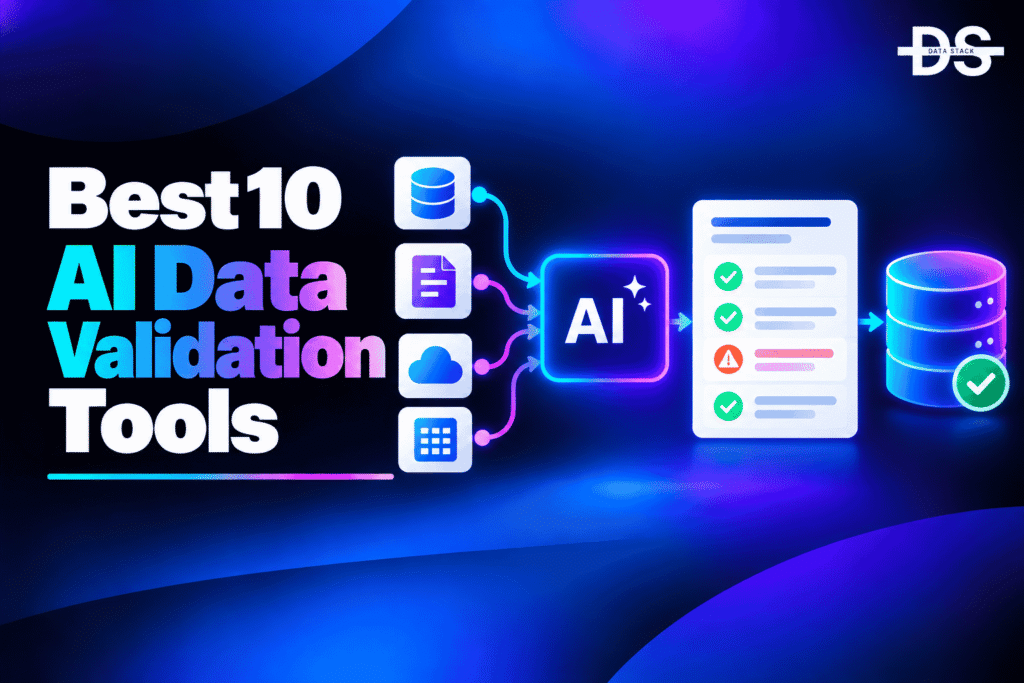
Data validation is an essential part of maintaining reliable data across databases, applications, data warehouses, and analytics platforms. Invalid values, missing fields, incorrect formats, inconsistent records, and unexpected changes can quickly reduce data quality and affect business decisions. AI data validation tools help organizations detect these problems more efficiently by combining automated validation with artificial intelligence and machine learning.
Traditional data validation usually depends on predefined rules such as checking whether an email follows a particular format, whether a value falls within an acceptable range, or whether a required field is populated. These rules remain useful, but they can struggle with large datasets and complex patterns that are difficult to define manually. AI can analyze historical data, identify unusual patterns, detect anomalies, and help data teams prioritize validation issues.
AI-powered validation is useful across customer data, financial information, healthcare data, product catalogs, operational databases, analytics pipelines, and AI/ML datasets. It can help teams identify suspicious values, detect unexpected changes, validate data against patterns, and continuously monitor data quality as new information enters a system.
In this guide, we compare the best AI data validation tools based on their AI capabilities, automated validation features, anomaly detection, data-quality capabilities, and ideal use cases. We also cover their key AI-focused features, compare them side by side, explain how to choose the right tool, and answer common questions about AI-powered data validation.
What Are AI Data Validation Tools?
AI data validation tools are software platforms that use artificial intelligence and machine learning to check whether data is accurate, complete, consistent, valid, and suitable for its intended use. These tools can combine predefined validation rules with AI-driven pattern recognition, anomaly detection, profiling, and automated data-quality analysis.
Unlike traditional validation systems that depend entirely on manually created rules, AI-powered validation can learn patterns from existing data and identify values or records that deviate from expected behavior. This is particularly useful when the definition of a valid record is difficult to express through fixed rules.
AI data validation tools can also support continuous data-quality monitoring. Instead of validating a dataset only when it is loaded or processed, organizations can monitor data pipelines and receive alerts when unusual patterns, unexpected values, missing data, schema changes, or other quality problems appear.
AI Data Validation Tools Comparison
The table below compares the leading AI data validation tools based on their AI capabilities, automation features, and ideal use cases.
| Tool | AI Capabilities | What You Can Automate | Best For | G2 Rating |
|---|---|---|---|---|
| Monte Carlo | AI-assisted anomaly detection, ML-based monitoring | Data-quality monitoring, anomaly detection, incident investigation | Data observability | 4.6/5 |
| Anomalo | ML anomaly detection, automated profiling | Validation, anomaly detection, data-quality monitoring | Automated data quality | 4.6/5 |
| Great Expectations | AI-assisted workflows and automated data validation integrations | Data tests, validation, profiling | Open-source data validation | 4.4/5 |
| Soda | AI-assisted anomaly detection and data quality | Testing, monitoring, anomaly detection | Data quality and observability | 4.3/5 |
| Bigeye | ML-based anomaly detection and monitoring | Data validation, monitoring, alerting | Enterprise data observability | 4.7/5 |
| Ataccama ONE | AI-assisted profiling, anomaly detection, classification | Validation, profiling, quality monitoring | Enterprise data quality | 4.2/5 |
| Informatica Data Quality | CLAIRE AI, intelligent profiling and anomaly detection | Validation, profiling, cleansing | Enterprise data quality | 4.3/5 |
| Acceldata | AI/ML-powered data observability | Quality monitoring, anomaly detection, pipeline monitoring | Data and pipeline observability | 4.5/5 |
8 Best AI Data Validation Tools
Let’s take a closer look at the 8 best AI data validation tools and what they bring to the table. We’ll cover their key features, AI capabilities, and best use cases to help you compare the top options.
#1. Monte Carlo
Monte Carlo is a data observability platform designed to help data teams monitor the reliability and health of data across modern data environments. Its capabilities cover data quality, freshness, volume, schema, lineage, and other dimensions that can indicate whether data is behaving as expected.
The platform uses machine learning and automated detection to identify unusual changes in data rather than requiring teams to manually create a validation rule for every possible problem. This makes it particularly useful for large data environments where the number of datasets and pipelines makes manual monitoring difficult.
Monte Carlo is best suited to organizations that want data validation to operate continuously across their data stack. Instead of checking data only during a pipeline run, teams can monitor production data and investigate issues when unexpected changes occur.
Key Features
- ML-Based Anomaly Detection: Monte Carlo can learn normal patterns in data and identify unusual changes in metrics such as volume, freshness, and distribution.
- Automated Data Monitoring: Teams can continuously monitor datasets without manually creating individual checks for every possible data-quality issue.
- Schema Change Detection: Unexpected changes to schemas can be detected and surfaced before they create downstream problems.
- Data Freshness Validation: Monitoring can identify when expected data has not arrived or has become delayed.
- Volume Monitoring: Significant increases or decreases in data volume can be detected automatically.
- Data Quality Monitoring: Multiple data-quality signals can be monitored across warehouses, lakes, pipelines, and other systems.
- Lineage-Aware Investigation: Data lineage helps teams understand which downstream assets may be affected when validation problems are detected.
- AI-Assisted Incident Investigation: Intelligent capabilities can help data teams investigate anomalies and understand potential causes more quickly.
G2 Rating: 4.6/5
Also Read: Best Monte Carlo Alternatives & Competitors in 2026
#2. Anomalo
Anomalo is an automated data-quality platform focused on detecting anomalies in data without requiring data teams to manually write extensive validation rules. It uses machine learning to learn the expected behavior of datasets and identify unusual changes.
This approach makes Anomalo particularly useful for organizations that have large numbers of tables and data pipelines where manually defining and maintaining thousands of validation rules would be difficult. The platform can continuously evaluate data and highlight records, columns, and datasets that behave unexpectedly.
Anomalo is a strong choice when automated anomaly detection is a major priority. It can help data teams discover quality problems that traditional rule-based validation may not catch because the issue is not necessarily a fixed invalid value but a deviation from historical patterns.
Key Features
- Machine Learning Anomaly Detection: Anomalo learns patterns in data and detects unusual behavior without requiring teams to manually define every anomaly.
- Automated Data Profiling: The platform analyzes datasets to understand their normal characteristics and establish a basis for ongoing validation.
- AI-Powered Data Quality: Machine learning can identify unusual changes across different dimensions of data quality.
- Distribution Monitoring: Changes in value distributions can be detected when data begins behaving differently from its historical pattern.
- Missing Data Detection: Unexpected increases in missing or null values can be surfaced automatically.
- Schema Monitoring: Changes to columns and data structures can be detected as part of continuous quality monitoring.
- Automated Alerts: Data teams can receive alerts when significant anomalies or validation problems are identified.
- Root-Cause Investigation: Anomaly context can help teams investigate what changed and where a data-quality problem originated.
G2 Rating: 4.6/5
Showcase your software to buyers actively comparing tools. Submit your product for editorial review and get featured on Data Stack Hub.
#3. Great Expectations
Great Expectations is an open-source data quality and validation framework that allows data teams to define expectations about what valid data should look like and automatically test datasets against those expectations.
It is different from fully managed AI-first data-quality platforms because its core strength is configurable data validation rather than autonomous AI anomaly detection. However, it remains an important option for AI and modern data teams because validation workflows can be integrated with machine learning pipelines, data engineering platforms, and automated data-quality processes.
Great Expectations is particularly useful for organizations that want control over their validation logic and prefer an open-source approach. Teams can create tests for values, schemas, completeness, uniqueness, distributions, and other characteristics before data is used downstream.
Key Features
- Automated Data Validation: Teams can define expectations and automatically validate datasets against those conditions.
- Schema Validation: Data structures can be checked to ensure expected columns and formats are present.
- Completeness Checks: Validation can identify missing or null values in fields where complete data is required.
- Uniqueness Validation: Duplicate values can be identified in fields that are expected to contain unique records.
- Distribution Checks: Teams can validate whether numerical or categorical distributions remain within expected ranges.
- Data Pipeline Integration: Validation can be incorporated into data pipelines so problems are detected before data moves downstream.
- Open-Source Framework: Organizations can deploy and customize the framework within their own data infrastructure.
- AI/ML Pipeline Validation: Data validation can be added before model training and inference workflows to reduce the risk of poor-quality input data.
G2 Rating: 4.4/5
#4. Soda
Soda is a data quality and observability platform that helps teams test, monitor, and investigate the reliability of data. It combines data quality checks with automated monitoring and anomaly detection to help organizations identify unexpected changes across their data environment.
The platform can be used to define data-quality checks while also monitoring datasets for unusual behavior. This combination is useful because some validation problems are easy to describe through rules, while others are better detected by observing how data changes over time.
Soda is a strong option for modern data teams that want data validation integrated into their engineering workflows. It can support continuous testing across data pipelines and provide visibility into data-quality issues before they affect downstream consumers.
Key Features
- Automated Data Quality Checks: Teams can create repeatable checks for completeness, validity, freshness, uniqueness, and other data-quality dimensions.
- AI-Assisted Anomaly Detection: Automated monitoring can help identify unusual patterns that may not be covered by static validation rules.
- Data Profiling: Dataset characteristics can be analyzed to establish expected patterns and identify changes.
- Freshness Validation: Teams can detect when expected data is late or missing from a pipeline.
- Distribution Monitoring: Changes in the distribution of values can be identified as potential quality problems.
- Schema Checks: Unexpected structural changes can be detected before they affect downstream systems.
- Data Pipeline Integration: Validation can be incorporated into CI/CD and data-engineering workflows.
- Data Quality Monitoring: Teams can continuously monitor datasets instead of relying only on one-time validation.
G2 Rating: 4.3/5
#5. Bigeye
Bigeye is a data observability platform focused on automated data quality monitoring and anomaly detection. It uses machine learning to establish expectations for data and identify changes that could indicate a problem.
The platform is useful for organizations managing large data environments where manual validation becomes difficult. Rather than requiring teams to write a rule for every table and metric, automated monitoring can identify unusual behavior and prioritize potential issues.
Bigeye is particularly relevant for enterprise data teams that want continuous validation across data warehouses, pipelines, and business-critical datasets. Its observability approach allows validation to happen continuously as data changes.
Key Features
- Machine Learning Monitoring: Bigeye can learn patterns in data and identify changes that may indicate quality problems.
- Automated Anomaly Detection: Unusual changes in metrics, distributions, and other data characteristics can be detected without manually defining every threshold.
- Data Profiling: Automated profiling helps establish an understanding of expected dataset behavior.
- Freshness Monitoring: Teams can identify delayed or missing data that could affect downstream reporting.
- Volume Monitoring: Unexpected changes in record counts or data volumes can trigger validation alerts.
- Schema Monitoring: Changes to data structures can be detected as part of continuous observability.
- Automated Alerting: Teams can receive notifications when significant data-quality anomalies are identified.
- Enterprise Monitoring: Bigeye can monitor data across large and complex environments rather than limiting validation to individual datasets.
G2 Rating: 4.7/5
#6. Ataccama ONE
Ataccama ONE is an enterprise data management platform that combines data quality, observability, governance, cataloging, and MDM capabilities. Its AI-assisted capabilities can help organizations profile data, identify anomalies, classify information, and monitor quality.
The platform is useful when data validation needs to operate as part of a broader data-quality strategy. Rather than simply checking whether values meet predefined rules, organizations can use profiling and intelligent analysis to understand data behavior and identify areas requiring attention.
Ataccama is particularly suitable for large organizations managing multiple data sources and business domains. Its broader data-management capabilities make it useful when validation is connected to governance, stewardship, quality management, and MDM.
Key Features
- AI-Assisted Data Profiling: Intelligent profiling can analyze datasets and identify patterns, inconsistencies, missing values, and other quality issues.
- Anomaly Detection: Automated analysis can identify unusual data behavior that may indicate a validation problem.
- Data Quality Rules: Teams can define validation rules for specific business requirements and monitor them continuously.
- Automated Classification: AI can help classify data attributes and provide additional context for data-quality workflows.
- Schema Monitoring: Changes to data structures can be detected and evaluated as potential quality issues.
- Data Quality Monitoring: Teams can continuously track data-quality conditions across multiple sources.
- Data Standardization: Inconsistent values can be standardized to improve the reliability of downstream validation.
- Governance Integration: Validation can be managed alongside data ownership, stewardship, governance, and other quality processes.
G2 Rating: 4.2/5
Also Read: Best Ataccama Alternatives and Competitors in 2026
Increase your product visibility by reaching software buyers researching the best tools. Every submission is reviewed by our editorial team.
Feature My Tool →#7. Informatica Data Quality
Informatica Data Quality provides a broad set of capabilities for profiling, validating, cleansing, standardizing, matching, and monitoring enterprise data. Its CLAIRE AI capabilities add intelligence to several data-management workflows.
The platform is designed for organizations where data validation is part of a larger data-quality program. Teams can identify patterns in source data, define validation rules, detect anomalies, and address invalid records before they reach downstream applications or analytics systems.
Informatica is especially useful for large enterprises that need validation across multiple data domains and systems. Its integration with broader data-management capabilities allows organizations to combine validation with cleansing, governance, matching, and MDM.
Key Features
- CLAIRE AI: Informatica’s AI technology can assist with data-quality analysis and automate parts of data-management workflows.
- Intelligent Data Profiling: Profiling can identify patterns, anomalies, missing values, and inconsistencies across datasets.
- Automated Validation: Data can be checked against defined business and technical quality rules.
- Anomaly Detection: Unusual data patterns can be surfaced for investigation.
- Data Standardization: Invalid or inconsistent formats can be identified and standardized.
- Data Completeness Checks: Teams can monitor required fields and identify unexpected increases in missing information.
- Data Quality Monitoring: Organizations can continuously evaluate the health of datasets across their data environment.
- Enterprise Integration: Validation can operate alongside data integration, governance, MDM, and other data-quality workflows.
G2 Rating: 4.3/5
#8. Acceldata
Acceldata is a data observability platform that provides monitoring across data pipelines, infrastructure, and data quality. Its AI and machine learning capabilities help identify anomalies and unexpected changes that may affect data reliability.
The platform is designed for organizations where data validation cannot be separated from pipeline and infrastructure health. A dataset may be technically present but still be unreliable because of changes in volume, freshness, schema, pipeline behavior, or other characteristics.
Acceldata helps teams monitor these signals together. This makes it useful for enterprise data environments where organizations need to validate both the data itself and the systems responsible for delivering it.
Key Features
- AI/ML Anomaly Detection: Machine learning can identify unusual patterns across data and pipeline behavior.
- Automated Data Observability: Teams can continuously monitor data quality and pipeline health rather than performing isolated validation checks.
- Data Quality Monitoring: Multiple quality dimensions can be tracked across datasets and data products.
- Pipeline Monitoring: Data pipelines can be monitored for failures, delays, and other issues that may affect validation.
- Schema Monitoring: Unexpected changes to schemas can be detected before they create downstream problems.
- Freshness Monitoring: Delayed or missing data can be identified automatically.
- Volume Monitoring: Unexpected changes in data volume can indicate pipeline or source-system problems.
- Root-Cause Analysis: Observability information can help data teams understand where a validation problem originated.
G2 Rating: 4.5/5
How to Choose an AI Data Validation Tool
The best AI data validation tool depends on the type of data you manage and how you want to validate it. Focus on these factors before making a decision:
- AI Validation Capabilities: Check whether the tool uses AI or machine learning for anomaly detection, profiling, pattern recognition, or automated validation.
- Data Quality Coverage: Look for support for completeness, accuracy, consistency, validity, uniqueness, freshness, and other quality dimensions relevant to your data.
- Automated Anomaly Detection: Prioritize tools that can identify unusual data behavior without requiring teams to manually define every possible issue.
- Validation Rules: Make sure you can create business-specific rules for requirements that AI cannot reliably infer from historical data.
- Data Profiling: Look for automated profiling that can understand data patterns and help establish appropriate validation expectations.
- Real-Time Monitoring: If your data changes continuously, choose a platform that can monitor new data and identify problems as they occur.
- Integration: Check whether the tool works with your databases, warehouses, data lakes, pipelines, BI platforms, and orchestration tools.
- Scalability: Make sure the platform can handle your number of datasets, records, pipelines, and validation checks as the environment grows.
- Alerting and Investigation: Look for useful alerts and enough context to understand what changed and where the problem originated.
- Use Case: Choose a tool based on whether you need simple data testing, AI-based anomaly detection, enterprise data quality, pipeline observability, or validation for AI/ML datasets.
Browse expertly curated software recommendations across hundreds of business categories.
Browse Top Tools →Conclusion
AI data validation tools help organizations move beyond static data-quality checks by combining traditional validation rules with automated profiling, anomaly detection, and machine learning. This is increasingly important as companies manage larger volumes of data across warehouses, lakes, applications, APIs, and AI systems.
Monte Carlo and Anomalo are strong choices for organizations that want automated data observability and machine learning-based anomaly detection. They can help data teams identify unusual changes without manually creating validation rules for every possible scenario.
Great Expectations remains an important open-source option for teams that want flexible and programmable data validation. It is particularly useful when developers and data engineers want to build validation directly into data pipelines and testing workflows.
Soda is a good choice for teams looking to combine data testing with continuous quality monitoring. Bigeye is another strong option for automated monitoring and machine learning-based anomaly detection across enterprise data environments.
For organizations looking for broader enterprise data management, Ataccama ONE and Informatica Data Quality provide validation alongside profiling, cleansing, governance, standardization, and other data-quality capabilities.
Acceldata is particularly useful when data validation needs to be combined with pipeline and infrastructure observability. This can help organizations investigate whether a data-quality problem originated in the source, pipeline, warehouse, or another part of the data stack.
The most important consideration is not simply whether a platform uses AI. A good AI data validation tool should identify meaningful problems while minimizing false alerts. It should also allow teams to combine machine learning with explicit business rules because not every validation requirement can be learned reliably from historical data.
Organizations should also consider how validation fits into their broader data workflow. For example, a data warehouse may require continuous monitoring for schema, freshness, and distribution changes, while an AI training pipeline may require strict checks for missing values, unexpected categories, outliers, and data drift.
The best tools therefore combine automation with control. AI can reduce the amount of manual monitoring required, while configurable rules allow data teams to enforce requirements that are specific to the business.
For teams building reliable analytics and AI systems, this combination is particularly valuable. Poor-quality input data can lead to inaccurate dashboards, broken pipelines, unreliable reports, and poor machine learning results. Continuous validation helps identify these problems earlier, before they affect downstream users and applications.
Ultimately, the right AI data validation tool depends on your data environment, validation requirements, and level of automation. A lightweight open-source framework may be enough for engineering teams that need programmable tests, while larger organizations may benefit from a full data-quality or observability platform with automated anomaly detection.
Frequently Asked Questions
1. What are AI Data Validation Tools?
AI data validation tools are platforms that use artificial intelligence and machine learning to check data for errors, anomalies, inconsistencies, missing values, unexpected patterns, and other quality problems. They can combine AI-based analysis with traditional validation rules.
2. What are the best AI data validation tools in 2026?
Some of the leading AI data validation tools include Monte Carlo, Anomalo, Great Expectations, Soda, Bigeye, Ataccama ONE, Informatica Data Quality, and Acceldata. The best option depends on whether you need data testing, anomaly detection, enterprise data quality, or broader data observability.
3. How does AI data validation work?
AI data validation tools analyze data to identify expected patterns and detect values or behaviors that differ significantly from those patterns. Depending on the platform, this can involve machine learning, automated profiling, anomaly detection, statistical analysis, and predefined validation rules.
4. What is the difference between AI data validation and traditional data validation?
Traditional data validation generally relies on predefined rules created by data teams. AI data validation can learn patterns from existing data and identify anomalies that may not have been explicitly defined in a rule.
5. Can AI data validation tools detect anomalies?
Yes. Anomaly detection is one of the most important AI applications in data validation. Machine learning can identify unusual changes in data distributions, volumes, freshness, values, and other characteristics.
6. Can AI data validation tools replace data-quality rules?
No. AI can reduce the need for manually created rules, but explicit rules remain important for business requirements. For example, an organization may require a specific identifier to always follow a defined format regardless of what historical data looks like.
7. Can AI data validation tools validate data in real time?
Some platforms support near-real-time or continuous monitoring, while others are better suited to batch validation within data pipelines. The appropriate approach depends on the speed and criticality of the data being processed.
8. Can AI data validation tools detect missing data?
Yes. They can identify missing or null values and, in some cases, detect unusual increases in missing data compared with historical patterns.
9. Can AI data validation tools detect schema changes?
Yes. Many data observability and data-quality platforms can monitor schemas and identify unexpected changes to columns, data types, or structures.
10. Can AI data validation tools validate data for AI and machine learning?
Yes. AI data validation is particularly useful before model training and inference. Teams can validate completeness, distributions, data types, unexpected values, anomalies, and other characteristics that could affect model performance.
11. Are there open-source AI data validation tools?
Yes. Great Expectations is one of the most widely used open-source options for automated data validation. It allows data teams to define expectations and integrate validation into data pipelines and engineering workflows.
12. What types of data can AI validation tools validate?
They can validate customer, financial, operational, product, healthcare, transactional, analytical, and machine learning data. The exact capabilities depend on the platform and the data source being monitored.
13. Can AI data validation tools monitor data quality continuously?
Yes. Data observability platforms can continuously monitor datasets for changes in freshness, volume, schema, distributions, and other quality signals. This allows teams to detect problems after data enters production rather than relying only on scheduled validation.
14. What should I look for in an AI data validation tool?
Look for AI-based anomaly detection, automated profiling, validation rules, data-quality monitoring, schema checks, freshness monitoring, alerting, integrations, scalability, and investigation capabilities. The tool should support both automated detection and the specific business rules your organization needs.
15. Why is AI data validation important for AI systems?
AI models depend on the quality of the data used for training and inference. Invalid, incomplete, inconsistent, or anomalous data can affect model performance and produce unreliable results. Automated validation helps identify these problems before they reach AI workflows.