
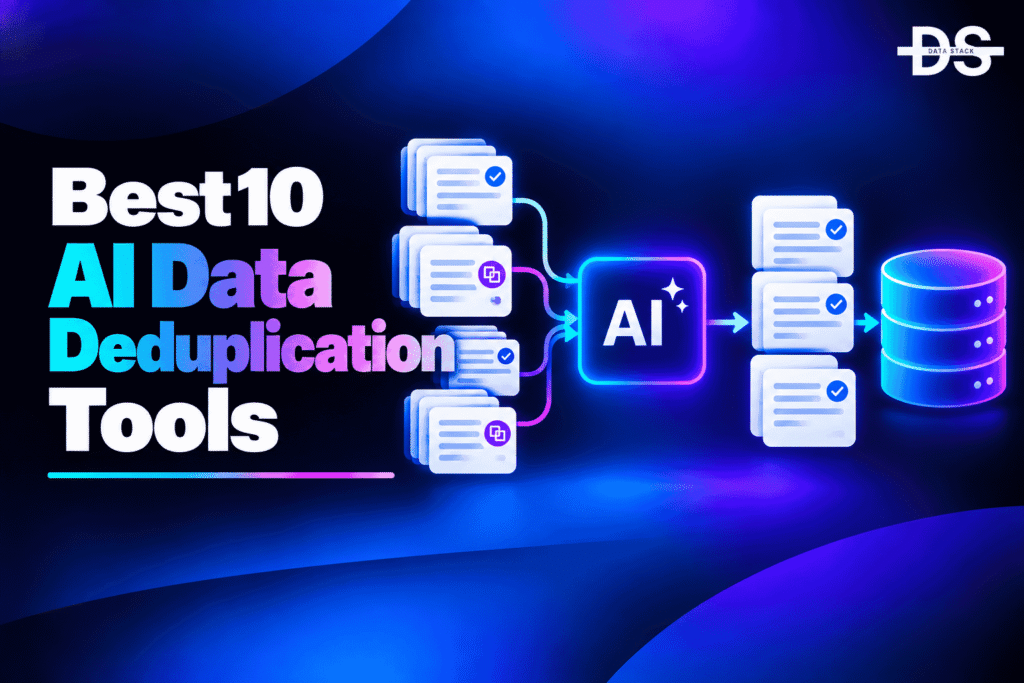
Duplicate data is one of the most common problems organizations face when managing information across multiple systems. The same customer, company, supplier, product, or contact can appear several times because of different spellings, outdated information, inconsistent formats, multiple identifiers, or manual data entry. These duplicates can affect reporting, analytics, customer experience, marketing, and downstream AI applications. AI data deduplication tools help organizations identify and resolve these duplicate records more efficiently.
Traditional deduplication typically depends on exact matching, manually defined rules, or basic fuzzy matching. These methods can work for simple datasets, but they become harder to maintain when organizations process millions of records from multiple sources. AI and machine learning can evaluate multiple attributes, identify patterns, calculate match confidence, and help determine whether two records represent the same real-world entity.
AI-powered deduplication is particularly useful for customer databases, CRM systems, master data management, data migrations, customer 360 projects, product catalogs, supplier records, and data warehouses. Instead of manually searching for duplicates, teams can automate much of the identification and review process while keeping human oversight for uncertain matches.
In this guide, we compare the best AI data deduplication tools based on their AI capabilities, duplicate detection, matching and entity resolution features, automation capabilities, and ideal use cases. We also cover their key AI-focused features, compare them side by side, explain how to choose the right tool, and answer common questions about AI-powered data deduplication.
What Are AI Data Deduplication Tools?
AI data deduplication tools are software platforms that use artificial intelligence and machine learning to identify, match, and resolve duplicate records across one or more datasets. These tools analyze multiple attributes and patterns to determine whether records represent the same real-world entity, even when the records are not identical.
Unlike basic duplicate detection, AI-powered deduplication can evaluate variations in names, addresses, contact information, identifiers, product descriptions, and other attributes. Some platforms use machine learning or probabilistic matching to calculate the likelihood that two records belong to the same entity.
AI data deduplication tools can also automate the next steps after identifying duplicates. Depending on the platform, this may include recommending which records should be merged, selecting the most reliable values, creating a golden record, flagging uncertain matches for review, or preventing new duplicates from entering a system.
AI Data Deduplication Tools Comparison
The table below compares the leading AI data deduplication tools based on their AI capabilities, automation features, and ideal use cases.
| Tool | AI Capabilities | What You Can Automate | Best For | G2 Rating |
|---|---|---|---|---|
| DataMatch Enterprise | AI-enabled matching, fuzzy and probabilistic matching | Deduplication, cleansing, matching, merging | Enterprise data cleansing | 4.2/5 |
| Tamr | Machine learning, AI-native deduplication, semantic matching | Duplicate detection, matching, standardization | Enterprise-scale data mastering | 4.4/5 |
| Reltio | AI-powered matching, ML and LLM-based entity resolution | Match, merge, survivorship | Cloud-native MDM | 4.4/5 |
| Senzing | AI-driven entity resolution, relationship awareness | Entity resolution, identity matching | Large-scale identity resolution | 4.9/5 |
| Informatica Data Quality | AI-assisted matching and data quality | Deduplication, profiling, cleansing | Enterprise data quality | 4.5/5 |
| Ataccama ONE | AI-assisted matching, profiling, classification | Matching, cleansing, quality management | Enterprise data quality | 4.2/5 |
| WinPure Clean & Match | AI-assisted matching and intelligent cleansing | Deduplication, cleansing, merging | SMB and mid-market data | 4.7/5 |
| Zingg | Machine learning-based entity resolution | Record linkage, matching, deduplication | Open-source data engineering | — |
8 Best AI Data Deduplication Tools
Here’s a closer look at 8 of the best AI data deduplication tools. We’ll break down the important features and capabilities of each tool to help you compare your options.
#1. DataMatch Enterprise
DataMatch Enterprise from Data Ladder is a data-quality and record-matching platform designed to identify, clean, standardize, and consolidate duplicate records. It can work with customer, contact, business, and other structured data from multiple sources.
The platform combines different matching approaches, including exact, fuzzy, phonetic, deterministic, and probabilistic techniques. This makes it useful for organizations where duplicates are caused by spelling differences, formatting inconsistencies, incomplete information, or variations across source systems.
DataMatch Enterprise is particularly useful when deduplication is the main requirement rather than implementing a complete MDM platform. Teams can use it to identify duplicates, review potential matches, merge records, and prepare cleaner data for downstream systems.
Key Features
- AI-Assisted Data Matching: Intelligent matching can compare multiple attributes across records to identify potential duplicates instead of relying only on exact field values.
- Fuzzy Matching: The platform can identify records with variations in names, addresses, company information, and other attributes where exact matching would fail.
- Probabilistic Matching: Matching can evaluate the likelihood that two records represent the same entity, which is useful when no single field provides a reliable identifier.
- Automated Deduplication: Duplicate records can be identified across large datasets and prepared for consolidation.
- Match Scoring: Potential matches can be scored so data teams can separate high-confidence duplicates from records that require additional review.
- Data Standardization: Source data can be standardized before matching to reduce duplicate records caused by inconsistent formatting.
- Merge and Survivorship: Matching results can be used to consolidate records while selecting preferred values from different source records.
- Multi-Source Deduplication: Teams can compare data across databases, CRM systems, spreadsheets, and other sources instead of limiting deduplication to one application.
G2 Rating: 4.2/5
#2. Tamr
Tamr is an AI-native data mastering platform designed to clean, consolidate, enrich, and unify data from multiple sources. Deduplication is one of its core use cases, with machine learning used to identify records that represent the same real-world entity.
Tamr is particularly useful for organizations dealing with large and messy datasets where traditional duplicate rules become difficult to maintain. The platform can learn from data and human feedback, helping organizations identify duplicates across customer, company, supplier, healthcare, and other datasets.
Rather than treating deduplication as a one-time cleanup exercise, Tamr supports ongoing data quality and mastering. This makes it useful when organizations need to continuously identify duplicates as new records enter their systems.
Key Features
- AI-Native Deduplication: Tamr uses machine learning to identify duplicate and related records across fragmented datasets.
- Machine Learning Matching: Matching models can learn from data and feedback, helping improve duplicate identification as more decisions are made.
- Semantic Matching: The platform can use contextual information and semantic relationships to identify records that may not look identical at the field level.
- Automated Duplicate Detection: Potential duplicates can be surfaced automatically instead of requiring teams to search through datasets manually.
- AI-Assisted Data Curation: AI can help data teams review and resolve duplicates, inconsistencies, and other data-quality problems.
- Data Standardization: Values can be standardized as part of the mastering process so formatting differences do not prevent related records from being identified.
- Golden Record Creation: Duplicate records can be consolidated into trusted master records after the matching process.
- Duplicate Prevention: Tamr can use AI-powered search and matching workflows to identify potential existing records before new duplicate records are created.
G2 Rating: 4.4/5
Also Read: Best Tamr Alternatives and Competitors in 2026
Showcase your software to buyers actively comparing tools. Submit your product for editorial review and get featured on Data Stack Hub.
#3. Reltio
Reltio is a cloud-native multidomain MDM platform that provides AI-powered matching and entity resolution alongside data quality, enrichment, relationship management, and golden-record capabilities. It is designed to create unified profiles across fragmented customer, product, supplier, and other business data.
Reltio’s matching capabilities can combine deterministic rules, fuzzy comparisons, relevance-based scoring, and AI-powered entity resolution. This allows organizations to handle both straightforward duplicates and more complex cases where multiple pieces of information need to be considered together.
The platform is a strong choice for organizations that want deduplication to be part of a broader customer 360 or multidomain MDM strategy. Rather than simply deleting duplicates, teams can use matching and survivorship capabilities to create trusted and continuously maintained entity profiles.
Key Features
- AI-Powered Entity Resolution: Reltio uses AI and machine learning to identify records that represent the same real-world entity.
- LLM-Powered Matching: Pretrained AI models can assist with resolving records that traditional deterministic rules may struggle to connect.
- Flexible Matching: Teams can combine exact, fuzzy, relevance-based, referential, and AI-powered matching approaches.
- Automated Duplicate Detection: Potential duplicates can be identified across connected source systems and added to entity profiles.
- Dynamic Survivorship: The platform can determine which values should be retained when multiple source records are consolidated.
- Automatic Unmerge: Matching logic can support separating records when changes in data or rules show that previously matched records should no longer be combined.
- Relationship-Aware Deduplication: Connections between entities provide additional context when resolving records.
- Real-Time Mastering: Deduplicated and mastered entity information can be maintained as source data changes.
G2 Rating: 4.4/5
#4. Senzing
Senzing is an entity-resolution platform focused on identifying people, organizations, and relationships across disparate datasets. While it is broader than a conventional deduplication application, its core entity-resolution capabilities make it highly relevant for AI-powered data deduplication.
Senzing is particularly useful when duplicates cannot be identified simply by comparing two records. Its approach evaluates available evidence and relationships to determine whether records belong to the same entity. This makes it suitable for identity resolution, customer 360, fraud prevention, compliance, risk management, and intelligence applications.
The platform is also designed for large-scale and real-time entity resolution. Organizations can continuously add information from different sources and update their understanding of an entity without relying solely on periodic batch deduplication.
Key Features
- AI Entity Resolution: Senzing uses AI-driven entity resolution to determine whether records from different sources belong to the same real-world entity.
- Relationship Awareness: The platform can identify relationships between entities, providing additional evidence when resolving potentially duplicate records.
- Real-Time Resolution: New information can be resolved against existing entities as data enters the system.
- Identity Consolidation: Records from different sources can be consolidated into unified entity views.
- Explainable Matching: Matching results can provide insight into why records were considered related, helping teams validate difficult decisions.
- Pre-Trained Models: Senzing is designed to work with pre-trained entity-resolution capabilities rather than requiring every organization to build a matching model from scratch.
- Large-Scale Processing: The platform is designed to handle high-volume entity-resolution workloads.
- AI-Assisted Data Mapping: AI capabilities can help map incoming data into the structure required for entity resolution.
G2 Rating: 4.9/5
#5. Informatica Data Quality
Informatica Data Quality provides enterprise data profiling, cleansing, matching, validation, standardization, enrichment, and deduplication capabilities. Its AI-powered capabilities can help automate parts of the data-quality process and make duplicate identification more scalable.
The platform is particularly useful when deduplication needs to be combined with broader data-quality management. Teams can profile source data, identify inconsistencies, standardize values, and then use matching capabilities to identify duplicate records.
For large enterprises, this approach can be valuable because duplicate records are often only one part of a broader data-quality problem. Informatica allows organizations to address matching alongside validation, enrichment, governance, and other data-management processes.
Key Features
- AI-Assisted Deduplication: Intelligent matching can identify potential duplicate records across different datasets and systems.
- AI-Powered Data Quality: AI can assist with identifying and prioritizing data-quality problems that can contribute to duplicate records.
- Fuzzy Matching: The platform can compare records even when values are not exactly identical.
- Automated Data Profiling: Profiling can identify patterns, missing values, inconsistent formats, and other issues before deduplication.
- Data Standardization: Records can be normalized to reduce false non-matches caused by inconsistent formats.
- Match and Merge: Potential duplicates can be reviewed and consolidated into cleaner records.
- Reusable Matching Rules: Organizations can create repeatable matching logic for recurring data-quality workflows.
- Enterprise Data Integration: Deduplication can operate as part of broader data integration, governance, and MDM workflows.
G2 Rating: 4.5/5
#6. Ataccama ONE
Ataccama ONE is an enterprise data management platform that combines data quality, data governance, observability, cataloging, and MDM capabilities. Its AI-assisted capabilities can support matching and duplicate detection while also addressing the underlying data-quality problems that often create duplicates.
The platform is useful for organizations that do not want deduplication to operate as an isolated process. Data profiling can identify inconsistencies in source systems, while intelligent matching can identify records that appear to represent the same entity.
Ataccama is particularly relevant for enterprise data teams managing multiple systems and data domains. It can provide a broader data trust layer while supporting matching, cleansing, standardization, and governance.
Key Features
- AI-Assisted Matching: Intelligent matching can help identify records that likely represent the same entity across different systems.
- Automated Duplicate Detection: Potential duplicates can be identified as part of broader data-quality workflows.
- AI Data Profiling: Intelligent profiling can surface missing values, inconsistent patterns, and other problems that can affect deduplication accuracy.
- Data Standardization: Records can be standardized before matching to improve consistency across datasets.
- AI-Assisted Classification: Machine learning can help classify data and attributes, providing additional context for quality and matching workflows.
- Data Quality Monitoring: Ongoing monitoring can help identify new quality issues that may result in duplicate or inconsistent records.
- Match and Merge: Related records can be consolidated after the matching process.
- Governance Integration: Deduplication can be managed alongside data ownership, governance, quality, and stewardship processes.
G2 Rating: 4.2/5
Also Read: Best Ataccama Alternatives and Competitors in 2026
Increase your product visibility by reaching software buyers researching the best tools. Every submission is reviewed by our editorial team.
Feature My Tool →#7. WinPure Clean & Match
WinPure Clean & Match is a data cleansing and matching platform designed to clean, standardize, match, and deduplicate business and consumer data. It is particularly useful for organizations working with CRM records, mailing lists, spreadsheets, databases, and customer information.
Its matching capabilities can identify duplicate records even when names, addresses, and other fields contain variations. The platform is more focused on practical data cleansing and deduplication than on being a full enterprise MDM platform.
WinPure can be a good fit for small and mid-sized organizations that need to clean and consolidate data without introducing the complexity of a large enterprise data-management platform.
Key Features
- AI-Assisted Matching: Intelligent matching can help identify similar records despite differences in names, addresses, and other attributes.
- Fuzzy Matching: Fuzzy comparison can identify records that are similar rather than requiring exact values.
- Automated Deduplication: Duplicate records can be identified across databases, spreadsheets, mailing lists, and CRM data.
- Data Cleansing: Records can be corrected and standardized before or during the deduplication process.
- Address Matching: Address information can be parsed and standardized to improve the identification of duplicate customer or contact records.
- Match Scoring: Potential matches can be evaluated based on their degree of similarity.
- Record Merging: Duplicate records can be consolidated into cleaner records after review.
- Recurring Data Cleansing: Teams can repeat matching and cleansing workflows as new data is added.
G2 Rating: 4.7/5
#8. Zingg
Zingg is an open-source entity-resolution platform that uses machine learning to identify similar and duplicate records. It is designed for data engineers and teams that want to build entity-resolution and deduplication workflows into their own data infrastructure.
Unlike commercial MDM platforms, Zingg gives technical teams more control over how entity-resolution workflows are implemented. It can be useful when organizations want an open-source approach and are comfortable managing the underlying infrastructure and data pipelines themselves.
Zingg is particularly relevant for large data-engineering environments where deduplication needs to be integrated into existing processing workflows rather than managed through a standalone business application. Its machine learning approach makes it a useful open-source inclusion in an AI data deduplication list.
Key Features
- Machine Learning Deduplication: Zingg uses machine learning to identify records that are likely to represent the same entity.
- Entity Resolution: The platform can link records across datasets even when they do not contain identical values.
- Open-Source Architecture: Teams can use and adapt the platform within their own data infrastructure without adopting a proprietary MDM platform.
- Similarity-Based Matching: Records can be evaluated based on similarities across multiple attributes.
- Model-Based Matching: Machine learning models can be trained to improve the identification of matching and non-matching records.
- Scalable Data Processing: Zingg is designed for large-scale entity-resolution workloads within data-engineering environments.
- Data Pipeline Integration: Deduplication can be incorporated into broader data-processing and data-integration workflows.
- Human Feedback: Matching decisions can be used to improve the model and refine entity-resolution results.
G2 Rating: —
How to Choose an AI Data Deduplication Tool
The right AI data deduplication tool depends on your data volume, duplicate patterns, systems, and level of automation required. Focus on these factors before selecting a platform:
- AI Matching Capabilities: Check how the tool uses AI or machine learning to identify duplicates beyond simple exact or rule-based matching.
- Data Quality: Look for built-in cleansing, standardization, and validation features because poor-quality source data can directly affect deduplication results.
- Match Accuracy: Test the platform with real records containing spelling differences, missing values, abbreviations, and inconsistent formats.
- Automation: Consider how much of the duplicate detection, review, merging, and ongoing monitoring process can be automated.
- Human Review: Make sure the platform allows teams to review uncertain matches before important records are merged or removed.
- Data Volume: Evaluate whether the tool can handle the number of records and data sources you expect to process.
- Integration: Check compatibility with your CRM, databases, ERP, data warehouse, APIs, and other systems.
- Scalability: Consider whether the platform can continue handling your data as the number of records and sources increases.
- Use Case: Choose based on whether your primary need is CRM deduplication, customer 360, MDM, product data, supplier data, migration, or general data cleansing.
- AI Readiness: If the deduplicated data will feed analytics or AI systems, prioritize tools that can create trusted, consistent, and continuously maintained records.
Browse expertly curated software recommendations across hundreds of business categories.
Browse Top Tools →Conclusion
AI data deduplication tools help organizations address one of the most persistent problems in modern data environments: duplicate and inconsistent records. As businesses collect information from CRM systems, databases, applications, spreadsheets, warehouses, and external sources, traditional rule-based deduplication can become difficult to maintain.
DataMatch Enterprise is a strong option for organizations looking for dedicated data cleansing, matching, and deduplication capabilities. Tamr is particularly well suited to large organizations that want an AI-native approach to data mastering and continuous duplicate detection.
Reltio is a better fit when deduplication needs to operate as part of a broader cloud-native MDM and customer 360 strategy. Its AI-powered matching and survivorship capabilities can help organizations maintain trusted entity profiles rather than simply remove duplicate rows.
Senzing stands out for identity-focused entity resolution and relationship-aware matching. It is especially relevant when organizations need to understand relationships between records rather than simply identify identical or similar rows.
Informatica Data Quality and Ataccama ONE are strong enterprise options when deduplication needs to be combined with data profiling, quality, governance, standardization, and other data-management capabilities.
WinPure Clean & Match is a more focused option for organizations that need practical cleansing and deduplication across customer, contact, CRM, spreadsheet, and database data. It can be a good choice when a full MDM implementation would be excessive.
For organizations that prefer an open-source approach, Zingg is worth considering. Its machine learning-based entity-resolution capabilities allow technical teams to incorporate deduplication into their own data pipelines and infrastructure.
The most important factor when evaluating AI data deduplication tools is not simply whether a vendor claims to use AI. The platform should produce reliable matches, handle messy real-world records, provide useful confidence signals, and allow teams to review uncertain cases before data is merged.
Organizations should also consider what happens after duplicate detection. The strongest solutions can move beyond identifying duplicates to standardize records, recommend merges, manage survivorship, create trusted entity profiles, and prevent duplicate records from entering the system again.
For companies preparing data for analytics and AI, this is especially important. Duplicate customer or product records can produce inconsistent metrics, fragmented profiles, and unreliable downstream insights. A strong deduplication process creates cleaner and more consistent data that can be used across analytics, MDM, applications, and AI workloads.
The best AI data deduplication tool ultimately depends on the complexity of your data and the role deduplication plays in your overall data strategy. A focused matching platform may be enough for a specific cleanup project, while a large enterprise may need deduplication as part of a complete MDM and data-quality architecture.
Frequently Asked Questions
1. What are AI Data Deduplication Tools?
AI data deduplication tools are software platforms that use artificial intelligence and machine learning to identify, match, and resolve duplicate records. They can compare multiple attributes and patterns to determine whether records represent the same real-world entity.
2. What are the best AI data deduplication tools in 2026?
Some of the leading options include DataMatch Enterprise, Tamr, Reltio, Senzing, Informatica Data Quality, Ataccama ONE, WinPure Clean & Match, and Zingg. The right choice depends on data volume, matching complexity, integrations, and whether you need standalone deduplication or a broader MDM platform.
3. How does AI data deduplication work?
AI data deduplication compares records using multiple attributes and matching signals to determine whether they represent the same entity. Depending on the platform, machine learning, fuzzy matching, probabilistic matching, semantic similarity, or entity-resolution models may be used.
4. What is the difference between AI deduplication and traditional deduplication?
Traditional deduplication often depends on exact matches and manually configured rules. AI deduplication can analyze multiple attributes and patterns to identify potential duplicates that may not have identical values.
5. Can AI tools automatically remove duplicate records?
Some tools can automate high-confidence deduplication, but organizations should be careful about automatically deleting or merging records. Strong platforms provide confidence scores and human-review workflows for uncertain matches.
6. Can AI data deduplication tools prevent duplicates?
Yes. Some platforms can check incoming records against existing data before creating a new record. This allows organizations to identify potential duplicates early instead of cleaning them after they have already entered production systems.
7. What types of data can AI deduplication tools clean?
AI deduplication tools can work with customer, contact, company, supplier, product, location, healthcare, financial, and other structured business data. The specific fields available for matching depend on the platform and use case.
8. Are AI data deduplication tools useful for CRM data?
Yes. CRM deduplication is one of the most common applications. AI can identify duplicate contacts, companies, accounts, leads, and customer records even when information differs between records.
9. Can AI deduplication tools be used for MDM?
Yes. Deduplication is an important part of master data management. Identifying duplicate entities allows organizations to consolidate records and create trusted golden records.
10. Can AI deduplication tools match customer records?
Yes. AI can compare names, addresses, email addresses, phone numbers, customer IDs, and other attributes to determine whether customer records from different systems belong to the same person or organization.
11. Can AI deduplication tools match product records?
Yes. Product deduplication can compare product names, descriptions, SKUs, specifications, attributes, categories, and other information to identify duplicate or equivalent products across catalogs and systems.
12. Are there open-source AI data deduplication tools?
Yes. Zingg is an important open-source option for machine learning-based entity resolution and deduplication. Open-source approaches generally require more technical expertise because organizations are responsible for integrating and operating the matching workflow within their own infrastructure.
13. Can AI deduplication replace human data stewards?
AI can reduce the amount of manual work required, but human review remains important for ambiguous or high-impact matches. The best approach is often to automate high-confidence decisions while sending uncertain records to data stewards.
14. What is entity resolution in AI deduplication?
Entity resolution is the process of determining whether records from different sources refer to the same real-world entity. It is more advanced than simply finding identical rows because the records may contain different names, addresses, identifiers, or other attributes.
15. What should I look for in an AI data deduplication tool?
Look for AI matching, entity resolution, duplicate detection, data cleansing, standardization, confidence scoring, automated merging, human review, scalability, integrations, and ongoing duplicate prevention. The most important factor is how accurately the tool handles your actual data rather than how many AI features it lists.