
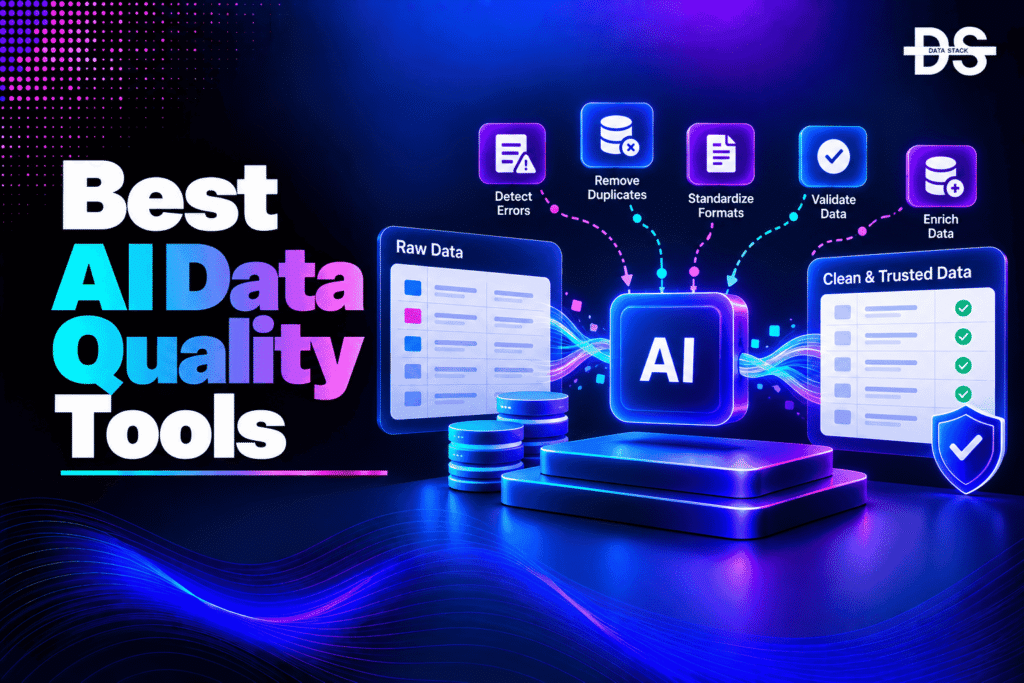
Data quality directly affects the reliability of analytics, machine learning, and AI systems. Incomplete records, duplicate values, inconsistent formats, inaccurate attributes, and unexpected changes can introduce errors that become difficult to detect once data moves through complex pipelines.
AI data quality tools use artificial intelligence and machine learning to make data quality management more automated and context-aware. Instead of relying entirely on manually defined validation rules, AI can identify unusual patterns, detect anomalies, discover relationships, classify data, recommend quality checks, and help explain why a dataset may have degraded.
The growth of AI-powered data quality tools is especially important as organizations manage increasingly large and diverse datasets for analytics and AI applications. AI can continuously learn from data behavior and help teams identify issues that traditional rule-based checks may overlook. GenAI can also make data-quality analysis easier by allowing users to investigate problems and ask questions about datasets using natural language.
However, not every data-quality platform with an AI assistant qualifies as an AI data quality tool. This list focuses on platforms where AI, machine learning, or GenAI plays a meaningful role in detecting, understanding, monitoring, predicting, or improving data quality. We evaluate their AI capabilities, automation potential, and ability to turn data-quality signals into actionable insights.
Table of Contents
ToggleWhat Are AI Data Quality Tools?
AI data quality tools use artificial intelligence, machine learning, and related technologies to identify, monitor, analyze, and improve the quality of data. They can detect anomalies, identify duplicates, recognize inconsistencies, classify data, discover relationships, and help teams understand potential quality problems.
Traditional data quality tools typically depend on predefined validation rules and thresholds. AI tools for data quality can complement those rules with machine-learning models that learn expected data behavior and identify deviations. GenAI can further help users investigate quality issues, explain findings, and create or refine quality checks using natural-language instructions.
AI Data Quality Tools vs. Traditional Data Quality Tools
| Capability | Traditional Data Quality | AI Data Quality |
|---|---|---|
| Data validation | Relies primarily on predefined rules and checks | Combines rules with AI-assisted and ML-based validation |
| Anomaly detection | Uses fixed thresholds and manually configured conditions | ML can identify unusual patterns and contextual anomalies |
| Duplicate detection | Uses exact or predefined fuzzy matching rules | AI can identify semantic similarities and potential duplicate entities |
| Pattern discovery | Depends on statistical analysis and configured profiling | AI/ML can discover less obvious patterns and relationships |
| Data classification | Requires predefined categories and rules | AI can classify data based on content and context |
| Issue detection | Reports violations of configured checks | AI can surface potential issues based on learned behavior |
| Issue explanation | Users manually investigate quality failures | GenAI can help explain findings and provide context |
| Automation | Primarily rule-based and scheduled | AI-assisted, adaptive, and increasingly automated |
AI Data Quality Tools Comparison
AI data quality platforms vary in how deeply they use AI. Some specialize in machine-learning anomaly detection, while others combine AI with data observability, intelligent matching, automated classification, or GenAI-assisted quality management.
| Tool | AI Capabilities | What You Can Automate | Best For | Free Trial | G2 Rating |
|---|---|---|---|---|---|
| Monte Carlo | ML anomaly detection and intelligent data observability | Quality monitoring, anomaly detection | Data observability | Yes — demo/trial options | 4.6/5 |
| Ataccama ONE | AI profiling, anomaly detection, classification | Quality detection and monitoring | Enterprise data quality | Yes — trial/demo | 4.6/5 |
| Informatica | CLAIRE AI, intelligent matching and quality analysis | Validation, profiling, quality monitoring | Enterprise data management | Yes — 30 days | 4.2/5 |
| Soda | ML-assisted anomaly detection and quality monitoring | Quality checks, anomaly detection | Data teams | Yes | 4.7/5 |
| Bigeye | ML-powered anomaly detection | Monitoring, profiling, quality detection | Data observability | Yes — demo | 4.6/5 |
| Dataiku | AI-assisted quality analysis and data preparation | Quality investigation and validation | Data science teams | Yes — 14 days | 4.4/5 |
| Great Expectations | AI-assisted workflows through ecosystem integrations | Validation and quality testing | Data engineering | Yes — open source | 4.5/5 |
| Acceldata | ML-driven data observability and anomaly detection | Quality monitoring and issue detection | Enterprise data platforms | Yes — demo | 4.5/5 |
| Anomalo | ML-powered automated data quality monitoring | Anomaly detection and quality monitoring | Automated data quality | Yes — demo | 4.5/5 |
9 Best AI Data Quality Tools
The tools below were selected based on their use of AI, machine learning, or intelligent automation for actual data-quality workflows. They cover AI-powered anomaly detection, automated quality monitoring, intelligent profiling, entity matching, data validation, and GenAI-assisted data-quality analysis.
#1. Monte Carlo
Monte Carlo is a data observability platform that uses machine learning and automated intelligence to help organizations understand and maintain data quality across their data environments. Rather than depending entirely on manually configured rules, its intelligent monitoring capabilities learn expected data behavior and identify unexpected changes that may indicate quality problems.
AI Capabilities
- ML-powered anomaly detection: Monte Carlo uses machine learning to identify unusual changes in data behavior, including changes that may not be captured by manually configured thresholds.
- Intelligent data monitoring: AI-driven monitoring helps establish what normal data behavior looks like and identifies deviations across monitored data assets.
- Automated issue detection: Machine-learning capabilities can surface potential data-quality incidents based on changes in data characteristics and behavior.
- Intelligent root-cause analysis: Data lineage and automated analysis help connect quality problems with upstream changes, reducing the amount of manual investigation required.
What You Can Automate
- Data anomaly detection: Automatically identify unexpected changes in data volume, freshness, distributions, schema, and other monitored characteristics.
- Quality monitoring: Continuously monitor datasets and pipelines instead of relying on periodic manual quality reviews.
- Issue detection: Surface potential data-quality incidents when observed behavior deviates from expected patterns.
- Impact analysis: Automatically identify downstream assets that may be affected when a data-quality problem occurs upstream.
- Root-cause investigation: Use lineage and intelligent analysis to help trace a detected problem back through related data assets.
Key Features
- ML anomaly detection: Learns data behavior and identifies unexpected changes across monitored assets.
- Data observability: Continuously monitors data health rather than treating quality assessment as a one-time activity.
- Data lineage: Connects datasets and dependencies so teams can understand how a detected issue can propagate.
- Automated incident detection: Identifies potential data incidents and brings them to the attention of data teams.
- Intelligent root-cause analysis: Uses data relationships and observed changes to help narrow down the source of quality problems.
Best For
Data engineering and analytics teams that need machine-learning-powered data quality monitoring across complex data environments.
AI Verdict
Monte Carlo’s core AI value comes from using machine learning to understand normal data behavior and detect anomalies automatically. This makes it particularly useful for organizations that want AI to continuously monitor data quality instead of relying exclusively on manually written checks.
Also Read: Best Monte Carlo Alternatives & Competitors in 2026

Showcase your software to buyers actively comparing tools. Submit your product for editorial review and get featured on Data Stack Hub.
Submit Your Tool →#2. Ataccama ONE
Ataccama ONE is an enterprise data management platform that combines data quality, data observability, data cataloging, master data management, and governance with AI-powered capabilities. Its AI and machine-learning functionality can help organizations detect data-quality issues, understand patterns, classify data, and automate parts of quality management.
AI Capabilities
- AI-powered data quality: Ataccama uses AI and machine learning to help identify data-quality issues and understand the characteristics of enterprise datasets.
- Machine-learning anomaly detection: AI can identify unusual patterns and changes that may indicate quality problems beyond traditional rule-based validation.
- Intelligent data classification: AI-assisted capabilities can identify and classify information based on data content and context.
- AI-assisted data understanding: The platform can use metadata and discovered relationships to provide additional context around data assets and quality issues.
What You Can Automate
- Quality issue detection: Automatically identify potential quality problems across datasets using profiling and intelligent analysis.
- Anomaly detection: Detect unusual data patterns and deviations from expected behavior.
- Data classification: Automatically identify and classify data based on its content and characteristics.
- Data-quality monitoring: Continuously monitor datasets and surface changes that may require investigation.
- Quality analysis: Combine profiling, monitoring, and AI-assisted analysis to investigate data-quality issues.
Key Features
- AI-powered profiling: Analyzes data characteristics to identify patterns and potential quality problems.
- Anomaly detection: Uses intelligent techniques to identify unusual data behavior.
- Data classification: Helps automatically identify and categorize data based on content and context.
- Data quality management: Combines validation, profiling, monitoring, and remediation capabilities.
- Data observability: Provides visibility into data behavior and changes across enterprise data assets.
Best For
Enterprise organizations that need AI-assisted data quality management combined with profiling, observability, governance, and master data capabilities.
AI Verdict
Ataccama ONE is useful when AI needs to support the complete data-quality lifecycle, rather than simply detect individual errors. Its combination of AI profiling, anomaly detection, classification, and data understanding allows organizations to use AI throughout the process of identifying and investigating quality problems.
#3. Informatica
Informatica provides enterprise data management capabilities spanning data quality, integration, governance, master data management, and data intelligence. Its CLAIRE AI technology uses artificial intelligence and machine learning to understand data, identify relationships, detect patterns, and support automated data-quality processes.
AI Capabilities
- CLAIRE AI: Informatica’s AI technology applies machine learning and metadata intelligence across its data management capabilities.
- Intelligent data quality: AI can help identify patterns, anomalies, relationships, and potential quality issues across enterprise datasets.
- AI-assisted entity matching: Machine learning can help identify records that represent the same entity even when values differ between systems.
- Intelligent classification: AI-assisted capabilities can identify and classify data based on its characteristics and context.
What You Can Automate
- Data-quality analysis: Automatically analyze datasets to identify completeness, consistency, duplication, and other quality concerns.
- Anomaly detection: Surface unusual data patterns that may require investigation.
- Entity matching: Automatically identify potential duplicate or related records across systems.
- Data classification: Classify information according to its content and business context.
- Quality monitoring: Continuously monitor data and connect detected issues with broader quality-management workflows.
Key Features
- CLAIRE AI: Provides AI and machine-learning capabilities across Informatica’s data management ecosystem.
- Data Quality: Supports profiling, validation, cleansing, standardization, matching, and monitoring.
- Intelligent matching: Uses AI-assisted techniques to identify related or duplicate records.
- Metadata intelligence: Uses metadata relationships to provide context around data and potential quality issues.
- Master Data Management: Helps create trusted master records from information distributed across multiple systems.
Best For
Large enterprises that need AI-powered data quality combined with intelligent matching, governance, metadata management, and master data management.
AI Verdict
Informatica’s AI capabilities are particularly useful for organizations dealing with large, fragmented enterprise datasets. CLAIRE AI adds intelligence to data-quality workflows by helping identify patterns, relationships, classifications, and potential issues that can be difficult to manage through manually configured rules alone.
#4. Soda
Soda is a data quality and observability platform that combines automated data-quality checks with machine-learning-based monitoring and anomaly detection. Its intelligent capabilities help teams understand how data behaves over time and identify unexpected changes that could indicate quality problems.
AI Capabilities
- ML-assisted anomaly detection: Soda can use machine-learning approaches to identify unusual changes in data behavior without requiring every anomaly threshold to be manually configured.
- Intelligent data monitoring: Automated analysis helps identify changes in distributions, volumes, freshness, and other important characteristics.
- AI-assisted quality analysis: Intelligent monitoring can help teams identify potentially meaningful deviations from expected data behavior.
- Automated data understanding: Profiling and monitoring provide an ongoing view of how data changes across pipelines and datasets.
What You Can Automate
- Data profiling: Automatically analyze important characteristics of datasets as they change.
- Anomaly detection: Detect unexpected changes in data behavior using automated and ML-assisted monitoring.
- Quality monitoring: Continuously monitor data instead of relying on periodic manual checks.
- Quality validation: Run automated quality checks and identify failures across data workflows.
- Issue investigation: Use detected anomalies and profiling information to investigate potential quality problems.
Key Features
- Soda Profiling: Provides automated visibility into important dataset characteristics and changes.
- ML-assisted detection: Helps identify unexpected patterns and deviations in data.
- Data quality checks: Allows teams to define and monitor important quality expectations.
- Data observability: Provides continuous visibility into data health across pipelines.
- Automated monitoring: Continuously evaluates data so teams can identify quality changes earlier.
Best For
Data teams that need AI-assisted anomaly detection and continuous data-quality monitoring without relying exclusively on static validation rules.
AI Verdict
Soda’s AI value comes primarily from making quality monitoring more adaptive and automated. Instead of requiring teams to manually anticipate every possible data problem, machine-learning capabilities can help identify unexpected behavior and bring potential quality issues to the surface.
#5. Bigeye
Bigeye is a data quality and observability platform that uses machine learning to monitor datasets and detect anomalies. Its approach focuses on learning normal data behavior and identifying unexpected changes automatically, allowing teams to detect potential quality problems without creating manual rules for every data asset.
AI Capabilities
- Machine-learning anomaly detection: Bigeye uses machine learning to identify unusual data behavior and deviations from expected patterns.
- Automated data profiling: Intelligent monitoring analyzes important characteristics of datasets and identifies changes that may require investigation.
- Behavior-based monitoring: Machine learning can distinguish normal changes in data from potentially problematic deviations.
- AI-assisted quality detection: Automated intelligence helps surface quality issues across large numbers of data assets.
What You Can Automate
- Data profiling: Automatically analyze datasets and track their characteristics over time.
- Anomaly detection: Identify unusual changes in distributions, values, volumes, and other data behavior.
- Quality monitoring: Continuously monitor datasets for unexpected changes.
- Issue detection: Automatically surface potential quality problems without requiring manual inspection of every dataset.
- Monitoring at scale: Apply machine-learning-based monitoring across large numbers of tables and data assets.
Key Features
- ML anomaly detection: Learns data behavior and identifies unusual changes.
- Automated data monitoring: Continuously analyzes data rather than relying on periodic profiling.
- Data quality monitoring: Tracks important characteristics and surfaces potential quality issues.
- Data profiling: Provides visibility into dataset behavior and changes.
- Data observability: Helps teams understand data health across pipelines and data environments.
Best For
Data engineering teams that need machine-learning-powered data quality monitoring and automated anomaly detection at scale.
AI Verdict
Bigeye is strongly focused on using machine learning to automate the detection of data-quality problems. Its value is particularly clear for teams managing many datasets where manually defining and maintaining quality rules for every possible anomaly would be difficult.
Increase your product visibility by reaching software buyers researching the best tools. Every submission is reviewed by our editorial team.
Feature My Tool →#6. Dataiku
Dataiku is a data and AI platform that combines data preparation, analytics, machine learning, and generative AI capabilities. Its AI-assisted features can help teams investigate data-quality problems, identify patterns, analyze unusual values, and incorporate quality analysis into broader AI and data workflows.
AI Capabilities
- AI-assisted data analysis: Dataiku can help users investigate datasets and identify characteristics that may affect data quality.
- Pattern analysis: AI-assisted workflows can help identify unusual values, relationships, and patterns that require additional investigation.
- GenAI assistance: Users can interact with supported data workflows using natural-language instructions to investigate and understand data.
- AI-assisted interpretation: GenAI can help explain analytical findings and provide context around identified data issues.
What You Can Automate
- Quality analysis: Automatically profile and analyze datasets to identify potential quality problems.
- Pattern detection: Investigate distributions, relationships, and unusual values across datasets.
- Quality investigation: Use AI assistance to explore potential causes or characteristics of detected issues.
- Data preparation: Automate repeatable preparation and transformation steps that improve data quality.
- AI-assisted analysis: Use natural-language interactions to investigate datasets and quality findings.
Key Features
- Visual data preparation: Provides interactive workflows for identifying and addressing data-quality issues.
- Data profiling: Generates statistics and information about dataset characteristics.
- AI-assisted analysis: Adds AI capabilities to supported exploration and analytical workflows.
- Python and SQL: Allows teams to build customized quality analysis when built-in functionality is insufficient.
- Machine learning workflows: Enables quality analysis to be incorporated into broader ML and AI pipelines.
Best For
Data science and analytics teams that want AI-assisted data-quality analysis connected directly to data preparation, machine learning, and AI development.
AI Verdict
Dataiku’s advantage is that data quality can be analyzed within the same environment used for data preparation and AI development. Its AI capabilities can help teams investigate quality issues and understand patterns before those datasets are used to train models or build AI applications.
Also Read: Best Dataiku Alternatives and Competitors
#7. Acceldata
Acceldata is an enterprise data observability platform that uses machine learning and intelligent monitoring to help organizations understand the health and quality of data across complex data environments. Its AI-driven capabilities can detect abnormal data behavior, identify potential quality issues, and help teams investigate problems across pipelines and data systems.
AI Capabilities
- ML-powered anomaly detection: Acceldata uses machine learning to identify abnormal behavior across data assets and pipelines instead of depending only on static thresholds.
- Intelligent data quality monitoring: AI-assisted monitoring can analyze data behavior and surface potential quality problems across complex environments.
- Behavior-based detection: Machine learning can help identify deviations from expected data patterns and distinguish them from normal changes.
- Intelligent issue analysis: Observability signals can be correlated to help teams understand relationships between data-quality problems and underlying pipeline behavior.
What You Can Automate
- Data quality monitoring: Continuously monitor data assets and pipelines for unexpected changes.
- Anomaly detection: Automatically identify unusual patterns and behavior that could indicate a data-quality issue.
- Pipeline monitoring: Analyze data movement and pipeline behavior to identify potential quality problems.
- Issue detection: Surface quality-related anomalies without requiring teams to manually inspect every dataset.
- Impact analysis: Use relationships across data assets to understand the potential impact of detected issues.
Key Features
- Machine-learning anomaly detection: Uses intelligent models to identify unexpected data behavior.
- Data observability: Provides continuous visibility into data health across complex environments.
- Data quality monitoring: Tracks quality-related signals across data assets and pipelines.
- Pipeline intelligence: Connects data behavior with pipeline activity to help investigate issues.
- Automated issue detection: Surfaces potential problems as data behavior changes.
Best For
Enterprise data teams that need AI-assisted data quality and observability across complex, distributed data environments.
AI Verdict
Acceldata is particularly relevant when AI-powered quality management needs to operate across large and complex data ecosystems. Its machine-learning approach can help teams identify abnormal behavior automatically and connect quality signals with broader pipeline and data observability information.
#8. Anomalo
Anomalo is an automated data quality platform built around machine learning-based anomaly detection. Instead of requiring data teams to manually define every possible quality rule, Anomalo learns patterns in datasets and identifies unusual changes that may indicate a data problem.
AI Capabilities
- Machine-learning anomaly detection: Anomalo learns the normal behavior of datasets and identifies unexpected changes using machine learning.
- Automated pattern learning: AI models can learn relationships and patterns across data without requiring every expected behavior to be manually defined.
- Context-aware anomaly detection: The platform can analyze multiple characteristics of data to determine whether a change is potentially unusual.
- Intelligent data quality: Machine learning helps surface quality problems that may not be covered by conventional rule-based checks.
What You Can Automate
- Data anomaly detection: Automatically identify unexpected changes across monitored datasets.
- Dataset monitoring: Continuously analyze data as new records and batches arrive.
- Quality issue detection: Surface potential problems without manually creating a check for every scenario.
- Pattern monitoring: Track learned patterns and identify when data deviates from expected behavior.
- Quality investigation: Use detected anomalies to focus investigation on the areas most likely to contain a problem.
Key Features
- Automated anomaly detection: Uses machine learning to identify unusual changes in datasets.
- Pattern learning: Learns data behavior rather than requiring teams to define every expected pattern manually.
- Data quality monitoring: Continuously evaluates datasets for potential issues.
- Automated alerts: Surfaces detected anomalies so data teams can investigate them.
- AI-based detection: Uses machine learning as a core part of the data-quality process rather than simply adding AI assistance to a traditional rules engine.
Best For
Data teams that want machine-learning-driven data quality monitoring with minimal dependence on manually written quality rules.
AI Verdict
Anomalo is one of the more AI-centric approaches to data quality because machine learning is central to how anomalies are detected. Its focus is on learning what normal data looks like and identifying deviations automatically, making it particularly useful for organizations that want to reduce the manual effort involved in defining and maintaining large numbers of quality checks.
#9. Great Expectations
Great Expectations is an open-source data quality framework that allows teams to define expectations and validate data across pipelines. Its core quality engine is primarily expectation- and rule-based rather than inherently AI-driven, but it can be incorporated into AI-powered data workflows and combined with modern AI tooling to generate, analyze, or manage validation logic.
AI Capabilities
- AI-assisted expectation development: AI coding and GenAI tools can assist teams in creating or refining expectations based on dataset requirements.
- AI workflow integration: Great Expectations can serve as the validation layer within broader machine-learning and GenAI data pipelines.
- AI-assisted quality analysis: Teams can combine validation results with AI systems to summarize failures and investigate recurring data-quality problems.
- Automated validation intelligence: Its structured validation results can provide machine-readable quality signals for downstream AI workflows.
What You Can Automate
- Data validation: Automatically evaluate datasets against defined expectations.
- Quality testing: Run repeatable data-quality tests as part of pipelines.
- Validation reporting: Generate structured results showing which expectations passed or failed.
- Pipeline quality gates: Prevent downstream workflows from continuing when important quality expectations fail.
- AI-assisted workflow development: Use GenAI coding tools to accelerate the creation and maintenance of validation logic.
Key Features
- Data Expectations: Define explicit requirements that datasets must satisfy before being accepted.
- Validation: Automatically test data against configured expectations.
- Data Docs: Provides human-readable documentation and visibility into validation results.
- Open-source framework: Allows engineering teams to customize and integrate quality validation into their own workflows.
- Pipeline integration: Can be incorporated into data engineering workflows and quality gates.
Best For
Data engineering teams that want open-source data validation that can serve as a quality layer within AI and machine-learning pipelines.
AI Verdict
Great Expectations is different from the other tools in this list because AI is not the core engine of its data-quality detection. Its strength is its role as a structured validation framework that can be integrated into AI-powered workflows. For teams specifically looking for native ML-driven anomaly detection, platforms such as Anomalo, Monte Carlo, or Bigeye are more directly AI-centric.
How to Choose the Right AI Data Quality Tool
- AI-powered anomaly detection: Prioritize tools that use machine learning to identify unusual data behavior rather than relying entirely on fixed thresholds and manually created rules.
- AI-based pattern recognition: Check whether AI can learn normal patterns across datasets and identify changes in distributions, values, relationships, or behavior that may indicate a quality problem.
- Intelligent duplicate detection: For customer, product, or entity data, look for AI or ML capabilities that can identify semantically similar records rather than relying only on exact or predefined fuzzy matching.
- AI-powered data classification: Evaluate whether AI can automatically classify data based on its content and context, including sensitive, business-critical, or domain-specific information.
- AI-assisted data validation: Look for platforms where AI can recommend, generate, or improve quality checks instead of requiring teams to manually define every validation rule.
- Context-aware quality detection: A strong AI data quality tool should consider the context and historical behavior of data when identifying an issue, rather than flagging every legitimate variation as an error.
- GenAI quality investigation: Check whether users can ask natural-language questions about quality problems and use GenAI to investigate why a dataset changed or why a particular check failed.
- AI-generated explanations: Evaluate whether the platform can explain detected anomalies and quality issues in understandable terms rather than simply producing an alert or failed check.
- AI-powered root-cause analysis: Look for AI or intelligent correlation capabilities that can connect a quality problem with upstream data, pipeline, schema, or transformation changes.
- Adaptive quality monitoring: For continuously changing datasets, prioritize machine-learning systems that learn expected behavior over time and automatically adjust their understanding of normal data patterns.
- AI-assisted remediation: Some platforms can go beyond detecting problems and recommend or automate corrective actions. This can include standardization, cleansing, enrichment, or workflow-based remediation.
- AI scalability: Evaluate whether the platform can apply its AI models across large numbers of datasets and data assets without requiring teams to manually configure and inspect each one.
- AI transparency: Check whether the platform provides enough context about why AI identified an issue, anomaly, duplicate, or classification so data teams can validate the result before taking action.
- AI integration with data workflows: The AI quality capabilities should be usable inside the broader data pipeline, analytics, ML, or GenAI workflow rather than operating as an isolated quality report.
- AI vs. rules balance: The strongest platforms do not necessarily eliminate rules. Look for tools that combine deterministic validation with AI/ML detection so known requirements can be enforced while previously unknown issues can also be discovered.
Browse expertly curated software recommendations across hundreds of business categories.
Browse Top Tools →Conclusion
AI data quality tools are moving data-quality management beyond manually defined validation rules. Machine learning can identify unusual behavior, learn expected data patterns, detect anomalies, and surface potential problems that may otherwise require extensive manual investigation. GenAI can further improve the workflow by helping teams understand quality findings and investigate issues through natural-language interactions.
The tools covered in this list take different AI-first approaches. Monte Carlo, Bigeye, Anomalo, Soda, and Acceldata focus heavily on machine-learning-based anomaly detection and continuous data observability. Ataccama ONE and Informatica combine AI-powered quality capabilities with profiling, classification, matching, and broader enterprise data management. Dataiku connects AI-assisted quality analysis with data preparation and AI development, while Great Expectations provides a rule-based validation foundation that can be incorporated into AI-powered data workflows.
The right AI data quality tool depends on how you want AI to participate in the quality process. Some organizations need machine learning to continuously detect unknown anomalies, while others need AI to classify data, resolve entities, recommend quality checks, explain failures, or support remediation.
AI can significantly reduce the manual effort involved in monitoring large datasets, but AI-generated findings should still be validated before they trigger important production changes. Combining AI detection with deterministic quality rules and human validation can provide a stronger approach for critical data environments.
Frequently Asked Questions
1. What are AI data quality tools?
AI data quality tools use artificial intelligence, machine learning, or GenAI to detect, analyze, monitor, and improve data quality. They can identify anomalies, discover patterns, classify data, detect duplicates, investigate quality issues, and help explain why data may have changed.
2. How are AI data quality tools different from traditional data quality tools?
Traditional data quality tools primarily depend on predefined validation rules, thresholds, and checks. AI-powered data quality tools can complement those rules with machine learning that identifies unusual patterns and behavior that may not have been explicitly defined in advance.
3. How is AI changing data quality management?
AI is making data-quality monitoring more adaptive and automated. Instead of manually defining every possible problem, machine-learning models can learn expected data behavior and identify deviations. GenAI can also help users investigate and explain quality issues.
4. What AI technologies are used in data quality tools?
Common technologies include machine learning, anomaly detection, pattern recognition, entity matching, classification models, natural-language processing, generative AI, and metadata intelligence. Different platforms use different combinations depending on their data-quality approach.
5. What can AI data quality tools automate?
AI can help automate anomaly detection, data profiling, duplicate detection, classification, quality monitoring, issue investigation, root-cause analysis, and in some platforms, recommendations for remediation.
6. Can AI detect data-quality problems without predefined rules?
Yes. Machine-learning-based systems can learn normal data behavior and identify deviations without requiring a manually written rule for every potential anomaly. However, deterministic rules remain useful for known business and regulatory requirements.
7. Can AI improve data validation?
Yes. AI can assist with identifying patterns, recommending quality checks, detecting anomalies, and analyzing validation results. Some platforms also allow GenAI to help users create or refine quality logic.
8. Can AI detect duplicate records?
Yes. AI and machine-learning models can identify records that may represent the same entity even when names, addresses, identifiers, or other attributes differ. This can be useful for customer, product, and company data.
9. Can GenAI explain data-quality issues?
Yes. GenAI can summarize quality findings, explain anomalies in natural language, help users investigate failed checks, and answer questions about profiling and monitoring results when those capabilities are supported by the platform.
10. Can AI data quality tools automatically fix bad data?
Some platforms provide recommendations or automated remediation capabilities, but detection and remediation are separate functions. AI-generated corrections should be validated before they are applied to important production datasets.
11. What are the best AI data quality tools in 2026?
The 9 AI data quality tools covered in this list are:
- Monte Carlo
- Ataccama ONE
- Informatica
- Soda
- Bigeye
- Dataiku
- Acceldata
- Anomalo
- Great Expectations
These tools cover different approaches to AI-powered data quality, including machine-learning anomaly detection, intelligent profiling, data classification, entity matching, continuous monitoring, and AI-assisted quality workflows.
12. Are AI data quality tools useful for machine learning and GenAI?
Yes. Poor-quality training and retrieval data can affect downstream AI systems. AI-powered quality tools can help identify anomalies, missing information, inconsistent records, and unexpected changes before data is used for machine learning, RAG, or GenAI applications.
13. Can AI data quality replace traditional data-quality rules?
Not necessarily. AI and traditional rules solve different problems. Rules are useful for known requirements that must always be enforced, while machine learning can help discover unexpected patterns and anomalies. Combining both approaches can provide broader quality coverage.
14. What should you look for in an AI data quality tool?
Focus on the depth of its AI capabilities, including ML anomaly detection, pattern learning, intelligent classification, duplicate detection, AI-assisted validation, GenAI investigation, root-cause analysis, adaptive monitoring, and AI-assisted remediation. The key is whether AI materially improves how quality problems are discovered and understood.