
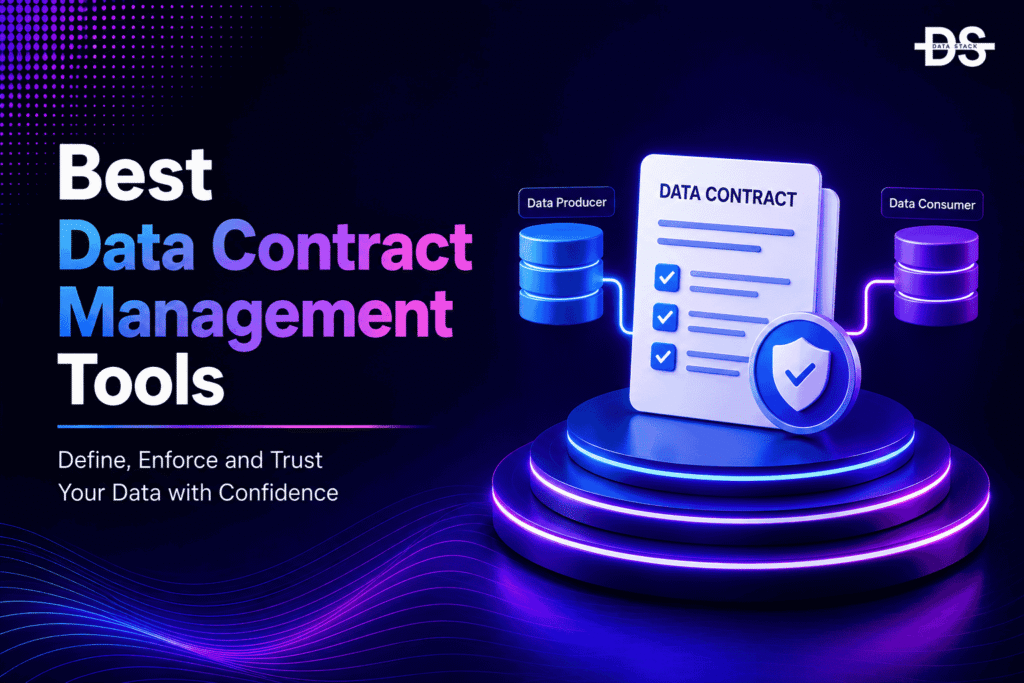
Data contracts help prevent a common problem in modern data environments: one team changes a dataset, API, or schema without realizing that downstream consumers depend on the previous structure. A renamed field, changed data type, altered business definition, or unexpected value can break pipelines and quietly degrade analytics.
The need for stronger data contracts has grown alongside the expansion of data products and decentralized data ownership. A 2024 dbt Labs survey found that 57% of data teams said data quality was one of their biggest challenges, highlighting the need for stronger controls around how data is produced and consumed.
Data contract management tools are platforms and frameworks that help teams define, validate, enforce, and monitor agreements between data producers and consumers. These agreements can specify schemas, field definitions, quality expectations, ownership, freshness, compatibility, and other requirements that data must satisfy as it moves between systems.
Data contract tools differ considerably in scope. Some focus on schema enforcement and contract testing within data pipelines, while others provide centralized governance, observability, ownership, versioning, and monitoring for data products. Open-source frameworks can also be useful for engineering teams that want to define contracts directly in code and integrate validation into CI/CD or existing pipelines.
This guide covers the 9 best data contract management tools in 2026 and evaluates them based on contract definition, schema validation, compatibility checks, testing, monitoring, governance, integrations, automation, deployment options, pricing, and open-source availability.
Why Do You Need Data Contract Management Tools?
Data contracts create a shared understanding between teams that produce and consume data, helping prevent unexpected changes from reaching downstream systems. Dedicated tools make it easier to manage those agreements consistently as organizations add more data sources, pipelines, teams, and data products.
- Prevent breaking changes: Detect schema or structural changes that could disrupt downstream pipelines, applications, dashboards, or analytical models.
- Define data expectations: Document requirements for fields, data types, allowed values, ownership, freshness, and other characteristics that consumers depend on.
- Improve data quality: Validate incoming data against predefined expectations before problems spread to downstream systems.
- Protect downstream consumers: Give analytics, engineering, and business teams greater visibility into changes that could affect the data they use.
- Automate contract testing: Run validation checks automatically during development, deployment, ingestion, or pipeline execution.
- Manage schema evolution: Track how datasets change over time and determine whether new versions remain compatible with existing consumers.
- Clarify data ownership: Establish which teams are responsible for producing, maintaining, and resolving issues with specific data products.
- Create reliable data products: Give consumers clearer expectations about the structure, meaning, quality, and availability of published datasets.
- Support decentralized data teams: Provide common standards when multiple teams independently produce and manage data.
- Catch issues earlier: Identify contract violations closer to the source instead of discovering broken data after it reaches dashboards or downstream applications.
- Improve collaboration: Create a shared technical agreement between producers and consumers so changes do not depend entirely on informal communication.
- Maintain contract history: Track changes to definitions and schemas so teams can understand when and why a data contract was modified.
- Integrate with data pipelines: Incorporate contract validation into existing ingestion, transformation, orchestration, and deployment workflows.
- Support governance: Connect technical data requirements with ownership, documentation, lineage, and broader data-governance processes.
- Scale data operations: Apply consistent expectations across growing numbers of datasets and data products without managing every agreement manually.
Top 9 Data Contract Management Tools: Comparison
Data contract management ranges from developer-focused contract testing frameworks to broader platforms that combine contracts with data quality, observability, cataloging, and governance. The comparison below focuses on the capabilities, deployment models, pricing, and open-source availability that matter when evaluating these tools.
| Tool | Best For | Open Source | Pricing | G2 Rating |
|---|---|---|---|---|
| Soda | Data quality and contract testing | Yes | Custom pricing / free options | 4.5/5 |
| Great Expectations | Code-based data validation and testing | Yes | Free; commercial options | 4.4/5 |
| Data Contract CLI | Developer-led data contract validation | Yes | Free and open source | N/A |
| Elementary | dbt-based data quality and contracts | Yes | Free; commercial options | 4.7/5 |
| Monte Carlo | Data observability and data contracts | No | Custom pricing | 4.6/5 |
| Bigeye | Data observability and quality monitoring | No | Custom pricing | 4.6/5 |
| Collibra | Data governance and contract-related controls | No | Custom pricing | 4.3/5 |
| Atlan | Data products, governance, and collaboration | No | Custom pricing | 4.6/5 |
| Aporia | Data quality and reliability workflows | No | Custom pricing | 4.6/5 |
Best 9 Data Contract Management Tools in 2026
The tools in this list cover data contract testing, schema validation, data quality, observability, governance, and data-product management. It includes open-source frameworks for engineering-led implementations alongside commercial platforms designed to manage data reliability across larger organizations.
#1 Soda
Soda is a data quality and observability platform that helps data teams define, test, and monitor expectations for data across modern data stacks. Its capabilities can be used to implement data contracts by turning requirements around freshness, completeness, validity, uniqueness, schema, and other quality dimensions into automated checks.
Soda supports both development-time and production data workflows, allowing teams to validate data as it moves through pipelines and monitor its condition after it reaches analytical systems. This helps data producers identify contract violations closer to the source while giving downstream consumers greater confidence that published datasets continue to meet agreed requirements.
The platform combines data quality testing with monitoring and investigation workflows, so teams can move from defining expectations to detecting failures and understanding their impact. This makes Soda useful for organizations that want data contracts to cover not only schema compatibility but also measurable data quality requirements.
Key Features
- Data contract checks: Define expectations around the structure, quality, and behavior of datasets and use automated checks to identify violations.
- Data quality testing: Validate conditions such as completeness, uniqueness, validity, missing values, and acceptable ranges before data reaches downstream consumers.
- Schema monitoring: Detect unexpected additions, removals, or modifications to columns and other structural elements.
- Freshness monitoring: Track whether datasets are being updated within the timeframes expected by their consumers.
- Anomaly detection: Identify unusual changes in data patterns that may indicate a pipeline problem or a deviation from established expectations.
- Data observability: Monitor data quality over time and provide visibility into the health of datasets across the data environment.
- Pipeline integration: Run data quality and contract checks as part of ingestion, transformation, orchestration, and other pipeline processes.
- Automated monitoring: Continuously evaluate datasets against defined quality expectations rather than relying on periodic manual checks.
- Incident management: Surface failed checks and quality issues so data teams can investigate and resolve problems.
- Data source connectivity: Connect monitoring and quality workflows with databases, warehouses, and other components of modern data infrastructure.
- Reusable checks: Create standardized quality checks that can be applied across multiple datasets and data products.
- Developer workflows: Allow data teams to incorporate quality validation into development and deployment processes before changes reach production.
Pricing: Commercial pricing is available through a custom quote, with free/open-source options also available.
G2 Rating: 4.5/5.
#2 Great Expectations
Great Expectations is an open-source data quality and validation framework that lets data teams define explicit expectations for how datasets should look and behave. It can be used to validate schemas, values, completeness, uniqueness, formats, and other conditions before data is consumed by downstream applications, analytics systems, or data products.
The framework takes a code-oriented approach to data validation, making it useful for teams that want to incorporate data contracts directly into their existing engineering workflows. Data teams can define reusable expectations for specific datasets and execute them during pipeline runs, development, or deployment. When data fails those expectations, teams can identify the problem before unreliable data moves further through the stack.
Great Expectations is broader than a dedicated data contract management platform. Its value comes from giving engineering and analytics teams a flexible validation layer that can enforce the practical requirements defined in a data contract. This makes it particularly relevant for organizations that want contract testing to remain closely connected to data pipelines and automated testing practices.
Key Features
- Data expectations: Define explicit rules describing the conditions that datasets are expected to satisfy.
- Schema validation: Check column names, data types, structures, and other schema characteristics against predefined expectations.
- Value validation: Validate ranges, formats, allowed values, nullability, and other field-level requirements.
- Completeness checks: Identify missing or unexpectedly null values that could violate data-quality requirements.
- Uniqueness validation: Check whether fields expected to contain unique values contain duplicates.
- Expectation suites: Group related validation rules into reusable collections that can be applied to specific datasets or workflows.
- Automated validation: Run data-quality checks automatically as part of ingestion, transformation, testing, or deployment workflows.
- Data documentation: Generate documentation around expectations and validation results so producers and consumers can understand dataset requirements.
- Pipeline integration: Incorporate validation into existing data-engineering workflows rather than maintaining a separate manual quality process.
- Python support: Provides a Python-based framework that developers can integrate into custom data applications and pipelines.
- Validation results: Records whether datasets satisfy defined expectations, helping teams identify failures and investigate data-quality problems.
- Open-source framework: Gives technical teams access to the underlying validation framework and flexibility to adapt it to their own infrastructure.
Pricing: Free and open source, with commercial offerings available.
G2 Rating: 4.4/5.
Showcase your software to buyers actively comparing tools. Submit your product for editorial review and get featured on Data Stack Hub.
#3 Data Contract CLI
Data Contract CLI is an open-source, developer-oriented approach to managing data contracts as part of the data engineering lifecycle. Instead of treating a contract as documentation that teams reference manually, it allows teams to define technical expectations for datasets and validate data against those expectations through automated workflows.
The approach is useful when data producers and consumers need a machine-readable agreement covering elements such as schema, data types, required fields, and quality expectations. Contracts can be versioned alongside code and incorporated into development or deployment processes, helping teams identify incompatible changes before they reach production.
Data Contract CLI is better suited to engineering-led environments than organizations looking for a centralized enterprise data governance platform. Teams can integrate contract validation into their existing CI/CD, pipeline, and testing infrastructure and maintain greater control over how contracts are created, reviewed, and enforced.
Key Features
- Data contract definitions: Create machine-readable contracts that describe the expected structure and requirements of published datasets.
- Schema validation: Compare incoming data against defined schemas to identify incompatible or unexpected structural changes.
- Contract testing: Automate checks that determine whether a producer continues to meet the requirements agreed with downstream consumers.
- Data type validation: Verify that fields contain the expected types and structures before data is consumed.
- Required-field checks: Identify missing fields or values that violate contract requirements.
- Version-controlled contracts: Store contract definitions alongside code so changes can be reviewed, tracked, and rolled back when necessary.
- CI/CD integration: Run contract validation during development, testing, and deployment to catch breaking changes before production.
- Automated validation: Reduce reliance on manual checks by executing contract tests as part of existing engineering workflows.
- Producer-consumer alignment: Give data producers and consumers a shared technical definition of what a dataset should contain.
- Developer-focused workflows: Allow engineering teams to manage contracts through code and existing development tools.
- Custom validation: Adapt contract checks to the specific structure and requirements of individual datasets.
- Open-source implementation: Provides teams with an approach they can inspect, customize, and operate within their own technical environment.
Pricing: Free and open source.
G2 Rating: N/A.
#4 Elementary
Elementary is an open-source data observability platform designed primarily for teams using dbt and modern analytics engineering workflows. It helps teams monitor data quality, transformation models, tests, freshness, schema changes, and other signals that indicate whether data continues to meet expected requirements.
Although Elementary is not limited to data contract management, its monitoring capabilities can support contract-driven data practices. Teams can establish expectations around transformed datasets and use automated monitoring to detect when schemas, freshness, volumes, or other data characteristics change unexpectedly. This creates a feedback loop between the expectations defined for a data product and the actual condition of that data in production.
Elementary is particularly relevant for organizations that already manage transformations through dbt and want data-quality monitoring integrated into that workflow. Instead of maintaining a separate monitoring layer, teams can use dbt metadata and tests alongside Elementary’s observability capabilities to identify issues and understand where they originated.
Key Features
- Data quality monitoring: Tracks the health of datasets and transformation models to identify quality issues over time.
- dbt integration: Connects with dbt models, tests, metadata, and transformation workflows.
- Schema change detection: Identifies unexpected structural changes that could affect downstream consumers.
- Freshness monitoring: Tracks whether datasets and models are updated according to expected schedules.
- Volume monitoring: Detects unexpected increases or decreases in the number of records being processed.
- Anomaly detection: Identifies unusual behavior in data metrics that may indicate a pipeline or contract problem.
- Data lineage: Shows upstream and downstream relationships between models and datasets to help teams assess the impact of changes.
- Test monitoring: Collects and monitors the results of data-quality tests so teams can identify recurring failures.
- Data profiling: Provides visibility into data characteristics and changes across monitored datasets.
- Alerting: Notifies data teams when monitored metrics or quality conditions move outside expected thresholds.
- Open-source platform: Provides an open-source option that teams can deploy and manage within their own environments.
- Production monitoring: Continuously observes data after it has been transformed and delivered to downstream consumers.
Pricing: Free and open source; commercial options are available.
G2 Rating: 4.7/5.
#5 Monte Carlo
Monte Carlo is a data observability platform that helps organizations monitor the reliability and quality of data across warehouses, pipelines, BI systems, and other parts of the modern data stack. Its scope extends beyond data contracts, but its ability to monitor freshness, schema, volume, lineage, and data quality makes it relevant for organizations implementing contract-based data practices.
A data contract can define what consumers expect from a dataset, while observability helps determine whether those expectations continue to hold in production. Monte Carlo provides automated monitoring that can detect unexpected changes and alert data teams when a dataset behaves differently from its established patterns.
The platform is designed for larger data environments where many teams produce and consume data. Its lineage and incident-management capabilities can also help teams understand which downstream assets may be affected when a dataset changes or fails to meet an expected condition.
Key Features
- Data observability: Provides continuous visibility into the health and reliability of data across the modern data stack.
- Schema monitoring: Detects unexpected changes to tables, columns, and other structural elements that may affect downstream consumers.
- Freshness monitoring: Identifies datasets that have not been updated within their expected time windows.
- Volume monitoring: Detects unusual changes in record counts and data volumes that may indicate upstream problems.
- Data quality monitoring: Tracks changes in data behavior and quality signals across production datasets.
- Data lineage: Maps relationships between data assets to help teams understand downstream impact when contracts or datasets change.
- Automated monitoring: Continuously evaluates data without requiring teams to manually inspect datasets after every pipeline run.
- Alerting: Sends notifications when monitored data violates expectations or shows potentially harmful changes.
- Incident management: Helps data teams investigate, prioritize, and resolve data reliability problems.
- Impact analysis: Uses lineage and dependency information to help identify consumers that may be affected by a data change.
- Integrations: Connects with data warehouses, transformation tools, orchestration systems, BI platforms, and other components of enterprise data environments.
- Data reliability workflows: Supports broader processes for maintaining dependable data products across distributed teams.
Pricing: Custom pricing.
G2 Rating: 4.6/5.
Also Read: Best Monte Carlo Alternatives & Competitors in 2026
#6 Bigeye
Bigeye is a data observability platform focused on monitoring data quality and detecting unexpected changes across enterprise data environments. It helps teams establish visibility into the condition of their datasets and identify issues involving freshness, volume, distributions, schema, and other data characteristics.
For data contract initiatives, Bigeye can provide the monitoring layer that checks whether published data continues to meet expected conditions after it enters production. Instead of relying exclusively on tests that run during development or pipeline execution, teams can continuously monitor the resulting data and investigate deviations from established baselines.
The platform is aimed at organizations managing data across multiple systems and pipelines. Its automated monitoring and anomaly-detection capabilities can reduce the amount of manual work required to identify data-quality problems and can help teams respond when data no longer behaves as expected.
Key Features
- Data quality monitoring: Continuously evaluates datasets to identify quality problems and unexpected changes.
- Anomaly detection: Detects unusual patterns in data that may indicate pipeline failures, quality issues, or contract violations.
- Schema monitoring: Tracks structural changes and identifies modifications that could affect downstream systems.
- Freshness monitoring: Checks whether data is arriving and updating according to expected schedules.
- Data profiling: Examines datasets to establish baselines and provide visibility into their characteristics.
- Distribution monitoring: Detects changes in the distribution of values that may signal unexpected upstream behavior.
- Automated alerts: Notifies teams when monitored datasets deviate from established expectations or thresholds.
- Data observability: Provides a broader view of data health across multiple sources and environments.
- Pipeline visibility: Helps teams identify where quality problems occur within the broader data flow.
- Monitoring automation: Reduces dependence on manually reviewing tables, dashboards, and pipeline outputs.
- Enterprise connectivity: Integrates monitoring with databases, warehouses, pipelines, and other data infrastructure.
- Issue investigation: Provides information that teams can use to investigate the source and potential impact of data-quality problems.
Pricing: Custom pricing.
G2 Rating: 4.6/5.
Increase your product visibility by reaching software buyers researching the best tools. Every submission is reviewed by our editorial team.
Feature My Tool →#7 Collibra
Collibra is a data intelligence and governance platform that helps organizations catalog, govern, document, and manage data across the enterprise. It is broader than a dedicated data contract testing solution, but its governance capabilities can support the organizational side of data contracts by establishing ownership, definitions, policies, quality expectations, and accountability around data assets.
Data contracts are not only technical agreements. In larger organizations, consumers also need to know who owns a dataset, what its fields mean, what policies apply to it, and where it is used. Collibra provides a centralized environment for managing these governance requirements and connecting business context with technical metadata.
This makes the platform relevant for organizations where data contracts form part of a wider data governance or data-product strategy. Rather than focusing exclusively on schema validation, teams can use governance workflows, metadata, lineage, and stewardship capabilities to establish clearer responsibilities around data.
Key Features
- Data governance: Provides centralized capabilities for defining and managing policies, standards, responsibilities, and governance processes.
- Data catalog: Maintains an inventory of datasets, reports, applications, and other data assets with associated metadata.
- Data ownership: Identifies responsible teams and individuals for data assets and domains.
- Business definitions: Documents business terms and definitions so producers and consumers have a common understanding of important data concepts.
- Data quality management: Connects data-quality information with governed data assets and business context.
- Metadata management: Organizes technical and business metadata from multiple systems.
- Data lineage: Shows relationships between data assets and helps users understand how information moves through the organization.
- Workflow management: Supports governance, approval, stewardship, and issue-resolution workflows.
- Policy management: Helps organizations apply governance requirements to data assets and processes.
- Data discovery: Makes governed datasets easier for consumers to find and understand.
- Stewardship: Provides processes for assigning and managing responsibilities around enterprise data.
- Enterprise integration: Connects governance and metadata workflows with data platforms and business systems.
Pricing: Custom pricing.
G2 Rating: 4.3/5.
#8 Atlan
Atlan is an active metadata and data catalog platform designed to help data teams discover, document, govern, and collaborate around data assets. Its focus extends beyond traditional cataloging by connecting technical metadata, business context, ownership, lineage, and quality information in a shared environment.
For data contracts, Atlan can provide the collaborative and governance layer around datasets and data products. Producers can document ownership and expectations while consumers can discover relevant datasets and understand their structure, context, lineage, and quality signals before using them.
The platform is particularly useful in organizations where data teams operate across many domains and need a shared source of information about their data assets. While it does not replace code-level contract testing in every implementation, it can complement those processes by making contract-related metadata and responsibilities accessible to a wider group of users.
Key Features
- Active metadata management: Collects and organizes technical and business metadata from across the data stack.
- Data catalog: Provides searchable discovery for tables, dashboards, models, pipelines, and other data assets.
- Data ownership: Makes owners and responsible teams visible so consumers know where to direct questions or issues.
- Data product management: Helps teams organize and present governed datasets as reusable data products.
- Data lineage: Maps upstream and downstream relationships to provide context around how data is produced and consumed.
- Data quality visibility: Surfaces available quality signals and information alongside governed data assets.
- Business context: Connects technical datasets with descriptions, definitions, ownership, and other contextual information.
- Collaboration: Allows producers and consumers to share context and work together around data assets.
- Governance workflows: Supports processes for policies, stewardship, access, and other governance requirements.
- Metadata search: Helps users locate relevant data and understand its context before using it.
- Integration ecosystem: Connects with warehouses, transformation tools, BI systems, orchestration platforms, and other components of the data stack.
- Data discovery: Makes technical and business information about data more accessible to engineering, analytics, and business teams.
Pricing: Custom pricing.
G2 Rating: 4.6/5.
#9 Aporia
Aporia provides monitoring and reliability capabilities for machine-learning and AI systems, with a focus on identifying changes in data and model behavior after deployment. Its primary use case is broader than traditional data contract management, but its data monitoring and validation capabilities can be relevant when contracts are used to define requirements for data feeding production AI systems.
AI applications often depend on data pipelines that need to maintain consistent structure, quality, and distribution. Aporia can help teams monitor these inputs and identify unexpected changes that could affect model behavior. This provides an additional layer of protection when data contracts are used as part of an AI reliability strategy.
The platform is therefore more specialized than general-purpose data contract tools. It is particularly relevant when data contracts need to operate alongside model monitoring, drift detection, and production AI observability rather than being limited to conventional analytical datasets.
Key Features
- Data monitoring: Tracks incoming data and relevant metrics to identify unexpected changes in production AI workflows.
- Data validation: Helps teams monitor whether data used by models continues to satisfy established requirements.
- Data drift detection: Identifies changes in data distributions that can affect model behavior and downstream AI systems.
- Anomaly detection: Surfaces unusual patterns that may indicate problems with upstream data or production inputs.
- Model monitoring: Tracks model behavior alongside the data that influences predictions and outputs.
- Performance monitoring: Provides visibility into changes in model and data behavior after deployment.
- Alerting: Notifies teams when monitored metrics or data conditions move outside expected thresholds.
- Production monitoring: Continuously evaluates deployed AI systems instead of relying solely on pre-production validation.
- Data and model visibility: Connects information about input data with model behavior to help teams investigate reliability problems.
- Workflow integration: Supports integration with engineering and operational workflows used to monitor production AI systems.
- Monitoring automation: Reduces the need for manual inspection of production datasets and model metrics.
- AI reliability: Helps organizations identify data-related issues before they result in degraded or unexpected AI system behavior.
Pricing: Custom pricing.
G2 Rating: 4.6/5.
How to Choose the Best Data Contract Management Tools
Choosing a data contract management tool depends on how your organization produces and consumes data, the level of enforcement required, and whether contracts need to cover technical, quality, or governance requirements.
- Define what the contract should cover: Decide whether your contracts need to specify only schemas and data types or also include freshness, completeness, validity, ownership, SLAs, and other requirements.
- Identify the contract owners: Establish whether data producers, platform teams, data stewards, or domain owners will be responsible for creating and maintaining contracts.
- Determine where validation should happen: Consider whether contracts need to be checked during development, CI/CD, ingestion, transformation, production monitoring, or across several stages.
- Assess your existing data stack: Look at the warehouses, databases, transformation frameworks, orchestration tools, and applications already used by your teams before selecting a platform.
- Consider your operating model: Centralized data teams may need governance and visibility, while decentralized data teams may place greater emphasis on self-service contract creation and ownership.
- Decide how changes should be managed: Determine how schema changes, new fields, removed fields, and incompatible updates should be reviewed and communicated.
- Plan for contract violations: Establish what should happen when published data does not meet its contract, including alerts, pipeline failures, rollback procedures, or manual review.
- Evaluate versioning requirements: Consider how contracts will be versioned and how consumers will transition when a producer publishes a new version of a dataset.
- Consider governance needs: If contracts need to include ownership, business definitions, policies, lineage, or stewardship, evaluate whether you need capabilities beyond technical contract testing.
- Assess scalability: Consider how the chosen approach will work as the number of datasets, data products, producers, consumers, and contracts grows.
- Review deployment requirements: Determine whether your organization requires an open-source framework, managed SaaS platform, self-hosted deployment, or a combination of approaches.
- Measure operational overhead: Consider how much effort teams will need to spend creating, maintaining, testing, monitoring, and updating contracts over time.
- Consider consumer visibility: Make sure downstream teams can easily discover contract requirements and understand what they can expect from a dataset before building against it.
- Evaluate integration with development workflows: If engineering teams manage data through code, consider whether contracts can be reviewed, tested, and deployed through existing version-control and CI/CD processes.
Browse expertly curated software recommendations across hundreds of business categories.
Browse Top Tools →Conclusion
Data contract management helps organizations create clearer agreements between the teams that produce data and the teams that depend on it. By defining expectations around schemas, quality, ownership, freshness, and other requirements, organizations can reduce the risk of unexpected changes reaching downstream systems.
The tools in this list take different approaches. Soda and Great Expectations focus heavily on data quality and validation, while Data Contract CLI provides a more developer-oriented approach to contract testing. Elementary combines data observability with dbt workflows, while Monte Carlo and Bigeye provide broader monitoring capabilities for production data environments. Collibra and Atlan bring governance, metadata, ownership, and data-product context into the picture, while Aporia is more specialized toward AI and machine-learning reliability.
The right choice depends on how your organization defines and enforces data expectations. Teams that want contracts embedded directly into engineering workflows may prefer open-source or code-first approaches, while larger organizations may need centralized governance, observability, and collaboration alongside contract validation.
Before selecting a platform, define what your contracts need to cover, where they need to be enforced, who will maintain them, and how violations should be handled. A practical data contract strategy should make expectations explicit without creating so much operational overhead that producers and consumers stop maintaining the agreements.