
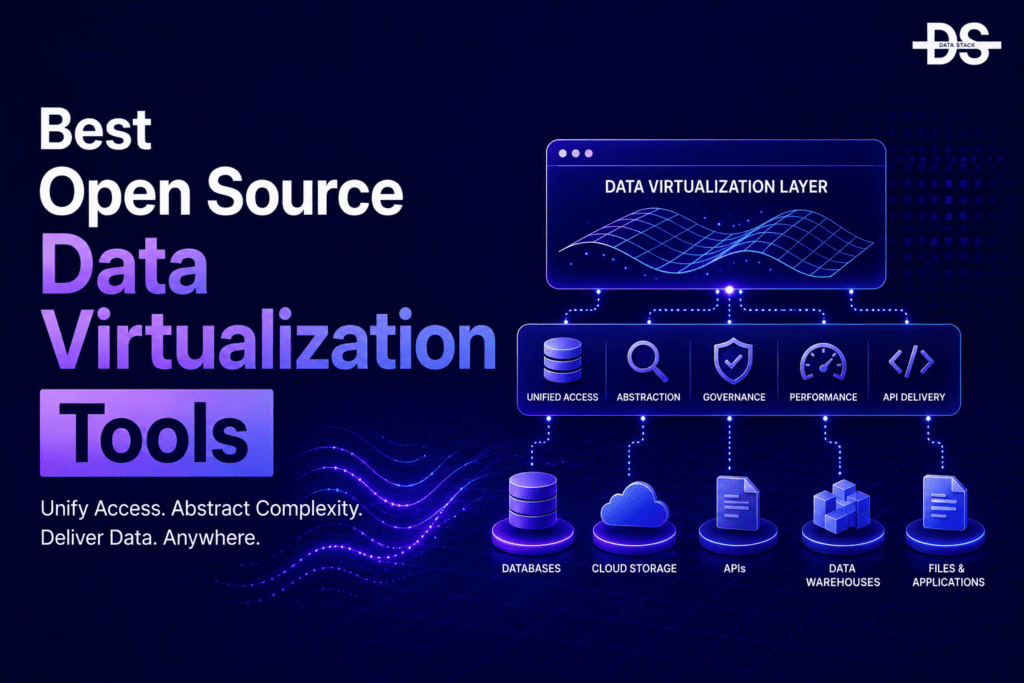
Data teams increasingly need to analyze information spread across databases, cloud warehouses, data lakes, SaaS applications, and operational systems. Moving every dataset into a central repository can improve consistency, but it also creates duplicate pipelines, additional storage costs, and delays between when data changes and when it becomes available for analysis.
Data virtualization offers a different approach. Instead of physically copying every dataset, a virtualization layer can provide a unified way to access and query data where it already lives. This can help analysts and applications work across multiple systems while reducing unnecessary data movement.
Open source data virtualization tools vary significantly in how they solve this problem. Some are purpose-built SQL query engines that federate queries across many sources, while others focus on logical data layers, API-based access, or virtualization within specific database ecosystems. The right tool depends on the number of sources, query patterns, performance requirements, and how much abstraction your team needs.
Table of Contents
ToggleWhat is a Data Virtualization Tool?
A data virtualization tool creates a logical access layer over data stored in different systems. Users can query or consume data through a unified interface without necessarily needing to replicate every dataset into a separate physical database or warehouse.
In practice, open source data virtualization is often implemented through query federation. A federated query engine connects to multiple sources, pushes processing down to those systems when possible, and combines results into a single query. Other platforms provide a semantic, API, or logical data layer on top of distributed sources. This means the best data virtualization tool is not always a traditional “virtualization platform”; it may instead be the query engine or abstraction layer that best fits the architecture.
Open Source Data Virtualization Tools Comparison for 2026
| Tool Name | Category | Best For | Key Strength | Deployment Options | Licensing |
|---|---|---|---|---|---|
| Trino | Federated SQL Engine | Large-scale cross-source analytics | Broad connector ecosystem and distributed SQL federation | Self-hosted, Docker, Kubernetes, cloud | Apache 2.0 |
| Apache Drill | Schema-Free Query Engine | Semi-structured and multi-source data | Schema-on-read queries across diverse sources | Self-hosted, Docker, cloud | Apache 2.0 |
| Dremio | Lakehouse and Virtualization Platform | Lakehouse data access and acceleration | Federated SQL with query acceleration and logical datasets | Self-hosted, Docker, Kubernetes, cloud | Apache 2.0 core |
| Teiid | Data Virtualization Platform | Relational data integration and abstraction | Unified relational views across heterogeneous sources | Self-hosted, Docker, cloud | Apache 2.0 |
| Presto | Distributed SQL Engine | Large-scale distributed analytics | Massively parallel SQL across distributed data | Self-hosted, Docker, Kubernetes, cloud | Apache 2.0 |
| Apache Calcite | Data Management Framework | Building custom federation and query layers | Extensible SQL parsing, optimization, and adapters | Embedded, self-hosted | Apache 2.0 |
| DuckDB | Analytical Query Engine | Local and embedded multi-source analytics | Lightweight SQL access to files and external data | Embedded, local, serverless | MIT |
| Denodo Community Edition | Data Virtualization Platform | Evaluating enterprise-style data virtualization | Logical data layer and broad data access capabilities | Self-hosted | Commercial / Community Edition |
The category has evolved considerably. Modern data virtualization increasingly overlaps with query federation, where engines such as Trino, Presto, and Dremio query distributed sources without requiring every dataset to be copied first. Traditional virtualization platforms still matter, particularly for enterprises that need a governed logical layer across legacy, cloud, and operational systems.
The 8 Best Open Source Data Virtualization Tools in 2026
The tools below cover the main approaches to open-source data virtualization: federated SQL, schema-on-read querying, logical relational abstraction, embedded analytics, and frameworks for building custom query layers.
#1 Trino
Trino is the strongest overall choice for organizations that need to query data across many different systems through a single SQL interface. It is an open source distributed SQL engine designed for analytics across object storage, relational databases, NoSQL systems, streaming platforms, and other data sources.
Its biggest advantage for data virtualization is its connector architecture. Instead of forcing teams to move every dataset into one warehouse or lake, Trino can connect to supported systems and execute federated queries across them. This makes it particularly useful when an organization has data distributed across technologies such as PostgreSQL, MySQL, Kafka, Iceberg, Hive, S3, Snowflake, or other platforms.
Trino is not a complete traditional data virtualization platform with every governance and semantic capability included. However, for SQL-based federation at scale, it is one of the most mature and widely adopted open-source foundations in this category.
Key Features
- Federated SQL queries: Query and join data across multiple supported systems through one SQL interface.
- Extensive connector ecosystem: Connects to databases, warehouses, object storage, streaming platforms, and lakehouse technologies.
- Distributed query execution: Uses massively parallel processing for large analytical workloads.
- Query pushdown: Pushes compatible filtering and processing operations closer to the underlying data source.
- Open lakehouse support: Works with technologies such as Apache Iceberg, Hive, and other open data environments.
- Scalable architecture: Can be deployed across clusters for larger and more demanding workloads.
Best For
Trino is best for organizations that need open source SQL federation across a large number of distributed data sources without physically consolidating all data first.
#2 Apache Drill
Apache Drill takes a more flexible approach to data virtualization through schema-on-read SQL querying. It allows users to explore and query structured and semi-structured data without requiring every source to follow a rigid predefined schema.
This makes Apache Drill particularly useful when data is spread across files, NoSQL databases, Hadoop environments, cloud storage, and other systems with different structures. Analysts and engineers can use SQL to explore JSON, Parquet, CSV, and other formats alongside more traditional data sources.
Compared with Trino, Apache Drill is especially attractive for exploratory and schema-flexible workloads. However, teams evaluating it for a large, modern production environment should carefully assess connector requirements, performance characteristics, and current project activity against their specific architecture.
Key Features
- Schema-on-read architecture: Allows data to be queried without requiring rigid schema definitions in advance.
- Multi-source SQL access: Supports querying across files, NoSQL systems, Hadoop environments, and other sources.
- Semi-structured data support: Works well with formats such as JSON and nested data.
- ANSI SQL interface: Allows users to work with different data sources through familiar SQL queries.
- Distributed execution: Supports scalable query processing across larger environments.
- Flexible exploration: Useful for investigating unfamiliar or rapidly changing datasets.
Best For
Apache Drill is best for teams that need flexible SQL access to structured and semi-structured data across multiple storage systems without extensive upfront modeling.
Showcase your software to buyers actively comparing tools. Submit your product for editorial review and get featured on Data Stack Hub.
Submit Your Tool →#3 Dremio
Dremio combines elements of data virtualization, query federation, and lakehouse architecture. It provides SQL access to distributed data while placing a stronger emphasis on open data formats, Apache Iceberg, semantic abstraction, and query acceleration.
One of Dremio’s major differentiators is its ability to create logical datasets and accelerate repeated workloads through its reflection technology. This makes it useful for organizations that want some of the flexibility of querying data in place without accepting the performance limitations that can come from repeatedly executing expensive federated queries.
Dremio is therefore particularly well suited to lakehouse-centric environments. It can federate across multiple sources, but its strongest architectural advantage is typically realized when object storage and open table formats are central to the data platform.
Key Features
- Federated SQL access: Queries supported sources through a unified SQL interface.
- Logical datasets: Creates reusable virtual views without requiring every transformation to produce a separate physical copy.
- Query acceleration: Uses reflections and optimization techniques to improve performance for repeated workloads.
- Apache Iceberg support: Strong alignment with open lakehouse table formats.
- Semantic abstraction: Helps create reusable business-friendly views over underlying data.
- Self-service access: Provides a user experience designed for analysts and data teams working with distributed data.
Best For
Dremio is best for organizations building an open lakehouse that need federated access, logical datasets, and query acceleration across distributed data.
#4 Teiid
Teiid is one of the more direct examples of an open source data virtualization platform. It provides a relational abstraction layer that allows teams to create unified views across different information sources.
Instead of requiring consumers to understand the location and structure of every underlying source, Teiid can expose integrated data through a common relational model. This approach is useful for organizations with heterogeneous environments that need to combine relational databases, files, web services, and other systems.
Teiid is particularly relevant when the primary goal is data abstraction rather than simply executing high-performance distributed analytics. It allows organizations to build logical views that hide some of the complexity of the underlying infrastructure.
Key Features
- Relational data abstraction: Creates unified views across different underlying data sources.
- Virtual database capabilities: Allows integrated data models to be exposed without physically consolidating all source data.
- Multiple connector types: Supports connections to relational databases, files, web services, and other systems.
- SQL-based access: Provides a common interface for querying heterogeneous data.
- Data transformation capabilities: Can transform and combine information as part of the virtualization layer.
- Embedded or server deployment: Can be integrated into applications or deployed as a separate platform.
Best For
Teiid is best for organizations that need a traditional open source data virtualization layer for creating unified relational views across heterogeneous enterprise data sources.
#5 Presto
Presto is an open source distributed SQL query engine designed for interactive analytics across large datasets and distributed data systems. It shares historical roots with Trino, but the two projects have evolved independently and should be evaluated as separate platforms.
For data virtualization, Presto allows organizations to query supported sources without first loading all information into one physical repository. Its distributed architecture makes it suitable for analytical workloads that need to span data stored across different systems.
Presto can be a good option for organizations already using its ecosystem or those evaluating alternatives to Trino. For a new implementation, however, the choice should be based on connector requirements, operational expertise, ecosystem alignment, and the specific capabilities needed from the federation layer.
Key Features
- Distributed SQL processing: Executes analytical queries across multiple workers.
- Federated data access: Connects SQL workloads with supported distributed data systems.
- Interactive analytics: Designed for querying large datasets with low-latency analytical use cases in mind.
- Connector architecture: Extends access to multiple databases and storage platforms.
- Scalable deployment: Can be operated across clustered infrastructure.
- Open source foundation: Gives teams control over deployment and customization.
Best For
Presto is best for organizations that need an open source distributed SQL engine for large-scale analytics and federated access across existing data systems.
Also Read: Best PrestoDB Alternatives and Competitors
#6 Apache Calcite
Apache Calcite is different from the other tools on this list because it is not a complete data virtualization platform that users deploy as a standalone query service. Instead, it is a framework that provides many of the building blocks needed to create data management, query federation, and virtualization systems.
It includes SQL parsing and validation, query optimization, relational algebra, and adapters for different data sources. This makes Calcite particularly valuable for software teams building a custom data access layer or integrating federation capabilities directly into another application or platform.
Many modern data technologies also use Apache Calcite concepts or components in their architectures, making it an important project for understanding how extensible query federation can be built.
Key Features
- SQL parser and validator: Provides components for processing and validating SQL.
- Extensible query optimizer: Supports customizable optimization rules and cost models.
- Data source adapters: Connects the framework with different databases and technologies.
- Logical and physical planning: Helps transform queries into executable plans.
- Storage-independent architecture: Focuses on data management and optimization rather than operating its own storage layer.
- Embeddable framework: Can be integrated into custom applications and data platforms.
Best For
Apache Calcite is best for engineering teams that want to build a custom data virtualization, query federation, or SQL-based abstraction layer rather than deploy a complete off-the-shelf platform.
Increase your product visibility by reaching software buyers researching the best tools. Every submission is reviewed by our editorial team.
Feature My Tool →#7 DuckDB
DuckDB is primarily an embedded analytical database, but it has become increasingly useful for lightweight data virtualization and federation use cases. It can query local files and connect to external data sources through extensions and integrations, allowing users to analyze distributed data without first building a large centralized platform.
Its architecture is very different from Trino or Presto. DuckDB is not designed as a large distributed query cluster. Instead, it excels at local, embedded, and application-oriented analytical workloads.
For teams that need a simple SQL engine capable of working directly with files and external data, DuckDB can provide a lightweight alternative to deploying a full-scale data virtualization platform.
Key Features
- Embedded analytical engine: Can run directly inside applications and local environments.
- Direct file querying: Works efficiently with analytical formats such as Parquet and CSV.
- SQL interface: Provides a familiar interface for analyzing multiple datasets.
- Extension ecosystem: Expands connectivity to additional data systems and formats.
- In-process execution: Avoids the operational overhead of running a separate database server for many workloads.
- Lightweight deployment: Useful for local analytics, applications, and smaller data workloads.
Best For
DuckDB is best for developers and data teams that need a lightweight SQL engine for querying files and external data sources without operating a distributed data virtualization platform.
Also Read: Best DuckDB Alternatives & Competitors in 2026
#8 Denodo Community Edition
Denodo is one of the best-known names in traditional enterprise data virtualization. Its platform focuses on creating a governed logical data layer that provides access to distributed information without requiring every dataset to be physically copied into a central location.
The Community Edition gives users an opportunity to evaluate the platform and its virtualization approach, although it should not be confused with a fully open source project. The underlying Denodo platform is commercial, making this entry useful primarily for teams comparing open-source approaches with a free or community-accessible enterprise virtualization product.
Its main strength is the broader platform experience around logical modeling, governance, security, and enterprise connectivity rather than simply acting as a federated SQL engine.
Key Features
- Logical data layer: Creates virtual views over distributed information sources.
- Data source abstraction: Hides some of the underlying complexity of heterogeneous systems from consumers.
- Federated query execution: Enables access to data without requiring complete physical consolidation.
- Enterprise governance: Provides capabilities for managing security and controlled access.
- Broad enterprise focus: Designed for environments containing cloud, legacy, and operational systems.
- Community evaluation option: Allows teams to explore the platform before committing to a commercial deployment.
Best For
Denodo Community Edition is best for teams that want to evaluate an enterprise-style data virtualization platform alongside fully open source federation and query engine alternatives.
Non-Open-Source Data Virtualization Tools and Platforms
Open source tools are particularly strong for query federation and custom architectures. Commercial platforms can be a better fit when an organization needs a managed experience, enterprise support, advanced governance, or broad connectivity across legacy and cloud systems.
#1 Starburst
Starburst provides commercial, enterprise-focused products built around the open source Trino ecosystem. It is designed for organizations that want federated analytics across distributed sources but prefer managed infrastructure, enterprise security, operational tooling, and commercial support.
Best For
Starburst is best for enterprises that need Trino-based data federation with managed or enterprise deployment, security, and operational support.
#2 Denodo Platform
The full Denodo Platform is a commercial data virtualization solution focused on creating a governed logical layer across distributed enterprise data. It is particularly strong for organizations that need to connect legacy systems, cloud platforms, operational databases, and other heterogeneous sources.
Best For
Denodo Platform is best for enterprises that need a dedicated, governed data virtualization layer across complex cloud, on-premises, and legacy environments.
#3 IBM Cloud Pak for Data
IBM Cloud Pak for Data is a broader enterprise data and AI platform that includes capabilities for data access, integration, governance, and virtualization. It is more comprehensive than a pure federated query engine and can fit organizations already invested in IBM’s enterprise data ecosystem.
Best For
IBM Cloud Pak for Data is best for large organizations looking for enterprise data virtualization alongside governance, integration, and broader data platform capabilities.
How to Choose the Right Open Source Data Virtualization Tool
The best open source data virtualization tool depends on where your data lives and what type of access you are trying to provide. A federated query engine may be ideal for analytical workloads, while a logical abstraction platform may be better for creating reusable enterprise data services.
- Start with your data sources: List the databases, warehouses, lakes, files, and streaming systems that need to be accessed. Connector availability should be one of the first filters.
- Define the primary workload: Interactive analytics, embedded applications, ad hoc exploration, API access, and enterprise data services have different performance and architecture requirements.
- Evaluate query federation capabilities: Check whether the platform can join data across the specific systems you use and how effectively it pushes filters and processing to those sources.
- Consider performance carefully: Virtualization does not automatically make cross-source queries fast. Large joins across remote systems can create latency, network overhead, and unpredictable costs.
- Decide when data should remain virtual: Some workloads are better served through materialization, replication, or transformation. A good architecture does not try to virtualize every query simply because it can.
- Review governance requirements: Enterprise deployments may require row-level security, column masking, centralized authentication, auditing, and policy enforcement across sources.
- Check operational complexity: Trino and Presto can provide powerful federation but require teams to operate distributed infrastructure. Embedded tools such as DuckDB have much lower operational overhead but serve a different scale of workload.
- Plan for the broader data architecture: Data virtualization should complement your warehouse, lakehouse, database, and transformation strategy rather than becoming an isolated access layer.
Browse expertly curated software recommendations across hundreds of business categories.
Browse Top Tools →Conclusion
The best open source data virtualization tool depends on whether you need large-scale SQL federation, flexible schema-on-read querying, traditional relational abstraction, or a lightweight embedded analytics layer.
Trino is the strongest overall choice for broad, large-scale query federation. Dremio is particularly compelling for lakehouse architectures that need logical datasets and query acceleration, while Apache Drill remains useful for flexible access to semi-structured data. Teiid is a strong option for teams looking for a more traditional data virtualization model, and Apache Calcite provides the foundation for organizations building a custom query or federation layer.
For many organizations, the most important decision is not simply choosing the “best” tool. It is deciding which data should remain in place, which workloads should use federated queries, and when replication or materialization will deliver better performance and reliability.
Frequently Asked Questions
1. What are open source data virtualization tools?
Open source data virtualization tools provide a logical way to access and query data across multiple systems without requiring every dataset to be physically copied into one central repository.
2. What are the best open source data virtualization tools?
Trino, Apache Drill, Dremio, Teiid, Presto, Apache Calcite, and DuckDB are among the most relevant open-source options, although they address different parts of the data virtualization and query federation landscape.
3. Is data virtualization the same as data federation?
They overlap significantly. Data federation generally focuses on querying and combining information across multiple sources, while data virtualization can also include logical abstraction, governance, reusable views, and unified data access.
4. Does data virtualization eliminate the need for ETL?
No. Data virtualization can reduce unnecessary data movement, but ETL or ELT is still useful when data needs to be transformed, standardized, persisted, optimized, or prepared for repeated workloads.
5. Is Trino a data virtualization tool?
Trino is primarily a distributed SQL query engine, but it is widely used for data virtualization through its ability to federate queries across many different data sources.
6. What is the difference between Trino and Dremio?
Trino focuses primarily on distributed SQL query federation across many sources. Dremio combines federated access with lakehouse capabilities, logical datasets, semantic abstraction, and query acceleration.
7. Is Apache Drill still useful for data virtualization?
Apache Drill can still be useful for flexible SQL querying across structured and semi-structured sources, especially in schema-on-read scenarios. Organizations should evaluate its ecosystem and operational fit against newer federation options before deployment.
8. Can data virtualization improve real-time analytics?
It can provide faster access to changing source data because information does not always need to be copied through a separate pipeline first. However, actual query performance depends on source latency, network conditions, query complexity, and pushdown capabilities.
9. What are the disadvantages of data virtualization?
Complex federated queries can be slower than querying centrally stored and optimized data. Performance can also depend on the weakest underlying source, while security, governance, and cross-system joins can increase operational complexity.
10. Is Dremio fully open source?
Dremio has open source foundations and components, but its overall product offering also includes commercial and managed capabilities. Teams should evaluate the specific edition and features they plan to use.
11. Can you join data from multiple databases without moving it?
Yes. Federated SQL engines such as Trino and Presto can execute queries across supported data sources, including joins between different systems, without requiring all of the data to be permanently copied into one database first.
12. Should you choose an open source or commercial data virtualization platform?
Choose open source when flexibility, self-hosting, customization, and control over the architecture are priorities. Commercial platforms can be a better choice when enterprise support, managed infrastructure, advanced governance, and broader operational tooling are more important.