
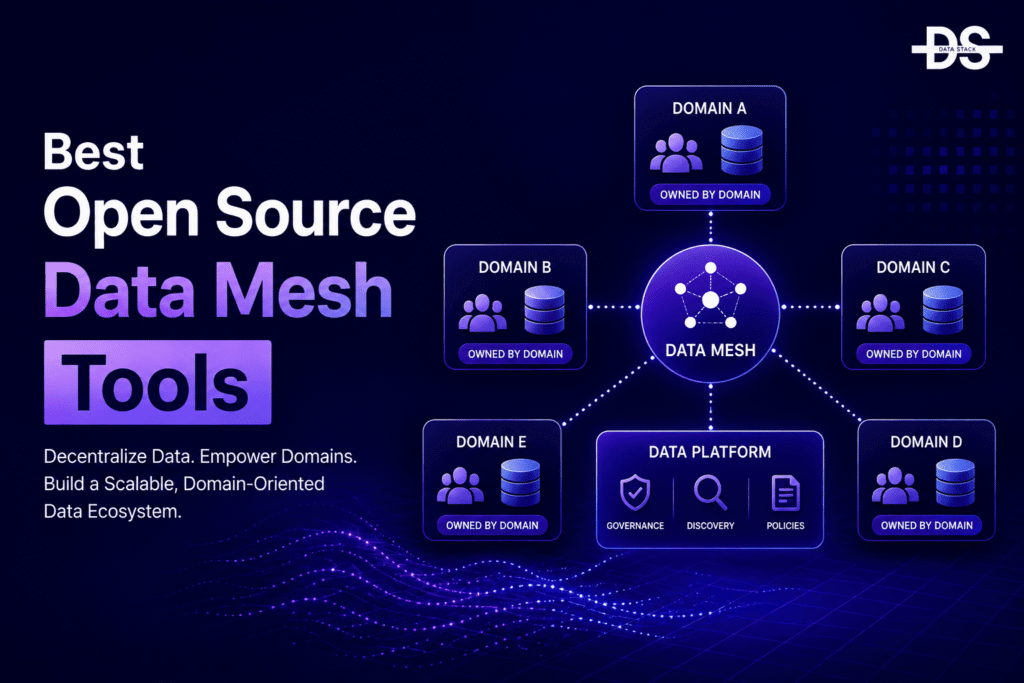
Data mesh has changed the way many organizations think about managing data at scale. Instead of placing responsibility for every dataset, pipeline, and analytical asset on a central data team, the data mesh approach encourages business domains to own and manage their data as products.
However, data mesh is not a single technology that can be installed and switched on. It is an architectural and organizational approach built around domain-oriented ownership, data as a product, self-service infrastructure, and federated computational governance. The challenge for data teams is finding tools that can help operationalize those principles rather than simply adding another data catalog or governance platform.
Open source data mesh tools give organizations the flexibility to build this architecture using modular technologies for data products, metadata, discovery, governance, contracts, access, and automation. Some tools are purpose-built to operationalize data mesh workflows, while others provide critical capabilities that support a broader decentralized data architecture. The best open-source data mesh tool therefore depends on which part of the mesh your organization is trying to implement.
Table of Contents
ToggleWhat is a Data Mesh Tool?
A data mesh tool helps organizations implement one or more principles of a data mesh architecture. This can include enabling domain teams to create and manage data products, providing self-service infrastructure, supporting data discovery, enforcing governance policies, managing contracts, or coordinating access between data producers and consumers.
Open source data mesh tools do not all solve the same problem. A dedicated data mesh platform can manage the lifecycle of data products, while a metadata platform may improve discovery and governance across decentralized domains. Other tools may provide the infrastructure for policy enforcement, data contracts, lineage, or federated access. In practice, many organizations build a data mesh architecture by combining several complementary technologies rather than relying on a single platform.
Open Source Data Mesh Tools Comparison for 2026
| Tool Name | Category | Best For | Key Strength | Deployment Options | Licensing |
|---|---|---|---|---|---|
| Open Data Mesh Platform | Data Mesh Platform | End-to-end data product lifecycle management | Purpose-built self-service data product operations | Self-hosted, Docker, Kubernetes, cloud | Apache 2.0 |
| OpenMetadata | Metadata and Data Product Platform | Governance and discovery across domains | Unified metadata, ownership, lineage, and data products | Self-hosted, Docker, Kubernetes, cloud | Apache 2.0 |
| DataHub | Metadata Platform | Decentralized data discovery and governance | Metadata graph and domain-oriented governance | Self-hosted, Docker, Kubernetes, cloud | Apache 2.0 |
| Apache Gravitino | Metadata Lake | Federated data architectures | Unified metadata across multiple engines and systems | Self-hosted, Docker, Kubernetes, cloud | Apache 2.0 |
| Data Mesh Pattern | Reference Architecture | Building a custom open source mesh | Reference implementation using composable components | Self-hosted, OpenShift, Kubernetes | Open source |
| Provenance | Data Mesh Coordination Platform | Governed domain data products | Policy enforcement, contracts, and lineage | Self-hosted, Docker, Kubernetes, cloud | Apache 2.0 |
| Open Policy Agent | Policy Engine | Federated computational governance | Policy-as-code enforcement | Self-hosted, Docker, Kubernetes, cloud | Apache 2.0 |
| OpenLineage | Data Lineage Standard | Cross-domain lineage and interoperability | Open lineage standard and ecosystem | Self-hosted, cloud, integrated deployment | Apache 2.0 |
The strongest open source data mesh stack is usually composable rather than monolithic. Purpose-built platforms such as Open Data Mesh Platform focus on the lifecycle of data products, while tools such as OpenMetadata and DataHub provide metadata and discovery capabilities. Policy engines and lineage standards can then support federated governance across domains.
The 8 Best Open Source Data Mesh Tools in 2026
The best open source data mesh tools address different layers of a decentralized data architecture. Some help domain teams publish and manage data products, while others support metadata, governance, lineage, federation, or policy enforcement.
#1 Open Data Mesh Platform
Open Data Mesh Platform, often referred to as ODMP, is one of the few purpose-built open source platforms designed specifically to operationalize data mesh principles. It focuses on managing the complete lifecycle of data products, from their initial definition and validation through deployment, access management, and eventual retirement.
The platform uses a modular architecture that separates higher-level data product operations from the underlying infrastructure. This allows organizations to connect their existing technologies for CI/CD, metadata management, access control, and other operational requirements through adapters rather than rebuilding their entire data stack.
ODMP is particularly relevant for organizations that have moved beyond discussing data mesh as an architectural concept and need practical tooling to help domain teams create, deploy, and operate governed data products in a self-service way.
Key Features
- Data product lifecycle management: Supports the creation, validation, deployment, evolution, and retirement of data products.
- Data product blueprints: Helps teams standardize how new data products are initialized and created.
- Computational policy validation: Can integrate policy checks into important stages of the data product lifecycle.
- Self-service operations: Gives domain teams APIs and tooling to manage data products with less dependency on a central platform team.
- Infrastructure adapters: Connects data product workflows with underlying technologies for CI/CD, metadata, access management, and other capabilities.
- Open standards support: Uses specifications such as the Data Product Descriptor to improve interoperability across the architecture.
Best For
Open Data Mesh Platform is best for organizations that want a purpose-built, open source platform for managing the lifecycle of domain-owned data products and operationalizing multiple data mesh principles through a modular architecture.
#2 OpenMetadata
OpenMetadata is an open source metadata platform that can play an important role in a data mesh architecture by connecting decentralized data products with shared discovery, governance, ownership, lineage, quality, and business context.
A common challenge with decentralized data ownership is that distributing responsibility can make data harder to discover and understand. OpenMetadata provides a centralized metadata layer without requiring organizations to centralize ownership of every underlying data asset. Domain teams can maintain responsibility for their data while users still have a common environment for discovering and evaluating available data products.
Its broader metadata model also makes it useful for connecting domains, ownership, contracts, lineage, quality signals, and other information that helps consumers understand whether a data product is suitable for their needs.
Key Features
- Data product management: Supports organizing and governing data assets as discoverable products.
- Domain and ownership modeling: Helps represent decentralized organizational ownership.
- Metadata discovery: Provides a common environment for finding and understanding distributed data assets.
- Lineage tracking: Connects upstream and downstream dependencies across the data environment.
- Data quality integration: Associates quality signals and validation information with data assets.
- Contracts and governance: Connects data contracts, policies, classifications, and other governance information with metadata.
Best For
OpenMetadata is best for organizations building a data mesh architecture that needs strong metadata discovery, data product context, ownership, lineage, and governance across decentralized domains.

Showcase your software to buyers actively comparing tools. Submit your product for editorial review and get featured on Data Stack Hub.
Submit Your Tool →#3 DataHub
DataHub is an open source metadata platform that can support the discovery and governance layer of a data mesh architecture. It is particularly useful for organizations that need to make distributed data assets easier to find, understand, and manage across multiple teams and domains.
DataHub uses a metadata graph approach that can connect datasets with ownership, domains, lineage, documentation, and other contextual information. In a decentralized architecture, this shared metadata layer can help prevent domain-owned data products from becoming isolated or difficult for other teams to discover.
While DataHub is not a complete data mesh platform on its own, it can become an important part of a composable architecture where domain teams own their data products while metadata and governance remain connected across the organization.
Key Features
- Metadata graph: Connects datasets, owners, domains, lineage, and other metadata relationships.
- Domain-oriented organization: Helps organizations represent decentralized business and technical domains.
- Data discovery: Provides search and discovery capabilities across distributed data systems.
- Ownership management: Associates data assets and products with responsible teams or individuals.
- Lineage visibility: Helps users understand dependencies across decentralized pipelines and systems.
- Governance framework: Supports policies, classifications, assertions, and broader governance workflows.
Best For
DataHub is best for organizations that need an open source metadata and discovery layer to support domain-owned data products across a distributed data architecture.
#4 Apache Gravitino
Apache Gravitino is an open source metadata lake designed to provide a unified metadata layer across multiple data systems, engines, and environments. This makes it relevant for data mesh implementations where domains may use different technologies but still need a consistent way to manage and discover data.
A decentralized architecture does not necessarily mean every domain should operate in complete isolation. Teams still need interoperability across domains, particularly when consumers need to discover data products or access information distributed across different storage systems and compute engines.
Gravitino addresses this challenge by focusing on metadata federation and unified management rather than replacing the underlying systems used by each domain.
Key Features
- Unified metadata layer: Provides a common way to manage metadata across distributed data systems.
- Multi-engine support: Designed to work with different processing and query technologies.
- Federated architecture: Helps connect data environments without requiring all domains to move to one platform.
- Centralized metadata governance: Supports more consistent management across distributed infrastructure.
- Open architecture: Can be integrated into a broader open source data mesh stack.
- Multi-environment support: Fits cloud, hybrid, and distributed data environments.
Best For
Apache Gravitino is best for organizations building a federated data mesh across multiple engines, storage systems, and environments that need a unified metadata layer without centralizing the underlying infrastructure.
#5 Data Mesh Pattern
Data Mesh Pattern is an open source reference implementation that demonstrates how a data mesh architecture can be assembled from multiple interoperable technologies. Rather than presenting a single packaged platform, it provides a pattern for combining open source components around the core principles of domain ownership, data as a product, self-service infrastructure, and federated governance.
The architecture includes components for storage, table management, query federation, data versioning, lineage, and governance. This makes it useful for organizations that want to understand the practical building blocks of an open source data mesh before deciding whether to adopt a dedicated platform.
It is especially valuable as a reference for technical teams planning to build their own composable architecture around existing infrastructure investments.
Key Features
- Reference data mesh architecture: Demonstrates how open source components can be combined into a distributed architecture.
- Domain ownership model: Supports organizing data responsibility around business domains.
- Composable technology stack: Uses specialized components for storage, serving, versioning, and governance.
- Data-as-code approach: Encourages reproducible and version-controlled data operations.
- Federated governance model: Provides a framework for applying common standards across decentralized domains.
- OpenShift and Kubernetes alignment: Designed around cloud-native infrastructure and containerized components.
Best For
Data Mesh Pattern is best for platform engineering teams that want a technical reference architecture for building a custom open source data mesh from composable technologies rather than adopting a single packaged platform.
#6 Provenance
Provenance is an open source platform designed to operationalize data mesh concepts through domain-owned data products, policy enforcement, contracts, access controls, and lineage. Its focus is on turning data mesh governance principles into executable platform capabilities rather than treating them as documentation or manual processes.
The platform allows domain teams to publish and manage governed data products while applying policies at important lifecycle boundaries. It also separates the coordination and governance layer from the underlying data infrastructure, meaning it is not intended to replace data warehouses, data lakes, ETL systems, or query engines.
As a newer project, Provenance should be evaluated carefully for production maturity and ecosystem fit. Its architecture is nevertheless directly aligned with organizations looking for a more complete open source implementation of data mesh coordination and governance.
Key Features
- Data product lifecycle management: Supports registering, versioning, publishing, and managing domain-owned data products.
- Policy-as-code: Uses executable policies to enforce governance requirements during data product workflows.
- Data contracts: Tracks schemas, ownership, service-level expectations, and other contract information.
- Data product marketplace: Provides a discovery layer for consumers to find and evaluate available data products.
- Automated lineage capture: Records transformations, access, and publication events to improve traceability.
- Federated connector framework: Connects the coordination layer with different underlying data systems.
Best For
Provenance is best for teams looking for an open source platform focused specifically on governed data products, policy enforcement, contracts, and coordination in a data mesh architecture.
Increase your product visibility by reaching software buyers researching the best tools. Every submission is reviewed by our editorial team.
Feature My Tool →#7 Open Policy Agent
Open Policy Agent, or OPA, is not a data mesh platform by itself, but it can provide an important foundation for federated computational governance. One of the core challenges of data mesh is allowing domains to operate independently while still following organization-wide policies around security, access, compliance, and data standards.
OPA provides a policy-as-code approach that allows rules to be defined separately from the applications and services that enforce them. In a data mesh environment, this can help organizations apply common governance requirements across independently managed data products and platforms.
Its value is strongest when combined with a broader data product or platform architecture rather than treated as a complete solution for data mesh.
Key Features
- Policy-as-code: Allows governance rules to be defined and versioned through code.
- Decoupled policy enforcement: Separates policy decisions from the applications and systems enforcing them.
- Custom governance rules: Supports organization-specific rules around access, security, compliance, and standards.
- Cloud-native integration: Works well with Kubernetes and distributed infrastructure.
- Reusable policies: Allows common governance requirements to be applied across multiple domains.
- Automation support: Can be integrated into CI/CD and automated data product workflows.
Best For
Open Policy Agent is best for organizations implementing federated computational governance across independently managed data products, services, and infrastructure.
#8 OpenLineage
OpenLineage is an open source standard and ecosystem for collecting and sharing lineage information across different data tools and platforms. In a data mesh architecture, lineage can become particularly important because data products are created and managed across multiple domains rather than through one centralized pipeline environment.
A shared lineage standard can help organizations understand how distributed data products are connected without requiring every domain to use the same processing technology. Producers can emit lineage events while compatible systems collect and visualize those relationships.
OpenLineage is therefore best understood as a supporting component of an open source data mesh stack rather than a complete mesh platform.
Key Features
- Open lineage standard: Provides a common format for capturing lineage information.
- Cross-tool interoperability: Allows compatible data systems to exchange lineage events.
- Job and dataset tracking: Captures relationships between processing jobs and the data they consume or produce.
- Distributed architecture support: Fits environments where pipelines run across different platforms and domains.
- Ecosystem integrations: Works with compatible orchestration, processing, and metadata technologies.
- Extensible model: Can be adapted as data architectures and lineage requirements evolve.
Best For
OpenLineage is best for organizations that need interoperable lineage across multiple domains, pipelines, and technologies within a broader data mesh architecture.
Non-Open-Source Data Mesh Tools and Platforms
Open source data mesh tools provide flexibility and control, but organizations with complex enterprise requirements may prefer commercial platforms that provide managed infrastructure, integrated governance, support, and more complete data product experiences.
#1 Data Mesh Manager
Data Mesh Manager is a commercial platform designed to help organizations manage data products, domains, governance, and other operational aspects of a data mesh implementation through a more centralized user experience.
Best For
Data Mesh Manager is best for enterprises looking for a commercial platform to coordinate and operationalize data mesh initiatives without assembling every platform capability internally.
#2 Atlan
Atlan is a commercial data and AI governance platform that can support data mesh initiatives through metadata management, discovery, ownership, governance, and collaboration across distributed data environments.
Best For
Atlan is best for organizations that want a managed enterprise data catalog and governance layer to support decentralized data ownership and data product discovery.
#3 Collibra
Collibra provides enterprise data governance, catalog, quality, and policy management capabilities. For large organizations implementing decentralized data ownership, it can provide centralized governance and visibility without requiring every domain to independently build governance processes.
Best For
Collibra is best for large enterprises that need strong centralized governance and compliance capabilities alongside a decentralized data architecture.
How to Choose the Right Open Source Data Mesh Tool
Choosing the right open source data mesh tool starts with identifying which part of the data mesh architecture is currently missing. Very few organizations need every component at once, and adopting a large platform before establishing clear domain ownership can create unnecessary complexity.
- Start with the operating model: Data mesh requires organizational changes as well as technology. Make sure domain teams are prepared to own and maintain data products before investing heavily in a platform.
- Identify the missing platform capability: Determine whether your biggest challenge is creating data products, metadata discovery, governance, policy enforcement, access management, or lineage. This will help separate purpose-built mesh platforms from supporting tools.
- Evaluate data product lifecycle support: If domain teams need a consistent way to create, validate, deploy, and evolve data products, prioritize platforms with lifecycle management and self-service capabilities.
- Plan for federated governance: Domain autonomy should not result in inconsistent security, compliance, or data standards. Look for policy-as-code and metadata capabilities that can apply common requirements across domains.
- Check interoperability with your existing stack: Most organizations already have warehouses, lakes, catalogs, orchestration systems, and CI/CD platforms. An open source data mesh tool should integrate with these investments rather than force an unnecessary replacement.
- Consider discovery and consumer experience: Data products only create value when other teams can find, understand, evaluate, and access them. Metadata, marketplaces, documentation, ownership, and lineage are important parts of the overall architecture.
- Avoid treating data mesh as a single product purchase: A data mesh platform can accelerate implementation, but it cannot replace the organizational model required for domain ownership and federated governance.
- Evaluate maturity carefully: Several purpose-built open source data mesh platforms are relatively new. Assess community activity, documentation, production readiness, integration support, and long-term maintenance before making one the foundation of a critical architecture.
Browse expertly curated software recommendations across hundreds of business categories.
Browse Top Tools →Conclusion
The best open source data mesh tool depends on how far an organization has progressed from data mesh strategy to implementation. Open Data Mesh Platform is one of the strongest purpose-built options for managing the lifecycle of data products, while OpenMetadata and DataHub can provide the metadata, discovery, and governance capabilities needed across decentralized domains.
Apache Gravitino, Open Policy Agent, and OpenLineage address important supporting layers such as metadata federation, computational governance, and cross-domain lineage. Data Mesh Pattern offers a useful reference for teams building their own composable architecture, while Provenance represents a newer approach focused on governed data products, contracts, and policy enforcement.
For most organizations, the best approach will be a combination of tools rather than a single platform. The technology stack should support the operating model, not define it. Establishing clear domain ownership and data product responsibilities first can make it easier to select the right open source components for a practical and sustainable data mesh.
Frequently Asked Questions
1. What are open source data mesh tools?
Open source data mesh tools help organizations implement data mesh principles through technologies for data products, self-service infrastructure, metadata, discovery, governance, policy enforcement, contracts, and lineage.
2. What are the best open source data mesh tools?
Open Data Mesh Platform, OpenMetadata, DataHub, Apache Gravitino, Data Mesh Pattern, Provenance, Open Policy Agent, and OpenLineage are useful options for different parts of a data mesh architecture.
3. Is data mesh a tool or architecture?
Data mesh is primarily an organizational and architectural approach rather than a single tool. Software platforms can help operationalize its principles, but successful adoption also requires changes to data ownership and governance.
4. What are the four principles of data mesh?
The four commonly associated principles are domain-oriented data ownership, data as a product, self-service data infrastructure, and federated computational governance.
5. Do you need a data mesh platform to implement data mesh?
No. Organizations can build a data mesh using existing tools and composable open source technologies. A dedicated platform can simplify some lifecycle and governance workflows but is not a requirement.
6. What is a data product in data mesh?
A data product is a domain-owned data asset designed to be discoverable, understandable, trustworthy, and reusable by consumers. It typically includes more than raw data and can include metadata, documentation, interfaces, ownership, quality expectations, and access mechanisms.
7. How does federated governance work in data mesh?
Federated governance allows domains to maintain autonomy while following shared organizational standards. Policy-as-code, metadata standards, contracts, and automated validation can help enforce common requirements without centralizing every data operation.
8. Can OpenMetadata be used for data mesh?
Yes. OpenMetadata can support important parts of a data mesh architecture, including domains, data products, ownership, discovery, lineage, quality, and governance. However, it is not a complete data mesh platform by itself.
9. What is the difference between a data mesh and a data fabric?
A data mesh focuses on decentralized domain ownership and treating data as a product. A data fabric generally focuses more on connecting and integrating distributed data through shared architecture, metadata, and automation. Organizations can use elements of both approaches.
10. Is data mesh suitable for small companies?
Not always. A small organization may add unnecessary complexity by creating multiple domains and distributed ownership before its data architecture requires it. Data mesh is generally more relevant when data ownership, scale, and organizational complexity have become difficult to manage centrally.
11. Can data mesh work with a data lakehouse?
Yes. A data mesh and a lakehouse address different architectural concerns. A lakehouse provides a way to store and manage analytical data, while a data mesh defines how ownership, products, governance, and infrastructure can be organized across domains.
12. Should you choose open source or commercial data mesh tools?
Open source tools are a strong option when flexibility, customization, self-hosting, and integration with existing infrastructure are priorities. Commercial platforms may be more suitable when organizations need managed infrastructure, enterprise support, and a more integrated user experience.