
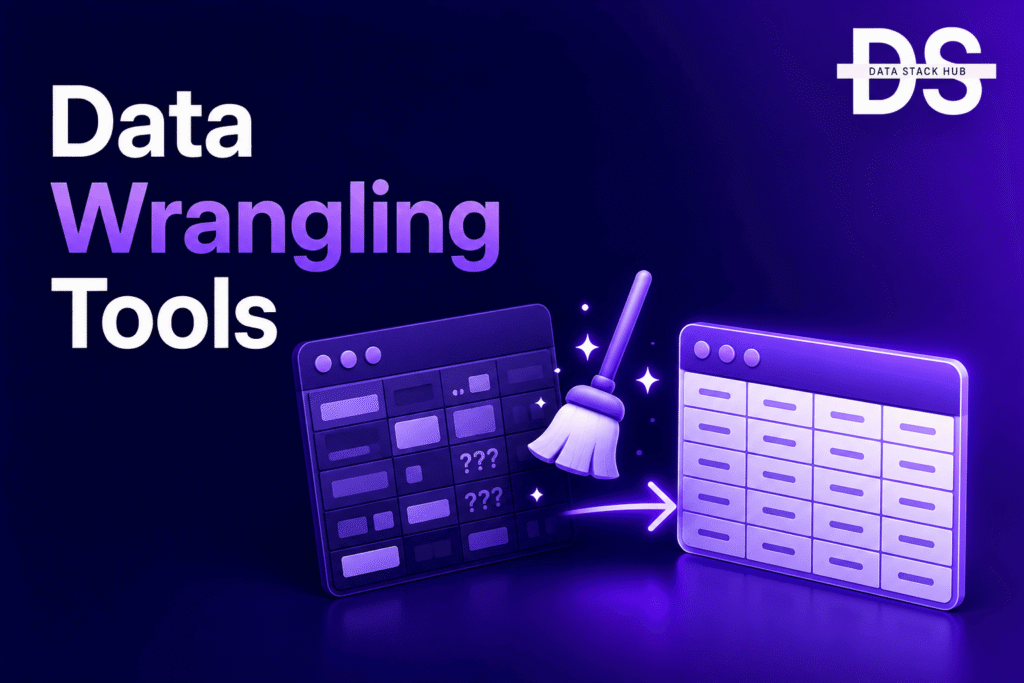
According to Gartner, poor data quality costs organizations an average of $12.9 million annually, while data scientists and analysts often spend 60% to 80% of their time preparing and cleaning data before analysis. As organizations collect information from cloud applications, databases, APIs, spreadsheets, IoT devices, and operational systems, transforming raw information into analytics-ready datasets has become one of the biggest challenges in modern data environments.
Even the most advanced analytics platforms, machine learning models, and AI systems can produce unreliable results when the underlying data is inconsistent, incomplete, duplicated, or poorly structured. This makes data preparation a critical step in the analytics lifecycle.
This is where Data Wrangling Tools become essential.
Data Wrangling Software helps organizations clean, transform, standardize, enrich, validate, and prepare information for analytics, reporting, business intelligence, machine learning, and AI initiatives. These platforms reduce manual effort while improving the quality and usability of enterprise data assets.
Another major trend shaping this market is generative AI. Modern Data Wrangling Platforms increasingly use AI-assisted transformations, natural language interfaces, automated data profiling, and intelligent recommendations to help teams prepare information faster and with less technical expertise.
To identify the best Data Wrangling Tools, we evaluated vendors based on transformation capabilities, automation, usability, scalability, AI readiness, integration support, governance capabilities, and enterprise adoption. Our selections include enterprise data preparation platforms, analytics-focused solutions, open-source tools, and emerging AI-native vendors.
What Are Data Wrangling Tools?
Data Wrangling Tools are software platforms that help organizations clean, transform, enrich, standardize, and prepare information before it is used for analytics, reporting, machine learning, AI, and operational decision-making. These tools automate many of the repetitive tasks associated with preparing datasets, including removing duplicates, handling missing values, restructuring information, standardizing formats, and combining multiple data sources.
Benefits of Data Wrangling Software
- Reduce manual data preparation effort.
- Improve data quality and consistency.
- Accelerate analytics and reporting projects.
- Support machine learning and AI initiatives.
- Improve business intelligence accuracy.
- Enable self-service data preparation.
- Reduce time-to-insight across teams.
Data Wrangling Software Comparison
| Tool | Best For | Pricing Model | Best Fit |
|---|---|---|---|
| Alteryx | Enterprise data preparation | Subscription | Enterprises |
| Trifacta | Cloud data wrangling | Subscription | Data teams |
| Talend Data Preparation | Data quality and preparation | Custom | Enterprises |
| Informatica Data Preparation | Enterprise governance | Custom | Large enterprises |
| Dataiku | AI-driven preparation | Custom | AI-focused organizations |
| KNIME | Open-source analytics workflows | Free + Paid | Analysts |
| Microsoft Power Query | Excel and Power BI users | Included | Microsoft customers |
| Apache Spark | Large-scale transformations | Open Source | Engineering teams |
| Tableau Prep | Visual data preparation | Subscription | BI teams |
| OpenRefine | Open-source cleaning | Free | Small teams |
| Julius AI | AI-native data wrangling | Subscription | Modern analytics teams |
11 Best Data Wrangling Tools
#1 Alteryx
Alteryx has long been considered one of the leading Data Wrangling Tools for enterprise analytics teams. The platform combines data preparation, transformation, enrichment, analytics, and automation capabilities within a visual workflow environment that allows both technical and non-technical users to prepare complex datasets efficiently.
Organizations frequently choose Alteryx because many data preparation tasks still require significant manual effort. Analysts often spend hours cleaning spreadsheets, combining datasets, validating information, and preparing reports. Alteryx automates many of these repetitive activities while providing a user-friendly drag-and-drop interface.
Compared with spreadsheet-based approaches, Alteryx offers significantly greater scalability and automation. Compared with code-first tools such as Apache Spark, it enables faster adoption among business users while still supporting advanced analytics workflows.
The platform remains particularly popular among financial services, healthcare, retail, and enterprise analytics teams that need to prepare large volumes of information without extensive coding.
Key Features
- Provides visual workflow-based data preparation and transformation capabilities.
- Automates cleansing, enrichment, and standardization processes.
- Supports blending information from databases, spreadsheets, APIs, and cloud platforms.
- Includes advanced analytics and predictive modeling capabilities.
- Enables self-service data preparation for business users.
- Supports automation and scheduling of recurring workflows.
- Integrates with analytics, reporting, and business intelligence platforms.
- Reduces manual effort associated with data preparation activities.
Pricing
Professional plans start at approximately $5,195 per user per year.
Best For
Enterprise analytics teams seeking powerful no-code data preparation capabilities.
Why Choose This Tool
Alteryx remains one of the strongest options for organizations that want to combine data wrangling, analytics, automation, and business-user accessibility within a single platform.
G2 Rating: 4.6/5
Gartner Rating: 4.6/5
Showcase your software to buyers actively comparing tools. Submit your product for editorial review and get featured on Data Stack Hub.
Submit Your Tool →#2 Trifacta (Google Cloud Dataprep)
Trifacta helped popularize modern data wrangling by introducing intelligent, visual approaches to data preparation. Now part of Google Cloud, the platform continues to be widely recognized for helping analysts and engineers prepare datasets quickly through AI-assisted transformation recommendations and intuitive interfaces.
Many organizations choose Trifacta because traditional data preparation often requires extensive SQL or scripting knowledge. Trifacta simplifies these workflows through visual interactions and automated recommendations that help users identify anomalies, missing values, formatting issues, and transformation opportunities.
Compared with Alteryx, Trifacta places greater emphasis on cloud-native data preparation and intelligent transformation suggestions. Compared with Power Query, it offers stronger capabilities for larger datasets and enterprise-scale environments.
The platform is particularly attractive to organizations operating within Google Cloud ecosystems and modern analytics environments.
Key Features
- Uses machine learning to recommend transformations and cleansing actions.
- Supports visual preparation of structured and semi-structured information.
- Identifies anomalies, inconsistencies, and quality issues automatically.
- Integrates with Google Cloud analytics and storage services.
- Supports cloud-scale data preparation workflows.
- Reduces technical barriers for analysts and business users.
- Accelerates preparation for analytics and machine learning projects.
- Enables collaborative data preparation processes.
Pricing
Custom enterprise pricing.
Best For
Cloud-native organizations preparing large datasets for analytics and AI.
Why Choose This Tool
Trifacta is an excellent option for organizations seeking AI-assisted data wrangling and strong cloud integration capabilities.
G2 Rating: 4.4/5
Gartner Rating: 4.5/5
#3 Talend Data Preparation
Talend Data Preparation combines data wrangling, quality management, governance, and integration capabilities within a unified platform. Unlike tools focused solely on preparation, Talend helps organizations improve trust in information throughout the entire lifecycle.
Organizations often adopt Talend because data preparation challenges are frequently connected to broader quality and governance problems. Simply cleaning information without addressing root causes can create recurring issues. Talend helps teams identify, correct, standardize, and govern information at scale.
Compared with Alteryx, Talend places greater emphasis on governance and quality management. Compared with Informatica, it often appeals to organizations seeking a more flexible and developer-friendly environment.
Key Features
- Supports data cleansing, standardization, enrichment, and transformation.
- Includes integrated data quality and governance capabilities.
- Enables preparation across cloud, hybrid, and on-premises environments.
- Supports collaborative workflows between technical and business teams.
- Integrates with databases, applications, APIs, and cloud platforms.
- Automates repetitive preparation and validation tasks.
- Improves consistency and trust across enterprise datasets.
- Supports analytics, reporting, and compliance initiatives.
Pricing
Custom enterprise pricing.
Best For
Organizations combining data preparation with governance and quality initiatives.
Why Choose This Tool
Talend is a strong choice when improving data quality and governance is just as important as preparing information for analytics.
G2 Rating: 4.3/5
Gartner Rating: 4.4/5
#4 Informatica Data Preparation
Informatica Data Preparation is part of Informatica’s broader Intelligent Data Management Cloud ecosystem and is designed for organizations that require enterprise-grade data wrangling, governance, metadata management, and compliance capabilities. Unlike tools focused primarily on analyst productivity, Informatica approaches data preparation as part of a larger enterprise data management strategy.
Organizations frequently choose Informatica because data preparation often involves highly regulated information spread across databases, applications, cloud platforms, warehouses, and operational systems. Simply cleaning data is not enough. Teams also need visibility into lineage, governance policies, ownership, and quality controls.
Compared with Talend, Informatica generally offers broader enterprise adoption and a larger ecosystem. Compared with Alteryx, it places greater emphasis on governance and enterprise-scale operational management.
The platform is especially popular among financial services, healthcare, insurance, government, and other heavily regulated industries.
Key Features
- Supports enterprise-scale data cleansing, transformation, and preparation workflows.
- Provides metadata management, lineage, and governance capabilities.
- Uses AI-driven recommendations to accelerate data preparation activities.
- Supports cloud, hybrid, and multi-cloud architectures.
- Integrates with warehouses, applications, databases, and cloud platforms.
- Includes data quality monitoring and validation capabilities.
- Supports compliance and regulatory requirements.
- Enables self-service and IT-managed preparation workflows.
Pricing
Custom enterprise pricing.
Best For
Large enterprises requiring governance-focused data preparation.
Why Choose This Tool
Informatica is one of the strongest options when data preparation must align with enterprise governance, compliance, and large-scale operational requirements.
G2 Rating: 4.3/5
Gartner Rating: 4.5/5
#5 Dataiku
Dataiku combines data preparation, analytics, machine learning, and AI capabilities within a collaborative platform. While many tools focus only on cleaning and transforming information, Dataiku helps organizations move directly from prepared data to predictive models, AI applications, and business insights.
Organizations increasingly adopt Dataiku because modern data projects often involve multiple stakeholders. Data engineers, analysts, business users, and data scientists frequently need to collaborate using the same datasets. Dataiku provides a shared environment that supports these workflows.
Compared with Alteryx, Dataiku places greater emphasis on machine learning and AI. Compared with Informatica, it focuses more heavily on analytics outcomes rather than governance-centric workflows.
The platform has become particularly popular among organizations pursuing AI transformation initiatives and advanced analytics programs.
Key Features
- Supports data wrangling, analytics, machine learning, and AI workflows.
- Provides visual and code-based development environments.
- Uses AI-assisted recommendations for preparation and transformation tasks.
- Enables collaboration across technical and business teams.
- Supports cloud warehouses, databases, applications, and data lakes.
- Includes governance and operationalization capabilities.
- Accelerates AI and analytics project delivery.
- Supports generative AI initiatives and model development.
Pricing
Custom enterprise pricing.
Best For
Organizations building AI and advanced analytics programs.
Why Choose This Tool
Choose Dataiku when data preparation is closely connected to machine learning, AI, and analytics outcomes.
G2 Rating: 4.5/5
Gartner Rating: 4.6/5
Increase your product visibility by reaching software buyers researching the best tools. Every submission is reviewed by our editorial team.
Feature My Tool →#6 KNIME
KNIME is one of the most widely adopted open-source data analytics and data wrangling platforms available today. The platform uses visual workflows to help organizations clean, transform, enrich, analyze, and prepare information without requiring extensive coding expertise.
Many organizations choose KNIME because it delivers capabilities similar to commercial platforms while maintaining open-source flexibility. Analysts and engineers can build sophisticated workflows using drag-and-drop components while still incorporating Python, R, SQL, and machine learning functionality when required.
Compared with Alteryx, KNIME offers a significantly lower cost of ownership. Compared with OpenRefine, it provides much broader workflow automation, analytics, and machine learning capabilities.
The platform is especially popular among universities, research organizations, analytics teams, and businesses seeking powerful open-source alternatives.
Key Features
- Provides visual workflow-based data preparation capabilities.
- Supports cleansing, transformation, enrichment, and analytics workflows.
- Integrates with Python, R, SQL, and machine learning frameworks.
- Supports databases, spreadsheets, APIs, warehouses, and cloud platforms.
- Enables automation of recurring preparation processes.
- Provides open-source flexibility and extensibility.
- Supports advanced analytics and predictive modeling workflows.
- Reduces dependency on proprietary software platforms.
Pricing
Open source. Commercial enterprise editions available.
Best For
Organizations seeking powerful open-source data wrangling capabilities.
Why Choose This Tool
KNIME is one of the best alternatives to expensive enterprise platforms for teams that want flexibility, automation, and strong analytics support.
G2 Rating: 4.6/5
Gartner Rating: 4.4/5
#7 Microsoft Power Query
Microsoft Power Query is one of the most widely used Data Wrangling Tools in the world because it is integrated directly into Excel, Power BI, and other Microsoft products. Millions of analysts rely on Power Query to clean, reshape, combine, and prepare information before reporting and analysis.
Organizations frequently choose Power Query because many data preparation activities still begin in spreadsheets. Rather than exporting information into separate platforms, users can perform transformation and cleansing tasks directly within familiar Microsoft environments.
Compared with Alteryx and Dataiku, Power Query is less scalable for large enterprise workloads. However, for analysts working primarily within Excel and Power BI, it often provides the fastest path from raw information to usable insights.
The platform remains one of the most accessible options for business users and citizen analysts.
Key Features
- Integrated directly into Excel and Power BI environments.
- Supports data cleansing, reshaping, transformation, and enrichment.
- Connects to databases, files, APIs, cloud platforms, and applications.
- Uses a visual interface that reduces coding requirements.
- Supports reusable transformation workflows.
- Enables self-service analytics and reporting.
- Helps analysts prepare information more efficiently.
- Integrates seamlessly with Microsoft’s analytics ecosystem.
Pricing
Included with Microsoft Excel and Power BI licenses.
Best For
Excel users, Power BI teams, and self-service analytics initiatives.
Why Choose This Tool
Power Query is often the easiest and most cost-effective option for organizations already standardized on Microsoft analytics products.
G2 Rating: 4.5/5
Gartner Rating: Not Available
#8 Apache Spark
Apache Spark is not traditionally marketed as a Data Wrangling Tool, but it has become one of the most widely used platforms for large-scale data transformation and preparation. Many modern analytics, machine learning, and AI environments rely on Spark to clean, standardize, enrich, and prepare massive datasets before they are consumed by downstream systems.
Organizations choose Spark because traditional data preparation tools often struggle when data volumes reach terabytes or petabytes. Spark’s distributed processing architecture allows teams to perform complex transformations across large datasets efficiently while supporting cloud-native and lakehouse architectures.
Compared with KNIME and Power Query, Spark requires significantly more technical expertise. However, it offers unmatched scalability for large-scale engineering and analytics environments.
The platform serves as a foundational technology behind many commercial solutions, including Databricks and other modern analytics platforms.
Key Features
- Supports distributed data transformation across massive datasets.
- Enables cleansing, enrichment, aggregation, and preparation workflows.
- Supports batch processing and streaming data preparation.
- Integrates with data lakes, warehouses, cloud platforms, and analytics systems.
- Supports Python, SQL, Scala, Java, and R development.
- Enables machine learning and AI data preparation workflows.
- Scales efficiently across cloud and hybrid environments.
- Provides open-source flexibility and ecosystem support.
Pricing
Open source. Infrastructure costs apply.
Best For
Engineering teams preparing large-scale datasets.
Why Choose This Tool
Apache Spark is often the preferred choice when scalability and performance are more important than low-code usability.
G2 Rating: 4.5/5
Gartner Rating: 4.6/5
#9 Tableau Prep
Tableau Prep was created to help analytics teams prepare information more efficiently before visualization and reporting. Rather than requiring analysts to perform extensive preparation within spreadsheets or external tools, Tableau Prep provides a visual environment specifically designed for data cleansing and transformation.
Organizations frequently adopt Tableau Prep because reporting projects often spend more time preparing information than creating dashboards. The platform simplifies these preparation activities through intuitive visual workflows and direct integration with Tableau’s analytics ecosystem.
Compared with Power Query, Tableau Prep offers a stronger visual experience for analytics teams. Compared with Alteryx, it focuses more narrowly on preparation and reporting workflows rather than broader analytics automation.
The platform is especially popular among organizations heavily invested in Tableau.
Key Features
- Provides visual workflows for cleaning and preparing information.
- Supports joins, unions, aggregations, and transformation tasks.
- Integrates directly with Tableau reporting environments.
- Helps identify anomalies and quality issues quickly.
- Supports reusable preparation workflows.
- Connects to databases, files, cloud platforms, and applications.
- Accelerates dashboard and reporting projects.
- Reduces manual spreadsheet-based preparation effort.
Pricing
Included with Tableau Creator plans. Pricing starts around $75/user/month.
Best For
Business intelligence and Tableau analytics teams.
Why Choose This Tool
Tableau Prep is an excellent choice for organizations that want to streamline preparation workflows before building dashboards and reports.
G2 Rating: 4.3/5
Gartner Rating: 4.4/5
#10 OpenRefine
OpenRefine is one of the most popular open-source Data Wrangling Tools for cleaning messy datasets. Although simpler than enterprise platforms such as Alteryx, Informatica, and Dataiku, OpenRefine remains extremely effective for data cleansing, transformation, and standardization tasks.
Organizations often choose OpenRefine because many preparation projects involve inconsistent formats, duplicate records, missing values, and poorly structured information. OpenRefine provides specialized capabilities for identifying and correcting these issues quickly.
Compared with KNIME, OpenRefine is more focused on cleansing and transformation rather than broader analytics workflows. Compared with Power Query, it provides stronger functionality for cleaning highly inconsistent datasets.
The platform remains widely used by researchers, journalists, analysts, and small teams working with messy information.
Key Features
- Cleans, standardizes, and transforms messy datasets.
- Identifies duplicates and inconsistent values automatically.
- Supports bulk editing and transformation operations.
- Provides powerful text manipulation capabilities.
- Works with CSV, Excel, JSON, and other common formats.
- Enables data profiling and quality assessment.
- Supports extensions and customization.
- Offers completely free open-source deployment.
Pricing
Free and open source.
Best For
Analysts and researchers cleaning messy datasets.
Why Choose This Tool
OpenRefine remains one of the best free tools available for data cleansing and preparation tasks.
G2 Rating: 4.5/5
Gartner Rating: Not Available
#11 Julius AI
Julius AI represents a new generation of AI-native Data Wrangling Tools. Instead of relying primarily on visual workflows, formulas, or manual transformations, Julius allows users to interact with datasets using natural language prompts.
Organizations are increasingly evaluating AI-native platforms because many data preparation tasks remain repetitive and time-consuming. Julius helps users clean, analyze, transform, visualize, and explore information through conversational interactions, reducing the learning curve associated with traditional preparation tools.
Compared with Power Query and Tableau Prep, Julius significantly reduces technical barriers. Compared with Dataiku, it focuses more heavily on AI-assisted analysis and natural language interactions rather than enterprise workflow management.
As generative AI adoption grows, tools such as Julius are helping reshape how business users interact with information.
Key Features
- Uses natural language prompts to prepare and transform datasets.
- Supports cleaning, analysis, visualization, and exploration workflows.
- Generates transformations through conversational interactions.
- Reduces technical barriers for non-technical users.
- Supports spreadsheets, CSV files, and analytics datasets.
- Enables AI-assisted data preparation and exploration.
- Accelerates time-to-insight for business users.
- Provides a modern AI-native analytics experience.
Pricing
Plans start at approximately $20/month.
Best For
Business users and teams seeking AI-assisted data preparation.
Why Choose This Tool
Julius AI is one of the most interesting emerging platforms for organizations looking to use generative AI to simplify data wrangling and analytics workflows.
G2 Rating: 4.8/5
Gartner Rating: Not Available
Which Data Wrangling Tool Should You Choose?
| Scenario | Recommended Tool |
|---|---|
| Best Overall | Alteryx |
| Best Enterprise Platform | Informatica Data Preparation |
| Best Governance & Quality | Talend Data Preparation |
| Best AI & Analytics Platform | Dataiku |
| Best Open Source Platform | KNIME |
| Best Microsoft Users | Power Query |
| Best Large-Scale Data Processing | Apache Spark |
| Best Tableau Environment | Tableau Prep |
| Best Free Data Cleaning Tool | OpenRefine |
| Best AI-Native Platform | Julius AI |
Browse expertly curated software recommendations across hundreds of business categories.
Browse Top Tools →Conclusion
Data wrangling remains one of the most important steps in the analytics lifecycle. Even the most advanced dashboards, machine learning models, and AI systems depend on clean, consistent, and well-prepared information to produce reliable outcomes.
The market now includes several distinct categories of solutions. Alteryx, Informatica, and Talend dominate enterprise environments where governance, quality, and scalability are critical. Dataiku is increasingly becoming the platform of choice for organizations connecting data preparation directly to AI and machine learning initiatives. KNIME and OpenRefine provide strong open-source alternatives, while Power Query and Tableau Prep continue to serve business intelligence teams effectively.
Perhaps the biggest trend is the emergence of AI-native platforms such as Julius AI, which are changing how users prepare and interact with information through natural language interfaces and automated recommendations.
The best Data Wrangling Tool ultimately depends on your technical requirements, data volumes, governance needs, analytics maturity, and AI strategy.
FAQs
1. What are Data Wrangling Tools?
Data Wrangling Tools help organizations clean, transform, standardize, enrich, and prepare information before it is used for analytics, reporting, machine learning, and AI initiatives.
2. What is data wrangling?
Data wrangling is the process of converting raw information into a clean, structured, and usable format suitable for analysis and decision-making.
3. What are the best Data Wrangling Tools?
Alteryx, Informatica Data Preparation, Talend Data Preparation, Dataiku, KNIME, Power Query, Tableau Prep, and Julius AI are among the leading solutions available today.
4. What is the difference between data wrangling and data cleansing?
Data cleansing focuses on correcting errors and inconsistencies, while data wrangling includes broader preparation activities such as transformation, enrichment, restructuring, and integration.
5. Which Data Wrangling Tool is best for AI?
Dataiku and Julius AI are among the strongest options for organizations building AI-assisted analytics and machine learning workflows.
6. Which platform is best for Excel users?
Microsoft Power Query is often the preferred option because it is integrated directly into Excel and Power BI.
7. Are there open-source Data Wrangling Tools?
Yes. KNIME, OpenRefine, and Apache Spark are widely adopted open-source platforms for data preparation and transformation.
8. How do Data Wrangling Tools support machine learning?
They help prepare, cleanse, standardize, and enrich information before it is used for training and deploying machine learning models.
9. Which platform is best for large-scale data preparation?
Apache Spark is one of the strongest options for preparing and transforming very large datasets.
10. How do I choose the right Data Wrangling Tool?
Evaluate scalability, usability, governance capabilities, AI support, integration options, pricing, and alignment with your analytics and data strategy.