
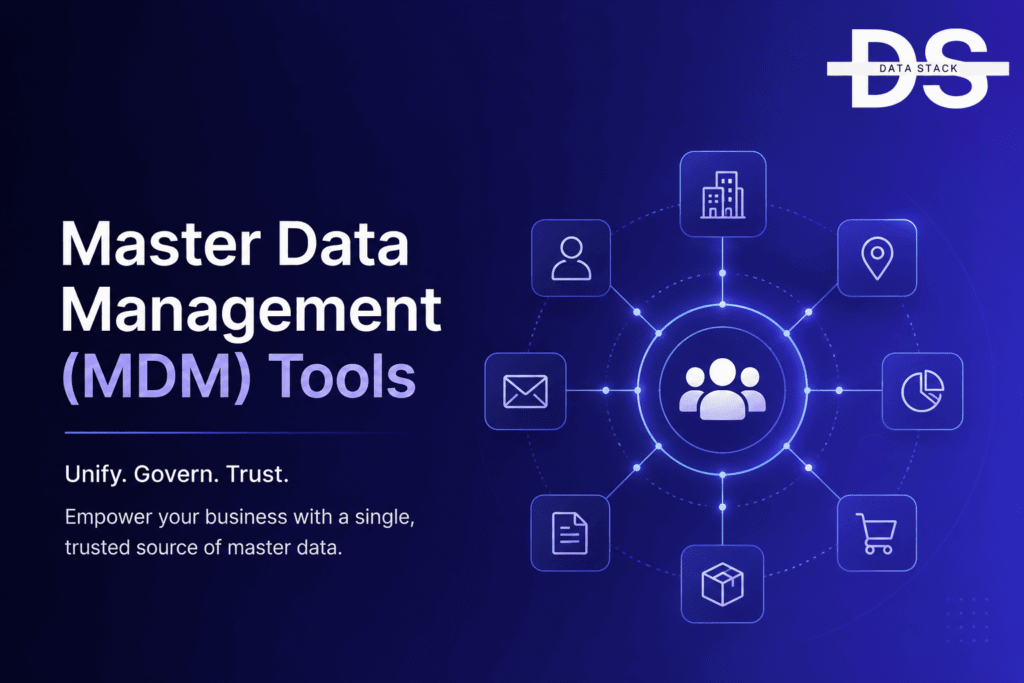
As organizations grow, master data becomes increasingly difficult to manage.
Customer information may exist across CRM systems, marketing platforms, support applications, ERP software, data warehouses, and operational databases. Product information often lives in multiple business systems with inconsistent definitions and conflicting updates. Supplier and reference data frequently face similar challenges.
Without a centralized strategy, organizations struggle with duplicate records, inconsistent information, poor reporting, compliance risks, and operational inefficiencies.
This is where Master Data Management (MDM) tools help.
MDM software helps organizations create a trusted, unified view of critical business entities such as customers, products, suppliers, assets, locations, and employees. Modern Master Data Management platforms combine governance, data quality, stewardship, matching, hierarchy management, and golden record creation capabilities to improve consistency across enterprise systems.
Whether you’re building a Customer 360 initiative, improving governance, or supporting analytics and AI programs, choosing the right MDM platform is a critical decision.
What Are Master Data Management Tools?
Master Data Management tools are software platforms that help organizations create, manage, govern, and synchronize trusted master data across multiple systems.
These platforms typically support:
- Customer master data management.
- Product master data management.
- Supplier data management.
- Multi-domain MDM initiatives.
- Data stewardship workflows.
- Golden record creation.
- Data matching and entity resolution.
- Governance and compliance programs.
Organizations use MDM tools to improve consistency, trust, and operational efficiency across business systems.
Benefits of MDM Software
- Create a single source of truth across systems.
- Improve customer and product data quality.
- Reduce duplicate and inconsistent records.
- Support governance and compliance initiatives.
- Enable Customer 360 programs.
- Improve reporting and analytics accuracy.
- Strengthen enterprise data management practices.
Enterprise MDM Software Comparison
| Tool | Best For | Deployment | Good Fit |
|---|---|---|---|
| Informatica MDM | Enterprise MDM | Cloud | Large enterprises |
| Reltio | Cloud-native MDM | Cloud | Modern enterprises |
| Semarchy xDM | Multi-domain MDM | Cloud | Mid-market and enterprise |
| Ataccama ONE MDM | Data trust initiatives | Cloud | Enterprises |
| SAP Master Data Governance | SAP environments | Cloud, Hybrid | SAP customers |
| IBM InfoSphere MDM | Complex enterprise environments | Hybrid | Large organizations |
| TIBCO EBX | Multi-domain governance | Cloud, Hybrid | Enterprises |
| Profisee | Microsoft-centric MDM | Cloud | Microsoft customers |
| Stibo Systems STEP | Product MDM and PIM | Cloud | Product-driven businesses |
| Oracle Enterprise Data Management | Oracle ecosystems | Cloud | Oracle customers |
10 Best Master Data Management (MDM) Tools
#1 Informatica MDM
Informatica MDM is one of the most widely recognized Master Data Management platforms in the market and is frequently considered a leader in enterprise MDM deployments. The platform helps organizations create trusted master data across customer, product, supplier, asset, and reference data domains.
A major reason enterprises choose Informatica is its ability to support complex multi-domain MDM initiatives. Rather than managing customer and product data separately, organizations can create a centralized framework that governs multiple business entities across the enterprise. The platform combines matching, deduplication, hierarchy management, stewardship workflows, and governance capabilities within a unified environment.
Informatica also supports the creation of golden records, helping organizations establish a trusted version of critical business information across multiple operational systems. These capabilities are particularly valuable for organizations pursuing Customer 360 programs, analytics modernization initiatives, and enterprise governance strategies.
Many enterprises evaluating MDM software also assess Data Governance Tools because governance and stewardship play critical roles in successful master data programs.
For organizations seeking a mature, enterprise-grade Master Data Management solution, Informatica remains one of the strongest choices available.
Key Features
- Supports customer, product, supplier, and multi-domain MDM initiatives.
- Provides matching, deduplication, and golden record management.
- Includes stewardship and governance workflows.
- Supports hierarchy and relationship management.
- Integrates with enterprise data ecosystems.
Why Choose This Tool
Informatica MDM is ideal for large enterprises that require comprehensive Master Data Management capabilities across multiple business domains and complex operational environments.
G2 Rating: 4.3/5
Gartner Rating: 4.6/5
Showcase your software to buyers actively comparing tools. Submit your product for editorial review and get featured on Data Stack Hub.
Submit Your Tool →#2 Reltio
Reltio is a cloud-native MDM platform that has become increasingly popular among organizations modernizing their data management architectures. Unlike many legacy MDM systems that originated in on-premises environments, Reltio was built specifically for cloud deployments and modern enterprise data ecosystems.
The platform helps organizations unify customer, product, supplier, healthcare, and partner data while maintaining strong governance and quality controls. Its cloud-native architecture enables faster deployment, greater scalability, and more flexible integration capabilities compared to many traditional MDM solutions.
One of Reltio’s strongest differentiators is its focus on real-time master data management. Organizations can continuously update, synchronize, and distribute trusted data across business systems, improving operational efficiency and customer experiences.
The platform is frequently selected by organizations pursuing digital transformation initiatives, Customer 360 strategies, and cloud modernization projects.
For enterprises seeking a modern alternative to traditional MDM software, Reltio is one of the most compelling options available.
Key Features
- Provides cloud-native Master Data Management capabilities.
- Supports customer, product, and supplier master data.
- Enables real-time synchronization and updates.
- Includes matching and entity resolution functionality.
- Supports governance and stewardship initiatives.
Why Choose This Tool
Reltio is a strong choice for organizations that want a modern cloud-native MDM platform capable of supporting real-time master data management and Customer 360 initiatives.
G2 Rating: 4.5/5
Gartner Rating: 4.7/5
#3 Semarchy xDM
Semarchy xDM has emerged as one of the fastest-growing Master Data Management platforms because it balances enterprise functionality with implementation simplicity. The platform supports customer, product, supplier, reference, and multi-domain MDM use cases while reducing much of the complexity historically associated with MDM projects.
Organizations often choose Semarchy because it provides strong governance, matching, stewardship, and golden record capabilities without requiring the lengthy deployment cycles commonly associated with legacy MDM solutions. The platform’s low-code capabilities also help organizations accelerate implementation and ongoing maintenance.
Semarchy is particularly attractive to organizations that want enterprise-grade MDM functionality but do not necessarily require the scale or complexity of the largest enterprise platforms.
Key Features
- Supports multi-domain Master Data Management initiatives.
- Provides matching, deduplication, and golden record creation.
- Includes low-code workflow capabilities.
- Supports governance and stewardship processes.
- Accelerates MDM implementation projects.
Why Choose This Tool
Semarchy xDM is well suited for organizations seeking a balance between enterprise functionality, implementation speed, and operational flexibility.
G2 Rating: 4.6/5
Gartner Rating: 4.6/5
#4 Ataccama ONE MDM
Ataccama ONE MDM combines Master Data Management, data quality, governance, metadata management, and observability capabilities within a single platform. This broader approach has helped Ataccama differentiate itself from vendors that focus exclusively on master data management.
The platform enables organizations to create trusted master records while continuously monitoring and improving the quality of underlying data assets. Rather than treating MDM as a standalone initiative, Ataccama positions master data as part of a broader data trust strategy.
Organizations can manage customer, supplier, product, and reference data while leveraging automated matching, entity resolution, stewardship workflows, and governance controls. AI-assisted recommendations further help teams identify data quality issues and improve matching accuracy.
One of the reasons enterprises choose Ataccama is its ability to connect MDM programs with governance and quality initiatives. This reduces platform sprawl while helping organizations establish stronger control over critical business information.
For enterprises focused on long-term data trust and governance, Ataccama ONE MDM is one of the strongest solutions available.
Key Features
- Supports customer, product, supplier, and reference data management.
- Combines MDM, governance, and data quality capabilities.
- Provides automated matching and entity resolution.
- Includes stewardship and workflow management.
- Supports enterprise-scale deployments.
Why Choose This Tool
Ataccama ONE MDM is ideal for organizations that want to combine Master Data Management with broader governance, quality, and data trust initiatives.
G2 Rating: 4.5/5
Gartner Rating: 4.7/5
#5 SAP Master Data Governance (MDG)
SAP Master Data Governance is designed to help organizations govern and manage master data across SAP and non-SAP environments. The platform is widely used by enterprises that rely heavily on SAP ERP, SAP S/4HANA, and related business applications.
SAP MDG supports customer, supplier, material, financial, and custom master data domains while providing governance workflows that help maintain consistency and compliance. Organizations can centralize data creation, approval, and maintenance processes to reduce duplication and improve accuracy.
One of SAP MDG’s biggest advantages is its deep integration with the SAP ecosystem. Companies already operating large SAP environments can leverage existing investments while improving master data governance across business processes.
The platform is particularly popular among manufacturing, retail, consumer goods, logistics, and global enterprise organizations.
Key Features
- Supports customer, supplier, material, and financial master data.
- Provides governance and approval workflows.
- Integrates deeply with SAP applications.
- Supports compliance and audit requirements.
- Enables centralized master data management.
Why Choose This Tool
SAP Master Data Governance is best suited for organizations that rely heavily on SAP applications and want strong governance capabilities integrated directly into their ERP ecosystem.
G2 Rating: 4.2/5
Gartner Rating: 4.5/5
Increase your product visibility by reaching software buyers researching the best tools. Every submission is reviewed by our editorial team.
Feature My Tool →#6 IBM InfoSphere MDM
IBM InfoSphere MDM is a long-established enterprise Master Data Management platform designed for complex business environments. The solution supports customer, product, account, supplier, and reference data management across large organizations.
The platform is known for its strong matching, relationship management, hierarchy management, and entity resolution capabilities. Organizations can create trusted master records while managing complex relationships between business entities across multiple systems.
IBM’s approach is particularly attractive for enterprises operating highly regulated environments where governance, compliance, and operational control are critical requirements. The platform also supports both registry-style and centralized MDM architectures, providing flexibility for different implementation strategies.
Many organizations evaluating IBM InfoSphere MDM also assess Data Quality Tools because master data initiatives depend heavily on data quality and matching accuracy.
For large enterprises managing complex data environments, IBM remains a proven MDM option.
Key Features
- Supports customer, supplier, product, and account master data.
- Provides advanced matching and entity resolution.
- Enables hierarchy and relationship management.
- Supports multiple MDM architectural approaches.
- Helps improve governance and compliance initiatives.
Why Choose This Tool
IBM InfoSphere MDM is a strong choice for large enterprises that require sophisticated entity management and governance capabilities.
G2 Rating: 4.1/5
Gartner Rating: 4.4/5
#7 TIBCO EBX
TIBCO EBX is a multi-domain Master Data Management platform that focuses heavily on governance, workflow management, and reference data management.
The platform enables organizations to manage customer, supplier, product, location, and reference data while maintaining strong governance controls. Its flexible data modeling capabilities make it particularly attractive for enterprises with unique master data requirements.
One area where TIBCO EBX stands out is reference data management. Many organizations struggle to maintain consistency across business definitions, codes, hierarchies, and classifications. EBX helps address these challenges through centralized governance and management capabilities.
The platform is commonly used in financial services, manufacturing, healthcare, and other industries with complex governance requirements.
Key Features
- Supports multi-domain MDM initiatives.
- Provides reference data management capabilities.
- Includes workflow and governance controls.
- Supports custom data models.
- Enables hierarchy management and stewardship.
Why Choose This Tool
TIBCO EBX is ideal for organizations that require flexible governance, reference data management, and multi-domain MDM capabilities.
G2 Rating: 4.3/5
Gartner Rating: 4.5/5
#8 Profisee
Profisee has become one of the fastest-growing MDM software vendors, particularly among organizations operating within Microsoft-centric environments.
The platform helps businesses create trusted customer, product, supplier, and location master records while providing governance, stewardship, matching, and workflow management capabilities. Its integration with Microsoft Azure, Power BI, Microsoft Fabric, and other Microsoft technologies has contributed significantly to its popularity.
One reason organizations choose Profisee is its focus on implementation simplicity compared to some larger enterprise MDM platforms. The solution aims to reduce deployment complexity while still delivering enterprise-grade functionality.
Profisee is especially attractive to mid-sized organizations and enterprises that want strong MDM capabilities without the complexity associated with some traditional MDM vendors.
Key Features
- Supports customer, product, supplier, and location master data.
- Integrates closely with Microsoft technologies.
- Provides matching and governance capabilities.
- Includes stewardship workflows.
- Simplifies MDM implementation and management.
Why Choose This Tool
Profisee is a strong option for organizations operating within Microsoft ecosystems that want modern MDM functionality with reduced implementation complexity.
G2 Rating: 4.7/5
Gartner Rating: 4.6/5
#9 Stibo Systems STEP
Stibo Systems STEP is widely recognized for its strengths in product master data management and product information management (PIM). The platform helps organizations manage product, customer, supplier, and location data while maintaining consistency across channels and systems.
Retailers, manufacturers, distributors, and e-commerce businesses frequently choose Stibo because of its ability to support complex product hierarchies, catalog management, and omnichannel commerce initiatives.
The platform combines MDM capabilities with governance, workflow management, and collaboration features that help organizations improve the quality and consistency of product information.
For businesses where product data plays a critical role in operations and customer experiences, Stibo Systems STEP remains one of the leading solutions available.
Key Features
- Supports product, supplier, customer, and location master data.
- Provides strong product data management capabilities.
- Enables governance and workflow management.
- Supports omnichannel commerce initiatives.
- Helps maintain consistent product information.
Why Choose This Tool
Stibo Systems STEP is ideal for organizations that prioritize product master data management and product information governance.
G2 Rating: 4.4/5
Gartner Rating: 4.5/5
#10 Oracle Enterprise Data Management
Oracle Enterprise Data Management helps organizations manage and govern master and reference data across Oracle business applications and enterprise environments.
The platform supports hierarchy management, governance workflows, change management, and synchronization across systems. Organizations can use Oracle EDM to maintain consistency across financial, operational, customer, and reference data assets.
A major advantage of Oracle’s solution is its integration with Oracle Cloud applications, ERP systems, and enterprise planning environments. This makes it particularly attractive for organizations that have standardized on Oracle technologies.
The platform is frequently used to support governance initiatives, financial data management, and enterprise-wide master data programs.
Key Features
- Supports master and reference data governance.
- Provides hierarchy and relationship management.
- Integrates with Oracle enterprise applications.
- Enables workflow-driven change management.
- Supports enterprise governance initiatives.
Why Choose This Tool
Oracle Enterprise Data Management is best suited for organizations that operate significant Oracle environments and require strong governance and hierarchy management capabilities.
G2 Rating: 4.2/5
Gartner Rating: 4.5/5
How to Choose an MDM Tool
Selecting the right Master Data Management software depends on your business priorities, governance maturity, and master data domains.
Consider the following factors:
- Domain Coverage: Determine whether you need customer MDM, product MDM, supplier MDM, or multi-domain MDM capabilities.
- Matching and Entity Resolution: Accurate matching is critical for creating trusted golden records.
- Governance Capabilities: Look for stewardship workflows, approvals, audit trails, and policy management.
- Integration Ecosystem: Ensure compatibility with ERP, CRM, analytics, and operational systems.
- Deployment Strategy: Evaluate cloud, hybrid, and on-premises options.
- Scalability: Enterprise environments require platforms capable of managing millions of records across multiple domains.
- Industry Requirements: Regulated industries may require stronger governance, compliance, and data lineage capabilities.
Informatica, Reltio, Semarchy, and Ataccama are among the strongest modern MDM platforms. SAP and Oracle remain excellent choices for organizations deeply invested in their ecosystems, while Profisee continues gaining traction among Microsoft-centric enterprises.
Browse expertly curated software recommendations across hundreds of business categories.
Browse Top Tools →Conclusion
Master Data Management tools help organizations create trusted, consistent, and governed master records across customers, products, suppliers, locations, and other critical business entities.
Informatica and Reltio continue to lead enterprise MDM initiatives, while Semarchy and Ataccama offer strong alternatives for organizations pursuing modern data strategies. SAP MDG and Oracle Enterprise Data Management provide deep ecosystem integration, while Profisee has emerged as a compelling option for Microsoft-focused organizations. Stibo Systems STEP remains a leader in product master data management, and IBM InfoSphere MDM continues to serve complex enterprise environments.
The right MDM platform depends on your data domains, governance requirements, architecture, and long-term business objectives.
FAQs
1. What are Master Data Management tools?
Master Data Management tools help organizations create, manage, govern, and synchronize trusted master data across multiple systems.
2. What is MDM software used for?
MDM software is used to manage customer, product, supplier, location, and reference data while improving consistency and governance.
3. What is a golden record in MDM?
A golden record is the most trusted and accurate version of a business entity created by consolidating data from multiple sources.
4. What is the best MDM tool?
Informatica MDM, Reltio, Semarchy xDM, Ataccama ONE MDM, and SAP Master Data Governance are among the leading MDM platforms.
5. What is multi-domain MDM?
Multi-domain MDM allows organizations to manage multiple business entities such as customers, products, suppliers, and locations within a single platform.
6. What is the difference between MDM and data governance?
MDM focuses on managing master records, while data governance establishes policies, ownership, and controls for managing data assets.
7. Which industries use MDM software?
Financial services, healthcare, manufacturing, retail, telecommunications, government, and technology organizations commonly use MDM platforms.
8. What is customer master data management?
Customer MDM focuses on creating a unified and trusted view of customer information across systems.
9. What is product master data management?
Product MDM helps organizations maintain consistent product information across business applications and sales channels.
10. How do I choose the right MDM platform?
Evaluate domain coverage, governance capabilities, matching accuracy, scalability, integrations, deployment options, and long-term business requirements.