
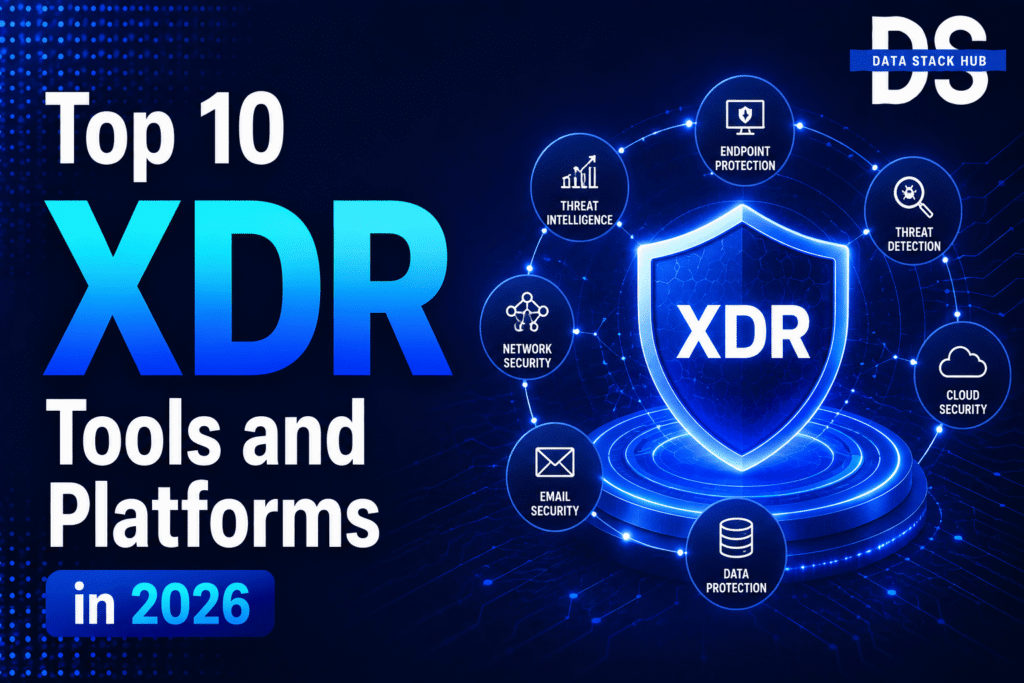
Modern cyberattacks rarely target a single endpoint or workload. Instead, attackers move across endpoints, identities, email, cloud workloads, networks, and applications, making it increasingly difficult for security teams to investigate threats using disconnected security products. Extended Detection and Response (XDR) platforms address this challenge by collecting and correlating telemetry from multiple security layers, enabling organizations to detect, investigate, and respond to sophisticated attacks from a centralized platform.
As ransomware, identity-based attacks, cloud threats, and AI-assisted cyberattacks continue to evolve, organizations are investing in XDR tools and platforms that combine artificial intelligence, behavioral analytics, automation, and threat intelligence. These capabilities help security teams reduce alert fatigue, accelerate investigations, improve threat visibility, and automate response workflows across hybrid and multi-cloud environments.
In this guide, we evaluated the top XDR tools and platforms based on market adoption, enterprise capabilities, AI-powered threat detection, platform maturity, integration ecosystem, customer feedback, and industry recognition. Whether you’re looking for an XDR platform to modernize your Security Operations Center (SOC), improve endpoint security, or consolidate multiple security products, this comparison highlights the leading XDR solutions available today.
Table of Contents
ToggleWhat Are XDR Tools and Platforms?
XDR (Extended Detection and Response) tools and platforms are cybersecurity solutions that collect, correlate, and analyze security telemetry from endpoints, identities, email, cloud workloads, networks, servers, and applications. Unlike traditional endpoint security solutions, XDR platforms provide centralized visibility across multiple security layers, allowing security teams to investigate incidents faster and respond to threats from a single console.
Modern XDR platforms often integrate artificial intelligence, machine learning, behavioral analytics, Security Information and Event Management (SIEM), Security Orchestration, Automation and Response (SOAR), threat intelligence, cloud security, and identity protection. Many XDR tools also support automated investigations, incident response, threat hunting, and managed detection and response (MDR), making them a core component of modern security operations.
Comparison Table: Top XDR Tools and Platforms
| Platform | Best For | Deployment | Free Trial | G2 Rating |
|---|---|---|---|---|
| SentinelOne Singularity XDR | AI-powered autonomous XDR | Cloud | Demo | 4.7/5 |
| CrowdStrike Falcon Insight XDR | Enterprise XDR | Cloud | Demo | 4.7/5 |
| Microsoft Defender XDR | Microsoft ecosystem | Cloud | Trial | 4.5/5 |
| Palo Alto Cortex XDR | Enterprise SOC | Cloud | Demo | 4.6/5 |
| Trend Vision One | Hybrid XDR | Cloud | Trial | 4.6/5 |
| Cisco XDR | Enterprise networking environments | Cloud | Trial | 4.4/5 |
| Trellix XDR | Large enterprise environments | Cloud | Demo | 4.3/5 |
| Stellar Cyber Open XDR | Open XDR platform | Cloud | Demo | 4.7/5 |
| Sophos XDR | Mid-market organizations | Cloud | Trial | 4.7/5 |
| Fortinet FortiXDR | Fortinet security ecosystem | Cloud | Demo | 4.4/5 |
Top 10 XDR Tools and Platforms
Let’s take a closer look at the top XDR tools and platforms, including their key features, pricing, best use cases, and what makes each one stand out.
#1 SentinelOne Singularity XDR
SentinelOne Singularity XDR is an AI-powered Extended Detection and Response (XDR) platform designed to help organizations detect, investigate, and respond to advanced cyber threats across endpoints, cloud workloads, identities, networks, and enterprise infrastructure. By combining autonomous AI with behavioral analytics, the platform enables security teams to correlate telemetry from multiple security layers while reducing manual investigation effort.
Unlike traditional endpoint security solutions, SentinelOne Singularity XDR continuously analyzes endpoint activity, cloud telemetry, identity events, and third-party security data to identify malicious behavior, ransomware, insider threats, credential attacks, and fileless malware. Its Purple AI assistant further accelerates investigations by allowing analysts to perform threat hunting, summarize incidents, and generate response recommendations using natural language.
Beyond XDR capabilities, the platform includes Endpoint Protection (EPP), Endpoint Detection and Response (EDR), Cloud Security, Cloud-Native Application Protection Platform (CNAPP), AI SIEM, Identity Security, and Managed Detection and Response (MDR). Organizations looking to consolidate multiple security products into a unified AI-powered security platform often consider SentinelOne among the strongest XDR tools and platforms available.
Key Features
- AI-powered XDR that correlates endpoint, identity, cloud, and network telemetry.
- Purple AI security assistant for AI-assisted investigations and threat hunting.
- Autonomous threat detection and response against ransomware, malware, and advanced attacks.
- Integrated Endpoint Protection (EPP) and Endpoint Detection and Response (EDR).
- Cloud Security and CNAPP supporting cloud workloads, containers, and Kubernetes.
- AI SIEM for intelligent alert correlation and security analytics.
- Threat hunting powered by behavioral analytics and machine learning.
- Integration with Microsoft Azure, AWS, Google Cloud Platform, Okta, Splunk, ServiceNow, and hundreds of enterprise security products.
Pricing
Custom enterprise pricing.
Best For
Organizations looking for an AI-powered XDR platform with autonomous threat detection, cloud security, and unified security operations.
Why Choose This Platform
SentinelOne combines AI-driven automation, behavioral analytics, cloud security, and XDR capabilities into a single platform that helps organizations detect and respond to sophisticated cyber threats.
G2 Rating: 4.7/5
Gartner Rating: 4.7/5
#2 CrowdStrike Falcon Insight XDR
CrowdStrike Falcon Insight XDR is an enterprise-grade XDR platform that extends the Falcon security ecosystem by correlating telemetry across endpoints, identities, cloud workloads, applications, email, and third-party security products. Built on CrowdStrike’s cloud-native architecture, the platform helps security teams investigate threats faster while improving visibility across modern enterprise environments.
The platform continuously analyzes security events using artificial intelligence, behavioral analytics, and global threat intelligence to identify ransomware, credential theft, insider threats, lateral movement, and advanced persistent threats (APTs). Falcon Insight XDR correlates detections across multiple attack vectors, allowing analysts to understand the complete attack chain rather than investigating isolated alerts. Charlotte AI further enhances investigations by helping analysts search, summarize, and respond to incidents using natural language.
Beyond XDR capabilities, CrowdStrike provides Endpoint Protection (EPP), Endpoint Detection and Response (EDR), Cloud Security, Identity Protection, Managed Detection and Response (MDR), Threat Intelligence, Exposure Management, and Next-Generation SIEM. Organizations seeking an enterprise-ready XDR platform with strong threat intelligence often shortlist CrowdStrike.
Key Features
- AI-powered XDR that correlates endpoint, cloud, identity, and third-party security telemetry.
- Charlotte AI for AI-assisted investigations, threat hunting, and incident analysis.
- Endpoint Protection (EPP) and EDR integrated into the Falcon platform.
- Cloud Security supporting workloads, containers, Kubernetes, and cloud infrastructure.
- Identity Protection for detecting credential compromise and privilege abuse.
- Threat intelligence backed by CrowdStrike’s global threat research.
- Next-Generation SIEM for centralized security analytics and investigations.
- Integration with Microsoft Azure, AWS, Google Cloud Platform, Okta, Splunk, ServiceNow, and enterprise security tools.
Pricing
Custom enterprise pricing.
Best For
Large enterprises looking for a cloud-native XDR platform with industry-leading threat intelligence and AI-assisted security operations.
Why Choose This Platform
CrowdStrike combines artificial intelligence, cloud-native architecture, and global threat intelligence to deliver one of the most comprehensive XDR tools and platforms available.
G2 Rating: 4.7/5
Gartner Rating: 4.8/5
Showcase your software to buyers actively comparing tools. Submit your product for editorial review and get featured on Data Stack Hub.
Submit Your Tool →#3 Microsoft Defender XDR
Microsoft Defender XDR is Microsoft’s unified Extended Detection and Response (XDR) platform, bringing together endpoint security, identity protection, email security, cloud application security, and threat intelligence into a centralized security operations experience. Organizations using Microsoft 365 and Azure can investigate and respond to attacks across multiple environments without switching between separate security products.
The platform continuously analyzes billions of security signals from Windows devices, Microsoft Entra ID, Microsoft Defender for Endpoint, Microsoft Defender for Office 365, Microsoft Defender for Cloud Apps, and Microsoft Defender for Identity. AI-powered analytics correlate these signals into unified incidents, allowing security analysts to understand attack progression, prioritize threats, and automate response actions. Microsoft Security Copilot further enhances investigations by using generative AI to summarize incidents, recommend actions, and accelerate threat hunting.
In addition to XDR capabilities, Microsoft Defender XDR integrates with Microsoft Sentinel, Microsoft Security Copilot, Defender for Cloud, vulnerability management, identity protection, and cloud security. This makes it one of the most comprehensive XDR platforms for organizations already invested in the Microsoft ecosystem.
Key Features
- Unified XDR platform that correlates endpoint, identity, email, cloud, and application telemetry.
- Microsoft Security Copilot for AI-powered investigations and security operations.
- Endpoint Detection and Response (EDR) through Microsoft Defender for Endpoint.
- Identity protection integrated with Microsoft Entra ID and Defender for Identity.
- Email and collaboration security through Microsoft Defender for Office 365.
- Threat intelligence powered by Microsoft’s global security telemetry.
- Integration with Microsoft Sentinel for SIEM and SOAR capabilities.
- Support for hybrid and multi-cloud environments including Azure, AWS, and Google Cloud Platform.
Pricing
Available through Microsoft Defender and Microsoft 365 security licensing.
Best For
Organizations using Microsoft 365 and Azure that want an integrated XDR platform with AI-powered threat detection and response.
Why Choose This Platform
Microsoft Defender XDR unifies endpoint, identity, email, cloud, and application security while leveraging generative AI and Microsoft’s extensive threat intelligence to improve enterprise security operations.
G2 Rating: 4.5/5
Gartner Rating: 4.7/5
#4 Palo Alto Cortex XDR
Palo Alto Cortex XDR is an enterprise XDR platform that combines endpoint telemetry, network data, cloud activity, identity signals, and threat intelligence into a single platform for threat detection and incident response. Powered by Precision AI, Cortex XDR helps organizations detect sophisticated attacks while reducing alert fatigue through intelligent analytics and automated investigation workflows.
The platform continuously collects and correlates security telemetry from endpoints, firewalls, cloud environments, identity providers, and third-party security products. Artificial intelligence and behavioral analytics identify ransomware, insider threats, credential attacks, malware, lateral movement, and advanced persistent threats that may bypass traditional security controls. Security teams can investigate complete attack timelines from a centralized console while automating repetitive response actions.
Beyond Extended Detection and Response (XDR), Cortex XDR integrates with Cortex XSIAM, Prisma Cloud, Next-Generation Firewalls, Unit 42 threat intelligence, Security Orchestration, Automation and Response (SOAR), and cloud security capabilities. Organizations looking to modernize their SOC often choose Cortex XDR as the foundation for broader security operations.
Key Features
- AI-powered XDR using Precision AI for advanced threat detection and investigation.
- Unified telemetry correlation across endpoints, networks, cloud environments, and identities.
- Behavioral analytics for identifying sophisticated cyber threats and attack patterns.
- Automated incident investigation with intelligent threat correlation.
- Integration with Cortex XSIAM for autonomous security operations.
- Prisma Cloud integration extending visibility into cloud-native environments.
- Threat intelligence backed by Palo Alto Networks Unit 42.
- Integration with Microsoft Azure, AWS, Google Cloud Platform, ServiceNow, Splunk, Okta, and enterprise security ecosystems.
Pricing
Custom enterprise pricing.
Best For
Enterprises seeking an AI-powered XDR platform with advanced SOC capabilities, network security integration, and cloud security visibility.
Why Choose This Platform
Cortex XDR combines AI-powered analytics, endpoint security, network telemetry, cloud visibility, and threat intelligence to help organizations detect and respond to advanced cyber threats from a unified platform.
G2 Rating: 4.6/5
Gartner Rating: 4.7/5
#5 Trend Vision One
Trend Vision One is an AI-powered XDR platform that provides centralized threat detection, investigation, and response across endpoints, email, identities, cloud workloads, servers, networks, and SaaS applications. Built for modern Security Operations Centers (SOCs), the platform combines artificial intelligence, behavioral analytics, and threat intelligence to help organizations identify complex attacks while reducing alert fatigue.
The platform continuously correlates telemetry collected from multiple security layers to detect ransomware, phishing attacks, credential compromise, insider threats, lateral movement, and cloud-based attacks. Its AI-driven analytics prioritize high-risk incidents, while built-in investigation workflows provide security teams with a complete attack timeline for faster response. Trend Vision One also integrates Attack Surface Risk Management (ASRM) to help organizations identify and prioritize security exposures before they can be exploited.
Beyond XDR capabilities, Trend Vision One includes Endpoint Protection (EPP), Endpoint Detection and Response (EDR), Cloud Security, Email Security, Network Detection and Response (NDR), Identity Security, Managed Detection and Response (MDR), and threat intelligence. Organizations looking for a unified cybersecurity platform can extend XDR across multiple security domains without deploying separate point solutions.
Key Features
- AI-powered XDR for centralized threat detection and incident investigation.
- Correlated telemetry across endpoints, email, cloud workloads, identities, networks, and servers.
- Attack Surface Risk Management (ASRM) for identifying and prioritizing security exposures.
- Endpoint Detection and Response (EDR) integrated with broader XDR capabilities.
- Cloud Security supporting AWS, Microsoft Azure, and Google Cloud Platform.
- Network Detection and Response (NDR) for identifying network-based threats.
- Managed Detection and Response (MDR) and global threat intelligence.
- Integration with Microsoft 365, AWS, Azure, Google Cloud, ServiceNow, Splunk, Kubernetes, and enterprise security platforms.
Pricing
Custom enterprise pricing.
Best For
Organizations looking for a unified XDR platform with cloud security, NDR, and AI-assisted security operations.
Why Choose This Platform
Trend Vision One combines AI-powered XDR, cloud security, identity protection, attack surface management, and threat intelligence within a single enterprise security platform.
G2 Rating: 4.6/5
Gartner Rating: 4.6/5
#6 Cisco XDR
Cisco XDR is a cloud-native Extended Detection and Response (XDR) platform designed to unify threat detection and incident response across endpoints, networks, email, identities, cloud environments, and third-party security products. Leveraging Cisco’s extensive networking and security ecosystem, the platform helps organizations investigate attacks through intelligent correlation and AI-assisted analysis.
Cisco XDR continuously ingests telemetry from Cisco Secure products as well as third-party security solutions, correlating alerts into unified incidents instead of isolated events. Artificial intelligence and threat intelligence from Cisco Talos prioritize the most critical threats, while Cisco AI Assistant helps analysts investigate incidents, summarize attack chains, and automate security workflows using natural language.
Beyond XDR capabilities, Cisco provides Endpoint Protection, Secure Firewall, Email Security, Identity Intelligence, Secure Access, Network Detection and Response (NDR), Security Service Edge (SSE), and cloud security. Organizations with existing Cisco infrastructure can extend AI-powered security operations through a tightly integrated platform.
Key Features
- AI-powered XDR for correlating telemetry across endpoints, networks, cloud environments, and identities.
- Cisco AI Assistant that accelerates threat investigations and security operations.
- Cisco Talos threat intelligence supporting advanced threat detection.
- Integrated network visibility leveraging Cisco’s enterprise networking ecosystem.
- Cloud Security supporting hybrid and multi-cloud environments.
- Identity Intelligence for detecting credential misuse and identity-based attacks.
- Automated investigation workflows that reduce analyst workload.
- Integration with Cisco Secure products, Microsoft, AWS, Google Cloud Platform, Splunk, ServiceNow, and third-party security solutions.
Pricing
Custom enterprise pricing.
Best For
Organizations using Cisco security and networking products that want a unified AI-powered XDR platform.
Why Choose This Platform
Cisco XDR combines artificial intelligence, enterprise networking, threat intelligence, and automated investigations to improve visibility across complex enterprise environments.
G2 Rating: 4.4/5
Gartner Rating: 4.6/5
Increase your product visibility by reaching software buyers researching the best tools. Every submission is reviewed by our editorial team.
Feature My Tool →#7 Trellix XDR
Trellix XDR is an enterprise XDR software that helps security teams detect, investigate, and respond to threats across endpoints, email, cloud workloads, networks, identities, and security infrastructure. Built on AI-driven analytics and extensive threat intelligence, the platform provides centralized visibility while helping analysts prioritize the incidents that require immediate attention.
The platform continuously correlates telemetry from multiple security sources to identify ransomware, phishing campaigns, insider threats, credential attacks, malware, and advanced persistent threats. Trellix Wise, the company’s generative AI capability, assists analysts by summarizing incidents, recommending remediation actions, and accelerating investigations. Automated workflows further reduce response times and improve SOC efficiency.
In addition to Extended Detection and Response (XDR), Trellix offers Endpoint Detection and Response (EDR), Email Security, Network Security, Data Loss Prevention (DLP), Cloud Security, Threat Intelligence, Security Analytics, and Managed Detection and Response (MDR). These capabilities make it suitable for enterprises seeking broad security coverage from a unified platform.
Key Features
- AI-powered XDR for detecting and correlating threats across multiple security layers.
- Trellix Wise providing generative AI assistance for investigations and incident response.
- Endpoint Detection and Response (EDR) integrated into a unified XDR platform.
- Email, cloud, identity, and network security for enterprise-wide visibility.
- Automated investigation and response workflows to reduce SOC workload.
- Threat intelligence supporting faster risk prioritization.
- Managed Detection and Response (MDR) services for continuous monitoring.
- Integration with Microsoft Azure, AWS, Google Cloud Platform, ServiceNow, Splunk, and enterprise security ecosystems.
Pricing
Custom enterprise pricing.
Best For
Large enterprises looking for AI-assisted XDR capabilities with broad security product integration.
Why Choose This Platform
Trellix XDR combines artificial intelligence, automated investigations, enterprise threat intelligence, and unified security visibility to help organizations modernize their security operations.
G2 Rating: 4.3/5
Gartner Rating: 4.5/5
#8 Stellar Cyber Open XDR
Stellar Cyber Open XDR is an open and interoperable XDR tool designed to unify security operations across endpoints, networks, cloud environments, identities, email, and third-party security tools. Unlike vendor-specific XDR solutions, Open XDR integrates with a wide range of security products, allowing organizations to consolidate security telemetry without replacing their existing technology stack.
The platform continuously ingests and correlates data from EDR, NDR, SIEM, firewalls, cloud services, identity providers, and SaaS applications. Artificial intelligence and behavioral analytics help identify ransomware, phishing attacks, insider threats, credential abuse, lateral movement, and other sophisticated attack techniques. Automated correlation reduces alert noise while giving analysts complete visibility into the attack lifecycle from a single console.
Beyond Extended Detection and Response (XDR), Stellar Cyber provides Network Detection and Response (NDR), Security Information and Event Management (SIEM), Security Orchestration, Automation and Response (SOAR), User and Entity Behavior Analytics (UEBA), threat intelligence, and security analytics. Its open architecture makes it attractive for organizations operating multi-vendor security environments.
Key Features
- Open XDR platform supporting hundreds of third-party security integrations.
- AI-powered threat detection across endpoints, networks, cloud workloads, identities, and applications.
- Integrated SIEM, SOAR, and NDR within a unified security operations platform.
- Behavioral analytics (UEBA) for detecting insider threats and credential misuse.
- Automated incident correlation to reduce alert fatigue and improve investigation efficiency.
- Threat intelligence integrated into detection and response workflows.
- Support for AWS, Microsoft Azure, Google Cloud Platform, Kubernetes, and hybrid environments.
- Integration with Microsoft, CrowdStrike, SentinelOne, Cisco, Fortinet, Palo Alto Networks, Okta, ServiceNow, Splunk, and many other security vendors.
Pricing
Custom enterprise pricing.
Best For
Organizations operating multi-vendor security environments that need an open XDR platform with broad third-party integrations.
Why Choose This Platform
Stellar Cyber Open XDR delivers unified visibility across diverse security products while combining AI-powered analytics, SIEM, SOAR, and NDR into a single platform.
G2 Rating: 4.7/5
Gartner Rating: 4.6/5
#9 Sophos XDR
Sophos XDR is a cloud-native XDR platform that extends endpoint security by correlating telemetry across endpoints, servers, firewalls, email, cloud environments, identities, and third-party security products. Integrated within Sophos Central, the platform enables organizations to investigate incidents, hunt threats, and automate response actions from a centralized security console.
The platform continuously analyzes endpoint activity and security events using artificial intelligence, behavioral analytics, and SophosLabs threat intelligence to identify ransomware, malware, phishing attacks, credential theft, and suspicious user behavior. Analysts can perform threat hunting across multiple security data sources while using automated workflows to accelerate containment and remediation.
Beyond XDR capabilities, Sophos offers Endpoint Protection (EPP), Endpoint Detection and Response (EDR), Managed Detection and Response (MDR), Firewall Security, Email Security, Mobile Security, Zero Trust Network Access (ZTNA), and cloud security. This broad portfolio makes Sophos a strong choice for organizations seeking integrated cybersecurity from a single vendor.
Key Features
- AI-powered XDR that correlates endpoint, firewall, email, identity, and cloud telemetry.
- Integrated EDR and Endpoint Protection (EPP) within Sophos Central.
- Threat hunting across multiple security data sources.
- Managed Detection and Response (MDR) available as an optional managed service.
- SophosLabs threat intelligence supporting advanced threat detection.
- Automated investigation and response to reduce incident response times.
- Cloud and hybrid environment support for modern enterprise infrastructure.
- Integration with Microsoft 365, AWS, Microsoft Azure, Google Cloud Platform, Active Directory, ServiceNow, and third-party security solutions.
Pricing
Subscription-based pricing. Enterprise plans are available through Sophos partners.
Best For
Mid-sized organizations looking for an easy-to-manage XDR platform with integrated endpoint, firewall, and email security.
Why Choose This Platform
Sophos XDR combines AI-powered analytics, integrated endpoint protection, managed detection services, and simplified security management within a unified platform.
G2 Rating: 4.7/5
Gartner Rating: 4.6/5
#10 Fortinet FortiXDR
Fortinet FortiXDR is an enterprise XDR platform that combines endpoint telemetry, network security, cloud workloads, email security, identity data, and third-party security products to provide centralized threat detection and response. Built as part of the Fortinet Security Fabric, the platform enables organizations to investigate and respond to threats across distributed enterprise environments.
FortiXDR continuously correlates security events collected from Fortinet products and supported third-party technologies using artificial intelligence and behavioral analytics. The platform identifies ransomware, phishing attacks, insider threats, credential compromise, lateral movement, and other advanced threats while automatically prioritizing incidents based on risk. Security teams can investigate attack timelines and automate response workflows from a centralized console.
In addition to Extended Detection and Response (XDR), Fortinet provides Endpoint Protection (EPP), Endpoint Detection and Response (EDR), Network Security, Secure Access Service Edge (SASE), Security Information and Event Management (SIEM), Network Detection and Response (NDR), Cloud Security, and Security Operations capabilities through the broader Fortinet ecosystem.
Key Features
- AI-powered XDR with centralized threat detection across multiple security layers.
- Integrated Security Fabric connecting Fortinet and third-party security products.
- Endpoint, network, email, cloud, and identity telemetry correlation for improved visibility.
- Behavioral analytics that prioritize high-risk incidents.
- Automated investigation and response for faster threat containment.
- Network Detection and Response (NDR) integration for enhanced network visibility.
- Cloud Security supporting AWS, Microsoft Azure, Google Cloud Platform, and hybrid environments.
- Integration with Fortinet Security Fabric, ServiceNow, Microsoft, AWS, Azure, Google Cloud Platform, and enterprise security tools.
Pricing
Custom enterprise pricing.
Best For
Organizations invested in the Fortinet ecosystem that want to extend security operations through a unified XDR platform.
Why Choose This Platform
FortiXDR combines endpoint security, network security, cloud security, AI-powered analytics, and automated response within the broader Fortinet Security Fabric.
G2 Rating: 4.4/5
Gartner Rating: 4.5/5
How to Choose the Best XDR Tool or Platform
Choosing the right XDR tool or XDR platform depends on your existing security stack, cloud environment, SOC maturity, and response automation requirements. While all XDR platforms aim to improve threat detection and incident response, they differ in AI capabilities, telemetry coverage, integration support, and automation features.
When evaluating XDR tools and platforms, consider the following factors:
- Telemetry coverage: Choose an XDR platform that collects and correlates telemetry across endpoints, identities, email, cloud workloads, networks, servers, SaaS applications, and third-party security tools.
- AI-powered threat detection: Look for artificial intelligence, behavioral analytics, and machine learning that improve detection accuracy while reducing false positives.
- Threat investigation and response: The best XDR tools provide automated investigations, attack timelines, root cause analysis, and guided or automated incident response.
- Integration ecosystem: Evaluate support for Microsoft, AWS, Google Cloud Platform, Okta, ServiceNow, Splunk, firewalls, IAM platforms, EDR, SIEM, SOAR, and cloud security solutions.
- Open vs. native XDR: Vendor-native XDR platforms generally provide deeper integration within their own ecosystem, while Open XDR platforms offer broader third-party compatibility.
- Cloud and hybrid support: Ensure the XDR platform supports on-premises infrastructure, hybrid environments, Kubernetes, containers, and multi-cloud deployments if required.
- Threat intelligence: Platforms backed by large global threat intelligence networks can often detect emerging attacks more effectively.
- Managed services: If your organization has a small security team, consider XDR tools that also offer Managed Detection and Response (MDR).
- Scalability: Enterprise organizations should evaluate data ingestion capacity, investigation performance, automation capabilities, and support for distributed global environments.
The best XDR platform should strengthen your security operations by improving visibility, reducing alert fatigue, accelerating investigations, and enabling faster response across your entire security environment.
Browse expertly curated software recommendations across hundreds of business categories.
Browse Top Tools →Conclusion
As enterprise environments continue to expand across endpoints, identities, cloud workloads, applications, and networks, security teams need more than isolated security products. Modern XDR tools and platforms help organizations consolidate security telemetry, correlate alerts, automate investigations, and improve incident response through artificial intelligence and behavioral analytics.
The top XDR tools and platforms featured in this guide each address different enterprise requirements. SentinelOne, CrowdStrike, Microsoft, and Palo Alto Networks lead the market with mature AI-powered XDR capabilities and broad security ecosystems. Trend Vision One, Cisco XDR, Trellix XDR, Stellar Cyber Open XDR, Sophos XDR, and Fortinet FortiXDR provide strong alternatives depending on your infrastructure, existing technology investments, and security operations strategy.
Before selecting an XDR tool or XDR platform, evaluate your security architecture, cloud strategy, integration requirements, automation goals, and SOC maturity. Running a proof of concept with your shortlisted platforms is the most effective way to determine which solution aligns with your operational requirements and long-term cybersecurity strategy.
Frequently Asked Questions (FAQs)
#1. What is an XDR tool?
An XDR tool is a cybersecurity solution that collects and correlates security telemetry from endpoints, identities, cloud workloads, networks, email, and other security layers to improve threat detection, investigation, and incident response.
#2. What is an XDR platform?
An XDR platform extends the capabilities of traditional endpoint security by providing centralized visibility across multiple security products, enabling security teams to investigate and respond to cyber threats from a single console.
#3. What is the difference between EDR and XDR?
EDR (Endpoint Detection and Response) focuses primarily on endpoint devices, while XDR (Extended Detection and Response) correlates telemetry from endpoints, identities, email, cloud environments, networks, servers, and third-party security products to provide broader threat visibility.
#4. Why are XDR tools important?
XDR tools help organizations reduce alert fatigue, improve threat detection, accelerate investigations, automate incident response, and provide centralized visibility across modern enterprise environments.
#5. Do XDR platforms use artificial intelligence?
Yes. Most modern XDR platforms use artificial intelligence, machine learning, behavioral analytics, and threat intelligence to detect sophisticated attacks, prioritize incidents, and automate investigations.
#6. Can XDR platforms integrate with SIEM and SOAR?
Yes. Many XDR platforms integrate with Security Information and Event Management (SIEM) and Security Orchestration, Automation and Response (SOAR) platforms to enhance threat detection, investigation, and automated response workflows.
#7. Which industries benefit from XDR platforms?
XDR platforms are widely used across finance, healthcare, manufacturing, government, retail, technology, telecommunications, education, and other industries that require centralized security operations and advanced threat detection.
#8. Can XDR tools secure cloud environments?
Yes. Most enterprise XDR tools integrate with AWS, Microsoft Azure, Google Cloud Platform, Kubernetes, SaaS applications, and cloud workloads to provide unified visibility across hybrid and multi-cloud environments.
#9. How do I choose the right XDR platform?
When selecting an XDR platform, evaluate telemetry coverage, AI capabilities, integration ecosystem, automation features, threat intelligence, cloud support, managed services, scalability, and compatibility with your existing security infrastructure.
#10. Which is the best XDR tool or platform in 2026?
The best XDR tool or platform depends on your organization’s requirements. SentinelOne, CrowdStrike, Microsoft Defender XDR, and Palo Alto Cortex XDR are widely recognized enterprise platforms, while Trend Vision One, Cisco XDR, Trellix XDR, Stellar Cyber Open XDR, Sophos XDR, and Fortinet FortiXDR offer strong capabilities for different deployment models and security environments.