
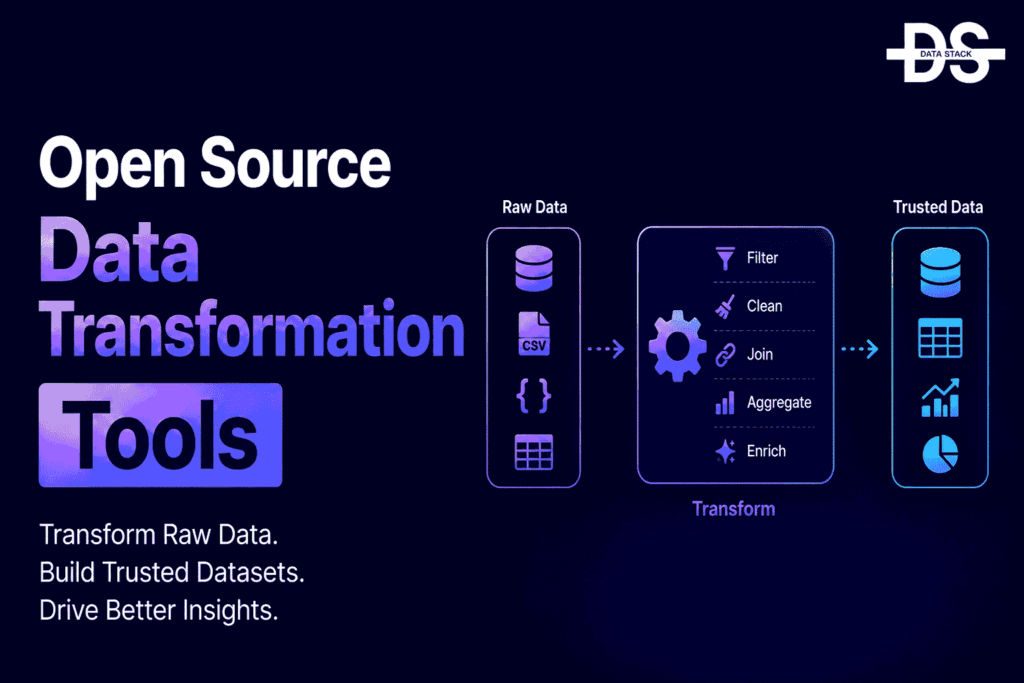
Data transformation is a core part of modern data workflows. Data collected from applications, databases, APIs, files, and event streams often needs to be cleaned, joined, filtered, aggregated, standardized, or restructured before it can support analytics, reporting, machine learning, or operational use.
The way these transformations are performed depends on the data architecture. Analytics teams may transform data directly inside a warehouse using SQL, while data engineering teams may need distributed processing for large batch workloads. Streaming systems introduce another requirement: transforming data continuously as events arrive.
Open source data transformation tools support these different approaches. Some focus on SQL-based data modeling, while others provide distributed batch processing, stream processing, visual pipelines, or high-performance DataFrame operations. This guide compares eight options based on the transformation workloads they are designed to handle.
Table of Contents
ToggleWhat is a Data Transformation Tool?
A data transformation tool helps convert data from its original format or structure into a form that can be used for a specific purpose. Common transformations include filtering records, cleaning values, joining datasets, aggregating metrics, creating calculated fields, changing data types, and restructuring tables.
Some tools run transformations directly inside a data warehouse or database, while others process data through distributed engines, streaming frameworks, or application code. The right choice depends on data volume, processing requirements, existing infrastructure, and whether transformations need to run in batch, real time, or both.
Open Source Data Transformation Tools Comparison for 2026
| Tool Name | Category | Best For | Key Strength | Deployment Options | Licensing |
|---|---|---|---|---|---|
| dbt Core | SQL Data Transformation | Analytics engineering workflows | Version-controlled SQL models and testing | Self-hosted, CLI, Docker, Kubernetes | Apache 2.0 |
| Apache Spark | Distributed Data Processing | Large-scale batch transformations | Distributed processing across large datasets | Self-hosted, Docker, Kubernetes, cloud | Apache 2.0 |
| Apache Flink | Stream Processing | Real-time data transformations | Stateful stream processing | Self-hosted, Docker, Kubernetes, cloud | Apache 2.0 |
| Apache Beam | Unified Data Processing | Portable batch and streaming pipelines | Unified programming model across runners | Self-hosted, cloud, Kubernetes | Apache 2.0 |
| Apache Hop | Data Integration & Transformation | Visual ETL and ELT workflows | Graphical pipeline development | Desktop, self-hosted, Docker | Apache 2.0 |
| Apache NiFi | Data Flow Processing | Flow-based transformations | Visual routing and processor-based flows | Self-hosted, Docker, Kubernetes | Apache 2.0 |
| Polars | DataFrame Processing | High-performance local transformations | Fast columnar DataFrame operations | Python, Rust environments | MIT |
| DuckDB | Analytical Data Processing | SQL transformations and local analytics | In-process analytical SQL engine | Embedded, CLI, self-hosted | MIT |
The 8 Best Open Source Data Transformation Tools in 2026
Open source data transformation tools address different processing requirements. SQL-based tools such as dbt Core are designed for analytical modeling, while Apache Spark and Apache Flink handle larger distributed batch and streaming workloads. Visual platforms and embedded analytical engines provide alternatives for teams with different development and deployment requirements.
#1 dbt Core
dbt Core is an open source data transformation framework for building SQL-based models inside warehouses and other supported data platforms. Teams define transformations as SQL, create dependencies between models, and manage the resulting project through version control.
Its analytics engineering workflow makes dbt Core particularly useful when data transformation needs to be repeatable, tested, and documented. Rather than treating transformation queries as isolated scripts, teams can organize them into modular models and run them according to their dependencies.
Key Features
- SQL-based transformations: Defines transformation logic using SQL models.
- Dependency management: Builds and executes models based on relationships between datasets.
- Version-controlled projects: Allows transformation code to be managed through Git workflows.
- Data testing: Supports reusable tests for validating transformed datasets.
- Documentation generation: Creates documentation for models, columns, and dependencies.
- Modular development: Supports reusable logic through references, macros, and project structure.
Best For
dbt Core is best for analytics engineering teams that need an open source data transformation tool for building version-controlled, SQL-based transformation workflows.
#2 Apache Spark
Apache Spark is an open source distributed processing engine used for large-scale data transformation across batch and streaming workloads. It can process datasets across multiple machines and supports APIs for SQL, Python, Java, Scala, and other supported environments.
Spark is particularly useful when data volumes exceed what a single machine or database can efficiently process. Teams can use it for large joins, aggregations, filtering, enrichment, and other transformation workloads across data lakes and distributed storage systems.
Key Features
- Distributed processing: Processes large datasets across multiple nodes.
- Batch transformations: Supports large-scale ETL and data processing workloads.
- Spark SQL: Provides SQL-based querying and transformation capabilities.
- Multiple language APIs: Supports Python, Scala, Java, and SQL workflows.
- Structured Streaming: Supports continuous processing for supported streaming workloads.
- Data source integration: Works with a range of storage systems and data formats.
Best For
Apache Spark is best for data engineering teams that need open source data transformation for large-scale batch processing and distributed data workloads.
Also Read: Apache Spark Alternatives
Showcase your software to buyers actively comparing tools. Submit your product for editorial review and get featured on Data Stack Hub.
Submit Your Tool →#3 Apache Flink
Apache Flink is an open source distributed processing framework designed for stateful stream processing and real-time data transformation. It can process events continuously while maintaining state, making it useful for transformations that depend on previous events or changing conditions.
Although Flink also supports batch-style processing, it is particularly relevant for organizations where low-latency event processing is a primary requirement. Teams can use it to filter, enrich, aggregate, join, and transform streaming data as it moves through the system.
Key Features
- Stateful stream processing: Maintains application state while processing continuous event streams.
- Real-time transformations: Processes and transforms events with low-latency execution.
- Event-time processing: Supports processing based on when events occurred.
- Windowing: Groups events into time-based or other defined windows for aggregation.
- Batch and streaming support: Handles bounded and unbounded data processing workloads.
- Fault tolerance: Provides mechanisms for recovering state and processing after failures.
Best For
Apache Flink is best for teams that need an open source data transformation tool for stateful, real-time, and event-driven data processing.
Also Read: Top 11 Flink Alternatives and Competitors in 2026
#4 Apache Beam
Apache Beam is an open source unified programming model for defining batch and streaming data processing pipelines. Teams can build transformation logic once and execute it using supported processing runners such as Apache Flink, Apache Spark, and cloud-based services.
Its portability makes Beam useful for organizations that want to separate pipeline logic from the underlying execution engine. The same transformation pipeline can support different processing environments depending on deployment and infrastructure requirements.
Key Features
- Unified programming model: Supports both batch and streaming data transformations.
- Runner portability: Allows pipelines to execute on different supported processing engines.
- Pipeline-based development: Organizes transformations into reusable processing steps.
- Windowing support: Supports processing and aggregating data across defined windows.
- Event-time capabilities: Handles time-based processing for streaming workloads.
- Multiple SDKs: Provides supported development SDKs for different programming languages.
Best For
Apache Beam is best for teams that need portable open source data transformation pipelines that can run across batch and streaming processing environments.
#5 Apache Hop
Apache Hop is an open source data integration and transformation platform that provides a visual environment for building pipelines. Teams can create transformations for processing data and workflows for coordinating multiple transformation and integration steps.
Its graphical approach makes it useful for teams that prefer visual development over writing every transformation in code. Apache Hop also supports reusable metadata and different execution approaches depending on the processing environment.
Key Features
- Visual pipeline development: Provides a graphical interface for designing transformations.
- ETL and ELT workflows: Supports extracting, transforming, and loading data.
- Reusable metadata: Allows connections and other configurations to be reused across projects.
- Workflow orchestration: Coordinates multiple transformations and processing steps.
- Multiple execution options: Supports different execution engines and deployment approaches.
- Project organization: Helps teams manage pipelines, workflows, and related configurations.
Best For
Apache Hop is best for teams that need an open source data transformation tool with a visual interface for building ETL and ELT pipelines.
#6 Apache NiFi
Apache NiFi is an open source data flow automation platform that uses processors to move, route, and transform data between systems. Teams can build flows through a visual interface and configure how data is filtered, enriched, split, merged, or delivered.
NiFi is useful when transformation is closely connected with data movement. Instead of focusing only on SQL models or distributed computation, it provides a flow-based approach for processing data as it travels between applications, databases, APIs, files, and messaging systems.
Key Features
- Visual flow design: Builds transformation workflows through a browser-based interface.
- Processor-based transformations: Uses configurable processors to manipulate and process data.
- Data routing: Routes records based on defined conditions and flow logic.
- Data provenance: Tracks how data moves through transformation workflows.
- Multiple system integrations: Connects with supported databases, APIs, files, and messaging platforms.
- Cluster support: Can distribute data flows across multiple nodes.
Best For
Apache NiFi is best for teams that need open source data transformation combined with data routing, movement, and flow automation.
Also Read: Best Apache NiFi Alternatives and Competitors
Increase your product visibility by reaching software buyers researching the best tools. Every submission is reviewed by our editorial team.
Feature My Tool →#7 Polars
Polars is an open source DataFrame library designed for high-performance data processing. It provides APIs for working with tabular data and supports transformation operations such as filtering, joining, grouping, aggregating, and reshaping datasets.
Its columnar execution model and support for lazy evaluation make it useful for developers and data teams that need faster local data transformation workflows. Polars is particularly relevant for Python and Rust environments where a lightweight DataFrame engine is preferred over a distributed processing platform.
Key Features
- High-performance DataFrames: Provides efficient operations for tabular data processing.
- Lazy evaluation: Can optimize supported query and transformation operations before execution.
- Columnar processing: Uses a column-oriented approach for analytical workloads.
- Data transformation operations: Supports joins, filters, aggregations, reshaping, and other operations.
- Python and Rust APIs: Supports development in Python and Rust.
- Expression-based workflows: Allows complex transformations to be defined through composable expressions.
Best For
Polars is best for developers and data teams that need a high-performance open source data transformation library for local Python or Rust workflows.
#8 DuckDB
DuckDB is an open source analytical database designed to run directly within applications and local environments. It provides SQL capabilities for querying and transforming data without requiring a separate database server for many use cases.
DuckDB is particularly useful for analytical transformations involving local files, embedded applications, and smaller data workflows. Teams can use SQL to join, aggregate, filter, and transform data from supported formats and storage locations.
Key Features
- In-process SQL engine: Runs analytical SQL directly within applications and local environments.
- SQL-based transformations: Supports joins, aggregations, filtering, and other analytical operations.
- Columnar execution: Uses columnar processing for analytical workloads.
- File format support: Can work with supported analytical data formats such as Parquet and CSV.
- Embedded deployment: Does not require a separate server for many use cases.
- Developer-friendly integration: Provides interfaces for multiple programming languages and environments.
Best For
DuckDB is best for developers and analysts that need a lightweight open source data transformation tool for SQL-based analytical processing in local or embedded environments.
Also Read: Best DuckDB Alternatives & Competitors in 2026
Non-Open-Source Data Transformation Tools and Platforms
#1 Matillion
Matillion is a commercial data integration and transformation platform designed for building data pipelines in cloud data environments. It provides a managed approach to preparing and transforming data for analytics workloads.
Best For
Matillion is best for organizations that want a managed platform for building data integration and transformation workflows in cloud data environments.
Also Read: Best Matillion Alternatives & Competitors in 2026
#2 Informatica Cloud Data Integration
Informatica Cloud Data Integration provides enterprise capabilities for integrating and transforming data across cloud and on-premises systems. It is designed for organizations managing complex transformation workflows alongside broader data management requirements.
Best For
Informatica Cloud Data Integration is best for large enterprises that need data transformation capabilities as part of a broader enterprise data integration platform.
#3 Alteryx
Alteryx provides a commercial analytics and data preparation platform with visual workflows for transforming, blending, and preparing data. It is commonly used by analysts and business teams that want to build transformation workflows without relying entirely on code.
Best For
Alteryx is best for analytics and business teams that need a visual platform for preparing and transforming data with low-code workflows.
Also Read: Best Alteryx Alternatives and Competitors in 2026
How to Choose the Right Open Source Data Transformation Tool
- Transformation environment: Start with where the data is processed. dbt Core is designed for SQL transformations inside analytical data platforms, while DuckDB is useful for local and embedded analytical workloads.
- Data volume and scale: Large distributed datasets require a processing engine designed to scale across multiple machines. Apache Spark is a stronger choice for large batch transformations, while Polars is better suited to high-performance local DataFrame processing.
- Batch versus streaming workloads: Apache Spark can support batch and streaming transformations, while Apache Flink is more focused on stateful, real-time event processing. Apache Beam is useful when the same pipeline needs to support both batch and streaming execution.
- Visual development: Teams that prefer building workflows through a graphical interface can consider Apache Hop or Apache NiFi. Apache Hop is more focused on ETL and transformation pipelines, while NiFi is useful when transformation is closely connected with routing and data movement.
- SQL versus code-based workflows: dbt Core and DuckDB are suitable for teams that prefer SQL-based transformations. Polars is better for Python or Rust-based DataFrame operations, while Spark, Flink, and Beam support programmatic pipeline development.
- Processing engine portability: Apache Beam separates pipeline logic from execution, allowing teams to run supported pipelines on different runners. This can be useful when infrastructure requirements may change or multiple execution environments are needed.
- Streaming state and event processing: For transformations that depend on event history, windows, or application state, Apache Flink provides capabilities designed specifically for stateful stream processing.
- Operational complexity: Distributed tools such as Spark and Flink require more infrastructure and operational expertise than local tools such as Polars or DuckDB. Choose a tool that fits both the workload and the team’s ability to manage the underlying environment.
Browse expertly curated software recommendations across hundreds of business categories.
Browse Top Tools →Conclusion
Open source data transformation tools are built for very different layers of the data stack, so comparing them as direct alternatives can be misleading. A tool that works well for SQL modeling inside a warehouse solves a different problem from one designed to process billions of streaming events.
For analytics transformation, dbt Core provides a structured way to build, test, and maintain SQL models. Apache Spark and Apache Flink address larger distributed workloads, with Spark covering broad batch processing and Flink focusing heavily on continuous, stateful event processing. Apache Beam is useful when portability across processing engines is an important requirement.
Teams that prefer visual development can use Apache Hop or Apache NiFi to build transformation workflows without making every step code-first. For local and embedded workloads, Polars and DuckDB provide lighter alternatives for processing and transforming data without operating a distributed platform.
The best open source data transformation tool is therefore the one that fits the actual transformation layer in your architecture. Start with where the data lives, how it needs to be processed, and whether the workload is SQL-based, distributed, streaming, visual, or local. That will narrow the options much faster than comparing every feature side by side.
Frequently Asked Questions
1. What is a data transformation tool?
A data transformation tool changes data from one format, structure, or state into another. Common operations include cleaning, filtering, joining, aggregating, standardizing, and restructuring data for analytics, applications, or other downstream use cases.
2. What are open source data transformation tools?
Open source data transformation tools are platforms and frameworks with publicly available source code that help teams process and transform data. Examples include dbt Core, Apache Spark, Apache Flink, Apache Hop, Polars, and DuckDB.
3. What is the best open source data transformation tool?
The best option depends on the workload. dbt Core is a strong choice for SQL-based analytics transformations, Apache Spark is suitable for large-scale distributed processing, Apache Flink is designed for real-time stream processing, and Polars is useful for high-performance local DataFrame transformations.
4. What is the difference between data transformation and data integration?
Data integration focuses on connecting and moving data between systems. Data transformation focuses on changing the structure, format, or content of that data. Many ETL and ELT pipelines include both processes.
5. Is dbt Core a data transformation tool?
Yes. dbt Core is an open source framework for defining and managing SQL-based data transformations. It allows teams to organize transformations as models, manage dependencies, test data, and document analytical datasets.
6. Which tool is best for large-scale data transformation?
Apache Spark is a strong choice for large-scale distributed data transformation because it can process datasets across multiple machines. It supports batch processing, SQL workloads, and supported streaming workflows.
7. Which open source tool is best for real-time data transformation?
Apache Flink is a strong option for real-time and stateful stream processing. It supports continuous event processing, event-time operations, windowing, and transformations that depend on application state.
8. Can data transformation tools support both batch and streaming data?
Yes. Apache Spark and Apache Beam support both batch and streaming data processing. Apache Flink also supports bounded and unbounded data processing, although it is particularly well suited to streaming workloads.