
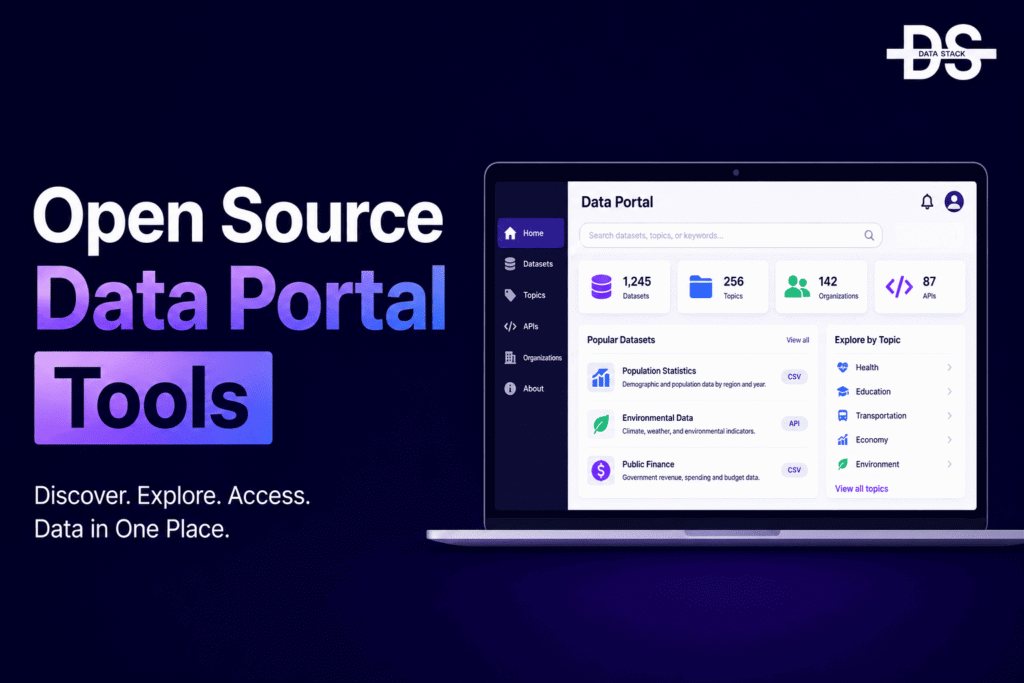
Data often exists long before anyone can easily find or use it. A government department may publish files across multiple pages, a research organization may maintain separate repositories, or an enterprise may have valuable datasets spread across warehouses, databases, and internal systems. Without a usable discovery layer, even well-managed data can remain difficult to access.
Data portals solve this problem by creating an environment where datasets can be published, documented, organized, and explored. Public portals are commonly used to make open data available to citizens, researchers, and developers, while internal portals can help employees discover approved datasets and data products across the organization. Search, metadata, categories, APIs, previews, and access workflows can all play a role depending on the platform.
Open source data portal tools are useful when organizations want more control over deployment, customization, and the way data is presented to users. Some provide complete platforms for publishing datasets, while others focus on metadata and discovery capabilities that can be used to build an internal portal. This guide compares seven open source data portal tools for different publishing and discovery requirements.
What is a Data Portal Tool?
A data portal tool is software used to create an interface where users can explore and access datasets or other data resources. It typically organizes information through metadata, search, categories, filters, and dataset pages so users can understand what is available before accessing the underlying data.
The scope of a data portal can vary significantly. A public open data portal may focus on publishing downloadable datasets and APIs, while an internal enterprise portal may connect metadata from multiple systems and help employees discover existing data without moving it into a single repository.
Open Source Data Portal Tools Comparison for 2026
| Tool Name | Category | Best For | Key Strength | Deployment Options | Licensing |
|---|---|---|---|---|---|
| CKAN | Open Data Portal | Public and organizational dataset portals | Dataset publishing, metadata, search, and APIs | Self-hosted, Docker, cloud | AGPLv3 |
| Magda | Federated Data Portal | Discovering data across distributed systems | Metadata aggregation and unified discovery | Self-hosted, Docker, Kubernetes, cloud | Apache 2.0 |
| DKAN | Open Data Platform | Drupal-based data portals | Native Drupal integration for dataset publishing | Self-hosted, cloud | GPLv2+ |
| Dataverse | Research Data Repository | Publishing research datasets | Metadata, versioning, and dataset discovery | Self-hosted, Docker, cloud | Apache 2.0 |
| OpenDataSoft UData | Data Publishing Platform | Interactive data portals | Dataset publishing and exploration capabilities | Self-hosted / platform deployment | Open-source components |
| DataHub | Metadata Platform | Internal enterprise data portals | Search, metadata, ownership, and lineage | Self-hosted, Docker, Kubernetes, cloud | Apache 2.0 |
| OpenMetadata | Metadata Platform | Internal data discovery portals | Unified metadata and data asset discovery | Self-hosted, Docker, Kubernetes, cloud | Apache 2.0 |
The 7 Best Open Source Data Portal Tools in 2026
The tools below cover different approaches to building a data portal, from publishing public datasets to creating an internal discovery experience across a modern data stack.
#1 CKAN
CKAN is one of the best-known open source data portal tools for organizations that need to publish and organize datasets. It provides the core components needed to create a searchable portal, including dataset pages, metadata, resource management, organizations, tags, and APIs.
Its strongest use case is structured dataset publishing. Rather than treating a portal as a collection of files, CKAN allows organizations to describe datasets, attach multiple resources, categorize information, and make data easier to discover. This makes it suitable for government open data initiatives, public institutions, research organizations, and enterprises building internal or external dataset portals.
Key Features
- Structured dataset publishing: Creates dedicated dataset records that can include multiple files, links, APIs, and other resources.
- Metadata and organization: Adds descriptions, tags, organizations, licenses, and other contextual information to improve usability.
- Search and filtering: Helps users discover datasets through keyword search, categories, organizations, and tags.
- DataStore capabilities: Supports structured storage and querying for compatible data resources.
- API access: Makes portal metadata and supported data resources available programmatically.
- Extensible platform: Supports extensions and customization for specialized portal requirements.
Best For
CKAN is best for organizations that need a complete open source platform for publishing, managing, and discovering datasets through a public or organizational data portal.
#2 Magda
Magda is an open source data portal and discovery platform designed for environments where information is distributed across multiple systems. Rather than requiring every dataset to be stored in one location, Magda can collect metadata from different sources and present it through a unified interface.
This approach makes Magda useful for organizations that already have data spread across databases, APIs, storage platforms, and other systems. A portal built around federated metadata can help users understand what data exists and where it can be accessed without creating unnecessary copies.
Key Features
- Federated metadata discovery: Brings metadata from different sources into a common portal experience.
- Searchable data catalog: Helps users search and browse available datasets and data resources.
- Metadata harvesting: Collects information from connected systems to improve visibility.
- Dataset pages and descriptions: Provides contextual information that helps users understand available resources.
- API-driven architecture: Supports integration with external applications and data platforms.
- Extensible deployment: Can be customized for organizational, government, or public data portal requirements.
Best For
Magda is best for organizations that need an open source data portal for discovering datasets distributed across multiple systems rather than publishing everything from a single repository.
Showcase your software to buyers actively comparing tools. Submit your product for editorial review and get featured on Data Stack Hub.
Submit Your Tool →#3 DKAN
DKAN is an open source data platform built on Drupal for organizations that want to combine dataset publishing with a flexible content management environment. It is particularly relevant when a data portal needs to include more than dataset pages, such as editorial content, landing pages, guides, announcements, and other public-facing information.
Its Drupal foundation gives organizations a familiar framework for managing both structured data and website content. This makes DKAN a strong option for public sector organizations and institutions building a data portal that also functions as a broader information website.
Key Features
- Drupal-based architecture: Combines data publishing capabilities with Drupal’s content management framework.
- Dataset management: Allows organizations to create and organize dataset records and related resources.
- Metadata support: Adds contextual information that helps users understand published datasets.
- Search and discovery: Helps visitors find datasets through portal navigation and search capabilities.
- API capabilities: Supports programmatic access to data and metadata.
- Customizable portal experience: Allows organizations to adapt the front end and content structure to their requirements.
Best For
DKAN is best for government agencies and organizations that want an open source data portal built around Drupal and need both dataset publishing and broader website content management.
#4 Dataverse
Dataverse is an open source repository platform designed for publishing, preserving, and sharing research data. It gives institutions a structured way to organize datasets, document them with metadata, manage versions, and make research resources discoverable for other users.
While it is more specialized than a general-purpose open data portal, Dataverse is a strong option for universities, research institutions, and scientific organizations. Its workflows are designed around the long-term management and reuse of datasets rather than simple file distribution.
Key Features
- Research dataset publishing: Provides structured workflows for creating and publishing datasets.
- Rich metadata: Supports detailed documentation that helps users understand and reuse research data.
- Dataset versioning: Maintains versions when published datasets are updated.
- Persistent identification: Supports persistent identifiers for published datasets.
- Access controls: Allows institutions to manage how and when research data becomes available.
- Search and discovery: Helps users locate datasets across collections and repositories.
Best For
Dataverse is best for universities and research organizations that need an open source data portal for publishing, preserving, and sharing research datasets.
#5 DataHub
DataHub is an open source metadata platform that can also serve as the discovery layer for an internal data portal. Instead of publishing datasets into a separate repository, it helps organizations surface information about data already stored across warehouses, databases, data lakes, dashboards, pipelines, and other systems.
This makes DataHub useful for enterprises where the challenge is not creating more copies of data, but making existing assets easier to find and understand. Users can search for relevant data, review documentation and ownership details, and explore relationships between assets before deciding whether the data is appropriate for their work.
Key Features
- Unified data discovery: Provides a central search experience for datasets, tables, dashboards, pipelines, and other data assets.
- Metadata management: Collects and organizes technical and business metadata from connected systems.
- Ownership information: Shows the teams or individuals responsible for specific data assets.
- Data lineage: Helps users understand relationships between upstream and downstream data assets.
- Documentation support: Allows teams to add descriptions and contextual information to improve data usability.
- Extensive integrations: Connects with a wide range of modern data platforms through metadata ingestion.
Best For
DataHub is best for enterprises that need an open source internal data portal for discovering and understanding data distributed across a complex data environment.
#6 OpenMetadata
OpenMetadata is an open source metadata platform that brings information about data assets into a shared discovery and governance environment. It can connect with databases, warehouses, dashboards, pipelines, and other systems to create a more complete view of an organization’s data.
For an internal data portal, OpenMetadata helps users move beyond basic search by adding context around ownership, descriptions, lineage, classifications, and related assets. This can make it easier for teams to identify trusted and relevant data before using it for analytics, reporting, or other workloads.
Key Features
- Centralized metadata: Brings metadata from supported data systems into a unified platform.
- Search and discovery: Helps users find tables, databases, dashboards, pipelines, and other data assets.
- Data lineage: Maps relationships and dependencies between connected assets.
- Ownership and documentation: Identifies responsible teams and supports contextual documentation.
- Data classification: Helps organize and identify data based on defined classifications.
- Data product organization: Supports grouping and presenting related data assets in a more structured way.
Best For
OpenMetadata is best for organizations building an open source internal data portal where discovery, documentation, ownership, and governance need to work together.
Increase your product visibility by reaching software buyers researching the best tools. Every submission is reviewed by our editorial team.
Feature My Tool →#7 Data.gov CKAN Extensions and Custom Portal Implementations
For organizations that need a highly customized open data experience, an open source data portal does not always have to come from a completely separate product. CKAN’s extensible architecture allows teams to build specialized portals around the core platform and adapt the user experience, metadata model, search behavior, and integrations for specific audiences.
This approach is useful when the requirements go beyond a standard out-of-the-box deployment. Government agencies, public institutions, and large organizations may need custom workflows, sector-specific metadata, multilingual support, or integrations with existing systems. Building on an established open source portal foundation can be more practical than creating the entire platform from scratch.
Key Features
- Customizable portal architecture: Allows organizations to adapt the portal experience to specific user and business requirements.
- Extension support: Adds specialized functionality through extensions and custom development.
- Flexible metadata models: Can be adapted to capture additional information required for specific datasets or domains.
- Integration capabilities: Connects portal functionality with existing APIs, data systems, and organizational workflows.
- Scalable publishing foundation: Supports large collections of datasets and structured metadata.
- Community ecosystem: Benefits from existing open source development and reusable extensions.
Best For
Custom CKAN implementations are best for organizations that need a tailored open source data portal and have requirements that go beyond a standard dataset publishing deployment.
Non-Open-Source Data Portal Tools and Platforms
Commercial data portal platforms can be a better fit for organizations that want managed infrastructure, vendor support, or built-in capabilities without maintaining and customizing an open source deployment.
#1 ArcGIS Hub
ArcGIS Hub provides a managed platform for creating data-driven websites and sharing geographic and organizational data. It is particularly useful for governments and organizations already using the ArcGIS ecosystem.
Best For
ArcGIS Hub is best for organizations that need a managed data portal for publishing and sharing geographic, location-based, and organizational datasets.
#2 OpenDataSoft
OpenDataSoft provides a managed platform for publishing, sharing, and building user-facing experiences around data. Organizations can use it to create data portals and make datasets easier for internal or external audiences to explore.
Best For
OpenDataSoft is best for organizations that want a managed platform for building interactive public or enterprise data portals without maintaining the underlying infrastructure.
#3 Alation
Alation is a commercial data intelligence platform focused on helping organizations discover, understand, and govern their data. It can support internal data portal use cases where enterprise users need a centralized experience for finding trusted data assets.
Best For
Alation is best for enterprises that need a managed data discovery and intelligence platform for helping employees find and understand data across the organization.
How to Choose the Right Open Source Data Portal Tool
- What type of data are you planning to publish or make discoverable? Start with the type and audience. Public datasets, internal enterprise data, research datasets, and geographic information often require different metadata structures and access experiences. A general-purpose platform may work well for public datasets but be less suitable for internal data discovery.
- Do users need to access the data directly from the portal? Some platforms store and publish datasets directly, while others act primarily as a discovery layer over existing databases, warehouses, and storage systems. If moving or duplicating data is unnecessary, a metadata-driven portal may be the better architecture.
- How important is metadata and search? A portal becomes less useful when users cannot understand what a dataset contains, who owns it, or whether it can be trusted. Look for strong metadata, search, filtering, documentation, and ownership capabilities based on the complexity of your data environment.
- Who will manage and maintain the portal? A self-hosted open source data portal requires ongoing infrastructure management, upgrades, integrations, and metadata maintenance. Consider whether your team has the technical resources to operate and customize the platform over time.
- Do you need a public-facing website or an internal discovery experience? Public portals often require customizable pages, dataset presentation, and broad accessibility. Internal portals may place more emphasis on enterprise authentication, ownership, lineage, and integration with the existing data stack.
- Will the portal need to connect with multiple data systems? If datasets already exist across warehouses, databases, APIs, and storage platforms, choose a tool that can aggregate or ingest metadata from those systems rather than requiring everything to be manually republished.
- What access and governance controls are required? Public data may need minimal restrictions, while internal or sensitive data can require authentication, permissions, classification, and governance workflows. Make sure the portal architecture aligns with those requirements before publishing data.
- How much customization do you need? Some open source tools provide a ready-made portal experience, while others are better used as a foundation for building a customized interface. Consider the development effort required if branding, workflows, metadata models, or integrations need significant changes.
Browse expertly curated software recommendations across hundreds of business categories.
Browse Top Tools →Conclusion
The best open source data portal tool depends on the type of data and the audience you want to serve.
CKAN is one of the strongest options for publishing and organizing datasets through a dedicated portal. Magda is useful when data is distributed across multiple systems, while DKAN provides a strong option for organizations that want to combine data publishing with a Drupal-based website.
Dataverse is more specialized for research data, whereas DataHub and OpenMetadata are better suited to internal enterprise discovery. For organizations with highly specific requirements, a customized portal built on an established open source foundation can provide greater flexibility than a fixed platform.
The key decision is whether the portal should primarily publish datasets, help users discover existing data, or support a broader content and information experience. Defining that use case first will make it easier to select the right platform.
Frequently Asked Questions
1. What are open source data portal tools?
Open source data portal tools are platforms used to publish, organize, discover, and provide access to datasets or other data resources. They can be used for public open data, research repositories, or internal enterprise data discovery.
2. What are the best open source data portal tools?
CKAN, Magda, DKAN, Dataverse, DataHub, and OpenMetadata are among the strongest options, depending on whether you need public publishing, research data management, or internal discovery.
3. What is the difference between a data portal and a data catalog?
A data portal focuses on providing a user-facing experience for discovering and accessing data. A data catalog primarily manages metadata about data assets, although modern catalog platforms can also provide portal-like discovery experiences.
4. Which open source data portal is best for public datasets?
CKAN is one of the best-known open source platforms for publishing and managing public datasets through a searchable portal.
5. Can a data portal connect to multiple data sources?
Yes. Tools such as Magda can aggregate metadata from distributed systems, while DataHub and OpenMetadata can connect with multiple enterprise data platforms to provide unified discovery.
6. Is CKAN only for government open data?
No. CKAN is widely used for open data initiatives, but organizations can also use it to create internal, industry-specific, or partner-facing data portals.
7. Which tool is best for research data?
Dataverse is a strong choice for universities, research institutions, and scientific organizations that need to publish, preserve, document, and share research datasets.