
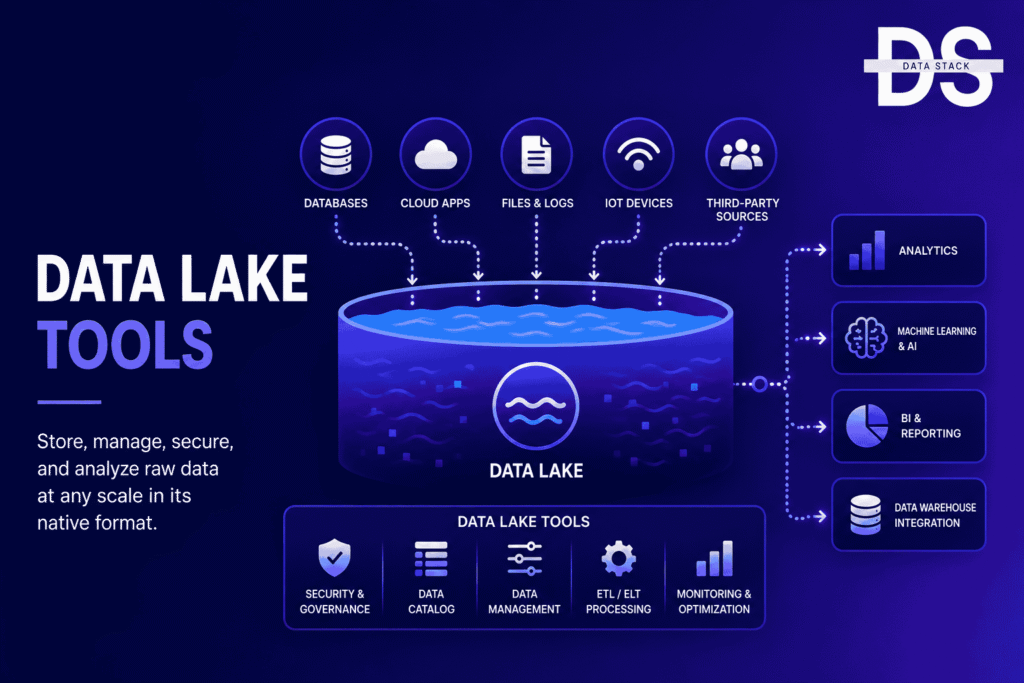
According to IDC, the global datasphere is projected to exceed 390 zettabytes by 2028, driven by cloud applications, IoT devices, AI workloads, machine-generated logs, streaming platforms, and enterprise data growth. As organizations collect increasingly large volumes of structured, semi-structured, and unstructured information, traditional databases and warehouses alone are often insufficient.
Modern organizations need scalable platforms capable of storing massive datasets while supporting analytics, machine learning, AI, governance, and operational workloads.
This is where Data Lake Tools play a critical role.
Data Lake Platforms help organizations centralize large volumes of raw data from multiple sources without requiring predefined schemas. These platforms support analytics, business intelligence, machine learning, data science, AI initiatives, and real-time processing while providing the flexibility needed to handle diverse data types.
Another major trend shaping this market is generative AI. Organizations increasingly use data lakes to store training data, vectorized content, documents, logs, and multimodal datasets that support AI applications. As a result, governance, lineage, quality, and security capabilities have become as important as storage scalability.
To identify the best Data Lake Tools, we evaluated vendors based on scalability, analytics support, cloud compatibility, governance capabilities, ecosystem maturity, AI readiness, and enterprise adoption. Our selections include cloud-native data lake platforms, lakehouse technologies, enterprise analytics ecosystems, and modern open data architectures.
What Are Data Lake Tools?
Data Lake Tools are software platforms that help organizations store, manage, govern, process, and analyze large volumes of structured, semi-structured, and unstructured data. Unlike traditional data warehouses that require predefined schemas, data lakes allow organizations to ingest raw information from multiple sources and transform it later based on business needs. Modern Data Lake Platforms often include governance, security, metadata management, lineage, AI support, and lakehouse capabilities alongside scalable storage.
Benefits of Data Lake Platforms
- Store massive datasets at lower cost than traditional warehouses.
- Support analytics, AI, machine learning, and reporting workloads.
- Centralize structured and unstructured information.
- Improve scalability across cloud environments.
- Enable modern lakehouse architectures.
- Support governance, security, and compliance initiatives.
- Reduce data silos across organizations.
Data Lake Platform Comparison
| Tool | Best For | Pricing Model | Best Fit |
|---|---|---|---|
| Databricks Lakehouse Platform | Lakehouse architecture | Consumption | Enterprises |
| Amazon S3 + Lake Formation | AWS data lakes | Usage-based | AWS customers |
| Microsoft Fabric | Unified analytics | Subscription | Microsoft customers |
| Snowflake | Data lakehouse workloads | Consumption | Cloud-first organizations |
| Google BigLake | Multi-cloud analytics | Usage-based | Google Cloud users |
| Cloudera Data Platform | Hybrid data lakes | Custom | Large enterprises |
| Dremio | Self-service lakehouse analytics | Subscription | Analytics teams |
| Starburst | Data lake analytics | Custom | Distributed environments |
| Apache Iceberg | Open table format | Open Source | Engineering teams |
| Delta Lake | Open lakehouse architecture | Open Source | Databricks users |
| Apache Hudi | Incremental processing | Open Source | Streaming workloads |
| IBM watsonx.data | Hybrid lakehouse | Custom | Enterprises |
| MinIO | Object storage data lakes | Open Source | Private cloud environments |
13 Best Data Lake Tools
#1 Databricks Lakehouse Platform
Databricks has become the most influential platform in the modern Data Lake market by popularizing the lakehouse architecture. Rather than forcing organizations to choose between a data warehouse and a data lake, Databricks combines the scalability of data lakes with the performance and governance capabilities traditionally associated with warehouses.
Organizations frequently adopt Databricks because AI, machine learning, analytics, and data engineering teams increasingly need to work from the same datasets. Traditional architectures often create separate environments for each workload, leading to duplication and governance challenges. Databricks addresses this problem through a unified platform.
Compared with traditional data lake deployments built solely on cloud storage, Databricks offers significantly stronger analytics, governance, machine learning, and AI capabilities. However, organizations looking only for low-cost storage may find simpler alternatives more economical.
Key Features
- Supports lakehouse architectures that unify data engineering, analytics, AI, and machine learning workloads.
- Uses Delta Lake technology to provide ACID transactions, schema enforcement, and reliability on data lakes.
- Enables collaborative workflows across analysts, engineers, scientists, and business users.
- Supports large-scale streaming and batch processing workloads.
- Integrates with governance, lineage, quality, and security frameworks.
- Provides native support for generative AI and machine learning initiatives.
- Scales across AWS, Azure, and Google Cloud environments.
Pricing
Consumption-based pricing. Pay-as-you-go model.
Best For
Organizations building modern lakehouse architectures and AI-driven analytics environments.
Why Choose This Tool
Choose Databricks if your goal extends beyond storage and includes analytics, AI, machine learning, and unified data operations. Few platforms offer the same combination of scalability, ecosystem maturity, and innovation.
G2 Rating: 4.5/5
Gartner Rating: 4.7/5
Showcase your software to buyers actively comparing tools. Submit your product for editorial review and get featured on Data Stack Hub.
Submit Your Tool →#2 Amazon S3 + Lake Formation
Amazon S3 remains the foundation of many cloud-based data lake implementations. When combined with AWS Lake Formation, organizations gain governance, security, metadata management, and access-control capabilities that transform object storage into a managed Data Lake Platform.
Organizations choose AWS because of its scalability, durability, extensive ecosystem, and integration with analytics services such as Athena, Redshift, Glue, EMR, and SageMaker. This flexibility makes AWS one of the most commonly deployed environments for enterprise data lakes.
Compared with Databricks, AWS provides greater architectural flexibility but often requires more assembly and management across multiple services.
Key Features
- Stores virtually unlimited structured and unstructured information.
- Supports centralized governance through AWS Lake Formation.
- Integrates with AWS analytics, machine learning, and processing services.
- Provides fine-grained access controls and security capabilities.
- Supports multi-petabyte analytics environments.
- Enables scalable storage for AI and machine learning workloads.
- Reduces storage costs through tiered storage options.
Pricing
Usage-based pricing. Storage and service costs vary by consumption.
Best For
Organizations building large-scale AWS-native data lake architectures.
Why Choose This Tool
AWS remains one of the most flexible and scalable choices for organizations standardizing on Amazon’s cloud ecosystem.
G2 Rating: 4.6/5
Gartner Rating: 4.7/5
#3 Microsoft Fabric
Microsoft Fabric is Microsoft’s unified analytics platform that combines data engineering, business intelligence, governance, lakehouse capabilities, and AI services within a single environment. Built around OneLake, Fabric aims to simplify how organizations manage and analyze enterprise data.
Organizations increasingly choose Fabric because it reduces the fragmentation often associated with modern analytics stacks. Instead of maintaining separate tools for storage, transformation, reporting, and governance, Fabric provides a more integrated experience.
Compared with traditional Azure data lake architectures, Fabric places greater emphasis on unification, self-service analytics, and operational simplicity.
Key Features
- Uses OneLake as a unified enterprise data foundation.
- Supports lakehouse, warehouse, analytics, and BI workloads.
- Integrates deeply with Power BI, Azure, and Microsoft services.
- Enables AI-powered analytics and reporting capabilities.
- Supports governance, lineage, and security initiatives.
- Reduces complexity across modern analytics architectures.
- Provides unified experiences for engineers, analysts, and business users.
Pricing
Subscription-based pricing with Fabric capacity options.
Best For
Organizations heavily invested in Microsoft analytics ecosystems.
Why Choose This Tool
Microsoft Fabric is ideal for enterprises seeking a unified platform that combines data lakes, analytics, governance, reporting, and AI within a single environment.
G2 Rating: 4.4/5
Gartner Rating: 4.5/5
#4 Snowflake
Snowflake began as a cloud data warehouse platform but has evolved into a broader Data Lakehouse platform capable of supporting large-scale storage, analytics, data sharing, AI, and application workloads. Through support for Iceberg tables, external storage integration, and open data architectures, Snowflake has become a serious contender in the modern data lake market.
Organizations often choose Snowflake because they want warehouse-level performance without managing complex infrastructure. Compared with traditional data lake deployments built on raw cloud storage, Snowflake simplifies administration while providing governance, security, and performance optimization capabilities.
Unlike Databricks, which originated from the data lake side of the market, Snowflake approaches the problem from an analytics and warehouse perspective.
Key Features
- Supports structured, semi-structured, and unstructured data within a unified platform.
- Enables lakehouse architectures through Iceberg and open table format support.
- Provides workload isolation that prevents resource contention across teams.
- Supports secure data sharing across business units, customers, and partners.
- Includes governance, security, lineage, and compliance capabilities.
- Enables AI, machine learning, and advanced analytics workloads.
- Reduces operational overhead through fully managed infrastructure.
Pricing
Consumption-based pricing.
Best For
Organizations seeking a managed lakehouse platform with strong analytics capabilities.
Why Choose This Tool
Snowflake is ideal for organizations that prioritize simplicity, performance, and governance while still wanting modern data lake capabilities.
G2 Rating: 4.5/5
Gartner Rating: 4.7/5
#5 Google BigLake
Google BigLake is Google’s lakehouse platform designed to unify analytics across data warehouses and data lakes. The platform allows organizations to query and govern data stored across cloud environments while maintaining centralized access controls and metadata management.
Organizations using Google Cloud frequently choose BigLake because it simplifies data management across BigQuery, object storage, and analytics workloads. Compared with traditional data lake architectures, BigLake places greater emphasis on governance, consistency, and unified access management.
The platform is particularly attractive for organizations building AI and machine learning workloads within Google Cloud.
Key Features
- Unifies warehouse and data lake management through a lakehouse architecture.
- Supports centralized governance across datasets and storage environments.
- Integrates with BigQuery and Google Cloud analytics services.
- Provides fine-grained security and access controls.
- Supports structured, semi-structured, and unstructured information.
- Enables AI and machine learning initiatives at scale.
- Simplifies management of distributed data assets.
Pricing
Usage-based pricing.
Best For
Organizations standardized on Google Cloud analytics services.
Why Choose This Tool
BigLake is a strong choice for businesses seeking lakehouse functionality combined with Google’s analytics and AI ecosystem.
G2 Rating: 4.4/5
Gartner Rating: 4.5/5
Increase your product visibility by reaching software buyers researching the best tools. Every submission is reviewed by our editorial team.
Feature My Tool →#6 Cloudera Data Platform
Cloudera remains one of the most established enterprise Data Lake vendors and continues to serve organizations operating large-scale hybrid and multi-cloud environments. While many modern competitors focus primarily on cloud-native deployments, Cloudera differentiates itself through flexibility across public cloud, private cloud, and on-premises infrastructures.
Organizations in highly regulated industries often choose Cloudera because migration to fully cloud-native architectures may not always be possible. Compared with Databricks and Snowflake, Cloudera offers stronger hybrid deployment capabilities but may require greater operational expertise.
Key Features
- Supports hybrid, private cloud, public cloud, and on-premises environments.
- Provides integrated governance, security, and metadata management capabilities.
- Supports large-scale analytics and machine learning initiatives.
- Enables centralized management of enterprise data assets.
- Supports data engineering, streaming, and operational analytics workloads.
- Provides strong compliance and regulatory support.
- Helps organizations modernize existing Hadoop-based environments.
Pricing
Custom enterprise pricing.
Best For
Large enterprises operating hybrid and multi-cloud architectures.
Why Choose This Tool
Cloudera remains one of the strongest options for organizations requiring flexibility across diverse infrastructure environments.
G2 Rating: 4.0/5
Gartner Rating: 4.4/5
#7 Dremio
Dremio is a lakehouse analytics platform designed to simplify access to data stored within modern data lakes. Rather than requiring organizations to move information into proprietary systems, Dremio enables direct analytics against data stored in open formats.
Organizations frequently choose Dremio because data movement often creates duplication, governance challenges, and unnecessary costs. Compared with traditional warehouses, Dremio promotes an open architecture approach that allows organizations to maintain greater control over their data assets.
The platform is particularly popular among analytics teams seeking self-service access to large datasets.
Key Features
- Enables direct analytics on data stored in cloud object storage environments.
- Supports Apache Iceberg and open table formats.
- Reduces data duplication across analytics environments.
- Provides SQL-based access for analysts and business users.
- Supports self-service analytics initiatives.
- Improves performance through query acceleration technologies.
- Helps organizations adopt open lakehouse architectures.
Pricing
Subscription pricing available. Enterprise plans offered.
Best For
Analytics teams adopting open lakehouse architectures.
Why Choose This Tool
Dremio is a compelling option for organizations that want high-performance analytics without moving data into proprietary storage layers.
G2 Rating: 4.3/5
Gartner Rating: 4.5/5
#8 Starburst
Starburst is built around Trino and focuses on distributed analytics across multiple data sources. Unlike many lakehouse platforms that centralize data into a single environment, Starburst allows organizations to analyze information where it already exists.
Organizations frequently adopt Starburst when data is distributed across warehouses, lakes, cloud platforms, databases, and operational systems. Compared with Dremio, Starburst places greater emphasis on data federation and distributed query capabilities.
Key Features
- Enables analytics across distributed data environments.
- Supports cloud data lakes, warehouses, and operational databases.
- Reduces the need for large-scale data movement projects.
- Provides high-performance distributed SQL query capabilities.
- Supports open table formats and lakehouse architectures.
- Improves access to enterprise-wide datasets.
- Enables multi-cloud analytics strategies.
Pricing
Custom enterprise pricing.
Best For
Organizations managing highly distributed data environments.
Why Choose This Tool
Starburst is ideal for enterprises seeking to unify analytics across multiple platforms without centralizing all data.
G2 Rating: 4.4/5
Gartner Rating: 4.5/5
#9 Apache Iceberg
Apache Iceberg is one of the most important open-source technologies shaping the future of modern Data Lake architectures. Rather than functioning as a standalone platform, Iceberg provides a table format that enables reliability, governance, performance optimization, and transactional consistency across large-scale data lakes.
Many organizations adopting lakehouse architectures now view Iceberg as a strategic technology because it helps reduce vendor lock-in while supporting interoperability across multiple analytics engines.
Key Features
- Provides ACID transaction support for data lakes.
- Supports schema evolution without disrupting workloads.
- Enables high-performance query execution.
- Reduces vendor lock-in through open standards.
- Supports interoperability across analytics platforms.
- Improves governance and operational consistency.
- Enables scalable lakehouse architectures.
Pricing
Open source.
Best For
Engineering teams building open data lakehouse architectures.
Why Choose This Tool
Iceberg is increasingly becoming a foundational technology for organizations prioritizing open, scalable, and future-proof data architectures.
G2 Rating: 4.7/5
Gartner Rating: Not Available
#10 Delta Lake
Delta Lake, originally created by Databricks, introduced many of the capabilities that helped popularize the lakehouse concept. The technology adds transactional reliability, governance, schema enforcement, and performance improvements to cloud data lakes.
Organizations frequently compare Delta Lake with Apache Iceberg when selecting open table technologies. While Iceberg emphasizes broad ecosystem interoperability, Delta Lake often appeals to organizations heavily invested in Databricks environments.
Key Features
- Adds ACID transactions to cloud data lakes.
- Supports schema validation and enforcement.
- Improves data reliability and consistency.
- Enables batch and streaming workloads.
- Supports governance and compliance initiatives.
- Integrates deeply with Databricks ecosystems.
- Helps organizations implement lakehouse architectures.
Pricing
Open source.
Best For
Organizations building Databricks-centric lakehouse environments.
Why Choose This Tool
Delta Lake remains one of the most mature and widely adopted lakehouse technologies available today.
G2 Rating: 4.7/5
Gartner Rating: Not Available
#11 Apache Hudi
Apache Hudi focuses on incremental processing and real-time data lake workloads. Organizations frequently adopt Hudi when large-scale streaming, change data capture, and continuously updated datasets are critical requirements.
Unlike Iceberg and Delta Lake, which are often associated with analytics optimization, Hudi’s strengths lie in handling operational and streaming-oriented use cases.
Key Features
- Supports incremental processing across large datasets.
- Enables efficient change data capture workflows.
- Improves performance for streaming workloads.
- Reduces processing costs through incremental updates.
- Supports real-time analytics use cases.
- Integrates with major cloud ecosystems.
- Enables operational data lake architectures.
Pricing
Open source.
Best For
Organizations processing continuously changing datasets.
Why Choose This Tool
Apache Hudi is a strong choice when real-time processing and incremental updates are more important than traditional batch analytics workloads.
G2 Rating: 4.5/5
Gartner Rating: Not Available
#12 IBM watsonx.data
IBM watsonx.data is IBM’s modern lakehouse platform designed to support analytics, AI, governance, and enterprise data management initiatives. The platform combines open architectures with enterprise-grade governance and security capabilities.
Organizations evaluating watsonx.data often prioritize governance, compliance, and AI readiness alongside data lake scalability.
Key Features
- Supports lakehouse architectures and open table formats.
- Provides governance, lineage, and security capabilities.
- Supports enterprise AI and analytics initiatives.
- Integrates with hybrid cloud environments.
- Enables cost-efficient storage and processing.
- Supports open ecosystem technologies.
- Helps organizations modernize enterprise analytics environments.
Pricing
Custom enterprise pricing.
Best For
Enterprises prioritizing governance and AI readiness.
Why Choose This Tool
watsonx.data is particularly attractive for organizations combining enterprise governance requirements with AI and analytics initiatives.
G2 Rating: 4.2/5
Gartner Rating: 4.4/5
#13 MinIO
MinIO is an open-source object storage platform frequently used as the storage foundation for private cloud and self-managed Data Lake deployments. Organizations choose MinIO when they want cloud-like scalability without relying entirely on public cloud providers.
Compared with cloud-native object storage services such as Amazon S3, MinIO provides greater deployment flexibility and infrastructure control.
Key Features
- Provides high-performance object storage for data lake environments.
- Supports private cloud and hybrid deployment models.
- Delivers S3-compatible APIs and ecosystem compatibility.
- Enables scalable storage for analytics and AI workloads.
- Supports modern lakehouse architectures.
- Reduces dependency on proprietary cloud storage platforms.
- Improves flexibility across self-managed environments.
Pricing
Open source. Enterprise support available.
Best For
Organizations building private cloud and self-managed data lake environments.
Why Choose This Tool
MinIO is ideal for businesses that require cloud-scale object storage while maintaining full control over infrastructure and data placement.
G2 Rating: 4.8/5
Gartner Rating: Not Available
Which Data Lake Tool Should You Choose?
| Scenario | Recommended Tool |
|---|---|
| Best Overall | Databricks |
| Best AWS Option | Amazon S3 + Lake Formation |
| Best Microsoft Option | Microsoft Fabric |
| Best Managed Lakehouse | Snowflake |
| Best Google Cloud Option | BigLake |
| Best Hybrid Enterprise Platform | Cloudera |
| Best Self-Service Analytics | Dremio |
| Best Data Federation Platform | Starburst |
| Best Open Lakehouse Technology | Apache Iceberg |
| Best Databricks Ecosystem Choice | Delta Lake |
| Best Streaming Data Lakes | Apache Hudi |
| Best Governance-Focused Platform | IBM watsonx.data |
| Best Private Cloud Storage | MinIO |
Browse expertly curated software recommendations across hundreds of business categories.
Browse Top Tools →Conclusion
Data lakes have evolved far beyond simple storage repositories. Modern Data Lake Platforms now serve as the foundation for analytics, machine learning, artificial intelligence, governance, real-time processing, and enterprise-wide data initiatives.
Organizations building AI-driven and analytics-centric architectures increasingly favor lakehouse platforms such as Databricks, Snowflake, Microsoft Fabric, and Google BigLake because they combine scalable storage with governance, performance, and analytics capabilities. At the same time, open technologies such as Apache Iceberg, Delta Lake, Apache Hudi, and MinIO continue gaining adoption among organizations that prioritize flexibility and reduced vendor lock-in.
The right Data Lake Tool depends on your cloud strategy, governance requirements, analytics maturity, AI initiatives, and architectural preferences. Enterprises focused on large-scale modernization projects may gravitate toward Databricks, Fabric, or Cloudera, while engineering teams building open architectures often evaluate Iceberg, Hudi, and MinIO.
As data volumes continue growing and AI adoption accelerates, organizations that invest in scalable, governed, and future-ready data lake architectures will be better positioned to support analytics, machine learning, and business innovation initiatives.
FAQs
1. What are Data Lake Tools?
Data Lake Tools are platforms that help organizations store, manage, govern, process, and analyze large volumes of structured, semi-structured, and unstructured information. They provide scalable storage environments that support analytics, AI, machine learning, and operational workloads.
2. What is the difference between a Data Lake and a Data Warehouse?
A data lake stores raw information in its original format, while a data warehouse typically stores structured and transformed information optimized for reporting and analytics.
3. What are the best Data Lake Tools?
Databricks, Amazon S3 with Lake Formation, Microsoft Fabric, Snowflake, Google BigLake, Cloudera, and Dremio are among the leading Data Lake Platforms available today.
4. What is a Lakehouse Architecture?
A lakehouse architecture combines the scalability and flexibility of a data lake with the governance, performance, and reliability traditionally associated with data warehouses.
5. Which Data Lake Platform is best for AI and Machine Learning?
Databricks is widely considered one of the strongest platforms for AI, machine learning, and advanced analytics because of its integrated lakehouse architecture and AI ecosystem.
6. What are Apache Iceberg and Delta Lake?
Apache Iceberg and Delta Lake are open table formats that add governance, transactional reliability, schema evolution, and performance optimization capabilities to modern data lakes.
7. Which Data Lake Tool is best for AWS?
Amazon S3 combined with AWS Lake Formation is one of the most widely adopted options for organizations operating within AWS environments.
8. Are Data Lakes cheaper than Data Warehouses?
In many cases, yes. Data lakes typically provide lower-cost storage for large volumes of raw information, although processing, governance, and operational costs should also be considered.
9. How do Data Lake Platforms support governance?
Modern platforms provide security controls, metadata management, lineage tracking, access management, policy enforcement, and compliance capabilities that improve governance across enterprise environments.
10. How do I choose the right Data Lake Tool?
Evaluate storage scalability, governance capabilities, analytics support, AI readiness, cloud compatibility, ecosystem maturity, operational complexity, and long-term architectural goals before selecting a platform.