
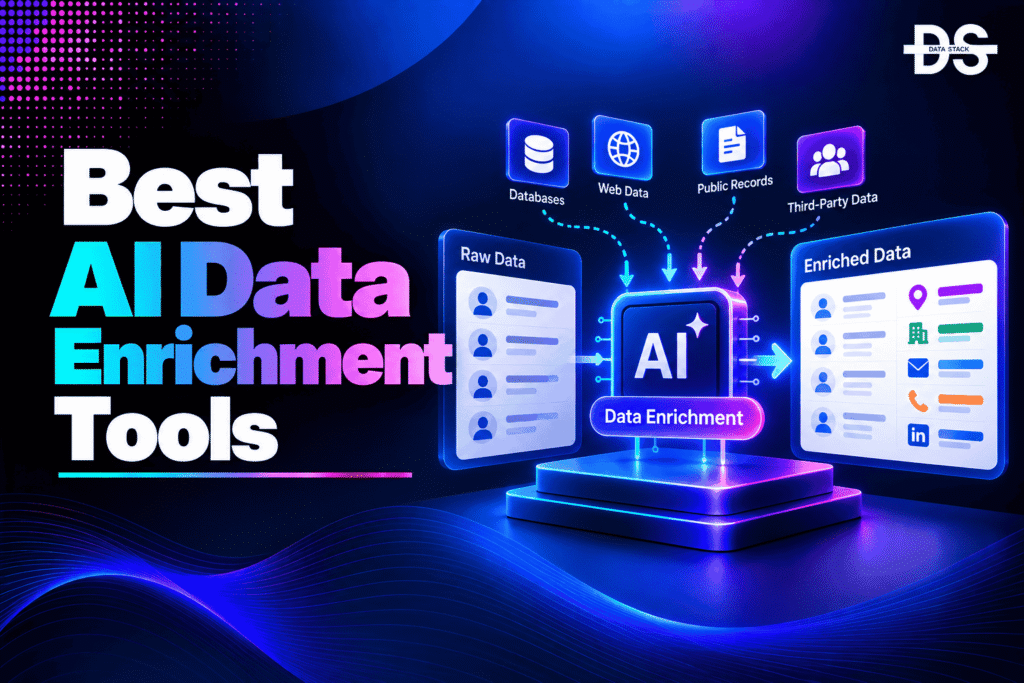
Data enrichment adds missing context, attributes, and intelligence to existing datasets so teams can make better use of their data. Organizations may enrich customer records with firmographic information, add geographic or demographic attributes, supplement datasets with external sources, or use AI to extract and classify information that was not previously structured.
AI data enrichment tools are changing this process by using artificial intelligence, machine learning, and generative AI to discover relevant information, extract attributes, classify records, match entities, and generate additional context from internal or external data sources. Instead of relying entirely on manually configured enrichment rules, teams can use AI to identify relationships and automate parts of the enrichment workflow.
The rise of AI-powered data enrichment tools is particularly important as organizations work with increasingly large and fragmented datasets. AI can help turn unstructured information into structured attributes, identify entities across different sources, and enrich records based on contextual relationships. This makes AI-powered enrichment useful across sales, marketing, analytics, data engineering, research, and AI applications.
However, not every data platform with an AI feature should be considered an AI data enrichment tool. For this list, the focus is on tools where AI plays a meaningful role in adding, extracting, matching, classifying, or generating information that enriches existing data. We also consider the types of enrichment supported, automation capabilities, data sources, and how each platform integrates AI into the enrichment process.
Table of Contents
ToggleWhat Are AI Data Enrichment Tools?
AI data enrichment tools use artificial intelligence, machine learning, or generative AI to add useful information and context to existing datasets. They can enrich records by extracting information from unstructured content, matching entities across sources, generating attributes, classifying data, or connecting records with relevant external information.
Unlike traditional data enrichment tools that primarily depend on predefined databases, lookup tables, APIs, or manually configured rules, AI tools for data enrichment can use contextual understanding to identify relationships and generate or recommend additional attributes. The exact approach varies by platform, with some specializing in business and contact enrichment while others focus on unstructured data, entity resolution, or AI-driven enrichment inside data workflows.
AI Data Enrichment Tools vs. Traditional Data Enrichment Tools
| Capability | Traditional Data Enrichment | AI Data Enrichment |
|---|---|---|
| Data enrichment | Relies primarily on predefined databases, lookup tables, APIs, or manually configured sources | Uses AI to identify, generate, extract, or recommend additional information |
| Entity matching | Uses predefined matching rules and exact or configured fuzzy matches | Uses AI/ML to identify relationships and similarities between records |
| Unstructured data | Requires predefined extraction rules or manual processing | AI can extract relevant attributes and context from text and other unstructured sources |
| Data classification | Depends on manually configured categories and rules | AI can classify records based on context, patterns, and semantic relationships |
| Attribute generation | Usually limited to information available from predefined sources | AI can generate or derive additional attributes from available data |
| External data | Enrichment depends on connected databases and data providers | AI can help identify and combine relevant information from supported sources |
| User interaction | Primarily uses configured workflows, APIs, or lookup processes | Adds natural-language interaction and AI-assisted enrichment workflows |
| Automation | Primarily rule-based and scheduled enrichment | Enables AI-assisted and increasingly context-aware enrichment automation |
AI Data Enrichment Tools Comparison
AI data enrichment tools differ significantly in what they enrich and how they use AI. Some specialize in business and contact intelligence, while others use AI to extract information from unstructured data, resolve entities, or enrich enterprise datasets.
| Tool | AI Capabilities | What You Can Automate | Best For | Free Trial | G2 Rating |
|---|---|---|---|---|---|
| Clay | AI research, enrichment, classification, and web data workflows | Research, enrichment, scoring, personalization | GTM & prospect data | Yes | 4.9/5 |
| Apollo.io | AI-assisted enrichment, research, and prospect intelligence | Contact and company enrichment | Sales teams | Yes — 14 days | 4.7/5 |
| ZoomInfo | AI-powered intelligence and enrichment | Contact, company, and intent enrichment | Enterprise GTM teams | Contact for demo | 4.4/5 |
| Clearbit | AI-assisted company and contact intelligence | Firmographic and contact enrichment | B2B data teams | Contact for demo | 4.4/5 |
| People Data Labs | ML-powered entity resolution and data enrichment | Person and company enrichment | Developers & data teams | Yes — trial options | 4.7/5 |
| Diffbot | AI knowledge graph and entity extraction | Web extraction, entity enrichment, knowledge graph creation | Web and enterprise data | Yes — trial options | 4.6/5 |
| Unstructured | AI-powered document parsing and data extraction | Extracting and structuring unstructured data | AI/RAG data pipelines | Yes — free options | 4.7/5 |
| Databricks | AI-assisted enrichment, classification, and data workflows | Enrichment pipelines and transformations | Enterprise data & AI teams | Yes — 14 days | 4.6/5 |
| Informatica | CLAIRE AI, entity matching, enrichment, and metadata intelligence | Entity enrichment, matching, classification | Enterprise data management | Yes — 30 days | 4.2/5 |
Top 9 AI Data Enrichment Tools 2026
The tools below were selected based on their ability to use AI, machine learning, or intelligent automation for actual data enrichment workflows. They cover different enrichment use cases, including contact and company data, entity resolution, web intelligence, unstructured data extraction, and enterprise-scale enrichment pipelines.
#1. Clay
Clay is a data enrichment and go-to-market automation platform that combines hundreds of data providers with AI-powered research, enrichment, classification, and workflow automation. Its AI capabilities allow users to research companies and people, generate custom attributes, analyze information from multiple sources, and build enrichment workflows without manually checking each source.
AI Capabilities
- AI-powered research: Clay’s AI can research companies, people, and other entities using connected data sources and return information based on defined research requirements.
- AI enrichment: Users can use AI to generate custom attributes and enrich records with information that may not be available as a standard field from a single provider.
- AI classification: Clay can classify records based on natural-language instructions, making it possible to segment enriched data according to custom criteria.
- Multi-source intelligence: AI can combine information from multiple enrichment providers and research sources to build a more complete picture of a record.
What You Can Automate
- Company enrichment: Automatically add firmographic, technology, industry, location, and other company attributes to existing records.
- Contact enrichment: Enrich people records with additional professional and business information from connected data providers.
- AI research: Run custom research prompts across large lists and return structured attributes based on the information discovered.
- Lead qualification: Use AI to evaluate enriched records against custom criteria and classify or score prospects.
- Data workflows: Trigger enrichment steps, transformations, and downstream actions automatically as records enter a workflow.
Key Features
- Claygent: AI-powered research capabilities that can investigate companies, people, and other information based on natural-language instructions.
- Multi-provider enrichment: Combines information from a large ecosystem of data providers rather than relying on a single database.
- Custom AI columns: Allows users to create AI-generated attributes tailored to their specific enrichment requirements.
- Waterfall enrichment: Can use multiple providers sequentially to find information when an earlier source does not return a result.
- Workflow automation: Connects enrichment, AI research, data transformation, and downstream actions within repeatable workflows.
Best For
GTM, sales, marketing, and data teams that need flexible AI-powered enrichment across multiple data sources and want to create highly customized enrichment workflows.
AI Verdict
Clay stands out for its combination of AI research, multi-source enrichment, and workflow automation. Instead of limiting users to predefined enrichment fields, it allows teams to define custom research and enrichment requirements, making it particularly useful when standard firmographic or contact databases do not provide all the information needed.
Showcase your software to buyers actively comparing tools. Submit your product for editorial review and get featured on Data Stack Hub.
Submit Your Tool →#2. Apollo.io
Apollo.io is a sales intelligence and engagement platform that combines a large B2B database with AI-powered prospecting, research, enrichment, and sales workflows. Its enrichment capabilities can help teams complete and update contact and company records while AI assists with identifying relevant prospects and using available data for more targeted workflows.
AI Capabilities
- AI-assisted prospect research: Apollo’s AI capabilities can help users research prospects and companies and surface relevant information for sales workflows.
- Contact intelligence: AI-assisted functionality helps users work with contact and company information to identify and understand potential prospects.
- Data enrichment: Apollo can supplement existing records with additional contact and company information from its database.
- AI-assisted targeting: AI can help users identify prospects and accounts that match specific characteristics or sales requirements.
What You Can Automate
- Contact enrichment: Automatically enrich prospect records with available professional and company information.
- Company enrichment: Add company-level attributes to existing records to improve account intelligence.
- Lead research: Automate research workflows that help sales teams understand prospects and target accounts.
- Lead qualification: Use available data and AI capabilities to identify prospects that match defined criteria.
- Prospecting workflows: Combine enrichment with prospect discovery, segmentation, and outreach workflows.
Key Features
- B2B database: Provides access to a large database of business and professional information for prospecting and enrichment.
- AI-assisted prospecting: Helps users discover and evaluate prospects based on natural-language or defined criteria.
- Contact enrichment: Provides additional information for people records used in sales workflows.
- Company intelligence: Adds company-level information that can help teams evaluate target accounts.
- Workflow automation: Combines enrichment with prospecting and engagement activities in a single workflow.
Best For
Sales and marketing teams that need AI-assisted contact and company enrichment connected directly to prospecting and engagement workflows.
AI Verdict
Apollo.io is most useful when data enrichment is directly connected to B2B prospecting and sales execution. Its combination of contact and company data with AI-assisted research and workflow automation makes it practical for teams that want to enrich records and immediately use that information for targeting and outreach.
Also Read: Best Apollo.io Alternatives and Competitors in 2026
#3. ZoomInfo
ZoomInfo is a B2B intelligence platform that provides company, contact, intent, and other business data for sales and marketing teams. Its AI capabilities can help organizations discover relevant information, identify buying signals, improve account intelligence, and maintain richer prospect and company records.
AI Capabilities
- AI-powered intelligence: ZoomInfo uses AI and machine learning to help identify relevant business information and signals across its data environment.
- Intelligent data enrichment: AI-assisted capabilities can help maintain and enhance company and contact records with additional information.
- Intent intelligence: AI and machine-learning capabilities help identify signals that may indicate increased interest in particular topics or solutions.
- AI-assisted research: Users can use intelligent capabilities to discover and understand information about accounts and prospects.
What You Can Automate
- Contact enrichment: Update prospect and contact records with available professional information.
- Company enrichment: Add company attributes, technologies, organizational information, and other account intelligence.
- Intent enrichment: Add intent signals to account records to provide additional context for targeting.
- Lead prioritization: Use enriched information and signals to identify accounts or contacts that meet specific criteria.
- Data synchronization: Connect enriched information with sales and marketing systems to keep records updated.
Key Features
- B2B intelligence database: Provides company and contact information for sales and marketing enrichment.
- Intent data: Adds behavioral and research signals to provide additional context about target accounts.
- AI-powered workflows: Uses AI to support prospect research, targeting, and intelligence workflows.
- Company intelligence: Provides information about organizations, industries, technologies, and other account characteristics.
- CRM enrichment: Helps teams connect business intelligence and enrichment data with their existing sales workflows.
Best For
Enterprise sales and marketing teams that need large-scale B2B data enrichment combined with intent intelligence and account research.
AI Verdict
ZoomInfo is particularly relevant for organizations where enrichment is part of a broader account intelligence strategy. Its AI capabilities extend beyond simply filling missing fields by helping teams combine company, contact, and intent information to create richer records for sales and marketing workflows.
Also Read: Best ZoomInfo Alternatives and Competitors in 2026
#4. Clearbit
Clearbit is a B2B data enrichment platform focused on enriching company and contact records with business information. Its data can be used to identify companies, understand firmographic attributes, improve lead records, and support automated marketing and sales workflows. Clearbit is now part of HubSpot, with its enrichment capabilities incorporated into HubSpot’s broader customer platform.
AI Capabilities
- Intelligent company identification: Clearbit can identify companies associated with website visitors and other business records to add organizational context.
- Automated enrichment: Enrichment capabilities can automatically add available company and contact attributes to existing records.
- Data matching: Clearbit can match information from different sources to existing records, helping organizations maintain more complete customer profiles.
- AI-assisted data workflows: Enrichment can be incorporated into automated workflows where additional business context is used for segmentation, qualification, and personalization.
What You Can Automate
- Company enrichment: Add firmographic information such as industry, company size, location, and other available attributes.
- Contact enrichment: Supplement contact records with professional and company information.
- Lead qualification: Use enriched company and contact attributes to segment and prioritize records.
- Visitor identification: Connect anonymous website activity with company-level information where supported.
- CRM enrichment: Keep customer and prospect records enriched with available business intelligence.
Key Features
- Company intelligence: Provides business information that can be used to enrich company records and understand target accounts.
- Contact enrichment: Adds available professional and organizational information to contact records.
- Website visitor identification: Helps organizations identify companies visiting their websites and add account-level context.
- Firmographic data: Provides attributes such as industry, employee count, location, and company characteristics.
- Workflow integration: Enrichment data can be incorporated into marketing and sales workflows for segmentation and personalization.
Best For
B2B marketing and sales teams that need company and contact enrichment integrated with customer and go-to-market workflows.
AI Verdict
Clearbit is best viewed as a B2B enrichment and intelligence layer rather than a general-purpose AI data-enrichment platform. Its strength is enriching customer and prospect records with company context and making that information useful inside automated marketing and sales workflows.
#5. People Data Labs
People Data Labs is a data platform that provides APIs and datasets for enriching person and company records. Its infrastructure is designed for developers and data teams that need to match identities, retrieve additional attributes, and build enrichment workflows into their own applications or data pipelines.
AI Capabilities
- Entity resolution: Machine-learning approaches can help match records to the correct person or company when information varies between sources.
- Identity matching: The platform can use available attributes to identify and connect records representing the same entity.
- Data enrichment: Existing records can be supplemented with additional person and company attributes available through the platform.
- Intelligent data matching: Matching capabilities can help developers connect incomplete or inconsistent records with richer profiles.
What You Can Automate
- Person enrichment: Add professional, employment, location, and other available attributes to person records.
- Company enrichment: Supplement company records with organizational and firmographic information.
- Identity resolution: Match incoming records against existing person or company identities.
- Record updating: Build automated workflows that retrieve additional information as new records enter a system.
- API-based enrichment: Integrate enrichment directly into applications, databases, or internal data pipelines.
Key Features
- Person Enrichment API: Provides additional attributes for person records using available identifiers and data.
- Company Enrichment API: Adds company information to existing business records.
- Person Match: Helps identify the correct person profile from incomplete or varying information.
- Company Match: Helps resolve company identities across different datasets.
- Developer APIs: Allows teams to integrate enrichment directly into applications and automated data workflows.
Best For
Developers and data teams that need API-first person and company enrichment with identity matching built into their own applications or pipelines.
AI Verdict
People Data Labs is particularly useful when AI-assisted enrichment needs to operate inside a technical data workflow rather than through a standalone user interface. Its identity matching and enrichment APIs allow developers to build automated processes for resolving and enriching records at scale.
Increase your product visibility by reaching software buyers researching the best tools. Every submission is reviewed by our editorial team.
Feature My Tool →#6. Diffbot
Diffbot is an AI-powered web data and knowledge graph platform that extracts structured information from websites and converts unstructured web content into machine-readable data. Its AI-based extraction and entity recognition capabilities can enrich datasets with information discovered across the web and connect entities through its knowledge graph.
AI Capabilities
- AI web extraction: Diffbot uses machine learning and computer vision to identify and extract structured information from web pages.
- Entity recognition: AI can identify people, companies, products, articles, and other entities within unstructured web content.
- Knowledge graph: Extracted entities and relationships are organized into a knowledge graph that provides additional context around records.
- Natural-language processing: NLP capabilities help interpret text and identify relevant entities and relationships within web content.
What You Can Automate
- Web data extraction: Automatically extract structured information from supported websites instead of manually collecting it.
- Entity enrichment: Add attributes and contextual information to existing company, person, product, and other entity records.
- Relationship discovery: Identify connections between entities and incorporate those relationships into datasets.
- Content enrichment: Extract information from articles and other web content to supplement existing records.
- Knowledge graph creation: Build connected datasets from entities and relationships discovered across web sources.
Key Features
- Knowledge Graph: Provides structured information about entities and the relationships between them.
- Crawlbot: Crawls websites and collects web content that can be processed and structured.
- Article and page extraction: Automatically identifies and extracts relevant information from different types of web pages.
- Entity extraction: Uses AI to recognize entities and attributes from unstructured content.
- Natural-language processing: Helps convert text-based web information into structured, searchable data.
Best For
Data teams, developers, and AI applications that need AI-powered web extraction, entity enrichment, and structured information from unstructured online content.
AI Verdict
Diffbot takes a fundamentally different approach to data enrichment by using AI to turn unstructured web information into structured, connected data. It is particularly valuable when the information needed to enrich a dataset is not available through a conventional B2B enrichment database and must instead be extracted from web content.
#7. Unstructured
Unstructured is an AI-focused data processing platform designed to extract and transform information from documents and other unstructured sources into structured data. It is particularly relevant for organizations building AI and RAG applications that need to turn PDFs, presentations, HTML, images, and other content into usable data before it enters downstream systems.
AI Capabilities
- AI-powered document extraction: Uses intelligent parsing and document-processing techniques to identify and extract useful information from complex files.
- Content classification: AI-assisted processing can identify different elements within documents and classify content according to its structure.
- Semantic processing: Extracted content can be prepared in ways that preserve context and structure for downstream AI applications.
- Multimodal processing: Supports processing workflows for documents containing text, tables, images, and other content types.
What You Can Automate
- Document extraction: Automatically extract text, tables, metadata, and other useful information from supported document formats.
- Content enrichment: Add structured metadata and contextual information to otherwise unstructured content.
- Document classification: Categorize extracted content based on document and element characteristics.
- AI data preparation: Convert documents into structured representations suitable for RAG and other AI workflows.
- Batch processing: Process large collections of documents through repeatable extraction and transformation workflows.
Key Features
- Document parsing: Processes PDFs, Word documents, PowerPoint files, HTML, images, and other supported formats.
- Partitioning: Breaks documents into meaningful elements such as titles, paragraphs, tables, and lists.
- Connectors: Integrates with cloud storage, databases, vector stores, and other data infrastructure.
- AI-ready output: Produces structured content suitable for downstream machine learning, RAG, and AI applications.
- Multimodal document processing: Handles documents containing different content types rather than relying solely on plain text extraction.
Best For
AI and data teams that need to extract and enrich information from unstructured documents for RAG, search, analytics, and downstream AI applications.
AI Verdict
Unstructured is a strong example of how AI data enrichment extends beyond contact and company databases. Its primary value is transforming unstructured content into structured, contextual data that can be used by AI systems, making it particularly relevant for organizations building document-heavy AI and RAG workflows.
#8. Databricks
Databricks is a unified data and AI platform that can support data enrichment as part of larger data engineering, analytics, and AI workflows. Rather than functioning only as a standalone enrichment database, Databricks allows teams to build enrichment pipelines that combine internal datasets with external information, apply AI-powered classification and extraction, and create enriched tables for downstream applications.
AI Capabilities
- AI-assisted data enrichment: Databricks AI capabilities can help teams enrich datasets through classification, extraction, transformation, and analysis workflows.
- Natural-language processing: AI can extract useful information from text and other unstructured data and turn it into structured attributes.
- AI-powered classification: Teams can classify records according to business-specific categories and requirements using AI models.
- Machine learning workflows: Databricks supports custom machine learning and AI models that can generate attributes and predictions used to enrich existing datasets.
What You Can Automate
- Text enrichment: Extract entities, categories, sentiment, topics, or other attributes from unstructured text.
- Record classification: Automatically classify large datasets according to custom business rules or AI models.
- External data enrichment: Combine internal datasets with external sources and apply transformations to create richer records.
- Entity enrichment: Build workflows that connect related records and add additional context to existing entities.
- Enrichment pipelines: Schedule and run repeatable enrichment workflows as new data becomes available.
Key Features
- AI/ML workflows: Supports custom models and AI applications that can generate attributes and predictions for existing datasets.
- Lakeflow: Provides capabilities for building and managing data pipelines used to ingest, transform, and enrich data.
- Mosaic AI: Provides tools for developing and deploying generative AI and machine-learning applications.
- Unity Catalog: Provides governance and management for data and AI assets used throughout enrichment workflows.
- SQL and notebooks: Supports SQL, Python, and notebook-based workflows for creating customized enrichment logic.
Best For
Enterprise data and AI teams that need custom, scalable data enrichment pipelines integrated with their existing data engineering and AI infrastructure.
AI Verdict
Databricks is most suitable when enrichment is part of a broader enterprise data and AI workflow rather than a simple contact or company lookup. Its flexibility allows teams to build custom AI-powered enrichment processes, particularly when they need to enrich large datasets with classifications, extracted attributes, predictions, or information from multiple sources.
Also Read: Best Databricks Alternatives and Competitors
#9. Informatica
Informatica is an enterprise data management platform that combines data integration, quality, governance, master data management, and AI-assisted data workflows. Its CLAIRE AI capabilities can help organizations understand data, identify relationships, match records, and automate parts of enrichment and data management processes.
AI Capabilities
- CLAIRE AI: Uses AI and machine learning to understand metadata, relationships, and patterns across enterprise data.
- Intelligent entity matching: AI-assisted matching can help identify records that represent the same person, organization, or other business entity.
- AI-powered data understanding: CLAIRE can help identify relationships between datasets and provide additional context for enrichment workflows.
- Intelligent data quality: AI-assisted capabilities can identify potential data-quality issues and support standardization and enrichment processes.
What You Can Automate
- Entity matching: Identify potentially identical or related records across multiple systems.
- Data enrichment: Add attributes and context to enterprise records using connected data sources and enrichment workflows.
- Data standardization: Normalize inconsistent values before they are used to create enriched records.
- Data quality workflows: Apply validation and quality checks as part of enrichment pipelines.
- Enterprise integration: Move and enrich data across applications, databases, cloud platforms, and other systems.
Key Features
- CLAIRE AI: Provides AI and machine-learning capabilities across Informatica’s data management environment.
- Customer 360: Helps organizations create unified customer records from information distributed across multiple systems.
- Master Data Management: Provides capabilities for creating and maintaining trusted master records.
- Data Quality: Supports profiling, cleansing, validation, matching, and monitoring alongside enrichment.
- Cloud Data Integration: Connects enterprise sources and provides workflows for moving, transforming, and enriching data.
Best For
Large enterprises that need AI-assisted data enrichment combined with entity resolution, master data management, data quality, and governance.
AI Verdict
Informatica is particularly relevant for organizations where enrichment involves complex enterprise records and multiple disconnected systems. Its AI capabilities extend enrichment beyond simply adding external attributes by helping teams match entities, understand relationships, improve data quality, and create more complete master records.
Also Read: Best Informatica Alternatives & Competitors in 2026
How to Choose the Right AI Data Enrichment Tool
Choosing the right AI data enrichment tool depends on what you want to enrich, where the enrichment data comes from, and how much of the process you want to automate. A sales team enriching company and contact records has very different requirements from an AI team extracting information from thousands of documents or an enterprise data team building entity-resolution workflows.
Consider these factors when evaluating AI-powered data enrichment tools:
- AI enrichment depth: Does AI actually enrich records, or is it mainly used for search, recommendations, or interface assistance?
- AI research: Can the tool independently research companies, people, products, or other entities and turn the findings into structured attributes?
- Entity resolution: Can AI recognize that different records refer to the same entity, even when names or attributes differ?
- Unstructured data enrichment: Can AI extract useful attributes from documents, web pages, emails, PDFs, images, and other unstructured sources?
- AI classification: Can the tool automatically categorize records using contextual understanding rather than only predefined rules?
- Attribute generation: Can AI create new fields or derive meaningful attributes from existing data?
- Multi-source enrichment: Can AI combine information from multiple providers or sources and determine which information is relevant?
- Natural-language enrichment: Can users describe the enrichment requirement in natural language instead of manually configuring every rule?
- AI automation: Can enrichment run automatically across large datasets, or does AI only assist with individual records?
- AI accuracy and validation: Can users review, validate, and correct AI-generated enrichment before it reaches production systems?
- AI scalability: Can the platform apply AI enrichment across thousands or millions of records without requiring manual intervention?
- AI governance: Does the platform provide visibility into how AI-generated or AI-extracted information was produced and allow teams to control its use?
Browse expertly curated software recommendations across hundreds of business categories.
Browse Top Tools →Conclusion
AI data enrichment tools are making it easier to add meaningful context to existing datasets without relying entirely on manually configured lookup rules or individual research processes. AI can help extract information, identify entities, classify records, generate attributes, and connect information from multiple sources to create richer datasets.
The tools covered in this list represent several different approaches to AI-powered data enrichment. Clay, Apollo.io, ZoomInfo, and Clearbit focus primarily on enriching business, company, and contact data. People Data Labs focuses on programmatic person and company enrichment and identity matching, while Diffbot uses AI to extract and structure information from web content. Unstructured approaches enrichment from the document and unstructured-data side, whereas Databricks and Informatica provide broader environments for building customized AI-assisted enrichment workflows.
The right tool depends largely on the type of information you need AI to add to your data. A GTM team may need AI-powered company research and prospect enrichment, while an AI engineering team may need to extract structured attributes from thousands of documents. Enterprise teams may require AI-based entity resolution and enrichment across multiple internal systems.
AI enrichment can reduce significant manual effort, but AI-generated or extracted information should still be validated when accuracy is important. The strongest workflows combine AI’s ability to process large amounts of information and identify patterns with appropriate human review and data-quality controls.
Frequently Asked Questions
1. What are AI data enrichment tools?
AI data enrichment tools use artificial intelligence, machine learning, or generative AI to add information, attributes, or context to existing datasets. They can perform tasks such as entity matching, information extraction, classification, AI research, and attribute generation.
2. How are AI data enrichment tools different from traditional data enrichment tools?
Traditional enrichment typically relies on predefined databases, lookup tables, APIs, and manually configured rules. AI-powered data enrichment tools can understand context, identify relationships, extract information from unstructured content, classify records, and generate or recommend additional attributes.
3. How is AI changing data enrichment?
AI is making enrichment more contextual and automated. Instead of simply looking up a predefined field, AI can research information, extract attributes from unstructured sources, resolve entities, classify records, and combine information from multiple sources.
4. What AI technologies are used in data enrichment tools?
AI enrichment platforms can use machine learning, generative AI, natural-language processing, entity resolution, semantic matching, information extraction, classification models, and knowledge graphs. The specific technologies vary by platform and enrichment use case.
5. What can AI data enrichment tools automate?
Depending on the platform, AI can automate company and contact research, entity matching, attribute extraction, classification, record enrichment, web information extraction, document processing, and enrichment pipelines.
6. Can AI enrich data from unstructured sources?
Yes. Some AI tools can extract and structure information from documents, web pages, PDFs, text, images, and other unstructured sources. Tools such as Diffbot and Unstructured are particularly relevant to this type of AI enrichment workflow.
7. Can AI data enrichment tools resolve duplicate entities?
Yes. AI and machine-learning-based entity resolution can identify records that represent the same person, company, or other entity even when their names, identifiers, or attributes are different.
8. Can AI generate new data attributes?
Yes. AI can derive or generate attributes from existing structured and unstructured information. For example, an AI enrichment workflow can classify a company, extract technologies mentioned on its website, identify topics in a document, or create a custom attribute based on a research instruction.
9. Can AI data enrichment tools use multiple data sources?
Yes. Some platforms can combine information from multiple databases, APIs, websites, internal systems, or other sources. AI can then help determine which information is relevant to the enrichment requirement.
10. Are AI data enrichment tools useful for AI and RAG applications?
Yes. AI enrichment can help prepare information for downstream AI systems by extracting metadata, identifying entities, classifying content, adding contextual attributes, and structuring unstructured information before it is used in RAG or other AI workflows.
11. What are the best AI data enrichment tools in 2026?
The 9 AI data enrichment tools covered in this list are:
- Clay
- Apollo.io
- ZoomInfo
- Clearbit
- People Data Labs
- Diffbot
- Unstructured
- Databricks
- Informatica
These tools cover different AI enrichment use cases, including GTM data enrichment, entity resolution, web extraction, document enrichment, and enterprise AI data workflows.
12. Can AI data enrichment replace human research?
AI can automate substantial portions of repetitive research and enrichment, but it does not guarantee that every generated or extracted attribute is correct. Human validation can remain important when enrichment data is used for high-impact business decisions or sensitive datasets.
13. How accurate is AI data enrichment?
Accuracy depends on the AI model, source data, enrichment methodology, and specific use case. AI can identify patterns and extract information at scale, but generated or inferred attributes can contain errors. Validation and data-quality checks are therefore important parts of AI enrichment workflows.