
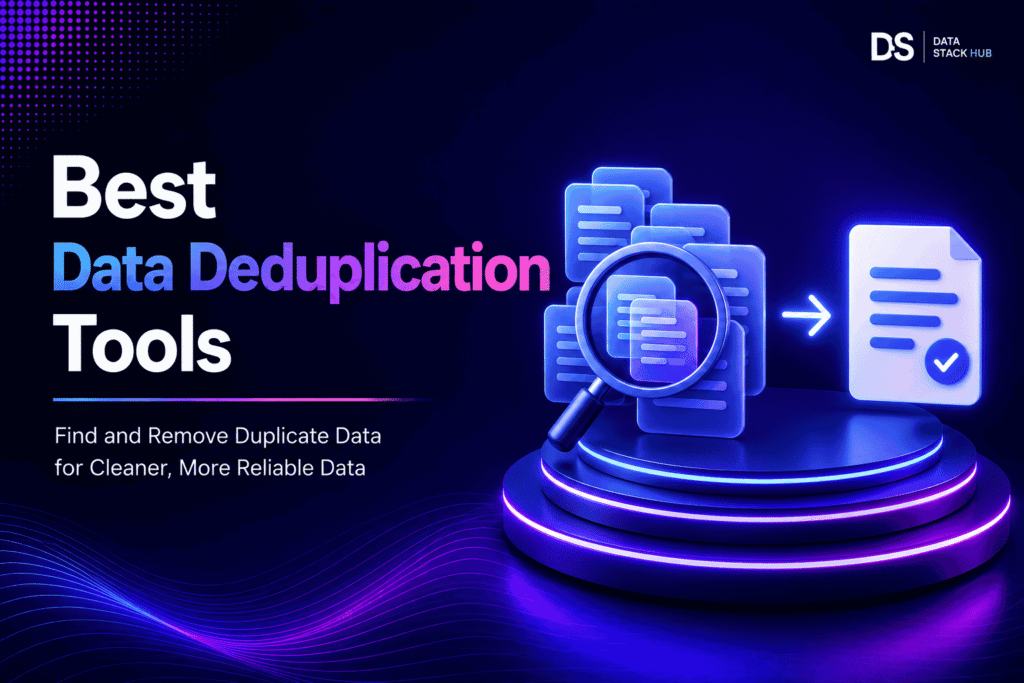
Duplicate records are rarely created by one mistake. They usually accumulate as data enters a business through multiple systems, imports, forms, integrations, acquisitions, and manual updates. A single customer may end up with several profiles because of a changed email address, a different spelling, an old phone number, or inconsistent formatting.
The scale of the problem is significant. Melissa’s 2025 State of Enterprise Data Quality research found that 84% of organizations struggle with inaccurate or duplicate data, showing why duplicate detection remains an important part of enterprise data-quality work.
Data deduplication tools are software platforms, libraries, or services that identify and help remove, merge, or manage duplicate records within or across datasets. They can use exact comparisons, fuzzy matching, rules, probabilistic techniques, or machine learning to determine whether multiple records represent the same entity.
Different deduplication tools are built for different environments. Some focus on cleaning customer and contact databases, while others are designed for master data management, large-scale entity resolution, database cleanup, or developer-controlled data pipelines. Open-source options can also be useful when teams want to build custom deduplication workflows rather than adopt a managed platform.
This guide covers the 10 best data deduplication tools in 2026 and compares them based on duplicate detection capabilities, matching methods, automation, supported data sources, scalability, integrations, deployment options, pricing, and open-source availability.
Table of Contents
ToggleWhy Do You Need Data Deduplication Tools?
Duplicate data can distort reporting, create conflicting customer records, waste storage, and make downstream systems less reliable. As organizations collect information from more applications and external sources, manually finding and consolidating duplicates becomes increasingly difficult.
- Remove duplicate records: Find repeated customer, company, product, supplier, employee, or other records that appear more than once in a dataset.
- Improve customer data: Consolidate multiple profiles that belong to the same person so teams have a more complete and consistent customer record.
- Clean data before migration: Detect duplicates before moving information between CRMs, databases, data warehouses, or other applications.
- Handle inconsistent records: Identify duplicates even when names, addresses, phone numbers, email addresses, or other fields are formatted differently.
- Automate repetitive cleanup: Replace manual spreadsheet-based duplicate checks with repeatable workflows that can process large datasets.
- Improve reporting accuracy: Prevent duplicate entities from inflating customer counts, revenue figures, operational metrics, and other business reports.
- Support master data management: Help organizations create cleaner master records by identifying and consolidating duplicate entities across business systems.
- Match records across sources: Connect records from multiple databases or applications when the same entity has different identifiers in each source.
- Reduce downstream errors: Prevent duplicate records from being passed into analytics, marketing, sales, finance, or operational systems.
- Manage uncertain matches: Separate high-confidence duplicates from questionable matches so users can review records before they are merged.
- Scale data-quality operations: Process large numbers of records more efficiently than manual comparison methods as datasets continue to grow.
- Standardize deduplication rules: Apply consistent matching criteria across recurring data-cleaning processes instead of relying on individual decisions.
- Support ongoing data hygiene: Run deduplication as a recurring process so new duplicates can be identified before they accumulate.
- Prepare data for AI and analytics: Cleaner datasets provide more reliable inputs for machine learning, reporting, segmentation, and other analytical workloads.
The best approach depends on the type of data being cleaned and how duplicates need to be handled. Simple datasets may only require exact or fuzzy matching, while complex enterprise environments can benefit from entity resolution, configurable rules, confidence scoring, survivorship logic, and human review.
Top 10 Data Deduplication Tools: Comparison
Data deduplication tools differ in how they identify duplicate records, from straightforward rule-based comparisons to fuzzy matching, machine learning, and broader entity-resolution workflows. The comparison below focuses on the capabilities, pricing, and deployment approaches that matter when selecting a tool for data cleansing and duplicate detection.
| Tool | Best For | Open Source | Pricing | G2 Rating |
|---|---|---|---|---|
| Openprise | Enterprise data deduplication and data quality | No | Custom pricing | 4.7/5 |
| Informatica MDM | Enterprise master data deduplication | No | Custom pricing | 4.2/5 |
| Talend Data Quality | Data cleansing and duplicate detection | No | Custom pricing | 4.3/5 |
| Ataccama ONE | AI-powered data quality and deduplication | No | Custom pricing | 4.6/5 |
| Precisely Data Integrity Suite | Data quality and duplicate detection | No | Custom pricing | 4.3/5 |
| WinPure | Contact and customer data cleansing | No | From $299/year | 4.8/5 |
| Data Ladder | Data cleansing and record deduplication | No | From $1,000/year | 4.7/5 |
| Dedupe | Python-based duplicate detection | Yes | Free and open source | N/A |
| Splink | Large-scale probabilistic deduplication | Yes | Free and open source | N/A |
| Zingg | Machine-learning entity deduplication | Yes | Free and open source; commercial options | N/A |
Best 10 Data Deduplication Tools in 2026
The tools in this list cover customer and contact deduplication, enterprise master data management, data cleansing, and developer-focused record linkage. It combines commercial platforms with open-source frameworks so teams can choose between managed data-quality workflows and customizable deduplication implementations.
#1 Openprise
Openprise is a data quality and RevOps data management platform that helps organizations clean, standardize, enrich, and deduplicate business data. It is particularly focused on customer, prospect, account, and other revenue-related records that become fragmented across CRM, marketing automation, enrichment, and other business systems.
Its deduplication capabilities allow teams to identify potentially duplicate records using configurable matching logic and then apply rules for merging, updating, or routing records. Because deduplication is part of a broader data-management platform, organizations can combine duplicate detection with data cleansing, normalization, enrichment, and workflow automation rather than maintaining separate processes for each task.
Key Features
- Record deduplication: Identifies duplicate customer, prospect, account, and other business records across connected data sources.
- Fuzzy matching: Accounts for variations in names, addresses, company information, and other attributes when exact matching is insufficient.
- Data standardization: Normalizes inconsistent values and formats before records are compared.
- Automated merge workflows: Helps organizations consolidate duplicate records according to predefined business rules.
- Data enrichment: Combines deduplication with enrichment processes to improve the completeness of business records.
- Multi-source data management: Works with information from CRM, marketing, sales, and other enterprise systems.
- Workflow automation: Allows data-quality and deduplication processes to run repeatedly without manual intervention.
- Data quality management: Provides broader cleansing and validation capabilities alongside duplicate detection.
Pricing: Custom pricing.
G2 Rating: 4.7/5.
#2 Informatica MDM
Informatica Master Data Management provides enterprise capabilities for consolidating, matching, and managing records across multiple business systems. Its matching and consolidation functionality can help organizations identify duplicate customer, supplier, product, and other master-data records before creating trusted master records.
The platform is designed for complex enterprise environments where deduplication is part of a larger master data strategy. Informatica can apply rules and machine-learning-based approaches to compare records, identify potential duplicates, and determine how information from different sources should contribute to a consolidated entity. This makes it more suitable for organizations that need deduplication alongside governance, data quality, relationships, and master-data workflows.
Key Features
- Duplicate detection: Identifies records that potentially represent the same entity across enterprise data sources.
- Intelligent matching: Uses configurable rules and AI-assisted capabilities to evaluate similarities between records.
- Entity resolution: Connects records belonging to the same customer, organization, product, supplier, or other entity.
- Data consolidation: Combines information from multiple source records into a trusted master representation.
- Survivorship rules: Determines which source values should be retained when duplicate records contain conflicting information.
- Data quality: Supports profiling, cleansing, standardization, validation, and enrichment alongside deduplication.
- Relationship management: Maintains relationships between mastered entities and associated records.
- Enterprise integrations: Connects master data processes with CRM, ERP, databases, cloud applications, and other enterprise systems.
Pricing: Custom pricing.
G2 Rating: 4.2/5.
Also Read: Best Informatica Alternatives & Competitors in 2026
Showcase your software to buyers actively comparing tools. Submit your product for editorial review and get featured on Data Stack Hub.
#3 Talend Data Quality
Talend Data Quality provides data profiling, cleansing, matching, and validation capabilities for organizations working with data across multiple systems. Its matching features can help teams identify duplicate records and inconsistent information before data is used for analytics, migration, integration, or operational processes.
The platform takes a broader data-quality approach rather than focusing exclusively on deduplication. Teams can profile datasets to understand their condition, standardize values, apply matching rules, and investigate potential duplicates as part of a larger cleansing workflow. This makes it useful when duplicate detection needs to be combined with other data-quality checks across databases, files, and enterprise applications.
Key Features
- Duplicate detection: Finds records that may represent the same entity within or across datasets.
- Record matching: Compares multiple attributes to identify potential matches based on configurable criteria.
- Fuzzy matching: Helps identify duplicates where fields contain spelling, formatting, or other variations.
- Data profiling: Analyzes datasets to reveal duplicates, missing values, inconsistent formats, and other quality problems.
- Data standardization: Normalizes values before matching to improve the consistency of comparison results.
- Data cleansing: Provides tools for correcting and transforming problematic records as part of the deduplication process.
- Match rules: Allows teams to configure matching logic according to specific data and business requirements.
- Data integration: Connects quality and matching workflows with broader data-integration processes.
Pricing: Custom pricing.
G2 Rating: 4.3/5.
Also Read: Best Talend Alternatives and Competitors
#4 Ataccama ONE
Ataccama ONE is a data management and data-quality platform that combines data profiling, cleansing, matching, governance, and observability capabilities. Its deduplication and entity-resolution functionality helps organizations identify records that refer to the same entity and improve consistency across distributed data environments.
The platform uses AI-assisted data-quality capabilities to help automate the identification and resolution of duplicate and inconsistent information. Teams can apply matching rules and quality processes across customer, product, supplier, and other domains while connecting those workflows with broader data governance activities. This makes Ataccama ONE relevant to enterprises that want duplicate management embedded within a comprehensive data-quality environment.
Key Features
- Entity matching: Identifies records that may represent the same entity across different systems and datasets.
- AI-assisted data quality: Uses machine learning and automation to help identify and manage data-quality issues.
- Duplicate detection: Finds duplicate or highly similar records that require consolidation or review.
- Data profiling: Analyzes data sources to identify patterns, anomalies, inconsistencies, and potential quality problems.
- Data cleansing: Supports standardization and transformation of records before or alongside deduplication.
- Data governance: Connects data-quality processes with governance, metadata, and stewardship workflows.
- Master data management: Supports consistent entity information across domains such as customers, products, and suppliers.
- Data observability: Provides monitoring capabilities to help teams detect changes and quality problems across their data environment.
Pricing: Custom pricing.
G2 Rating: 4.6/5.
#5 Precisely Data Integrity Suite
Precisely Data Integrity Suite provides a collection of data-quality and data-management capabilities that organizations can use to identify, standardize, validate, and improve records across different sources. Its matching and duplicate-detection functionality can be incorporated into broader data-quality workflows for customer, business, and other enterprise data.
Rather than functioning solely as a duplicate-removal application, the suite combines data matching with profiling, cleansing, enrichment, and other integrity processes. Teams can use these capabilities to identify similar records, standardize information before comparison, and improve the consistency of data moving between operational and analytical systems.
Key Features
- Record matching: Compares records across datasets to identify potential duplicates and related entities.
- Duplicate identification: Detects repeated or highly similar records that may require consolidation.
- Data standardization: Normalizes names, addresses, formats, and other attributes to improve matching accuracy.
- Data profiling: Examines datasets to reveal quality patterns and potential duplicate or inconsistent information.
- Data cleansing: Provides processes for correcting and standardizing problematic records.
- Identity resolution: Helps connect records that represent the same real-world entity across multiple sources.
- Data enrichment: Adds trusted information to improve the completeness and consistency of records.
- Enterprise data connectivity: Supports data from multiple applications, databases, files, and other enterprise environments.
Pricing: Custom pricing.
G2 Rating: 4.3/5.
#6 WinPure
WinPure is a data quality and cleansing platform focused on cleaning, matching, and deduplicating customer, contact, supplier, and other business datasets. It provides a more specialized approach to data cleansing than large enterprise MDM platforms and can be used to identify and consolidate duplicate records before data is imported into business systems.
Its matching capabilities allow users to compare records using multiple fields and similarity criteria rather than relying exclusively on exact values. WinPure can also standardize data and provide duplicate-analysis workflows, making it useful for teams that need a dedicated data-cleansing tool without implementing a full master data management platform.
Key Features
- Data deduplication: Identifies duplicate records within datasets and helps users consolidate them.
- Fuzzy matching: Finds similar records even when values differ because of spelling, formatting, or other variations.
- Record matching: Compares names, addresses, contact information, and other fields to identify potential duplicates.
- Data cleansing: Corrects and standardizes inconsistent data as part of the cleaning workflow.
- Address cleansing: Helps normalize address information before records are matched.
- Merge and purge: Provides workflows for reviewing duplicates and combining or removing redundant records.
- Data profiling: Helps users understand duplicate patterns and other quality issues in their datasets.
- Multiple data formats: Supports working with common structured data sources and files used in data-cleaning workflows.
Pricing: Starts at approximately $299/year, depending on the edition and licensing requirements.
G2 Rating: 4.8/5.
Increase your product visibility by reaching software buyers researching the best tools. Every submission is reviewed by our editorial team.
Feature My Tool →#7 Data Ladder
Data Ladder provides data-quality software for profiling, cleansing, matching, and deduplicating records. Its DataMatch Enterprise product is designed to help organizations compare records across multiple sources and identify duplicates using fuzzy matching and configurable data-quality rules.
The platform is particularly relevant to teams working with customer, supplier, product, and other operational datasets that need to be cleaned before analysis, migration, or integration. Data Ladder combines duplicate detection with data transformation and standardization capabilities, allowing teams to prepare records before matching and then review or consolidate the results.
Key Features
- Data matching: Compares records across datasets using multiple fields and matching criteria.
- Duplicate detection: Identifies duplicate and near-duplicate records within business datasets.
- Fuzzy matching: Accounts for variations in spelling, formatting, abbreviations, and other inconsistencies.
- Data cleansing: Standardizes and cleans records before matching to improve results.
- Match rules: Provides configurable rules and thresholds for controlling how potential duplicates are identified.
- Record consolidation: Helps users review and merge matching records into cleaner datasets.
- Data profiling: Provides visibility into duplicate patterns and other data-quality problems.
- Batch processing: Supports processing larger datasets as part of recurring data-quality operations.
Pricing: Starts at approximately $1,000/year, depending on the product and licensing configuration.
G2 Rating: 4.7/5.
#8 Dedupe
Dedupe is an open-source Python library for finding and linking similar records in structured data. It is designed for developers who need to build custom deduplication or entity-resolution workflows rather than use a complete managed data-quality platform.
The library uses machine learning to learn how fields should be compared and can be trained with examples of records that should or should not be considered matches. This approach can be useful when simple exact matching is insufficient and the data contains meaningful variations. Developers can integrate Dedupe into Python applications and data-processing pipelines while maintaining control over how records are indexed, matched, and consolidated.
Key Features
- Machine-learning matching: Learns matching patterns from labeled examples instead of depending entirely on manually defined rules.
- Duplicate detection: Identifies records that are likely to refer to the same entity within a dataset.
- Record linkage: Supports matching records across different datasets where entities may appear differently.
- Active learning: Allows users to label examples of matches and non-matches to improve the matching model.
- Fuzzy comparison: Handles variations in text and other field values when exact matching is insufficient.
- Blocking: Reduces the number of record pairs that need detailed comparison, improving processing efficiency.
- Python integration: Can be incorporated into custom Python applications, scripts, notebooks, and data pipelines.
- Open-source framework: Gives developers access to the underlying matching workflow and allows it to be deployed within their own infrastructure.
Pricing: Free and open source.
G2 Rating: N/A.
#9 Splink
Splink is an open-source framework for probabilistic record linkage that can be used to identify and remove duplicate records at scale. It was developed by the UK Ministry of Justice and is designed for situations where records do not have a reliable unique identifier and need to be compared using multiple attributes.
Rather than loading an entire dataset into memory for pairwise comparison, Splink uses SQL-based processing and blocking techniques to make large-scale record linkage more practical. Teams can compare fields such as names, addresses, dates, and other attributes, then use probabilistic models to estimate whether records represent the same entity. This makes Splink particularly relevant for data engineering teams working with large datasets.
Key Features
- Probabilistic deduplication: Estimates the likelihood that two records refer to the same entity.
- Record linkage: Connects related records across datasets when unique identifiers are unavailable.
- Fuzzy comparison: Supports similarity-based comparisons for names, addresses, dates, and other attributes.
- Blocking: Reduces unnecessary record comparisons by generating smaller sets of likely candidate pairs.
- Large-scale processing: Uses SQL-based data-processing engines to support substantial record-linkage workloads.
- Custom comparison logic: Allows developers to configure how individual fields should be compared.
- Model evaluation: Provides tools for reviewing matching results and assessing model behavior.
- Open-source: Can be used and customized without purchasing a proprietary deduplication platform.
Pricing: Free and open source.
G2 Rating: N/A.
#10 Zingg
Zingg is an open-source entity-resolution and data-matching framework that uses machine learning to identify duplicate and related records. It is designed for data teams that need to process large datasets and build scalable deduplication workflows without depending on a proprietary matching platform.
Zingg can learn from examples provided by users and apply that information to identify records that are likely to represent the same entity. Its distributed architecture makes it suitable for data environments where large datasets need to be processed efficiently. Developers can incorporate Zingg into data pipelines and use it for customer, supplier, product, or other entity-matching scenarios.
Key Features
- Machine-learning deduplication: Uses learned patterns to identify records that are likely to represent the same entity.
- Entity resolution: Connects records across datasets even when identifiers and attributes differ.
- Active learning: Uses user-provided examples to improve matching decisions for specific datasets.
- Fuzzy matching: Handles variations across names, addresses, identifiers, and other fields.
- Scalable architecture: Supports large datasets through distributed data-processing capabilities.
- Duplicate detection: Finds repeated or highly similar entities that can be reviewed and consolidated.
- Pipeline integration: Can be incorporated into existing data-engineering and data-processing workflows.
- Open-source deployment: Gives teams control over implementation and infrastructure rather than requiring a proprietary managed service.
How to Choose the Best Data Deduplication Tools
Choosing a data deduplication tool depends on the type of data you are cleaning, the scale of the duplicate problem, and how much control your team needs over the deduplication process.
- Define the duplicate problem: Determine whether you need to remove duplicate customers, companies, contacts, products, suppliers, or other records before evaluating specific tools.
- Understand your matching requirements: Decide whether exact matching is sufficient or whether your data requires fuzzy, probabilistic, rules-based, or machine-learning approaches.
- Assess data volume: Consider the number of records that need to be processed regularly and whether that volume is expected to increase over time.
- Check source-system compatibility: Make sure the tool can access the databases, CRM platforms, files, warehouses, and other sources where duplicate records exist.
- Consider data quality before matching: Poor formatting, missing values, inconsistent addresses, and outdated information can affect duplicate detection, so evaluate the tool’s ability to standardize data before matching.
- Plan how duplicates will be handled: Identify whether records should be merged, deleted, flagged for review, or retained according to specific business rules.
- Evaluate human review requirements: For uncertain matches, consider whether your team needs review queues, confidence scores, approval workflows, or other controls before records are consolidated.
- Consider deployment requirements: Review whether your organization needs a cloud-based service, self-hosted software, or an open-source framework that can run within existing infrastructure.
- Assess ongoing maintenance: Matching rules and source data can change over time, so choose an approach that your team can maintain as datasets and business requirements evolve.
- Compare total cost: Look beyond the license price and consider implementation, infrastructure, data volume, maintenance, and the engineering or operations resources required to manage deduplication.
Browse expertly curated software recommendations across hundreds of business categories.
Browse Top Tools →Conclusion
Data deduplication is an important part of maintaining reliable business data when records are collected from multiple systems and sources. Duplicate customer profiles, company records, contacts, products, and other entities can create inconsistencies that affect reporting, analytics, integrations, and day-to-day operations.
The tools covered in this guide approach the problem from different angles. Openprise, Informatica MDM, Talend Data Quality, Ataccama ONE, and Precisely combine duplicate detection with broader data-quality or master data management capabilities. WinPure and Data Ladder provide more focused data-cleansing and matching functionality, while Dedupe, Splink, and Zingg give technical teams open-source options for building customized deduplication and entity-resolution workflows.
There is no single best data deduplication tool for every dataset. Organizations should consider the types of records they need to clean, the quality and size of their data, the matching techniques required, and how much automation or human review is appropriate.
Before selecting a platform, evaluate how duplicates will be identified and handled, which systems need to be connected, and whether deduplication will be a one-time cleanup project or an ongoing data-quality process. The right solution should make duplicate detection more consistent while fitting into the organization’s existing data-management workflows.
Frequently Asked Questions
#1. What are data deduplication tools?
Data deduplication tools identify duplicate or highly similar records within or across datasets. They can use exact matching, fuzzy matching, rules, probabilistic methods, or machine learning to determine which records may represent the same entity.
#2. What are the best data deduplication tools in 2026?
Some of the leading options include Openprise, Informatica MDM, Talend Data Quality, Ataccama ONE, Precisely Data Integrity Suite, WinPure, Data Ladder, Dedupe, Splink, and Zingg. The appropriate choice depends on the data type, scale, matching requirements, and deployment model.
#3. What is data deduplication?
Data deduplication is the process of identifying duplicate records and removing, merging, or otherwise managing them to create a cleaner dataset. It is commonly used for customer, contact, company, product, supplier, and other business records.
#4. What is the difference between data deduplication and data matching?
Data matching identifies records that may represent the same entity, while deduplication focuses on identifying and managing duplicate records. Data matching is often one of the techniques used as part of a broader deduplication process.
#5. Can data deduplication tools handle fuzzy duplicates?
Yes. Many data deduplication tools support fuzzy matching to identify records that are similar but not identical. This can help detect duplicates caused by spelling variations, abbreviations, formatting differences, or incomplete information.
#6. Can deduplication tools work across multiple databases?
Yes. Enterprise data-quality and master data platforms can connect records from multiple databases, applications, files, and other data sources. Technical frameworks can also be integrated into custom data pipelines to compare information across different environments.
#7. Are there open-source data deduplication tools?
Yes. Dedupe, Splink, and Zingg are open-source options that can be used to build duplicate-detection and entity-resolution workflows. These approaches generally require more technical configuration than managed commercial platforms.
#8. How does machine learning help with data deduplication?
Machine learning can identify patterns that indicate whether two records represent the same entity. Instead of relying entirely on fixed rules, machine-learning approaches can learn from examples and use multiple attributes to improve duplicate detection.
#9. What types of data can be deduplicated?
Common examples include customer records, contact databases, company information, supplier records, product catalogs, employee data, healthcare records, and other structured datasets containing potentially repeated entities.
#10. Can data deduplication be automated?
Yes. Deduplication can be incorporated into recurring data-quality workflows, data pipelines, CRM processes, MDM systems, and migration projects. Automation can continuously identify potential duplicates and route uncertain records for review.