
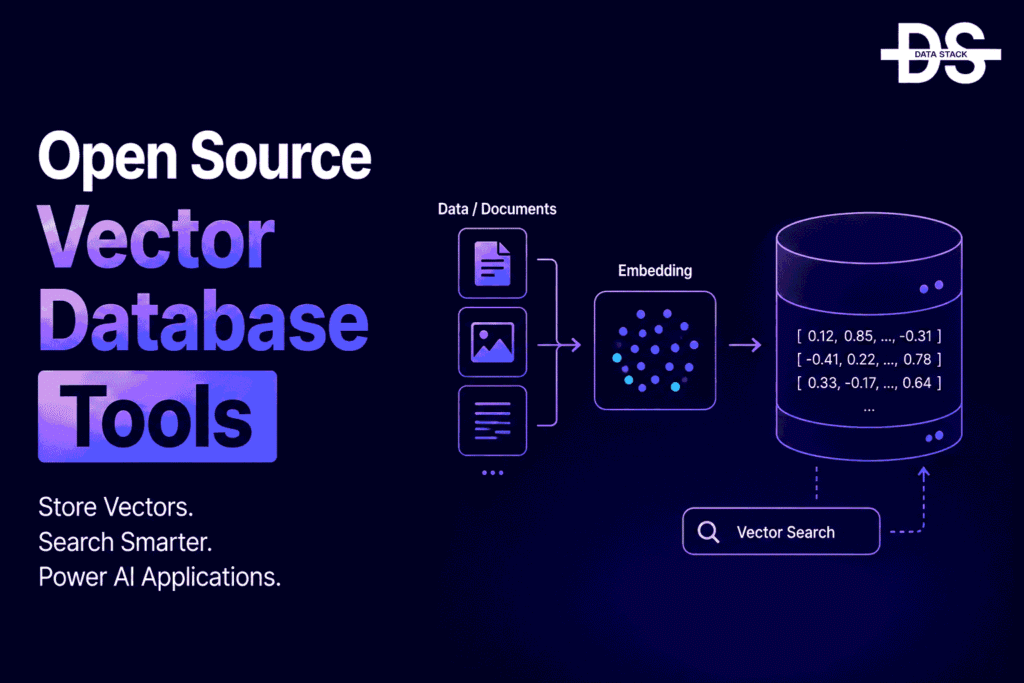
AI applications increasingly need to work with information based on meaning rather than exact keywords. Semantic search, retrieval-augmented generation (RAG), recommendation systems, and similar applications convert text, images, and other unstructured data into vector embeddings that can be compared to identify similar information. As datasets grow, storing and searching those embeddings efficiently becomes a separate database requirement.
Open source vector database tools are databases and data platforms designed to store, index, and search vector embeddings using similarity search and related retrieval methods. Some are purpose-built vector databases, while others are established databases that have added vector search capabilities alongside their existing data models.
That difference is important when evaluating the available options. A dedicated vector database may focus heavily on approximate nearest neighbor search and vector workloads, while a relational, search, or multi-model database can combine vectors with structured data and existing application requirements. This guide compares the leading open source vector database tools across dedicated vector search, hybrid retrieval, scalability, and different deployment approaches.
Table of Contents
ToggleWhy Use Open Source Vector Database Tools?
Open source vector database tools give teams more control over how embedding data is stored, indexed, and queried. This can be useful for AI applications where retrieval requirements, embedding models, metadata structures, and deployment environments vary significantly. Teams can evaluate and run the software within their own infrastructure rather than depending entirely on a proprietary vector search service.
They also provide flexibility in how vector search fits into an existing stack. Some projects are purpose-built for large-scale similarity search, while others extend relational, search, or multi-model databases with vector capabilities. This gives teams a choice between introducing a dedicated vector database and adding vector search to technology they may already use.
Open source software still requires operational ownership. Index management, scaling, replication, infrastructure, security, and monitoring remain the responsibility of the team when running a self-managed deployment. The main benefit is the ability to choose an architecture that fits the application’s retrieval requirements rather than adopting a single managed platform.
Open Source Vector Database Tools Comparison
| Tool Name | Category | Best For | Key Strength | Deployment Options | License |
|---|---|---|---|---|---|
| Qdrant | Dedicated Vector Database | Production AI and RAG applications | Filtering and vector search | Self-hosted, Docker, Kubernetes, Cloud | Apache 2.0 |
| Milvus | Dedicated Vector Database | Large-scale similarity search | Distributed vector search | Self-hosted, Docker, Kubernetes, Cloud | Apache 2.0 |
| Weaviate | Vector Database | AI-native retrieval applications | Vector and hybrid search | Self-hosted, Docker, Kubernetes, Cloud | BSD-3-Clause |
| Chroma | AI Application Database | Local development and prototypes | Developer-friendly embedding workflows | Local, Docker, Cloud | Apache 2.0 |
| pgvector | PostgreSQL Extension | Vector search with relational data | PostgreSQL integration | Self-hosted PostgreSQL, managed PostgreSQL | PostgreSQL License |
| FAISS | Vector Search Library | Custom similarity search applications | High-performance nearest-neighbor search | Local, server, custom deployment | MIT |
| Vespa | Search and AI Platform | Large-scale hybrid search | Vector, keyword, and ranking capabilities | Self-hosted, Docker, Kubernetes, Cloud | Apache 2.0 |
| OpenSearch | Search and Analytics Engine | Hybrid search workloads | Combined search and vector capabilities | Self-hosted, Docker, Kubernetes, managed services | Apache 2.0 |
The 8 Best Open Source Vector Database Tools
Vector search requirements can range from a local prototype with a small embedding collection to a production RAG application handling millions or billions of vectors. The open source vector database tools below reflect those different requirements, covering dedicated vector databases, relational extensions, search platforms, and developer libraries for similarity search.
#1 Qdrant
Qdrant is an open source vector database built specifically for storing and searching vector embeddings. It is designed around similarity search and retrieval workloads where applications need to find records that are mathematically close to a query vector. Alongside vector data, Qdrant works with associated metadata, allowing retrieval systems to combine similarity with application-specific information.
Qdrant belongs in this list because it represents the dedicated vector database approach rather than adding vector capabilities to an existing relational or search engine. For AI applications where vector retrieval is a central part of the architecture, a purpose-built database can provide a more focused environment than adapting a general-purpose database to handle embeddings.
Among open source vector database tools, Qdrant is a strong fit for production RAG, semantic search, recommendation, and other retrieval applications that need vector search alongside metadata-aware filtering. Its dedicated approach differentiates it from pgvector, which extends PostgreSQL, and from search platforms such as OpenSearch. Teams that want a standalone system centered on vector workloads can consider Qdrant as a focused option.
Key Features
- Similarity search: Searches vector collections to identify embeddings that are closest to a query vector.
- Metadata filtering: Combines vector similarity with filters based on associated payload data.
- Multiple vector support: Supports storing and working with different vector representations for a record.
- Hybrid retrieval support: Can be used in retrieval workflows that combine dense vectors with other search approaches.
- Distributed deployment: Supports scaling vector workloads across nodes in supported deployment configurations.
- REST and gRPC APIs: Provides interfaces for integrating vector search capabilities into applications and services.
#2 Milvus
Milvus is an open source vector database designed for managing and searching large collections of vector embeddings. It focuses on approximate nearest neighbor search and distributed vector workloads, making it suitable for applications where similarity search needs to operate across substantial datasets. The project is built around vector retrieval as a primary database function rather than as an additional capability layered onto another data model.
It belongs in this list because dedicated vector infrastructure becomes increasingly relevant as embedding collections grow and retrieval workloads become more demanding. Applications involving large document collections, image datasets, recommendations, or other high-dimensional data may need a system designed specifically around indexing and searching vectors at scale. Milvus represents this large-scale, purpose-built approach.
Among open source vector database tools, Milvus is particularly relevant for teams planning high-volume or distributed similarity search workloads. It differs from developer-oriented options such as Chroma and database extensions such as pgvector by focusing more directly on dedicated vector infrastructure. Teams building larger AI retrieval systems can evaluate Milvus when scalability and specialized vector search are more important than combining embeddings with an existing relational database.
Key Features
- Approximate nearest neighbor search: Supports vector indexes designed to retrieve similar vectors efficiently.
- Multiple index types: Provides different indexing approaches for balancing recall, latency, and resource requirements.
- Scalar filtering: Allows vector queries to be narrowed using supported non-vector fields.
- Distributed architecture: Supports deployments designed to scale vector data and query workloads.
- High-dimensional vector support: Stores and searches embeddings generated by supported AI and machine learning models.
- Client SDKs: Provides APIs and client libraries for integrating vector search into applications.
Showcase your software to buyers actively comparing tools. Submit your product for editorial review and get featured on Data Stack Hub.
Submit Your Tool →#3 Weaviate
Weaviate is an open source vector database built for storing data objects and retrieving them through vector similarity and other search methods. It is designed for AI and semantic retrieval use cases where applications need to search information based on meaning while also working with structured properties attached to each object. Its data model allows vector retrieval to operate alongside other ways of querying stored information.
Weaviate is included because vector-based applications often need more than a basic nearest-neighbor lookup. RAG and semantic search workflows may need to combine similarity results with structured data, keyword-based retrieval, or application-level filtering. Weaviate represents an AI-oriented database approach that brings these retrieval patterns together within a system designed around vector workloads.
Among open source vector database tools, Weaviate is well suited to teams building AI applications that need semantic and hybrid retrieval within the same platform. It differs from FAISS, which is primarily a vector similarity library, and from pgvector, which brings embeddings into PostgreSQL. For applications where vector search is central but structured objects and multiple retrieval approaches are also important, Weaviate provides a dedicated alternative.
Key Features
- Vector search: Retrieves stored objects based on similarity to a query vector.
- Hybrid search: Supports combining vector-based retrieval with keyword-oriented search.
- Metadata filtering: Narrows retrieval results using supported object properties.
- Multiple vectorization options: Works with externally generated embeddings and supported vectorization workflows.
- GraphQL and REST APIs: Provides interfaces for querying and managing stored data.
- Cluster deployment: Supports multi-node configurations for larger workloads.
#4 Chroma
Chroma is an open source database designed around embedding-based applications and retrieval workflows. It provides developers with a simpler environment for storing embeddings, associated documents, and metadata while building applications that need semantic retrieval. Its approach is oriented toward application development, making it useful when teams want to experiment with or integrate vector retrieval without introducing a more complex distributed database from the beginning.
It belongs in this list because vector database requirements vary significantly between experimentation and large-scale production environments. Not every application needs a distributed system designed for billions of vectors. Chroma represents a more developer-focused approach that can help teams prototype RAG systems, semantic search features, and other embedding-based applications while keeping the vector layer relatively straightforward.
Among open source vector database tools, Chroma is particularly suitable for local development, prototypes, and smaller AI application workflows. It differs from Milvus and Qdrant by placing greater emphasis on developer simplicity, while FAISS provides a lower-level library for custom similarity search implementations. Teams that want to get an embedding-based application running quickly can consider Chroma before introducing more specialized infrastructure.
Key Features
- Embedding storage: Stores vector embeddings with associated documents and metadata.
- Similarity retrieval: Returns records based on their similarity to query embeddings.
- Metadata filtering: Supports narrowing retrieval using associated metadata.
- Collection-based organization: Groups related embedding records into collections.
- Python and JavaScript support: Provides client libraries for supported application development environments.
- Local and server deployment: Can be used during local development or deployed as part of an application environment.
#5 pgvector
pgvector is an open source extension that adds vector similarity search capabilities to PostgreSQL. Rather than introducing a separate vector database, it allows applications to store embeddings alongside relational data and query them through the PostgreSQL environment. This approach can simplify architectures where structured application data and vector embeddings need to remain closely connected.
It belongs in this list because a dedicated vector database is not always necessary. Teams already using PostgreSQL may prefer to add vector capabilities to their existing database rather than operate another specialized system. pgvector represents the relational database approach to vector retrieval, making it particularly relevant for applications where vector search is one component of a broader transactional or structured data model.
Among open source vector database tools, pgvector is a practical choice for PostgreSQL-based applications that want to keep embeddings and relational records within the same database environment. It differs from Qdrant and Milvus, where vector search is the central architectural focus. Teams can consider pgvector when operational simplicity and PostgreSQL integration are more valuable than introducing separate infrastructure for vector workloads.
Key Features
- Vector data type: Adds support for storing vector embeddings within PostgreSQL tables.
- Nearest-neighbor search: Provides similarity search using supported distance calculations.
- Vector indexing: Supports indexes designed to improve approximate nearest-neighbor query performance.
- SQL integration: Allows vector queries to be combined with standard PostgreSQL queries and relational data.
- Transactional consistency: Works within PostgreSQL’s existing database and transaction model.
- PostgreSQL ecosystem compatibility: Can be used alongside existing PostgreSQL tools, extensions, and deployment environments.
#6 FAISS
FAISS is an open source library for efficient similarity search and clustering of dense vectors. Unlike the dedicated database platforms covered earlier, it provides the underlying vector search technology that developers can integrate into their own applications and infrastructure. This gives teams greater control over how vectors are stored, indexed, searched, and connected to the rest of the application.
It belongs in this list because some vector search workloads do not require a complete database with its own service layer and data management model. Developers building highly customized retrieval systems may prefer a lower-level library that can be incorporated directly into an existing application or machine learning pipeline. FAISS represents this library-based approach to working with large collections of embeddings.
Among open source vector database tools, FAISS is most relevant for teams that need direct control over similarity search implementation and are comfortable building surrounding infrastructure themselves. It differs from Qdrant, Milvus, and Weaviate because those platforms provide a more complete database environment. FAISS can be a strong option for custom AI, machine learning, and retrieval applications where developers want flexibility over a ready-made vector database service.
Key Features
- Similarity search: Performs nearest-neighbor searches across dense vector collections.
- Multiple index types: Provides different index structures for balancing search speed, memory usage, and recall.
- GPU acceleration: Supports GPU-based processing for supported indexing and search workloads.
- Large-scale vector search: Can work with substantial collections of high-dimensional vectors.
- Clustering support: Includes algorithms for clustering vector data.
- Python and C++ interfaces: Provides APIs for building vector search functionality into supported applications.
Increase your product visibility by reaching software buyers researching the best tools. Every submission is reviewed by our editorial team.
Feature My Tool →#7 Vespa
Vespa is an open source platform for building large-scale search and AI applications. It combines data storage, retrieval, ranking, and query processing, allowing applications to work with vector search alongside keyword search and other ranking approaches. Its broader search architecture makes it suitable for systems where retrieval is only one part of a more complex application-level search and ranking process.
It belongs in this list because many production retrieval systems need to combine several signals instead of relying only on vector similarity. Search applications may need structured filters, lexical matching, vector retrieval, and custom ranking logic within the same query flow. Vespa represents this broader search-platform approach, making it relevant for teams building sophisticated AI retrieval or recommendation systems.
Among open source vector database tools, Vespa is particularly suitable for large-scale applications that need hybrid retrieval and advanced ranking rather than a dedicated vector store alone. It differs from Chroma or Qdrant by covering a wider search and serving layer around vector retrieval. Teams with complex search requirements can consider Vespa when vectors need to work alongside ranking models, structured data, and other retrieval signals.
Key Features
- Vector similarity search: Supports nearest-neighbor retrieval across vector fields.
- Hybrid retrieval: Combines vector search with lexical, structured, and other query signals.
- Custom ranking: Allows ranking expressions and machine learning models to influence result ordering.
- Distributed architecture: Supports scaling data storage and query processing across multiple nodes.
- Real-time indexing: Updates supported data while the application remains available for querying.
- Application-level schemas: Uses schemas to define document fields, indexing, and ranking behavior.
Also Read: Best Vespa Alternatives and Competitors in 2026
#8 OpenSearch
OpenSearch is an open source search and analytics platform that supports vector search alongside traditional full-text and structured search capabilities. For teams already using a search engine as part of their application architecture, it provides a way to add vector retrieval without deploying a separate dedicated vector database. This makes it useful when semantic search needs to coexist with established search and analytics workloads.
It is included because vector retrieval is increasingly being added to systems that already manage documents, text, logs, and other searchable information. Instead of separating keyword and semantic retrieval into completely different platforms, OpenSearch allows supported vector capabilities to operate within the same broader search environment. This can reduce architectural separation when multiple retrieval methods are required for the same data.
Among open source vector database tools, OpenSearch is best suited to teams that already have search-centric workloads or need to combine semantic and keyword retrieval. It differs from dedicated vector databases by providing a broader search and analytics foundation, while pgvector takes a relational database approach. For applications where hybrid search is more important than operating a specialized vector-only system, OpenSearch can be a practical option.
Key Features
- Vector search: Stores and searches vector embeddings using supported vector field and query capabilities.
- Approximate nearest-neighbor search: Supports index structures designed for efficient similarity retrieval.
- Hybrid search: Combines vector retrieval with full-text and structured search methods.
- Distributed search: Scales indexing and query workloads across multiple nodes.
- Filtering and aggregations: Supports filtering search results and analyzing indexed data.
- REST APIs and ecosystem tools: Provides APIs and supporting tools for integrating search capabilities into applications.
Also Read: Best OpenSearch Alternatives and Competitors in 2026
How to Choose the Right Open Source Vector Database Tool
The right choice depends on whether vector search is the main database requirement or one capability within a broader application architecture. Before comparing index types or benchmark numbers, look at how embeddings will be generated, queried, filtered, and connected to the rest of the application.
- Dedicated vector database: Qdrant, Milvus, and Weaviate are more suitable when vector search is a central part of the application and the team wants infrastructure built specifically around embedding retrieval. The choice between them can depend on scale, filtering requirements, hybrid search, and operational preferences.
- Existing relational data: If the application already relies heavily on PostgreSQL, pgvector can keep embeddings and structured records within the same database. This approach can reduce infrastructure complexity when vector search does not require a separate specialized platform.
- Custom similarity search: FAISS is better suited to developers who need direct control over the vector search layer and are prepared to build the surrounding storage and application infrastructure themselves.
- Hybrid search and ranking: Vespa and OpenSearch are stronger fits when vector similarity needs to work alongside keyword search, filters, ranking logic, or other search signals. These platforms can be useful when retrieval is part of a larger search application rather than an isolated vector lookup.
- Dataset size and query volume: A local prototype and a production system with millions of embeddings do not have the same infrastructure requirements. Evaluate how the collection is expected to grow, how many concurrent queries the application must handle, and whether the deployment needs distributed scaling.
- Metadata filtering: RAG and recommendation workflows often need to limit retrieval results based on user, document, category, date, or other application data. Check how each platform combines metadata filtering with vector similarity before making a decision.
- Operational requirements: Consider deployment, replication, persistence, backups, monitoring, security, and infrastructure ownership. A lightweight development option may be easier to start with, while a larger production environment may require stronger scaling and operational capabilities.
Browse expertly curated software recommendations across hundreds of business categories.
Browse Top Tools →Conclusion
Choosing a vector database starts with deciding what role vector search will play in the application. Some teams need a dedicated system built around embeddings and similarity retrieval, while others only need vector search as part of an existing relational database or search platform. That architectural decision can eliminate several options before individual features are compared.
The retrieval workflow matters as well. A simple semantic lookup has different requirements from a RAG system that combines vectors with metadata filters, or a search application that needs keyword matching and custom ranking alongside semantic results. Dedicated databases, vector libraries, relational extensions, and search platforms each support a different way of building those systems.
The best open source vector database tool is therefore the one that fits the surrounding application architecture and retrieval pattern. Teams should first determine whether they need a complete vector database, a library for custom development, vector support inside an existing database, or a broader hybrid search platform. Once that role is clear, the shortlist becomes much easier to define.
Frequently Asked Questions
1. What are open source vector database tools?
Open source vector database tools are databases, platforms, and libraries that store vector embeddings and support similarity search. They are commonly used in applications such as semantic search, RAG, recommendation systems, image retrieval, and other AI workloads that need to find similar data.
2. What is a vector database?
A vector database is a system designed to store and search numerical vector representations called embeddings. It uses similarity or distance calculations to find records that are mathematically close to a query vector.
3. What are vector embeddings?
Vector embeddings are numerical representations of data such as text, images, audio, or other information. Machine learning models generate these representations so that data with similar characteristics can be located through vector similarity search.
4. What is the best open source vector database?
The best option depends on the workload. Qdrant, Milvus, and Weaviate are dedicated vector databases, pgvector adds vector search to PostgreSQL, FAISS provides a lower-level similarity search library, and OpenSearch or Vespa can support hybrid search requirements.
5. Is pgvector a vector database?
pgvector is an open source PostgreSQL extension rather than a standalone vector database. It adds vector storage and similarity search capabilities to PostgreSQL, allowing embeddings to be managed alongside relational data.
6. What is the difference between a vector database and a traditional database?
Traditional databases primarily organize and query data through structures such as tables, documents, or key-value records. A vector database focuses on storing embeddings and retrieving records based on mathematical similarity, although some platforms combine vector search with other data models.
7. What is the difference between FAISS and a vector database?
FAISS is a library for similarity search and clustering, while a vector database provides a more complete system for storing, indexing, managing, and querying vector data. Applications using FAISS may need to handle additional infrastructure and data management requirements themselves.
8. Can PostgreSQL be used for vector search?
Yes. The pgvector extension adds vector storage, similarity operations, and vector indexing capabilities to PostgreSQL. This allows applications to perform vector search while continuing to use relational tables and SQL.
9. What is hybrid search?
Hybrid search combines vector similarity with other retrieval methods, commonly including keyword or full-text search. It can help applications use semantic relevance alongside exact terms, filters, and other search signals.
10. Are open source vector databases suitable for RAG?
Yes. Open source vector databases are commonly used in retrieval-augmented generation applications to store document embeddings and retrieve relevant information for an AI model. The best option depends on factors such as data volume, filtering requirements, retrieval latency, and deployment architecture.