
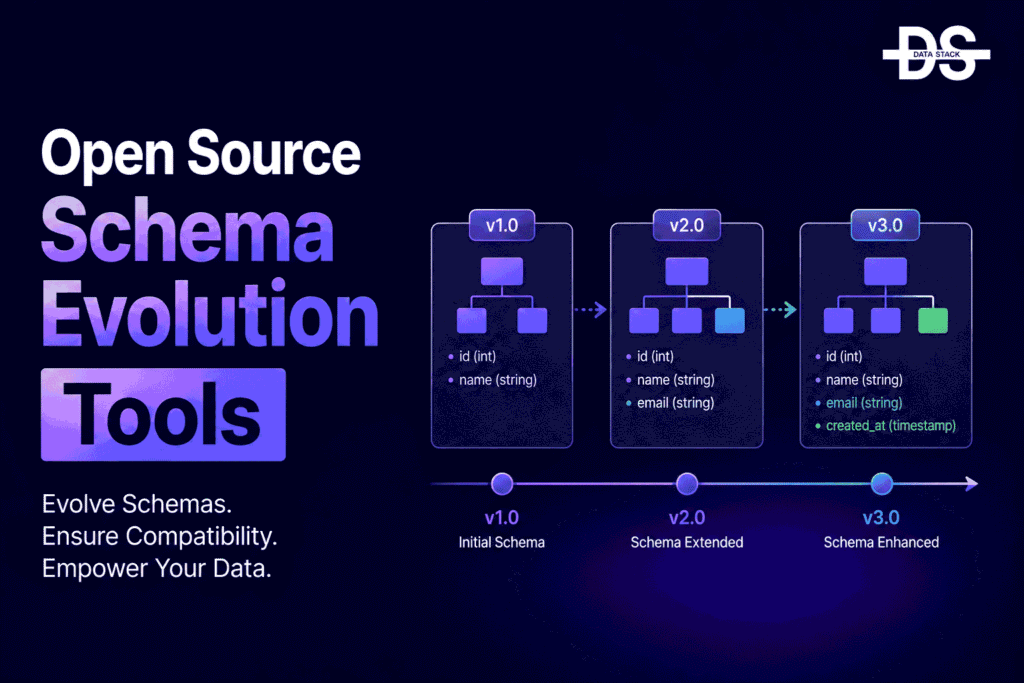
Schema changes are a normal part of modern data systems. New fields are added, existing columns are renamed, data types change, and event structures evolve as applications and pipelines develop. The challenge is making those changes without breaking downstream consumers, transformation jobs, APIs, or analytics workflows that still depend on earlier versions.
Schema evolution tools help teams manage this process by introducing versioning, compatibility checks, migration controls, and other mechanisms for handling structural changes safely. Depending on the environment, schema evolution may apply to Kafka events, database tables, APIs, data contracts, or analytical datasets. The right approach depends heavily on where the schema lives and how changes are deployed.
Open source schema evolution tools cover several different ecosystems rather than one single category. Some focus on event schemas and compatibility, while others manage database migrations, data contracts, or table formats that support schema changes over time. This guide compares nine tools that can help teams manage schema evolution across modern data environments.
Table of Contents
ToggleWhat is a Schema Evolution Tool?
A schema evolution tool helps teams manage changes to the structure of data while reducing the risk of breaking existing systems. It can track schema versions, validate compatibility between old and new definitions, control database migrations, or manage how table structures evolve as new data is written.
Schema evolution is particularly important when multiple producers, consumers, applications, and data pipelines depend on the same data. Instead of treating every structural change as an isolated deployment, teams can use compatibility rules and version-controlled processes to introduce changes in a more predictable way.
Open Source Schema Evolution Tools Comparison for 2026
| Tool Name | Category | Best For | Key Strength | Deployment Options | Licensing |
|---|---|---|---|---|---|
| Apicurio Registry | Schema & API Management | Multi-format schema evolution | Versioning and compatibility rules | Self-hosted, Docker, Kubernetes | Apache 2.0 |
| Karapace | Kafka Schema Management | Kafka-compatible schema evolution | Confluent-compatible compatibility checks | Self-hosted, Docker, Kubernetes | Apache 2.0 |
| Apache Pulsar | Event Streaming | Pulsar-native schema changes | Built-in schema versioning and compatibility | Self-hosted, Docker, Kubernetes, cloud | Apache 2.0 |
| Snowplow Iglu | Event Schema Management | Evolving analytics event schemas | Versioned JSON Schema repositories | Self-hosted, Docker, cloud | Apache 2.0 |
| Liquibase | Database Schema Migration | Controlled database schema changes | Version-controlled database migrations | Self-hosted, CLI, Docker, Kubernetes | Apache 2.0 |
| Flyway Community | Database Migration | SQL-based schema evolution | Simple versioned migrations | Self-hosted, CLI, Docker | Apache 2.0 |
| Apache Iceberg | Open Table Format | Evolving data lake table schemas | Metadata-driven schema evolution | Self-hosted, cloud, Kubernetes | Apache 2.0 |
| Delta Lake | Open Table Format | Schema evolution in lakehouse pipelines | Controlled schema enforcement and evolution | Self-hosted, cloud, Spark environments | Apache 2.0 |
| Apache Avro | Data Serialization | Application-level schema evolution | Built-in schema resolution and compatibility concepts | Embedded library, self-hosted applications | Apache 2.0 |
Also Read: 8 Best Open Source Schema Registry Tools for 2026
The 9 Best Open Source Schema Evolution Tools in 2026
Schema evolution can happen at different layers of the data stack. The best open source schema evolution tools therefore range from schema registries and database migration frameworks to open table formats and serialization systems. The right choice depends on whether teams are evolving events, databases, APIs, or analytical datasets.
#1 Apicurio Registry
Apicurio Registry is an open source platform for managing schemas and API artifacts as they evolve. It provides centralized storage, versioning, and compatibility controls that help teams introduce changes without unexpectedly breaking applications or consumers using existing definitions.
Its multi-format approach makes it useful for organizations that need schema evolution capabilities across more than one system. Rather than being limited to a single streaming platform, teams can use Apicurio Registry to manage different artifact types while applying governance around how versions change.
Key Features
- Artifact versioning: Maintains multiple versions of schemas and other supported artifacts.
- Compatibility rules: Helps teams evaluate whether schema changes can safely work with existing consumers and producers.
- Multi-format support: Supports multiple schema and API artifact types from a centralized platform.
- Centralized management: Provides a shared system for registering, retrieving, and governing schema definitions.
- REST APIs: Allows schema management workflows to be integrated into applications and automated processes.
- Version history: Helps teams track how schemas and artifacts have changed over time.
Best For
Apicurio Registry is best for organizations that need an open source schema evolution tool supporting multiple schema formats and compatibility requirements across distributed applications and data systems.
#2 Karapace
Karapace is an open source schema registry designed for Kafka-compatible environments. It supports schema versioning and compatibility checks, helping teams manage changes to event structures without requiring every producer and consumer to update at the same time.
Its compatibility with Confluent Schema Registry APIs makes it particularly useful for organizations that already have Kafka applications built around that ecosystem. Teams can adopt Karapace as part of a schema evolution strategy while maintaining compatibility with existing workflows.
Key Features
- Schema versioning: Stores and manages successive versions of registered schemas.
- Compatibility validation: Helps identify schema changes that could break existing producers or consumers.
- Confluent-compatible APIs: Supports migration and integration with Kafka applications using compatible APIs.
- Multiple schema formats: Supports Avro, JSON Schema, and Protocol Buffers.
- Kafka ecosystem support: Fits into Kafka-based event streaming architectures.
- Centralized schema access: Provides a common source for producers and consumers to retrieve schema definitions.
Best For
Karapace is best for Kafka-based teams that need an open source schema evolution tool with versioning and compatibility checks while maintaining compatibility with existing Confluent-oriented workflows.

Showcase your software to buyers actively comparing tools. Submit your product for editorial review and get featured on Data Stack Hub.
Submit Your Tool →#3 Apache Pulsar
Apache Pulsar includes built-in schema management that allows producers and consumers to work with versioned schemas directly within the event streaming platform. Teams can associate schemas with topics and manage changes as event structures evolve.
This native approach can simplify schema evolution for organizations already using Pulsar. Instead of operating a separate registry, teams can manage schema versions and compatibility as part of their existing streaming infrastructure.
Key Features
- Built-in schema management: Provides schema capabilities directly within Apache Pulsar.
- Schema versioning: Maintains versions as message structures evolve.
- Compatibility controls: Helps manage whether updated schemas remain compatible with previous versions.
- Multiple schema types: Supports formats including Avro, JSON, and Protocol Buffers.
- Topic-level integration: Associates schemas with Pulsar topics and message workflows.
- Native deployment: Eliminates the need for a separate schema registry in many Pulsar environments.
Best For
Apache Pulsar is best for teams already using Pulsar that need open source schema evolution capabilities built directly into their event streaming platform.
#4 Snowplow Iglu
Snowplow Iglu is an open source schema repository designed for managing event and behavioral data schemas. It helps teams define, version, and validate event structures as tracking requirements change over time.
Its versioned approach is particularly useful for organizations where analytics events are consumed by multiple downstream systems. Teams can evolve event definitions while maintaining clearer control over schema changes and validation.
Key Features
- Schema versioning: Maintains versions of event schemas as data structures evolve.
- JSON Schema support: Uses JSON Schema for defining event structures and validation requirements.
- Schema repositories: Provides centralized repositories for publishing and retrieving schemas.
- Event validation: Helps validate event payloads against registered schema definitions.
- Versioned event tracking: Supports controlled changes to analytics and behavioral event structures.
- Data pipeline integration: Fits into event collection and downstream processing workflows.
Best For
Snowplow Iglu is best for teams that need an open source schema evolution tool for managing versioned analytics, product, and behavioral event schemas.
#5 Liquibase
Liquibase is an open source database schema migration tool that helps teams manage structural database changes through version-controlled change sets. Instead of applying schema updates manually, teams can define changes such as creating tables, adding columns, modifying constraints, or updating indexes as part of a repeatable deployment process.
This makes Liquibase useful for schema evolution in transactional and operational databases. Teams can track which changes have been applied, automate migrations across environments, and integrate database schema updates into broader development and CI/CD workflows.
Key Features
- Version-controlled changes: Manages database schema updates through structured change sets.
- Database migrations: Supports changes to tables, columns, indexes, constraints, and other database objects.
- Change tracking: Records which schema changes have already been applied to a database.
- Rollback support: Provides mechanisms for reversing supported database changes when required.
- Multiple database support: Works across a broad range of relational database platforms.
- CI/CD integration: Allows schema changes to be included in automated deployment workflows.
Best For
Liquibase is best for development and data teams that need an open source schema evolution tool for managing controlled and versioned database schema changes across multiple environments.
#6 Flyway Community
Flyway Community is an open source database migration tool that manages schema changes primarily through versioned SQL migrations. Teams can define migration files, apply them in sequence, and maintain a consistent history of database changes across development, testing, and production environments.
Its SQL-first approach makes it a practical option for teams that want a straightforward schema evolution workflow without introducing a separate abstraction layer for every database change.
Key Features
- Versioned migrations: Applies database schema changes in a defined sequence.
- SQL-based workflow: Allows teams to manage migrations using SQL scripts.
- Migration history: Tracks which migrations have been applied to each database.
- Repeatable migrations: Supports migrations that can be reapplied when their definitions change.
- Command-line automation: Can run migrations through automated development and deployment workflows.
- Multiple database support: Works with a range of supported database systems.
Best For
Flyway Community is best for teams that need a simple open source schema evolution tool based on version-controlled SQL migrations.
Increase your product visibility by reaching software buyers researching the best tools. Every submission is reviewed by our editorial team.
Feature My Tool →#7 Apache Iceberg
Apache Iceberg is an open table format for large analytical datasets that supports schema evolution without requiring expensive table rewrites for many common changes. Teams can add, remove, rename, or update columns while maintaining table metadata and compatibility with supported processing engines.
Its approach is particularly relevant for modern data lakes and lakehouse architectures where table structures continue to evolve as datasets grow. Schema changes are managed through table metadata rather than relying only on physical file structure.
Key Features
- Schema evolution: Supports changes such as adding, dropping, renaming, and updating columns.
- Metadata-driven architecture: Separates table metadata from underlying data files to manage structural changes.
- Column ID tracking: Uses field identifiers to help maintain column identity as schemas evolve.
- Engine interoperability: Works with multiple query and processing engines.
- Partition evolution: Supports changes to partitioning strategies without rewriting existing data in many cases.
- Large-scale table management: Designed for analytical datasets stored across distributed data infrastructure.
Best For
Apache Iceberg is best for organizations that need open source schema evolution for large analytical tables in data lake and lakehouse environments.
#8 Delta Lake
Delta Lake is an open source table format and storage layer that provides schema enforcement and controlled schema evolution for data lakehouse workloads. It helps teams prevent unexpected structural changes while allowing approved schema updates as data models evolve.
This makes Delta Lake useful when teams need to balance flexibility with control. New columns and other supported schema changes can be introduced through defined operations instead of allowing every incoming write to silently modify the table structure.
Key Features
- Schema enforcement: Helps prevent writes that do not match the expected table structure.
- Controlled schema evolution: Supports approved schema changes as tables and datasets evolve.
- Transaction log: Maintains a record of table changes and operations.
- Versioned table history: Allows teams to access previous versions of table state.
- Data lakehouse integration: Supports analytical workloads across supported processing environments.
- Metadata management: Maintains schema and table information independently from underlying data files.
Best For
Delta Lake is best for data teams that need open source schema evolution and enforcement for analytical datasets and lakehouse pipelines.
#9 Apache Avro
Apache Avro is an open source data serialization framework with built-in support for schema evolution. It allows writers and readers to use different versions of a schema while applying schema resolution rules to determine how data should be interpreted.
Unlike a standalone schema registry or migration platform, Avro provides schema evolution capabilities at the serialization layer. It is commonly used in distributed systems and event-driven applications where data structures may change while older and newer applications continue to exchange records.
Key Features
- Schema-based serialization: Uses defined schemas to structure serialized data.
- Schema resolution: Allows readers and writers using different schema versions to work together when changes are compatible.
- Backward and forward compatibility concepts: Supports evolution patterns through reader and writer schema resolution.
- Compact data format: Uses binary serialization for efficient data exchange.
- Language support: Provides implementations and libraries for multiple programming languages.
- Ecosystem integration: Commonly used with event streaming systems and distributed applications.
Best For
Apache Avro is best for developers and data teams that need open source schema evolution capabilities directly within data serialization and distributed application workflows.
Non-Open-Source Schema Evolution Tools and Platforms
#1 Confluent Schema Registry
Confluent Schema Registry is a widely used option for managing schema versions and compatibility in Kafka environments. It helps teams control how event schemas change as producers and consumers evolve.
Best For
Confluent Schema Registry is best for organizations using the Confluent ecosystem that need managed or enterprise-grade schema evolution for Kafka-based applications.
#2 AWS Glue Schema Registry
AWS Glue Schema Registry provides centralized schema management and compatibility controls for streaming and event-driven applications running in AWS. It can reduce the operational effort of managing schema infrastructure within AWS-based data architectures.
Best For
AWS Glue Schema Registry is best for teams building streaming data pipelines and event-driven applications primarily on AWS.
#3 Azure Schema Registry
Azure Schema Registry provides managed schema storage and version management for applications using Azure messaging and event services. It is designed to help distributed applications work with shared and evolving schema definitions.
Best For
Azure Schema Registry is best for organizations using Azure Event Hubs or related Azure services that need managed schema evolution capabilities.
How to Choose the Right Open Source Schema Evolution Tool
- Schema format and data type: Start by identifying what is actually evolving. Kafka events may require a schema registry such as Apicurio Registry or Karapace, while analytical tables may be better served by Apache Iceberg or Delta Lake. Database changes require migration tools such as Liquibase or Flyway.
- Compatibility controls: If producers and consumers need to support multiple schema versions at the same time, prioritize tools with clear compatibility rules. Apicurio Registry, Karapace, Apache Pulsar, and Apache Avro are relevant when backward or forward compatibility is important.
- Database migration workflow: Teams evolving relational database schemas should look for version-controlled migration capabilities. Liquibase provides structured change sets and rollback options, while Flyway Community is a simpler SQL-first option.
- Lakehouse schema changes: For large analytical datasets, evaluate how the table format handles adding, renaming, dropping, or changing columns. Apache Iceberg and Delta Lake are stronger choices when schema evolution is part of a data lake or lakehouse architecture.
- Event and streaming infrastructure: Choose a tool that fits the existing event platform. Karapace is designed for Kafka-compatible environments, Apache Pulsar provides native schema management, and Snowplow Iglu is better suited to evolving analytics and behavioral event schemas.
- Protobuf and application data: Teams working directly with serialized application data should consider whether schema evolution needs to happen at the serialization layer. Apache Avro provides schema resolution capabilities for applications working with different schema versions.
- Version control and deployment: Schema changes should fit into existing development workflows. Evaluate support for CI/CD, automated validation, migration history, and review processes before choosing a tool.
- Operational complexity: A dedicated registry may provide stronger governance but require additional infrastructure. Built-in platform capabilities or migration frameworks may be simpler when schema evolution is limited to a specific database, table format, or streaming platform.
Browse expertly curated software recommendations across hundreds of business categories.
Browse Top Tools →Conclusion
The best open source schema evolution tool depends on where schema changes occur in the data architecture.
Apicurio Registry and Karapace are strong options for managing evolving event schemas, while Apache Pulsar provides schema evolution capabilities directly within its streaming platform. Snowplow Iglu is more specialized for analytics and behavioral event schemas.
Liquibase and Flyway Community are better suited to controlled database schema changes. Apache Iceberg and Delta Lake handle schema evolution for analytical tables, while Apache Avro supports compatibility between different schema versions at the serialization layer.
The most important step is to match the tool to the layer where schema changes happen. A Kafka event schema, relational database, lakehouse table, and serialized application record all require different approaches to schema evolution.
Frequently Asked Questions
1. What is schema evolution?
Schema evolution is the process of changing a data structure over time while maintaining compatibility with existing applications, datasets, or consumers. Changes can include adding or removing fields, renaming columns, changing data types, or modifying event structures.
2. What are open source schema evolution tools?
Open source schema evolution tools help teams manage structural changes through schema versioning, compatibility checks, database migrations, table metadata, or serialization rules. Examples include Apicurio Registry, Liquibase, Flyway Community, Apache Iceberg, and Apache Avro.
3. What is the best open source tool for schema evolution?
The best option depends on the use case. Apicurio Registry is a strong choice for multi-format schema management, Liquibase is useful for database changes, Apache Iceberg supports evolving analytical tables, and Apache Avro handles schema evolution during data serialization.
4. What is the difference between schema evolution and schema migration?
Schema evolution is the broader process of allowing data structures to change while maintaining compatibility. Schema migration usually refers specifically to applying controlled structural changes to a database.
5. How does Apache Iceberg handle schema evolution?
Apache Iceberg manages schema changes through table metadata and field identifiers. This allows supported operations such as adding, dropping, renaming, and updating columns without depending only on the physical structure of existing data files.
6. Does Delta Lake support schema evolution?
Yes. Delta Lake provides schema enforcement and controlled schema evolution, allowing approved structural changes to be applied while helping prevent unexpected writes that do not match the expected table schema.
7. Can Apache Avro handle schema evolution?
Yes. Apache Avro supports schema resolution between reader and writer schemas, allowing compatible versions of a schema to work together as data structures evolve.
8. Why is schema compatibility important?
Schema compatibility helps prevent changes from breaking existing applications, producers, consumers, pipelines, or downstream systems. It allows teams to evolve data structures more safely when different systems cannot all be updated simultaneously.