
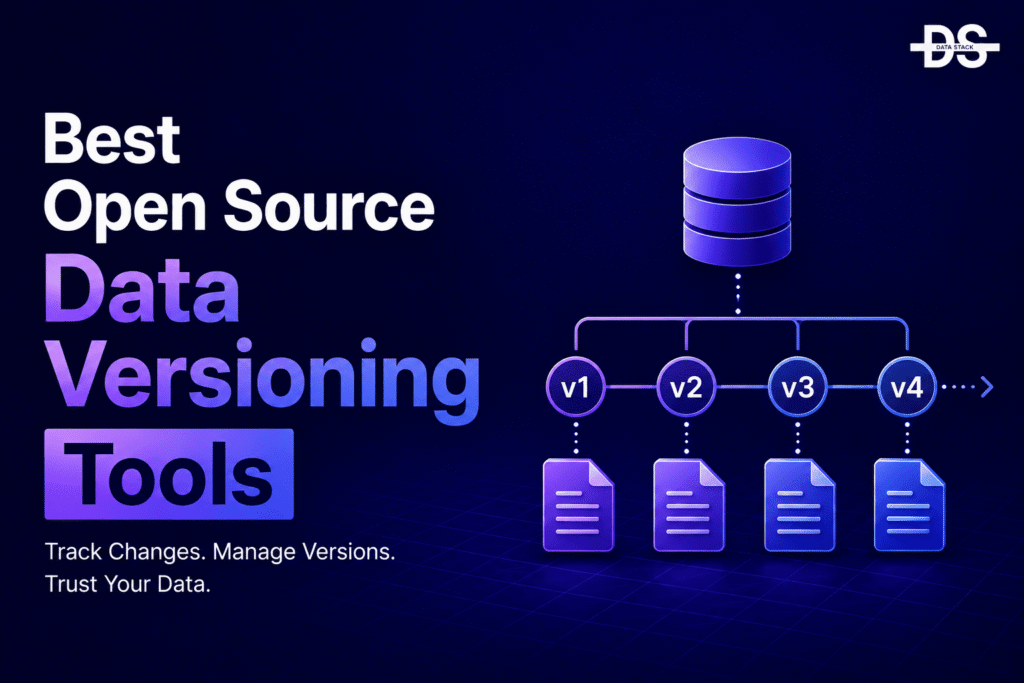
Data rarely stays in one state. A pipeline can overwrite records, a dataset can be corrected after analysis, new files can be added to a data lake, or a schema change can alter how downstream systems interpret the same information. As data environments grow, simply knowing where the latest dataset lives is no longer enough. Teams also need to know what changed, when it changed, and whether they can reproduce or restore an earlier state.
That is where open source data versioning tools become useful. They apply version control concepts to different layers of the data stack, helping teams track datasets, files, tables, object storage, databases, or pipeline outputs over time. Some follow a Git-like model with commits and branches, while others use snapshots or metadata to preserve historical states without creating a complete physical copy of the data every time something changes.
The best approach depends on what your team is actually trying to version. A machine learning team may need dataset version control tied to experiments and code, while a data engineering team may need to isolate changes across an entire data lake. Lakehouse teams may focus on table history and catalog-level versioning, whereas application teams may want branching and rollback directly inside a relational database. This guide compares seven of the best open source data versioning tools across those different use cases.
Table of Contents
ToggleWhat is a Data Versioning Tool?
A data versioning tool helps teams record how datasets and other data assets change over time. Depending on the architecture, it can preserve snapshots, track commits, support branches, compare versions, or make it possible to return to an earlier state. This gives teams a clearer record of which version of the data was used for a specific analysis, pipeline run, or machine learning experiment.
Data version control is different from simply keeping backups. Backups are primarily intended for recovery, while versioning helps teams work with changing data as part of everyday development and collaboration. A data engineer might test a pipeline against a separate version of a data lake, an ML team might reproduce an experiment using an earlier dataset, or a database team might compare two versions before merging changes. The right open source data versioning tool therefore depends on whether the data lives in files, object storage, lakehouse tables, pipelines, or a relational database.
Open Source Data Versioning Tools Comparison for 2026
| Tool Name | Category | Best For | Key Strength | Deployment Options | Licensing |
|---|---|---|---|---|---|
| lakeFS | Data Lake Versioning | Large-scale object storage and data lakes | Git-like branching, commits, and isolated data changes | Self-hosted, Docker, Kubernetes, cloud | Apache 2.0 |
| DVC | Dataset Version Control | Data science and ML workflows | Tracks datasets and pipelines alongside code | Local, self-hosted, cloud storage | Apache 2.0 |
| Project Nessie | Catalog Versioning | Lakehouse and multi-engine data environments | Git-like branches and commits at the catalog layer | Self-hosted, Docker, Kubernetes, cloud | Apache 2.0 |
| Dolt | Versioned SQL Database | Structured and relational data | Native commits, branches, diffs, and merges | Self-hosted, Docker, cloud | Apache 2.0 |
| Pachyderm | Versioned Data Pipelines | Reproducible data processing workflows | Data lineage across versioned inputs and outputs | Kubernetes, self-hosted, cloud | Apache 2.0 |
| Apache Iceberg | Table Versioning | Lakehouse tables and analytical datasets | Snapshot history and time travel | Self-hosted through compatible engines | Apache 2.0 |
| Git LFS | Large File Versioning | Smaller datasets and binary artifacts | Git-based tracking for large files | Local, self-hosted, cloud | MIT |
These tools approach data versioning from different layers of the stack. lakeFS and DVC are closer to traditional data version control, while Project Nessie manages versions through the catalog layer. Dolt brings Git-style workflows directly to relational data, Pachyderm connects versioning with reproducible pipelines, and Apache Iceberg maintains historical table states through snapshots.
The 7 Best Open Source Data Versioning Tools in 2026
The best open source data versioning tools help teams track changing data, reproduce previous states, and manage updates without losing visibility into what changed. The right choice depends on whether you are versioning datasets, a data lake, tables, pipelines, or an operational database.
#1 lakeFS
lakeFS is one of the strongest open source data versioning tools for teams working with large datasets stored in object storage. It brings Git-like concepts such as repositories, branches, commits, and merges to data lakes without requiring the underlying data to be stored inside Git.
The platform is particularly useful when data pipelines can make large or potentially risky changes. Teams can create an isolated branch, run transformations or validation, and merge the changes only after the new data state is ready. This makes lakeFS a strong fit for data engineering teams that need more control over changes across shared S3-compatible or cloud object storage environments.
Key Features
- Git-like branching for data: Creates isolated branches so teams can test pipeline changes without immediately affecting the main data state.
- Commits and version history: Records changes as commits, making it easier to identify and work with previous versions of data.
- Merge workflows: Allows validated changes from one branch to be incorporated into another, supporting controlled collaboration.
- Rollback and recovery: Helps teams return to an earlier data state when a pipeline produces incorrect or unwanted changes.
- Object storage integration: Works with large-scale data stored in supported object storage environments rather than requiring data to be copied into a separate version control system.
- Data pipeline isolation: Supports development and testing workflows where transformations can run against an isolated version of shared data.
Best For
lakeFS is best for data engineering teams that need Git-like version control for large data lakes and object storage environments where pipelines, transformations, and multiple users can modify shared data.
#2 DVC
DVC is an open source data versioning tool built for teams that want to manage datasets, machine learning artifacts, and data pipelines alongside their existing code workflows. It uses Git to track metadata while the actual data can remain in external storage, helping teams avoid placing large datasets directly inside a source code repository.
This approach makes DVC particularly useful for reproducible data science and ML projects. A team can connect a specific version of a dataset to a particular experiment, pipeline, or model, making it easier to understand how a result was produced and recreate it later. It is a better fit for project-level dataset versioning than for managing branches across an entire enterprise data lake.
Key Features
- Dataset version tracking: Records versions of datasets without requiring large files to be stored directly in Git.
- Git-based workflow: Uses familiar commits and repository workflows to connect data changes with code changes.
- External storage support: Stores actual datasets in supported remote storage while maintaining version information separately.
- Pipeline reproducibility: Defines data processing stages and dependencies to help reproduce workflows.
- Experiment tracking integration: Supports workflows where dataset versions need to be connected with experiments and outputs.
- Data change comparison: Helps teams identify which dataset version or pipeline state was used for a particular result.
Best For
DVC is best for data science and ML teams that need open source dataset versioning tied closely to code, experiments, models, and reproducible pipelines.
Showcase your software to buyers actively comparing tools. Submit your product for editorial review and get featured on Data Stack Hub.
Submit Your Tool →#3 Project Nessie
Project Nessie is an open source catalog versioning tool designed for modern data lakehouse environments. Rather than versioning every file or dataset directly, it applies Git-like concepts to the catalog layer that tracks data objects and their references.
This makes Nessie particularly useful for teams working with technologies such as Apache Iceberg and multiple query engines. Teams can create branches, test changes to tables or catalog references in isolation, and merge those changes when they are ready. The result is a controlled workflow for managing changes across shared analytical environments.
Key Features
- Git-like catalog versioning: Supports commits, branches, tags, and merges for catalog-managed data objects.
- Isolated development environments: Allows teams to test changes without immediately affecting the main data environment.
- Multi-engine support: Designed for lakehouse architectures where different compute engines access shared data.
- Table reference management: Tracks changes to table metadata and catalog references over time.
- Branch-based workflows: Supports controlled development, testing, and promotion of data changes.
- Open architecture: Can be deployed as part of a self-managed lakehouse environment.
Best For
Project Nessie is best for data platform teams that need open source version control at the catalog layer for collaborative Apache Iceberg and lakehouse environments.
#4 Dolt
Dolt takes a different approach from most open source data versioning tools by building Git-style version control directly into a SQL database. Instead of versioning files, object storage, or metadata references, Dolt allows users to work with relational data using concepts such as commits, branches, diffs, and merges.
This makes Dolt useful when structured data itself needs to move through a collaborative versioning workflow. Teams can create a branch, make changes to database tables, compare those changes, and merge them into another branch. It can be particularly useful for reference data, configuration data, shared datasets, and applications where understanding row-level changes matters.
Key Features
- Versioned SQL database: Stores relational data while maintaining a version history of changes.
- Native commits and branches: Supports Git-like workflows directly within the database environment.
- Data diffs: Allows teams to compare changes between database versions.
- Merge capabilities: Supports combining changes from different branches.
- SQL compatibility: Uses a familiar database interface for querying and modifying structured data.
- Collaborative workflows: Makes it easier for multiple users or teams to manage controlled changes to shared relational datasets.
Best For
Dolt is best for teams that need Git-style version control directly for structured, relational data rather than for files or object storage.
#5 Pachyderm
Pachyderm combines data versioning with automated data pipelines. Its approach is particularly useful when reproducibility depends not only on knowing which data version was used, but also on understanding how that data moved through multiple processing stages.
Each stage in a pipeline can work with versioned inputs and produce versioned outputs, creating a clear relationship between source data, transformations, and resulting datasets. This makes Pachyderm relevant for complex data processing and machine learning workflows where lineage and reproducibility are closely connected.
The platform is more infrastructure-heavy than a lightweight dataset versioning tool, so it is generally a better fit for teams already comfortable running Kubernetes-based data workloads.
Key Features
- Versioned data repositories: Tracks changes to data used as pipeline inputs and outputs.
- Automated lineage: Connects processed results with the source data and pipeline stages that produced them.
- Pipeline reproducibility: Helps rerun workflows against known versions of data.
- Incremental processing: Can process new or changed data without necessarily rerunning the entire workflow.
- Kubernetes-native architecture: Designed for containerized and scalable data processing environments.
- Multi-stage pipeline support: Connects versioned datasets across complex processing workflows.
Best For
Pachyderm is best for engineering and ML teams that need open source data versioning combined with reproducible, automated pipelines and detailed data lineage.
#6 Apache Iceberg
Apache Iceberg is an open source table format that provides built-in support for tracking the history of changes to analytical tables. It is not a Git-style data version control platform, but its snapshot-based architecture makes it an important option for teams that need to work with previous table states in a lakehouse environment.
Each change to an Iceberg table creates a new snapshot. This allows compatible query engines to access historical versions, support time-travel queries, and roll back table metadata to an earlier state when necessary. For analytics teams already using an Iceberg-based lakehouse, these capabilities may remove the need to introduce a separate data versioning tool for certain table-level use cases.
Key Features
- Snapshot-based table history: Records table states as changes are committed.
- Time travel: Allows compatible engines to query historical versions of a table.
- Rollback support: Makes it possible to return table metadata to an earlier snapshot.
- Schema evolution: Supports controlled changes to table schemas over time.
- Partition evolution: Allows partition strategies to change without requiring a complete table rewrite.
- Multi-engine compatibility: Works across a growing ecosystem of compatible processing and query engines.
Best For
Apache Iceberg is best for lakehouse teams that need open source table versioning, historical snapshots, and time-travel capabilities as part of their analytical data architecture.
Increase your product visibility by reaching software buyers researching the best tools. Every submission is reviewed by our editorial team.
Feature My Tool →#7 Git LFS
Git LFS is a lightweight option for teams that already use Git and need to manage larger files without storing the full file contents directly in the main repository. It replaces large files with lightweight pointers while keeping the actual content in separate storage.
Git LFS is not designed for large-scale data lakes or enterprise data pipelines. However, it can be useful for smaller datasets, training files, binary artifacts, and project-level data that need to follow the same versioning workflow as application code.
Key Features
- Large file handling: Stores large files outside the standard Git object database while keeping references inside the repository.
- Git workflow compatibility: Uses familiar commits, branches, and repository operations.
- Version tracking: Associates different file versions with repository history.
- Selective file storage: Allows teams to define which file types should use LFS.
- Collaborative workflows: Works with existing Git-based development and review processes.
- Simple project-level adoption: Can be easier to introduce for smaller data assets than a dedicated data versioning platform.
Best For
Git LFS is best for developers and small data teams that need a simple, Git-compatible way to version smaller datasets, model artifacts, and other large project files.
Non-Open-Source Data Versioning Tools and Platforms
Open source data versioning tools give teams more control over their infrastructure and workflows, but commercial platforms can be a better fit when managed operations, enterprise governance, or integrated data platform capabilities are the priority.
#1 Databricks
Databricks provides managed lakehouse capabilities for handling historical table versions, time travel, and controlled changes across analytical data. It is particularly relevant for teams already building on the Databricks ecosystem and looking for managed alternatives to self-hosted open source data versioning tools.
Best For
Databricks is best for organizations that need managed lakehouse infrastructure with built-in table history, reproducibility, and enterprise data platform capabilities.
Also Read: Best Databricks Alternatives and Competitors
#2 Snowflake
Snowflake provides capabilities such as Time Travel and data cloning that allow teams to access historical data states and create isolated copies for development, testing, and recovery workflows. While it is not a dedicated Git-style data versioning platform, it can address many practical versioning requirements for teams operating inside Snowflake.
Best For
Snowflake is best for teams that need managed data version history and recovery capabilities within a cloud data platform.
#3 Versioned
Versioned is a commercial platform focused on bringing version control concepts to data and analytics workflows. It is aimed at teams that want a more managed and collaborative approach to tracking changes across shared data assets.
Best For
Versioned is best for organizations looking for a commercial data version control platform with collaboration and managed workflow capabilities.
How to Choose the Right Open Source Data Versioning Tool
Choosing the right open source data versioning tool starts with identifying what actually needs to be versioned. A dataset in object storage, an ML training file, an analytical table, and a relational database all require different approaches.
- Start with the data layer: Use lakeFS for broad object-storage and data lake workflows, DVC for project-level datasets, Dolt for relational data, and Iceberg when table snapshots are already part of your lakehouse architecture.
- Consider whether you need Git-like workflows: Branches, commits, merges, and isolated development environments are valuable when multiple teams need to test changes before they reach production.
- Check reproducibility requirements: ML and data pipeline teams should prioritize tools that connect data versions with code, experiments, transformations, and outputs.
- Look at the scale of your data: Git LFS can work for project-level files, while large data lakes require a platform designed to manage version metadata without repeatedly duplicating massive datasets.
- Evaluate your existing architecture: A tool that fits naturally with your object storage, Kubernetes environment, lakehouse catalog, or database ecosystem will usually be easier to operate.
- Separate versioning from backup: If your main requirement is disaster recovery, a backup solution may be more appropriate. Choose a data versioning tool when you also need collaboration, comparison, reproducibility, or controlled changes.
- Think about branching before production changes: Teams making risky pipeline or schema changes should prioritize tools that support isolated environments and controlled promotion.
- Avoid adding another platform unnecessarily: If your existing data architecture already provides the version history you need, such as Iceberg snapshots for analytical tables, a separate version control layer may add complexity without enough benefit.
Browse expertly curated software recommendations across hundreds of business categories.
Browse Top Tools →Conclusion
The best open source data versioning tool depends on where your data lives and how your team works with it.
lakeFS is the strongest choice for Git-like version control across large data lakes and object storage. DVC is better suited to data science and ML teams that need to connect dataset versions with code and reproducible workflows. Project Nessie fits collaborative lakehouse environments, while Dolt is the standout option for teams that want commits, branches, and diffs directly inside a relational database.
For pipeline-heavy environments, Pachyderm combines data versioning with lineage and reproducibility. Apache Iceberg is a practical choice when snapshot history and time travel at the table level are sufficient, while Git LFS works best for smaller project-level datasets and binary artifacts.
The right choice is not necessarily the tool with the most features. Start by identifying the data asset you need to version, then choose the platform that fits that layer of your architecture without adding unnecessary operational complexity.
Frequently Asked Questions
1. What are open source data versioning tools?
Open source data versioning tools help teams track changes to datasets and other data assets over time. Depending on the tool, they can support version history, snapshots, branches, commits, rollback, comparisons, and reproducible workflows.
2. What are the best open source data versioning tools?
lakeFS, DVC, Project Nessie, Dolt, Pachyderm, Apache Iceberg, and Git LFS are strong options for different data versioning requirements.
3. What is data version control?
Data version control is the practice of tracking changes to data so teams can identify, compare, reproduce, and restore specific states. It applies version control concepts to datasets, tables, files, databases, or data pipelines.
4. Is data versioning the same as data backup?
No. Backups are primarily designed for recovery after data loss or failure. Data versioning focuses on tracking ongoing changes and supporting reproducibility, collaboration, comparison, and controlled rollback.
5. Which open source tool is best for versioning datasets?
DVC is one of the strongest options for project-level dataset versioning, particularly for data science and machine learning workflows that are closely connected to Git and code repositories.
6. Can you version an entire data lake?
Yes. Tools such as lakeFS are designed to bring version control concepts such as branches and commits to data stored across supported object-storage environments.
7. Is Apache Iceberg a data versioning tool?
Apache Iceberg provides snapshot history, time travel, and rollback capabilities for analytical tables. It can address table-level versioning requirements, although it is different from a dedicated Git-style data version control platform.
8. What is the difference between DVC and lakeFS?
DVC is primarily designed for versioning datasets and supporting reproducible data science or ML workflows alongside code. lakeFS is designed to manage Git-like versioning across larger collections of data stored in object storage and data lakes.
9. Can relational databases use data version control?
Yes. Dolt is an example of a versioned SQL database that supports Git-style concepts such as commits, branches, diffs, and merges directly for relational data.
10. Do data versioning tools duplicate the entire dataset?
Not necessarily. Many tools store metadata, references, snapshots, or object-level changes instead of creating a complete duplicate of the entire dataset for every version.