
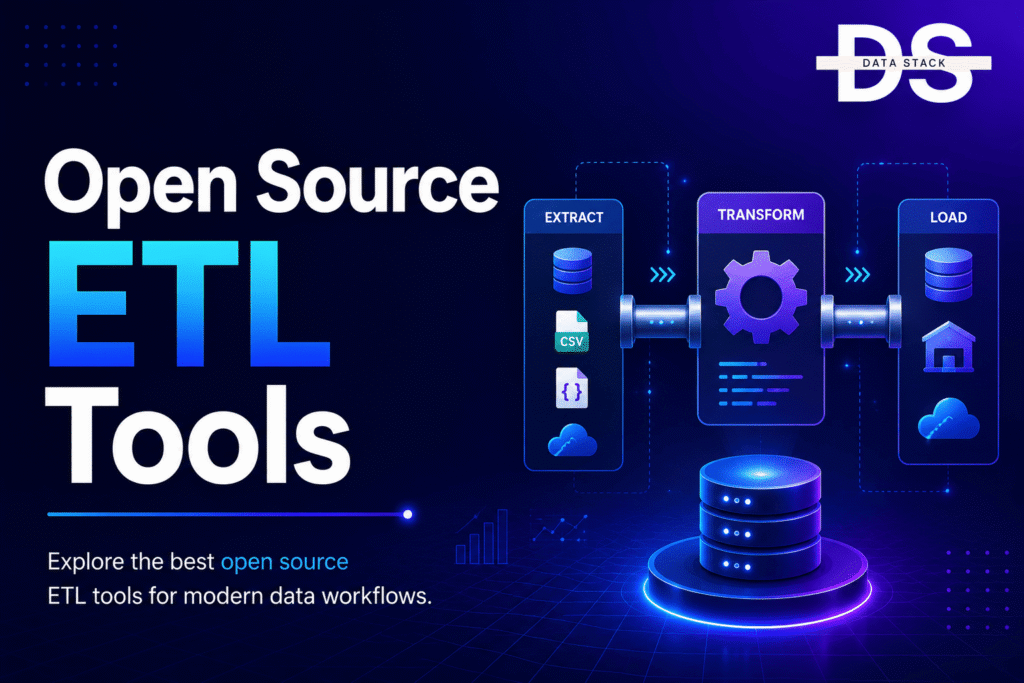
ETL (Extract, Transform, Load) remains one of the most important foundations of modern data architecture. Whether organizations are building cloud data warehouses, data lakes, business intelligence environments, machine learning platforms, or real-time analytics systems, data must first be collected, transformed, and delivered from source systems to downstream destinations.
Historically, ETL tools focused on extracting information from operational databases, transforming it through predefined workflows, and loading it into analytical systems. Today, the market has evolved significantly. Modern data teams often combine traditional ETL, ELT (Extract, Load, Transform), data integration, change data capture (CDC), streaming pipelines, and real-time processing into unified architectures.
As organizations seek greater flexibility and lower software costs, open-source ETL tools have become increasingly popular. Many enterprises now use free ETL software and self-hosted data integration platforms to power mission-critical analytics and data engineering workloads.
The best open-source ETL platforms can help organizations:
- Build data pipelines
- Automate data movement
- Synchronize databases
- Support cloud data warehouses
- Process batch and streaming data
- Implement CDC workflows
- Enable real-time analytics
- Improve data integration efficiency
In this guide, we compare the best open source ETL tools, free ETL software platforms, and open-source data integration solutions available in 2026.
Top Open Source ETL Tools Comparison Table
| Tool | Best For | License | Self-Hosted | Primary Focus |
|---|---|---|---|---|
| Airbyte | Modern ELT Pipelines | MIT | Yes | Data Integration |
| Apache NiFi | Data Flow Automation | Apache 2.0 | Yes | ETL & Data Movement |
| Talend Open Studio | Traditional ETL | Open Source | Yes | Data Integration |
| Pentaho Data Integration | Enterprise ETL | Open Source | Yes | Data Pipelines |
| Apache Hop | Modern ETL Development | Apache 2.0 | Yes | Data Orchestration |
| Debezium | Change Data Capture | Apache 2.0 | Yes | CDC |
| Kafka Connect | Streaming Integration | Apache 2.0 | Yes | Real-Time Pipelines |
| Apache Spark | Large-Scale ETL | Apache 2.0 | Yes | Data Processing |
| Apache Flink | Streaming ETL | Apache 2.0 | Yes | Stream Processing |
| StreamSets Data Collector | Data Ingestion | Apache 2.0 | Yes | Pipeline Automation |
| Apache Camel | Enterprise Integration | Apache 2.0 | Yes | Integration Framework |
| CloverDX Community Edition | Data Transformation | Community Edition | Yes | ETL Workflows |
| Apache SeaTunnel | Data Synchronization | Apache 2.0 | Yes | Data Integration |
| Logstash | Log & Event ETL | Apache 2.0 | Yes | Data Ingestion |
List of 14 Best Open Source ETL Tools 2026
#1 Airbyte
Airbyte has quickly become one of the most popular open-source ETL and ELT platforms because it addresses a problem almost every modern data team faces: connecting data from dozens of different systems without building and maintaining custom integrations.
Traditional ETL projects often require significant engineering effort to move information between SaaS applications, databases, APIs, cloud platforms, and analytical environments. Airbyte simplifies this process through a rapidly expanding connector ecosystem that supports hundreds of sources and destinations.
Unlike many legacy ETL platforms, Airbyte follows a modern ELT approach. Data is extracted and loaded into a destination such as a cloud data warehouse before transformations are applied. This architecture aligns closely with modern platforms such as Snowflake, BigQuery, Redshift, Databricks, and ClickHouse.
For organizations building modern data stacks, Airbyte has become one of the leading free ETL tools available today.
Key Features
- Extensive connector ecosystem: Connect databases, SaaS applications, APIs, cloud services, and operational platforms through hundreds of prebuilt integrations.
- Incremental data synchronization: Reduce processing overhead by moving only changed records rather than reloading entire datasets.
- Modern ELT architecture: Support cloud-native analytical environments where transformations occur after data loading.
- Custom connector development: Build proprietary integrations when unique business systems require specialized connectivity.
- Automated scheduling: Run extraction and loading workflows on configurable schedules without manual intervention.
Pros
- One of the largest connector ecosystems.
- Strong community adoption.
- Modern ELT architecture.
- Active development roadmap.
Cons
- Complex transformation logic often requires additional tools.
- Connector maturity varies.
- Large deployments require operational planning.
Licensing
MIT License
Deployment Options
- Docker
- Kubernetes
- Self-hosted infrastructure
- Cloud deployments
Best For
Organizations building modern ELT pipelines, cloud warehouse architectures, and scalable data integration environments.
Limitations
Teams seeking advanced transformation orchestration may pair Airbyte with dbt, Spark, or dedicated transformation platforms.
#2 Apache NiFi
Apache NiFi remains one of the most versatile open-source ETL platforms available because it combines data ingestion, transformation, routing, monitoring, and delivery within a single visual environment.
Unlike tools that focus primarily on extraction, NiFi allows organizations to build complete end-to-end data flow architectures. Users can design pipelines through a graphical interface rather than writing large amounts of custom code, making it easier to manage complex integration projects.
The platform excels in environments where data must move between diverse systems while maintaining visibility, governance, and operational control.
Many enterprises use NiFi as both a data integration platform and a data pipeline automation solution.
Key Features
- Visual pipeline development: Build ETL and data integration workflows through drag-and-drop interfaces that simplify implementation and maintenance.
- Real-time data movement: Support streaming and continuous ingestion workloads across operational systems.
- Broad connectivity support: Integrate databases, APIs, messaging systems, cloud platforms, file systems, and enterprise applications.
- Flow monitoring capabilities: Track throughput, failures, bottlenecks, and operational health across data pipelines.
- Flexible routing and transformation: Apply business logic and processing rules while data moves through workflows.
Pros
- Extremely flexible architecture.
- Excellent real-time capabilities.
- Strong monitoring features.
- Extensive processor library.
Cons
- Learning curve for large deployments.
- Resource requirements increase with scale.
- Operational complexity grows in enterprise environments.
Licensing
Apache License 2.0
Deployment Options
- Kubernetes
- Docker
- Self-hosted infrastructure
- Hybrid environments
Best For
Organizations managing complex ETL workflows, data integration projects, and real-time data movement requirements.
Limitations
Teams seeking simpler SaaS-style ETL experiences may prefer platforms focused primarily on connector-based integrations.

Showcase your software to buyers actively comparing tools. Submit your product for editorial review and get featured on Data Stack Hub.
Submit Your Tool →#3 Talend Open Studio
Talend Open Studio is one of the most recognized names in the ETL market and has been widely used by enterprises for years. It provides a graphical environment for designing, managing, and executing ETL workflows across a wide variety of systems.
The platform supports traditional ETL methodologies where data is extracted, transformed, and loaded through structured workflows. Its extensive library of connectors and transformation components makes it suitable for a broad range of integration scenarios.
For organizations evaluating free ETL software with mature capabilities, Talend remains one of the strongest options available.
Key Features
- Visual ETL development: Design complex extraction, transformation, and loading workflows through graphical interfaces.
- Extensive transformation library: Clean, enrich, standardize, and transform data before loading it into downstream systems.
- Broad connectivity support: Integrate databases, applications, cloud services, APIs, and enterprise platforms.
- Reusable workflow components: Accelerate development through templates and reusable pipeline elements.
- Enterprise-grade integration capabilities: Support large-scale data integration and migration initiatives.
Pros
- Mature ETL platform.
- Strong transformation capabilities.
- Large connector ecosystem.
- Enterprise adoption history.
Cons
- Interface feels older than newer platforms.
- More complex than modern ELT tools.
- Some advanced capabilities require commercial offerings.
Licensing
Open Source Edition
Deployment Options
- Self-hosted infrastructure
- Enterprise environments
- Private cloud deployments
Best For
Organizations seeking a mature ETL platform with strong transformation capabilities and broad integration coverage.
Limitations
Modern cloud-native data teams may prefer ELT-oriented architectures and lighter-weight deployment models.
#4 Pentaho Data Integration
Pentaho Data Integration (often called Kettle) has long been one of the most respected open-source ETL platforms in enterprise environments. While newer ELT platforms have gained attention in recent years, Pentaho remains a powerful choice for organizations that need advanced transformation capabilities, complex workflow orchestration, and large-scale data integration.
Many enterprises still operate hybrid environments that combine legacy systems, operational databases, cloud applications, data warehouses, and business intelligence platforms. Pentaho excels in these scenarios because it provides extensive support for data extraction, transformation, cleansing, enrichment, and loading workflows.
Its visual development environment allows teams to create sophisticated pipelines without writing large amounts of custom code, while still offering the flexibility required for enterprise-scale projects.
Key Features
- Advanced ETL development environment: Build complex extraction, transformation, and loading workflows through graphical interfaces.
- Rich transformation capabilities: Clean, validate, aggregate, enrich, and standardize data before loading it into analytical systems.
- Workflow orchestration support: Coordinate multi-step data pipelines across diverse business systems and infrastructure environments.
- Enterprise connectivity: Integrate with databases, cloud platforms, APIs, ERP systems, CRM applications, and data warehouses.
- Batch processing optimization: Handle large-scale ETL workloads efficiently across enterprise environments.
Pros
- Mature enterprise platform.
- Strong transformation engine.
- Extensive connectivity options.
- Proven scalability.
Cons
- Older architecture than modern ELT tools.
- User interface feels dated.
- Initial setup can be complex.
Licensing
Open Source Edition
Deployment Options
- Self-hosted infrastructure
- Enterprise environments
- Hybrid architectures
- Private cloud deployments
Best For
Organizations managing large-scale ETL workloads that require extensive transformation capabilities and enterprise-grade integration support.
Limitations
Teams building cloud-native ELT architectures may prefer more modern platforms designed specifically for warehouse-centric workflows.
#5 Apache Hop
Apache Hop (Hop Orchestration Platform) is one of the most promising open-source ETL and data orchestration platforms available today. Developed by many of the original Pentaho contributors, Hop modernizes traditional ETL concepts while introducing improved orchestration, metadata management, and pipeline development capabilities.
Unlike older ETL platforms that were designed primarily for on-premises environments, Apache Hop aligns more closely with modern data engineering practices. It supports pipeline development, workflow orchestration, metadata-driven processing, and integration across both traditional and cloud-based infrastructures.
As organizations modernize data architectures, Apache Hop is increasingly being viewed as a next-generation alternative to legacy ETL tools.
Key Features
- Metadata-driven architecture: Centralize configuration and reduce duplication across ETL workflows and data pipelines.
- Visual pipeline development: Design extraction, transformation, and loading processes through graphical development environments.
- Workflow orchestration: Coordinate dependencies, scheduling, and multi-stage data processing activities.
- Hybrid deployment support: Run pipelines across local environments, cloud infrastructure, and distributed processing platforms.
- Modern ETL and ELT support: Enable both traditional ETL workflows and modern warehouse-centric architectures.
Pros
- Modern architecture.
- Active Apache project.
- Strong orchestration capabilities.
- Easier modernization path for Pentaho users.
Cons
- Smaller ecosystem than older ETL platforms.
- Fewer community resources.
- Lower enterprise adoption compared to mature competitors.
Licensing
Apache License 2.0
Deployment Options
- Docker
- Kubernetes
- Self-hosted environments
- Cloud infrastructure
Best For
Organizations seeking a modern open-source ETL platform that combines orchestration, pipeline development, and metadata-driven architecture.
Limitations
Teams requiring large enterprise support ecosystems may still find more mature platforms better established.
#6 Debezium
Debezium is fundamentally different from traditional ETL software because it focuses on Change Data Capture (CDC). Instead of repeatedly extracting entire datasets, Debezium captures changes as they occur and streams those updates to downstream systems.
This approach dramatically reduces processing overhead while enabling near real-time synchronization between operational databases and analytical environments. As businesses increasingly demand faster insights, CDC has become a critical component of modern data integration architectures.
Many organizations now combine Debezium with ETL, ELT, streaming, and analytics platforms to create highly responsive data pipelines.
Key Features
- Change Data Capture (CDC): Capture inserts, updates, and deletes directly from database transaction logs.
- Real-time data movement: Deliver changes continuously rather than relying solely on scheduled batch processing.
- Database replication support: Synchronize operational and analytical systems with minimal latency.
- Event-driven architecture integration: Enable modern streaming and real-time analytics workflows.
- Reduced processing overhead: Eliminate the need for repeated full-table extraction processes.
Pros
- Excellent real-time capabilities.
- Efficient CDC architecture.
- Reduces infrastructure costs.
- Strong adoption in modern data stacks.
Cons
- Focused primarily on CDC.
- Not a full ETL platform.
- Requires supporting infrastructure for broader workflows.
Licensing
Apache License 2.0
Deployment Options
- Kafka ecosystems
- Kubernetes
- Self-hosted infrastructure
- Cloud environments
Best For
Organizations implementing real-time analytics, database replication, streaming architectures, and low-latency data pipelines.
Limitations
Teams requiring extensive transformation capabilities will typically combine Debezium with additional ETL or processing platforms.
Increase your product visibility by reaching software buyers researching the best tools. Every submission is reviewed by our editorial team.
Feature My Tool →#7 Kafka Connect
Kafka Connect extends the Apache Kafka ecosystem by simplifying the movement of data between external systems and Kafka clusters. It serves as a powerful data integration layer that helps organizations build scalable real-time ETL and streaming architectures.
Instead of developing custom integrations for every source and destination, teams can deploy reusable connectors that handle extraction and delivery automatically. This significantly reduces development effort while improving reliability and scalability.
For organizations investing in event-driven architectures and streaming analytics, Kafka Connect often becomes a central component of the data platform.
Key Features
- Connector-based integration: Move data between databases, applications, cloud services, and Kafka through reusable connectors.
- Streaming ETL support: Enable continuous extraction and loading workflows for real-time use cases.
- Scalable distributed architecture: Process large volumes of data across clustered environments.
- Fault tolerance and recovery: Improve reliability through automatic recovery and offset management.
- Kafka ecosystem integration: Connect operational systems directly to streaming and analytical platforms.
Pros
- Excellent scalability.
- Large connector ecosystem.
- Strong streaming support.
- Proven enterprise adoption.
Cons
- Best suited for Kafka environments.
- Operational complexity increases with scale.
- Less useful outside event-driven architectures.
Licensing
Apache License 2.0
Deployment Options
- Kafka clusters
- Kubernetes
- Cloud infrastructure
- Self-hosted environments
Best For
Organizations building real-time ETL pipelines, streaming data platforms, and event-driven architectures.
Limitations
Teams focused primarily on traditional batch ETL may find dedicated ETL platforms easier to manage.
#8 Apache Spark
Apache Spark is one of the most widely adopted big data processing engines and plays a major role in modern ETL architectures. While Spark is not an ETL tool in the traditional sense, many organizations use it as the transformation and processing layer within large-scale data pipelines.
Spark excels when organizations need to process massive datasets, perform advanced transformations, support machine learning workloads, and handle distributed computing requirements. Its performance advantages over traditional MapReduce frameworks helped make it a cornerstone technology for modern data engineering.
For enterprises working with large-scale analytics and big data workloads, Spark remains one of the most important open-source data processing platforms available.
Key Features
- Distributed data processing: Process massive datasets across clusters with high performance and scalability.
- Advanced transformation capabilities: Execute complex ETL workflows, aggregations, joins, and analytical operations.
- Batch and streaming support: Handle both historical processing and near real-time workloads.
- Machine learning integration: Support advanced analytics and AI initiatives through integrated libraries.
- Multi-language support: Develop pipelines using Python, Scala, Java, and SQL.
Pros
- Exceptional scalability.
- High-performance processing.
- Large ecosystem.
- Enterprise-standard technology.
Cons
- Requires technical expertise.
- Infrastructure complexity.
- Not a turnkey ETL platform.
Licensing
Apache License 2.0
Deployment Options
- Kubernetes
- Hadoop environments
- Cloud platforms
- Self-hosted clusters
Best For
Organizations processing large-scale datasets that require advanced transformations, analytics, and distributed computing capabilities.
Limitations
Smaller teams seeking low-code ETL solutions may find Spark unnecessarily complex.
#9 Apache Flink
Apache Flink has become one of the most important platforms for organizations building real-time ETL pipelines and streaming data architectures. While traditional ETL tools were designed around scheduled batch processing, Flink was built with continuous data processing in mind.
As businesses increasingly rely on real-time analytics, fraud detection, personalization, IoT platforms, operational monitoring, and event-driven applications, the ability to process data instantly has become a competitive advantage. Flink enables organizations to ingest, transform, enrich, and deliver information with very low latency.
Although it requires more technical expertise than visual ETL platforms, Flink is one of the strongest open-source solutions for high-performance stream processing and modern data engineering.
Key Features
- Real-time ETL processing: Transform and process streaming data continuously rather than relying solely on batch workflows.
- Stateful stream processing: Maintain application state across events to support complex analytical and operational use cases.
- Event-driven architecture support: Power modern applications that depend on low-latency data movement and processing.
- Scalable distributed execution: Process large volumes of streaming and batch data across clusters.
- Unified processing model: Support both batch and streaming workloads within the same platform.
Pros
- Excellent streaming capabilities.
- High-performance architecture.
- Strong scalability.
- Widely adopted in modern data platforms.
Cons
- Requires specialized expertise.
- More complex than visual ETL tools.
- Not designed for low-code workflows.
Licensing
Apache License 2.0
Deployment Options
- Kubernetes
- Cloud infrastructure
- Self-hosted clusters
- Enterprise environments
Best For
Organizations building real-time ETL pipelines, streaming analytics systems, and event-driven data architectures.
Limitations
Teams focused primarily on batch-oriented ETL may find simpler ETL platforms easier to manage.
#10 StreamSets Data Collector
StreamSets Data Collector was created to address one of the biggest challenges in enterprise ETL environments: maintaining reliable pipelines as schemas, applications, APIs, and business systems evolve over time.
Many ETL projects work well initially but become difficult to maintain when source systems change. Schema modifications, API updates, and application upgrades can break pipelines unexpectedly. StreamSets helps organizations manage these challenges through monitoring, schema evolution handling, and operational visibility.
Its focus on reliability makes it especially valuable for enterprises running large numbers of data pipelines across complex environments.
Key Features
- Enterprise data ingestion: Build ETL pipelines that connect databases, applications, cloud services, and operational systems.
- Schema drift management: Detect and adapt to source system changes before they disrupt downstream workflows.
- Pipeline monitoring: Track performance, throughput, errors, and operational health across ETL environments.
- Hybrid architecture support: Move data across on-premises and cloud infrastructure.
- Operational automation: Improve reliability through managed pipeline execution and monitoring.
Pros
- Strong operational visibility.
- Excellent schema management.
- Enterprise-oriented architecture.
- Supports hybrid environments.
Cons
- More complex than lightweight ETL platforms.
- Smaller ecosystem than Airbyte.
- Higher infrastructure requirements.
Licensing
Apache License 2.0 (Core Components)
Deployment Options
- Kubernetes
- Self-hosted environments
- Hybrid infrastructure
- Cloud platforms
Best For
Organizations running enterprise-scale ETL operations that require strong monitoring, governance, and operational reliability.
Limitations
Smaller teams may find Airbyte or Apache Hop easier to deploy and maintain.
#11 Apache Camel
Apache Camel is an integration framework rather than a traditional ETL platform, but it remains highly relevant for organizations building complex data integration and transformation workflows.
Camel provides hundreds of connectors and implementation patterns that simplify communication between databases, applications, APIs, cloud services, messaging systems, and enterprise platforms. Many organizations use Camel to orchestrate data movement while applying transformation and routing logic.
Its flexibility makes it particularly attractive for enterprises with diverse integration requirements that extend beyond standard ETL use cases.
Key Features
- Enterprise integration framework: Connect databases, APIs, applications, cloud platforms, and messaging systems through reusable components.
- Data transformation capabilities: Modify and enrich data as it moves through integration workflows.
- Routing and orchestration support: Direct information to appropriate destinations based on business logic and processing rules.
- Extensive connector library: Support hundreds of integration scenarios across enterprise environments.
- Event-driven processing: Enable real-time integration and streaming architectures.
Pros
- Extremely flexible.
- Large connector ecosystem.
- Proven enterprise adoption.
- Strong integration capabilities.
Cons
- Developer-oriented platform.
- Steeper learning curve.
- Not a dedicated ETL solution.
Licensing
Apache License 2.0
Deployment Options
- Java applications
- Kubernetes
- Self-hosted environments
- Cloud infrastructure
Best For
Organizations building sophisticated integration architectures that combine ETL, APIs, messaging, and operational workflows.
Limitations
Teams seeking visual ETL development may prefer platforms such as Pentaho, Talend, or Apache Hop.
#12 CloverDX Community Edition
CloverDX is a data integration and ETL platform designed to help organizations automate complex data movement and transformation workflows. It combines visual pipeline development with advanced transformation capabilities that support both operational and analytical use cases.
The platform is often used for data migration, warehouse loading, application integration, and large-scale data processing initiatives. Its graphical development environment allows teams to build sophisticated workflows while reducing reliance on custom code.
For organizations looking for a balance between flexibility and usability, CloverDX provides a strong middle ground between traditional ETL software and developer-centric frameworks.
Key Features
- Visual ETL design: Create extraction, transformation, and loading workflows through graphical development tools.
- Advanced transformation support: Clean, enrich, validate, and standardize information across pipelines.
- Data migration capabilities: Simplify large-scale migration and modernization projects.
- Workflow automation: Schedule and manage recurring data integration processes.
- Enterprise connectivity: Integrate databases, files, APIs, cloud services, and business applications.
Pros
- Strong transformation capabilities.
- Good visual development experience.
- Enterprise-friendly workflows.
- Broad integration support.
Cons
- Smaller community than Apache projects.
- Limited open-source ecosystem.
- Fewer community resources available.
Licensing
Community Edition
Deployment Options
- Self-hosted environments
- Enterprise infrastructure
- Hybrid deployments
Best For
Organizations requiring visual ETL development and advanced transformation workflows without extensive custom coding.
Limitations
Teams seeking large open-source communities may find stronger ecosystem support elsewhere.
#13 Apache SeaTunnel
Apache SeaTunnel is one of the fastest-growing open-source data integration platforms. Originally created to simplify large-scale data synchronization and pipeline development, it has evolved into a comprehensive solution for modern ETL and ELT workflows.
SeaTunnel supports batch and real-time processing while providing connectors for databases, cloud platforms, data warehouses, and analytical systems. Its growing popularity reflects increasing demand for modern, scalable, and cloud-friendly data integration platforms.
As adoption continues to expand, SeaTunnel is becoming a serious contender in the open-source ETL ecosystem.
Key Features
- Unified data integration platform: Support ETL, ELT, synchronization, migration, and replication use cases within a single framework.
- Batch and streaming support: Process historical and real-time data through unified pipelines.
- Connector ecosystem: Integrate with databases, warehouses, cloud platforms, and enterprise applications.
- Scalable architecture: Support growing workloads and large-scale deployments.
- Cloud-native compatibility: Align with modern infrastructure and deployment practices.
Pros
- Modern architecture.
- Growing Apache ecosystem.
- Supports batch and streaming.
- Strong future potential.
Cons
- Smaller community than mature platforms.
- Lower market awareness.
- Ecosystem still expanding.
Licensing
Apache License 2.0
Deployment Options
- Kubernetes
- Cloud environments
- Self-hosted infrastructure
- Enterprise deployments
Best For
Organizations seeking a modern open-source ETL and data integration platform capable of supporting both traditional and modern architectures.
Limitations
Enterprises requiring highly mature ecosystems may still prefer more established platforms.
#14 Logstash
Logstash is best known as part of the Elastic Stack, but it also serves as a powerful ETL and data ingestion platform for logs, events, telemetry, and operational data. Many organizations use Logstash to collect, transform, and route information from diverse systems into analytical and monitoring environments.
Its strength lies in processing machine-generated data at scale. Organizations frequently deploy Logstash to support observability, security analytics, operational intelligence, and centralized logging initiatives.
While not a traditional business-focused ETL platform, it remains an important tool within modern data engineering ecosystems.
Key Features
- Data ingestion pipelines: Collect information from applications, infrastructure, cloud services, and operational systems.
- Transformation capabilities: Parse, enrich, normalize, and structure incoming data streams.
- Extensive plugin ecosystem: Connect with numerous technologies and destinations.
- Real-time processing: Support continuous ingestion and delivery workflows.
- Elastic Stack integration: Work seamlessly with Elasticsearch and observability environments.
Pros
- Excellent ingestion capabilities.
- Mature ecosystem.
- Strong observability support.
- Large user community.
Cons
- Primarily focused on operational data.
- Less suitable for business ETL workloads.
- Resource requirements can grow significantly.
Licensing
Apache License 2.0
Deployment Options
- Self-hosted environments
- Kubernetes
- Cloud infrastructure
- Enterprise deployments
Best For
Organizations managing log analytics, observability pipelines, security monitoring, and machine-generated data workloads.
Limitations
Business-focused ETL initiatives may benefit more from dedicated ETL and data integration platforms.
Open Source ETL Tools vs Commercial ETL Platforms
Choosing between free open-source ETL software and commercial ETL solutions is rarely just about budget.
For many organizations, the decision comes down to flexibility versus convenience.
Open-source ETL platforms give engineering teams complete control over infrastructure, pipeline design, deployment models, security configurations, and data ownership. Organizations can customize workflows, build proprietary integrations, and avoid vendor lock-in.
Commercial ETL vendors such as Fivetran, Hevo Data, Matillion, Informatica, Qlik Replicate, and AWS Glue typically focus on reducing operational complexity. Connector maintenance, infrastructure management, monitoring, and upgrades are largely handled by the vendor.
The trade-off is cost and flexibility.
| Open Source ETL | Commercial ETL |
|---|---|
| Full infrastructure control | Managed infrastructure |
| No per-row or usage pricing | Usage-based pricing |
| Highly customizable | Faster deployment |
| Self-hosted options | Vendor-managed operations |
| Strong developer flexibility | Lower engineering effort |
| No vendor lock-in | Vendor dependency |
Many mature data teams eventually adopt a hybrid strategy.
For example:
- Airbyte for extraction
- dbt for transformation
- Snowflake for storage
- Airflow for orchestration
This approach often delivers more flexibility than an all-in-one commercial platform.
How to Choose an Open Source ETL Tool
The biggest mistake organizations make when evaluating ETL software is focusing on features before understanding the architecture they want to build.
Instead of asking:
“Which ETL tool is best?”
Ask:
“Which ETL tool best matches our data strategy?”
If You Are Building a Modern Cloud Data Stack
Prioritize:
- Airbyte
- Apache Hop
- Apache SeaTunnel
These platforms align well with warehouse-first architectures and modern ELT workflows.
If You Need Heavy Data Transformation
Look at:
- Pentaho Data Integration
- Talend Open Studio
- Apache Spark
These tools excel when transformation logic is complex and business rules are extensive.
If Real-Time Data Matters
Focus on:
- Debezium
- Kafka Connect
- Apache Flink
These platforms support streaming ETL, CDC, and low-latency analytics.
If Operational Reliability Is Critical
Consider:
- Apache NiFi
- StreamSets Data Collector
Both provide strong monitoring, observability, and operational visibility capabilities.
If You Have a Small Data Team
Avoid selecting the most powerful platform simply because it ranks highly.
Many organizations get more value from:
- Airbyte
- Apache Hop
than from maintaining large Spark or Flink environments.
If You Expect Rapid Growth
Prioritize platforms with:
- Active communities
- Frequent releases
- Strong documentation
- Growing ecosystems
A platform that solves today’s requirements but stagnates tomorrow can create migration challenges later.