
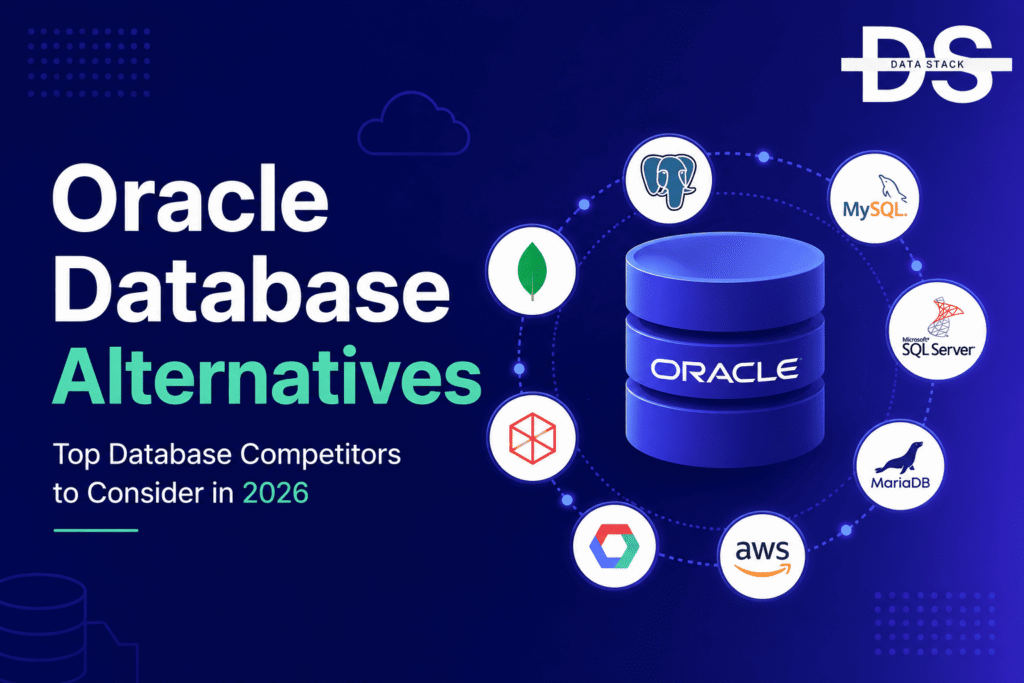
Oracle Database has remained one of the most widely adopted enterprise database management systems for decades. Large organizations across finance, healthcare, retail, manufacturing, telecommunications, and government sectors use Oracle for transactional workloads, analytics, ERP systems, and large-scale enterprise applications.
However, the modern database landscape has changed significantly over the last few years. Businesses are increasingly adopting cloud-native infrastructure, open-source technologies, distributed systems, and managed database platforms to reduce operational overhead and improve scalability.
As a result, many organizations are now actively evaluating Oracle Database alternatives that offer lower licensing costs, greater deployment flexibility, easier cloud integration, and modern developer-friendly ecosystems.
In this guide, we compare the best Oracle Database alternatives in 2026 based on scalability, enterprise readiness, cloud support, transactional performance, ecosystem maturity, operational complexity, and pricing flexibility.
What is Oracle Database?
Oracle Database is a relational database management system (RDBMS) developed by Oracle Corporation. It is designed to support enterprise-grade transactional processing, analytics, data warehousing, and mission-critical workloads.
The platform includes advanced capabilities such as:
- Multi-model database support
- High availability and disaster recovery
- Real Application Clusters (RAC)
- Advanced security controls
- Data Guard replication
- Multi-tenant architecture
- Hybrid cloud deployment options
- Enterprise scalability features
Oracle Database is commonly used in large enterprise environments where reliability, compliance, and high-performance data processing are essential.
Despite its capabilities, many businesses now look for Oracle alternatives because of licensing complexity, infrastructure costs, operational overhead, and modernization initiatives focused on cloud-native architectures.
Why Look for Oracle Database Alternatives?
Organizations migrate from Oracle Database for a variety of operational, financial, and technical reasons.
One of the biggest drivers is cost. Oracle licensing and support expenses can become extremely expensive at scale, particularly for organizations running large enterprise deployments, clustered environments, or highly available infrastructure.
Many teams also want greater flexibility. Oracle environments are often deeply integrated into enterprise systems, which can create long-term vendor lock-in concerns and reduce infrastructure portability across hybrid or multi-cloud environments.
Another important factor is modernization. Modern engineering teams increasingly prioritize open-source databases, cloud-native deployments, automation tooling, and distributed scalability over traditional enterprise infrastructure models.
Operational complexity is also a major concern. Oracle Database administration frequently requires specialized DBA expertise for tuning, clustering, backup management, performance optimization, and disaster recovery planning.
At the same time, open-source and managed cloud databases have matured significantly. Platforms such as PostgreSQL, MySQL, CockroachDB, and Amazon Aurora now provide enterprise-grade reliability and scalability for many workloads that previously depended on Oracle infrastructure.
Common reasons organizations evaluate Oracle Database competitors include:
- High licensing and maintenance costs
- Complex enterprise infrastructure management
- Cloud migration strategies
- Vendor lock-in concerns
- Preference for open-source database platforms
- Need for distributed scalability
- Reduced DBA operational overhead
- Faster deployment cycles
- Modern application architecture requirements
- Better cloud-native integration
The best Oracle Database replacement ultimately depends on workload complexity, compliance requirements, scalability needs, and deployment strategy.
Quick Comparison Table
| Database | Best For | Deployment | Open Source | Cloud Support | Ideal Use Case |
|---|---|---|---|---|---|
| PostgreSQL | Enterprise open-source workloads | Self-hosted / Cloud | Yes | Excellent | Enterprise modernization |
| Microsoft SQL Server | Microsoft ecosystems | Hybrid | No | Strong | Business applications |
| MySQL | Web applications | Self-hosted / Cloud | Yes | Excellent | SaaS and transactional apps |
| MariaDB | Open-source flexibility | Self-hosted / Cloud | Yes | Strong | Cost-conscious organizations |
| Amazon Aurora | AWS-native workloads | Cloud | No | Excellent | Managed cloud databases |
| IBM Db2 | Enterprise analytics | Hybrid | No | Strong | Regulated industries |
| SAP HANA | Real-time analytics | Hybrid | No | Strong | SAP environments |
| CockroachDB | Distributed applications | Cloud-native | Partial | Excellent | Global scalability |
| Google Cloud Spanner | Distributed cloud databases | Cloud | No | Excellent | Multi-region applications |
| SQLite | Lightweight embedded apps | Embedded | Yes | Limited | Local applications |
10 Best Oracle Database Alternatives in 2026
#1. PostgreSQL
PostgreSQL is one of the most popular open-source relational database management systems and a leading Oracle Database alternative for organizations modernizing enterprise infrastructure.
It is widely adopted across startups, enterprises, SaaS platforms, fintech companies, analytics platforms, and cloud-native environments because of its reliability, extensibility, and strong SQL compliance.
Many businesses migrating away from Oracle choose PostgreSQL because it delivers enterprise-grade transactional capabilities without the licensing overhead associated with traditional enterprise databases.
PostgreSQL also benefits from a massive open-source ecosystem, strong cloud provider support, and broad compatibility with modern development frameworks and analytics platforms.
Key Features
- Advanced SQL compliance
- ACID-compliant transactional processing
- JSON and semi-structured data support
- Extensive extension ecosystem
- Advanced indexing capabilities
- Replication and high availability support
- Strong cloud-native integrations
- Partitioning and query optimization features
Limitations
Organizations migrating highly customized Oracle workloads may still require migration planning for PL/SQL procedures, proprietary integrations, and legacy application dependencies.
Pricing
PostgreSQL is completely open-source and free to use. Managed cloud pricing depends on the provider and deployment architecture.
Why Choose PostgreSQL
PostgreSQL is ideal for organizations seeking an enterprise-ready open-source database with strong scalability, broad ecosystem support, and lower total cost of ownership.
#2. Microsoft SQL Server
Microsoft SQL Server remains one of the strongest enterprise database competitors to Oracle Database, particularly for organizations heavily invested in Windows infrastructure, Azure cloud services, and Microsoft enterprise applications.
The platform combines transactional database capabilities with advanced business intelligence, analytics, and reporting functionality.
SQL Server is widely adopted in industries such as healthcare, banking, retail, manufacturing, and enterprise SaaS because of its reliability and integration with Microsoft ecosystems.
Key Features
- Tight integration with Azure
- Enterprise-grade transactional performance
- Advanced analytics and reporting
- Hybrid cloud deployment support
- High availability capabilities
- Strong security and compliance tooling
- Built-in business intelligence features
- Data warehousing support
Limitations
Enterprise licensing costs can still become expensive for large-scale deployments and highly available infrastructure environments.
Pricing
Pricing varies based on edition, licensing model, deployment architecture, and cloud usage.
Why Choose Microsoft SQL Server
SQL Server is an excellent Oracle alternative for enterprises already operating within Microsoft ecosystems and organizations prioritizing hybrid cloud infrastructure.
Showcase your software to buyers actively comparing tools. Submit your product for editorial review and get featured on Data Stack Hub.
Submit Your Tool →#3. MySQL
MySQL is one of the most widely deployed relational databases globally and remains a popular Oracle Database competitor for SaaS platforms, web applications, and transactional systems.
The database is known for simplicity, broad developer adoption, and strong ecosystem maturity. It powers thousands of modern applications ranging from small websites to enterprise-scale cloud platforms.
MySQL is especially attractive for organizations seeking lower infrastructure costs, open-source flexibility, and easier operational management compared to traditional enterprise databases.
Key Features
- Open-source availability
- Broad ecosystem support
- High-performance transactional processing
- Replication and clustering capabilities
- Flexible cloud deployment support
- Extensive developer tooling
- Strong compatibility across platforms
Limitations
Complex enterprise-scale workloads may require additional tuning and infrastructure planning compared to Oracle Database environments.
Pricing
Community edition is free. Enterprise pricing depends on Oracle subscription plans and support requirements.
Why Choose MySQL
MySQL is well suited for SaaS applications, web platforms, transactional systems, and organizations prioritizing simplicity and cost efficiency.
#4. MariaDB
MariaDB is a popular open-source fork of MySQL designed to provide enterprise database capabilities while maintaining community-driven development and deployment flexibility.
It has become increasingly popular among businesses looking for alternatives to Oracle-owned database technologies.
MariaDB supports transactional workloads, analytics, cloud-native deployments, and distributed database architectures while offering strong compatibility with existing MySQL ecosystems.
Key Features
- Open-source architecture
- MySQL compatibility
- Replication and clustering support
- Flexible cloud deployment
- Enterprise security capabilities
- ColumnStore analytics engine
- Scalable transactional processing
Limitations
Some advanced Oracle enterprise capabilities may require additional migration adjustments for highly customized workloads.
Pricing
MariaDB offers both open-source and enterprise subscription models.
Why Choose MariaDB
MariaDB is a strong Oracle Database replacement for organizations seeking open-source flexibility with strong relational database performance and lower infrastructure costs.
#5. Amazon Aurora
Amazon Aurora is a fully managed relational database platform built for cloud-native scalability and high availability within AWS environments.
The platform supports MySQL and PostgreSQL compatibility while delivering automated scaling, backups, patching, replication, and infrastructure management.
Aurora has become a major Oracle Database alternative for organizations migrating enterprise workloads to AWS and reducing operational overhead associated with self-managed databases.
Key Features
- Fully managed AWS service
- High availability architecture
- Automated scaling and backups
- Multi-region deployment support
- MySQL and PostgreSQL compatibility
- Enterprise-grade reliability
- Cloud-native optimization
Limitations
Aurora is heavily optimized for AWS infrastructure, which may increase cloud dependency for multi-cloud organizations.
Pricing
Pricing is usage-based and depends on compute, storage, I/O operations, and data transfer requirements.
Why Choose Amazon Aurora
Aurora is ideal for organizations standardizing on AWS and seeking managed database scalability with minimal infrastructure maintenance.
#6. IBM Db2
IBM Db2 is an enterprise-grade relational database platform designed for analytics, transactional processing, AI workloads, and large-scale hybrid cloud environments.
The platform remains widely used across banking, healthcare, government, and regulated industries where performance, compliance, and high availability are critical requirements.
Db2 also integrates advanced analytics and machine learning capabilities for enterprise data processing environments.
Key Features
- AI-assisted query optimization
- Enterprise-scale transactional processing
- Hybrid cloud deployment support
- Advanced security and compliance tooling
- High availability architecture
- Integrated analytics capabilities
- Strong data governance support
Limitations
Complex deployments may still require experienced database administrators and enterprise infrastructure expertise.
Pricing
Pricing depends on deployment model, enterprise licensing, infrastructure requirements, and support contracts.
Why Choose IBM Db2
IBM Db2 is well suited for enterprises requiring large-scale transactional performance, compliance capabilities, and advanced analytics infrastructure.
Increase your product visibility by reaching software buyers researching the best tools. Every submission is reviewed by our editorial team.
Feature My Tool →#7. SAP HANA
SAP HANA is an in-memory relational database platform optimized for real-time analytics, enterprise applications, and SAP ecosystem integration.
The database is commonly adopted by organizations running SAP ERP systems and analytics workloads requiring high-speed data processing and transactional performance.
Unlike traditional disk-based databases, SAP HANA uses in-memory computing to accelerate analytics and operational workloads.